

China has two main trends: rapid clean energy growth and shifts in heavy industry that hurt air quality. A new report from the Centre for Research on Energy and Clean Air (CREA) shows emissions have decreased. But relocating industries is creating new pollution problems in areas that were once clean.
China’s Solar Power Drives Emissions Down
The first half of 2025 marked a positive change for China’s climate efforts. Carbon dioxide emissions fell about 1% year-on-year, the first sustained decline since the pandemic. This progress came mainly from clean energy growth.
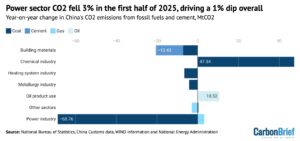
- Solar, wind, and nuclear energy produced an extra 270 terawatt hours (TWh) of electricity. This not only met the 170 TWh rise in demand but also cut fossil fuel use.
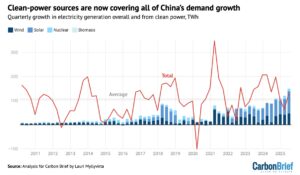
Solar stood out with 170 TWh—equivalent to the annual output of Mexico or Turkey. Wind added 80 TWh, and nuclear contributed 20 TWh, while hydropower declined due to lower rainfall.
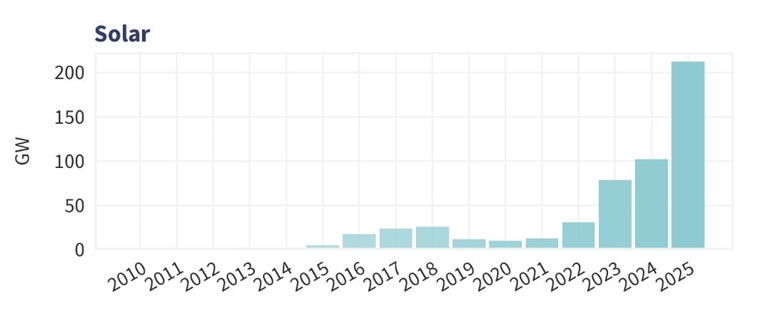
Now, low-carbon sources make up 40% of China’s electricity mix, up from 36% in early 2024. Rapid solar growth means 2025 could break records. It might add 212 gigawatts (GW) in just six months, right before a mid-year policy change. This surge makes solar the main driver of China’s emissions decline.
As a result, emissions from the power sector—the largest CO₂ source—fell by 3% compared to last year.
Cleaner Air, But Regional Disparities
Air quality improved across the country. Fine particulate matter (PM2.5) fell by 5% year-on-year. Other pollutants, such as sulfur dioxide and nitrogen dioxide, either decreased or stayed the same.
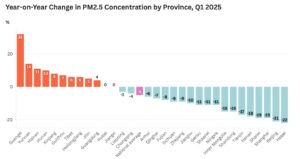
However, improvements weren’t uniform. Western provinces faced stark contrasts. Guangxi saw PM2.5 levels soar by 32%, Yunnan by 14%, and Xinjiang by 8%. Unlike past spikes from weather, CREA found these increases stemmed from structural growth in emissions.
This rise is tied to relocating heavy industry westward, along with local factors like sandstorms and biomass burning. Regions once seen as safe from pollution are now emerging as new challenges for China’s air quality.
A Seasonal Double Threat
Even where pollution decreased, China faces a “two-season problem.” Winter smog is driven by coal use for heating and industry. Average national PM2.5 levels exceeded the official standard by 18%, with nearly three-quarters of provinces not meeting compliance goals.
In summer, ozone becomes the main issue. Unlike PM2.5, which declined, ozone pollution rose by 4% over the past year. This has become a significant challenge for China’s air quality policies. The mix of winter smog and summer ozone highlights the need for more adaptable governance.
Industry Moves West, Pollution Follows
The westward shift in industry is the main cause of rising pollution in inland regions. Provinces once seen as minor players in heavy manufacturing are now reporting sharp growth in steel, metals, and chemical production. Pig iron output rose over 10%, crude steel by nearly 6%, and non-ferrous metals by more than 4% in the first half of 2025.
Much of this growth relies on traditional, coal-heavy methods. Coal-based steelmaking and conventional coal chemical industries still dominate, offsetting gains from cleaner power elsewhere. As a result, polluted days are becoming more common in inland regions like Ningxia, Shanxi, and Hubei.
These trends show that industrial relocation is shifting not just jobs but also pollution from east to west.
- READ MORE: China’s First-Ever Sovereign Green Bond Hits Global Market: Will It Power Its Net Zero Ambitions?
Coal Still Impacts China’s Energy Transition
Coal remains a significant concern. Although coal-fired electricity generation has decreased, new coal plants are still being added rapidly. CREA estimates that coal power capacity could increase by 80 to 100 GW in 2025, setting a new record.
The coal-to-chemicals sector is another fast-growing source of emissions. Coal use for synthetic fuels and chemicals grew by 20% in the first half of the year. Since 2020, this sector has contributed 3% to China’s overall CO₂ emissions, with projections showing it could add another 2% by 2029.
Lauri Myllyvirta, lead analyst at the Centre for Research on Energy and Clean Air and senior fellow at Asia Society Policy Institute, shared in the guest post for Carbon Brief that, in 2024, this sector consumed 390 million tonnes of coal and emitted about 690 million tonnes of CO₂. It’s 6% of the country’s fossil emissions and nearly 10% of total coal use.
This expansion complicates China’s goal to peak emissions before 2030 and reach net zero by 2060.
Policy Needs to Catch Up
CREA’s analysis shows that China’s air quality efforts focus mainly on eastern “key control zones.” These areas were the first to face pollution challenges. In contrast, western and central provinces, where industry is expanding quickly, do not receive the same oversight, funding, or enforcement.
This creates a dangerous policy gap. Without stronger frameworks, pollution could simply shift inland, undermining national progress. CREA further recommends that the upcoming 15th Five-Year Plan (2026–2030) broaden air quality policies to fully include western and central regions, with specific targets and monitoring.
Stronger environmental assessments for new industrial projects, especially in coal-heavy sectors, could help prevent cumulative risks. At the same time, clean energy deployment and industrial electrification need to accelerate in coal-dependent provinces, supported by fiscal incentives and grid investment.
Missed Targets Increase Pressure
Despite the emissions drop this year, China is likely to miss several 2025 climate goals. These include reducing carbon intensity, curbing coal growth, and increasing the share of electric-arc steelmaking. This shortfall will heighten pressure on China’s next nationally determined contribution (NDC) for 2035 and its new five-year plan.
The good news is that the declining emissions trend, driven by solar growth, could inspire policymakers to set stronger goals. This trend shows that large-scale clean power expansion can slow and even reverse emissions growth.
The Road Ahead
China’s 2025 path shows a dual transition. Record solar growth and lower emissions indicate clean energy’s impact. Yet, pollution is moving west, ozone levels are rising, and coal-heavy industries keep expanding.
The coming years will reveal if China can close this gap. It must ensure that national progress isn’t slowed by regional issues. If air quality protections expand inland and clean energy surpasses fossil fuels, China could make lasting climate gains. Currently, its clean energy boom occurs alongside an industrial shift that may only move the pollution problem elsewhere.
The post China’s Clean Energy Cuts Emissions 1%, But Coal and Industry Cast a Shadow appeared first on Carbon Credits.

EU carbon credit claims changed on 27 September 2026, the day the Directive (EU) 2024/825 began to apply across the European Union. The change is narrow. It changes how a company can talk about the credits it buys. A product can no longer be called neutral on the strength of compensation alone; however, every specific, evidenced statement about what a company measured, reduced, and funded stays fully available.

The post Promoting Improved Cooking Practices in Nigeria appeared first on Terrapass.



-
Climate Change1 year ago
Guest post: Why China is still building new coal – and when it might stop
-

 Greenhouse Gases2 years ago
嘉宾来稿:满足中国增长的用电需求 光伏加储能“比新建煤电更实惠”
-
Greenhouse Gases1 year ago
Guest post: Why China is still building new coal – and when it might stop
-

 Climate Change2 years ago
嘉宾来稿:满足中国增长的用电需求 光伏加储能“比新建煤电更实惠”
-

 Renewable Energy12 months ago
Sending Progressive Philanthropist George Soros to Prison?
-
Climate Change2 years ago
Bill Discounting Climate Change in Florida’s Energy Policy Awaits DeSantis’ Approval
-
Greenhouse Gases1 year ago
嘉宾来稿:探究火山喷发如何影响气候预测
-

 Climate Change2 years ago
Analysis: China’s CO2 falls 1% in Q2 2024 in first quarterly drop since Covid-19