

Welcome to Carbon Brief’s China Briefing.
China Briefing handpicks and explains the most important climate and energy stories from China over the past fortnight. Subscribe for free here.
Key developments
Emissions halt in China
PEAK OR PLATEAU?: A new analysis for Carbon Brief found that China’s carbon dioxide (CO2) emissions were kept “below the previous year’s levels in the last 10 months of 2024” due to a “record surge of clean energy”. (Read more about the surge below.) The author Lauri Myllyvirta, lead analyst at the Centre for Research on Energy and Clean Air (CREA), said that clean energy would “accelerate” in 2025 as “largescale wind, solar and nuclear projects race to finish before the 14th five-year plan period comes to an end”. Combined with slowing electricity demand growth, this would be expected to push coal-power output into decline, Myllyvirta said. However, he added that “another period of industrial demand growth driven by government stimulus efforts could change this picture, particularly if the real-estate slump turns around”. In a newly published Carbon Brief interview, Tsinghua University’s Prof Wang Can said that China’s emissions were “close to…the peak”.
-
Sign up to Carbon Brief’s free “China Briefing” email newsletter. All you need to know about the latest developments relating to China and climate change. Sent to your inbox every Thursday.
FALLING COAL?: A Reuters article citing several other analysts said coal generation is “set to fall in 2025 for the first time in a decade”, although there is “caution” that “extreme weather or stronger than expected industrial growth could upend that forecast”. The China Electricity Council forecast that electricity demand would grow by 6% in 2025, down from 6.8% in 2024, China energy news reported. Soaring renewable expansion makes it “clear” that China’s future “electric power system” will have non-fossil energy being the “main supply” and fossil-fuel being the “[energy security] guarantee”, according to an article published by industry news outlet BJX News. For now, however, a “more aggressive wave of coal power infrastructure construction is on its way” to keep up with rising electricity demand and more extreme weather events, added the article.
Clean energy surge
RENEWABLES RISE 25%: About 357 gigawatts (GW) of solar and wind was built in China last year, reported the Associated Press citing data from China’s National Energy Administration (NEA). The NEA’s data showed that, as of the end of 2024, the capacity of renewable energy reached 1,889GW, up 25% year-on-year and accounting for about 56% of the total capacity, reported Jiemian. In addition, the capacity of “new energy storage” surpassed 70GW, Xinhua said.

GERMAN-SIZED GROWTH: The clean-energy capacity completed in 2024, including new nuclear, is sufficient to generate around 500 terawatt hours (TWh) per year, the Carbon Brief analysis showed – equivalent to the total annual power output of Germany. In 2025, China is set to add enough to generate 600TWh per year, roughly twice the output of the UK.
‘SUPER DAM’ DOUBTS: Meanwhile, “concerns” over China’s proposed “super dam” in Tibet, which could produce 300TWh of electricity annually, continued to rise, according to the New York Times, “in part, because Beijing has said so little about it”. The dam would be built on the Yarlung Tsangpo river, which flows into India and Bangladesh, added the newspaper. Randhir Jaiswal, spokesperson for India’s foreign ministry, criticised the “mega project with a lot of ecological disturbances” for not taking “the interests of the lower riparian states” into account, reported the Financial Times. The newspaper added that India “fears…[it] could spur floods and water scarcity downstream”. Prof Y Nithiyanandam of Indian thinktank the Takshashila Institution wrote in a comment for the New Indian Express that the Yarlung Tsangpo basin is already “vulnerable” to “climate change and disasters”, which together “rais[e] serious questions about the long-term viability and safety of the project”.
US-China tariff tensions
TRUMP TARIFF RETALIATION: In response to the Trump administration imposing an additional 10% tariff on Chinese imports, China announced duties of 10-15% on US fossil fuels and certain other goods, the Financial Times reported, adding that the scope was “limited…in a possible attempt to avoid a full-blown trade war”. Coal and liquified natural gas (LNG) will face an additional 15% tariff, while crude oil, agricultural machinery and some cars will bear an extra 10%, the newspaper continued. China was the second-largest buyer of US coal in the first three quarters of 2024 after India, the report added.
‘EFFECTIVELY DEAD’: In a comment for Reuters, columnist Clyde Russell said that while the fossil-fuel trade between the two countries was now “effectively dead”, “the immediate impact of China’s measures…is likely to be limited”, given that China’s oil purchases from the US make up less than 2% of its imports, LNG volumes are “modest” and the US is “little more than a fringe supplier” of coal to the country.
CRITICAL MINERALS: Meanwhile, China announced additional controls on more than two dozen rare metal products and technologies, according to the Financial Times. “Molybdenum and indium-related items” – materials used to make low-carbon technologies including wind turbines – were on the list published by the Chinese communist party-affiliated newspaper People’s Daily. For now, the new controls mirror earlier restrictions, which added paperwork but – per previous Carbon Brief analysis – only temporarily interrupted critical mineral trade flows.
Money, money, money
LARGEST MARKET: Chinese investment in the low-carbon transition “grew 20% last year, accounting for $134bn of the $202bn global increase”, the Financial Times reported, citing new figures from data provider BloombergNEF. The report found that mainland China was the “largest market for investment” in the energy transition, accounting for $818bn out of a global total that surpassed $2tn for the first time in 2024. BusinessGreen said that global investment levels were only at 37% of the level needed to meet global targets, according to a separate BloombergNEF report, with China “the closest to being on track”.
OVERSEAS INVESTMENT: China signed new clean energy- and environment-related contracts with other countries worth just over $49bn in 2024, up 13% year-on-year, the state-supporting Global Times said, citing China’s Ministry of Commerce. This outpaced the 1% growth in new overseas contracts overall, according to the newspaper. In addition, a “record amount of generation capacity” (24GW) was installed by Chinese companies in countries falling under China’s Belt and Road Initiative in 2024, the Hong Kong-based South China Morning Post reported. About 52% of the projects “employed renewable sources”, while 48% were fossil fuel-based, it added. Dialogue Earth reported that, between 2006 and 2022, 86% of the approximately $9bn that Chinese entities invested in Indonesia’s energy sector focused on fossil fuels, “leaving just 14% for renewables”.
Captured
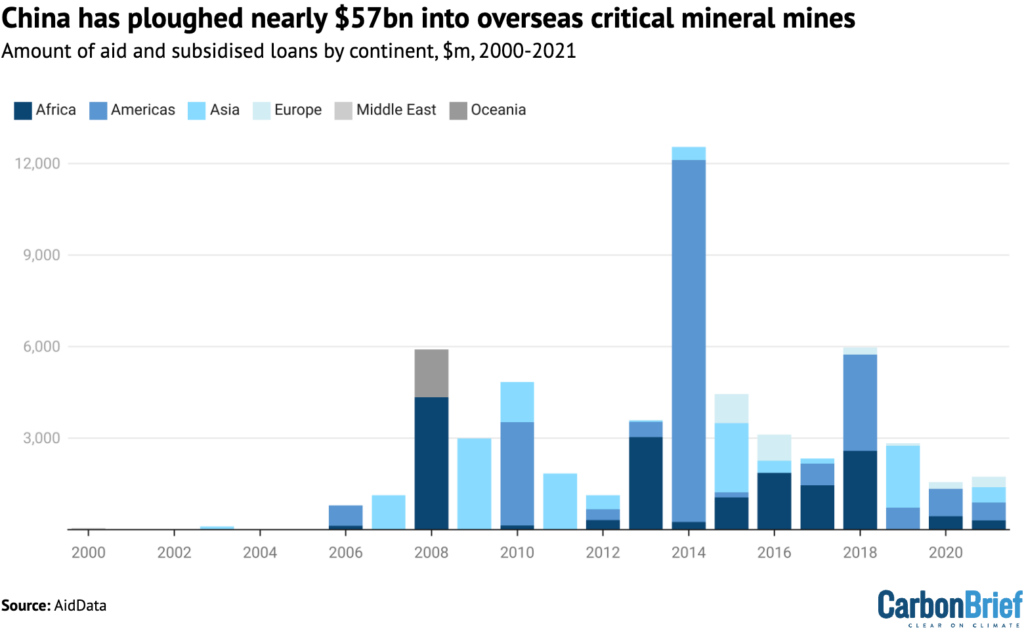
China issued just under $57bn in “aid and subsidised credit”, predominantly loans, to other countries to develop mines for critical minerals between 2000 and 2021, according to a new dataset by AidData. Chinese-backed mining activity focused on “copper, cobalt, nickel, lithium and rare-earth elements”, for which it developed mines across 19 low-income and middle-income countries, noted a report accompanying the dataset. Loans made to the Middle East in 2000 and the Americas in 2014 are too small to be visible on the chart.
Spotlight
How ‘green’ is the 2025 Asian Winter Games?
The 9th Asian Winter Games will be held in Harbin, capital of the northmost province in China, bordering Russia, from tomorrow to 14 February.
Being “green and eco-friendly” is the city’s “principle” for hosting the event, according to the official report. In this issue, Carbon Brief explores the “green” efforts that have been made for this four-yearly multisports event.
‘100% green electricity’
China has hosted two Olympic games and three Asian Games. Similar to the 2022 Beijing Winter Olympics and 2023 Hangzhou Asian Summer Games, the 2025 Harbin Asian Winter Games has also claimed to be relying on “green electricity”.
State news agency Xinhua said it is the “first time in history that 100% green electricity will be guaranteed during the Asian Winter Games, covering both the venue renovations and the games’ operations”.
Harbin is the biggest city in the province of Heilongjiang. From January to October 2024, Heilongjiang produced 103,710 gigawatt hours (GWh) of electricity, according to commercial data provider Hua Jing.
“Green electricity” from wind, solar and hydropower contributed nearly 29% of the total output, it added, with coal at 71%. It also reported that thermal generation – mainly coal – was down 2% year-on-year, while wind was up 17%, solar 1% and hydro 6%.
The amount of electricity needed to run the games is small in comparison to these totals. The entire games, including preparations, would consume just 88GWh – less than 3% of the renewable electricity generated by the province in an average month.
However, whereas a new “green electricity grid” was built to power the Beijing Winter Olympics in 2022, Harbin does not appear to have commissioned specific new generating capacity or grid infrastructure as part of hosting the Asian winter games.
Instead, state-supported Science and Technology Daily reported that 73GWh of “green electricity” had been “traded” – bought from elsewhere – in order to “fully meet the green power demand” during the games.
‘New energy’ transport
Other than renewable electricity, the Harbin organisers also “introduced new-energy vehicles (NEVs) to cater to transportation needs” during the games.
NEVs include battery-electric (EVs), plug-in hybrids as well as fuel-cell electric vehicles, and emit less carbon dioxide (CO2) than fossil fuel-powered cars.
In contrast to other recent games that mainly used EVs, the Harbin Games will employ more than 350 “methanol-hydrogen-electric hybrid” vehicles as the “official transport fleet” to ensure “eco-friendly, reliable travel even in temperatures as low as -20C”, according to state media CGTN. (EVs are also being used for these games.)
Methanol-hydrogen-electric vehicles, according to state-run China Daily, use methanol as a “liquid fuel” in place of petrol, but are otherwise similar to hybrid vehicles such as a Prius.
A more detailed commercial report said that Geely, the firm making the cars, is also participating in production plants where electrolytic hydrogen is combined with CO2 to produce “low-carbon methanol” to power the vehicles.
According to Geely, a first 100,000 tonnes-per-year demonstration phase of the Alxa “green methanol” project opened in Inner Mongolia in October 2024. The full 500,000t per year scheme is expected to cut CO2 emissions by 750,000 tonnes per year.
State media CGTN said the Harbin games would mark the “first large-scale use of methanol vehicles at an international event”.
The China Daily report also said that, “if widely adopted, these vehicles could help reduce oil imports by 125m tonnes annually and cut carbon emissions by 215m tonnes”.
More ‘greener’ winter games
Harbin is home to the world’s biggest snow and ice festival each year and hosted the 1996 Asian Winter Games.
Despite the city usually receiving consistent snowfall during winter, it still made up to 800,000 cubic metres of artificial snow as of January at its main skiing venue, Yabuli ski resort, for the 2025 event.
Scientists have warned that climate change will, over time, leave fewer places with enough natural snowfall for hosting winter sports.
Last year, the International Olympic Committee (IOC) warned that only 10 countries would be able to host snow sports by 2040 as a result of warming, BBC News reported.
The 2022 Winter Olympics sparked a backlash for being almost entirely dependent on artificial snow and ice, as its host city Beijing has received barely any snow in recent years.
At the time, the IOC defended the decision, saying artificial snow had been used for years and was needed “to get the right quality” for consistent race conditions.
The environmental impact of major international sporting events has been coming under increasing scrutiny.
The Paris 2024 Olympics emitted less than half the average of the 2012 and 2016 Olympics, according to Carbon Brief analysis.
The upcoming 2026 Milan Olympics is committed to “fighting climate change and protecting natural ecosystems”, while the 2028 games has announced a “no cars” ambition and plans to build a “greener Los Angeles”.
Watch, read, listen
‘CLIMATE LEADER’: A podcast from Singapore’s Straits Times asked: “Can China step up to become a climate leader?” It hosted Li Shuo, director of China Climate Hub at the Asia Society Policy Institute.
NUCLEAR FUSION: An article from thinktank MacroPolo explored whether China’s energy development model, which “marries state capital with iterative and process innovation in the private sector”, can “succeed in frontier energy technologies, particularly the holy grail of nuclear fusion”.
ENERGY STORAGE: The South China Morning Post published a comment by analyst Tim Daiss under the title: “How battery storage development can wean China off fossil fuels.”
STEEL REFORM: Shanghai-based media outlet the Paper explored decarbonisation pathways for the Chinese steel industry.
20,000
The number of petrol stations expected to close in China during the 15th “five-year plan” (2026-2030), out of 110,000 that are currently under operation, reported financial media Caijing. The closures are due to the rise of electric cars and LNG-fuelled trucks, which means that China’s demand for refined oil products is declining and its oil demand overall is “entering a peak plateau period”, added the report.
New science
Planted forests in China have higher drought risk than natural forests
Global Change Biology
Planted forests in China are less able to cope with drought than natural forests, according to new research. The study, which used satellite observations over 2001-20 to understand forest drought risk, found that planted forests exhibit lower drought resilience and resistance than natural forests, particularly subtropical broad-leaved evergreen and warm temperate deciduous broad-leaved forests. Lower forest canopy height and poorer soil nutrients are among the factors responsible for planted forests’ higher drought risk, according to the researchers. They emphasised the need for “enhanced [forest] management strategies” as droughts become more frequent and severe.
Temperature effects on peoples’ health and their adaptation: empirical evidence from China
Climate Change
Chinese residents “implement appropriate protective measures” when temperatures exceed 30C, but underestimate the risks posed by temperatures of 25-30C, a new study said. This can lead to “significant health issues”, the paper warned. The authors combined meteorological data with results from the China family panel survey, which includes data from around 33,500 adults on hospital stays and self-reported “unhealthy status”. The paper found that increased healthcare expenditure and reduced physical activity are “two possible ways in which residents respond to climate change”.
China Briefing is compiled by Wanyuan Song and Anika Patel. It is edited by Wanyuan Song and Dr Simon Evans. Please send tips and feedback to china@carbonbrief.org
The post China Briefing 6 February 2025: Emissions halt; ‘Green’ Asian Winter Games; US-China tariff war appeared first on Carbon Brief.
China Briefing 6 February 2025: Emissions halt; ‘Green’ Asian Winter Games; US-China tariff war

Three countries have been named by the Paris Agreement’s compliance committee for failing to submit a nationally determined contribution (NDC) and repeatedly snubbing offers of help with their climate plans.
After months of internal debate over whether to identify serial non-responders, the Paris Agreement’s Implementation and Compliance Committee (PAICC) named the three countries which have failed to engage with it over their NDCs on Friday.
It named Democratic Republic of Congo, Senegal and North Korea in a footnote of its annual report, adding that it decided to name them “with a view to facilitating engagement”, adding that representatives of the three nations had been invited to its meeting in early 2027 “with the purpose of identifying any challenges and constraints”.
“The Committee noted the importance of Parties engaging with the Committee in a timely manner, while noting that some delays may be due to the national capabilities and circumstances of the Parties”, the report said.
-
Under US pressure, World Bank says it will back gas “where appropriate”
The US wants the World Bank to expand its gas support while climate campaigners are pushing for it to end – its head spoke this week of limited backing for the fossil fuel -
IPCC scientists vow to press on with climate reports despite political deadlock
After governments again failed to agree a timeline, nearly 120 IPCC authors pledged to complete their assessment on time and with full scientific rigour -
Paris Agreement committee snubbed over missing NDC climate plans
Many governments have still not submitted a nationally determined contribution to the UN, breaching a key requirement of the Paris Agreement

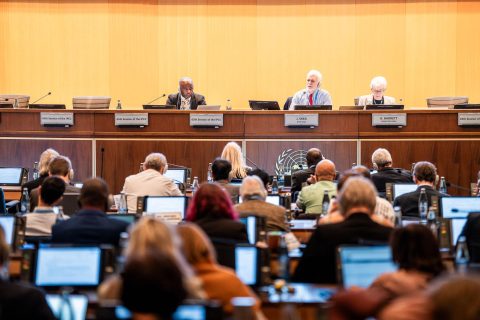

In July, PAICC said 12 countries had ignored its repeated attempts to discuss why they had not published an NDC as required every five years under the 2015 Paris accord.
Members of the committee had been divided over whether to name them, but at a September meeting decided to do so in their annual report to the annual climate COP summit.
By the time the report was published on Friday, only Congo, Senegal and North Korea “had not communicated an NDC or submitted a [Biennial Transparency Report] and had not yet responded to any of the Committee’s notifications, despite several reminders issued by the Committee in this regard”.
Rainforest and renewable energy ambitions
The silence from Congo and Senegal is notable because the former is home to much of the Congo Basin rainforest while the latter has sought billions of dollars in climate finance to support its renewable energy ambitions.
After Brazil, Congo has more rainforest than any country in the world. This forest, and the country’s peatlands, absorb huge amounts of greenhouse gas but are fast being lost to expanding farmland, charcoal production, logging and mining.
Senegal signed a Just Energy Transition Partnership with Canada and wealthy European nations in 2023, to help it meet its renewable energy targets under the-then government of Macky Sall. It was chair of the Least Developed Countries group between January 2022 and December 2023.

Tejas Rao, who is researching the PAICC as part of a doctoral thesis at Cambridge University, said the governments of the three countries should engage with the committee.
“Engagement costs these governments very little and the committee has shown it will listen,” he said.
“Silence leaves the committee with no basis to help, and it leaves the [governments] exposed to the narrative that they are simply disengaged,” he told Climate Home News.
Paris Agreement requirement
The 2015 Paris Agreement requires all parties to publish an NDC every five years outlining their emissions reduction targets, with each plan meant to be more ambitious than the country’s last NDC.
The latest set – the third round of plans, with new targets for 2035 – was due in February 2025. While most countries missed this deadline, all but around 30 – mostly small emitters but including Egypt, Vietnam and Argentina – have now submitted them.
Over the year, the PAICC – which is made up of government climate officials from developed and developing countries – has been communicating with governments that have not submitted NDCs and trying to overcome barriers to them doing so.
Some nations have cited exceptional circumstances as the reason for not submitting an NDC, a process that requires a significant amount of work in tracking emissions and consulting on how to curb them across the economy. For example, a letter from a Sudanese official to the PAICC, seen by Climate Home News, said that the country’s civil war had led to the suspension of its NDC preparation.