

The World Bank has confirmed it will serve as trustee and interim secretariat host for the Tropical Forest Forever Facility (TFFF), as Brazil prepares to launch the showcase investment-driven fund for rainforest protection at next month’s climate summit in the Amazon city of Belém.
With a proposed initial investment of $25 billion from donor countries and $100 billion from private capital, the TFFF seeks to leverage investments in financial markets and channel the returns to countries that can prove they have kept their forests standing.
CEO Ajay Banga announced in September the World Bank’s willingness to host the fund – a role it already fulfills for other climate funds such as the Fund for Responding to Loss and Damage. He said the bank’s role would be to “lay the rails and maintain them so the trains can run”, while beneficiary countries and donors should “focus on delivery”.
On Tuesday, the bank gave formal confirmation at a board meeting that it would take on most of the TFFF’s administrative workload – including initial operations and fiduciary reporting – while a permanent institutional home is established.
-
Ahead of COP30, Brazil grants Petrobras a licence to drill for oil in Amazon region
Brazil has authorised Petrobras to explore for oil off the Amazon coast, a move campaigners say undermines global climate goals -
COP30 president hints Brazil may be open to a cover decision in Belém
André Corrêa do Lago tells Climate Home News the COP30 talks could conclude with an additional text on key outcomes if countries want it – something Brazil has so far resisted -
Lula says he is “optimistic” about US support for new rainforest fund
The Brazilian president says that for COP30 to be successful, it needs the commitment of all world leaders


Brazilian Finance Minister Fernando Haddad said the World Bank’s decision transforms the TFFF “from an idea into a fully operational reality”, adding that “with this foundation in place, the TFFF is now ready for countries to follow Brazil’s lead by making their own pledges”.
Right way to plug forest finance gap?
The Brazilian initiative comes as developing countries have complained about being unable to access existing forest funds at the Global Environment Facility, while foreign aid budgets which have supported forest conservation shrink in the US and Europe.
Finance needs in developing countries are large and growing, with estimates ranging between $20 billion and $72 billion every year to protect forests. In contrast, in 2022, the total finance destined for forests was just $2.3 billion.
But while the fund has enjoyed expressions of support from both forest-rich and donor countries, it has drawn criticism from some sectors – including over the World Bank’s central role, and whether it has been overly optimistic in the returns it can expect from investing money in emerging economies.
Explainer: Brazil’s “right answer” to forest finance turns to markets to keep rainforest standing
The Global Forest Coalition (GFC) – an international coalition of Indigenous rights NGOs – has pushed back against the TFFF for its high reliance on private investments, urging the World Bank to step back from hosting the fund.
“All the financial schemes put in place for forest conservation supported by the World Bank continue to fail people. They are in place rather to favour capitalist investors instead of solving the deforestation issues,” said Kwami Kpondzo, executive director of Togo’s Centre for Environmental Justice, a member of the GFC alliance.
“TFFF is taking the same direction, where Indigenous peoples and local communities’ rights will be sacrificed once again in the name of conservation,” Kpondzo added in a statement.
Brazil first to pledge TFFF seed capital
The TFFF is being proposed as a blended finance instrument, with funding from both public and private sources. It would seek to directly pay tropical countries that can show effective forest protection.
On paper, the TFFF will get its money similarly to an investment fund. Donor countries and private investors put their money into the fund, which then invests the capital in financial markets. Part of the returns is used to pay back investors and what remains is allocated to forest protection in tropical countries.
In September, Brazil announced a $1 billion contribution into the fund. The starting capital from sponsor countries is seen as a key way of reducing the fund’s risk and improving its credit rating, which would allow for better market returns.
Brazil pledges $1bn in first contribution to COP30 rainforest fund
While no other pledges have been announced so far, donor countries including Norway, Germany, the United Arab Emirates and Britain have voiced support for the new fund and have been involved in its design. They and others are expected to contribute financially, with hopes high that new pledges will be announced at the launch of the TFFF on November 6 at the COP30 leaders’ summit in Belém.
The fund’s concept note proposes an interim hosting period of three years after which its board of directors will assess whether to keep the TFFF housed with the World Bank. It also sets out plans to establish an official secretariat for the fund, which the Brazilian government said would ensure the “TFFF operates with the highest standards of governance, accountability, and predictability”.
The TFFF is expected to be steered by a board of directors from 18 countries, equally split between donors and forested nations. It also foresees the creation of a scientific advisory panel and an advisory council of Indigenous people.
The post Brazil hails World Bank decision to host forest fund ahead of COP30 launch appeared first on Climate Home News.
Brazil hails World Bank decision to host forest fund ahead of COP30 launch

Continue Reading
Three countries have been named by the Paris Agreement’s compliance committee for failing to submit a nationally determined contribution (NDC) and repeatedly snubbing offers of help with their climate plans.
After months of internal debate over whether to identify serial non-responders, the Paris Agreement’s Implementation and Compliance Committee (PAICC) named the three countries which have failed to engage with it over their NDCs on Friday.
It named Democratic Republic of Congo, Senegal and North Korea in a footnote of its annual report, adding that it decided to name them “with a view to facilitating engagement”, adding that representatives of the three nations had been invited to its meeting in early 2027 “with the purpose of identifying any challenges and constraints”.
“The Committee noted the importance of Parties engaging with the Committee in a timely manner, while noting that some delays may be due to the national capabilities and circumstances of the Parties”, the report said.
-
Under US pressure, World Bank says it will back gas “where appropriate”
The US wants the World Bank to expand its gas support while climate campaigners are pushing for it to end – its head spoke this week of limited backing for the fossil fuel -
IPCC scientists vow to press on with climate reports despite political deadlock
After governments again failed to agree a timeline, nearly 120 IPCC authors pledged to complete their assessment on time and with full scientific rigour -
Paris Agreement committee snubbed over missing NDC climate plans
Many governments have still not submitted a nationally determined contribution to the UN, breaching a key requirement of the Paris Agreement

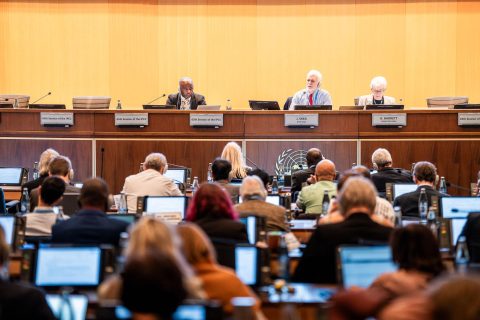

In July, PAICC said 12 countries had ignored its repeated attempts to discuss why they had not published an NDC as required every five years under the 2015 Paris accord.
Members of the committee had been divided over whether to name them, but at a September meeting decided to do so in their annual report to the annual climate COP summit.
By the time the report was published on Friday, only Congo, Senegal and North Korea “had not communicated an NDC or submitted a [Biennial Transparency Report] and had not yet responded to any of the Committee’s notifications, despite several reminders issued by the Committee in this regard”.
Rainforest and renewable energy ambitions
The silence from Congo and Senegal is notable because the former is home to much of the Congo Basin rainforest while the latter has sought billions of dollars in climate finance to support its renewable energy ambitions.
After Brazil, Congo has more rainforest than any country in the world. This forest, and the country’s peatlands, absorb huge amounts of greenhouse gas but are fast being lost to expanding farmland, charcoal production, logging and mining.
Senegal signed a Just Energy Transition Partnership with Canada and wealthy European nations in 2023, to help it meet its renewable energy targets under the-then government of Macky Sall. It was chair of the Least Developed Countries group between January 2022 and December 2023.

Tejas Rao, who is researching the PAICC as part of a doctoral thesis at Cambridge University, said the governments of the three countries should engage with the committee.
“Engagement costs these governments very little and the committee has shown it will listen,” he said.
“Silence leaves the committee with no basis to help, and it leaves the [governments] exposed to the narrative that they are simply disengaged,” he told Climate Home News.
Paris Agreement requirement
The 2015 Paris Agreement requires all parties to publish an NDC every five years outlining their emissions reduction targets, with each plan meant to be more ambitious than the country’s last NDC.
The latest set – the third round of plans, with new targets for 2035 – was due in February 2025. While most countries missed this deadline, all but around 30 – mostly small emitters but including Egypt, Vietnam and Argentina – have now submitted them.
Over the year, the PAICC – which is made up of government climate officials from developed and developing countries – has been communicating with governments that have not submitted NDCs and trying to overcome barriers to them doing so.
Some nations have cited exceptional circumstances as the reason for not submitting an NDC, a process that requires a significant amount of work in tracking emissions and consulting on how to curb them across the economy. For example, a letter from a Sudanese official to the PAICC, seen by Climate Home News, said that the country’s civil war had led to the suspension of its NDC preparation.
-
IPCC scientists vow to press on with climate reports despite political deadlock
After governments again failed to agree a timeline, nearly 120 IPCC authors pledged to complete their assessment on time and with full scientific rigour -
Under US pressure, World Bank says it will back gas “where appropriate”
The US wants the World Bank to expand its gas support while climate campaigners are pushing for it to end – its head spoke this week of limited backing for the fossil fuel -
Who shapes climate science? The equity question facing the IPCC
Early completion of the next global climate science assessment reports risks excluding research from the Global South, which is key to ensuring the findings are fair
The US and Iran are not signed up to the Paris Agreement and so do not have active NDCs, nor does Taiwan, which is not a UN member state.
Rao said that because the PAICC is “facilitative and non-punitive”, naming the countries “is meant to open a door, not close one – the invited consultation is the point”.
“In recent months, governments that explained their constraints, whether capacity, finance or domestic process, have been met with follow-up and support rather than sanction, and the number of silent governments has fallen sharply,” Rao said.
The post Paris Agreement committee names three countries snubbing it over NDCs appeared first on Climate Home News.
Paris Agreement committee names three countries snubbing it over NDCs