

Amazon is expanding the types of carbon credits available to companies through its Sustainability Exchange, helping businesses lower emissions across their operations and supply chains. The e-commerce giant now offers lower-carbon fuel (LCF) inset credits and superpollutant refrigerant destruction credits, giving companies more tools to take meaningful climate action.
The Sustainability Exchange: A Hub for Climate Action
Amazon launched the Sustainability Exchange in 2024 to provide resources, playbooks, and guidance for companies aiming to meet net-zero goals. It shares knowledge on measuring emissions, transitioning to clean energy, decarbonizing operations, and purchasing high-quality carbon credits.
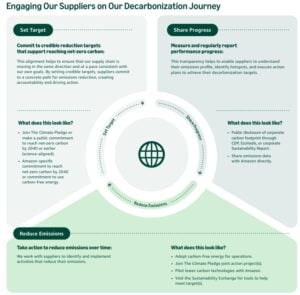
Since its launch, the Exchange has expanded its offerings to support companies at every stage of their climate journey, especially those within Amazon’s supply chain. However, these credits are available only to companies with net-zero targets across Scope 1, 2, and 3, who measure and report emissions regularly and commit to implementing decarbonization strategies aligned with climate science.
The platform now includes a wider variety of carbon credits, making it easier for companies to take action beyond their own facilities.
Lower-Carbon Fuel (LCF) Inset Credits: Decarbonizing Transportation the Smart Way
Transportation is one of the most challenging sectors to decarbonize. Long-haul trucking, aviation, and maritime shipping often rely on heavy payloads and lack sufficient electrification infrastructure. Thus, lower-carbon fuels provide a practical path to reduce emissions while using existing infrastructure.
How They Work
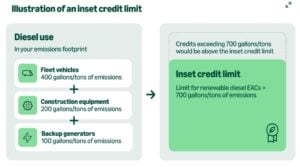
LCF inset credits help companies support the production of cleaner fuels such as renewable diesel, biodiesel, and sustainable aviation fuel, which can reduce greenhouse gas emissions by 65–80% compared with conventional fossil fuels.
These credits, a type of Environmental Attribute Certificate (EAC), allow companies to claim emission reductions by investing in cleaner fuel production even if they cannot directly use the fuels themselves. For instance, a company operating diesel trucks can purchase renewable diesel inset credits to support cleaner fuel production and receive recognition for the equivalent emissions reductions, enabling transportation decarbonization without changing existing operations.
Amazon’s Approach
Amazon prioritizes efficiency and electrification first, then uses LCFs where access is limited. The company tracks the full life cycle of fuels—from feedstock production to final use—using third-party verification and globally recognized methodologies. Waste-based feedstocks, like used cooking oil and agricultural byproducts, are prioritized for their high emission reduction potential and support for circular economies.
The Advanced and Indirect Mitigation (AIM) Platform helps companies account for and report on insets across sectors. Amazon’s methodology aligns with cross-industry standards while adapting to specific sectors, ensuring that results are accurate and verifiable.
Notably, Crane Worldwide Logistics is one company using Amazon’s LCF credits. Sustainability Director Carlos Pacheco said, “Partnering with Amazon on their carbon insets program helps us drive real reductions in sectors that matter most to our business.”
Superpollutant Refrigerant Destruction Credits: Tackling Methane, HFCs, and Black Carbon
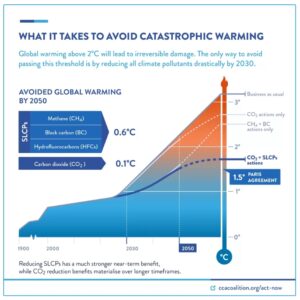
Superpollutants, including methane, HFCs, black carbon, and tropospheric ozone, are significantly more potent than CO₂. Unlike CO₂, which can linger in the atmosphere for centuries, superpollutants last from a few days to around a century, meaning cutting their emissions can produce measurable results within decades.
Millions of tons of refrigerant gases remain in old equipment, materials, or stockpiles. Without intervention, these superpollutants could add billions of tons of CO₂ equivalents to the atmosphere. Reducing these emissions can prevent up to 0.6°C of warming by 2050, according to IPCC scenarios.
How They Work
Now these credits fund the safe destruction of potent greenhouse gases, such as methane and hydrofluorocarbons (HFCs), which trap far more heat than CO₂. By destroying these gases, companies can help slow global warming and achieve measurable climate benefits within decades.
Amazon’s Approach
Amazon sources refrigerants primarily from small businesses in developing countries and avoids large corporate or government stockpiles. Specialized facilities destroy gases using incineration or plasma-arc gasification, converting them into CO₂, water, and inert salts.
Furthermore, refrigerant destruction also helps the ozone layer recover faster, reducing harmful UV radiation, protecting ecosystems, supporting global food production, and benefiting human health.
It credits companies based on modeled leak rates over a maximum 10-year period, ensuring realistic and verifiable climate impact. Projects follow internationally recognized protocols and avoid double-counting emissions reductions.
Building a Robust Carbon Credit Strategy
As we understand now, Amazon’s carbon credit program allows companies to blend neutralization and inset credits, giving them flexibility to tackle Scope 1, 2, and 3 emissions while pursuing net-zero targets.
Insetting vs. Offsetting
- Insets: Reduce emissions directly within a company’s own supply chain.
- Offsets: Compensate for emissions by supporting external climate projects.
Neutralizing Remaining Emissions
While cutting emissions within its own operations remains the top priority, Amazon invests in climate mitigation efforts outside its value chain. This includes direct investments, advance purchase agreements, coalition building, new methodology development, and innovative technologies.
Despite its Climate Pledge commitment, its total carbon emissions rose to 68.25 million metric tons of CO₂ equivalent in 2024, a 6% increase from 2023. This growth was driven by data center expansion for AI and fuel use in its delivery fleet.
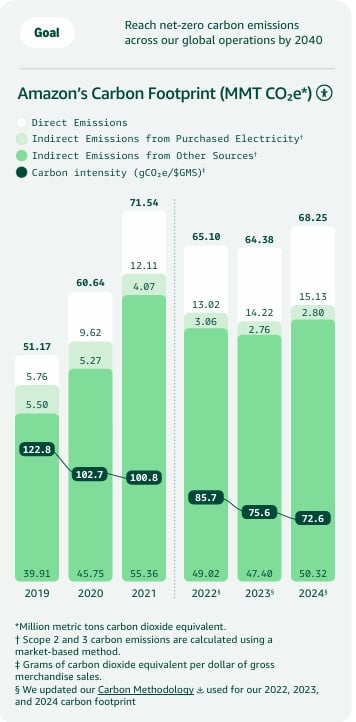
Amazon mainly uses carbon credits to complement its own emissions reductions. Its focus is on high-quality, science-based removal projects rather than offsetting ongoing emissions.
Key Purchases, Investments, and Strategy Context
The retail giant has committed to buying 250,000 metric tons of direct air capture (DAC) credits from 1PointFive’s STRATOS facility over 10 years starting in 2023. In addition, it sources credits through the LEAF Coalition to help protect Brazilian forests and invests in nature-based projects, such as preventing deforestation and restoring ecosystems.
More recently, Amazon expanded its platform to include lower-carbon fuel inset credits, like renewable diesel, alongside its existing nature- and technology-based removal credits. Early users include companies like Flickr and industries such as real estate and tech consulting.
In simple terms, these credits help Amazon reach its goal of net-zero emissions by 2040 under the Climate Pledge. The main focus is on removing leftover emissions after first improving energy efficiency and using renewable energy. While Amazon does not share the exact yearly volume of credits it buys, every credit is carefully checked for additionality, permanence, and transparency. This ensures credibility and addresses doubts about the voluntary carbon market.
The post Amazon Expands Its Carbon Credit Strategy with Lower-Carbon Fuel and Superpollutant Solutions appeared first on Carbon Credits.

EU carbon credit claims changed on 27 September 2026, the day the Directive (EU) 2024/825 began to apply across the European Union. The change is narrow. It changes how a company can talk about the credits it buys. A product can no longer be called neutral on the strength of compensation alone; however, every specific, evidenced statement about what a company measured, reduced, and funded stays fully available.

The post Promoting Improved Cooking Practices in Nigeria appeared first on Terrapass.



-
Climate Change1 year ago
Guest post: Why China is still building new coal – and when it might stop
-

 Greenhouse Gases2 years ago
嘉宾来稿:满足中国增长的用电需求 光伏加储能“比新建煤电更实惠”
-
Greenhouse Gases1 year ago
Guest post: Why China is still building new coal – and when it might stop
-

 Climate Change2 years ago
嘉宾来稿:满足中国增长的用电需求 光伏加储能“比新建煤电更实惠”
-

 Renewable Energy12 months ago
Sending Progressive Philanthropist George Soros to Prison?
-
Climate Change2 years ago
Bill Discounting Climate Change in Florida’s Energy Policy Awaits DeSantis’ Approval
-
Greenhouse Gases1 year ago
嘉宾来稿:探究火山喷发如何影响气候预测
-

 Climate Change2 years ago
Analysis: China’s CO2 falls 1% in Q2 2024 in first quarterly drop since Covid-19