Image source: AP/ALEX BRANDON
Remember Scott Morrison, Australia’s former Prime Minister? Well, brace yourselves because he’s back in the spotlight, and this time it’s for a jaw-dropping reason.
A groundbreaking investigation by Nine Papers, splashed across today’s front page, has uncovered a shocking connection between Morrison, the international arms trade, and the controversial world of deep sea mining. Yep, you heard that right – deep sea mining, the wild west of industries that’s causing a stir for all the wrong reasons.
So, what’s the deal with deep sea mining anyway?
Picture this: giant machines dredging the ocean floor in search of precious metals that are supposedly crucial for the green energy revolution. Well, not according to leading scientists and manufacturing giants like Samsung and BMW. They’re waving red flags left, right, and centre, warning of the serious economic and environmental risks this industry poses.

Now, let’s talk about players.
One company at the forefront of this deep sea gold rush is The Metals Company, led by Australian businessman Gerard Barron. He’s gearing up for a front-row seat at the next International Seabed Authority meeting in Jamaica this July. This meeting will be ground zero for deciding the fate of deep sea mining, with countries like Australia holding some serious sway.
We don’t think The Metals Company are big fans of Greenpeace, after our peaceful protest at one of their vessels in 2023...
With characters like Scott Morrison and Trump’s former Secretary of State Mike Pompeo in the mix, something smells fishy. Using national security fears to bulldoze through environmental regulations? Not on our watch.
What does Greenpeace have to say?
According to Glenn Walker, our Head of Nature, the links between deep sea mining, the arms trade, and the AUKUS submarine deal are setting off major alarm bells.
“We all know that Scott Morrison likes to appoint himself to secret ministries but even for him, this is truly jumping the shark.” And let’s be real, nobody wants to see the clean energy transition used as a cover-up for weapons manufacturing.
Jack Kerr, our Senior Investigator, isn’t holding back either. He’s calling out deep sea mining for what it really is – an attempt to plunder the oceans for profit and power. “Deep sea mining is pivoting from greenwashing to green beret,” said Kerr.
What’s the bottom line here?
Here’s the kicker – while 25 countries, including the UK and France, have already slammed the brakes on deep sea mining, there’s growing frustration that Australia isn’t stepping up to the plate. The question on everyone’s lips: where’s the leadership, Albanese Government?
It’s time to stand up and say no to deep sea mining. Our oceans are too precious to be treated like a free-for-all gold rush, especially when the stakes are this high. Let’s protect our marine environments, stand against destructive industries, and keep fighting for a cleaner, greener future. Who’s with us?


Sinking land and rising seas could expose more than seven million people living in Africa’s coastal “megacities” to flooding by the middle of the century, according to new research.
The analysis, published in Science Advances, combines satellite data with projections of sea level rise to assess the risk of flooding in 20 of Africa’s most populous coastal cities.
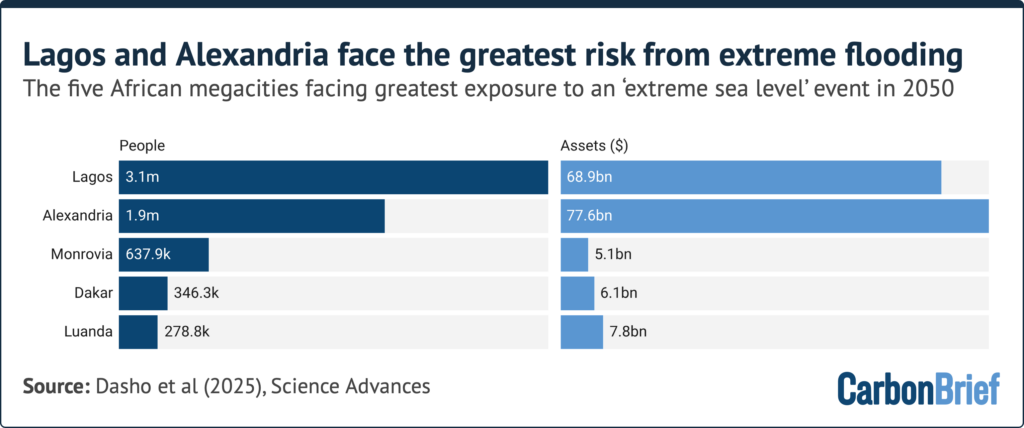
The study finds that, under a moderate warming scenario, an “extreme sea level event” – when sea levels are unusually high due to short-term changes in weather and ocean conditions – could expose a million buildings and $180bn of assets to flooding.
Lagos, the capital of Nigeria, and Alexandria in Egypt are the most vulnerable cities in the analysis.
In these two cities alone, five million people and $150bn in assets could be exposed to flooding and the cities by mid-century.
Human activity, such as pumping groundwater or drilling for fossil fuels, can cause the ground to sink, in a process called “subsidence”.
Seismic or volcanic activity can also drive changes in the height of the land, causing it to either rise or fall. This “vertical land movement” can either alleviate or exacerbate the effects of sea level rise.
The researchers combined more than 4,000 satellite images of Africa’s coastline to determine how quickly different regions are rising or sinking.

They identified Lagos and Alexandria as “subsidence hotspots”, finding that the two cities are sinking at rates of 5.2mm and 6.3mm per year, respectively.
This is “comparable to rates reported for south-east Asian megacities such as Jakarta, Manila and Ho Chi Minh City”, which have recorded “some of the highest subsidence rates yet observed”, according to the study.
The authors combined these estimates with sea level rise projections from the Intergovernmental Panel on Climate Change’s sixth assessment report under three different emissions scenarios, to assess the regional sea level rise across the African coastline.
They used 2020 population data, building footprints and GDP per capita to estimate how much of each city would be exposed to these flooding events over the 21st century, if the city itself stays the same.
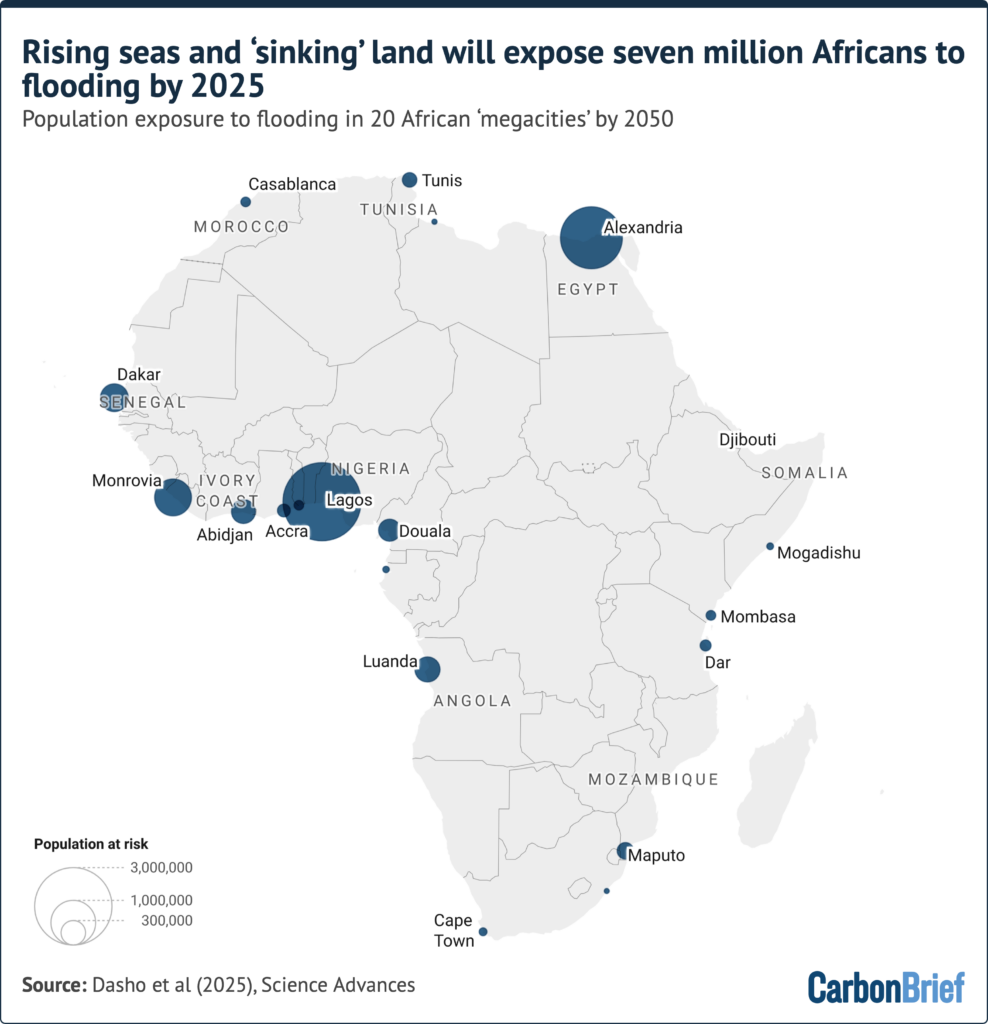
While Lagos and Alexandria are the most vulnerable cities, the research finds that Djibouti City in Djibouti, Mogadishu in Somalia and Tripoli in Libya will face “minimal economic exposure due to their smaller populations and infrastructure bases”.
Lead author Oluwaseyi Dasho, a PhD student at Virginia Tech, tells Carbon Brief that the analysis holds population and city data constant at 2020 levels, so that the authors can isolate the effects of sea level rise and vertical land movement on changing flood exposure.
He notes that if people move away from “threatened areas” over the coming decades, then estimates could be too high. However, if “continued urban growth” causes city populations to increase, the estimates could be too low.
Africa is the world’s fastest-urbanising region, with cities growing at an average rate of 3.5% every year. By 2050, Africa’s urban population is expected to double from 7m to 1.4bn.
He also notes that “the flood model assumes no coastal defenses, so the estimates are a worst-case physical picture”.
Subsidence in African coastal cities has not been consistently monitored in the past, largely due to a lack of local data, the study explains.
The authors say their method of using satellites to assess subsidence and uplift could be used in other “data-scarce coastal regions across the global south”.
Dasho, O., et al (2026), Sinking cities: Latent flood risk in Africa’s coastal megacities, Science Advances, doi:10.1126/sciadv.aeh6538