Connect with us

Published

on

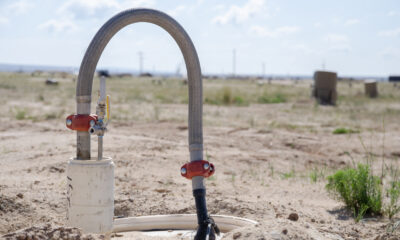
Project Jade could eventually use the same amount of electricity as produced by 10 nuclear power plants, boosting Wyoming’s energy industry while challenging efforts to limit emissions and stressing water supplies.

Wyoming is poised to become an artificial-intelligence powerhouse after Laramie County commissioners last week unanimously voted to move forward with the construction of a 1.8 gigawatt data center designed to eventually scale up to 10 gigawatts, which would be the largest single AI campus in the U.S.

Wyoming County Approves Construction of What Could Become the Largest Data Center in US

Climate Change

Roadmaps and Colombia conference aim to shift fossil fuel transition into higher gear

Published

on

Two years after governments agreed to transition away from fossil fuels in energy systems, a series of conferences and consultations in 2026 will move the conversation on to how the transition should be carried out in a fair and orderly way, according to those leading key international processes.

On Thursday, Climate Home News hosted an event with former German climate envoy Jennifer Morgan, the Brazilian COP30 presidency’s chief strategy officer Tulio Andrade, Fossil Fuel Non-Proliferation Treaty Initiative director Alex Rafalowicz and Natural Resource Governance Institute programme director Erica Westenberg.

The speakers discussed the first international conference on a just transition away from fossil fuels – taking place in the Colombian city of Santa Marta on April 28-29 – and the announcement at COP30 that the Brazilian presidency should consult on and draw up a global roadmap away from fossil fuels.

Morgan, Andrade and Rafalowicz said these were opportunities for many different political, economic and social groups – ranging from Indigenous Peoples and diplomats to those involved in finance and infrastructure – to get involved in designing the transition away from fossil fuels.

Andrade did not give details on the roadmap’s timeline, but said it would reflect that shifting off fossil fuels is not just a “climate imperative but actually something that is going to determine planning and stability from a much wider perspective that goes from financial stability, from social stability, from economic stability”.

He added that planning is needed to transition workers and to avoid disruption as the financial systems of fossil fuel-exporting countries are “still reliant on the legacy of petrodollars and the liquidity they gave”. Rafalowicz noted that price stability for consumers and access to energy for those without it are other important issues to address.

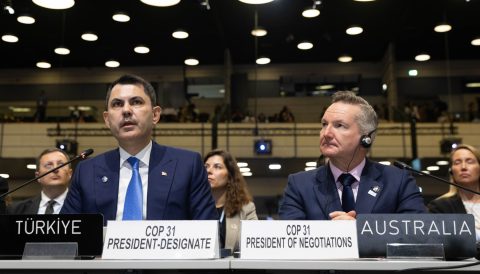
Morgan said governments could put the COP30 presidency’s promised roadmap on the official agenda for the mid-year climate talks in Bonn in June or at COP31 in November. She added that financial institutions and governments should draw up their own roadmaps for moving away from fossil fuels because “a roadmap is a course, it’s a process, it’s a multifaceted thing – it’s not just one single roadmap”.

Santa Marta conference

Rafalowicz, whose campaign group is supporting the Colombian and Dutch governments in organising the Santa Marta conference, said it would be a venue for participants to discuss the enabling conditions needed for phasing down fossil fuel production and use. The governments of Pacific island nations Tuvalu and Vanuatu have offered to hold a follow-up conference, he added.

Alongside the official conference, there will be events run by civil society around Santa Marta’s University of Magdalena, he said. The public university has a long history of exploring the challenge in question because the province of Magdalena is a major fossil fuel producer, he said. There’s also “a very strong local Indigenous population that has a lot of experience with both the harms of fossil fuel extraction, but also trying to manage the transition to the new economy”.

    Rafalowicz added that the event’s organisers intend to produce a chair’s summary which can feed back into the official UN climate talks. At COP30, the Brazilian presidency officially welcomed the conference and Andrade told the webinar its conclusions should be “integrated” into COP discussions.

    The Brazilian official said that a “Global Implementation Accelerator” (GIA) agreed at COP30 should aim for positive tipping points in climate action as “perhaps the only way” that governments can limit global warming to 1.5C above pre-industrial levels. Currently scientists expect that limit to be breached on a long-term basis by the end of the decade but say temperatures can be brought back down below it again.

    Andrade said the GIA could focus on high-impact measures that can serve as an “emergency brake” on global warming like cutting emissions of methane and non-carbon dioxide gases, ecosystem restoration, early warning for climate disasters and building state capacities.

    High-carbon exports harm sovereignty

    Speaking in Spanish on a separate webinar on Thursday, Colombia‘s Minister of Environment and Sustainable Development Irene Vélez Torres said her government is trying to replace industries that extract natural resources with productive industries based on “life”, like tourism.

    She said Colombia’s strategy was “very different from Venezuela” and partly motivated by what she called Venezuela’s “mistake” in the 2000s of not acting to curb extractivism and dependence on fossil fuels.

    “Part of the struggle for sovereignty in the south of the [American] continent has to do with overcoming extractivism,” she said. “We are more sovereign if we are less dependent on exports that are carbon-intensive.”

    The post Roadmaps and Colombia conference aim to shift fossil fuel transition into higher gear appeared first on Climate Home News.

    Roadmaps and Colombia conference aim to shift fossil fuel transition into higher gear

    Continue Reading

    Climate Change

    At ‘Davos of mining’, Saudi Arabia shapes new narrative on minerals

    Published

    on

    As competition for natural resources fractures the global order, Saudi Arabia is cementing its position as the centre of gravity for international discussions to accelerate the production of minerals the world needs for clean energy and digital technologies.

    Ministers and senior representatives from more than 100 countries gathered in Riyadh this week for the Future Minerals Forum, an annual event that has become a mainstay of the minerals industry’s calendar since its launch in 2022.

    Among them were representatives from all G20 countries, which include the US, Canada, China, Germany, France and Russia, as well resource-rich African and Latin American nations, the Saudi government said.

    The fast-expanding forum has been a tour de force in helping position oil and mineral-rich Saudi Arabia at the heart of the conversation to step up production of minerals at a time when competition for resources is dominating global politics.

      President Donald Trump has made control over natural resources and access to critical minerals a core tenet of the US’s national security strategy as it seeks to curb China’s dominance over mineral supply chains. In a massive disruption to the global order, Washington has deployed forces to seize Venezuelan oil, both physically from sanctioned tankers and indirectly by deposing its leader, and is making a play to acquire mineral-rich Greenland from fellow NATO-member Denmark.

      “The reality is that we are in the middle of what is happening in the world,” Adel Al-Jubeir, Saudi Arabia’s minister of state for foreign affairs, told the minerals conference.

      “Our objective is not to seek more territory or more people or more minerals,” he said. “Our objective is stability and calm so that we can focus on resources and building a better future.”

      A global decision-shaping platform

      The world’s second-largest oil producer, Saudi Arabia sits on minerals worth an estimated $2.5 trillion – including lithium, rare earths, zinc and copper – all of which are needed to manufacture batteries and other clean energy technologies.

      Under its Vision 2030 development plan, Saudi Arabia has made mining a key pillar for diversifying its economy away from fossil fuels and is investing its oil revenues into becoming a hub for processing and trading minerals.

      “There’s only one [country] – that’s the Kingdom of Saudi Arabia – that has the trust of enough countries to convene at this critical time,” said Scott Brison, vice-chair of BMO Wealth Management, whose banking arm specialises in the metals and mining sector.

      “This [forum], in a very short time, has become the Davos of mining,” he added.

      Like the famed Swiss ski resort, which will host the annual World Economic Forum next week, the Future Minerals Forum has become a must-attend annual event for investors and decision-makers, who seek to broker deals and invest in mineral value chains.

      Saudi Arabia’s minister of industry and mineral resources, Bandar bin Ibrahim Al-Khorayef, described the event as “a global decision-shaping platform” that “influences policies, mobilise[s] investment and build[s] collaboration across the entire mineral value chain”.

      It comes just weeks after Saudi Arabia opposed any discussion of possible binding rules at the UN to limit the environmental harm caused by mining and make supply chains more transparent.

      The cityscape of Riyadh
      A view of the cityscape in Riyadh, Saudi Arabia (Photo: REUTERS/Mohammed Benmansour)

      US pitch for partners

      The forum focused on the challenges of meeting rapidly-rising demand for minerals, driven by the roll-out of clean energy technologies and AI infrastructure, amid funding gaps and political uncertainty.

      Industry leaders agreed that Saudi Arabia’s geographic location, mineral wealth, extensive relations with both the West and China – originally built on fossil fuel exports – and vast amounts of cheap energy make the Kingdom well-placed to become a global minerals processing hub.

      Amid geopolitical tensions, “the Kingdom has the ability to be a neutral processor” and supply the US market, said José Luis Manzano, chairman of private investment group Integra Capital.

      The US and Saudi Arabia have already agreed to co-operate on mineral supply chains, with the US government pledging to finance a new rare earths refinery in the country.

      Earlier this week, Trump signed an executive order calling for “agreements with foreign trading partners” to help reduce US dependence on China.

      Addressing the Riyadh conference, Audrey Robertson, the US assistant secretary for critical minerals and energy innovation, defended President Trump’s approach to securing mineral supplies from resource-rich countries, insisting the US “seeks to have great partnerships where we all bring different things to the table”.

      “There’s no strong-arming, there’s only strategic alliances to better our nations and better the world,” she said. Yet, when it comes to Greenland, she warned: “I would take our president at his word.”

      Riyadh pledges to break with old ways

      Delegates also discussed improving the transparency of mineral supply chains and ensuring that local communities endowed with mineral wealth benefit from their extraction.

      Saudi minister of state for foreign affairs Al-Jubeir said the “old ways” that saw “foreign companies come in, mine, exploit, take all the value outside of the country and leave the host country with nothing but a big hole on its territory” had to change.

      “The new view is we need to invest. We need to keep as much of the value chain as we can in-country so that we produce jobs [and] opportunities, which in turn produce stability, which in turn helps all of us around the world.”

        At the same time, to establish itself as a minerals processing hub, Saudi Arabia is seeking to broker bilateral deals with developing countries, particularly in Africa, to secure access to resources it can refine.

        Several ministers from mineral-rich African nations, including Democratic Republic of the Congo, Zambia, Ghana, Mauritania and Morocco, attended the conference.

        Riyadh is also working with the World Bank on funding opportunities for seven planned infrastructure corridors to accelerate minerals development in Africa and Latin America and help get resources to the market.

        Saudi strategy stirs Africa tensions

        Nonetheless, Nafi Quarshie, Africa director of the Natural Resource Governance Institute, who attended the forum, told Climate Home News there is “tension” between Saudi Arabia’s plan to process minerals and African nations’ ambitions to add value to their resources and reduce exports of raw materials.

        “There’s a kind of a push for Africa to do business with Saudi Arabia,” she said.

        It remains unclear how African governments can ensure that any minerals agreement with Saudi Arabia creates a win-win situation and helps drive investment to refine ores into higher-value products for clean technologies on the continent, she added.

        There were few civil society representatives in the glitzy halls of the King Abdulaziz International Conference Center, while communities impacted by mining projects were not represented.

        Yet, if Saudi Arabia is serious about doing things differently, activists and affected peoples need to be included in the forum to put transparency, human rights and environment protection at the core of the discussions, said Quarshie.

        The post At ‘Davos of mining’, Saudi Arabia shapes new narrative on minerals appeared first on Climate Home News.

        At ‘Davos of mining’, Saudi Arabia shapes new narrative on minerals

        Continue Reading

        Climate Change

        Prof Ben Santer: Trump administration is ‘embracing ignorance’ on climate science

        Published

        on

        The attacks on climate science by the Trump administration means the US is now “part of the problem” on global warming and “not part of the solution”, says Prof Ben Santer.

        Santer – a leading climate scientist and early pioneer in establishing the human “fingerprint” on warming – has played a central role in major climate change reports during his career spanning four decades.

        In a wide-ranging interview with Carbon Brief, Santer says the Trump administration is “engaged in a systematic attempt to dismantle climate science”.

        The “insane” cuts to major scientific institutions, satellite monitoring and climate research funding amounts to “institutionalised efforts to destroy the US capability to monitor, measure and understand changes in Earth’s climate”, he says.

        He adds that “we all lose if we embrace ignorance with open arms and claim that the real world is what the president believes it to be, not what we actually measure and monitor”.

        It is “heartbreaking” that “many of the best and the brightest [scientists] will leave the country”, says Santer, and go to work in Europe, China, Japan or Australia.

        Now semi-retired, Santer himself is relocating to the UK in order to continue his research in the Climatic Research Unit at the University of East Anglia as it has become “difficult” to do so in the US.

        He has been granted a five-year visa under the UK’s “Global Talent” programme.

        He says he worries about the US influence on European politics as there “have been some efforts to export our willful ignorance” over to the UK.

        The interview was conducted shortly before the Trump administration announced that it was withdrawing from more than 60 international bodies and treaties, including the UN Framework Convention on Climate Change (UNFCCC) and Intergovernmental Panel on Climate Change (IPCC).

        Carbon Brief: Ben, thank you very much for joining us. So, after a long career in the US, you’re now relocating to the UK, where you studied for your degrees. What has prompted your return?

        BS: It’s really difficult for me to continue doing work in attribution science in the US in 2026. I’m a scientist – working on identification of human fingerprints on climate is in my life blood. It’s part of who I am. It’s part of what I’ve done for the last 40 years. The notion of not being able to do that work anymore in the US is unacceptable to me, so that’s one of the reasons why I’m moving to the UK to continue to do work in trying to disentangle human and natural effects on climate. I’m also coming to the UK because my partner lives here and I want to be with her.

        CB: In Trump’s first term [as US president], you were at the Lawrence Livermore National Laboratory. I wonder, what impacts did you experience of the Trump administration when you were there?

        BS: A number of impacts and those impacts started right at the beginning of the first Trump administration. So Trump’s nominee for the Environmental Protection Agency, Scott Pruitt, when he was nominated, had to go through Senate confirmation hearings. During those confirmation hearings, he was asked about the reality and seriousness of climate change. He responded that there had been no significant global warming since 1998. 1998 was a big natural El Nino, natural warming event. And Mr Pruitt was cherrypicking. He was saying [in effect], “when I look at satellite temperature records, the temperature of the lower atmosphere – the troposphere – and only go back to 1998 and then march forward in time, I believe there’s been no significant warming”. That was wrong, demonstrably so.

        My colleagues and I at Lawrence Livermore National Lab were asked to investigate Mr Pruitt’s claim. We did. We published a paper in 2017 in the Journal of Climate [it was actually in Scientific Reports], showing that that claim was wrong. Even if one did the cherrypicking and forgot about the pre-1998 portion of the satellite temperature record. The LA Times [it was actually the Washington Post] reported on our Journal of Climate paper and I think it’s fair to say that the Trump administration did not like that we had factchecked Mr Pruitt. And did not like that we had shown that his on-the-record statement to the US Senate was wrong.

        That incident led to a complaint by the Trump Department of Energy – the funder, primary funder, of Lawrence Livermore National Lab – to the director of Lawrence Livermore National Lab. The director asked for a meeting with me and, during that meeting, told me that the Trump administration was in a position to cut my funding for detection and attribution research at Livermore – and, indeed, to cut funding for Lawrence Livermore National Lab. In the end, the Trump administration did cut the funding for my research and my group’s research in climate change detection and attribution. In my opinion, that was a direct result of doing science [by] factchecking Mr Pruitt. The administration didn’t like that and they didn’t like the result of the factchecking.

        CB: So, how were you able to continue your research at the time?

        BS: I was able to continue my research by cutting down the amount of time that I was actually paid by the Department of Energy. So, essentially, I reduced my time at Livermore in order to allow my younger colleagues to continue to do this critically important work. At the time of these cuts, I had been in my position at Livermore for nearly three decades. I was at the tail end of my career. They were not – my younger colleagues were not – and I wanted them to continue to have sufficient funding to do this work.

        CB: Fast forward to the Trump second term and there have been reported cuts to climate science and related programmes at the EPA [US Environmental Protection Agency], NCAR [National Center for Atmospheric Research], NOAA [National Oceanic and Atmospheric Administration] and NASA. I wonder which of these concerns you the most?

        BS: They are all of deep concern to me. I would say the administration – the second Trump Administration – has engaged in a systematic attempt to dismantle climate science and not only climate science in the US, but I know the climate science piece of things reasonably well. They’ve gone after monitoring. They’ve gone after computer modelling. They’ve gone after people who do the kind of attribution science work that I do; people who look at extreme events and human contribution to the changes in the properties of extreme events – droughts, flooding, all of that – they’ve fired thousands of employees.

        And when you break the evidentiary chain, when you no longer monitor, say, changes in Arctic sea ice extent or carbon emissions or atmospheric temperature, you make it difficult for people like me to get at the causes of climate change. That’s a deep, deep concern that we may no longer be able to continuously monitor stuff that we urgently need to monitor, not only for climate, but also for basic weather prediction. For example, if you stop monitoring atmospheric moisture, then you degrade the quality of weather forecasts that give you early warning of severe storms, of atmospheric rivers – it’s unthinkable to actually kill those kinds of critically important measurements, but yet, that’s where we are. It’s heartbreaking.

        I have hundreds of colleagues at the National Centre for Atmospheric Research, at the Geophysical Fluid Dynamics Lab at the [NASA] Goddard Institute for Space Studies – women and men who have devoted their entire scientific careers to trying to model the climate system, understand the climatic shape of things to come. Many of them, particularly probationary employees, are gone. And you can’t flip a switch under a more enlightened administration, which we hope we get in three years from now, and bring all of that back. Science doesn’t work that way. Many of the best and the brightest will leave the country and will go to Europe or go to China or go to Japan or Australia. They will leave the US. They will see no future for themselves there. Or they won’t even come to the country to study, to do degrees – and that loss of talented, dedicated researchers is heartbreaking. That’s the only word for it.

        CB: You mentioned a lot of programmes that have been cut – for example, monitoring. Do you think other countries can step into the void? And, if so, who and how?

        BS: I hope so. I hope the Europeans and the Chinese and the Australians and the Japanese are making serious contingency plans – and recognising that this is a real thing. The Trump administration is going to turn off satellites. They’ve announced their intent to severely cut NASA and go after things like the Orbiting Carbon Observatory and other remote sensing systems that make measurements that they don’t like. So hopefully other space agencies recognise the danger to this evidentiary chain.

        But, again, that’s not like flipping a switch that you can suddenly launch a satellite – developing sensors, deploying sensors in space – all of that is the stuff of years, not the stuff of a couple of months. But I hope that these kinds of discussions are going on at the highest level in countries that recognise the value of information – again, not only for climate, but for basic weather forecasting. If the US no longer is willing to lead, is no longer willing to invest in basic monitoring of weather and climate, other countries have to try and fill the gap.

        CB: Shortly before Trump won his second term, you wrote that his election risks trapping the US and the planet in an “eddy of ignorance”. I wonder what your reflections are now that Trump is in power?

        BS: We are in that “eddy of ignorance” in the US. Clearly, this administration seeks to redefine reality itself; seeks in its public-facing websites – say NASA, EPA – to generate a picture of a world where climate isn’t changing, or if it is, the changes are purely natural – they’re due to the sun, volcanoes, orbital perturbations; humans have no agency, have no discernible influence on climate. So, they’re creating an alternative universe in which human caused fossil fuel burning has no impact on climate. And what do you even call that? “Eddy of ignorance” is too weak a term to describe that willful misrepresentation of the world we actually live in – of the climate we actually live in – how it’s changed, how it’s likely to change it. It’s – again – heartbreaking when you think of the destruction of information on websites, the destruction of libraries – like, as has recently been reported, the Goddard Space Flight Centre library of volumes about atmospheric science, ocean science – the thought of that stuff going away, of not being there anymore. I don’t know what to do with that, I guess.

        The only thing I can do with it – and have tried to do with that kind of willful ignorance – is shine a light on it and say “this is wrong”. No matter what differences in political positions we have, we all lose if we embrace ignorance with open arms and claim that the real world is what the president believes it to be, not what we actually measure and monitor. That’s where we are in the US – president Trump is defining reality and we risk – as many have written – going back to the Soviet Lysenkoism, where any science that conflicts with the prevailing political views of the leader is dismissed and denied. And that has serious negative consequences – of course, not only for the US, but for the entire world. We’re part of the problem now in the US, not part of the solution to the problem of climate change.

        CB: You mentioned the Department of Energy (DoE) earlier and its involvement in the Lawrence Livermore Lab. And I wonder what your reaction was to their “critical review” on climate change that they published last year?

        BS: So they published this review in July of 2025. It involved five noted climate change sceptics. I had dealt with all of them over the course of my time at Livermore. It was not a surprise that the administration was going to try and come up with some counter narrative to IPCC and national climate assessments. But what did surprise me was just how brazen and blatantly wrong bits of it were.

        So, I’ll give you an example. Chapter 5.5 of this Department of Energy climate working group review dealt with temperature changes in the stratosphere. And it touched on work that my colleagues and I had had done and published most recently in 2023 in a paper in Proceedings of the National Academy of Sciences. And the DoE report cited our 2023 paper and said that we had not found a human fingerprint on climate. We had. We had found the most convincing evidence yet of a human fingerprint on the structure of atmospheric temperature. This predicted fingerprint of warming of the lower atmosphere and cooling of the upper atmosphere – predicted by Suki Manabe back in 1967 – we had found it in satellite measurements of atmospheric temperature change. And we had found that this signal was particularly clear where Manabi had predicted back in ‘67 – that it would be clear right in the upper stratosphere. The Department of Energy, in saying “you didn’t find a fingerprint”, was essentially doing the equivalent of something like this: The walls here in this room were white. They’re essentially telling you, “no, they’re not white, they’re black”. What do you do with something like that? When someone mischaracterises your own work and the work of your colleagues – sober, mature science that you’ve spent decades doing – and fundamentally turns it on his head in an official government report for a specific political purpose.

        You know, the report was released on the same day as EPA administrator Lee Zeldin announced his intent to repeal the 2009 endangerment finding – the finding that emissions of greenhouse gases, through their effect on temperature and through temperature effects on air pollution, materially harm human health. So, this report fed into that political goal of wanting to repeal the endangerment finding. And our science is being misrepresented to support that political goal. That was pretty shocking to me – that it would be so blatant. There was no pretence, really, of trying to get the science right. And the example that I just mentioned – with our vertical fingerprint work with atmospheric temperature – is only one example of many dozens that the Dessler report takedown – and Carbon Brief’s own takedown of the many errors in the DoE report – showed. This was a pattern of behaviour. My job is about pattern analysis and there was a pattern in the DoE report of trying to misrepresent well-understood science.

        CB: Your career has spanned periods where climate science has been attacked quite fiercely – back to the time of Kyoto in the 90s or Climategate at the end of the 2000s. What parallels or differences do you see today?

        BS: So, back in the mid-90s, the attacks focused on the IPCC second assessment report. That report came out in early 1996 and its headline finding was the infamous 12-word statement: “The balance of evidence suggests a discernible human influence on global climate.” And that was significant because it was the first time that the international scientific community said formally: “We see a signal of human activity.” Other individual scientists had made such claims in the past – notably, Jim Hansen in 1988 in a paper in Journal of Geophysical Research. But this was the international community, the IPCC, saying: “Hey, humans are no longer innocent bystanders in the climate system. We formally identified a climate change signal due to our actions. It’s not the sun, it’s not volcanoes, it’s not natural internal variability, it’s on us.”

        And as the play Kyoto, which you just mentioned, clearly notes, that was threatening – that discernible human influence finding – to very powerful, moneyed interests. To, for example, the Global Climate Coalition – a consortium of energy interests – they recognised that this was bad for business, that this finding might have downstream implications for their business models, for their ability to continue burning fossil fuels without considering the negative externalities of their actions. So the Global Climate Coalition and other fossil-fuel funded organisations – Western Fuels [Association], the Petroleum Association [the American Petroleum Institute] – went after the IPCC and went after me. No personal animus, but I was the lead author of the chapter in which this finding was situated. And individual folks in Congress, too, like Dana Rohrabacher, a Republican congressman, wanted to make names for themselves and felt that they could do so by casting doubt on the integrity of the IPCC process – the scientific integrity of people like me. So there was some attempt back then to politicise the science too. It wasn’t just fossil-fuel interests that went after the IPCC. It was also folks like Rohrabacher who wanted to make a name for themselves.

        What’s different today is that it’s an entire administration. This is institutionalised, willful ignorance on the part of the administration – institutionalised efforts to destroy the US capability to monitor, measure and understand changes in Earth’s climate. That’s qualitatively different from anything I encountered in the mid-90s at the time of the IPCC second assessment report.

        CB: If you were in the earlier stages of your career now, as you were then, do you think you would be just as involved in communication and public engagement on climate change?

        BS: Absolutely. The lesson I learned 30 years ago – back at the time of the discernible human influence finding in 1996 – was, sometimes, you don’t have the luxury of sitting on the fence and just waiting to see how things develop. Back then, I was a representative of an entire scientific community. My job had been to – with my peers – assess the then-available science and come up with our best representation of what the science, back then – 30 years told us – and we did and we were right. The cautious, even wimpy, “balance of evidence suggests a discernible human influence on global climate” [statement] was justified by the then-available science. And, in the next 30 years, the science progressed – better models, longer data records, better fingerprint techniques for disentangling human and natural effects on climate, more scientists involved in this kind of work all over the world – leading to the word “unequivocal”.

        It is now unequivocal, as the IPCC judged in its 2021 sixth assessment report [on climate science], that there are human fingerprints all over Earth’s climate system – atmosphere, oceans, land surface. Back then, in 1995-96, we were primarily looking at surface thermometer records, surface temperature records. Now, folks have interrogated literally dozens of variables – Arctic sea ice extent, atmospheric moisture, specific humidity, sea level pressure, ocean heat content, clouds, circulation patterns, extreme event properties – you name it, they’ve looked at it. They’ve kicked the tires. They’ve used pattern recognition methods to assess whether purely natural influences can explain the changes in each of those independently measured variables – natural causes can’t.

        And that’s the frustration, I would say – this disconnect between this much more mature understanding of causes now in 2021 and this willful ignorance that we see in the Trump administration. Where the president of your own country refers to all of the work that you’ve done and your colleagues have done as a “con job”. So not only wrong, but criminal – as if there’s intent, on your part and your colleagues’ part, to mislead the global public about the reality and seriousness of climate change. The only response, in my opinion, is you have to, as a scientist, push back against that. If you don’t, if you remain silent, then really bad stuff happens. And I think that’s true for our democracy as well. If good people remain silent when there are serious challenges facing science and democracy, we all lose.

        CB: What would be your advice to climate scientists in the US today, particularly those leading the organisations under attack?

        BS: “Hang together or hang separately,” as Benjamin Franklin, I believe, famously said. You have to provide some kind of united front to these systematic efforts to dismantle US science. If you don’t, if you leave that to individuals or let the administration attack individual universities, you’re not going to prevail in preventing really serious harms. And I would say it’s taken the scientific community a long time to recognise that. In the US, certain institutions that should have led right from the beginning and said, “no, this is wrong”. Going after the CDC [Centers for Disease Control and Prevention] and going after vaccine schedules harms public health. People will die. Those kinds of messages needed to be made public very early, very forcefully – and they weren’t.

        Same with climate science – starting to fire probationary employees, starting to go after climate modelling and to argue that modellers were scaring America’s children by making projections of the climatic shape of things to come. All of that demanded a firm, clear response, which was late in coming. And unfortunately, again, many of the harms that happened in those first few months – the firings, the withholding of grant money that will affect research at universities, climate research, medical research labs, the continuity of whole departments – those harms can’t be easily reversed. I think, for me, the personal lesson learned from the first administration is only when you push back quickly and forcefully in a united way do you have some hope of avoiding the worst outcomes.

        CB: We’ve seen how quickly US federal climate science policy has changed under a new government. I wonder what lessons can European governments and institutions and scientists take from that on protecting climate science, regardless of political change?

        BS: That’s a great question and it’s one I worry about a lot, because there have been some efforts to export our willful ignorance, say, to this country [the UK]. Steve Koonin, one of the five authors of the DoE climate working group report, has tried to persuade British colleagues that the science – the climate science done, say, at the Hadley Centre and other research centres and universities isn’t credible, that they shouldn’t make policy based on IPCC or internal climate assessments. And I think we’ll see more of that. I think the Royal Society needs to be very clear that it has to push back against those efforts to try and export our willful ignorance to this country and to Europe.

        [The following part of Santer’s answer is missing from the video recording because of a technical issue.]

        Those efforts are only just starting to ramp up in the US. We hear that the same five folks who worked on the DoE report are going to be in charge of the next [US] national climate assessment. And I would not be surprised to see folks like Koonin and others make more appearances over here and it’s in the [Trump] administration’s interests to undermine climate science internationally. Why? Because then they can say, well, “buy our oil – there are no consequences, no climate consequences. And the people who have told you that there are climate consequences are not real, credible scientists – believe our five hand-picked experts who wrote this DoE report and are now rewriting national climate assessments.”

        I think you need here, in the UK, to observe what happened and the institutional failures to push back against this kind of willful ignorance and to learn from those failures. It really is critically important to support science and leading institutions can’t be silent. They can’t say, oh, we don’t want to offend president Trump, or we don’t want to offend Elon Musk, who is one of our members in the Royal Society. No, you will suffer serious, long-lasting reputational harm if you don’t defend science. That’s my lesson learned.

        CB: Where do you see things going next in the US? What’s the next move for the Trump administration on climate change?

        BS: Well, what I’ve mentioned already is that the five individuals who wrote the DoE’s climate working group report in July 2025 have apparently been tasked with leading the next national climate assessment, which is a congressionally mandated report to Congress. And it’s likely that that will be the same stuff we saw in the DoE report in July 2025 – a counter narrative, if you will, to mature scientific understanding encoded in 30+ years of IPCC reports. So, on the science side of things, it’s about presenting that counter narrative. It’s also, I think, about continuing to dismantle websites and continuing to present the public on EPA and NASA and NOAA websites with a very, very different understanding of the causes of climate change.

        It’s – if Congress doesn’t do anything to stop it – going to involve continued cuts to NASA. The Trump administration has made it very clear that they don’t care about observing changes in Earth’s climate from space and they’re going to go after missions that they don’t like that provide basics – atmospheric temperature and atmospheric moisture and, again, pollutants, CO2 emissions, methane emissions, all of those kind of things I would say are imperilled, which is insane. That’s the only word for it. Removing our ability to measure and monitor how the world around us is changing, makes no sense whatsoever. But, yet, that’s where we are, because the data is inconvenient and doesn’t comport with the narrative of the president, that nothing is happening, nothing is changing, or if it is, it’s all natural.

        I think there will be continued efforts to go after modelling capability, which is – again – heartbreaking. Some of the institutions I mentioned – like the National Centre for Atmospheric Research, Geophysical Fluid Dynamics Lab in Princeton, Goddard Institute for Space Studies [GISS] – they’re already under attack. Their funding is under attack. Their leases, in the case of GISS, have been rescinded or cancelled. There are efforts to break up these groups of very, very talented women and men and scatter them to the wind. I think that’s going to continue. And what will be important will be to see whether Congress pushes back against these things or is fearful of incurring Trump’s wrath and allows this sort of stuff to continue internationally.

        I think the US is not going to engage with IPCC or UN Framework Convention [on Climate Change] or COPs. [The Trump administration has now withdrawn the US from the IPCC and UNFCCC.] They don’t care. All they care about is exporting US and now Venezuelan oil, presumably. And they don’t care about advancing climate science or any kind of science, really, which is an unbelievable thing to say, coming from a country where science has, since the end of the second world war, been an integral part of the country, of its development, of its economy, of its of its future. Now we’re turning away from science in the US. It’s like we’re handing the baton of leadership to you and saying, “here, we’re done leading in climate science, medical science – you lead now, rest of the world, we’re going to go back and try and make the horse and buggy great again”.

        CB: What do you see happening to the [EPA’s] “endangerment finding”?

        BS: I think the EPA Administrator Lee Zeldin has, right from the beginning, intended to rescind the endangerment finding – following Trump’s lead and following the guidance of Project 2025 [A blueprint to reshape the US federal government under a Republican president, published in 2023 by the Heritage Foundation and other right-wing organisations.] There are powerful interests in the US that, right from the beginning, have argued, “the endangerment finding is bad for business, so get rid of it. This should be an important thrust of the second Trump administration.” And it has been, right from the beginning of the administration. And part of the job has been to come up with this scientific counter narrative – in the DoE report and, I believe, now in the planned next national climate assessment – to argue that, “the science isn’t credible. We don’t need an endangerment finding because human actions aren’t endangering the climate. It’s all natural, folks. Nothing to see here.” That’s going to continue.

        But, as I mentioned, that faces challenges, that counter narrative now, because it was so badly done. The DoE report was so sloppy, so riddled with mistakes – some of which were really transparent, not shades of grey differences between experts, but really badly wrong stuff. That’s the DoE report. The factchecking on that report has been done. It’s out there, [it] got widespread publicity – thank you Carbon Brief; thank you, Andy Dessler. The fast track study of the US National Academy of Sciences – done partly in response to the DoE report – has affirmed and confirmed the science is credible. Humans are influencing global climate through burning fossil fuels, through particulate pollution, and we need to do something about it. This is a serious danger to human health.

        So, Mr Zeldin’s challenge is a difficult one. I would say he’s got powerful scientific – well, decades of mature science – that he’s going against, that he’s tilting against. And that’s going to be a tough sell. But, that said, it’ll wind up before the US supreme court and the supreme court has a conservative majority. How they adjudicate, given that they already decided back in 2009 [it was actually 2007] that climate change constitutes a danger to human health, will they reverse their decision? There’s a lot of uncertainty. But one thing that is very certain is that Trump wants the endangerment finding rescinded and everything flows from that.

        CB: I want to look back now a little bit more. We’re now 15+ years on since Climategate [when thousands of emails between climate scientists were stolen from a university server and selectively released online in an attempt to undermine COP15 in Copenhagen in 2009]. And I wondered how you feel about that whole experience now?

        BS: Pretty bad about the whole experience. I did my PhD at the Climatic Research Unit at UEA [the University of East Anglia]. I got my PhD in 1987 and I then went to Hamburg to do a postdoc at the Max Planck Institute [for Meteorology]. Then, after Max Planck, I went to Livermore in 1992 and I continued to work together with people at the Climatic Research Unit. They weren’t only colleagues. They were friends. We published a boatload of papers together. Watching what happened, what unfolded in 2009 and thereafter was terrible. The human cost hasn’t really been revealed – to good people who spent their lives trying to compile surface temperature data sets.

        The case of Phil Jones, in the case of Keith Briffa – to do dendrochronology and advance understanding of century timescale changes in climate from looking at tree rings – all of that good work was dragged through the mud by these forces of unreason, by folks who had no real understanding of the science of the integrity of the work. It was sickening and disgusting to witness bad things happen to such good people. I spent a fair bit of time back then in 2009 and 2010 providing input to various investigations, speaking publicly about the individuals involved, and I remain deeply concerned at that human cost. This isn’t a game. When you go after the integrity of individuals and the[ir] decency and honesty – in the public arena – in such a vicious and nasty way, it has consequences.

        Some of those consequences aren’t visible to people on the outside, who don’t know folks like Phil Jones and folks like Keith Briffa and others deeply involved in Climategate – folks like Michael Mann. But those consequences, those personal consequences, are very real and I’m concerned that that’s where we’re going again. The way forward, say, for the Trump administration is to challenge the integrity and decency and honesty and motives of climate scientists – as is occurring with use of incendiary language like “con job”. That’s where we’re going again.

        CB: How do you think that public trust in climate science – and scientists – compares now to back then?

        BS: Well, language matters. Words matter. That’s been a lesson of mine – a lesson I learned back in 1995 with those 12 words with the “discernible human influence” finding. So when there’s this drum beat of incendiary language – “con job”, “hoax”, “conspiracy” – again and again and again, it erodes public trust in science and scientists: “Well, the President surely wouldn’t be saying these things if there weren’t something behind them.” These folks have huge megaphones that they can exploit on a daily basis.

        They are in control of the levers of power now – websites at NASA, NOAA, EPA. The president can address the UN General Assembly and use this kind of “con job” language, “you’re all fools if you believe scientists”. I have to believe that that has impact – cumulative impact. If you keep on doing it again and again and again, you can erode public confidence in science. And that’s why part of my job, as I see it, is to be a public figure – to speak and to write about evidence: “How do we know? How have we reached this time in history when we know that we’re not innocent bystanders in the climate system. What’s the nature of the evidence? Who gained it? How did they gain it? Do scientists look at alternate hypotheses? Could it all be the sun, volcanoes, orbital perturbations, intrinsic variability?” We have to do a better job explaining how we know and why it matters to what’s at stake here.

        This [year] is likely – 2025 – to be the second- or third-warmest year ever. [This has now been confirmed.] And, over my lifetime, I’ve seen the signal of human-caused warming emerge from the noise of natural variability. We know it’s real. We know that if we do nothing to reduce emissions of greenhouse gases, that signal is going to manifest more clearly every year. So it’s critically, just critically, important to speak science to power and continue to push back against this narrative of “con job” and “hoax” and “conspiracy”. But it’s an uphill struggle. Again, given that I can have an interview with you, I can write stuff in Scientific American, but the president can reach tens of millions of people every day.

        CB: Just thinking about the media, how do you think the media’s coverage of climate science has changed over time?

        BS: I think it’s gotten better. Certainly back in the 90s, it was much more this binary, “he says, she says” type things: “Here’s Expert A, here’s Expert B, giving you some completely different view of a scientific question.” I would say that the reporting is now much more focused on trying to understand the science and rather than having duelling experts out there. Even in the US, we don’t get [prominent climate-sceptic scientists] Dick Lindzen or John Christy now, as we used to on every story about warming and changes in sea ice. You don’t get the counter narrative out there. And that’s good and that’s really positive.

        Much of the reporting is now more in depth about what’s going on with the Thwaites great glacier, or what’s going on with sea level and what are the drivers of sea level rise? And all of that is good and positive. And I do think that there’s more effort to hold the administration accountable – the Trump administration accountable – for making incorrect claims. We were unwilling to use the word “lie” at the beginning of the first Trump administration. People are more willing now to say, “this is untrue, there’s no scientific basis for this statement or that statement”, and that’s good, too.

        What I think is necessary, as I said before, is for more voices to enter the fray – for the leadership of powerful professional organisations to say, “this claim by the administration that climate science is a ‘con job’ is wrong. It’s not. And here are three decades of reports that we published that show that it’s a thing and we need to worry about it.” It can’t be just individual voices there of a few climate scientists speaking about the reality and seriousness of climate change.

        CB: So, you have, obviously, been heavily involved in all IPCC reports throughout the years. We’re now at the early stages of the seventh assessment and countries are still yet to agree on a timeline for publication of the assessment reports. And I wonder what you thought that says about the state of climate politics today?

        BS: Well, I’ve been involved in every IPCC assessment since the first one in 1990. I think they’re unique. They’re an invaluable way of providing the collective understanding of an entire community and showing how that understanding has evolved over time. I hope the IPCC continues. I think there’s a continuing need for an authoritative international organisation to say: “This is our best understanding of the science and this is our best understanding of likely outcomes if we do nothing to address the problem, or we follow this emission scenario, or this overshoot scenario.” We need that and it’s clearly good to be able to put error bars on these projections, to have the entire global scientific community involved – and be able to say: “This is what we know with confidence, this is what we don’t know with confidence. Here are our levels of confidence.”

        All of that is extraordinary when you think about it, how a community has come together to make these authoritative assessments of the state of our understanding. Which is why it’s been so threatening, I think, to the Trump administration and why they pulled out of IPCC [in 2025] and why they don’t like it.

        [The following part of Santer’s answer is missing from the video recording because of a technical issue.]

        Because it doesn’t support the president’s narrative that this is a “con job” and that history is valuable to see how, over time, things have firmed up, how the “balance of evidence” finding was transformed into “unequivocal” human fingerprints on climate. Capturing that arc of history, that arc of scientific understanding.

        But the IPCC has challenges. The US is backing out now. There are some efforts on the part of the philanthropic community to allow individual US scientists to participate. I hope that that continues. I hope that the US, in some way or other, continues to make scientific contributions to the IPCC. But I do worry about this fractured landscape, with powerful forces out there seeking to undermine the work of the IPCC. We’re going to see the rise of those forces – not only in the US, but elsewhere – to silence or diminish the effectiveness of voices like IPCC. So we need to be prepared for that and we need to have very clear communications about the richness of the evidence.

        I think the scientific community and the IPCC maybe haven’t been that good in terms of explaining just how compelling the evidence is for human effects on climate – just how multivariate it is: atmosphere, ocean, land, temperature, moisture, circulation, ice. It’s everywhere. It’s in our backyards. It’s not just evidence of human effects on climate in the far flung Arctic or a few Pacific islands, we need to communicate that better.

        CB: Thank you so much for your time.

        The post Prof Ben Santer: Trump administration is ‘embracing ignorance’ on climate science appeared first on Carbon Brief.

        Prof Ben Santer: Trump administration is ‘embracing ignorance’ on climate science

        Continue Reading

        Trending

        Copyright © 2022 BreakingClimateChange.com