Connect with us

Published

on

In today’s dynamic manufacturing world, energy is more than just a utility; it’s the spark that keeps production running. Industrial facilities, powered by massive engines and heavy machinery, often operate 24/7, driving output but also consuming enormous amounts of electricity.

The issues? Soaring energy costs and a growing environmental footprint.

Sometimes it’s like a cycle that often feels impossible to break, but what if your facility could draw energy from a cleaner, more reliable, and cost-effective energy source?

Yes, you heard it right, and that’s where solar power comes in!

As electricity prices continue to rise and corporate sustainability goals become more pressing, manufacturers are rethinking how they power their commercial operations.

Therefore, solar energy is emerging as a game-changing solution, offering reliability, long-term savings, and a sustainable path forward for the Australian manufacturing industry.

In this blog, we’ll explore how manufacturers are successfully implementing solar power, featuring real-world case studies from Cyanergy that highlight both the business advantages and environmental impact.

So, let’s explore how solar energy can help your manufacturing facility reduce costs and enhance efficiency, achieving long-term sustainability.

Why Solar Energy Is Essential for Modern Manufacturing Facilities?

In Australia, manufacturing facilities typically have large roof or yard footprints, significant and relatively
stable electrical loads, including lighting, motors, HVAC, and other machinery. So, the energy used every day is
enormous.

By harnessing the sun’s energy, factories can significantly cut operating
costs
, reduce carbon emissions, and gain greater control over long-term energy stability.

Beyond the environmental benefits, solar power also strengthens a company’s competitive edge and brand reputation in
an increasingly eco-conscious market.

Here we’ve penned down the importance of solar power in the manufacturing industry:

  1. Energy cost mitigation 
  2. So, how solar energy reduces manufacturing costs in Australia?

    With electricity prices rising and energy market volatility increasing, incorporating solar energy offers a
    way to
    reduce grid dependency and lower utility costs in the long term.

  3. Ensure Operational Continuity & Resilience
  4. Solar panel systems, when paired
    with
    battery storage, can help smooth peak energy demand, reduce grid dependence, and improve functioning
    time.

  5. Promote Sustainability and Brand Value
  6. In larger industries, many manufacturers are under pressure from customers, regulators, investors, and
    internal
    stakeholders to reduce
    their carbon footprint
    .

    Solar helps them to achieve energy freedom, powering businesses with a sustainable energy source.

  7. Increase Asset value & ROI
  8. Solar systems, when sized appropriately and properly optimised, can deliver payback in a few years and
    continue to
    provide savings thereafter.

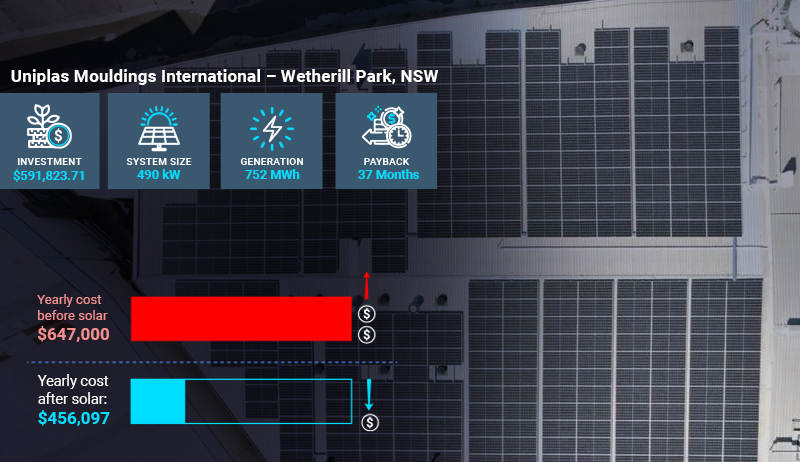
According to Cyanergy’s capability statement, we delivered a 490
kW system
that generated 752 MWh for a manufacturing client, with a 37-month payback period.

This shows that industrial-scale solar can deliver real, practical results for manufacturers.

Now, let’s examine solar power solutions for manufacturing facilities, case studies, and best practices to ensure a
clear understanding.

Case Studies from Cyanergy: Real-World Manufacturing Success in Australia!

In this part of the blog, we have selected three examples from Cyanergy to illustrate how manufacturing facilities are utilising solar energy.

These are not generic installations; these are production-oriented businesses taking real steps across different states of Australia.

1. Uniplas Mouldings International – Wetherill Park, NSW

Project Overview

  • System size: 490 kW solar system installed in staged phases
  • Investment: AUD $591,823.71.
  • Annual generation: 752 MWh
  • Yearly energy costs before solar: approximately $647,000.
  • After solar: $456K, which is approximately 55% of the previous
  • Payback period: 37 months

Why it matters

For Uniplas, a large industrial manufacturer, the solar system not only significantly reduces their operating energy
costs, but the payback of just over 3 years means that the return on investment is also attractive for the
business.

The staged approach also allowed them to access multiple subsidies and implement the project rapidly; for example,
the first stage of 200 kW was completed in four weeks.

This clearly shows how manufacturing operations can incorporate
solar
without any significant disruption.

2. AC Laser – Thomastown, VIC

Project Overview

  • System size: 99.45 kW
  • Annual generation: 141.75 MWh
  • Annual electricity cost before solar: $79,000.
  • After solar: $38,160, a reduction of more than 50%
  • Payback period: 26 months

Why it matters

This is a smaller-scale manufacturing facility compared to Uniplas, yet the results are impressive: a more than 50%
cost reduction and a shorter payback period.

This shows that not only large-scale commercial properties but also mid-sized manufacturing operations can benefit
from solar, not just large ones.

Insights Gained from the Case

  • Don’t wait until your business is huge, as size is scalable.
  • The solar system’s size aligned well with the manufacturing load, saving thousands of dollars.
  • Rapid ROI shows manufacturing facilities can justify solar as a capital investment for their business.

3. Specialised (Cycling-Industry manufacturer) – Port Melbourne, VIC

Project Overview

  • System size: 39.6 kW
  • Annual generation: 47.32 MWh
  • Electricity cost before solar: $26,720; after solar: $17,770
  • Payback period: 45 months

Why it matters

Although smaller, this project depicts that solar energy is a viable option for manufacturing across various sizes
and sectors, even in facilities with a relatively small carbon footprint.

The case emphasises sustainability as a business value and how solar can support brand positioning as well as cost
savings.

Major Takeaways

  • Solar supports both cost and branding sustainability
    goals
    .

  • Even medium-sized systems can provide meaningful savings.
  • The ROI
    generated
    must be viewed in terms of both financial and reputational benefits for any
    business, whether it’s large or small.

Is Now the Right Time for Manufacturers to Transition to Solar Energy?

After knowing the numerous benefits of solar solutions, you may be tempted to go solar. However, transitioning from
traditional energy sources to solar energy comes with a cost. 

From government
incentives
to long-term cost savings, the financial case for solar energy is compelling.

Still wondering, is it time for businesses to go solar? Here’s why you should act now:

  • Electricity prices continue to rise in many markets, strengthening the return on investment for solar
    energy.

  • Many governments and utilities offer incentives, favourable tariffs, or rebates
    for industrial solar projects.

  • Day by day, the pressure for sustainability reporting and corporate social responsibility (CSR) is
    intensifying. Manufacturing facilities with high energy loads are often subject to inspection.

  • Technology costs have fallen recently, making solar panels and inverters
    more affordable than ever and reducing payback time.

  • With the right sizing and execution, the solar system becomes a long-term asset that pays for itself,
    releasing capital for other manufacturing investments.

Best Practices for Manufacturing Facilities Considering Solar

Solar can be a powerful game-changer for manufacturing companies and large commercial buildings when implemented correctly.

But that doesn’t mean it’s as easy as flipping the switch.

Therefore, before investing in Solar power, ensure you understand every step that leads to real savings and sustainable success for your business.

1. Conduct a detailed energy assessment & align solar to load

Before installation, it is essential to understand your manufacturing facility’s energy usage patterns, including the peak usage limit, daily load curves, and seasonal variations.

The better the match between system size, orientation, and actual usage, the higher the yield and the quicker the payback.

At Cyanergy, we provide a customised design based on site analysis.

2. Use staging or modular deployment

If you have a large manufacturing site, you may benefit from staging the solar solution in phases.

For example, in Uniplas’s case, the installation was divided into three stages. This enables access to multiple subsidies, enhances cash flow, and mitigates the risk of disruption.

3. Optimise your system size & measure consumption rate

Over-sizing or under-sizing can both cause significant loss in a business. Therefore, the design should minimise waste and maximise the use of solar energy on-site.

As in AC Laser’s mid-sized facility, a 99 kW system fits their load and delivers huge savings.

4. Check your rooftop or plant infrastructure

Is your rooftop compatible with solar panel installation?

For manufacturing facilities, factors such as roof strength, shading, orientation, structural constraints, and maintenance access are crucial.

Ensure the facility can support panels, inverters, wiring, and monitoring systems without compromising building aesthetics.

5. Perform regular monitoring & performance tracking

Everything requires a certain amount of care and maintenance to function properly over time. The story is the same for a solar panel system.

Real-time monitoring allows you to spot performance issues, shading effects, degradation, and inverter downtime.

Cyanergy emphasises continuous monitoring post-installation.

6. Research on financial modelling & payback analysis

When going for solar, always calculate realistic payback periods, ensure system cost fits within capital budgets,

You should also check the available incentives, tax benefits, payback time, and how to stack several rebates for maximum savings.

For example, many Cyanergy projects offer a 2–4 year payback, with several solar rebates that can be combined with the VEU Rebate.

7. Align with sustainability and your brand strategy

In manufacturing factories, incorporating solar energy can be a substantial component of a broader sustainability strategy. Why?

Solar reduces your dependency on harmful fossil fuels, cutting greenhouse gas emissions.

It positions your brand and promotes your business, demonstrating corporate responsibility and improving stakeholder perception.

8. Maintenance & lifecycle planning

Solar systems require periodic maintenance, inverter replacements, cleaning, and monitoring.

So, manufacturing facilities should incorporate service arrangements into their design. Plan for system longevity, degradation, and eventual replacement or upgrade to ensure optimal performance.

9. Consider adding Battery storage

Even though optional, integrating battery storage or demand management can enhance value by enabling peak shaving, reducing demand charges, and storing excess energy for nighttime use or during grid outages.

10. Engage stakeholders and minimise disruption

In manufacturing, you can’t easily stop production. Plan your solar installation during low-production periods, coordinate with your team, and prioritise safety to minimise downtime.

Final Notes: Ready To Take The Next Step?

For manufacturing facilities, solar power isn’t just about being eco-friendly; it’s a smart business move for Australians. Cyanergy’s case studies showed that even large manufacturers can achieve paybacks of 2–4 years, reduce costs, lower emissions, and enhance brand value.

With proper planning, energy assessment, correct system sizing, phased installation, and active monitoring, solar can deliver lasting benefits.

So, if rising energy bills or sustainability goals are on your radar, it’s time to view solar energy as an innovative manufacturing solution, apart from just a renewable energy source.

Reach out to Cyanergy, conduct an energy audit, and engage a solar specialist with manufacturing experience today. Cyanergy is here to help!

Your Solution Is Just a Click Away

The post Understanding Commercial Heat Pump Warranties with Cyanergy  appeared first on Cyanergy.

Understanding Commercial Heat Pump Warranties with Cyanergy 

Continue Reading

Renewable Energy

US Offshore Wind Restarts After Court Injunctions

Published

on

Weather Guard Lightning Tech

US Offshore Wind Restarts After Court Injunctions

Allen covers four US offshore wind projects winning injunctions to resume construction, including major updates from Dominion Energy’s Coastal Virginia project. Plus Ming Yang’s proposed UK manufacturing facility faces security review delays, Seaway 7 lands the Gennaker contract in Germany, and Taiwan’s Fengmiao project hits a milestone.

Sign up now for Uptime Tech News, our weekly newsletter on all things wind technology. This episode is sponsored by Weather Guard Lightning Tech. Learn more about Weather Guard’s StrikeTape Wind Turbine LPS retrofit. Follow the show on YouTubeLinkedin and visit Weather Guard on the web. And subscribe to Rosemary’s “Engineering with Rosie” YouTube channel here. Have a question we can answer on the show? Email us!

Happy Monday everyone!

Four offshore wind projects have secured preliminary injunctions blocking the Trump administration’s stop-work order.

Dominion Energy’s Coastal Virginia Offshore Wind.

Avangrid’s Vineyard Wind 1.

Equinor’s Empire Wind.

And Ørsted’s Revolution Wind.

All four argued they were at critical stages of construction.

The courts agreed.

Work has resumed.

A fifth project… Ørsted’s Sunrise Wind… has a hearing scheduled for today.

Now… within days of getting back to work… milestones are being reached.

Dominion Energy reported seventy-one percent completion on Coastal Virginia.

The first turbine… installed in January.

The Charybdis… America’s only U.S.-flagged wind turbine installation vessel… is finally at work. Fifty-four towers, thirty nacelles, and twenty-six blade sets now staged at Portsmouth Marine Terminal. The third offshore substation has arrived.

But here is where the numbers tell the real story.

The month-long delay fighting the Bureau of Ocean Energy Management?

Two hundred twenty-eight million dollars.

New tariffs?

Another five hundred eighty million.

The project budget now stands at eleven-point-five billion dollars.

Nine-point-three billion already invested by end of 2025.

Dominion and partner Stonepeak are sharing the cost.

Dominion insists offshore wind remains the fastest and most economical way to deliver nearly three gigawatts to Virginia’s grid.

A grid that powers military installations… naval shipbuilding… and America’s growing AI and cyber capabilities.

First power expected this quarter.

Full completion… now pushed to early 2027.

Up in New England… Vineyard Wind 1 also resumed work.

The sixty-second and final turbine tower shipped from New Bedford this week.

Ten blade sets remain at the staging site.

The installation vessel is scheduled to depart by end of March.

The turbines are going up.

But eight hundred eight million dollars in delays and tariffs…

That is a price the entire industry is watching.

═══ Scotland Waits on Ming Yang Decision ═══

In Scotland… a decision that could reshape European supply chains… hangs in the balance.

Chinese manufacturer Ming Yang wants to build the UK’s largest wind turbine manufacturing facility.

The site… Ardersier… near Inverness. The investment… one-point-five billion pounds.

The jobs… fifteen hundred.

Trade Minister Chris Bryant says the government must weigh security.

Critical national infrastructure must be safe and secure.

Scotland’s First Minister John Swinney is losing patience.

He told reporters this week the decision has taken too long.

He called it pivotal to Scotland’s renewable energy potential…

and a crucial component of the nation’s just transition.

Meanwhile… Prime Minister Keir Starmer met with President Xi Jinping in Beijing this week.

He spoke of building a more sophisticated relationship between the two nations.

Whisky tariffs… halved to five percent.

Wind turbine factories?

Still under review.

Bryant says they want a steady, eyes-wide-open relationship with China.

Drive up trade where possible.

Challenge where necessary.

But no flip-flopping.

For now… Scotland waits.

And so does the UK supply chain.

═══ Seaway 7 Lands Gennaker Contract ═══

In the German Baltic Sea… a major contract award.

Seaway 7, part of the Subsea 7 Group, will transport and install sixty-three monopiles and transition pieces for the Gennaker offshore wind farm.

The contract value… one hundred fifty to three hundred million dollars.

Subsea 7 calls it substantial.

The client is Skyborn Renewables… a portfolio company of BlackRock’s Global Infrastructure Partners.

Nine hundred seventy-six megawatts of capacity.

Sixty-three Siemens Gamesa turbines.

Four terawatt-hours of annual generation.

Enough to power roughly one million German homes.

Seaway 7’s work begins next year.

═══ Taiwan’s Fengmiao Hits Milestone ═══

In Taiwan… Copenhagen Infrastructure Partners completed the first batch of jacket foundations for the Fengmiao offshore wind farm.

Five hundred megawatts.

On schedule for late 2027 completion.

Offshore installation begins later this year.

The jackets were built by Century Wind Power… a local Taiwanese supplier.

CIP called it a sign of strong execution capabilities and proof they can deliver large-scale, complex energy projects.

But they are not stopping there.

Fengmiao 2… six hundred megawatts… is already in development.

Taiwan is aiming for a major boost in large-scale renewable energy by 2030.

And that is the state of the wind industry for February 2, 2026

Join us tomorrow for the Uptime Wind Energy Podcast.

US Offshore Wind Restarts After Court Injunctions

Continue Reading

Renewable Energy

How Is U.S. Insanity Affecting Tourism?

Published

on

It’s probably a bit too soon to have useable statistics on this subject, but it’s certainly not too early to apply some common sense.

There are at two factors at play here:

1) America is broadly regarded as a rogue country.  Do you want to visit North Korea? Do Canadians want to spend money in a country that wants to annex them?

2) America is now understood to be unsafe.  Do you want to visit Palestine? Ukraine? Iran?

How Is U.S. Insanity Affecting Tourism?

Continue Reading

Renewable Energy

Commercial Solar Solutions: Real Case Studies by Cyanergy

Published

on

Instead of reacting to the next power bill shock, many Australian businesses are starting to think forward.

Every day, more and more Australian companies are asking a simple question we all seek an answer to: How can we reduce energy costs without compromising performance?

Well, for many, the answer lies in commercial solar power, and Cyanergy is one of the Australian companies helping businesses take that step with confidence.

With hands-on experience delivering commercial solar solutions across a wide range of industries, from farms and sporting clubs to breweries and large manufacturing facilities, Cyanergy’s real-world projects demonstrate how tailored solar systems can transform energy usage and significantly reduce operating expenses.

In this blog, we’ll explore what commercial solar power is, why it matters today, and how Cyanergy’s real-world case studies illuminate the path to a cleaner, more profitable energy future, both financially and environmentally

Let’s get into it!

What Are Commercial Solar Solutions? |Why does this matter?

Solar solutions for commercial applications are photovoltaic (PV) systems designed to meet the energy needs of businesses, large facilities, and organizations. This system often consumes much more power than residential households.

Commercial solar systems typically include:

  • Solar PV panels that capture sunlight and convert it to electricity
  • Inverters and electrical integration are used to convert DC to usable AC power
  • Monitoring and performance systems are installed to track energy generation
  • Optional battery storage to support energy autonomy and peak demand management

Unlike residential solar, commercial systems are scaled to handle larger loads and are often optimized for financial return, corporate sustainability goals, and energy independence.

Why Australian Businesses Are Turning to Solar Now?

Throughout the world, many companies are adopting solar power for several compelling reasons. It is already proven
that solar can:

  1. Reduce Operational Costs
  2. Electricity prices are volatile and often increasing worldwide. Incorporating a solar panel helps businesses lock
    in
    energy cost savings by
    producing electricity on-site rather than relying exclusively on grid power.

  3. Strong Financial Returns
  4. Commercial solar systems can pay back their investment in just a few years, far shorter than the 25 to 30 years
    the
    panels last. This ultimately means, after that, you are left with decades of essentially free electricity.

  5. Sustainability and Brand Value
  6. Customers, employees, and stakeholders increasingly value organizations that visibly commit to environmental
    responsibility.

  7. Energy Security
  8. Generating power locally reduces reliance on external sources and grid outages, a huge advantage for businesses
    with
    continuous operations.

    This mix of economic, environmental, and operational benefits makes commercial solar a smart choice for
    forward-looking organizations and commercial
    property
    owners
    .

4 Proven Solutions Through Real Case Studies by Cyanergy

To understand how these benefits play out in real situations, let’s dive into several commercial solar projects executed by Cyanergy. These case studies show diverse applications of solar power and tangible outcomes for different kinds of businesses.

1. Kew Golf Club (VIC): Sporting Facility Goes Solar

At a local golf club that relied on consistent electricity for lighting, clubhouse operations, and course facilities, Cyanergy installed an 88 kW commercial solar system to reduce costs.

Key Results

  • Payback period: around 63 months (5 years)
  • Annual savings: $26,165, a 50% drop in electricity costs
  • Energy generated per year: 141 MWh

This project demonstrates that not only industrial property but also community-oriented facilities can benefit greatly from solar power.

Beyond cost savings, the golf club also reinforced its commitment to sustainability, attracting eco-conscious members and reducing its carbon footprint.

Why This Matters?

Solar is not limited to manufacturing or heavy industry. In Australia, many Sports clubs, community centres, and similar facilities often have high energy use during peak daylight hours, which can be supported by solar.

2. Sparacino Farms: Where Agriculture Meets Solar Innovation!

Whether for irrigation, cooling, processing, or storage, agricultural operations have faced rising energy costs for a long time.

Similarly, Sparacino Farm was suffering from high electricity costs. For this family-run farm, Cyanergy implemented a 99.76 kW solar system that revolutionised their energy expenses.

Project Highlights

  • Electricity cost dropped: from $48,000 to $12,000 per year
  • Monthly savings: roughly $3,000
  • Payback period: 30 months (2.5 years)
  • Annual clean energy production: 87 MWh

This dramatic turnaround showcases how rural and agricultural businesses can achieve some of the fastest returns on solar investments.

In environments where a roof, sunlight, or a shed space is available, solar becomes both a strategic and practical choice.

The Sparacino farms example proves that solar isn’t just an environmental sustainability, it’s a core business decision that can significantly improve margins.

3. Philter Brewing: Crafting Sustainability

Sustainability often aligns naturally with brand identity, and for Philter Brewing, this was a perfect match.

With the help of Cyanergy, the brand installed an 86 kW system to slash power costs and support green operations.

Project Impact

  • Annual energy generated: 99 MWh
  • Annual savings: $29,130, cutting electricity costs from $81,900 to $52,770
  • Payback period: 45 months (3.75 years)

The brewery not only reduced operating expenses but also strengthened its reputation as an environmentally conscious brand, a powerful differentiator in a competitive market.

4. Uniplas Mouldings International: Heavy Industry Solar Success

In one of Cyanergy’s most impactful case studies, a large industrial manufacturer significantly transformed its energy profile with solar. And that’s Uniplas Mouldings International!

Project Features

  • Total installed solar: 490 kW, executed in staged phases
  • Timeline: Stage 1 (200 kW) completed in just 4 weeks
  • Subsidy optimisation: Accessed three sets of government incentives
  • Payback period: as short as 37 months
  • Annual generation: 752 MWh
  • Energy cost savings: Lowered from $647,000 to $456,000 per year

Big industrial energy users can unlock dramatic operational savings with solar, saving hundreds of thousands of dollars a year while achieving rapid ROI that justifies investment sooner, without delay.

Beyond Case Studies: Cyanergy’s Approach to Commercial Solar

Across all these projects, Cyanergy’s methodology shares some common themes that contribute to success:

1. Customized System Design

We all know that no two energy profiles are identical, whether it’s a golf club or a manufacturing plant.

At Cyanergy, we design systems tailored to the business’s actual energy usage, site orientation, and financial goals. So you don’t have to worry about adding a solar solution.

2. Financial Optimization

From government incentives to financial investment planning, Cyanergy helps businesses structure their solar projects to reduce upfront costs and improve payback timelines.

3. End-to-End After-Sale Support

Proper solar implementation requires more than panels; it requires site assessment, design, installation coordination, monitoring, and performance guarantee.

At Cyanergy, we support clients at every step, from early energy audits to post-installation support.

4. Monitoring and Reporting

Tracking system performance and energy generation ensures ongoing optimization and confidence in the investment.

Our real-time monitoring tools empower business owners to understand exactly how solar contributes to their bottom line.

The Transformative Role of Solar in Business Strategy

The benefits of commercial solar extend far beyond the energy generated or the energy cost that’s reduced. Overall, solar is a strategic business asset that impacts:

Profitability: Lower operating costs mean more available working capital, whether for reinvestment, dividends, or growth initiatives.

Resilience: Energy independence provides a hedge against market volatility in electricity pricing.

Sustainability Credentials: Solar investments signal that your organization is serious about environmental stewardship, which is crucial to investors, customers, and regulators alike.

Employee and Community Engagement: A company that commits to clean energy signals a long-term vision, strengthening morale and community trust.

Takeaway Thoughts

Cyanergy’s real case studies show how businesses from farms to breweries to industrial giants have harnessed solar to cut costs, stabilize operations, and enhance sustainability.

Whether your organization is exploring its first solar project or looking to scale existing efforts, the data is clear: smart solar investment delivers measurable ROI and long-term value.

As energy dynamics continue to evolve, solar power will become increasingly relevant, and companies that act now will secure economic and environmental advantages for years to come.

So, it’s time for you to take the next move! For more information, contact us today and win a free solar quote!

Your Solution Is Just a Click Away

The post Commercial Solar Solutions: Real Case Studies by Cyanergy appeared first on Cyanergy.

https://cyanergy.com.au/blog/commercial-solar-solutions-real-case-studies-by-cyanergy/

Continue Reading

Trending

Copyright © 2022 BreakingClimateChange.com