

The European Union’s decision to dilute its corporate sustainability rules could hurt the bloc’s efforts to fight climate change and risks rewarding companies with a poor track record, environmental NGOs and clean energy advocates say.
In a deal clinched in the early hours of Tuesday, EU leaders, the European Commission and the Parliament agreed a series of amendments to the Corporate Sustainability Due Diligence Directive (CSDDD), which will require larger companies to identify and address any environmental or human rights violations in their supply chains.
The amendments, which still need formal approval by the Parliament and EU member states, mean the due diligence requirements will apply to far fewer companies than initially targeted and maximum penalties will be reduced from 5% to 3% of a company’s annual global turnover.
In another change, the EU also scrapped a requirement for companies to publish climate transition plans setting out how they would make their business model compatible with the Paris Agreement.
-
Mining is destroying our homes: We need global binding rules for mineral extraction
Amid a rush for minerals needed for the energy transition, voluntary safeguards and corporate goodwill are insufficient to protect nature and human rights -
Brazil’s Lula requests national roadmap for fossil fuel transition
After countries failed to formally back a global energy transition roadmap at COP30, Brazil’s president takes the initiative by mandating a national plan


The EU Commission said the changes, which follow months of corporate lobbying, US pressure and interventions by France and Germany, will remove all requirements for many smaller companies and introduce greater flexibility for larger companies, which will help to ease administrative burdens on businesses and drive investment.
But climate campaigners and clean tech industry representatives said the watered down rules were a setback for European efforts to clean up supply chains and reduce emissions.
“By deleting the climate transition plan implementation, the EU is weakening the key legislative frameworks for businesses to prepare for climate risks and global challenges that can severely affect their operations and value chains,” said Julia Otten, who works on corporate due diligence at Frank Bold, a sustainability NGO and law firm.
“This is counter-productive for businesses, weakens accountability, and jeopardises the EU’s own plans and objectives on climate and the industrial transition,” she added.
“Extremely disappointing”
Industry leaders in clean energy technologies say that the changes undermine their sector’s climate efforts and risk putting companies that prioritise sustainability at a disadvantage.
Rachel Owens, CEO of the Solar Stewardship Initiative, a multistakeholder scheme that has set out standards for what transparent and sustainable solar value chains should look like, told Climate Home News the move was “extremely disappointing”.
Requiring companies to set out their climate transition plans would have demonstrated that the production of solar panels and other renewable energy technologies and the energy they generate have much lower emissions than their fossil fuel alternatives, she said.
For Maurice Loosschilder, global head of sustainability at Signify – a multinational company that manufactures LED lighting systems that help reduce energy consumption – the removal of the climate transition plans from the law will make it more difficult to align businesses and their supply chains with the EU’s climate goals and could reduce incentives for innovation.
Because of its large size, Signify still falls under the law’s requirement. But Loosschilder said he was concerned that the company could lose its competitive edge when faced with small companies for which the same sustainability rules do not apply.
Intense lobbying
The agreement reached on Tuesday followed intense lobbying by industry and governments.
In a letter addressed to EU leaders, the US and Qatar warned that investment and energy supplies to the EU would be harmed if the CSDDD came into effect in its original form.
Documents obtained by the Amsterdam-based Centre for Research on Multinational Corporations (Somo) show how 10 major companies lobbied to dilute the regulation. This included oil and gas majors ExxonMobil, Chevron and TotalEnergies as well as metals and minerals producer Nyrstar, a subsidiary of commodity trading giant Trafigura Group.
Total Energies defended its advocacy in Brussels and in European capitals as being “in full compliance with applicable laws and regulations”. The other companies did not respond to Somo’s requests for comment.
-
South Africa’s platinum mine dumps get a second look as clean energy lifts demand
Mining firms say extracting minerals from tailings is a sustainable way to boost global supplies, but local communities want to see benefits this time around -
Efforts to green lithium extraction face scrutiny over water use
Direct lithium extraction has been hailed as a way to reduce mining impacts in South America but experts warn the technology may not be ready for large-scale deployment -
Self-taught mechanics give second life to Jordan’s glut of spent EV batteries
As EV sales boom in Jordan, a lack of formal infrastructure for dealing with end-of-life batteries is leading to some innovative solutions


NGO Global Witness accused EU leaders of giving in to lobbying by the fossil fuel industry.
“Major oil and gas giants will now be able to dodge their responsibility to act on [the] climate, largely thanks to intense US political and corporate pressure,” Beate Beller, a senior campaigner at Global Witness, told Climate Home News.
The EU’s about-face also weakens efforts to clean up the supply chains of technologies needed for the energy transition such as electric vehicles, batteries and solar panels.
“Clean tech cannot be ‘clean’ if the raw materials behind it are mined under weakened standards. This is what made the spirit of the CSDDD so promising: it paired climate transition plans to cut fossil-fuel dependence with robust human-rights and environmental due diligence across clean-tech supply chains,” she added.
Lower bar on supply chain oversight
The rules will now only apply to companies established in the EU with at least 5,000 employees and a net global turnover of 1.5 billion euros. It had originally applied to companies with at least 1,000 employees and turnover of 450 million euros. Member states have until July 2028 to transpose the requirements into national law.
When assessing their supply chains, companies will need to follow a risk-based approach and focus on areas that carry the biggest potential for harm. For example, an EV maker might focus on the production of the battery, which requires a range of different minerals whose extraction and processing carry high risks.
However, companies are no longer required to carry out comprehensive mapping of their direct and indirect suppliers. Instead, they will need to conduct “a general scoping exercise” based on “reasonably available information”.
Johannes Blankenbach, a senior researcher at the Business and Human Rights Centre, told Climate Home News that it is important that companies identify risks beyond their direct suppliers.
That’s because the most severe risks typically lie further up the supply chain, for example, where raw materials are sourced or extracted from the ground, he said.
In addition, harmonised rules across the EU to allow victims of harms to take companies to court have been removed, which will make it more difficult for communities to find legal remedies, Blankenbach added.
While the EU Commission said the less onerous requirements should help drive investment, Sonia Dunlop, CEO of the Global Solar Council, a trade body for the solar industry, said investors in solar farms wanted guarantees about the origin of solar panels and battery storage equipment.
“They want to know where it was made, and they want to know that it was properly made according to the highest environmental, social and governance standards,” she said, citing industry initiatives to boost supply chain transparency and standards such as the Solar Stewardship Initiative.
She said the initiative had been spurred by both the EU’s plan to tighten due diligence laws as well as industry concerns over the use of forced labour in the production of polysilicon used in solar panels in China’s Xinjiang region.
The post EU weakening of corporate sustainability rules ‘jeopardises’ climate action, critics say appeared first on Climate Home News.
EU weakening of corporate sustainability rules ‘jeopardises’ climate action, critics say

Climate Change
Foreign minister: Nepal needs “meaningful” international support to face climate threats
In the wake of the recent flash flood that swept down from the Himalayas, Nepal is seeking immediate aid from a UN fund for climate loss and damage to help vulnerable families displaced by the disaster and rebuild destroyed schools and hospitals, the country’s foreign minister told Climate Home News.
“This is exactly the kind of climate-driven catastrophe the Fund was created to address,” Shisir Khanal said in an interview. He added that “stronger global solidarity and meaningful international support” are needed for countries like Nepal, which are facing increasingly severe climate-related disasters.
The floods were caused by a glacier collapsing and triggering a landslide that forced a torrent of water and debris to rush down the Bhote Koshi River valley, causing catastrophic impacts downstream. More than 1,300 people died and over 5,300 are still missing in the area.
Khanal described the disaster as a “Himalayan tsunami”, telling Climate Home News that early assessments suggest the roads, bridges, hydropower stations, highways and settlements it wiped out could require billions of dollars to rebuild. Reconstruction estimates by the government range between $2.5 billion and $5 billion.
The minister of foreign affairs said Nepal would not be asking the UN’s new Fund for Responding to Loss and Damage (FRLD) “to write a single check for this total amount”, explaining that the government is finalising a post-disaster assessment “to guide our broader international donor appeals”.
Nepal disaster seen as test case for fledgling fund
In reality, if Nepal does receive rapid support from the FRLD, it is likely to be a fraction of the total bill because the fund has a cap of $20 million per project and has little more than $350 million available to hand out in its initial phase.
So far its board has not approved any projects as it is still working out how to allocate its scarce resources, nor does it have a process in place to respond to sudden climate disasters such as glacial lake outburst floods or powerful storms.
On August 31, Nepal’s government sent a direct appeal for emergency grant funding to the FRLD, emphasising that “a prompt response would… demonstrate that the fund can translate international solidarity into timely support for vulnerable countries and communities when it is most urgently needed”.
A couple of days later, eight developing-country board members – later joined by those from small island states – signed a letter, seen by Climate Home News, asking the fund’s board to hold an extraordinary meeting to respond to Nepal’s request.
The FRLD said in a statement that the devastating impacts on the ground “underscore both the urgency and scale of need and reaffirm the fundamental purpose for which the FRLD was established”.
It added that it is “committed to approaching Nepal’s request with the urgency, compassion, and careful consideration that these difficult circumstances require, while respecting the Fund’s governing instrument and established decision-making processes”. As of Wednesday, Climate Home News understands that discussions were still ongoing.
Designing infrastructure for extreme shocks
Khanal pointed to “the unprecedented scale” of the huge flood which occurred within a matter of minutes and swept away river gauges meant to provide early warning in Rasuwa and Nuwakot, near the border with Tibet.
“You cannot easily ‘plan’ against a mountain collapsing,” he said. But the lesson, he added in written responses in English, is that “our historical baseline for infrastructure engineering is no longer sufficient”.
Building resilient infrastructure means that “hydropower projects, roads and early warning systems must be designed for extreme, unpredictable climate shocks”, he said. Another key element will be plans to better understand and protect ecosystems, he added.
-
As science comes under attack at UN talks, climate movement splits over how to respond
A rift over how IPCC messages are produced and turned into policy is creating tensions in the world’s most influential coalition of climate NGOs -
At regional summit, Pacific islands ask for COP31 support for clean energy and finance
Pacific nations want the annual climate conference to deliver funding for renewables and ocean protection, as the UN warns of devastating sea level rise
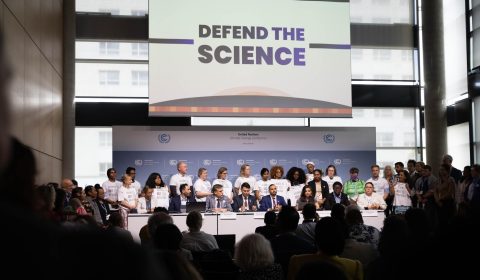

The minister noted that Nepal, India and China share a common, interconnected Himalayan ecosystem and all three countries are affected by the impacts of climate change in the Himalayan mountain chain.
“Therefore, our call is for the three countries to work together to strengthen preparedness, resilience and regional cooperation,” he said.
New research from consultancy Systemiq, released on Wednesday, finds that Himalayan glaciers are losing mass 65% faster than a decade ago, and that only around 20 of the Himalaya’s estimated 40,000 glaciers are currently monitored. India alone has 56 glacial lakes rated very high risk, it warns.

Early cross-border efforts on information-sharing
Since the same region of Nepal was hit by smaller-scale but still highly destructive flooding in 2024 and 2025, China and Nepal have stepped up efforts to cooperate in tackling glacier-related risks in the region.
In August 2025, Climate Home News reported that authorities in both countries had agreed to share cross-border information about the risks of glacial lake outburst floods across the Tibetan region, in a first step that could be expanded to the national level in an effort to reduce deaths and damage.
This May, a delegation from China’s Ministry of Water Resources and the Water Resources Department of the Xinjiang Autonomous Region held talks with Nepalese officials in charge of water and disaster management about establishing a joint disaster information mechanism.
Then in August, a team from the Institute of Mountain Hazards and Environment under the Chinese Academy of Sciences also visited Nepal for scientific research and exchange, sharing China’s experience in monitoring glacial lakes.
Nepal and China agree to cooperate on glacial lake flooding, as warming hikes threat
However, experts told Climate Home News that progress on putting in place concrete measures has been slow. Narendra Khanal, a professor in the department of geography at Tribhuvan University, blamed that partly on Nepal’s traditional administrative system and bureaucratic delays.
“We have to share information with them, and they have to share information with us,” he said. “In my understanding, the Chinese side is also facing difficulties in making this cooperation work.”
Mohan Bahadur Chand, a Himalayan glaciologist and assistant professor at Kathmandu University, said China has the technology and human resources to provide significant information to its neighbour downstream.
But, to make that work, “we have to build trust between the two countries”, which is currently lacking but could be developed, he said. “As scientists, we are already working with them personally. If we create a trusted environment, cooperation should not be difficult.”
Nepal lacks monitoring and warning technology
Experts said Nepal – one of the world’s least-developed countries – does not have the technology or resources to install the sophisticated monitoring and warning systems needed to protect its population from growing threats linked to accelerating glacier melt in the Himalayas.
A senior meteorologist at the Department of Hydrology and Meteorology, who did not want to be named, told Climate Home News that the government had not invested enough in rainfall and weather monitoring stations, especially above 3,500 metres, and therefore lacks reliable data about what is happening at high altitudes.
“The stations we have are operated by different organisations, but many of them are not functioning properly,” the official added.
Comment: The loss and damage fund needs far more finance to deliver climate justice
This year, the UN’s Green Climate Fund released initial funding for a $50-million project to address the risks from four glacial lakes in other parts of Nepal, but has come under criticism for taking seven years to approve the proposal. The fund said this was due to efforts needed to strengthen and consult on the project, as well as administrative, institutional and COVID-related delays.
Foreign minister Khanal said Nepal was calling on the international community for support to tackle global warming impacts into the future.
“This disaster should not be viewed simply as a one-time event requiring one-time assistance,” he emphasised. “We need to recognise the longer-term consequences of rising temperatures and climate change, particularly for vulnerable communities and developing countries.”
The post Foreign minister: Nepal needs “meaningful” international support to face climate threats appeared first on Climate Home News.
Foreign minister: Nepal needs “meaningful” international support to face climate threats
Amy Youngman is a legal and policy specialist at the campaigning group Environmental Investigation Agency (EIA).
The chair’s August Aid to Negotiations is being sold as a pragmatic way to rescue the global plastics treaty. However, the text is starting to resemble the architecture of a Paris Agreement-style framework: a patchwork of vague commitments, nationally determined action and reporting, with the hardest substantive decisions left to a future that, my experience following these negotiations tells me, would never arrive.
In March 2022, governments adopted UNEA Resolution 5/14 by consensus, launching negotiations for a legally binding international instrument to end plastic pollution. I joined the global plastics treaty process in Paris in 2023, where hopes of drafting a treaty capable of confronting one of the defining environmental and human health threats of our time were first derailed by procedural warfare.
-
“We’ve gone backwards” – new plastics treaty text dims hopes for production curbs
During troubled talks, fossil fuel-producing nations have pushed for a global pact to tackle only plastic waste rather than reducing the size of the problem -
Why we couldn’t agree on a plastics treaty in Geneva – and what might happen next
Switzerland’s lead negotiator at INC-5.2 reflects on why the talks didn’t succeed – and the options now for getting an effective agreement
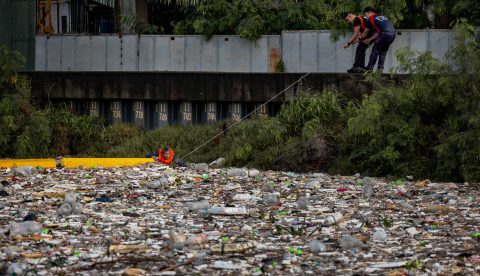

Five months later, in Nairobi, I watched the chair close a meeting while delegates still negotiated -allegedly to catch a flight. In 2024 and 2025, in Ottawa, Busan and Geneva, the same small group of blocking states grew bolder, cloaking opposition in language about defending the vulnerable while subsidising a system that fuels the pollution crisis. Offended by ambition, ashamed of nothing.
A year after the last formal attempt to negotiate a treaty, we are tasked with protecting a fragile process. And despite long-standing support, including legal, policy and technical expertise from my own Environmental Investigation Agency, the chair has excluded observers from the rooms where the treaty’s fate is being decided.
In that orchestrated quiet, the loudest proposal emerged: the suggestion that the instrument be a “framework convention.” The new Aid, intended to shape the late-September Heads of Delegation meeting, never uses the word “framework”. It does not need to. It strips back substantive obligations and presupposes future action.
A framework is no match for this crisis
Framework conventions outline broad principles and leave each country to develop its own plan, often delaying tough decisions to future negotiations that may never happen. This tactic is a political shell game: persuading states that want action now to give up meaningful, binding measures to reach agreement.
The Chair’s Aid arrives at a framework by subtraction rather than by proposal, which makes it harder to name and potentially easier to accept. Using the Aid, effectively the rejected text from Geneva, as a basis for the next informal meeting in Bangkok will be sold as a way to preserve a distressed UN system and reach consensus in a fractured geopolitical environment.
This is diplomacy drowning in wishful thinking that the countries fighting binding rules today will approve tougher ones tomorrow. Four years of negotiations and decades of climate diplomacy taught us that this is not a bridge to ambition – this is how ambition dies.

Production is driven by global oil, gas and chemical markets, while products and waste travel across borders. No singular government can regulate its way out of a problem created and amplified by a globalised system.
Countries have tried, and production kept rising. Now there is plastic everywhere we look, and the cost falls hardest on the people least responsible.
That failure is why there was consensus to negotiate a treaty, because this crisis requires global action. The purpose was never to list national efforts and call that progress but to create common global rules to address pollution.
The most politically sensitive issues cannot simply be postponed. How much plastic is produced, which toxic chemicals are allowed in it, which throwaway products are banned, and how future decisions are made are precisely the issues that require global answers. An instrument that refuses to negotiate them will be easier to adopt but useless on arrival.
Learn from climate governance
Supporters of a framework approach may point to the ozone treaty as proof that it can work. But the Vienna Convention succeeded for one reason: governments quickly adopted binding upstream controls on ozone-depleting substances.
Climate offers the opposite warning: a framework followed by contested, delayed and insufficient measures, while emissions keep rising.
The new chair not only deleted a direct reference to “production and consumption” and bracketed similar preambular language copied from the original mandate. The article on reporting borrows language from the Paris Agreement. Another summer of record heat, fires and floods offers a glimpse of how well that model is working.
Nothing suggests that the states blocking binding rules today will suddenly accept them tomorrow, and the exponential rise in unchecked plastic production will not pause while governments wait for courage. Blockage is not being resolved, but just pushed forward.
A framework would lock in the wrong response: unlimited upstream growth with waste management attempting to handle it downstream. No waste system can keep pace with a material engineered for endless growth.
Keeping to 1.5C of warming is no longer possible – but we must still limit the overshoot
After four years of INC negotiations, governments know this. States must reject the false choice that the only path to agreement is an instrument too weak to solve the problem it was created to address. Compromise is part of diplomacy. Surrender is not.
And if the UN keeps pushing that choice, the countries prepared to act must be willing to pursue alternative pathways. Groups of willing governments have built effective agreements before, and existing environmental regimes can deliver new rules without inventing a new empty instrument.
This process was never meant to find a lowest common denominator. It was to create the rules necessary to change our direction. Bangkok in September will be where the second iteration of this text is shaped. If ambitious countries do not push back, the argument about a framework convention will already be lost by default.
Negotiations cannot end with governments accepting the crisis rather than solving it. The science is clear and the damage is accelerating. The world does not need another promise to act later. It needs the treaty governments promised to deliver in 2022.
The post The world doesn’t need a Paris Agreement for plastics appeared first on Climate Home News.
Climate Change
As science comes under attack at UN talks, climate movement splits over how to respond
With June’s UN climate talks inching towards gridlock, a group of diplomats calling themselves “Friends of Science” issued a stark warning: climate science was under attack in Bonn.
The coalition, spanning the world’s richest to its most vulnerable nations, pointed the finger primarily at those who think “science threatens their economic prospects” – a thinly-veiled reference to fossil fuel-dependent states accused of casting doubt on long-held scientific tenets in the UN climate process.
Fiji’s lead negotiator, Sivendra Michael, went still further. He denounced what he called “a very polluted narrative” taking hold outside the negotiating rooms and singled out ECO, a daily newsletter on the talks produced by Climate Action Network (CAN) International, for overlooking the issue.
“They are representing developing countries, but they are not representing us,” Michael said. His words hinted at how a rift between governments over the science of global warming has created tensions inside the climate movement.
Watchers of the UN climate talks have told Climate Home News there is growing unease over where the world’s most influential coalition of climate NGOs stands in an increasingly heated debate about how scientific messages produced by the Intergovernmental Panel on Climate Change (IPCC) are crafted and turned into global climate policy.
UN sets out narrow path back to 1.5C warming after inevitable overshoot
CAN’s international leadership has publicly backed a line of argument, championed by some big emerging economies including India, that questions how fair and equitable the models underpinning the work of the IPCC – the UN’s climate science body – are because they are dominated by research from the Global North.
But some climate activists, including from nations on the frontline of the climate crisis in the Pacific, are increasingly disappointed by CAN’s silence in a connected row over whether the IPCC’s forthcoming assessment report should be finished in time to inform the next UN scorecard of global climate action.
Over the last two years, India, Saudi Arabia, China, Russia and Kenya have pushed back against attempts by a large coalition of nations to align the IPCC’s AR7 report timeline with the second stocktake of national climate plans under the UN climate process. They claim this would put a burden on developing countries with limited resources and restrict their ability to provide scientific input into the process.
India flags bias in IPCC assumptions
CAN International Executive Director Tasneem Essop spoke at an online event last month in which panelists challenged the “Friends of Science” campaign launched at the Bonn talks.
During the webinar, an Indian scientist and government negotiator set out her view that the IPCC’s way of working and scientific assumptions perpetuate inequity between developed and developing countries – and yet its reports have come to be treated as “scripture” that cannot be questioned.
In her intervention, Essop did not comment directly on the Bonn science campaign nor on the IPCC timeline issue. But the participation of CAN’s leadership in an event where such criticism of the IPCC was aired has sparked concern in some parts of the NGO community.
“The way in which CAN International is playing into what could be the destruction of the IPCC inputs into the climate process is very concerning,” said Bill Hare, who was involved in CAN’s establishment nearly four decades ago and now runs think-tank Climate Analytics.
Science ‘under attack’ from fossil fuel interests at UN climate talks
He added that it was a mistake for CAN International to align itself with arguments made by India and Saudi Arabia, when those countries are blocking the conclusion of the IPCC’s next key report on cutting emissions in time for it to feed into the next global stocktake, which is due to conclude in 2028.
Like other insiders Climate Home News spoke to, the veteran Australian climate scientist fears these tensions could hamper CAN’s widely recognised power to influence the talks.
“The CAN International voice has been very, very important in the process. That voice doesn’t need to be diluted at this moment in history – that would be a really bad move,” Hare said.
Dialogue to reconcile differing views
Over the last decade, CAN has been working to transform itself into an organisation that is more representative of, and responsive to, voices and needs in the Global South. In 2019, it appointed Essop – a South African expert on climate, energy, poverty and social justice – as executive director, shifting further away from its European and North American roots.
CAN International, which functions as the broader network’s secretariat, says it is discussing how to reconcile varying views on the IPCC and the science and equity question among its hundreds of member groups spread across 130 countries.
“We acknowledge that there are different perspectives within a global network of over 2,000 members on these issues,” CAN International’s Essop said in response to questions from Climate Home News. “Given this diversity, we have democratic processes to build internal agreements.”
“Science and equity are both fundamental principles for effective climate action and are firmly embedded in CAN’s work,” she added in a written statement. “Putting these principles into practice in a painfully unjust world is not always straightforward, which is why we need continued dialogue across the network.”
Calls for “fair share” approach
The webinar in late August – which aimed to untangle what organisers described as “a growing narrative” that “treats science and equity as opposing priorities” – opened with a presentation by Tejal Kanitkar, a prominent Indian climate scientist who also serves on her government’s delegations at the IPCC and UN climate talks.
Outlining the findings of a paper she co-authored, Kanitkar argued that the IPCC had used scenarios for future emission reduction trajectories based primarily on assumptions put forward by Global North researchers that are skewed against the world’s poorest nations. These, she noted, were then incorporated into the first UN review of global climate action in 2023 and turned into widely cited emissions-cutting targets for limiting warming to 1.5C – a goal the UN has now conceded will be breached, at least temporarily.
Kanitkar said the “Friends of Science” group included “some of the people who have over-consumed the carbon budget and now use science as a slogan”. When Climate Home News raised the participation of diplomats from vulnerable countries, she said they should be asked why they “accept outcomes that burden the poorest the most”.
Commenting on Kanitkar’s presentation, CAN’s Essop said everyone knows that “imbalances of power dictate who sits at the table, who designs the models and who determines the assumptions underlying them”.
Her wider intervention focused more generally on the need to ensure that emissions-reduction pathways follow an equitable approach and account for the “fair share” of action countries need to take based on their historical responsibilities for climate change.
IPCC working to update models
Hare later acknowledged that most of the IPCC models used for 1.5C scenarios fail to account for the higher cost of capital and transition financing faced by developing countries. But as this is a “well-known” limitation, the IPCC gives a nuanced reading of the scenarios, and the next generation of models it uses is expected to include more consideration of equity, he added.
Echoing this, a climate scientist from a developing country currently involved in the IPCC process, who did not want to be identified, told Climate Home News that economic models inevitably contain biases and IPCC authors are already working to identify and correct them.
-
UN sets out narrow path back to 1.5C warming after inevitable overshoot
Leading scientists say warming must peak at 1.8C to be able to reverse course this century, but current government climate policies are way off track -
Keeping to 1.5C of warming is no longer possible – but we must still limit the overshoot
We need a strategy for navigating the huge risks to ecosystems and societies
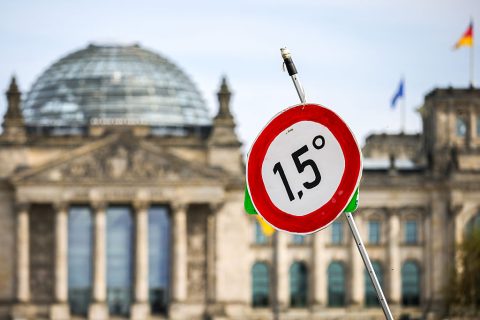

Despite criticisms of how IPCC scientific reports have been produced, all governments must sign off on every line of a key “summary for policy-makers” at a dedicated meeting. In 2023, the approved summary included the emissions reduction figures in question that informed the UN’s first global stocktake.
Irrespective of this wider debate, Hare said the “Friends of Science” campaign, which he supports, is focused on the timing of the IPCC’s next assessment cycle rather than the equity of its models.
Unresolved row over IPCC report timeline
A political battle over that time-frame has dragged on for more than two years at successive meetings of the science panel, with governments repeatedly failing to find a solution.
A large majority of nations have been pushing for a timeline that would ensure the next round of AR7 reports can feed into the UN’s global stocktake. But a group of countries, including Saudi Arabia, India, China, Russia and Kenya, have said at previous IPCC meetings that this would put a burden on developing countries with limited resources and have lobbied for a longer process.
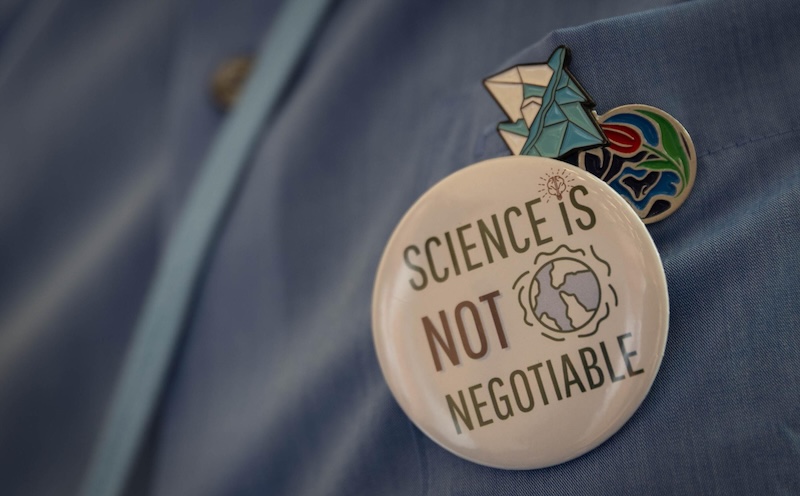
In Bonn this summer, the coalition that wants to align AR7 with the 2028 stocktake – which includes diplomats from Fiji, Nepal, the European Union, Switzerland, Sierra Leone and Panama – vowed to ensure that decision-making in the UN climate process remains based on the “best available science”, including the IPCC assessment reports.
They pointed the finger at “the usual suspects” but stopped short of singling out any countries at the public press conference. Discussions in the previous week had seen Saudi Arabia and India play down the centrality of IPCC reports in the UN stocktake and oppose calls in draft texts to encourage scientific work on scenarios to limit an overshoot of the 1.5C warming goal.
Bonn upset fuels further tension
A campaigner with knowledge of internal discussions told Climate Home News that many civil society groups from some of the world’s most vulnerable nations, including the Pacific islands, had expected CAN International to back calls in Bonn defending the centrality of the IPCC in UN climate policy-making.
Despite this, a day before the “Friends of Science” press conference, CAN published an ECO newsletter that did not mention the issue. Instead, it voiced surprise over the claims of an attack on science happening in the negotiations and accused some of the IPCC’s loudest-defending governments of hypocrisy for continuing to expand fossil fuels and not delivering “fair shares” of emissions cuts and finance to the developing world.
“We were really shocked we could not find a common position and then this jarring narrative was being pushed,” the campaigner added.
After divisions hardened in Bonn, Hare said his organisation was approached by “very upset” CAN members from various regions about the stance taken by the network’s international leadership on the issue.
Industry and NGOs lobby to weaken UN carbon credit rules in “coordinated” push
While Climate Home News understands that internal discussions have continued during the summer, including at a CAN leadership meeting in Nairobi in recent days, the campaigner said that CAN International’s endorsement of the recent webinar that directly challenged the “Friends of Science” coalition did not send a reassuring signal.
Some observers said they feared it would inflame tensions over how climate science is defined and utilised for policy purposes, with consequences reaching well beyond Bonn.
In a statement to Climate Home News, Essop said that “at a time when communities are experiencing the most horrific impacts of climate chaos, our collective energy must turn to solutions such as filling the Loss and Damage Fund, the phasing out of fossil fuels led by the Global North, and justice for people who are least responsible for this climate emergency”.
The post As science comes under attack at UN talks, climate movement splits over how to respond appeared first on Climate Home News.
As science comes under attack at UN talks, climate movement splits over how to respond



-
Climate Change1 year ago
Guest post: Why China is still building new coal – and when it might stop
-

 Greenhouse Gases2 years ago
嘉宾来稿:满足中国增长的用电需求 光伏加储能“比新建煤电更实惠”
-
Greenhouse Gases1 year ago
Guest post: Why China is still building new coal – and when it might stop
-

 Climate Change2 years ago
嘉宾来稿:满足中国增长的用电需求 光伏加储能“比新建煤电更实惠”
-

 Renewable Energy11 months ago
Sending Progressive Philanthropist George Soros to Prison?
-
Climate Change2 years ago
Bill Discounting Climate Change in Florida’s Energy Policy Awaits DeSantis’ Approval
-
Greenhouse Gases1 year ago
嘉宾来稿:探究火山喷发如何影响气候预测
-

 Carbon Footprint2 years ago
US SEC’s Climate Disclosure Rules Spur Renewed Interest in Carbon Credits