

The “cost” of cutting UK emissions to net-zero is less than the cost of a single fossil-fuel price shock, according to a new report from the Climate Change Committee (CCC).
Moreover, a net-zero economy would be almost completely protected from fossil-fuel price spikes in the future, says the government’s climate advisory body.
The report is being published amid surging oil and gas prices after the US and Israel attacked Iran, which has triggered chaos on international energy markets.
It builds on the CCC’s earlier advice on the seventh “carbon budget”, which found that it would cost the UK less than 0.2% of GDP per year to reach its net-zero target.
In the new report, the CCC sets out for the first time a full cost-benefit analysis of the UK’s net-zero target, including the cost of clean-energy investments, lower fossil-fuel bills, the health benefits of cleaner air and the avoided climate damages from cutting emissions.
It finds that the country’s legally binding target to reach “net-zero emissions” by 2050 will bring benefits worth an average of £110bn per year to the UK from 2025-2050, with a total “net present value” of £1,580bn.
The CCC states that its new report responds to requests from parliamentarians and government officials seeking to better understand its cost assumptions, amid the ongoing cost-of-living crisis in the UK.
The report also pushes back on “misinformation” about the cost of net-zero, with CCC chair Nigel Topping saying in a statement that it is “important that decision-makers and commentators are using accurate information to inform debates”.
Co-benefits outweigh costs
The CCC’s new report is the first to compare the overall cost of decarbonising with the wider benefits of avoiding dangerous climate change, as well as other “co-benefits”, such as cleaner air and healthier diets.
It sets the CCC’s previous estimate of the net cost of net-zero – some £4bn per year on average out to 2050 – against the value of avoided damages and other co-benefits.
These “co-benefits” are estimated to provide £2bn to £8bn per year in net benefit by the middle of the century, according to the report.
The CCC notes that this approach allowed it to “fully appraise the value of the net-zero transition”.
It concludes that the net benefits of reaching net-zero emissions by 2050 are an average of £110bn per year from 2025 to 2050.
These benefits to the UK amount to more than £1.5tn in total and start to outweigh costs as soon as 2029, says the CCC, as shown in the figure below.
In addition, the CCC says that every pound spent on net-zero will bring benefits worth 2.2-4.1 times as much.
This updated analysis includes the value of benefits from improved air quality being 20% higher in 2050 than previously suggested by the CCC.
However, the “most significant” benefit of the transition is the avoidance of climate damages, with an estimated value of £40-130bn in 2050. The report states:
“Climate change is here, now. Until the world reaches net-zero CO2 [carbon dioxide] emissions, with deep reductions in other greenhouse gases, global temperatures will continue to rise. That will inevitably lead to increasingly extreme weather, including in the UK.”
The CCC’s conclusion is in line with findings from the Office for Budget Responsibility (OBR) in 2025, which suggested that the economic damages of unmitigated climate change would be far more severe than the cost of reaching net-zero.
The CCC notes that its approach to the cost-benefit analysis of the net-zero target is in line with the Treasury’s “green book”, which is used to guide the valuation of policy choices across UK government.
It says that one of the key drivers of overall economic benefit is a more efficient energy system, with losses halved compared with today’s economy.
It says that the UK currently loses £60bn a year through energy waste. For example, it says nearly half of the energy in gas is lost during combustion to generate electricity.
In a net-zero energy system, such energy waste would be halved to £30bn per year, says the CCC, thanks to electrified solutions, such as electric vehicles (EVs) and heat pumps.
For example, it notes that EVs are around four times more efficient than a typical petrol car and so require roughly a quarter of the energy to travel a given distance.
Collectively, these efficiencies are expected to halve energy losses, saving the equivalent of around £1,000 per household, according to the CCC.
Net-zero protects against price spikes
The CCC tests its seventh carbon budget analysis against a range of “sensitivities” that reflect the uncertainties in modelling methodologies and assumptions for key technologies. This includes testing the impact of a fossil-fuel price spike between now and 2050.
In the original analysis, the committee had assumed that the cost of fossil fuels would remain largely flat after 2030.
However, the report notes that, in reality, fossil-fuel prices are “highly volatile”. It adds:
“Fossil-fuel prices are…driven by international commodity markets that can fluctuate sharply in response to geopolitical events, supply constraints, and global demand shifts. A system that relies heavily on fossil fuels is, therefore, exposed to significant price shocks and heightened risk to energy security.”
It draws on previous OBR modelling of the impact of a gas price spike. This suggested that future price spikes would cost the UK government between 2-3% of GDP in each year the spike occurs, assuming similar levels of support to households and businesses as was provided in 2022-23.
The CCC adapts this approach to test a gas-price spike during the seventh carbon budget period, which runs from 2038 to 2042.
It finds that, if a similar energy crisis occurred in 2040 and no further action had been taken to cut UK emissions, then average household energy bills would increase by 59%. In contrast, bills would only rise by 4%, if the UK was on the path to net-zero by 2050.
The committee says that when considering the impact on households, businesses and the government, a single fossil-fuel price shock of this nature would cost the country more than the total estimated cost of reaching.
The finding is particularly relevant in the context of rising oil and gas prices following conflict in the Middle East, which has prompted some politicians and commentators to call for the UK to slow down its efforts to cut emissions.
In his statement, Topping said that it was “more important than ever for the UK to move away from being reliant on volatile foreign fossil fuels, to clean, domestic, less wasteful energy”.
Angharad Hopkinson, political campaigner for Greenpeace UK, welcomed this finding, saying in a statement:
“Each time this happens it gets harder and harder to swallow the cost. The best thing the UK can do for the climate is also the best thing for the cost of living crisis – get off the uncontrollable oil and gas rollercoaster that drags us into wars we didn’t want but still have to pay for. Inaction on climate is unaffordable.”
Benefits remain even if key technologies are more expensive
In addition to testing the impact of more volatile fossil-fuel prices, the CCC also tests the implications if key low-carbon technologies are cheaper – or more expensive – than thought.
It concludes that the upfront investments in net-zero yield significant overall benefits under all of the “sensitivities” it tested. As such, it offers a rebuttal to the common narrative that net-zero will cost the UK trillions of pounds.
The net cost of net-zero comes out at between 0% and 0.5% of GDP between 2025 and 2050, says the CCC, under the various sensitivities it tested.
“This sensitivity analysis shows that an electrified energy system is both a more efficient and a more secure energy system,” adds the CCC.
Finally, the report takes into account the costs of the alternative to net-zero. It looks at what would need to be spent in an economy where net-zero was not pursued any further.
The CCC says that the gross system cost of the balanced pathway falls below the baseline cost from 2041, which is consistent with its previous seventh carbon budget advice.
As shown in the chart below, costs fall under a net-zero pathway between 2025 to 2050, whereas they rise in the baseline of no further action.
Moreover, the total costs of the alternatives are broadly similar, with the relatively small difference shown by the solid line.
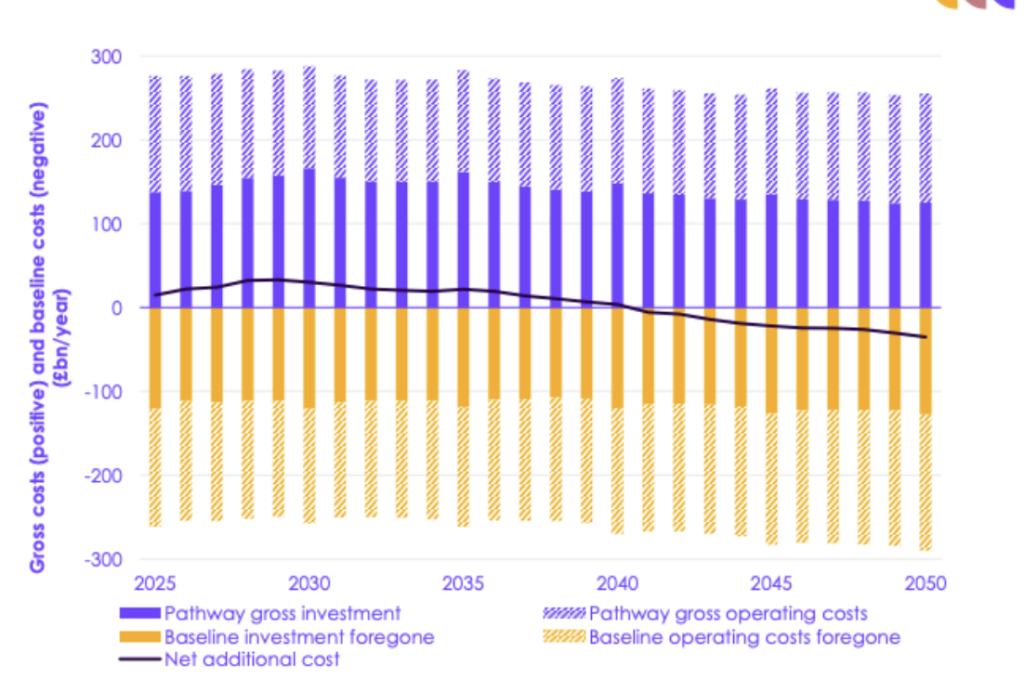
The decline in energy system costs shown in the figure above is broadly driven by more efficient low-carbon technologies, says the CCC, helping costs to fall from 12% of GDP today to 7% by the middle of the century.
The CCC’s new analysis comes ahead of the UK parliament voting on and legislating for the seventh carbon budget, which it must do before 30 June 2026.



The post CCC: Net-zero will protect UK from fossil-fuel price shocks appeared first on Carbon Brief.

The UK government has approved extraction at the Jackdaw gas field in the North Sea, despite acknowledging that this decision could make it harder for Britain to convince other countries to move away from fossil fuel production.
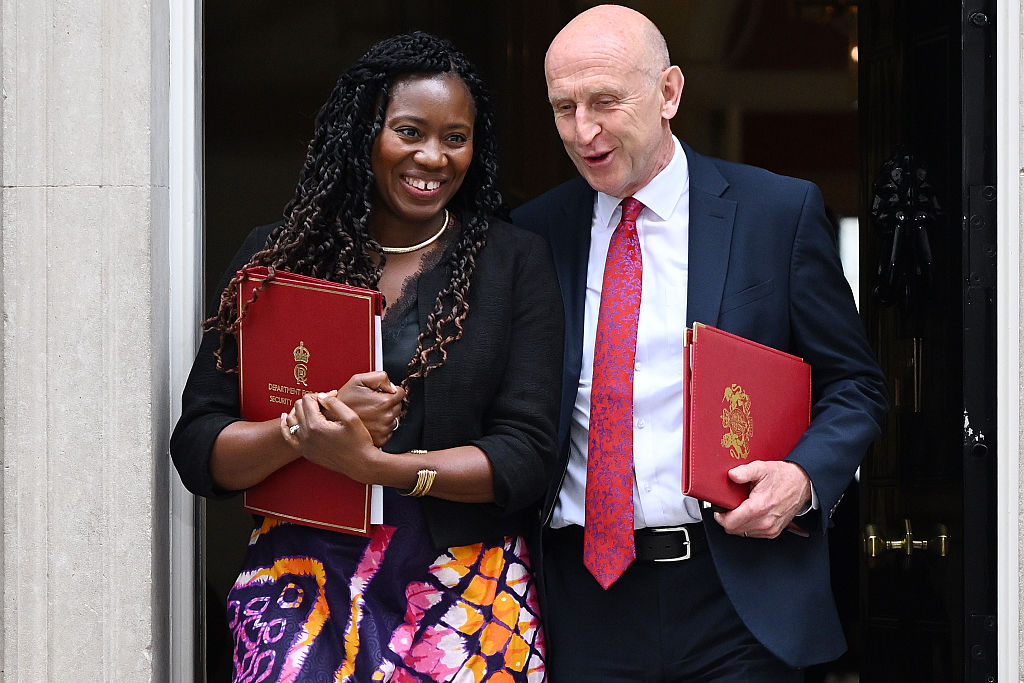
UK energy secretary Miatta Fahnbulleh approved the drilling on Wednesday after months of high-profile debate, fuelled in part by interventions from US President Donald Trump. She argued that the project would boost energy security in the wake of the Middle East fossil fuel crisis, protect hundreds of jobs and add £2.9 billion ($3.88bn) to the UK economy.
She said Jackdaw’s gas would be cleaner than imported gas and would not prevent the UK from meeting its legally-binding carbon targets and its goal of net zero by 2050. As the field is already licensed, she said extraction was consistent with the Labour Party’s 2024 manifesto promise not to issue any new oil and gas licenses.
The same morning, the government announced a new Energy Wealth Fund to reinvest oil and gas revenues in the climate transition. It will start with £2 billion ($2.67bn) from the government and be topped up over time with tax revenues from offshore oil and gas production.
Climate campaigners in the UK and abroad were quick to condemn the decision, while a leading legal expert told Climate Home News it goes against the advice of the International Court of Justice. Meanwhile, the government’s own documents reveal that it recognises the drilling could damage the UK’s reputation and its ability to push forward the global transition away from fossil fuels.
“Climate leadership” blow
The 92-page decision document says Fahnbulleh “acknowledges that international standing on climate is important and accepts that a decision to grant consent may not further the UK’s international climate leadership.”
It adds: “She acknowledges concerns about the potential implications for the UK’s credibility and influence – including the difficulty inherent in encouraging other states to move away from fossil fuel production while the UK continues, in a limited and transitional way, to draw on its own domestic resources.”
While noting that Jackdaw has not been issued with a new license – just permission to extract gas – the document says Fahnbulleh “accepts this does not fully resolve the underlying tension in the UK’s position” but “considers this alongside the substance of the UK’s wider record [on emissions reduction], which remains significant”.
It continues that she accepts these concerns are “legitimate” and weigh against approving gas extraction, but only gives this argument a “moderate negative weight” set against the benefits of gas production.
“Huge” wrong signal
In international climate talks, the UK has long supported the transition away from fossil fuels and is one of very few major oil and gas producers to ban new licenses. Across the North Sea, the Norwegian government continues to make offshore areas available for oil and gas exploration through annual licensing rounds.
Climate experts and campaigners shared the concern, acknowledged in the decision document, that approving Jackdaw could set a precedent for fossil fuel production elsewhere. Sam Fankhauser, professor of climate change economics at Oxford University, said the direct climate impact of Jackdaw is “much smaller than the debate around it would suggest” but the “wrong signal it sends, however, is huge”.
-
Carbon capture industry faces tough future, as UK raids green spending
Despite a spate of projects getting underway, the mood at an industry conference in London this week was low with government subsidies set to shrink -
Paris Agreement committee names three countries snubbing it over NDCs
More than 30 countries have failed to submit an NDC, but only three have repeatedly ignored the committee’s efforts to engage with them -
Turkish giant sponsoring COP31 cut climate goals then cashed in on oil boom
COP31 sponsors should be screened for “climate integrity”. Yet Koç Holding has become a top partner while its oil refiner runs flat out and its climate targets slip


Bob Ward, policy and communications director at the Grantham Research Institute on Climate Change, said that while Jackdaw’s output will be very small, “it will signal to other fossil fuel producers that they too should carry on with business as usual, less than a month before the COP31”.
Kenyan campaigner Mohamed Adow, director of Power Shift Africa, called the decision “a serious blow to Britain’s international climate credibility” as “the UK cannot expect developing countries to move away from fossil fuels while giving the green light to new drilling in its own backyard”.
International Court of Justice
In July 2025, the International Court of Justice (ICJ) advised that government failure to take appropriate climate action “including through fossil fuel production” may amount to an internationally wrongful act.
The UK voted in favour of a United Nations resolution welcoming the advisory opinion. Yet, in its Jackdaw decision document, it notes that the ICJ opinion is not legally binding and says the UK does not accept the court’s opinion that the customary international law duty to prevent significant harm to the environment applies to climate change.
Fahnbulleh concludes that, although it will have “significant effect on the environment”, gas drilling in Jackdaw “would not lead to significant harm to the environment” – and so does not breach any duty to prevent such harm. Instead, the government document says the duty should be considered “as a matter of policy rather than legal obligation”.
Margaretha Wewerinke-Singh, who led Vanuatu’s legal team pushing for the ICJ’s advisory opinion, told Climate Home News that treating the duty as a matter of policy rather than legal obligation is “not how international law works”. “An advisory opinion is not a judgement,” she said, “but it states the law as it stands, and that law binds the UK whether or not it accepts it.”
“Even as a matter of policy,” she added, “the decision asks the wrong question: whether Jackdaw on its own would cause significant harm. The Court found that accumulated emissions are already causing significant harm. What matters is whether approving new production is consistent with the stringent due diligence the duty requires.”
Public support for decision
While the decision was criticised by climate campaigners and the opposition Green party, polling reported by Politico suggests that 55% of British adults support drilling at Jackdaw, with just 14% opposed. Even supporters of the UK’s net zero target back new drilling by more than two to one, the polling found.
Jackdaw is one of two North Sea oil and gas fields the government has been debating whether to extract more from for months. While Jackdaw is a small gas field, the other, Rosebank, is a much larger field that holds mostly oil.
Rosebank’s emissions are estimated to be around seven times higher than Jackdaw’s. Fahnbulleh told Sky News that Rosebank is “different” to Jackdaw because its oil would be exported, whereas Jackdaw’s gas will be used in the UK, adding that she will consider it “in its own right”.
The Guardian reported on Wednesday that UK officials say Fahnbulleh is minded to refuse approval for Rosebank. She has not yet taken a final decision on Rosebank, the newspaper said, but a ruling is expected later this year.
The post UK approves gas drilling despite admitting blow to “climate leadership” status appeared first on Climate Home News.
UK approves gas drilling despite admitting blow to “climate leadership” status
A surge in wholesale costs driven by expensive gas is responsible for nearly 90% of the rise in UK household electricity bills since 2020, reveals new analysis.
The figures, shared with Carbon Brief by thinktank Nesta, show that wholesale gas costs are also behind the vast majority (77%) of the increase in household gas bills.
The analysis firmly contradicts the idea, which has become embedded in UK media and political narratives, that the UK’s net-zero target is to blame for high energy bills.
Andrew Sissons, director for sustainable future at Nesta, tells Carbon Brief that net-zero is, in fact, “helping to shelter Britain from the impact of expensive gas”. He adds:
“Rising gas prices, not net-zero, have driven most of the recent surge in Britain’s energy bills. Britain is particularly exposed, with over 80% of households connected to gas mains, while our electricity system still relies too much on gas as the marginal unit.”
The analysis comes after the UK government gave its approval for the Jackdaw gas field to be developed in the North Sea, despite stating that it “would not…affect prices”.
Another gas crisis
In January 2026, Carbon Brief reported that two-thirds of the rise in electricity bills since before the 2022 global energy crisis was due to high gas prices.
Now, amid ongoing conflict in the Middle East, wholesale gas prices are at their highest levels since Russia’s 2022 invasion of Ukraine.
Indeed, as of 19 October, UK wholesale gas prices stood at 220p per therm (£75 per megawatt hour, MWh), above the average for 2022 of 210p/therm (£72/MWh).
The figure below shows that, after accounting for inflation, typical UK annual household electricity bills had risen £180 by the fourth quarter of 2026, relative to the same period in 2020.
Some 90% of this increase (£161) is due to wholesale costs, driven by the price of gas.
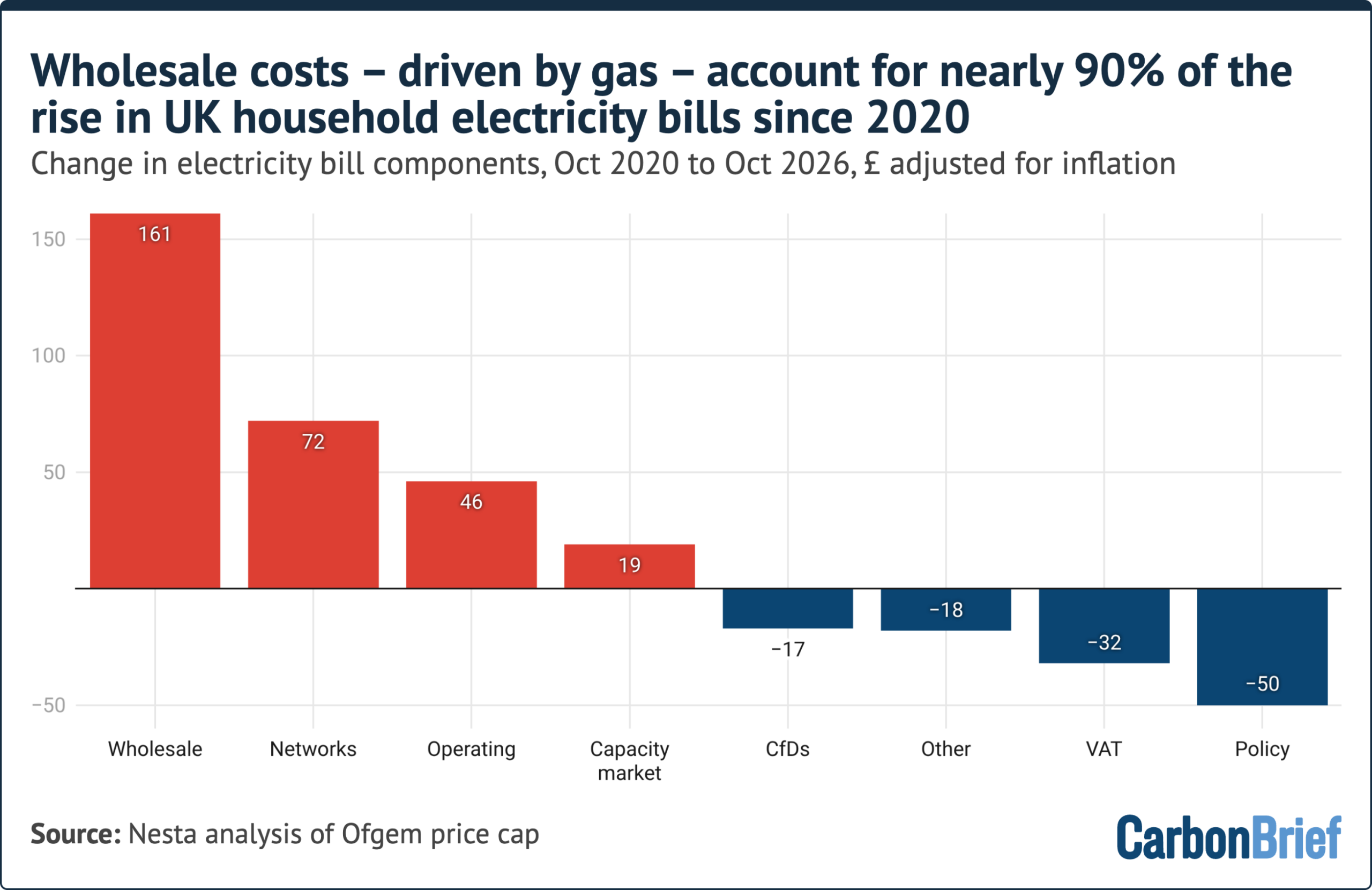
In contrast – and contrary to widespread perceptions – renewable “contracts for difference” (CfDs) are reducing electricity bills by £17 under the current price cap, according to the Nesta analysis.
In addition, the government has cut policy costs for electricity by moving 75% of legacy renewable support onto general taxation, ending the “ECO” efficiency scheme and temporarily removing VAT.
Network costs have added £72 to typical bills since 2020, according to Nesta. Most of this (£46) is for investment in the electricity transmission network, known as the “motorways” of the grid.
Only £21 of the rise in network costs relates to balancing the system, including “constraint payments” for turning off windfarms – and turning on gas plants – due to insufficient grid capacity.
Wind constraint payments regularly receive extensive news coverage, despite balancing costs – in total – making up just £35 (4%) of a typical £858 annual household electricity bill.
The Nesta figures show energy supplier operating costs have gone up by £46 since 2020. These costs are not broken down in the underlying Ofgem figures, but the increase is thought to be driven by the cost of rising household energy debt. Supplier profits are capped at 2.5% of bills.
Breaking the link
Notably, household electricity prices h