

Curbs on raw minerals exports by more than a dozen African countries are unlikely to kickstart home-grown processing industries unless they are accompanied by major investments in energy infrastructure, private sector partnerships and regional cooperation, mining analysts say.
Last month, Zimbabwe became the latest African country to announce new restrictions, banning the export of all raw minerals and lithium concentrates. So far, at least 13 African countries have enacted export curbs since 2023 as they seek to add value to their exports and create local jobs by processing and refining minerals domestically.
Zimbabwe, Africa’s top producer of lithium, which is used to make batteries for electric vehicles (EVs) and renewable energy storage, wants its resources of the silvery-white metal to be processed into higher-grade compounds such as lithium sulphate, an intermediate product that can be refined into a battery-grade material, rather than exported as raw concentrate for refining elsewhere.
-
Lithium boom: Zimbabwe looks to China to secure a place in the EV battery supply chain
Chinese investors have flocked to Zimbabwe to secure lithium supplies, promising local development. But analysts warn Zimbabwe needs more robust governance for communities to reap the benefits

Government officials say adding value to mineral resources locally is a way to boost economic growth and fund social development. “Government remains committed to ensuring transparency, in-country value addition and beneficiation, compliance, and accountability in the exportation of Zimbabwe’s mineral resources,” said Polite Kambamura, the country’s minister of mines and mining development.
Done correctly, curbs on raw material shipments may encourage development, said Namibia-based public policy researcher Suzie Shefeni.
“A ban like this can serve development interests if it is [firstly], systematically and gradually implemented and backed by appropriate legal mechanisms and [secondly] done in collaboration with the private sector,” Shefeni said.
Restrictions alone won’t ensure added value
But others say that laying the groundwork for viable processing industries will take time and money.
The continent has “not considered everything that is needed for value addition and beneficiation to happen”, said Obert Bore, critical minerals expert and programme manager at the Zimbabwe Environmental Law Organisation, a Harare-based NGO.
“From a private sector perspective, when you speak to mining companies they will tell you these export bans do not work because we don’t have enough water, we don’t have enough energy,” Bore told Climate Home News.
Silas Olan’g, Africa energy transition advisor at the Natural Resource Governance Institute (NRGI), said that while the intention behind export curbs is understandable, “experience shows that bans alone rarely deliver the desired outcomes”.
For export bans to work, he said governments must first put the right conditions in place, including reliable energy, supporting infrastructure, investment incentives and strong governance. Without these fundamentals, “such restrictions can inadvertently undermine the very value addition they seek to achieve”, he said.
Given these constraints, Olan’g argued that “export bans are not the right tool at this stage if the fundamentals are not in place” and could prove “counterproductive”. Instead, governments should use contracts with buyers to secure commitments on infrastructure, skills and technology transfer, building the foundations for value addition before imposing restrictions.
“Without skills, infrastructure, and reliable energy, local value addition cannot take off simply because exports are restricted” Olan’g said.
High price of added value
Africa is a major supplier of minerals needed for the global energy transition. The continent holds about 30% of the world’s critical mineral reserves, including lithium, cobalt and copper. The Democratic Republic of Congo produces roughly 70% of global cobalt, a key ingredient in lithium-ion batteries, while countries such as Guinea dominate bauxite production and Mozambique and Tanzania hold significant graphite deposits.
Zimbabwe exported more than 1.1 million metric tons of lithium-bearing spodumene concentrate in 2025. However with the recent move to ban exports, Bore said lithium processing requires huge quantities of energy and water, putting further strain on scarce supplies in Zimbabwe, which is prone to drought and has a hefty power deficit that causes prolonged outages.
The southern African nation, which initially banned exports of unprocessed lithium ore in 2022, before extending that to lithium concentrates last month, aims to provide 20% of global supplies.
Processing just one metric ton of lithium can require more than 50,000 litres of water, Bore said, meaning ramped-up activity by producers could significantly impact local communities and other economic sectors.
“In Zimbabwe at least, we are seeing significant impact on communities that will no longer have water, we are running out of water for our agriculture, for livestock because the companies are trying to comply with the government ban and by trying to comply they are drawing huge amounts of water just to process one ton of lithium which is not a lot,” he said.
South African rare earths project aims to rival Chinese with low-cost model
Energy is another major constraint for African nations intent on adding value to their critical minerals exports.
In Zimbabwe, Bore said half of the country’s electricity is already used by the mining sector.
However, officials say the country’s lithium boom is already delivering economic gains with export earnings from lithium surging to over $200 million in September of 2023, up from $70 million the year before. The sector has also attracted more than $1 billion in foreign investment, largely from Chinese firms developing mines and battery-material processing plants in the country.
One way of addressing the power deficit would be for governments to make less costly and faster renewable energy development an integral part of the plans for the mining sector, said Namibia-based Shefeni.
“(They) should prioritise a trajectory of green beneficiation by promoting the use of renewables including solar PV and wind, in their value addition systems,” she said.
Skirting the rules
If the right conditions are not in place for mining companies to comply with processing requirements, export bans run the risk of being bypassed, according to Bore.
Bans on exporting raw lithium have been introduced gradually since 2023, but Bore’s research suggests compliance remains weak.
“There are leakages. People are not complying because we don’t have the capacity, we don’t have the water, we don’t have the energy,” he said.

He added that complicated licensing processes are also creating opportunities for corruption.
“If the system is not conducive, it creates a breeding ground for corruption because people are trying to get licences and permits, and sometimes those licences end up in the wrong hands,” he said.
If African countries are to foster the development of mineral-processing industries, they will need to implement appropriate regulations, Shefeni said.
China maximises battery recycling to shore up critical mineral supplies
The development of a comprehensive mining land registry could help countries minimise the scope for illegality and smuggling. Integrating the registry with geospatial mapping and production reporting would allow authorities to compare reported output with export declarations.
“This requires investment into a strong enforcement system that can hold offenders accountable by the law,” she said.
Unified Africa vs bilateral deals
Speaking during the World Economic Forum in Davos, Wamkele Mene, secretary-general of the African Continental Free Trade Area Secretariat, said African nations risk missing out on the opportunities offered by the global race for critical minerals if they do not coordinate their approach.
Echoing Mene’s call, Sierra Leone’s President Julius Maada Bio lamented: “We do not have collective bargaining power as a continent.”

Export bans by individual countries risk weakening their bargaining power by negotiating separately with international partners, rather than forming a common stance with other African nations in negotiating with major partners such as China, Bore said.
“We don’t have leverage doing it individually,” he said. He argued that African countries should stop speaking individually and instead present a united front. By highlighting the continent’s vast resources – copper in Zambia, cobalt in the DRC, lithium in Zimbabwe and Nigeria, bauxite in Guinea and iron in Mali – they could push for industries to be built locally and add value to these materials.
In that scenario, he said, China could respond and say “OK fine, you have the resources, you have the market. We can give you the technology, we will train your people and we can develop your skills.”
Shefeni also called for a greater focus on regional value chains, with “individual countries assessing how they are well positioned to contribute”.
NRGI’s Olan’g added that fragmented negotiations only “allow external partners to play countries against each other, leading to weaker commitments on infrastructure, skills, and technology transfer”.
“A unified Africa could pool demand, create economies of scale for smelters and refineries, and set common rules that strengthen governance and investor confidence,” he added.
The post Africa needs more than export bans to cash in on critical minerals, experts say appeared first on Climate Home News.
Africa needs more than export bans to cash in on critical minerals, experts say

Three countries have been named by the Paris Agreement’s compliance committee for failing to submit a nationally determined contribution (NDC) and repeatedly snubbing offers of help with their climate plans.
After months of internal debate over whether to identify serial non-responders, the Paris Agreement’s Implementation and Compliance Committee (PAICC) named the three countries which have failed to engage with it over their NDCs on Friday.
It named Democratic Republic of Congo, Senegal and North Korea in a footnote of its annual report, adding that it decided to name them “with a view to facilitating engagement”, adding that representatives of the three nations had been invited to its meeting in early 2027 “with the purpose of identifying any challenges and constraints”.
“The Committee noted the importance of Parties engaging with the Committee in a timely manner, while noting that some delays may be due to the national capabilities and circumstances of the Parties”, the report said.
-
Under US pressure, World Bank says it will back gas “where appropriate”
The US wants the World Bank to expand its gas support while climate campaigners are pushing for it to end – its head spoke this week of limited backing for the fossil fuel -
IPCC scientists vow to press on with climate reports despite political deadlock
After governments again failed to agree a timeline, nearly 120 IPCC authors pledged to complete their assessment on time and with full scientific rigour -
Paris Agreement committee snubbed over missing NDC climate plans
Many governments have still not submitted a nationally determined contribution to the UN, breaching a key requirement of the Paris Agreement

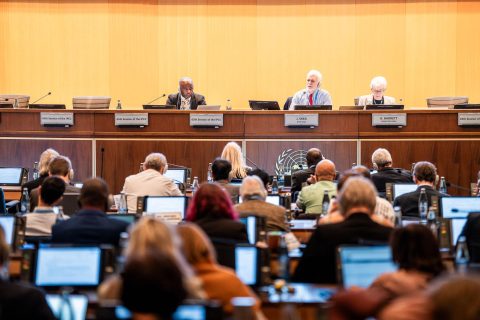

In July, PAICC said 12 countries had ignored its repeated attempts to discuss why they had not published an NDC as required every five years under the 2015 Paris accord.
Members of the committee had been divided over whether to name them, but at a September meeting decided to do so in their annual report to the annual climate COP summit.
By the time the report was published on Friday, only Congo, Senegal and North Korea “had not communicated an NDC or submitted a [Biennial Transparency Report] and had not yet responded to any of the Committee’s notifications, despite several reminders issued by the Committee in this regard”.
Rainforest and renewable energy ambitions
The silence from Congo and Senegal is notable because the former is home to much of the Congo Basin rainforest while the latter has sought billions of dollars in climate finance to support its renewable energy ambitions.
After Brazil, Congo has more rainforest than any country in the world. This forest, and the country’s peatlands, absorb huge amounts of greenhouse gas but are fast being lost to expanding farmland, charcoal production, logging and mining.
Senegal signed a Just Energy Transition Partnership with Canada and wealthy European nations in 2023, to help it meet its renewable energy targets under the-then government of Macky Sall. It was chair of the Least Developed Countries group between January 2022 and December 2023.

Tejas Rao, who is researching the PAICC as part of a doctoral thesis at Cambridge University, said the governments of the three countries should engage with the committee.
“Engagement costs these governments very little and the committee has shown it will listen,” he said.
“Silence leaves the committee with no basis to help, and it leaves the [governments] exposed to the narrative that they are simply disengaged,” he told Climate Home News.
Paris Agreement requirement
The 2015 Paris Agreement requires all parties to publish an NDC every five years outlining their emissions reduction targets, with each plan meant to be more ambitious than the country’s last NDC.
The latest set – the third round of plans, with new targets for 2035 – was due in February 2025. While most countries missed this deadline, all but around 30 – mostly small emitters but including Egypt, Vietnam and Argentina – have now submitted them.
Over the year, the PAICC – which is made up of government climate officials from developed and developing countries – has been communicating with governments that have not submitted NDCs and trying to overcome barriers to them doing so.
Some nations have cited exceptional circumstances as the reason for not submitting an NDC, a process that requires a significant amount of work in tracking emissions and consulting on how to curb them across the economy. For example, a letter from a Sudanese official to the PAICC, seen by Climate Home News, said that the country’s civil war had led to the suspension of its NDC preparation.
-
IPCC scientists vow to press on with climate reports despite political deadlock
After governments again failed to agree a timeline, nearly 120 IPCC authors pledged to complete their assessment on time and with full scientific rigour -
Under US pressure, World Bank says it will back gas “where appropriate”
The US wants the World Bank to expand its gas support while climate campaigners are pushing for it to end – its head spoke this week of limited backing for the fossil fuel -
Who shapes climate science? The equity question facing the IPCC
Early completion of the next global climate science assessment reports risks excluding research from the Global South, which is key to ensuring the findings are fair
The US and Iran are not signed up to the Paris Agreement and so do not have active NDCs, nor does Taiwan, which is not a UN member state.
Rao said that because the PAICC is “facilitative and non-punitive”, naming the countr