Connect with us

Published

on

“Extreme” wildfires emitted more than 8bn tonnes of carbon dioxide during the 2024-25 “global fire season”, according to a new report.

The annual “state of wildfires” report from an international team of scientists finds that fires burned at least 3.7m square kilometres of land – an area larger than India – between March 2024 and February 2025.

This is almost 10% below the average annual area burned over the past two decades.

But, due to an increase in wildfires in carbon-rich forests, the CO2 emissions resulting from these fires were almost 10% above average.

The report also zooms in on four of the most prominent extreme wildfire events during this time: southern California; north-east Amazonia; South America’s Pantanal-Chiquitano region; and the Congo Basin. 

All of these events were found to have been more likely to occur as a result of human-caused climate change.

The researchers identify that, in some cases, the area burned by these fires was 25-35 times larger than it would have been without global warming.

The report also estimates that more than 100 million people around the world were exposed to wildfires in 2024 and 2025.

These fires are “reshaping lives, economies and ecosystems on a global scale”, one of the report authors, Dr Carmen Steinmann from ETH Zürich, said in a statement. 

‘Increasing extent and severity’

Scientists from dozens of institutions analyse “extreme wildfires” globally between March 2024 and February 2025 in the second annual edition of the report.

The report explains that the “March-February definition of the global fire season latest global fire season is chosen so as to align with an annual lull in the global fire calendar in the boreal spring months”.

According to the report, the authors “harness‬‭ and‬‭ adopt‬‭ new‬‭ methodologies‬‭ brought‬‭ forward‬‭ by‬‭ the‬‭ scientific‬‭ community”. They add that in future reports, they hope to “enhance the tools presented in this report to predict extremes with increasing lead times, monitor emerging situations in near-real time and explain their causes rapidly”.

In the report’s “summary for policymakers”, study author Dr Matthew Jones, from the University of East Anglia, says:

“[The report] focuses on the global extreme wildfire events of the global fire season, explains why they happened and fingerprints the role of climate change as one of the key drivers of changing wildfire risk globally.”

The authors aim to “deliver actionable information” to policy experts and wider society about wildfires, the report says.

Using satellite data, the authors find that 3.7m square kilometres (km2) of land burned globally between March 2024 and February 2025. This means that the 2024-25 fire season ranks 16th out of all fire seasons since 2002, indicating below-average burned area compared to the rest of the 21st century. 

However, the global fire emissions database shows that the 2024-25 wildfire season drove more than 8bn tonnes of CO2 emissions, according to the report. This is 10% above the average of wildfire seasons since 2002.

Jones explains that this is indicative of a trend towards “increasing extent and severity of fire in global forests, which are carbon-rich”, as opposed to less carbon-rich grassland biomes.

The chart below shows global burned area (top) and carbon emissions (bottom) during the 2024-25 wildfire season, compared to the average over 2002-24, for different world regions. Red bars indicate that the 2024-25 wildfire season had higher-than-average burned area or emissions for the given region, while blue indicates lower-than-average numbers.

Burned area, in thousands of km2 (top) and carbon emissions in teragrams of carbon.
Burned area, in thousands of km2 (top) and carbon emissions in teragrams (equivalent to millions of tonnes) of carbon (bottom) during the 2024-25 wildfire season, compared to the 2002-24 average, for different world regions and biomes. The triangles (right y-axis) indicate the percentage of the relative anomaly compared to the average. Source: Kelley et al. (2025)

Savannas, grasslands and shrublands account for more than 80% of the burned area in a typical year, with forests and croplands making up the rest.

According to the report, burned area in tropical and subtropical grasslands, savannah and shrublands‬‭ was 10% below the 2002-24 average over 2024-25, but still contributed 70% towards the total global burned area.

The 2024-25 wildfire season was the second consecutive year that African‬‭ savannahs‬‭ “experienced‬‭ a‬‭ low‬‭ fire‬‭ season”, the report notes, with below average burned area and carbon emissions.

Meanwhile, the report finds that the greatest increases in burned area and carbon emissions during the 2024-25 wildfire season were seen in the ‭Canada’s boreal‬‭ forests‬‭, the‬‭ moist‬‭ tropical‬‭ forests‬‭ in‬‭ the Amazon region, the‬‭ Chiquitano‬‭ dry‬‭ forests‬‭ of‬‭ Bolivia and the Cerrado – a tropical savannah in central Brazil.

The graphic below shows some key figures from the 2024-25 wildfire season.

Key figures from the 2024-25 wildfire season
Key figures from the 2024-25 wildfire season. Source: State of wildfires project, summary for policymakers (2025).

Study author Dr Douglas Kelley, from the UK Centre for Ecology and Hydrology, told a press briefing that the author team spent time “actively engaging with a big regional panel of experts”. 

The team identified four “focal events” – extreme wildfire events that were chosen both for the severity of the fire and the impacts on people and the environment.

For each focal point, the study authors assessed the drivers of the wildfire. They also used attribution – a field of climate science that aims to identify the “fingerprint” of climate change on an extreme event – to determine the contribution of human-caused climate change.

Finally, the authors estimated the likelihood of similar events occurring in the future as the climate continues to warm over the coming century.

Kelley told the press briefing that “capturing fires themselves can be quite tricky”, because they are affected by a range of different factors.

The report notes that wildfires are affected by changes in weather, with hot and dry weather providing the best conditions for wildfires. It adds that changes in land use are also important, as they can affect ignition.

Kelley explained that the report authors used “multiple types of attribution” to capture these different factors, using a range of fire models, weather forecasting models and land use data.

North America

In North America, 2024-25 was an “extreme” fire year, the report says.

Both burned area and carbon emissions reached their second-highest levels since records began in 2002 and 2003, respectively. Across the continent, the burned area was 35% higher than the average since 2002 and the carbon emissions were more than double the average emissions since 2003.

In Canada, 46,000km2 of land burned during the 2024-25 fire season, releasing 282m tonnes of carbon (Mt). The burned area was 85% higher than average, but the associated emissions were more than 200% higher than average, according to the report.

The report also notes that the wildfire season started early in Canada in 2024, due to earlier-than-normal snowmelt, as well as persistent, multiyear drought and “holdover fires” that reignited in the spring after smouldering through the winter months.

In the US, more than 64,000 individual wildfires contributed to a total burned area larger than 36,000km2. More than 8,000 wildfires in Mexico led to a record 16,500km2 of burned area.

The regions experiencing record or near-record burned area and carbon emissions were varied: from the Canadian tundra and the north-western US mountain ranges to California’s grasslands and Mexico’s tropical forests. In the far-northern boreal forest – which contains around 20% of the world’s forest carbon – the season trailed only the record-breaking 2023-24 fire season in burned area and associated emissions. 

The researchers select the January 2025 southern California wildfires as one of the four “focal events” of the report.

The maps below show the locations of the four focal events: southern California, the Congo Basin, north-east Amazonia and the Pantanal-Chiquitano. The colours show the percentage difference from the average burned area, with blue indicating less burned area than average and darker browns showing more burned area.

The burned area anomaly, expressed as a percentage difference from the 2002-24 average, for each of four focal events
The burned area anomaly, expressed as a percentage difference from the 2002-24 average, for each of four focal events (clockwise from top left): southern California, Congo Basin, Pantanal-Chiquitano and north-east Amazonia. The inset on each chart shows the location of the event. Blue colours indicate negative anomalies (less burned area than usual) and browns indicate positive anomalies. Source: Kelley et al. (2025)

In early January 2025, more than a dozen fires broke out in and around Los Angeles. Although January is “well outside the typical fire period”, the fires “became the most expensive wildfires ever recorded in just a few short days”, Prof Crystal Kolden – a study author and the director of the University of California, Merced’s Fire Resilience Center – wrote in the report. 

The two largest fires, named the Palisades fire and the Eaton fire, resulted in at least 30 deaths, more than 11,500 homes destroyed and more than 153,000 people being evacuated from their homes.

The fires resulted in estimated economic losses of $140bn, placing “substantial pressure on the already volatile home insurance market in California”, according to the report. It notes that the fires also contributed to the “housing and affordability crisis” in southern California.

The report says that the severity of the January fires was largely due to intensifying extremes in the water cycle – an unusually wet period that allowed vegetation to flourish, followed by an unusually arid winter that dried out that vegetation, turning it into fuel. It notes:

“Between 5 and 25 January, favourable weather, fuel availability and ignition sources aligned, leading to create ideal conditions for ignition and rapid fire spread.

“The substantial suppression efforts deployed is unaccounted for in our modelling framework and could be one of the possible reasons the fires did not escalate even further.”

Previous attribution analysis found that the January 2025 fires were “likely influenced” by human-driven climate change. The report authors also find that the burned area in the southern California event was 25 times greater due to climate change.

However, whether extreme fire activity in southern California continues to intensify depends largely on how the region’s plants and trees respond to increased atmospheric CO2, the report says. It also notes that climate models disagree as to whether wintertime rainfall will increase or decrease in future climates.

South America

The report finds that South America had a total area burned by wildfires of 120,000km2 during the 2024-25 fire season – 35% higher than average.

That translated into the release of 263Mt of carbon – the “highest carbon emissions on record for the continent” and 84% above average, the report says.

Jones, a study author, said in a press briefing that South America “hasn’t seen carbon emissions like this on record before”.

The report underlines that South America’s fire season was “unprecedented” in many ways, such as fire extent, emission levels, intensity and their impacts on society and the environment, although not in the number of fires.

For example, fires in the north-east Amazon impacted air quality, crops, houses and native vegetation, affecting people living in the region, including Indigenous peoples such as the Yanomami, the report says.

Laercio Fernandes, a volunteer firefighter and Indigenous man, holds a shell of a turtle found dead after a forest fire hit the Kadiwéu Indigenous land, in Mato Grosso do Sul, Brazil, in 2024.
Laercio Fernandes, a volunteer firefighter and Indigenous man, holds a shell of a turtle found dead after a forest fire hit the Kadiwéu Indigenous land, in Mato Grosso do Sul, Brazil, in 2024. Credit: Diego Cardoso / Alamy Stock Photo

The country with the largest area burned by wildfires during the 2024-25 fire season was Brazil, with a total burned area of 243,000km2, followed by Bolivia, with a total of 107,000km2 of burned area, and Venezuela, with a total of 43,000km2 of burned area.

The most-affected biomes in the region were the Amazon rainforest, with 47,000km2 of wildfires above the average since 2002.

Second was the Chiquitano and Chaco dry forests – encompassing parts of Bolivia, Brazil, Paraguay and Argentina. These biomes experienced a “record-breaking” fire season with more than 46,000km2 of burned area. These fires resulted in 100Mt of carbon emissions – six times higher than the average since 2003.

More than 46,000km2 of the Pantanal – the largest tropical wetland located in Brazil, Bolivia and Paraguay – burned in 2024-25, with associated carbon emissions of 67Mt above the average.

According to the report, fire activity in the region was primarily driven by “anomalous dry weather”.

In the north-eastern Amazon, the severity of the fire season between January and April 2024 was compounded by natural sources of climate variability, such as El Niño and the Atlantic Meridional Mode, which contributed to very high temperatures and absence of rainfall. There, deep soil moisture dropped to 1%.

Meanwhile, in Pantanal and Chiquitano, “extreme dry weather” since 2023 and “multiple years of below-average rainfall” contributed to the severe fires, the report says. Study author Dr Francesca Di Giuseppe said in a briefing that the “wet season that usually happens between February and May failed completely to recharge the soil that kept completely dry and this drove most of the fire season” in the region.

The authors conduct an attribution analysis and find that the fire weather conditions in the north-eastern Amazon that season were “significantly more likely” due to climate change. In the Pantanal and Chiquitano, the conditions were 4.2-5.5 times more likely due to climate change.

Africa

Overall, the scale of fires across Africa was “well-below average” in 2024 and 2025, the report finds, except in certain areas, including the Congo Basin, northern Angola and South Africa.

In 2024, a record-high amount of land was burned in the Congo Basin – a biodiverse region in central Africa spanning six countries that holds the world’s second-largest tropical forest. This burned area was 28% higher than the annual average and there were 4,000 fires in total, 20% more than usual, in 2024. 

Fires also caused “hazardous” air pollution and contributed to the Congo Basin’s highest loss of primary forest in a decade.

The analysis in the report finds that it is “virtually certain” that human-caused climate change contributed to the extreme fire weather in this region in July and August 2024.

The hot, dry and windy conditions were 3-8 times more likely to occur as a result of climate change and the area scorched by fires was three times greater than it would have been otherwise, the findings show.

Climate change has also driven an increase of more than 50% in the average annual burned area in the Congo Basin, which the researchers say is “one of the most robust signals of climate influence” in the fire trends they analysed.

Drought was a major factor behind the fires, the report finds, and water stress is expected to be the main driver shaping future fires in the Congo Basin.
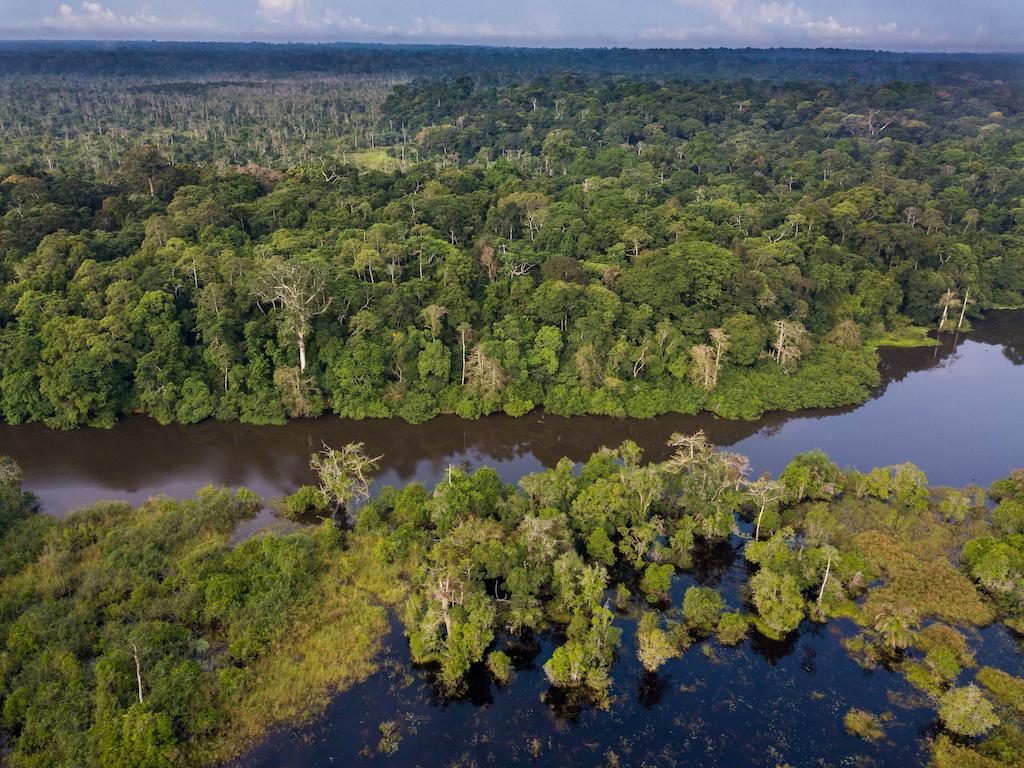
Congo rainforest along Rembo Ngowe river in Akaka, Loango National Park, Gabon.
Congo rainforest along Rembo Ngowe river in Akaka, Loango National Park, Gabon. Credit: Lee Dalton / Alamy Stock Photo.

These fires are “part of a long-term trend of increasing fire encroachment into African moist forests, driven by climate change and human pressure”, says Prof Michael Wimberly, a professor at the University of Oklahoma who was not involved in the report, but has researched wildfires in Africa. He tells Carbon Brief: 

“The increased fire activity in the Congo Basin is troubling because of the vast expanses of unfragmented forests and peatlands that store massive amounts of carbon, provide habitat for threatened species and supply vital resources to local populations.”

The report notes that there is “sparse reporting and poor media coverage” on the impacts of fires in the Congo Basin in 2024, despite millions of people being impacted.

In South Africa, 34 people were killed and thousands of livestock and homes were destroyed in fires last year. In Ivory Coast, 23 people were killed and 50km2 of land was burned.

Dr Glynis Humphrey, a postdoctoral research fellow at the University of Cape Town, who was not involved in the study, adds that a below-average burned area across Africa “does not necessarily indicate a decline in fire risk or impact”. She tells Carbon Brief: 

“In some ecosystems, fewer but more intense fires are being observed, which can still have severe ecological and atmospheric consequences.”

Using climate models, the researchers project that fires to the extent of those in the Congo Basin last year could occur up to 50% more often by 2100, under a medium-emissions pathway. 

The region is also projected to see more increases in extreme wildfire risk by the end of this century. Gabon, Equatorial Guinea and the central part of the Democratic Republic of the Congo could see some of the largest increases in burned area, which, the report estimates, could double or quadruple in some cases. 

Humphrey notes that fire patterns are “shifting” in response to climate change, which is “leading to significant consequences for ecosystems that don’t typically burn – like the forests in the Congo Basin”. She tells Carbon Brief:

“This is of concern, as primary forests harbour critical biodiversity that supports ecosystem functioning and provide services to people…These forests are also sanctuaries for endangered species.”

The post Global wildfires burned an area of land larger than India in 2024 appeared first on Carbon Brief.

Global wildfires burned an area of land larger than India in 2024

Continue Reading

Climate Change

Q&A: Why does gas set the price of electricity – and is there an alternative?

Published

on

A surge in gas prices triggered by the Iran war has caused a knock-on spike in the price of electricity in the UK, Italy and many other European markets.

This is because gas almost always sets the price of power in these countries, even though a significant share of their electricity comes from cheaper sources.

This “coupling”, which is part of what UK energy secretary Ed Miliband calls the “fossil-fuel rollercoaster”, is due to the “marginal pricing” system used in most electricity markets globally.

After another fossil-fuel price shock, just four years after Russia’s invasion of Ukraine, this coupling between gas and electricity prices is once again under the spotlight, in the UK and the EU.

There are various alternatives that have been put forward as ways to break – or “decouple” – the link between gas and electricity prices.

Electricity prices could be “decoupled” from gas prices by changing the way the market works, but ideas for doing this either have not been tested or have problems of their own.

Some people have implied that the UK could insulate itself from high and volatile international gas prices by extracting more gas from the North Sea.

However, contrary to false claims by, for example, the hard-right climate-sceptic Reform UK party, this would not be expected to cut energy bills, because gas prices are set on international markets.

Finally, electricity prices can be “decoupled” from gas by burning less of it, a shift that is nearly complete in Spain and that is already having an impact in the UK.

Why does gas set the price of electricity?

In liberalised economies, electricity is bought and sold via market trading. The market uses a system called “marginal pricing” to match buyers with enough supply to meet their demand.

(The same system is used in most commodity markets, including for oil, gas or food products.)

All of the power plants that are available to generate make “bids” to sell electricity at a particular price. The bids are arranged in a “merit order stack”, from the cheapest to the most expensive, shown in the illustrative schematic below.

Stylised merit order stack, showing generators arranged from the cheapest to the most expensive. Source: Neon Energy.

This means that the price of gas sets the price of electricity, whenever gas plants are at the margin.

In the UK, the marginal unit is almost always a gas-fired power plant. As a result, one widely cited academic analysis found that gas set the price of power 97% of the time in the UK in 2021.

In contrast, the analysis found that gas only sets the price of power 7% of the time in France, as shown in the figure below. This is because the French market is dominated by nuclear power.

Chart showing that the UK's electricity market is more exposed to gas prices than many others
Share of hours in 2021 when gas set the wholesale price of electricity in selected European countries, %. The dashed line shows the average for the “EU+”, meaning the EU, UK and Norway. Note that, here, the UK only refers to the island of Great Britain. Source: Zakeri and Staffell 2023.

The “pay as clear” marginal-pricing system means that gas sets the price of power more often than might be expected, given its share of electricity generation overall.

For example, gas set the price of power 97% of the time in 2021, even though it only accounted for 37% of electricity generation that year. Equally, even though renewables now make up around half of UK electricity supplies, gas still usually sets the price of power in the UK.

(There are some important subtleties to this, due to the fact that not all gas-fired power plants are equally expensive to run. This is discussed further below.)

Overall, the fact that gas hardly ever sets the price of power in some European markets hints at the potential to decouple electricity prices from gas, by shifting towards alternative sources.

Back to top

What is the impact of gas setting the electricity price?

The tight coupling of gas and electricity prices in the UK and other markets is the source of significant political debate, particularly during periods when the price of gas soars.

When gas prices hit record highs after Russia’s invasion of Ukraine in 2022, politicians, commentators and the media rushed to understand why this also spiked electricity bills.

The same dynamic is playing out in 2026, following the attacks on Iran by the US and Israel, the closure of the Strait of Hormuz and the resulting surge in international gas prices.

An editorial in the Financial Times published earlier this month is headlined: “The déjà vu of Europe’s energy shock.” It says the crisis is once again raising questions over electricity pricing:

“In Britain, in particular, questions remain on how to reform its electricity pricing, which currently leaves it highly exposed to volatile wholesale gas prices.”

This exposure is illustrated in the figure below, which shows the tight link between prices on the “day-ahead” markets for gas and electricity.

Chart showing that UK electricity prices are still largely dictated by gas prices
Day-ahead prices for wholesale gas (pence per therm) and electricity (£ per megawatt hour) in the UK. Source: Montel Online.

Indeed, recent analysis from the UK Energy Research Centre (UKERC), published before the Iran war, found that high gas prices were still the biggest driver of high UK electricity bills.

The UK is not the only market being hit by high electricity prices after the outbreak of war in the Middle East. Italy is also suffering, at a time when it was already in the midst of a major debate over how to cut electricity prices, which are also high due to its heavy reliance on gas power.

Back to top

What market reforms have been proposed?

Historically, some governments set the price of electricity themselves. However, this is increasingly rare and most countries now have “liberalised” electricity markets to determine prices.

These markets use the “pay as clear” system of marginal pricing, described above, to balance supply and demand in each hour of the day.

Alternative models include “pay as bid”, where each power plant is only paid the amount that it bid to supply electricity, rather than the higher price of the marginal unit.

However, this “would not provide cheaper prices”, according to the European Commission, because bidders would seek to maximise their profits by guessing the clearing price:

“In the pay-as-bid model, producers (including cheap renewables) would simply bid at the price they expect the market to clear, not at zero or at their generation costs.”

Another option would be to create two separate markets, one “green power pool” for renewables and another for conventional sources of electricity.

One proponent of this idea is Prof Michael Grubb at University College London. In a March 2026 post on LinkedIn he says:

“The impact of surging gas prices on electricity will again highlight the oddities of our current electricity market – which make sense to many economists, but to hardly anyone else.”

Explaining his rationale for creating separate power markets, he continues:

“The crisis again emphasises that gas-generated power and renewables are not really the same commodity and deserve distinct and tailored market structures to also enhance transparency. Unless and until that occurs, no amount of policy tinkering can overcome the volatility imposed by geopolitical events outside our control.”

However, the UK government concluded in 2024 that it “[did] not consider [a green power pool] to be deliverable”, adding that, even if it were possible, it “would not provide additional benefits”.

This was part of the UK government “review of electricity market arrangements” (REMA), which considered – and then rejected – a series of alternative ways to structure the market.

Similarly, it is less than two years since the European Commission also considered – and then rejected – alternatives to the marginal pricing system, notes Jon Ferris, head of flexibility and storage at consultancy LCP Delta, in a LinkedIn post. The commission explains:

“This model provides efficiency, transparency and incentives to keep costs as low as possible. There is general consensus that the marginal model is the most efficient for liberalised electricity markets.”

In the UK, a debate in parliament in early March 2026 saw Labour MP Toby Perkins questioning the marginal pricing system, which he said was now “far less robust”. He said:

“Because renewables are cheaper, should we not look to benefit from that, rather than having a system that allows gas to set the price, even if it accounts for only 1% of our energy?”

Ultimately, however, marginal pricing is the “worst approach to clearing markets apart from all the others”, Ferris tells Carbon Brief.

The Iran crisis has also been used to resurface a more radical option, put forward last year by consultancy Stonehaven and NGO Greenpeace, of taking gas out of the market completely.

The idea would effectively see gas plants being taken into a strategic reserve, where they would receive a regulated return for remaining open. They would be managed centrally and called on to generate power as needed outside of the market, which would continue to use marginal pricing.

Adam Bell, partner at Stonehaven and the government’s former head of energy policy, tells Carbon Brief that it would be possible to implement within 18 months, but only if moving at a pace that the civil service might describe as “brave”.

Back to top

Why is ‘marginal pricing’ in the news again?

Despite the decisions at UK and EU level to reject the alternatives, interest in moving away from marginal pricing has recently been reignited – even before the shock of the Iran war.

For example, in a speech in February, European Commission president Ursula von der Leyen said a recent meeting of member states had seen “intense discussion” over marginal pricing:

“We did not come to a conclusion. I want to be very clear on this one. But to the next European Council, I will bring different options and findings on whether it is time to move forward on the market design or whether we are still good on this market design.”

A subsequent leak from the commission, seen by Carbon Brief, also implies that marginal pricing is up for debate, as part of ongoing discussions on how to tackle high energy prices.

Subsequently, Philippe Lamberts, climate advisor to von der Leyen, made comments implying that the marginal pricing system was problematic.

In response, ahead of a meeting of EU governments in the week beginning 16 March, a group of seven member states wrote to the commission warning against market reform.

Their letter says that “no satisfactory alternative model has been identified” and that “all other options discussed would introduce inefficiencies”, compared with sticking to marginal pricing.

Industry group Eurelectric makes similar comments in its own letter, as well as warning about the uncertainty that would be created by market reform. It says:

“Delivering massive investments in clean power generation is the structural answer to reduce our dependence on fossil fuels. Reopening the fundamental principles of market design risks increasing uncertainty, delaying investment decisions and, ultimately, raising system costs.”

Another element to the debate has come from Italian government proposals to subsidise gas plants, in an effort to reduce electricity prices in the country.

The proposal has drawn comparisons with the so-called “Iberian mechanism”, under which the governments of Spain and Portugal subsidised gas power during the 2022 energy crisis.

This support did yield “short-term price relief”, says Chris Rosslowe, senior analyst at thinktank Ember in a post on LinkedIn. However, he says it also had “perverse consequences”, including increasing demand for gas “in the middle of a gas supply crisis”.

These sorts of ideas “would cause a lot of collateral damage” in terms of market efficiency, investor confidence and other areas, says Prof Lion Hirth at the Hertie School in Berlin, in a LinkedIn post.

Jean-Paul Harreman, director at consultancy Montel Analytics, writes in an article on LinkedIn:

“[R]eplacing transparent marginal pricing with political price formation is often like replacing a thermometer because you dislike the temperature reading. It may feel satisfying. It does not change the weather.”

Back to top

Would it help if more gas were extracted domestically?

In the UK, there has also been intense pressure from opposition politicians and some sections of the media to expand gas production in the North Sea.

Nigel Farage, the climate-sceptic head of Reform UK, was recently quoted by Bloomberg as claiming: “Producing our own gas would reduce everybody’s electricity bills significantly.”

There is no evidence to support this claim.

While the opposition Conservatives have also been loudly calling for an expansion of North Sea drilling, they have been more circumspect about any impact on bills.

Writing in the Daily Telegraph, Conservative leader Kemi Badenoch only indirectly links such an expansion in domestic gas production with lower bills. She writes:

“[P]art of the reason we’re being hit so hard by [the Iran war] is because we are not drilling our own oil and gas thanks to [the government’s] net-zero madness.”

Badenoch’s own shadow energy secretary Claire Coutinho contradicted this idea in 2023, when she was in government. She said at the time that awarding new oil and gas licensing “wouldn’t necessarily bring energy bills down”.

This is because, as the UK’s energy minister Michael Shanks said at a recent event: “We will always be a price taker in international fossil-fuel markets, not a price maker.”

What he is saying is that UK gas production is small relative to the size of the European and global market for the fuel. As such, any increases in UK production would not materially affect prices.

Moreover, North Sea gas production has been in decline for decades and this is set to continue, whether or not the government allows new drilling to take place. This is because much of the gas it once contained has already been extracted and burned.

Back to top

Would burning less gas stop it setting electricity prices?

The final idea for breaking the link between gas and electricity prices is simply to burn less gas.

This is one of the key motivations behind the UK government’s “clean power 2030” plan, which aims to largely decarbonise electricity supplies by 2030.

The government said when launching its plan:

“These investments will protect electricity consumers from volatile gas prices and be the foundation of a UK energy system that can bring down consumer bills for good.”

In 2026, however, UK electricity prices are still largely dictated by gas prices, as described above.

Yet this does not mean that the expansion of renewables has had no impact. Indeed, analysis by thinktank the Energy and Climate Intelligence Unit (ECIU) suggests that renewables have already reduced UK wholesale electricity prices by a third in 2025.

As more renewable generation is added to the system, the most expensive gas plants in the merit order “stack” are knocked out of the market. Even though another gas plant may still be setting power prices, it will be a cheaper and more efficient unit.

This intermediate impact of renewables is already visible when comparing electricity prices in the UK with those in Italy and Spain, as shown in the figure below.

The figure shows that UK wholesale electricity prices have been lower than those in Italy, as a result of the expansion of renewable sources over the past decade. (Prior to this, wholesale prices were similar in both countries.)

The contrast with prices in Spain is even larger , where Ember says “strong solar and wind growth [has] reduced the influence of expensive coal and gas power on the electricity market”.

Chart showing that renewables are 'decoupling' power prices from gas in some countries
Wholesale electricity prices in the UK, Spain and Italy, € per megawatt hour. Source: Ember.

The UK is already seeing electricity prices that are “decoupled” from gas prices on windy days. In addition, an increasing amount of electricity is set to be generated by renewable sources that hold “contracts for difference” (CfDs).

CfD projects are paid a fixed price for the electricity they generate, regardless of the price on the “day-ahead” wholesale market. As such, they dilute the impact of gas on consumer bills.

In 2022, when the last energy crisis hit, only 7% of UK generation was covered by CfDs, according to freelance “energy geek” Ben Watts. As of 2026, he says this has climbed to 13%.

By 2030, CfD projects will make up as much as half of total electricity supplies in the UK.

Callum McIver, research fellow at the University of Strathclyde and a member of the UKERC, tells Carbon Brief that CfDs are a “mechanism to decouple bills from the cost of gas”. He adds:

“With significant volumes of new and lower cost renewables on CfDs expected to connect to the system over the next few years, the impact of the scheme on price decoupling should accelerate…This provides an ever increasing hedge against future price shocks.”

Power-purchase agreements (PPAs) can have a similar effect. Here, large users such as industrial sites sign a contract with a power plant to buy the electricity they generate at a fixed price. Again, this takes some electricity out of the wholesale market, diluting the impact of gas prices.

Increases in UK renewable generation are yet to unseat gas from its role in determining electricity prices in most hours of the year, but this shift is starting to have an impact.

Analysis by consultancy Modo Energy suggests that electricity prices in the UK were above the price of gas power in nearly 90% of hours in 2018, a figure that had fallen to below 80% in 2024. Modo’s director Ed Porter said on Twitter: “The link between gas and power prices is weakening.”

In Spain, analysis by Ember shows that the link is well on the way to being completely broken. Ember data shared with Carbon Brief shows that power prices were above the cost of gas power in 52% of hours in 2021, but this had fallen to 15% of hours in 2026 to date.

This data, shown in the figure below, is in stark contrast with Italy, where the influence of gas on electricity prices has actually increased in recent years.

Chart showing that Spain has nearly 'decoupled' its power prices from gas, unlike Italy.
Share of hours when wholesale power prices in Spain and Italy exceed the cost of gas power, %. Source: Ember. Figures for 2026 are for the year to 10 March.

A similar effect would be possible for the UK. Recent analysis from LCP Delta shows that the UK electricity system would be “almost entirely insulated from gas price shocks”, if it reaches the government’s clean-power 2030 targets.

Posting on LinkedIn, Sam Hollister, principal and head of UK market strategy, writes that a spike in gas prices similar to current levels would only increase household bills by 8%, if the 2030 targets are met. In contrast, bills would rise by 45%, if no CfD-backed renewables were on the system.

In his LinkedIn article, Montel’s Harreman concludes:

“The real structural solution to high power prices is not to mute marginal pricing, but to reduce exposure to fossil fuels and accelerate clean capacity, grids and flexibility. That lowers marginal costs structurally rather than cosmetically.”

“Marginal pricing is uncomfortable in volatile times. But discomfort is not evidence of failure. It is often evidence that the system is telling the truth. And, in energy markets, obscuring the truth is usually more expensive than confronting it.”

Back to top

The post Q&A: Why does gas set the price of electricity – and is there an alternative? appeared first on Carbon Brief.

Q&A: Why does gas set the price of electricity – and is there an alternative?

Continue Reading

Climate Change

DeBriefed 13 March 2026: War and oil | Why gas drives electricity prices | Japan’s ‘vulnerability’ to Iran crisis

Published

on

Welcome to Carbon Brief’s DeBriefed.
An essential guide to the week’s key developments relating to climate change.

This week

War and oil

HISTORIC: Leaders from 32 countries agreed to the “biggest emergency oil release in history” in response to the energy crisis sparked by the Iran war, reported Politico. The coordinated release of 400m barrels of oil by member nations of the International Energy Agency (IEA) is “more than twice” the amount released following Russia’s invasion of Ukraine in 2022, the outlet continued.

$100 BARREL: The agreement came as oil surged past $100 a barrel for the first time in four years on Monday, as “traders bet widening conflict in the Middle East would lead to weeks-long supply disruptions”, said the Financial Times. According to a report from the US Energy Information Administration, crude oil prices are likely to remain above $95 a barrel in the next two months, before falling to around $70 by the end of this year, reported Reuters. Research consultancy Wood Mackenzie, meanwhile, said oil prices could yet reach $150 per barrel, according to Reuters

KREMLIN: The war in Iran has pushed up demand for Russian oil and gas, with the nation making €6bn (£5bn) in fossil-fuel sales in the last fortnight, according to analysis by the Centre for Research on Energy and Clean Air covered by the Guardian. Read Carbon Brief’s Q&A on what the war means for the energy transition and climate action.

Around the world

  • FLOODS: A month’s worth of rain in 24 hours triggered floods that killed more than 40 people in Kenya, reported the country’s Daily Nation newspaper. 
  • NET-ZERO: A new report from the UK’s Climate Change Committee outlined that achieving net-zero by 2050 will have less of a financial impact than the kind of fossil-fuel price rises experienced during the 2022 energy crisis, reported Carbon Brief.
  • SOLAR: The amount of solar energy installed in the US fell by 14% between 2024 and 2025, according to an industry report, reported the New York Times.
  • WATCHING: A Paris Agreement “watchdog” will discuss this month how to respond to countries who have failed to submit their latest national climate plan, Climate Home News reported, adding that about a third of countries are yet to submit more than a year after the deadline.

99%

The amount by which UK gas production in the North Sea is set to fall by 2050, when compared to 2025, as a result of a long-term decline in the basin.

97%

The amount by which North Sea gas production is set to decline from 2025 to 2050 if the government allows new drilling, according to new Carbon Brief analysis.


Latest climate research

  • One-third of the world’s population lives in areas where heat and humidity would “severely limit activity for younger adults” | Environmental Research: Health
  • The increase in extreme fire weather over 1980-2023 bears a “clear externally-forced signal” that is attributable to human-caused climate change | Science
  • More than 85,000 social media posts from commuters in Boston, London and New York reveal “widespread thermal discomfort” in metro systems | Nature Cities

(For more, see Carbon Brief’s in-depth daily summaries of the top climate news stories on Monday, Tuesday, Wednesday, Thursday and Friday.)

Captured

Gas almost always sets the price of power in the UK and many other European countries, due to the “marginal pricing” system used in most electricity markets. A new Carbon Brief Q&A explored why this is the case and whether there are alternatives.

Spotlight

Japan’s ‘vulnerability’ to Iran energy crisis

Carbon Brief talks to experts about the implications of the Iran war for Japan’s energy and economy.

Japan, the world’s fifth largest economy and eighth largest greenhouse gas emitter, is among the countries reeling from the energy crisis fuelled by war in Iran.

Japan’s energy system is “structurally dependent” on imported fossil fuels, making the country “highly vulnerable” to geopolitical shocks, Yuri Okubo, a senior researcher at the Renewable Energy Institute in Tokyo, told Carbon Brief.

Japan currently imports 87% of its energy supply, with the vast majority of that coming from fossil fuels. According to the IEA, 36% of its total supply is met by oil alone.

Some 95% of Japan’s oil comes from the Middle East, with about 70% travelling via the Strait of Hormuz – a crucial shipping route currently under effective blockade, reported Reuters.

That means approximately two-thirds of Japan’s oil supply could currently be prevented from reaching its destination.

‘80 million barrels’

On Wednesday, as the International Energy Agency called for an emergency release of global oil reserves, Japanese prime minister Sanae Takaichi announced she would “release” 45 days of stockpiled oil, the largest volume in Japan’s history, according to the Asahi Shimbun.

This is only a portion of the 254 days of oil Japan has stockpiled, but if a supply shortage were to become severe, the prime minister may have to consider “restriction of energy usage”, like that seen during the oil shocks of the 1970s, Ichiro Kutani, director of the energy security unit at the Institute of Energy Economics, told Carbon Brief.

In 1973, the Organization of Arab Petroleum Exporting Countries (OAPEC) launched an oil embargo against countries suspected of supporting Israel during the 1973 Yom Kippur war, including Japan.

The subsequent shock for Japan’s economy was a major factor in the country’s shift from heavy industries to lighter industries such as electronics, academics have said.

Kutani told Carbon Brief:

“The failure to achieve the goal of reducing dependence on the Middle East for crude oil – pursued for more than 50 years since the 1970s oil crisis – is a bitter lesson.”

‘Nuclear’

On Monday, an opposition leader called on Takaichi to reopen Japan’s remaining fleet of nuclear power plants “as a carbon-free power source with less dependence on ​overseas sources”.

Prior to the Fukushima disaster in 2011, nuclear power provided roughly 30% of Japan’s electricity.

All 54 of Japan’s nuclear power plants were taken offline in 2011 after the Fukushima Daiichi nuclear plant meltdowns.

Over the past decade these have been slowly coming back online, but 18 out of 33 operable plants remain closed.

Takaichi has previously been vocal in her support of restarting Japan’s fleet of nuclear power plants, but developments in Iran “may add urgency to the debate”, Yuko Nakano of the Center for Strategic and International Studies told Carbon Brief.

Takeo Kikkawa, president of the International University of Japan, told S&P Global that the expansion of renewables has played a role in making up the shortfall from less nuclear power, adding:

“Now, with nuclear reduced to about 8%, renewables, especially solar, have increased to make up some of the difference. But overall, the combined self-sufficiency rate is still only about 15%.”

Sanae Takaichi and Donald Trump pictured in Japan in October 2025.
Sanae Takaichi and Donald Trump pictured in Japan in October 2025. Credit: Blueee / Alamy Stock Photo

US-Japan summit’

Takaichi has so far resisted condemning or endorsing the attacks on Iran and refrained from making an assessment on the legality of US-Israeli strikes.

This could change next week, however, when she meets president Donald Trump for a US-Japan summit arranged before the war broke out.

In Washington DC, she may be expected to provide a more “full-throated endorsement” of the US war effort, “if not an outright request for Japan to dispatch its forces in support of US military activities in the Persian Gulf,” Tobias Harris, founder of Japan Foresight, a Japan-focused advisory firm in the US, said in a statement.

The Japanese government was already increasing oil imports from the US to diversify after the supply shocks from the Russia-Ukraine war – a trend that will likely be “further encouraged” by the Middle East war, said Dr Jennifer Sklarew, assistant professor of energy and sustainability at George Mason University. She told Carbon Brief:

“The overall effect of the war in the Middle East, thus, may be greater Japanese dependence on US oil and gas.”

Watch, read, listen

PLEDGE WATCH: The Cypress Climate Advisory group released a “NDC benchmarker” that monitors countries’ emissions against their nationally determined contributions (NDC) under the Paris Agreement.

FEMALE LEADERSHIP: A comment piece in Climate Home News explored why women’s leadership is “central” to unlocking the global phaseout of fossil fuels.

NOW OR NEVER: Martin Wolf, the chief economics commentator at the Financial Times, argued that one of the economic lessons from the Iran war is the “need to invest in renewables, in order to reduce vulnerability”.

Coming up

Pick of the jobs

DeBriefed is edited by Daisy Dunne. Please send any tips or feedback to debriefed@carbonbrief.org.

This is an online version of Carbon Brief’s weekly DeBriefed email newsletter. Subscribe for free here.

The post DeBriefed 13 March 2026: War and oil | Why gas drives electricity prices | Japan’s ‘vulnerability’ to Iran crisis appeared first on Carbon Brief.

DeBriefed 13 March 2026: War and oil | Why gas drives electricity prices | Japan’s ‘vulnerability’ to Iran crisis

Continue Reading

Climate Change

Q&A: How climate change and war threaten Iran’s water supplies

Published

on

Climate change, war and mismanagement are putting Iran’s water supply under major strain, experts have warned.

The Middle Eastern country has faced years of intense drought, which scientists have found was made more intense due to human-caused climate change.

In recent years, Iranian citizens have protested against the government’s management of water supplies, pointing the blame at decades of poor planning and shortsighted policies.

As water supplies run low, authorities warned last year that several of Iran’s major cities – including the capital, Tehran – could soon face “water day zero”, when a city’s water service is turned off and existing supplies rationed.

Meanwhile, recent air strikes on desalination plants in Iran and Bahrain are driving wider questions about how the war might exacerbate water insecurity across the Middle East.

One expert tells Carbon Brief the conflict is “straining an already-fragile [water] system” within Iran.

In this article, Carbon Brief looks at how conflict is combining with climate change and unsustainable use to place pressure on Iran’s water supplies.

How close are Iran’s major cities to a ‘water day zero’?

Iran is one of the most water-stressed countries in the world and is currently in the grips of an unprecedented, multi-year drought.

The country’s hot and dry climate means that freshwater is scarce. However, many Iranian citizens also blame decades of government mismanagement for the present-day water shortages.

In January, the Guardian explained that over multiple decades, Iranian officials abandoned the country’s “qanat aquifer system”, which consists of tens of thousands of tunnels dug into hillsides across the country that lead to underground water storage. This system has been “supplying [Iran’s] cities and agriculture with freshwater for millennia”, the newspaper said.

To replace the aquifer system, the government built dozens of dams over the second half of the 20th century, which together hold around a quarter of the country’s total water resource, according to the Guardian. However, it added:

“But by putting major dams on rivers too small to sustain them, the authorities brought short-term relief at the cost of longer-term water loss: evaporation from reservoirs increased while upland areas were deprived of water, now trapped behind the dams.”

Yale Environment 360 noted in December that “in the past half century, around half of Iran’s qanats have been rendered waterless through poor maintenance or as pumped wells have lowered water tables within hillsides”.

Agriculture is responsible for 90% of Iran’s water use. Over 2003-19, Iran lost around 211 cubic kilometres of groundwater – around twice the country’s annual water consumption – largely due to unregulated water pumping for farming.

The images below show how Lake Urmia in the north-west of the country – once the largest lake in the Middle East – has almost completely dried up since 2001 as water that feeds that lake has been diverted.

Lake Urmia has almost completely dried up since 2001 as water that feeds that lake has been diverted.

Towards the end of 2025, Iran’s Meteorological Organisation warned that the main dams supplying drinking water to major cities, such as Tehran, Tabriz and Mashhad, were close to “water day zero”.

The term “water day zero” has been used by academics, media and governments to describe the moment when a city or region’s municipal water supply becomes so depleted that authorities have to turn off taps and implement water rationing. It has been used to describe water crises in Cape Town, South Africa and Chennai, India.

In a televised national address in November, Iranian president Masoud Pezeshkian reportedly said the government had “no other choice” but to relocate the capital due to “extreme pressure” on water, land and infrastructure systems.

(This came after the government announced in January it would relocate its capital to the southern coastal region of Makran, citing Tehran’s enduring overpopulation, power shortages and water scarcity.)

Tehran is home to 10 million people and consumes nearly a quarter of Iran’s water supplies.

The water shortages have fuelled nation-wide protests, which have been often-violently suppressed by the government.

Prof Kaveh Madani, former deputy vice-president of Iran and the director of the UN University Institute for Water, Environment and Health, tells Carbon Brief that recent rainfall means the threat of “water day zero” has subsided in Iran in recent months.

However, he stresses that a combination of climate change and “local human factors” mean “many, many places in Iran are in ‘water bankruptcy’ mode”.

“Water bankruptcy” is when water systems have been overused to the point they can no longer meet demand without causing irreversible damage to the environment, according to Madani’s own research.

Back to top

What role is climate change playing?

Iran is currently facing its sixth year of consecutive drought conditions.

An update posted in November by the National Iranian American Council quoted Mohsen Ardakani – managing director of Tehran Water and Wastewater Company – as saying:

“We are entering our sixth consecutive drought year. Since the start of the 2025-26 water year (about a month ago), not a single drop of rain has fallen anywhere in the country.”

The country’s most recent “water year”, which ran from September 2024 to September 2025, was one of the driest on record. Over the 12-month period, the country recorded 81% less rainfall than the historical average.

Meanwhile, temperatures in Iran can soar above 50C in the hot season, pushing the limits of human survivability and exacerbating water loss through evaporations from reservoirs of water.

Multiple attribution studies have shown that climate change is making the country’s hot and dry conditions more intense and likely.

In 2023, the World Wealth Attribution service (WWA) carried out an analysis on the drought conditions in Iran over 2020-23.

This study investigated agricultural drought, which focuses on the difference between rainfall amounts and levels of evapotranspiration from soils and plants.

The study explored how often a drought of a similar intensity would have occurred in a world without warming and how often it could occur in the climate of 2023. The researchers found that the drought would have been a one-in-80 year event without global warming, but a one-in-five year event in 2023’s climate.

They added that if the planet continues to heat, reaching a warming level of 2C above pre-industrial temperatures, Iran could expect a drought of 2023’s severity, on average, every other year.

The graphic below illustrates these results, where a pink dot indicates the number of years in every 81 with an event like the 2020-23 drought over Iran.

The box on the left shows how often such a drought would be expected in a pre-industrial climate, in which there is no human-driven warming. The box in the centre shows 2023’s climate, which has warmed 1.2C as a result of human-caused climate change. The box on the right shows a world in which the climate is 2C warmer than in the pre-industrial period.

Expected frequency of drought such as the 2020-23 drought in Iran, at different warming levels.
Expected frequency of drought such as the 2020-23 drought in Iran, at different warming levels. Source: WWA (2023)

Two years later, WWA carried out another study on drought in Iran, this time focusing on the five-year drought over 2021-25. The authors found an “even stronger impact” of climate change than their previous analysis.

A range of other attribution studies for Iran over the past five years have concluded that climate change made heatwaves and droughts over the region more intense and likely.

Meanwhile, the World Meteorological Organization’s (WMO’s) “state of the climate in the Arab region 2024” report warned about the impact of climate change on water security across the region.

In a statement, WMO secretary general Prof Celeste Saulo warned that “droughts are becoming more frequent and severe in one of the world’s most water-stressed regions”.

Back to top

What other factors are involved?

Climate change is not the only – or even the primary – driver of water scarcity in Iran.

Madani explains:

“We have both the human factors and the climatic factors…A lot of times, local human factors are much more important and significant than the global factors.”

For example, Madani says, the country has experienced large population growth, but its population is concentrated in “a very few large metropolitan” areas, meaning it can struggle to provide enough water to those places. He also points to inefficient agricultural practices and overreliance on technological solutions, including dams and desalination plants.

The vast majority of the country’s water stress comes from its agricultural sector, which accounts for more than 90% of Iran’s water use.

Dr Assem Mayar, an independent researcher focused on water resources and climate security, tells Carbon Brief that Iran’s arid climate means that it uses more water per unit area for cultivating crops than other countries. This issue is compounded by government policies promoting domestic agriculture, he says:

“[Iran’s] government tries to be self-reliant in [the] food sector, which consumes the most share of water in the country.”

Both of the country’s main water sources – surface water and groundwater – are overexploited, Mayar says.

A 2021 study on the drivers of groundwater depletion in Iran found that between 2002 and 2015, Iran’s aquifers were depleted by around 74 cubic kilometres – 1.6 times larger than the amount of water stored in Iran’s largest lake, Lake Urmia, at its highest recorded levels.

The study also found that some basins had experienced depletion rates of up to 2,600% in that timeframe.

Groundwater aquifers naturally “recharge” as water percolates down from the surface. However, a 2023 study also found that this rate of recharge has been declining since the early 2000s.

When groundwater or other resources are extracted from the ground in high quantities, the land above the aquifer can compact and the aquifers themselves can collapse, leading to “subsidence” as the land surface sinks. Iran is one of the countries with the largest subsidence rates in the world, according to a 2024 study.

Women work in rice paddies near Masuleh, Iran.
Women work in rice paddies near Masuleh, Iran. Credit: Jim Keir / Alamy Stock Photo

In late 2025, BBC News reported that Iran had begun “cloud seeding” – injecting salt particles into clouds to promote condensation, in an effort to “combat the country’s worst drought in decades”.

The country has been employing the technique since 2008 and reports that rainfall increased by 15% in the targeted areas as a result.

However, this does little to address the root of the problem, experts tell Carbon Brief.

Prof Nima Shokri, director of the Institute of Geo-Hydroinformatics at Hamburg University of Technology, tells Carbon Brief:

“Iran’s water crisis stems primarily from decades of policy choices that prioritised ideological and geopolitical objectives over sustainable resource management. A costly foreign policy posture and prolonged international isolation have limited access to foreign investment, modern technology and diversified economic development.

“Domestically, this has translated into policies that encouraged groundwater-dependent agriculture, expanded irrigated land without enforceable extraction limits, maintained heavy energy and water subsidies and underinvested in wastewater reuse, leakage reduction and monitoring systems.”

Back to top

How could attacks on desalination plants impact water supplies in the Middle East?

A pair of attacks on desalination plants has led to significant media speculation around how the conflict might exacerbate freshwater supplies, both in Iran and across the Middle East.

On Saturday 7 March, Iran accused the US of attacking a desalination plant on Qeshm Island in the Strait of Hormuz.

Describing the attack on the critical water infrastructure as “blatant and desperate crime”, foreign minister Seyed Abbas Araghchi said water supply in 30 villages had been impacted.

The next day, Bahrain government said Iran had caused “material damage” to one of its desalination plants during a drone attack.

David Michel, senior fellow for water security at the Centre for Strategic and International Studies, told the Daily Mail that attacks on water plants in Gulf states by Iran could be designed to “impose costs” that push them to intervene or call for the end of the war.

There has been a boom in desalination across the Middle East in recent decades, as water-scarce countries have turned to the technology – which transforms seawater into freshwater – to boost freshwater supplies.

Collectively, the Middle East accounts for roughly 40% of global desalinated water production, producing 29m cubic metres of water every day, according to a 2026 review. This is shown in the chart below.

Operational desalination capacity worldwide.
Operational desalination capacity worldwide. Chart by Carbon Brief. Source: Hilal et al (2026)

Iran has more than 163 desalination plants. However, it is less reliant on these plants than smaller countries in the region with fewer water reserves.

In a 2022 policy paper, the Institut Français des Relations Internationales noted Kuwait, Qatar and Oman sourced 90%, 90% and 86% of drinking water from desalination plants, respectively.

In contrast, an official from Iran’s state-run water company told the Tehran Times in 2022 that just 3% of the country’s drinking water came from desalination plants. (Iran’s water supply is sourced primarily from groundwater and rivers and reservoirs.)

Shrokri says the ongoing conflict is “hitting water security” in Iran through “direct and indirect” attacks on critical infrastructure – including desalination plants, power stations and water networks. He adds:

“The conflict is straining an already fragile system inside Iran. The country entered the war with severe drought, depleted groundwater and shrinking reservoirs, so any disruption to energy systems, industrial facilities or supply chains can quickly cascade into water shortages.”

Shokri also highlights that attacks on desalination plants in the Gulf could have serious consequences for major cities – including Dubai, Doha and Abu Dhabi – “rely heavily” on desalinated seawater for drinking water. He says:

“Without desalination plants, large parts of the region’s modern urban system will struggle to exist. The ripple effects would extend far beyond drinking water. Sanitation systems would begin to fail, public health risks would rise and economic activity could slow dramatically.”

Experts have pointed out that attacks on electricity infrastructure could also impact provision of drinking water, given desalination plants are energy-intensive and often co-located with power plants.

Dr Raha Hakimdavar, a hydrologist at Georgetown University, told Al Jazeera that attacks on desalination plants could also impact domestic food production in the long-term, if groundwater is diverted away from agriculture and towards households.

Back to top

What policies could help Iran avoid a ‘water day zero’?

Experts tell Carbon Brief that the conflict could make chronic water shortages in Iran more likely – even if hostilities are unlikely to directly force a “water day zero”.

Shokri says:

“The war could accelerate the timeline, but it didn’t create the risk of day zero. Iran’s water system was already under extreme pressure from long-term mismanagement and distorted policy priorities. Conflict simply reduces the margin for error.”

Mayar says the war is “unlikely to force day zero nationwide”, but could bring forward “localised day‑zero conditions in already stressed regions”. These effects could be felt most acutely in Iran’s islands and cities that are already “facing chronic shortages”, he continues.

Since agriculture is such a large contributor to the country’s water usage, potential solutions must focus on that sector, experts say.

Mayar says the government should “phase out subsidy policies that encourage overuse”.

In 2018, researchers at Stanford University released a “national adaptation plan for water scarcity in Iran”, as part of a programme looking at the country’s long-term sustainable development.

That report lays out two sets of adaptation actions: those that work to improve the efficiency of water use and those that end water-intensive activities. Among the specific actions recommended by the report are reusing treated wastewater, reducing irrigated farming and enhancing crop-growing productivity through technological solutions.

The adaptation report concludes:

“The underlying solution to address Iran’s water problem is obvious: consumption should be regulated and reduced, water productivity should be improved and wastewater should be treated and reused in the system.”

Meanwhile, Shokri argues that the “main obstacle” to water reform in Iran is not technical capacity, but “government-set national priorities”. He explains:

“Significant public resources are directed toward non-civil spending and external commitments, leaving limited room for sustained investment in water management and environment…Real progress will require shifting attention and resources toward water security, environmental protection and long-term economic resilience.”

Back to top

The post Q&A: How climate change and war threaten Iran’s water supplies appeared first on Carbon Brief.

Q&A: How climate change and war threaten Iran’s water supplies

Continue Reading

Trending

Copyright © 2022 BreakingClimateChange.com