China has strengthened its hold on the world’s lithium supply chain. The Ministry of Commerce (MOFCOM) updated China’s catalogue of technologies prohibited or restricted from export. They added important battery and lithium processing technologies. This includes lithium carbonate and hydroxide preparation, along with cathode material manufacturing.
The metal is essential for electric vehicles (EVs) and battery storage. With control over lithium mining, processing, and manufacturing, China now dominates nearly every part of this fast-growing sector.
The move lets Beijing control what technical know-how leaves China. It also strengthens its grip on the clean energy supply chain. This control affects global lithium prices, investment, and clean energy goals across Europe, the U.S., and Asia.
China’s Expanding Role in Lithium Production
Lithium demand has soared as countries push for cleaner transport and renewable energy. The International Energy Agency (IEA) says global lithium demand jumped almost 30% in 2024. This rise came mainly from EV production and big battery storage needs.

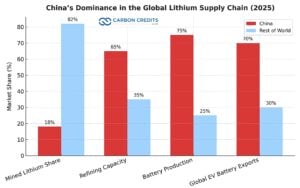
China produces about 18% of the world’s mined lithium, but its real strength lies in refining. Chinese companies hold about 65% of the world’s lithium chemical processing. They also account for over 75% of global battery cell production. These numbers show that even if lithium ore is mined in Chile, Argentina, or Australia, most of it ends up in Chinese refineries, which process it into battery-grade material.
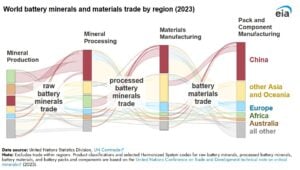
China also leads in midstream and downstream battery manufacturing. In 2024, China made more than 1,200 gigawatt-hours (GWh) of lithium-ion batteries. That’s around three-quarters of the world’s total, as reported by BloombergNEF.
Major producers like CATL and BYD supplied both domestic and foreign automakers, including Tesla, BMW, and Toyota.
The country’s major players, such as Ganfeng Lithium and Tianqi Lithium, have spent years investing in foreign mines. They invest in lithium projects in South America, Africa, and Australia. This helps them secure long-term access to raw materials. This strategy ensures China’s industry gets the feedstock it needs, supports local gigafactories, and boosts global exports.
How Beijing’s Moves Sway Global Lithium Markets
Lithium prices have been on a roller coaster. After record highs in 2022, prices dropped sharply in 2023 and early 2024 due to oversupply. But by mid-2025, prices in China began to rebound. Lithium carbonate traded between CNY 59,000 and 69,000 per metric ton (roughly US$8,500–9,000).
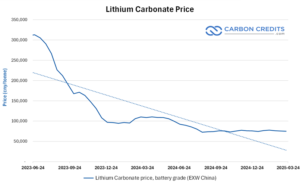
Industry analysts say Chinese producers used this price flexibility to outcompete foreign suppliers. When prices drop, many non-Chinese mining firms, especially in Australia and Africa, struggle to stay profitable.
Some market experts think China oversupplied the market on purpose. They believe this was to keep global influence and slow down rival producers.
Despite recent rebounds, volatility remains high. The IEA warns that lithium demand may double by 2030. It could reach over 1.3 million tonnes of lithium carbonate equivalent (LCE) each year. Without new mines and processing capacity, global shortages might return. This could lead to price spikes that impact battery and EV production worldwide.
- SEE LITHIUM PRICES here…
Technology and Export Controls
China’s advantage goes beyond production scale. It now leads in processing technology, equipment, and battery chemistry. Beijing is now limiting exports of lithium-processing machines and technology. This move aims to protect local industries and manage intellectual property.
In 2025, several Chinese equipment suppliers limited shipments abroad. This makes it harder for competitors in the U.S. and Europe to build their own refining systems. These export limits are part of a broader strategy to keep the high-value stages of the supply chain inside China.
Meanwhile, the U.S. IRA provides up to $369 billion for climate and energy. It includes strong incentives for local battery and mineral production. Europe’s Critical Raw Materials Act aims for 40% of critical minerals used in the EU to come from local or allied sources by 2030. But industry analysts say it could take up to a decade for these efforts to significantly reduce dependence on China.
The Global Response: Diversifying Supply Chains
Governments and companies are now racing to reduce dependence on China. The United States, Canada, and Australia are expanding domestic mining and refining. Chile and Argentina, along with other South American nations, are building local industries. They aim to process lithium instead of just exporting raw materials.
- RELATED: U.S. Lithium Push: How Washington’s Bet on Lithium Americas Could Reshape the Global Market
The IEA warns that global lithium supply must increase sevenfold by 2035 to meet climate goals. That means bringing new mines and refineries online faster while maintaining environmental standards.
In 2024, the World Bank estimated that over €680 billion (US$730 billion) was invested in renewable power and storage. However, only a small part funded the raw material supply. If supply growth lags, battery shortages could slow EV production by the late 2020s.
However, challenges persist. Lithium extraction can strain water resources and ecosystems. Building new facilities also requires stable regulation and financing, which can take years to secure.
Surge Battery Metals: Strengthening North American Supply
In North America, one of the emerging players helping to diversify lithium supply is Surge Battery Metals (CSE: NILI). The company is developing the Nevada North Lithium Project. This project is in one of the U.S.’s most promising lithium-rich areas.
Surge aims to produce battery-grade lithium for the growing North American EV market. Its exploration results have shown strong potential for large-scale, high-grade lithium clay deposits. Projects like Surge’s align with U.S. efforts to build a secure domestic supply chain and reduce reliance on imports from China.
Surge helps ensure supply security and meet environmental goals by creating cleaner extraction and processing methods. Its work supports the U.S. Department of Energy’s plan to create a domestic battery materials supply chain. It seeks to meet 90% of the country’s lithium demand by 2035.
What’s Ahead: Competition, Cooperation, and Climate Goals
The global lithium race is about more than profits. It shapes the pace of the clean energy transition. China’s dominance gives it both economic power and geopolitical influence. Western economies are investing a lot to find new supplies and to lower strategic risks.
The market outlook suggests demand will remain strong throughout the decade. Analysts expect lithium prices to stabilize as new supply enters the market, but competition will remain intense.
For the world to meet its climate goals, cooperation will be as important as competition. Shared technology, recycling, and sustainability standards could help reduce emissions and stabilize supply chains.
Surge Battery Metals and other new miners are working to localize production. They aim to boost transparency and ensure lithium supply helps the clean energy transition, not hinders it.
China now controls the heart of the global lithium industry, from mining and refining to battery exports. This dominance brings both opportunity and risk. The rest of the world is responding, but catching up will take time, investment, and innovation.
The post China’s Grip on Lithium Tightens as Global Supply Struggles to Keep Up appeared first on Carbon Credits.
Carbon Footprint
Climate Reality Check: Only 12% of Global Companies Align With 1.5°C Goal, MSCI Reports
A new report from MSCI shows that many listed companies are still not aligned with the world’s most ambitious climate goal. The findings suggest that progress is uneven. Some companies are moving in the right direction. Many are not yet cutting emissions fast enough.
According to MSCI’s latest Transition Finance Tracker, about 38% of companies in the MSCI All Country World Investable Market Index (ACWI IMI) have emissions trajectories that are aligned with limiting global warming to 2°C or below. This includes 12% aligned with 1.5°C or less and 26% aligned between 1.5°C and 2°C.
However, only about 12% of companies are aligned with the stricter 1.5°C goal set under the Paris Agreement. The remaining companies are on pathways that imply warming above 2°C.
In fact, 36% of companies fall in the range above 2°C but below 3.2°C, while 26% exceed 3.2°C. Overall, the median listed company trajectory implies 3°C (5.4°F) of warming above preindustrial levels this century.

MSCI uses a tool called the Implied Temperature Rise (ITR) metric. This tool estimates how much global temperatures would rise if the whole economy followed the same emissions pathway as a given company. It looks at aggregate emissions, sector-specific carbon budgets, and corporate climate targets.
Inside the ITR: Measuring Corporate Warming Impact
MSCI’s ITR metric helps investors understand climate risk. It compares a company’s projected emissions with global carbon budgets that align with temperature goals. The dataset used in this estimate covers roughly 95% of ACWI IMI constituents, as about 5% lack sufficient data for the calculation.
If a company’s emissions plan fits within a 1.5°C carbon budget, it is considered aligned with the most ambitious Paris goal. If it fits within a 2°C budget, it is considered moderately aligned. If not, it implies higher warming.
- The Paris Agreement aims to limit global warming to well below 2°C, and preferably to 1.5°C, compared with pre-industrial levels.
The Intergovernmental Panel on Climate Change (IPCC) has warned that global emissions must fall by about 43% by 2030, compared with 2019 levels, to keep 1.5°C within reach.
MSCI’s data shows that most companies are not reducing emissions at that pace. The report also notes that its latest warming estimate is three-tenths of a degree higher than the previous quarter due to a methodological update that removed a cap on how much companies could exceed their carbon budgets.
This gap matters because corporate emissions play a major role in global totals. The MSCI ACWI IMI includes 8,225 companies and captures about 99% of the global equity investment opportunity set as of Dec. 31, 2025.
Winners and Laggards: How Sectors Stack Up on Climate
The Transition Pathway Initiative (TPI) gives a clear look at how corporate climate performance differs by industry.
The TPI report looked at more than 2,000 major companies. These companies have a total market value of about US$87 trillion. The focus was on their climate governance and progress on emissions. It found that 98% of companies lack credible plans to shift capital away from carbon-intensive assets.

The report warns that 554 companies in 12 high-emitting sectors are on a dangerous path. Their current emissions are on track to overshoot the 1.5°C carbon budget by 61% between 2020 and 2050. These same pathways will also likely exceed the 2°C budget by 13% during that same period.
The analysis suggests that many firms consider climate issues in daily decisions. However, few have solid long-term transition plans.
TPI also shows clear differences in sector progress. For example, automotive and electricity companies reduced emissions intensity nearly five times faster between 2020 and 2023 than cement and steel firms. Conversely, sectors such as oil & gas, aluminum, and coal mining remain among the most misaligned with Paris goals.
This highlights that while some industries are beginning to cut emissions and improve governance, most still need stronger transition plans and clearer capital alignment to meet global climate targets.
Climate Alignment Is Now a Financial Risk Indicator
Findings reveal that climate alignment is not only an environmental issue. It is also a financial one.
Governments are tightening climate policies. Carbon pricing systems now cover about 23% of global greenhouse gas emissions, according to the World Bank’s State and Trends of Carbon Pricing report.
More countries are setting net-zero targets. Regulations are increasing disclosure requirements. Investors face growing pressure to measure climate risk in portfolios.
The MSCI report also shows that 19% of listed companies had a climate target validated by the Science Based Targets initiative (SBTi) as of Dec. 31, 2025, up from 14% a year earlier. Meanwhile, 32% of companies have set a companywide net-zero target, and 60% have published some form of climate commitment.
Companies that are not aligned with global climate goals may face higher regulatory costs, stranded assets, or weaker demand in the future. On the other hand, companies aligned with 1.5°C or 2°C pathways may benefit from new markets and lower transition risk.
MSCI’s data helps investors compare companies on this basis. The 38% alignment figure gives a broad snapshot of progress across global markets.
Progress, But Not Fast Enough
The fact that 38% of companies align with 2°C or below shows improvement compared with past years. Corporate climate reporting has expanded. More companies now set net-zero targets, and many publish science-based targets.
Disclosure rates have also improved. As of Dec. 31, 2024, 79% of listed companies disclosed Scope 1 and/or Scope 2 emissions, up from 76% a year earlier. A majority, 56%, reported at least some Scope 3 emissions, up from 51%.

Still, MSCI’s findings show that ambition and action are not always the same. Some companies set long-term targets but delay near-term reductions. Others rely heavily on carbon offsets instead of direct emissions cuts. In some cases, emissions intensity improves while absolute emissions remain high.
The IPCC has made clear that global emissions must fall sharply this decade. Delayed action increases future costs and transition risks.
A Fossil-Fuel-Heavy World Complicates the Shift
Global energy-related CO₂ emissions reached a record 37.8 billion tonnes in 2023, according to the International Energy Agency. While renewable energy growth has accelerated, fossil fuels still account for around 80% of global primary energy supply.
These global figures explain why corporate alignment remains challenging. Many companies operate in economies that still depend on fossil energy.
MSCI’s report reflects this broader reality. Corporate alignment depends on system-wide change, not just company-level pledges. Moreover, the report’s findings come as corporate climate pledges continue to rise sharply.
According to the SBTi, the number of companies setting both near-term and net-zero science-based targets surged 227% between late 2023 and mid-2025. Companies setting near-term targets alone grew by nearly 97% over the same period.

By the end of 2023, only 17% of companies with validated targets had both near-term and net-zero commitments. That share rose to 33% in 2024 and reached 38% by mid-2025.
The figures show that more companies are formalizing climate commitments. However, MSCI’s data indicates that only 12% of listed firms align with 1.5°C, while 38% align with 2°C or below — highlighting a gap between target-setting and full emissions alignment.
The Road Ahead: Bridging the 1.5°C Gap
The headline figure shows that more than one-third of listed firms are moving in a direction consistent with global climate goals. That gap is significant.
To meet the Paris Agreement’s goals, alignment will need to increase quickly across all sectors. This means faster emissions cuts, clearer short-term targets, and stronger capital allocation toward low-carbon technologies. Today’s alignment rate suggests progress is underway, but it also shows that most companies still have to work harder to be on track to a 1.5°C path.
The post Climate Reality Check: Only 12% of Global Companies Align With 1.5°C Goal, MSCI Reports appeared first on Carbon Credits.
Carbon Footprint
How Power Demand, Emissions, and China Will Shape the Global Energy System to 2030
Global electricity demand is entering a decisive growth phase. IEA’s 2026 electricity report forecasts that over the next five years, power consumption is set to rise faster than at any time in recent decades, marking a structural shift in how the world uses energy. This trend reflects the rapid electrification of industries, transport, buildings, and digital infrastructure, alongside climate-driven demand for cooling and heating.
Unlike previous cycles, electricity demand is no longer simply following economic growth. Instead, power consumption is becoming a leading driver of economic activity. This shift signals the arrival of what analysts increasingly call the “Age of Electricity,” where power is the backbone of modern economies and decarbonization strategies.
Let’s deep dive into IEA’s report here to understand the present and the future of electricity demand.
Electricity Demand Breaks Away from Economic Growth
Global electricity demand is projected to grow at an average annual rate of around 3.6% between 2026 and 2030, significantly faster than the growth seen over the past decade. In contrast, total energy demand will rise much more slowly, meaning electricity will expand at least 2.5 times faster than overall energy consumption.
This divergence marks a fundamental change. Historically, electricity consumption closely tracked GDP growth. That relationship is now reversing. In 2024, electricity demand outpaced economic growth globally for the first time in three decades outside of crisis periods, and this trend is expected to continue.
Several structural drivers are accelerating this shift:
- Electrification of transport, especially electric vehicles
- Expansion of data centres and artificial intelligence workloads
- Rising demand for air conditioning due to climate change
- Industrial electrification and reshoring
- Growth in heat pumps and electric heating
Together, these trends are pushing electricity to become the dominant form of final energy consumption.
Emerging economies will remain the main engine of demand growth, accounting for roughly 80% of new electricity consumption through 2030. However, advanced economies are also seeing a resurgence after more than a decade of stagnation, driven by digitalization and electrification.

Global Power Mix: Renewables and Nuclear Take Half the Market
Globally, renewables and nuclear are on track to supply around 50% of electricity generation by 2030. Solar is the fastest-growing source, contributing more than half of annual generation additions.
Renewable generation is expected to grow by about 1,000 TWh per year through 2030, with solar alone adding more than 600 TWh annually. Nuclear power is also gaining momentum, supported by reactor restarts, lifetime extensions, and new builds in emerging economies.
However, coal will likely remain the single largest source of electricity in 2030, even as its share declines. Natural gas generation is also expected to rise, driven by US demand and fuel switching in the Middle East.
Overall, renewables, nuclear, and gas are projected to meet all net new electricity demand globally, displacing coal in aggregate but not eliminating it.

Advanced Economies Re-Enter the Demand Growth Cycle
Electricity demand in advanced economies is rising again after a prolonged period of stagnation. In the United States, demand is projected to grow by around 2% annually through 2030, with data centres accounting for roughly half of the increase.
In the European Union, electricity demand is expected to grow at around 2% per year, though consumption may not return to pre-2021 levels until the late 2020s. Other advanced economies, including Japan, Canada, Korea, and Australia, are also seeing accelerating growth.
This resurgence reflects:
- AI and cloud computing expansion
- Electrification of heating and transport
- Industrial reshoring and new manufacturing facilities
- Climate-driven cooling demand
Electricity is becoming a core input for economic competitiveness in digital and industrial sectors.
Power Sector Emissions: Plateau but Not Yet Declining Fast Enough
Electricity generation remains the largest source of energy-related carbon dioxide emissions, producing roughly 13.9 billion tonnes of CO₂ per year. After rising between 2022 and 2024, power sector emissions stabilised in 2025.
Looking ahead, emissions are expected to plateau through 2030, rather than decline sharply. This reflects the rapid growth in electricity demand, offsetting gains from clean power deployment.

The carbon intensity of electricity has already fallen by around 14% over the past decade, and it is expected to decline faster as low-emission generation expands. This decline is mainly due to more renewable energy and strong nuclear power output.
- The trend is expected to accelerate. CO₂ intensity is forecast to fall by around 3.7% per year, dropping from 435 g CO₂ per kWh in 2025 to about 360 g CO₂ per kWh by 2030.
However, absolute emissions reductions will be harder to achieve due to rising demand. China’s trajectory is particularly critical. As the world’s largest power market and emitter, its pace of renewable deployment, coal retirement, and grid reform will heavily influence global climate outcomes.

China: The Single Largest Driver of Global Electricity Growth
China will remain the central force shaping global electricity demand over the next decade. Despite slower economic growth and structural shifts toward services, China’s sheer scale means it will contribute close to half of global electricity demand growth through 2030.
Electricity demand in China rose by just over 5% in 2025, down from roughly 7% in 2024. Looking ahead, demand is expected to grow at an average of around 4.9% annually between 2026 and 2030, slower than the past decade but still massive in absolute terms.
The drivers are multifaceted:
- Continued electrification across industry and households
- Expansion of manufacturing, including clean energy supply chains
- Growing services sector electricity use
- Rising cooling demand due to extreme heat events
- Digital infrastructure and smart technologies

China’s power demand growth over the next five years alone is expected to match the current total electricity consumption of the European Union. This highlights the scale of China’s influence on global power markets, fuel demand, and emissions trajectories.
At the same time, efficiency improvements are tempering demand growth. Government policies targeting lower energy intensity and more efficient appliances are helping reduce electricity use per unit of GDP. However, these gains are not enough to offset the scale of electrification and economic activity.
MUST READ:
- China Adds Power 8x More Than the US in 2025, with $500B Energy Build-Out in a Single Year
- How China’s $180B Clean-Tech Investments Transform the Global South
Renewables Surge, But Grid Constraints Loom Large
China’s renewable energy buildout continues at an unprecedented pace. Solar generation jumped by more than 40% in 2025, while wind grew by double digits. The share of variable renewable energy (VRE) in China’s power mix reached around 22%, up sharply from the previous year.
Record capacity additions are transforming the power system. More than 300 GW of solar and over 100 GW of wind were added in a single year, driven partly by developers rushing to complete projects before the end of fixed-price tariffs.
However, this rapid expansion is creating new challenges. Curtailment rates for solar and wind increased, reflecting grid congestion and integration constraints. This highlights a global issue: generation is growing faster than grid infrastructure.
Coal’s Role Is Changing, Not Disappearing
Despite the renewable boom, coal remains a dominant force in China’s power sector. Coal-fired generation declined slightly in 2025, but coal still accounts for the largest share of electricity generation.
China’s coal share is expected to fall from around 55% in 2025 to about 43% by 2030, reflecting the rapid expansion of renewables and nuclear. However, coal capacity continues to grow, driven by projects approved during the 2022–2023 permitting boom.
Rather than serving as baseload power, coal plants are increasingly being used as flexibility and backup resources to support variable renewables. Capacity utilisation is expected to decline, even as installed capacity rises.
This shift illustrates a broader global trend: coal is becoming a reliability asset rather than a growth engine, but its persistence complicates decarbonization efforts.
Grids and Flexibility: The Hidden Bottleneck
The transition to an electricity-centric energy system depends on grid expansion and flexibility. Investment in grids currently lags far behind generation capacity additions. Worldwide, more than 2,500 GW of projects are stuck in grid connection queues, including renewables, storage, and large industrial loads such as data centres. Without faster grid expansion and smarter system management, power shortages and curtailment risks will rise.
Meeting projected demand will require around 50% higher annual grid investment by 2030, rising from roughly USD 400 billion today. Without this, congestion, curtailment, and reliability risks will increase.
Flexibility solutions are also scaling rapidly. Utility-scale battery deployment is accelerating, especially in regions with high solar and wind penetration. However, conventional power plants still provide most flexibility today.
Policy reforms, grid-enhancing technologies, and non-firm connection agreements could unlock 1,200–1,600 GW of stalled projects, significantly accelerating the transition.

The Global Outlook: A Power-Centric Energy System
The global energy system is undergoing a structural transformation. Electricity is becoming the dominant vector for economic growth, digitalization, and decarbonization. Demand growth is accelerating across emerging and advanced economies, with China playing the most decisive role.
Renewables and nuclear are rapidly expanding, but coal and gas will remain part of the mix for reliability. Emissions are stabilising but not falling fast enough to meet climate targets, highlighting the scale of the challenge ahead.
The next five years will be critical. Grid expansion, flexibility solutions, and policy reforms will determine whether the Age of Electricity delivers a clean, affordable, and resilient energy future—or locks in new infrastructure bottlenecks and emissions risks.
- ALSO READ: 2026: The Year Nuclear Power Reclaims Relevance With 15 Reactors, AI Demand, and China’s Expansion
The post How Power Demand, Emissions, and China Will Shape the Global Energy System to 2030 appeared first on Carbon Credits.
Carbon Footprint
Nuclear’s Next Chapter: newcleo Raises $88M to Scale SMR Powered by Nuclear Waste
newcleo, a European nuclear technology company, announced that it has raised €75 million (about USD $88 million) in a new funding round. The cash will help the company build and develop advanced small nuclear reactors powered by recycled nuclear waste. The financing is a sign of growing investor interest in clean and low-carbon energy solutions.
Newcleo also said that it has now raised more than $124 million in total for 2025. The company was founded in September 2021 and is based in Paris, France. The nuclear energy developer also operates in Italy, the UK, Belgium, and Slovakia, with roughly 1,000 employees.
What newcleo’s Technology Does: Turning Nuclear Waste into Usable Fuel
newcleo develops a type of advanced nuclear technology known as lead-cooled fast reactors (LFRs). These reactors are a form of small modular reactor (SMR).
Unlike traditional nuclear reactors that use fresh uranium fuel, newcleo’s design aims to use reprocessed nuclear waste as fuel. This means existing waste from older reactors could become a power source.
Using nuclear waste as fuel is intended to have two benefits:
- It could reduce long-term waste storage needs.
- It may help lower the carbon footprint of nuclear power.
Lead-cooled fast reactors also use liquid lead to transfer heat out of the core. The liquid lead acts as a coolant and enables the reactor to operate at high temperatures without high pressure.
This reactor type is still under development and not yet in wide commercial operation. But companies like newcleo believe it could play a role in future clean energy systems.
Heavy Industry and Investors Double Down
The €75 million funding round brought in both new and existing investors. New industrial backers included heavy industry groups such as:
- Danieli & C, a steel mill manufacturer
- Cementir Holding, a cement and concrete producer
- Orion Valves, an industrial valve maker
- NextChem, an energy engineering firm
Existing financial backers also participated. These included Kairos, Indaco Ventures, Azimut Investments, the CERN pension fund, and Walter Tosto (industrial engineering).
The mix of industrial and financial investors shows that newcleo’s technology draws interest from companies looking for reliable, low-carbon power and firms focused on clean energy investments.
Scaling from Design to Deployment
newcleo said the fresh funding will support several key parts of its business. The company highlighted progress in:
- Licensing and regulatory approval processes
- Research and development (R&D) of reactors and fuel systems
- Vertical integration of technology and manufacturing
- Geographic expansion in key markets like Europe and the United States
This means newcleo is working not just on reactor design, but on building the skills and facilities needed to support production, testing, and commercial deployment. The company also has partnerships and projects in multiple countries, including France, Italy, Slovakia, and the U.S. These collaborations relate to licensing and siting work, research facilities, and future commercial reactor projects.
Closing the Nuclear Fuel Loop
Nuclear power is often seen as a low-carbon energy source because it produces virtually no direct CO₂ emissions during operation. However, it leaves behind radioactive waste that can remain hazardous for thousands of years.

Traditional reactors use uranium fuel once and store the resulting waste. newcleo’s approach aims to reuse existing waste as reactor fuel. This could potentially reduce the volume and hazard of waste that needs long-term storage.
Lead-cooled fast reactors are one class of Generation IV nuclear technology. These designs are intended to be safer and more efficient than older reactors. They can run on fuels that traditional reactors cannot and may help make nuclear energy more sustainable in the long term.
Using recycled radioactive fuel helps close the nuclear fuel cycle. This means sourcing more energy from mined uranium, which leaves less waste behind.
Building a Cross-Border Nuclear Footprint
newcleo has stated that it plans to roll out its technology in several countries with active regulatory frameworks for advanced nuclear projects. The company has started licensing and planning partnerships in Europe and the U.S. These moves aim to make it a major supplier of advanced nuclear power systems.
In France, newcleo is preparing regulatory filings for both fuel and reactor projects. In Italy, it is building R&D infrastructure and test systems, while in Slovakia, it has formed a joint venture to deploy multiple reactors at a nuclear site. And in the U.S., it is engaging in collaborations to build fuel manufacturing and fabrication capabilities.
The company’s CEO, Stefano Buono, said investors view newcleo’s progress in licensing, R&D, and global expansion as a key advantage. He further added,
“Our ability to deliver impactful low-carbon energy solutions for energy-intensive firms is proving an attractive investment rationale for both industrial and financial investors. Our tangible progress in licensing, R&D, vertical integration, and geographic expansion is seen by investors as a key differentiator in the race to deliver clean, safe, and affordable nuclear energy.”
Small Modular Reactors Gain Global Traction
Interest in small modular reactors is rising as countries look for reliable, low-carbon power. Governments and industry groups also track SMRs more closely than before.
One sign is the growing number of designs in development. The OECD Nuclear Energy Agency (NEA) reported that its latest SMR Dashboard found 98 SMR technologies globally. It detailed 56 of these SMRs in its dashboard set.
A separate NEA summary shows a larger count of designs tracked over editions. This highlights how quickly the pipeline is expanding.
-
Forecasts also show wider deployment in the coming decades. The International Energy Agency (IEA) publishes scenario data on global SMR capacity from 2025 to 2050.
In its analysis, SMR capacity rises from near-zero today to tens of gigawatts by 2050 in its main scenarios (39 GW), and it grows even higher in its “high SMR” case (190 GW). This suggests that SMRs could move from pilot projects to meaningful scale if costs fall and licensing speeds up.

International institutions also expect nuclear growth overall, with SMRs playing a bigger role. In September 2025, the International Atomic Energy Agency (IAEA) said it raised its long-term nuclear outlook again.
In its best-case scenario, the IAEA predicts that global nuclear capacity could grow to 2.6 times the 2024 level by 2050. It also noted that SMRs will be key to this growth.
Policy signals further support this direction. The NEA reports that over 20 countries at COP28 pledged to triple global nuclear energy capacity by 2050.
These forecasts do not guarantee fast deployment. SMRs still face key hurdles such as licensing timelines, supply chains, fuel availability, and first-of-a-kind costs.
SMRs are increasingly central to global nuclear talks. The NEA tracks more designs, and the IEA outlines new deployment pathways. And interest from investors and policymakers has grown as countries look for reliable low-carbon baseload power.
- SEE MORE: From Now to 2060: How Canada’s SMRs and Maritime Nuclear Power Will Drive a Net-Zero Future
The €75 million funding round adds to newcleo’s growing capital base. It boosts the company’s ability to advance its technology and work toward deployment. As of early 2026, newcleo has raised more than $124 million over the past year, with total funding since 2021 likely exceeding €645 million.
Private Capital Signals a Nuclear Comeback
The investment in newcleo highlights a broader trend: private capital is moving into advanced nuclear technologies.
Investors in heavy industry and finance are now seeing nuclear power as key to global decarbonization efforts. Some countries have recently updated their policies. This supports nuclear research and licensing. It shows a focus on energy security and climate goals.
Lead-cooled fast reactors and similar designs remain in early stages of testing and regulatory review. Newcleo and similar companies think their technologies can provide clean, reliable power. They also believe these systems create less waste over their life cycles compared to older reactors.
If successful, this approach could expand the role of nuclear power in the energy transition. But much work remains in testing, licensing, manufacturing, and cost reduction before commercial deployment at scale.
The post Nuclear’s Next Chapter: newcleo Raises $88M to Scale SMR Powered by Nuclear Waste appeared first on Carbon Credits.
-
Climate Change6 months ago
Guest post: Why China is still building new coal – and when it might stop
-
Greenhouse Gases6 months ago
Guest post: Why China is still building new coal – and when it might stop
-
Climate Change2 years ago
Bill Discounting Climate Change in Florida’s Energy Policy Awaits DeSantis’ Approval
-
Greenhouse Gases2 years ago嘉宾来稿:满足中国增长的用电需求 光伏加储能“比新建煤电更实惠”
-

Climate Change2 years ago
Spanish-language misinformation on renewable energy spreads online, report shows
-
Climate Change2 years ago嘉宾来稿:满足中国增长的用电需求 光伏加储能“比新建煤电更实惠”
-
Climate Change Videos2 years ago
The toxic gas flares fuelling Nigeria’s climate change – BBC News
-
Renewable Energy2 years ago
GAF Energy Completes Construction of Second Manufacturing Facility


