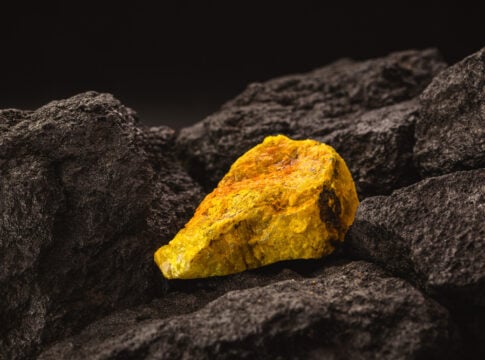
The U.S. depends heavily on imported uranium to power its nuclear reactors, using about 50 million pounds each year while producing less than 1% at home. Boosting domestic uranium production is crucial for energy security and reducing reliance on foreign sources. In this context, Anfield Energy Inc. (NASDAQ: AEC; TSXV: AEC) is making progress with its Velvet-Wood uranium project in San Juan County, Utah.
The Utah Department of Oil, Gas, and Mining recently approved the project for construction. This allows Anfield to move quickly toward production.
Velvet-Wood Gains Green Light for Rapid Development
In May, Anfield Energy Inc. announced that the U.S. Department of the Interior approved its Velvet-Wood uranium project in San Juan County, Utah.
This project was the first mining initiative approved under a new fast-track permitting process by the U.S. Department of the Interior. This process, introduced after President Trump’s energy emergency declaration in January 2025, lets energy projects complete environmental reviews in just 14 days.
By selecting Velvet-Wood, federal agencies highlighted its importance for the domestic uranium and vanadium supply.
Notably, Secretary of the Interior Doug Burgum said the Bureau of Land Management ensures safe and responsible extraction while protecting the environment.
With federal and state approvals in hand, Anfield plans to start mobilization immediately. The company expects to break ground within 30 days. They will:
- reopen the mine portal
- dewater the site
- build surface facilities
- develop a new mine incline.
These steps aim to bring Velvet-Wood into production quickly while keeping safety and environmental standards high.
Anfield Boots U.S. Energy Security with Domestic Production
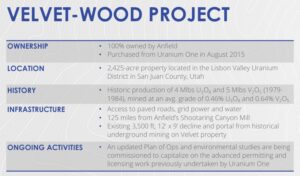
Anfield acquired Velvet-Wood in 2015. The mine previously produced around 4 million pounds of uranium and 5 million pounds of vanadium from 1979 to 1984.
- A preliminary economic assessment shows 4.6 million pounds of uranium at a grade of 0.29% eU3O8, plus additional inferred resources.
CEO Corey Dias said the approvals clear the way for building the mine and starting production. The company also plans to increase its reclamation bond with the Bureau of Land Management to meet federal land restoration rules.
Anfield’s project helps the U.S. reduce dependence on foreign minerals. The country imports uranium from Russia, Kazakhstan, and Uzbekistan. Vanadium supply mainly comes from China, Russia, South Africa, and Brazil.
By producing uranium and vanadium domestically, Anfield enhances energy security and supports industries such as nuclear power, aerospace, and defense.
Uranium and Vanadium: Key Strategic Materials
Uranium powers nuclear reactors, fuels U.S. Navy submarines, and helps produce medical isotopes. It is also used in tritium production for national defense. Vanadium strengthens steel and titanium alloys used in both commercial and military aircraft. Together, these minerals are vital for energy, defense, and industrial security.
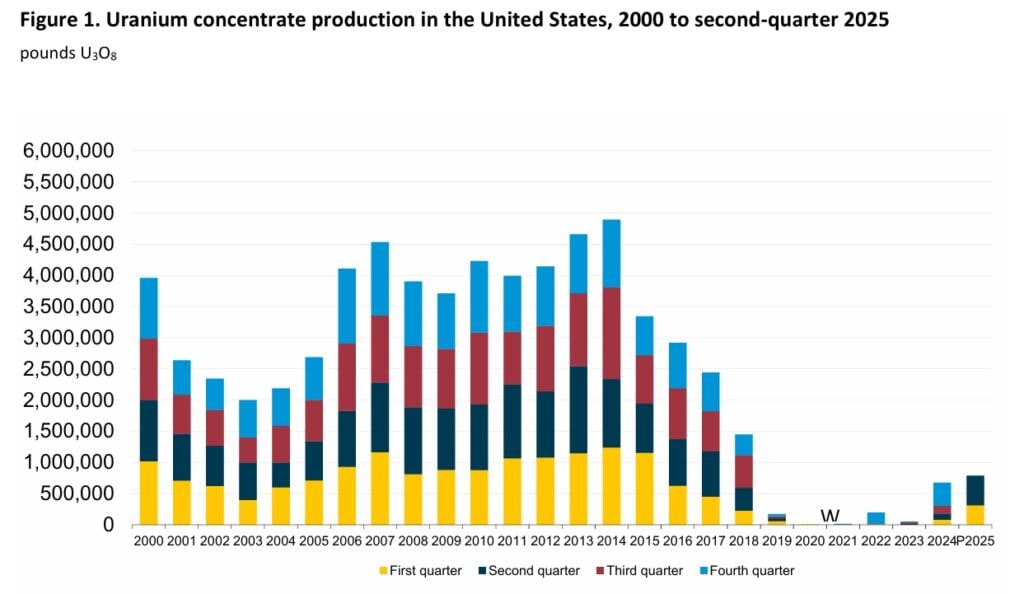
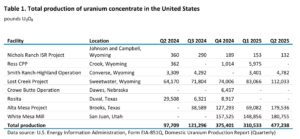
EIA’s Domestic Uranium Production Report Second-Quarter 2025 highlights that in Q2 2025, the U.S. produced 437,238 pounds of uranium concentrate (U3O8), up 41% from the first quarter’s 310,533 pounds.
Production came from the following mines:
Underground Mining Keeps Environmental Impact Low
Velvet-Wood will focus on underground mining. The company will use existing mine workings and develop new mineral areas. This approach keeps surface disturbance to just three acres and makes use of the old Velvet mine site.
Anfield also owns the Shootaring Canyon mill, one of only three licensed uranium mills in the U.S. Restarting this mill will allow the company to convert uranium ore into concentrate, reduce reliance on imports, and support domestic nuclear fuel production.
Economic and Strategic Benefits
Anfield combines strong assets with efficient operations. Its hub-and-spoke model links mining sites with processing mills, maximizing the value of Velvet-Wood’s resources. With measured resources, a licensed mill, and fast government approvals, the company is ready to meet growing demand for uranium and vanadium.
The project also brings jobs to Utah and supports local communities. Restarting the Shootaring Canyon mill adds processing capacity, lowers costs, and improves efficiency.
Moving Toward a Sustainable Energy Future
Anfield focuses on sustainable growth. Its operations balance environmental responsibility with energy and defense needs. By producing domestic uranium and vanadium, the company supports a carbon-free energy future while reducing reliance on imports.
Velvet-Wood shows how companies and supportive policies can address energy and security challenges. By using old mining assets and modern techniques, Anfield aims to become a leading U.S. uranium producer. It’s fast move from permitting to production sets an example for other critical mineral projects.
The post U.S. Uranium Production Set to Rise as Anfield Energy Gains Velvet-Wood Approval appeared first on Carbon Credits.
Carbon Footprint
How to improve Scope 3 data accuracy for CSRD
For most businesses, the emissions that matter most sit outside their own walls. Scope 3 emissions, everything generated across your value chain, from the suppliers who make your inputs to the customers who use your products, typically make up the majority of a company’s total carbon footprint. Under the Corporate Sustainability Reporting Directive (CSRD), those value-chain emissions now have to be measured and disclosed with a rigour that spend-based estimates alone struggle to satisfy. This guide sets out how to improve Scope 3 data accuracy for CSRD: the calculation methods open to you, how to move from estimates to verified supplier data, and how to govern that data so it holds up to audit.
![]()
Carbon Footprint
How community stewardship makes carbon credits durable
A carbon credit is a commitment that extends well into the future. The tonne of CO₂ compensated for today from a nature-based carbon project must remain out of the atmosphere for good, which means the forest behind the credit has to remain standing long after the transaction is complete. For any buyer, this raises a defining question: What ensures that the forest endures?
![]()
Carbon Footprint
Why Conventional Carbon Offsets Are Losing Boardroom Credibility
What replaced the cheap REDD credit on the boardroom slide deck, and why procurement is leading the rewrite.
Three years ago, a corporate slide showing a portfolio of cheap REDD+ credits could carry a board meeting. The number was big, the price was low, and the press release wrote itself. Today, that same slide gets sent back with questions. The questions are uncomfortable, the answers are unclear, and your general counsel is suddenly in the room.
Conventional carbon offsets are not dead. The voluntary carbon market retired 202 million tonnes in 2025, and the Morgan Stanley Institute for Sustainable Investing survey published in January 2026 confirmed that interest from corporate buyers remains substantial. What changed is the credibility threshold. The integrity floor has risen, the disclosure scrutiny has tightened, and the buyer profile has shifted. This article tracks what changed, what sophisticated buyers now ask before signing, and what serious corporates are putting on the board slide instead.
What boards used to buy, and why it stopped working
The 2020 to 2022 model was simple: buy a large tranche of avoidance credits at low single-digit prices, retire them against the company footprint, announce the carbon-neutral claim, and move on. Most of those credits came from REDD+ projects, renewable energy installations in countries where the renewable energy was already economic, or methane projects with thin documentation.
Several things broke that model. Academic research published in 2023, including a widely cited Science paper, found that the majority of REDD+ credits issued under the most common methodologies did not represent additional reductions when tested against rigorous counterfactuals. The Voluntary Carbon Markets Integrity Initiative published its Claims Code of Practice, which sets requirements for what companies can credibly claim from credit use. The European Union finalised its Green Claims Directive, restricting how companies can describe products as climate-neutral. France’s Décret 2022-539 already restricts carbon neutrality advertising. California’s AB 1305 imposes disclosure requirements on any company making net-zero or carbon-neutral claims while doing business in the state.
The collective effect: the cheap credit no longer buys the announcement, and the announcement now carries litigation risk.
The integrity reset: ICVCM, VCMI, and what changed
The Integrity Council for the Voluntary Carbon Market published the Core Carbon Principles in 2023 and began assessing methodologies against them in 2024. The first methodologies received the CCP label later that year. The point of the label is to give corporate buyers a defensible quality screen they can cite in disclosure.
The Voluntary Carbon Markets Integrity Initiative complements this on the demand side. Its Claims Code of Practice defines what a buyer can say (Silver, Gold, or Platinum claims, with associated requirements) based on the quality of credits used and the underlying decarbonisation strategy. Together, CCP and VCMI build a quality stack: CCP on the supply, VCMI on the claim, with the science-based target sitting underneath both.
The reset is not a ban on offsets. It is a ratchet. Credits that meet the new bar continue to clear; credits that do not, do not. The Morgan Stanley survey found that 61% of current buyers like the CCP label concept but that supply of labelled credits remains limited. That supply constraint is now visible in pricing.
What sophisticated buyers ask before they sign
The questions on the procurement scorecard have changed. A 2022 buyer might have asked about price, vintage, and project type. A 2026 buyer asks five different questions before any of those.
- What does the counterfactual look like, and who validated it.
- What is the permanence regime, and what is the buffer pool exposure.
- What is the leakage risk, and how is it mitigated.
- What rating has the project received from the independent ratings agencies (Sylvera, BeZero, Calyx Global), and what was the rationale.
- What is the documentation discipline that survives an audit four years from now when the procurement team that signed the contract has moved on.
If the vendor cannot answer those five questions on a first call, the conversation ends. Conversely, if the vendor can answer them with documented specificity, the conversation often expands beyond a single transaction toward a multi-year engagement.
Where this leaves your near-term commitments
You probably have near-term commitments that pre-date the integrity reset. Public targets to be carbon neutral by 2025 or 2030. Product-level claims that ran in last year’s marketing. Disclosed reduction trajectories that assumed continued access to cheap credits.
You have three workable paths. The first is to re-baseline your strategy, replacing the most exposed credits with higher-quality alternatives and adjusting the public language to match what you can defend. The second is to shift the underlying spend from offsetting outside your value chain to investing inside your value chain, where reductions count against Scope 3 directly and the audit trail is cleaner. The third is to keep the strategy and absorb the risk, which is increasingly the most expensive option once you price in litigation, restatement, and reputational exposure.
Most serious buyers are choosing the second path. It moves the carbon spend from a compliance cost to a procurement and resilience investment, and it removes the central failure point of the legacy model: the disconnect between where the emissions occurred and where the reductions sat. Nature-based supply chain investments, structured under the GHG Protocol Land Sector and Removals Standard and aligned to the SBTi FLAG Guidance, are the asset class that fits this brief. They generate inventory-grade reductions, they produce audit-grade documentation, and they survive the new claim restrictions because the carbon math sits inside the value chain that the disclosure already covers.
If you are reassessing a carbon strategy under the new integrity bar, or rebuilding a board narrative that has to survive a more skeptical audience, the carbon and sustainability experts at Carbon Credit Capital can help. The Dual-Value Model gives you a defensible alternative to legacy offset purchases, with the documentation and operational integration that survives the procurement scorecard and the audit. Schedule a consultation.
-
Climate Change11 months ago
Guest post: Why China is still building new coal – and when it might stop
-
Greenhouse Gases11 months ago
Guest post: Why China is still building new coal – and when it might stop
-
Greenhouse Gases2 years ago嘉宾来稿:满足中国增长的用电需求 光伏加储能“比新建煤电更实惠”
-

Climate Change2 years ago嘉宾来稿:满足中国增长的用电需求 光伏加储能“比新建煤电更实惠”
-
Climate Change2 years ago
Bill Discounting Climate Change in Florida’s Energy Policy Awaits DeSantis’ Approval
-
Renewable Energy9 months agoSending Progressive Philanthropist George Soros to Prison?
-
Carbon Footprint2 years agoUS SEC’s Climate Disclosure Rules Spur Renewed Interest in Carbon Credits
-
Greenhouse Gases1 year ago
嘉宾来稿:探究火山喷发如何影响气候预测

