China’s carbon dioxide (CO2) emissions fell by 1% in the final quarter of 2025, likely securing a decline of 0.3% for the full year as a whole.
This extends a “flat or falling” trend in China’s CO2 emissions that began in March 2024 and has now lasted for nearly two years.
The new analysis for Carbon Brief shows that, in 2025, emissions from fossil fuels increased by an estimated 0.1%, but this was more than offset by a 7% decline in CO2 from cement.
Other key findings include:
- CO2 emissions fell year-on-year in almost all major sectors in 2025, including transport (3%), power (1.5%) and building materials (7%).
- The key exception was the chemicals industry, where emissions grew 12%.
- Solar power output increased by 43% year-on-year, wind by 14% and nuclear 8%, helping push down coal generation by 1.9%.
- Energy storage capacity grew by a record 75 gigawatts (GW), well ahead of the rise in peak demand of 55GW.
- This means that growth in energy storage capacity and clean-power output topped the increases in peak and total electricity demand, respectively.
The CO2 numbers imply that China’s carbon intensity – its fossil-fuel emissions per unit of GDP – fell by 4.7% in 2025 and by 12% during 2020-25.
This is well short of the 18% target set for that period by the 14th five-year plan.
Moreover, China would now need to cut its carbon intensity by around 23% over the next five years in order to meet one of its key climate commitments under the Paris Agreement.
Whether Chinese policymakers remain committed to this target is a key open question ahead of the publication of the 15th five-year plan in March.
This will help determine if China’s emissions have already passed their peak, or if they will rise once again and only peak much closer to the officially targeted date of “before 2030”.
‘Flat or falling’
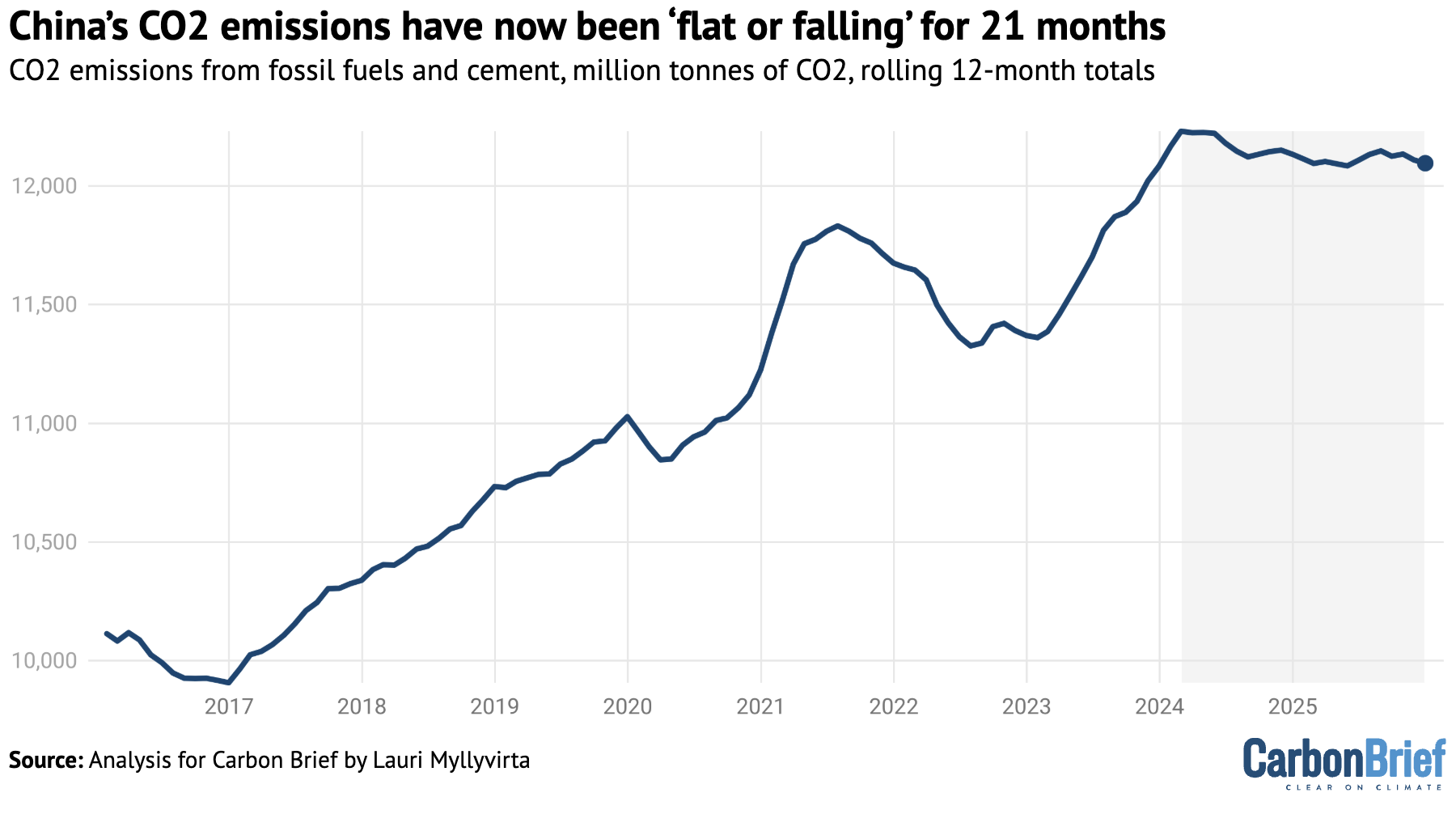
The latest analysis shows China’s CO2 emissions have now been flat or falling for 21 months, starting in March 2024. This trend continued in the final quarter of 2025, when emissions fell by 1% year-on-year.
The picture continues to be finely balanced, with emissions falling in all major sectors – including transport, power, cement and metals – but rising in the chemicals industry.
This combination of factors means that emissions continue to plateau at levels slightly below the peak reached in early 2024, as shown in the figure below.
Power sector emissions fell by 1.5% year-on-year in 2025, with coal use falling 1.7% and gas use increasing 6%. Emissions from transportation fell 3% and from the production of cement and other building materials by 7%, while emissions from the metal industry fell 3%.
These declines are shown in the figure below. They were partially offset by rising coal and oil use in the chemical industry, up 15% and 10% respectively, which pushed up the sector’s CO2 emissions by 12% overall.
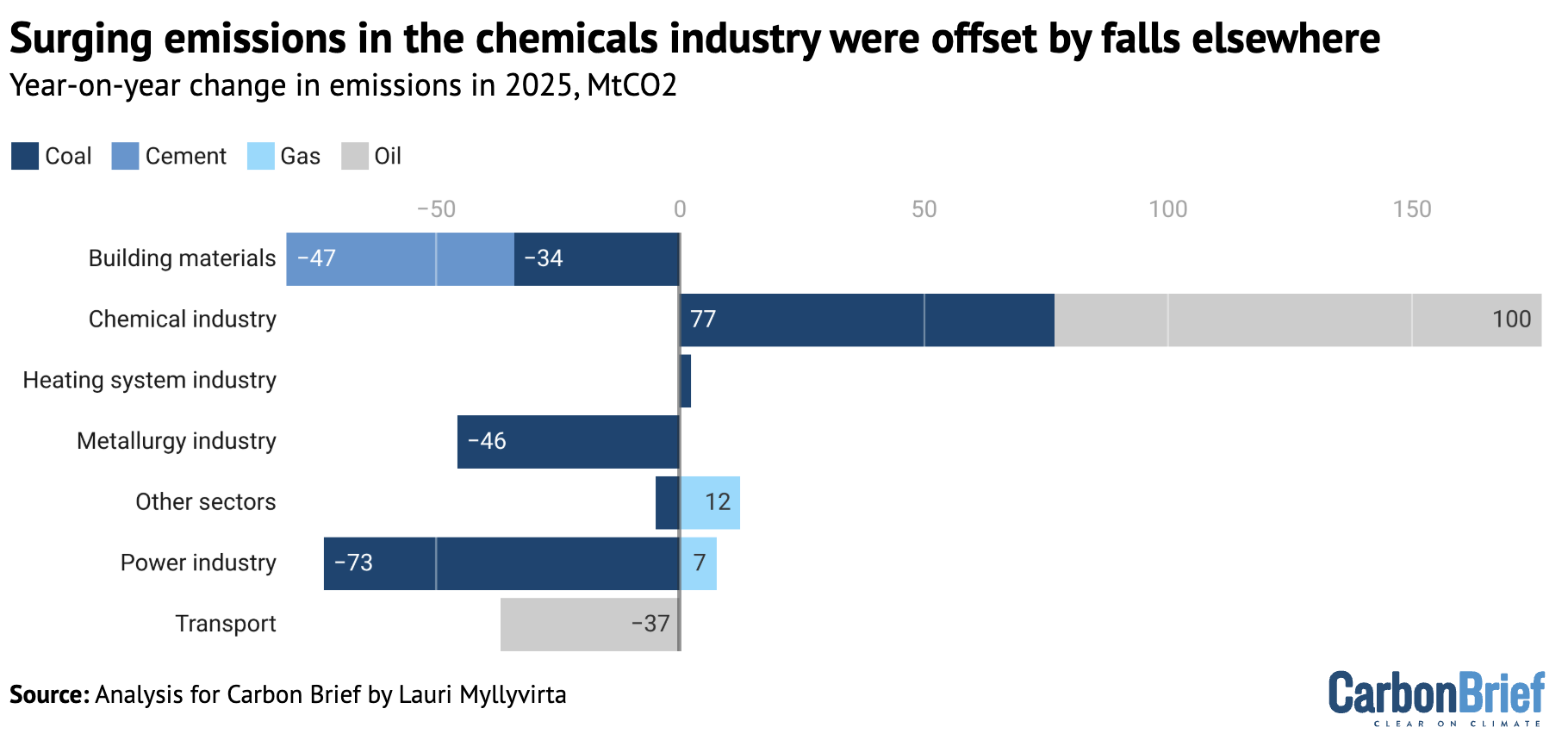
In other sectors – largely other industrial areas and building heat – gas use increased by 2%, more than offsetting the reduction in emissions from a 3% drop in their coal consumption.
Clean power covers electricity demand growth
In the power sector, which is China’s largest emitter by far, electricity demand grew by 520 terawatt hours (TWh) in 2025.
At the same time, power generation from solar increased by 43% and wind power generation by 14%, delivering 360TWh and 130TWh of additional clean electricity. Nuclear power generation grew 8%, supplying another 40TWh. The increased generation from these three sources – some 530TWh – therefore met all of the growth in demand.
Hydropower generation also increased by 3% and bioenergy by 3%, helping push power generation from fossil fuels down by 1%. Gas-fired power generation increased by 6% and, as a result, power generation from coal fell by 1.9%.
Furthermore, the surge in additions of new wind and solar capacity at the end of 2025 will only show up as increased clean-power generation in 2026.
On the other hand, the growth in solar and wind power generation has fallen short of the growth in capacity, implying a fall in capacity utilisation – a measure of actual output relative to the maximum possible. This is highly likely due to increased, unreported curtailment, where wind and solar sites are switched off because the electricity grid is congested.
If these grid issues are resolved over the next few years, then generation from existing wind and solar capacity will increase over time.
Developments in 2025 extended the trend of clean-power generation growing faster than power demand overall, as shown in the top figure below. This trend started in 2023 and is the key reason why China’s emissions have been stable or falling since early 2024.
In addition, 2025 saw another potential inflection point, shown in the bottom figure below. It was the first year ever that energy storage capacity – mainly batteries – grew faster than peak electricity demand in 2025 and faster than the average growth in the past decade.
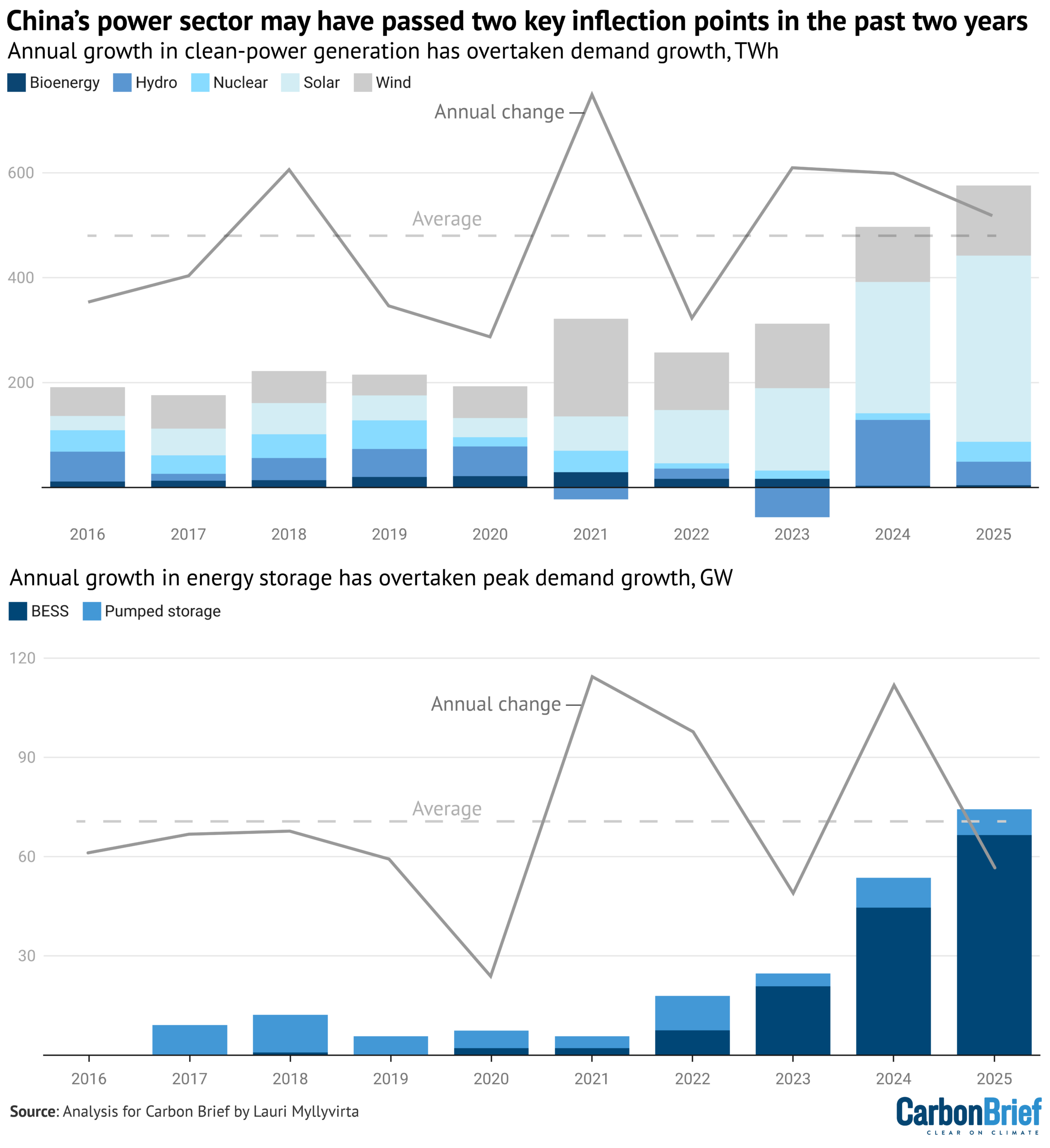
China’s energy storage capacity increased by 75GW year-on-year in 2025, while peak demand only increased by 55GW. The rise in storage capacity in 2025 is also larger than the three-year average increase in peak loads, some 72GW per year.
Peak demand growth matters, because power systems have to be designed to reliably provide enough electricity supply at the moment of highest demand.
Moreover, the increase in peak loads is a key driver of continued additions of coal and gas-fired power plants, which reached the highest level in a decade in 2025.
The growth in energy storage could provide China with an alternative way to meet peak loads without relying on increased fossil fuel-based capacity.
The growth in storage capacity is set to continue after a new policy issued by China’s top economic planner the National Development and Reform Commission (NDRC) in January.
This policy means energy storage sites will be supported by so-called “capacity payments”, which to date have only been available to coal- and gas-fired power plants and pumped hydro storage.
Concerns about having sufficient “firm” power capacity in the grid – that which can be turned on at will – led the government to promote new coal and gas-fired power projects in recent years, leading to the largest fossil-fuel based capacity additions in a decade in 2025, with another 290GW of coal-fired capacity still under construction.
Reforming the power system and increasing storage capacity would enable the grid to accommodate much higher shares of solar and wind, while reducing the need for new coal or gas capacity to meet rising peaks in demand.
This would both unlock more clean-power generation from existing capacity and improve the economics and risk profiles of new projects, stimulating more growth in capacity.
Peaking power CO2 requires more clean-energy growth
China’s key climate commitments for the next five-year period until 2030 are to peak CO2 emissions and to reduce carbon intensity by more than 65% from 2005 levels. The latter target requires limiting CO2 emissions at or below their 2025 level in 2030.
The record clean-energy additions in 2023-25 have barely sufficed to stabilise power-sector emissions, showing that if rapid growth in power demand continues, meeting the 2030 targets requires keeping clean-energy additions close to 2025 levels over the next five years.
China’s central government continues to telegraph a much lower level of ambition, with the NDRC setting a target of “around” 30% of power generation in 2030 coming from solar and wind, up from around 22% in 2025.
If electricity demand grows in line with the State Grid forecast of 5.6% per year, then limiting the share of wind and solar to 30% would leave space for fossil-fuel generation to grow at 3% per year from 2025 to 2030, even after increases from nuclear and hydropower.
Such an increase would mean missing China’s Paris commitments for 2030.
Alternatively, in order to meet the forecast increase in electricity demand without increasing generation from fossil fuels would require wind and solar’s share to reach 37% in 2030.
Similarly, China’s target of a non-fossil energy share of 25% in 2030 will not be sufficient to meet its carbon-intensity reduction commitment for 2030, unless energy demand growth slows down sharply.
This target is unlikely to be upgraded, since it is already enshrined in China’s Paris Agreement pledge, so in practice the target would need to be substantially overachieved if the country is to meet its other commitments.
If energy demand growth continues at the 2025 rate and the share of non-fossil energy only rises from 22% in 2025 to 25% in 2030, then the consumption of fossil fuels would increase by 3% per year, with a similar rise in CO2 emissions.
Still, another recent sign that clean-energy growth could keep exceeding government targets came in early February when the China Electricity Council projected solar and wind capacity additions of more than 300GW in 2026 – well beyond the government goal of “over 200GW”.
Chemical industry
The only significant source of growth in CO2 emissions in 2025 was the chemical industry, with sharp increases in the consumption of both coal and oil.
This is shown in the figure below, which illustrates how CO2 emissions appear to have peaked from cement production, transport, the power sector and others, whereas the chemicals industry is posting strong increases.

Even though chemical-industry emissions are small relative to other sectors – at roughly 13% of China’s total – the pace of expansion is creating an outsize impact.
Without the increase from the chemicals sector, China’s total CO2 emissions would have fallen by an estimated 2%, instead of the 0.3% reported here.
Without changes to policy, emission growth is set to continue, as the coal-to-chemicals industry is planning major increases in capacity.
Whether these expansion plans receive backing in the upcoming five-year plan for 2026-30 will have a major impact on China’s emission trends.
Another key factor is the development of oil and gas prices. Production in the coal-based chemical industry is only profitable when coal is significantly cheaper than crude oil.
The current coal-to-chemicals capacity in China is dominated by plants producing higher-value – and therefore less price-sensitive – chemicals such as olefins and aromatics, as feedstocks for the production of plastics.
In contrast, the planned expansion of the sector is expected to be largely driven by plants producing oil products and synthetic gas to be used for energy. For these products, electrification and clean-electricity generation provide a direct alternative, meaning they are even more sensitive to low oil and gas prices than chemicals production.
Outlook for China’s emissions
This is the latest analysis for Carbon Brief to show that China’s CO2 emissions have now been stable or falling for seven quarters or 21 months, marking the first such streak on record that has not been associated with a slowdown in energy demand growth.
Notably, while emissions have stabilised or begun a slow decline, there has not yet been a substantial reduction from the level reached in early 2024. This means that a small jump in emissions could see them exceed the previous peak level.
China’s official plans only call for peaking emissions shortly before 2030, which would allow for a rebound from the current plateau before the ultimate emissions peak.
If China is to meet its 2030 carbon intensity commitment – a 65% reduction on 2005 levels – then emissions would have to fall from the peak back to current levels by 2030.
Whether China’s policymakers are still committed to meeting this carbon intensity pledge, after the setbacks during the previous five-year period, is a key open question. The 2030 energy targets set to date have fallen short of what would be required.
The most important signal will be whether the top-level five-year plan for 2026-30, due in March, sets a carbon intensity target aligned with the 2030 Paris commitment.
Officially, China is sticking to the timeline of peaking CO2 emissions “before 2030”, which was announced by president Xi Jinping in 2020.
According to an authoritative explainer on the recommendations of the Central Committee of the Communist Party for the upcoming five-year plan, published by state-backed news agency Xinhua, coal consumption should “reach its peak and enter a plateau” from 2027.
It says that continued increases in demand for coal from electricity generators and the chemicals industry would be offset by reductions elsewhere. This is despite the fact that China’s coal consumption overall has already been falling for close to two years.
The reference to a “plateau” in coal consumption indicates that in official plans, meaningful absolute reductions in emissions would have to wait until after 2030. Any increase in coal consumption from 2025 to 2027, before the targeted plateau, would need to be offset by reductions in oil consumption, to meet the carbon intensity target.
Moreover, allowing coal consumption in the power sector to grow beyond the peak of overall coal use and emissions implies slowing down China’s clean-energy boom. So far, the boom has continued to exceed official targets by a wide margin.
In addition, the explainer’s expectation of further growth in coal use by the chemicals industry indicates a green light for at least a part of its sizable expansion plans.
The Xinhua article recognises that oil product consumption has already peaked, but says that oil use in the chemicals industry has kept growing. It adds that overall oil consumption should peak in 2026.
Elsewhere, the article speaks of “vigorously” developing non-fossil energy and “actively” developing “distributed” solar, which has slowed down due to recent pricing policies.
Yet it also calls for “high-quality development” of fossil fuels and increased efforts in domestic oil and gas production, suggesting that China continues to take an “all of the above” approach to energy policy.
The outcome of all this depends on how things turn out in reality. The past few years show it is possible that clean energy will continue to overperform its targets, preventing growth in energy consumption from fossil fuels despite this policy support.
The key role of the clean-energy boom in driving GDP growth and investments is one key motivator for policymakers to keep the boom going, even when central targets would allow for a slowdown. It is also possible that the five-year plans of provinces and state-owned enterprises could play a key role in raising ambition, as they did in 2022.
About the data
Data for the analysis was compiled from the National Bureau of Statistics of China, National Energy Administration of China, China Electricity Council and China Customs official data releases, as well as from industry data provider WIND Information and from Sinopec, China’s largest oil refiner.
Electricity generation from wind and solar, along with thermal power breakdown by fuel, was calculated by multiplying power generating capacity at the end of each month by monthly utilisation, using data reported by China Electricity Council through Wind Financial Terminal.
Total generation from thermal power and generation from hydropower and nuclear power were taken from National Bureau of Statistics monthly releases.
Monthly utilisation data was not available for biomass, so the annual average of 52% for 2023 was applied. Power-sector coal consumption was estimated based on power generation from coal and the average heat rate of coal-fired power plants during each month, to avoid the issue with official coal consumption numbers affecting recent data.
CO2 emissions estimates are based on National Bureau of Statistics default calorific values of fuels and emissions factors from China’s latest national greenhouse gas emissions inventory, for the year 2021. The CO2 emissions factor for cement is based on annual estimates up to 2024.
For oil, apparent consumption of transport fuels – diesel, petrol and jet fuel – is taken from Sinopec quarterly results, with monthly disaggregation based on production minus net exports. The consumption of these three fuels is labeled as oil product consumption in transportation, as it is the dominant sector for their use.
Apparent consumption of other oil products is calculated from refinery throughput, with the production of the transport fuels and the net exports of other oil products subtracted. Fossil-fuel consumption includes non-energy use such as plastics, as most products are short-lived and incineration is the dominant disposal method.
The post Analysis: China’s CO2 emissions have now been ‘flat or falling’ for 21 months appeared first on Carbon Brief.
Analysis: China’s CO2 emissions have now been ‘flat or falling’ for 21 months
Greenhouse Gases
Q&A: What the EU’s new industry and ‘Made in Europe’ rules mean for climate action
The European Commission has put forward a plan to boost production of EU-made, low-carbon steel, cement and renewables in an effort to rely less on other countries.
The proposed “Industrial Accelerator Act” (IAA) aims to boost “resilient and decarbonised” industrial production in EU manufacturing, says the commission.
Under the proposal, a percentage of products bought from “energy-intensive industries” and other sectors under public-procurement deals would be required to be “low-carbon” and made in the EU.
This includes targets for steel, aluminium and electric vehicle (EV) parts.
Non-EU countries with trade agreements, such as the UK and Japan, could also be included in the “Made in Europe” portion of the plan.
The proposal – which must be approved by the European Parliament and EU member states – could save millions of tonnes of carbon dioxide (CO2) by 2030, claims the commission.
Much of the media coverage on the proposed policy focuses on its aim to tackle reliance on China for low-carbon technologies, while Politico calls it a “climate law in disguise”.
In this Q&A, Carbon Brief outlines the key details of the proposal, what must happen for it to take effect and what it could mean for climate change.
Where does the ‘Industrial Accelerator Act’ proposal come from?
The publication of the proposed IAA follows weeks of delays as the EU attempts to boost its manufacturing industries – which have been struggling with international competition and high energy costs – while also supporting decarbonisation.
Industries such as steel, cement and chemicals produce roughly a fifth of the EU’s emissions, so decarbonising them will be essential for achieving the bloc’s net-zero goals.
The IAA is an effort to help energy-intensive industries cut their emissions while remaining globally competitive, in part by “creating lead markets for low-carbon products”.
It was first announced in the European Commission’s 2024 political guidelines, laying out its priorities for the five years out to 2029.
In the section concerning the EU’s plans for a “clean industrial deal” – referring to broader plans to support industries and accelerate their decarbonisation – the guidelines stated:
“We will put forward an industrial decarbonisation accelerator act to support industries and companies through the transition.”
When the clean industrial deal was subsequently released in February 2025, it said the promised act would introduce “clean, resilient, circular, cybersecure” criteria that would “strengthen demand for EU-made clean products”.
The act was also intended to “speed-up permitting for industrial access to energy and industrial decarbonisation” and “develop a voluntary label on the carbon intensity of industrial products”.
Underpinning these plans was the idea of increasing demand for low-carbon products in public and private procurements – in particular, those that were “Made in Europe”.
The proportion of products that will be included under the “Made in Europe” definition remains unclear. In the final proposal, the commission notes it will “tailor requirements to the specific structure, maturity and dependencies of each sector”.
The word “decarbonisation” was dropped from the act’s title by commission president Ursula von der Leyen in her state of the EU address in September 2025, in order “to allow for a broader sectoral and technological scope”.
This reflects wider disputes within the commission itself around the coverage of the IAA. There has also been strong opposition to the proposed “made in Europe” section of the act from different groups of member states.
The debate has also taken place against the background of calls to weaken key parts of EU climate policy – in particular, the EU emissions trading system (ETS).
Environmental groups have voiced concerns about the climate focus of the IAA being sidelined, at the expense of boosting the bloc’s competitiveness.
A major issue in the discussions has been whether the “made in Europe” label should include “trusted partners” from outside the EU, such as the UK and Switzerland.
The commission’s trade directorate has reportedly pushed for a more open system that includes more countries. Germany has been among the member states warning that restrictive rules could deter foreign investment and raise prices.
Meanwhile, Politico reported that the commission’s growth directorate, supported by France, wanted “made in Europe” to be restricted to countries in the European Economic Area – the 27 EU member states alongside Iceland, Liechtenstein and Norway.
The publication of the IAA proposal – which follows on from the automotive package adopted by the EU in December 2025 – was delayed numerous times amid the disagreements.
According to Politico, “haggling” continued over the Monday and Tuesday before the proposal was released, before it could be agreed internally within the commission by the “college of commissioners”.
What is in the IAA proposal?
Following these tense internal negotiations, the European Commission released its IAA proposal on 4 March 2026. It says the proposal will “increase demand for low-carbon, European-made technologies and products”.
The act sets a goal of increasing manufacturing’s share of EU GDP to 20% by 2035, up from 14.3% in 2024.
It introduces “targeted and proportionate” low-carbon and “made in EU” requirements for public procurement and public support schemes for specific sectors.
These will initially apply to steel, cement, aluminium, cars and net-zero technologies – defined within the proposal as batteries, battery energy storage systems (BESS), solar PV, heat pumps, wind turbines, electrolysers and nuclear technologies. It also establishes a framework that could be extended to other energy-intensive sectors in the future.
The commission notes that these sectors have been chosen due to their strategic importance, as well as being “essential enablers of the clean transition and vital to downstream industries”.
However, it says they are facing declining production in Europe, slower decarbonisation investments and global competition and market distortions, such as unfair subsidies.
For steel, the proposal would introduce a requirement for public procurement and public support schemes to use low-carbon steel within the automotive and construction industries.
This will help “create market demand” and “give investors confidence and predictability, boosting innovation and making clean steel a core part of the EU’s industrial future”, says the commission.
However, this falls short of the 70% low-carbon steel requirement that had been included in an earlier draft of the act, according to Reuters. Other earlier drafts of the IAA proposal had also included an emissions label for steel.
This voluntary carbon-intensity label had previously been set out within the clean industrial deal and had originally been expected to come into effect in 2025, before being pushed back and, ultimately, excluded from the IAA.
Beyond steel, the IAA sets minimum “Made in EU” requirements for public procurement of 70% for EVs, 25% for aluminium and 25% for cement.
The European Commission will now offer the UK, Japan and other like-minded countries the opportunity to be included under the “Made in Europe” manufacturing targets, if they offer reciprocal access to EU-based manufacturers, according to the Financial Times. The outlet adds that this is being welcomed by the UK government, which had lobbied for such access for months.
The measures within the IAA are in line with the recommendations of the Draghi report on EU competitiveness, says the commission. As such, it says they are designed to “increase value creation in the EU, strengthening our industrial base against the backdrop of growing unfair global competition and increasing dependencies on non-EU suppliers in strategic sectors”.
Alongside the introduction of requirements on public procurement within the bloc, the IAA proposal highlights that the EU is “committed to maintaining that openness as a key source of economic strength and resilience”.
The EU hosted almost a quarter of global foreign direct investment in 2024.
To further support such investment and ensure the benefits extend to technology transfer and job creation, the IAA introduces additional conditions for international investments.
These would apply for investments of more than €100m in emerging sectors such as batteries, EVs, solar PV and critical raw materials by companies that hold more than 40% of global production capacities.
Conditions would include EU companies holding a majority share, technology transfer, integration into EU value chains and job creation, according to the European Commission. There would also need to be a guarantee that a minimum of 50% of employees are European.
The introduction of common conditions across the bloc would mean the IAA “strike[s] a carefully calibrated balance by ensuring that strategic foreign investments contribute to Europe’s competitiveness, resilience and industrial transformation, while preventing fragmentation”, according to the commission.
Additionally, EU member states would be required to set up a single digital permitting process to “speed up and simplify manufacturing projects” under the IAA.
This would include dedicated single points of contact and maximum timelines of 18 months for certain projects, such as energy-intensive industry decarbonisation projects or those located in “industrial acceleration areas”.
Member states would designate these areas to encourage strategic manufacturing clusters, it says. The commission adds that projects within these areas would benefit from improved coordination and access to infrastructure, finance and skills ecosystems, as well as faster permitting.
What comes next?
The commission’s proposal will now be negotiated by members of the European Parliament and then by country ministers at the Council of the EU.
After these negotiations take place, the proposal can be adopted and the act can take effect.
But this may not be a simple process, as many countries remain divided on the key terms of the proposed law. (See: Where does the ‘Industrial Accelerator Act’ proposal come from?)
Nine EU countries pushed back on the proposal last December, reported Politico. The UK has been “lobbying” countries including Germany, Italy and the Netherlands to oppose it, according to Bloomberg. Reuters noted that the plan is backed by France.
EU commissioner for internal market and services, Stéphane Séjourné, told a press conference on 4 March that the “faster” the proposal moves through the EU lawmaking stages, the “more stability we will actually have”.
After the law takes effect, the commission says it will evaluate the key results three years later. A full review is then proposed after five years.
What could the act mean for carbon emissions?
The IAA could save around 30.6m tonnes of CO2 (MtCO2) in 2030, according to the European Commission.
According to the impact assessment published alongside the proposed act, the changes brought in for the steel, cement, aluminium, battery and vehicle sectors would drive significant CO2 reductions by 2030.
The document breaks down these emissions savings for 2030 as follows:
- Producing more batteries in the EU, rather than relying on imports from China, could save 25.6MtCO2.
- The 25% low-carbon steel target in the automotive and construction sectors could save around 3.4MtCO2.
- Vehicle manufacturing emissions could drop by 0.7MtCO2 due to “shifts in production”.
- The 5% low-carbon cement target could save 0.69MtCO2.
- The 25% low-carbon aluminium target could save 0.22MtCO2.
According to the impact assessment, the emissions required to produce a battery in the EU are around 25% lower than a “Chinese manufactured battery using the average Chinese grid”. This is due to “strict” EU environmental standards, it adds.
The report estimates that all of these savings in CO2 would be worth more than €3bn in avoided climate damages.
Streamlining the process for permitting to “accelerate” decarbonisation projects should also “lea[d] to an accelerated pace of GHG [greenhouse gas] savings”, the document says, but does not list a figure for this.
The impact assessment for the IAA proposal notes that there is currently a “structural imbalance” in the EU’s industrial transition.
It states that although emissions associated with industrial production are declining, this is “largely driven by shrinking production”, rather than improved carbon efficiency.
Carbon emissions and production volumes in the EU iron and steel sectors have dropped “almost in parallel” between 2005 and 2023, says the report.
It adds that projections show that these emissions will need to decline “much faster” to meet future EU climate targets.
The “competitiveness and decarbonisation” of EU manufacturing is “unlikely to improve” without further action, such as the IAA, says the report.
In other words, the IAA effectively aims to ensure that emissions cuts can accelerate while maintaining – or even increasing – industrial production within the EU.
What has the reaction to the IAA been?
While many welcomed the IAA proposal as a “first step”, others criticised the final proposal for walking back on the ambition in earlier drafts.
In a statement released alongside the proposal, Stéphane Séjourné, executive vice-president for prosperity and industrial strategy at the European Commission, said the IAA marked a “major step in the renewal of the European economic doctrine”. He added:
“Facing unprecedented global uncertainty and unfair competition, European industry can count on the provisions of this Act to boost demand and guarantee resilient supply chains in strategic sectors. It will create jobs by directing taxpayers’ money to European production, decreasing our dependencies and enhancing our economic security and sovereignty.”
Others shared his sentiment that in the face of a changing international trade environment, the IAA would boost European competitiveness. Neil Makaroff, director at the European thinktank Strategic Perspectives, said in a statement:
“With its first ‘made in Europe’ policy, the EU is embracing long-overdue economic realism and adapting itself to the new brutal global trade reality. Rather than letting the single market be an open outlet for Chinese overcapacities, each euro of taxpayer money can be directed to rebuild Europe’s manufacturing base. This is how Europeans can start learning the language of industrial powers.”
Tinne van der Straeten, the CEO of WindEurope, said the IAA sent an “important political signal”, but “a simple and harmonised implementation of the new rules is crucial”.
WWF highlighted that public procurement is only a small part of the EU economy and called for complementary measures that also target private consumption.
Camille Maury, senior policy officer on industrial decarbonisation at WWF EU, said:
“The commission has finally pressed the accelerator on clean industry by opening the door to create demand for clean products. However, to win the race to decarbonise, the commission and policy makers will need to put effort into strengthening low-carbon requirement criteria and designing truly green labels for steel and cement that exclude fossil fuel-based production.”
In particular, the lack of a low-carbon label for steel within the IAA drew criticism, with, for example, Daniel Pietikainen, policy manager for steel at climate NGO Bellona Europa, saying:
“The Act no longer provides the basis for a low-carbon steel label. While we can work with the Ecodesign Regulation as the vehicle for a steel label, the commission must commit to an ambitious timeline now. Any operational labelling scheme that is contingent on a delegated act with no clear timeline is not a signal; it is a delay.”
Similarly, the exceptions for international investment in emerging sectors, such as batteries and solar, were labelled as a “very disappointing…watering-down” by Christoph Podewils, secretary general of the European Solar Manufacturing Council. In a statement, he added:
“We need ‘Made in Europe’ to ensure the continent’s long-term energy security. The current explosion in energy prices, caused by the war in Iran, demonstrates the importance of being independent of other regions.
“If the European solar industry has to wait another three years after the legislation is adopted, many companies will have disappeared in the meantime due to ongoing unfair competition from China.”
The post Q&A: What the EU’s new industry and ‘Made in Europe’ rules mean for climate action appeared first on Carbon Brief.
Q&A: What the EU’s new industry and ‘Made in Europe’ rules mean for climate action
Greenhouse Gases
Analysis: UK emissions fall 2.4% in 2025 as coal hits 400-year low
The UK’s greenhouse gas emissions fell by 2.4% in 2025 to their lowest level in more than 150 years, according to new Carbon Brief analysis.
The biggest factors were gas use falling to a 34-year low and coal use dropping to levels last seen in 1600, when Queen Elizabeth I was on the throne and William Shakespeare was writing Hamlet.
These shifts were helped by record-high UK temperatures, elevated gas prices, the end of coal power in late 2024 and a sharp slowdown in the steel industry.
Other key findings of the analysis include:
- The UK’s greenhouse gas emissions fell to 364m tonnes of carbon dioxide equivalent (MtCO2e) in 2025, the lowest level since 1872.
- Coal use roughly halved, with more than half of this due to the end of coal power and another third due to closures and other issues in the steel industry.
- Gas use fell by 1.5% to the lowest level since 1992, with roughly equal contributions from cuts in heat for buildings and industry, more than offsetting a small rise in gas power.
- Oil use fell by 0.9%, despite rising traffic, helped by more than 700,000 new electric vehicles (EVs), electric vans and plug-in hybrids on the nation’s roads.
- The UK’s emissions are now 54% below 1990 levels, while its GDP has nearly doubled.
The 2.4% (8.9MtCO2e) fall in emissions in 2025 was only slightly more than half of the 15MtCO2e cut needed each year on average until 2050, to reach the UK’s legally binding net-zero target.
The analysis is the latest in a decade-long series of annual estimates from Carbon Brief, covering emissions during 2024, 2023, 2022, 2020, 2019, 2018, 2017, 2016, 2015 and 2014.
Emissions fall to 150-year low
The UK’s territorial greenhouse gas emissions – those that occur within the country’s borders – have now fallen in 27 of the 36 years since 1990.
(The recent fall in territorial emissions has not been “offset” by a rise in the amount of CO2 embedded in imports, which has stayed relatively constant since around 2008.)
Apart from brief rebounds after the global financial crisis and the Covid-19 lockdowns, UK emissions have fallen every year for the past two decades.
The latest 9MtCO2e (2.4%) reduction takes UK emissions down to 364MtCO2e, according to Carbon Brief’s analysis, which is 54% below 1990 levels.
This is the lowest since 1872, as shown in the figure below.

The latest fall puts UK emissions below the level seen during the 1926 general strike, when the nation’s industrial base was brought to a standstill.
It means that UK emissions are now at sustained lows not seen since Victorian times.
Nevertheless, emissions will need to continue falling in order to meet the UK’s legal climate goals and its net-zero target, which is part of international efforts under the Paris Agreement to stop dangerous warming.
Record lows for coal and gas
The key factors in driving down UK emissions in 2025 were coal and gas use falling to their lowest levels since 1600 and 1992, respectively.
For gas, this was mainly down to lower demand from building heat and from industry, likely at least partly related to record-high temperatures and elevated gas prices. For coal, this was a combination of the end of coal power and a steel-industry slowdown, as shown below.

These were not the only factors driving the change in UK emissions in 2025.
The UK saw record generation from renewable sources, particularly wind and solar, but a further decline in nuclear generation, the end of coal power and an increase in electricity demand for the second year running meant that gas-fired power output also went up slightly.
In the transport sector, demand for oil fell by 0.9% year-on-year, even though traffic levels went up by around 1%, according to provisional figures through to September 2025.
This partly reflects the changing makeup of vehicles on the road.
By 2024, there were 2.8m fewer diesel vehicles than there were in 2019, a trend likely to continue due to falling diesel car sales. In contrast, there are now nearly 3m EVs, plug-in hybrids or electric vans on the nation’s roads, making up 5% of the car fleet overall and 2% of vans.
These electrified vehicles are cutting UK emissions by more than 7MtCO2 every year, according to Carbon Brief analysis, with the 700,000 new EVs in 2025 alone saving nearly 2MtCO2.
Drivers with EVs saved a total of £2m in lower fuel costs in 2025, the analysis shows, as EVs are much more efficient and, therefore, cheaper to run than petrol or diesel vehicles. This amounts to more than £700 per EV per year and more than £1,100 for each electric van.
Despite falling demand for oil-derived fuels and the impact of the growing EV fleet, Carbon Brief estimates that the UK’s oil-related emissions actually increased by 0.2% in 2025. This is largely down to a shift in the amount and type of biofuel blended into diesel and petrol at the pump.
Coal falls to lowest level in 400 years
There have been dramatic declines in UK coal use over the past decade, in particular resulting from the phaseout of coal-fired electricity generation.
UK coal demand fell by another 56% in 2025 to just under 1m tonnes (Mt). This is down 97% from the 37Mt burned in 2015 and is 99.6% below the peak of 221Mt in 1956.
As shown in the figure below, coal demand is now at the lowest level since 1600, when Elizabeth I was the queen of England and Ireland.
(It was during her five-decade reign that coal had become the country’s main source of fuel, following an Elizabethan “energy crisis” triggered by a lack of wood for making charcoal.)

The UK’s last coal-fired power plant, at Ratcliffe-on-Soar in Nottinghamshire, closed down on 30 September 2024. It had run at low levels that year, but still burned some 0.7m tonnes of coal. The end of coal power contributed nearly three-fifths of the fall in demand for the fuel in 2025.
There has also been a marked reduction in UK steel production in recent years, particularly since the closure of two of the nation’s last blast furnaces at Port Talbot in south Wales in 2024.
The last blast furnaces in the country are at the British Steel plant in Scunthorpe in Lincolnshire, which had been due for closure in early 2025 until the government stepped in to keep it open.
The slowdown in coal-based steel production accounts for around a third of the decline in UK coal use in 2025, but only 14% of the drop in the past decade, which was mainly due to coal power.
Globally, the steel industry is facing intense competition in an oversupplied market, with a growing “glut” that has driven down prices. At the same time, the industry in the UK has ageing equipment and expensive electricity, which UK Steel says is largely a result of high gas prices.
The Port Talbot site is being converted to “electric arc furnace” (EAF) steelmaking, which does not rely on coal. The same shift is under discussion for the Scunthorpe site. Analysis from thinktank Green Alliance suggests EAFs would be the cheapest option for both sites.
Gas falls to lowest level in 34 years
There have also been dramatic declines in UK demand for gas over the past 15 years. After another 1.5% drop in 2025, gas use is now at the lowest level since 1992, as shown below.
This means gas demand is now similar to when the UK began its “dash for gas” in the early 1990s. Starting in 1991, this period saw a wave of new gas-fired power stations being built. It was triggered by a change in regulations to allow the use of gas to generate electricity, advances in turbine technology, a period of low gas prices and the privatisation of the UK electricity system.
In total, UK gas demand has fallen by nearly two-fifths since 2010. Half of this overall reduction is due to a 50% fall in gas-fired electricity generation, which has been displaced by falling demand and renewable sources. Another third of the overall reduction is from home heating, where demand has dropped due to more efficient gas boilers and improved insulation.

In 2025, the 1.5% reduction in gas use was caused by roughly equal contributions from lower demand for building heat and from industrial users.
This was helped by 2025 being the hottest year on record, with high gas prices likely also a factor.
Gas prices have remained significantly above the levels seen before Russia’s invasion of Ukraine in 2022. At the start of March 2026, UK gas prices roughly doubled as a result of the conflict in the Middle East triggered by the US and Israeli attacks on Iran.
Whereas the UK’s fleet of EVs is already having a significant impact on emissions, domestic heat pump sales remain at relatively low levels, particularly compared with other European nations.
After a 25% year-on-year increase in 2025, there were still only 125,000 heat pump sales in the UK. These new installations will have cut UK emissions by around 0.2MtCO2 in 2025 relative to gas heating, shows Carbon Brief analysis.
By the end of 2025, the UK had a total of around 450,000 domestic heat pumps, generating total savings of roughly 0.7MtCO2 after accounting for the increase in electricity demand.
The 2.3m domestic heat pumps expected by 2030 in the National Energy System Operator’s “future energy scenarios” would save the UK around 4.5MtCO2 per year.
Emissions continue to decouple from growth
In total, UK greenhouse gas emissions in 2025 fell to 54% below 1990 levels, the baseline year for its legally binding climate goals.
Since then, the UK economy has nearly doubled in size, with GDP growing by 95% according to data from the World Bank, as shown in the figure below.

Transport remains the single-largest sector, accounting for around 30% of UK emissions, followed, in order, by buildings, agriculture, industry and electricity generation.
The majority of emissions cuts over recent decades have come in the power sector – formerly, the UK’s largest emitter – as coal has been phased out and renewables have replaced gas.
This is set to change over the next 10-15 years. The rise of EVs is set to make transport the largest source of emissions cuts from now until 2040, according to the Climate Change Committee.
While industrial emissions have also declined significantly since 1990, falling some 74% by 2025, the size of UK manufacturing output has also roughly doubled.
Despite the progress in cutting emissions to date, the UK has a long way to go if it is to meet its climate goals in the future, including the yet-to-be legislated seventh “carbon budget”, covering the years 2038-2042, as well as the 2050 net-zero target.
Emissions would need to fall by 15MtCO2e each year until 2050 on average, in order to meet the net-zero target. Meeting the UK’s 2035 international pledge under the Paris Agreement, a 78% reduction below 1990 levels, emissions would need to fall by 22MtCO2e per year.
These figures can be compared with the 9MtCO2e cut achieved in 2025. Emissions did, in fact, fall by an average of 15MtCO2e per year over the past decade – and by an average of 13MtCO2e per year since the turn of the century.
Methodology
The starting point for Carbon Brief’s analysis of UK greenhouse gas emissions is preliminary government estimates of energy use by fuel. These are published monthly, with the final month of each year appearing in figures published at the end of the following February. The same approach has accurately estimated year-to-year changes in emissions in previous years (see table, below).
Annual change in UK greenhouse gas emissions, %
| Year | Official figures | Carbon Brief | Difference |
|---|---|---|---|
| 2010 | 2.5 | 2.7 | 0.1 |
| 2011 | -7.2 | -7.7 | -0.4 |
| 2012 | 3.1 | 3.6 | 0.6 |
| 2013 | -2.1 | -4.1 | -2.0 |
| 2014 | -7.4 | -7.5 | -0.1 |
| 2015 | -3.8 | -3.7 | 0.0 |
| 2016 | -5.4 | -5.7 | -0.3 |
| 2017 | -2.4 | -2.0 | 0.4 |
| 2018 | -1.6 | -1.7 | -0.1 |
| 2019 | -3.6 | -3.9 | -0.3 |
| 2020 | -8.9 | -8.8 | 0.1 |
| 2021 | 3.6 | 3.5 | -0.1 |
| 2022 | -4.3 | -3.6 | 0.7 |
| 2023 | -5.0 | -5.2 | -0.2 |
| 2024 | -2.7 | -3.0 | -0.3 |
| 2025 | -2.4 |
One large source of uncertainty is the provisional energy use data, which is revised at the end of March each year and often again later on.
Emissions data is also subject to revision in light of improvements in data collection and the methodology used, with major revisions in 2021 and more minor changes in early 2026.
The latest changes to the DESNZ emissions methodology have led to 2% reduction in baseline 1990 emissions, but the impact on recent years is minimal.
This does not affect the UK’s carbon budgets, which are set in terms of tonnes of emissions over a five-year period, rather than a percentage reduction compared with 1990 levels.
The table above applies Carbon Brief’s emissions calculations to the comparable energy use and emissions figures, which may differ from those published previously.
Another source of uncertainty is the fact that Carbon Brief’s approach to estimating the annual change in emissions differs from the methodology used for the government’s own provisional estimates. The government has access to more granular data not available for public use.
Carbon Brief’s analysis takes figures on the amount of energy sourced from coal, oil and gas reported in Energy Trends 1.2. These figures are combined with conversion factors for the CO2 emissions per unit of energy, published annually by the UK government. Conversion factors are available for each fuel type, for example, petrol, diesel, gas and coal for electricity generation.
For oil, the analysis also draws on Energy Trends 3.13, which further breaks down demand according to the subtype of oil, for example, petrol, jet fuel and so on. Similarly, for coal, the analysis draws on Energy Trends 2.6, which breaks down solid fuel use by subtype.
Emissions from each fuel are then estimated from the energy use multiplied by the conversion factor, weighted by the relative proportions for each fuel subtype.
For example, the UK uses roughly 50m tonnes of oil equivalent (Mtoe) in the form of oil products, around half of which is from road diesel. So half the total energy use from oil is combined with the conversion factor for road diesel, another one-fifth for petrol and so on.
Energy use from each fossil fuel subtype is mapped onto the appropriate emissions conversion factor. In some cases, there is no direct read-across, in which case the nearest appropriate substitute is used. For example, energy use listed as “bitumen” is mapped to “processed fuel oils – residual oil”. Similarly, solid fuel used by “other conversion industries” is mapped to “petroleum coke” and “other” solid fuel use is mapped to “coal (domestic)”.
The energy use figures are calculated on an inland consumption basis, meaning they include bunkers consumed in the UK for international transport by air and sea. In contrast, national emissions inventories exclude international aviation and shipping.
The analysis, therefore, estimates and removes the part of oil use that is due to the UK’s share of international aviation. It draws on the UK’s final greenhouse gas emissions inventory, which breaks emissions down by sector and reports the total for domestic aviation.
This domestic emissions figure is compared with the estimated emissions due to jet fuel use overall, based on the appropriate conversion factor. The analysis assumes that domestic aviation’s share of emissions is equivalent to its share of jet fuel energy use.
In addition to estimating CO2 emissions from fossil fuel use, Carbon Brief assumes that CO2 emissions from non-fuel sources, such as land-use change and forestry, are the same as a year earlier. The remaining greenhouse gas emissions are assumed to change in line with the latest government energy and emissions projections.
These assumptions are based on the UK government’s own methodology for preliminary greenhouse gas emissions estimates, published in 2019.
Note that the figures in this article are for emissions within the UK measured according to international guidelines. This means they exclude emissions associated with imported goods, including imported biomass, as well as the UK’s share of international aviation and shipping.
The Office for National Statistics (ONS) has published detailed comparisons between various approaches to calculating UK emissions, on a territorial, consumption, “environmental accounts” or “international accounting” basis.
The UK’s consumption-based CO2 emissions increased between 1990 and 2007. Since then, however, they have fallen by a similar number of tonnes as emissions within the UK.
Bioenergy is a significant source of renewable energy in the UK and its climate benefits are disputed. Contrary to public perception, however, only around one-quarter of bioenergy is imported.
International aviation is considered part of the UK’s carbon budgets and faces the prospect of tighter limits on its CO2 emissions. The international shipping sector has a target to at least halve its emissions by 2050, relative to 2008 levels.
The post Analysis: UK emissions fall 2.4% in 2025 as coal hits 400-year low appeared first on Carbon Brief.
Analysis: UK emissions fall 2.4% in 2025 as coal hits 400-year low
Greenhouse Gases
China Briefing 5 March 2026: New five-year climate goals revealed at ‘two sessions’ meeting
Welcome to Carbon Brief’s China Briefing.
China Briefing handpicks and explains the most important climate and energy stories from China over the past fortnight. Subscribe for free here.
Key developments
Government ‘work report’ for 2026 announced
LOWER GROWTH: China is aiming for economic growth of 4.5-5% in 2026, reported state-run newspaper China Daily in its coverage of the “government work report” – an outline of China’s policies in 2026 delivered by Chinese premier Li Qiang at the annual “two sessions” meeting of key government and party officials in Beijing. This is the lowest target since 1991, said BBC News, as China “grapples with challenges both at home and abroad”. Li said “geopolitical risks are rising”, noted the Financial Times. The lower GDP target reflects a shift to what Beijing calls “high-quality growth”, said the Guardian.
‘GREEN DEVELOPMENT’: The work report cited the publication of China’s 2035 climate pledge under the Paris Agreement as one of the achievements made last year, noted state-run broadcaster CGTN. Another CGTN article said that “new quality productive forces” also “grew steadily” in 2025, referring to a term that includes “green development”. Financial services firm ING said that the report highlighted priorities for 2026 including “high-quality” and “green development”, as well as domestic consumption, but that it also scaled back China’s consumer “trade-in” policy relative to 2025.
‘LAX’ INTENSITY: The report set a target to cut China’s “carbon intensity” – its carbon dioxide (CO2) emissions per unit of GDP – by 3.8% in 2026, reported Reuters, which quoted Lauri Myllyvirta of the Centre for Research on Energy and Clean Air saying this was “alarmingly lax”. He told Carbon Brief that emissions could rise by up to 0.5-1.0% while still meeting this target.
DUAL-CARBON DOUBTS: The work report said that China’s goal of peaking CO2 emissions before 2030 would be “accomplished as planned” and that a system to control the total amount of emissions would also be implemented, said Bloomberg. The report offers little detail on the shift to this system for the “dual control of carbon”, said Greenpeace East Asia’s Yao Zhe in a statement.

TRANSITION FUND: Another China Daily article reported that China will “establish a national fund for low-carbon transition” this year. Citing the work report, it said this fund would be used to “foster new growth drivers such as hydrogen power and green fuels”. The newspaper pointed to other climate-related elements of the report, including promoting the “clean and efficient use of fossil fuels” and “zero-carbon industrial parks”, expanding the coverage of China’s emissions trading system and improving systems for carbon accounting.
Pre-meeting positioning
CARBON ‘CO-BENEFIT’S: The Ministry of Ecology and Environment (MEE) published new air quality standards that could “cut CO2 [carbon dioxide] emissions by more than 7bn metric tonnes [over a decade] as a co-benefit”, said the state-run newspaper China Daily. Energy news outlet China Energy Net reported that these co-benefits could come from the new standards “effectively fostering…development of new quality productive forces such as clean energy and new-energy vehicles”, as well as driving low-carbon transitions in the “industrial, energy and transportation” sectors.
GATHERING VIEWS: In a press conference held ahead of the two sessions, MEE spokesperson Pei Xiaofei told Shanghai-based outlet the Paper that 85% of policy proposals submitted to the ministry for the meetings were focused on “building a Beautiful China”, meeting China’s carbon peak and neutrality goals and “tackling pollution”. According to a partial transcript published on the MEE website, MEE atmospheric environment director Li Tianwei said “heavy reliance” on fossil fuels, dominance of heavy industries and “road-centric” transport presented continuing “challenges” for emissions reduction.
-
Sign up to Carbon Brief’s free “China Briefing” email newsletter. All you need to know about the latest developments relating to China and climate change. Sent to your inbox every Thursday.
OFFICIAL OUTLOOK: Several director generals of National Energy Administration (NEA) departments published articles on their outlook for the fifteenth five-year plan. Development and planning department head Ren Yuzhi wrote in China Electric Power News that China must “expand the non-fossil energy supply system”, construct a power system “compatible with high proportions of renewable energy” and “promote the peaking of coal and oil consumption”. Head of the new energy and renewable energy department Li Chuangjun argued that the “main” direction for clean energy was “expanding scale, improving quality and ensuring reliable substitution”. The heads of the oil and gas, market regulation and power safety departments also authored articles.
OFFICIAL STATS: Meanwhile, new government statistics showed that China’s energy and industry emissions saw a 0.3% decline in 2025, reported the Financial Times. [The data confirmed earlier analysis for Carbon Brief that also calculated a drop of 0.3%.] The data release also revealed that “solar power generation overtook wind for the first time” in 2025, according to Bloomberg. China’s carbon intensity fell 5.1% in 2025, reported the state-run newspaper China Daily in its coverage of the data. [Carbon Brief put this figure at 4.7%, but the scope of the official data appears to have changed.]
Merz’s many meetings
EXTENDED COOPERATION: China and Germany signed an agreement on climate change during a visit by chancellor Friedrich Merz to Beijing, reported Agence France-Presse. The agreement to “extend” a Sino-German dialogue and cooperation mechanism on “climate change and the green transition” pledged to focus on “energy, industry, energy efficiency and the circular economy”, as well as “further implementing the objectives of the Paris Agreement”, said energy news outlet BJX News. Reuters noted that Germany signed far fewer agreements than the UK or Canada during their own recent visits, quoting Merz as saying that trade dynamics were “not healthy” due to overcapacity.
TECH TOUR: Xi told Merz that Germany’s focus on “technology, innovation and digitalisation…aligns closely with China’s smart, green and integrated development”, reported state news agency Xinhua. Merz later met with the heads of several Chinese technology firms in the eastern city of Hangzhou, including representatives from electric vehicle companies, reported the Hong Kong-based South China Morning Post (SCMP).
OVERCAPACITY OUTCRY: Ahead of Merz’s China visit, EU trade chief Maroš Šefčovič called for adapting global trading rules to account for “overcapacities”, “unfair trade policies” and “state subsidies”, said SCMP, quoting Šefčovič as saying Europe was “monitoring very closely the increase of plug-in hybrid Chinese vehicle” exports to the EU. The International Monetary Fund (IMF) also called on China to halve state support for industry, noting that industrial policies are “giving rise to international spillovers and pressures” and have had a “negative” impact on China’s economy, according to the Financial Times.
More China news
- ENERGY SECURITY: Chinese refiners have been instructed to “suspend exports of diesel and gasoline” following the outbreak of the Iran war, reported Bloomberg.
- GET THE GAS: China will waive some import charges for certain oil and gas exploration equipment and gas imports to “improve” energy production and “support” gas utilisation, said energy news outlet International Energy Net.
- LAW REVISIONS: The NEA aims to revise the Electricity Law and Renewable Energy Law in 2026, according to economic news outlet Jiemian.
- DIPLOMATIC ENDEAVOURS: The party committee of China’s Ministry of Foreign Affairs wrote in the communist party-affiliated People’s Daily that addressing climate change through “concrete actions” is a major element of its diplomatic strategy.
- SOLAR RUSH: Solar manufacturers are “ramping up production to boost exports” ahead of the cancellation of solar-export rebates in April, reported energy news outlet China Energy Net.
- DOC DROP: The UK has published its climate agreement with China, signed last year, which includes agreements on “offshore windfarms, electricity grids, battery storage, carbon capture and hydrogen”, reported the Daily Telegraph.
Captured

Spotlight
How climate features in China’s 15th five-year plan
China will set a carbon-intensity reduction target of 17% for 2030, according to a draft of the 15th five-year plan– although analysts note changes to the metric’s methodology.
More broadly, the draft represents continuity with China’s “build before breaking” approach to the energy transition.
Below are some of its key implications for China’s energy transition. A full analysis will be published on the Carbon Brief website tomorrow.
‘Active and steady’ advance
Achieving China’s climate targets will remain a key driver of the country’s policies in the next five years from 2026-30, according to the draft 15th five-year plan.
The draft, released this morning, said China will “actively and steadily advance and achieve carbon peaking”, with policymakers continuing to strike a balance between building a “green economy” and ensuring stability.
Five-year plans are one of the most important documents in China’s political system, outlining policy direction for the next five years.
The latest plan covers the years until 2030, before which China has pledged to peak its carbon emissions. (Analysis for Carbon Brief found that emissions have been “flat or falling” since March 2024.)
China will “continue to pursue” its established direction and objectives on climate, Professor Li Zheng, dean of the Tsinghua University Institute of Climate Change and Sustainable Development (ICCSD), told Carbon Brief.
Carbon-intensity confusion
In the lead-up to the release of the plan, analysts were keenly watching for signals around China’s adoption of a “dual-control of carbon” system that will see targets set for both carbon intensity and total carbon emissions.
Looking back at the previous five-year plan period, the latest document said China had already achieved a carbon-intensity reduction of 17.7%, just shy of its 18% goal.
Analysis by Lauri Myllyvirta, lead analyst at the Centre for Research on Energy and Clean Air (CREA), had suggested that China had only cut its carbon intensity by 12% over the past five years.
He told Carbon Brief that the newly reported 17.7% figure is likely due to an “opportunistic” methodological revision to include industrial processes.
The draft 15th five-year plan sets a binding target of another 17% reduction in carbon intensity by 2030. The new methodology means that this leaves space for overall emissions to rise by “3-6% over the next five years”, Myllyvirta said.
The plan also did not set an absolute emissions cap, although Myllyvirta noted that a cap may be announced later in the five-year period, or imposed on select industries via China’s carbon market.
Double in a decade
The five-year plan continued to call for China’s development of a “new energy system that is clean, low-carbon, safe and efficient” by 2030, with continued additions of “wind, solar, hydro and nuclear power”.
It also called for a doubling of “non-fossil energy” in “10 years” – although it did not clarify whether this meant their installed capacity or electricity generation, or what the exact starting point would be.
Research has shown that doubling wind and solar capacity by 2035 in China would be “consistent” with aims to limit global warming to 2C.
But the plan continued to support the “clean and efficient utilisation of fossil fuels” and did not mention either a cap or peaking timeline for coal consumption.
“How quickly carbon intensity is reduced largely depends on how much renewable energy can be supplied,” said Yao Zhe, global policy advisor at Greenpeace East Asia, in a statement.
Meanwhile, clean-energy technologies continue to play a role in upgrading China’s economy, with several “new energy” sectors listed as key to its industrial policy.
Named sectors include smart electric vehicles, “new solar cells”, new-energy storage, hydrogen and nuclear fusion energy.
This comes as the EU outlined measures to limit China’s hold on clean-energy industries.
However, China is unlikely to crack down on clean-tech production capacity, Dr Rebecca Nadin, director of the Centre for Geopolitics of Change at ODI Global, told Carbon Brief.
Instead, she said, Beijing is “prepared to pour investment into these sectors to cement global market share, jobs and technological leverage”.
Watch, read, listen
‘A LOT AT STAKE’: The Penn Project on the Future of US-China Relations held a webinar discussing China’s strength in clean-energy industries and how the US should respond.
KEEPING COAL AFLOAT: Electricity Market Tracker explored the impact of China’s coal “capacity payment” mechanism and what it could mean for the country’s energy transition.
TRACKING PRIORITIES: The Oxford Institute for Energy Studies podcast outlined key energy and climate issues to watch in China in 2026.
FINDING BALANCE: The Asia Society Policy Institute unpacked the drivers behind China’s overcapacity challenges and what a “plausible new equilibrium” might look like.
166.6bn yuan
The direct economic losses ($24.2bn) caused by “floods and geological disasters” in China last year, according to a National Bureau of Statistics data release published by BJX News. China suffered a further 8.6bn yuan ($1.3bn) in losses due to drought, it added.
New science
- Rising greenhouse gas emissions have caused “icing days” – during which the daily maximum temperature is lower than 0C – to become less common, but more intense in China over 1961-2020 | Journal of Geophysical Research, Atmospheres
- “A-share listed companies” in China “significantly enhanced” their carbon emission reductions and green innovation over 2007-22 in response to rising “climate risk”, but did not show a significant change to their “environmental protection” | Mitigation and Adaptation Strategies for Global Change
Recently published on WeChat
China Briefing is written by Anika Patel and edited by Simon Evans. Simon Evans contributed to the writing of this edition. Please send tips and feedback to china@carbonbrief.org
The post China Briefing 5 March 2026: New five-year climate goals revealed at ‘two sessions’ meeting appeared first on Carbon Brief.
China Briefing 5 March 2026: New five-year climate goals revealed at ‘two sessions’ meeting
-
Greenhouse Gases7 months ago
Guest post: Why China is still building new coal – and when it might stop
-
Climate Change7 months ago
Guest post: Why China is still building new coal – and when it might stop
-
Greenhouse Gases2 years ago嘉宾来稿:满足中国增长的用电需求 光伏加储能“比新建煤电更实惠”
-
Climate Change2 years ago
Bill Discounting Climate Change in Florida’s Energy Policy Awaits DeSantis’ Approval
-
Climate Change2 years ago
Spanish-language misinformation on renewable energy spreads online, report shows
-
Climate Change2 years ago嘉宾来稿:满足中国增长的用电需求 光伏加储能“比新建煤电更实惠”
-
Climate Change Videos2 years ago
The toxic gas flares fuelling Nigeria’s climate change – BBC News
-
Carbon Footprint2 years agoUS SEC’s Climate Disclosure Rules Spur Renewed Interest in Carbon Credits