Connect with us

Published

on

Solar technology in Australia is no longer just panels installed on rooftops for residents; it is evolving into
something smarter, sleeker, and far more efficient power option.

From copper-infused cells that boost energy output to AI-driven systems that optimize panel performance in real time,
Australia is quietly becoming a global testing ground for the solar revolution.

Moreover, the addition of ultra-thin flexible panels, solar windows, and even solar paint has made it clear that the
future of energy is no longer on the horizon; it’s already reshaping how and where we harness the sun.

But this is just the beginning. Many more emerging technologies and integrated solar storage systems are poised to
push
the boundaries of what’s possible.

So, what is the future technology of solar panels
in Australia?

Let’s have a look!

A Glimpse of Tomorrow: What’s Changing in Solar Technology?

The solar panels of tomorrow are not only more efficient, but they’re also smarter, cheaper, and more versatile.

Although traditional silicon-based solar panels have served us well, as we look ahead to the next decade, they are making way for groundbreaking innovations tailored explicitly to Australia’s diverse climate, environment, and energy needs.

So, in the following part, let’s dive into the key trends reshaping solar panel technology in Australia.

Advancements in Solar Cell Technologies

Researchers are continuously working on improving the efficiency of solar cells. These technologies may become more prominent in the Australian market as they mature.

However, recently, Perovskite solar cells, for example, have shown great promise for Australians due to their higher efficiency and lower manufacturing costs than traditional silicon-based cells.

In addition to perovskites, next-generation solar cell architectures such as Bifacial and Tandem solar cells are also gaining attention.

Next-Gen Efficiency: Tandem, Bifacial, and Perovskite Panels in Australia

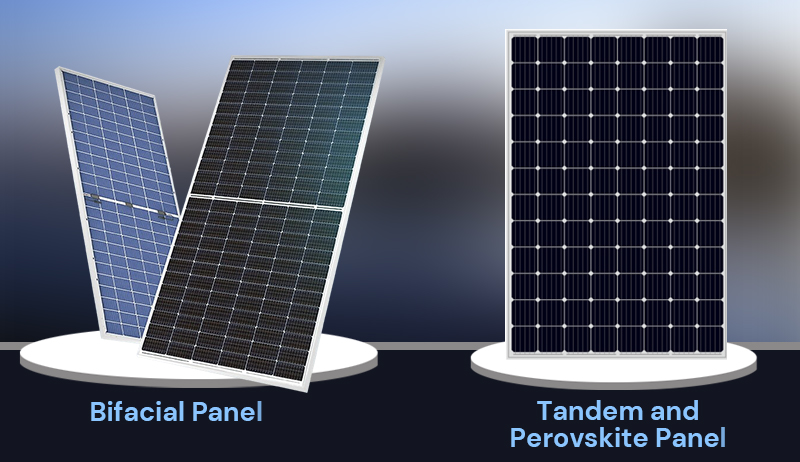
Bifacial Solar Panel  

These panels can capture sunlight from both the front and back sides, increasing the total energy output. These panels can utilize reflected and diffused light, making them suitable for installation in various environments.   

They can produce 10–30% more energy than conventional panels, especially in Australia’s reflective landscapes, such as deserts, sandy soils, or water bodies. 

Additionally, as the cost of bifacial panels continues to decrease, their adoption is expected to increase. 

Tandem and Perovskite Panels 

These combine two or more layers of different photovoltaic materials to absorb a broader range of the solar spectrum, further enhancing efficiency. 

Why are they different?  

  • These tandem solar cells use layers of different materials to capture a wide range of sunlight.
  • Some combinations, such as perovskite-silicon tandems, are achieving lab efficiencies of 30%, significantly higher than those of standard panels. 

Beyond the Panels: The Rise of Solar Skins  

Most solar panels are installed on rooftops or ground-mounted systems, which can ruin building aesthetics or occupy valuable land space.   

A possible solution is to create solar skins, which are thin, flexible materials that can harvest solar energy and also serve as functional or decorative elements in buildings or vehicles.  

Solar skins can be made from various technologies, such as:  

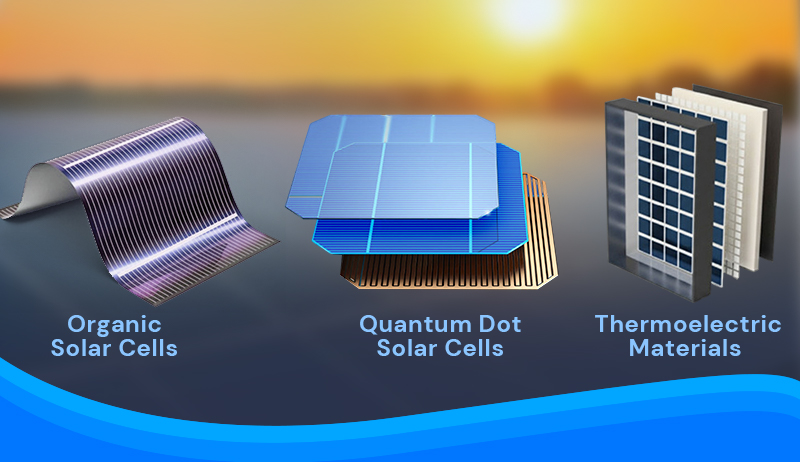
Organic Solar Cells 

These cells use organic molecules, such as polymers or dye-sensitized materials, to absorb sunlight and generate electricity. They can be made into colorful and transparent films that can be applied to various surfaces.  

Quantum Dot Solar Cells  

These cells utilize nanoscale crystals, known as quantum dots, to absorb sunlight and generate electricity. They can be tuned to different colors and brightness levels by changing their size or shape.  

Thermoelectric Materials  

These materials can convert heat into electricity or vice versa. They can harvest waste heat from buildings or vehicles and turn it into useful power.  

So, what are the advantages of integrating solar skins over conventional panels?   

Solar skins have several advantages over conventional solar panels, such as:  

  • Versatility: Solar skins can be integrated into various shapes and forms, such as windows, walls, roofs, pavements, cars, buses, or trains.  
  • Aesthetics: Solar skins can be designed to match the color and style of the existing environment or create new visual effects.  
  • Functionality: Solar skins can also provide additional benefits, such as insulation, shading, lighting, or communication.  

Solar skins are also still in the research and development stage and face challenges such as durability, reliability, and compatibility.  

Moreover, Australian researchers are exploring new ways to create and apply solar skins for various applications.  

Building-Integrated Solar: Blending Beauty and Power

Who wants to settle for space-consuming rooftop solar mounting when it can be seamlessly integrated into your
building?

The future of solar energy in Australia is no longer limited to rooftops only. Nowadays, solar power is being
integrated
directly into buildings, bridges, and even windows.

Let’s see how it works:

Building-Integrated Photovoltaics (BIPV)

Building-Integrated Photovoltaics (BIPV) refers to solar power technology that is integrated directly into the
building
materials, such as the roof, facade, windows, or skylights, rather than mounted on top of an existing structure.

Key Features of BIPV:

  • They serve a Dual purpose, acting as both a building material and a power generator.
  • These enhance the building’s aesthetic, which is more visually appealing than that of traditional rooftop panels.
  • With BIPV technology, you can save space, eliminating the need for extra structures or roof space.
  • These solutions are customizable and especially attractive for architects, developers, and homeowners seeking
    aesthetics
    without sacrificing energy production.

Though still more expensive than standard panels, prices are dropping rapidly, and BIPV is expected to become more
accessible to the mainstream market within the next few years.

Transparent Solar Glass

These solar cells allow visible light to pass through while generating energy. It’s more like turning windows into
power
sources.

In Australia, researchers have already developed transparent perovskite cells with an efficiency of 17% at a
transparency of 10%.

They can be used in office towers, shopping centers, or even home windows, turning every surface into a power source.

Floating Solar Farms: Making the Most of Water Surfaces

In the Australian urban areas, space is precious. Residents face intense pressure on land use, particularly around
farmland and nature reserves.

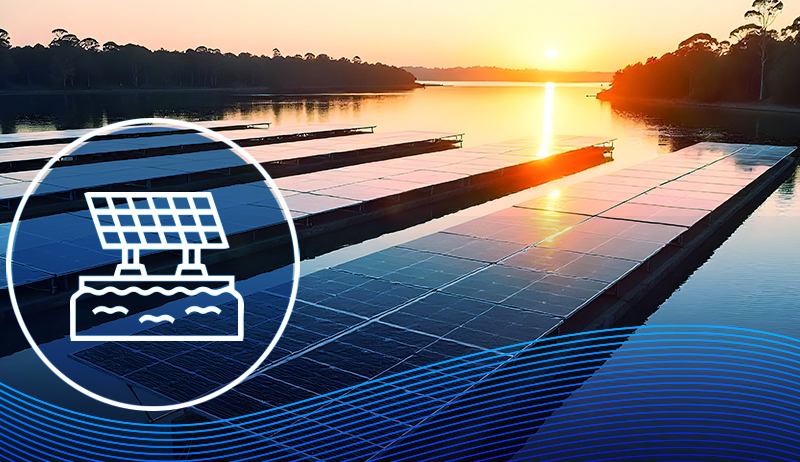
To address this, they plan to utilize water bodies such as reservoirs, lakes, rivers, and wastewater treatment ponds
for floating solar farms, thereby turning unused surfaces into sources of clean energy.

  • These solar farms are also referred to as Floatovoltaics, which reduce land use, cut
    carbon footprint
    , boost
    efficiency through cooling, and deliver a cleaner lifecycle.
  • They have several advantages, including reducing evaporation, keeping panels cool to increase efficiency, and
    significantly reducing their carbon footprint.
  • With many reservoirs and drought-prone zones, floating solar is both efficient and smart.

Australia is well-positioned to adopt this advanced technology, particularly in regions with high evaporation rates
and limited land availability. Not only this!

Floating solar also complements hydroelectric infrastructure, offering a dual-use approach to renewable energy and
water management.

Agrivoltaics: Farming and Energy in Harmony

Confused about choosing between solar panels and farmland? Why not have both?

Rather than competing for land, imagine rows of crops growing under solar panels, or sheep grazing peacefully beneath a sun-powered grid. That’s how agrivoltaics works, a system that combines solar energy and agriculture in perfect harmony.

It’s a smart, space-efficient solution that lets your land do double work, making your energy system more productive, sustainable, and future-ready.

Here’s how agrivoltaics benefits Australians:

  • Panels provide partial shade, which can help certain crops thrive in hot conditions.
  • Farmers get a second revenue stream, energy from the sun, alongside food from the land.
  • In dry or drought-prone regions, agrivoltaics can also reduce soil erosion and evaporation.

Research shows that with smart design, agrivoltaics can boost both crop yields and energy generation.

So, isn’t it a win-win for the environment, the economy, and regional communities?

Smart Home Energy Management and Grid Integration in Australia

In Australia, residents are integrating solar energy into smart home ecosystems and the electrical grid for efficient
and responsive energy usage.

It enables homeowners to generate, store, use, and even sell energy in a manner that optimizes both personal savings
and
grid stability.

The integration of solar power systems with smart home and grid technologies is a significant trend in the solar
power
industry.

Home Energy Management Systems

Home energy management systems utilize advanced software and intelligent algorithms to optimize energy usage and
maximize self-consumption. These systems monitor energy generation and consumption patterns.

These smart homes allow homeowners to make informed decisions about their energy usage and identify areas for further
improvement in efficiency.

Grid Integration and Demand Response

Do you know that integrating solar panel systems with the electricity grid enables more effective energy supply and
demand management?

In Australia, homeowners can participate in demand response programs, where their solar power systems can be remotely
controlled to adjust energy generation and energy consumption
based on grid conditions.

This integration helps improve grid stability, reduce peak demand, and create a more resilient and efficient energy
infrastructure.

Energy Storage Integration

Solar Battery technologies are evolving rapidly, offering higher energy density, longer lifespans, and faster
charging
capabilities.

In the Australian energy market, Lithium-ion batteries have
been dominating over the years. However, emerging
technologies, such as solid-state and flow batteries, are also showing great promise.

These advancements will enable more efficient energy storage and give homeowners greater control over their energy
consumption.

Home battery systems, such as Tesla’s Powerwall, SLA Battery, Alpha ESS, and the development of
large-scale
grid-connected energy storage projects,
will become more prevalent.

Parting Thoughts: A Nation Powered by the Sun

As Australia approaches its goal of achieving net-zero emissions by 2050, the need to transition to renewable
energy
has
become increasingly urgent. And at the heart of this transformation is the country’s abundant solar power.

The sun has always been a reliable power source in Australia’s story. Now, it can be the source of our most
sustainable
chapter yet.

Thinking of going solar?

The time to act is now! Contact Cyanergy today and explore our budget-friendly
solar packages to join the energy
revolution.

Your Solution Is Just a Click Away

The post What Is the Future Technology of Solar Panels in Australia?  appeared first on Cyanergy.

https://cyanergy.com.au/blog/what-is-the-future-technology-of-solar-panels-in-australia/

Continue Reading

Renewable Energy

Jan 6

Published

on

Can’t swear that this is true but hoping so.

We must never forget.

The more visibility and the more frequent reminders we can get on this catastrophe in U.S. history the better.

Jan 6

Continue Reading

Renewable Energy

California

Published

on

It’s almost funny when we hear that California is a socialist state, or a police state (due to our environmental restrictions), or that people are leaving in droves to go to Texas or Florida.  When I come across people who say this, I wonder: have you ever actually been to California?

Do you know that the garden-variety 3 BR, 2 BA house here lists at about $1.2 million, where, if it were moved to, say, the Midwest, it would be worth perhaps $2500,000?  Why do you think that could possibly be?  Maybe the law of supply and demand doesn’t apply to the Marxist part of the nation?

Perhaps it’s because Californians are offered fantastic economic opportunities. We develop and implement ideas that improve the lives of everyone on Earth, and that we profit greatly from our undertakings.

Something for the MAGA crowd to consider.

California

Continue Reading

Renewable Energy

Who or What Creates Wealth?

Published

on

The main way governments create wealth is by educating people so that they can become productive members of society. They also build roads and airports and maintain law and order so that honest businesses can thrive.

Anyone living now who believes that Elon Musk and Jeff Bezos are creating wealth for anyone but themselves is a total fool.

A ton of people bought into the concept expressed here in the mid-20th Century, but no semi-intelligent person today believes that tax breaks for billionaires/trillionaires generates a nickel for the common person.

Who or What Creates Wealth?

Continue Reading

Trending

Copyright © 2022 BreakingClimateChange.com