Bifacial Solar Panel
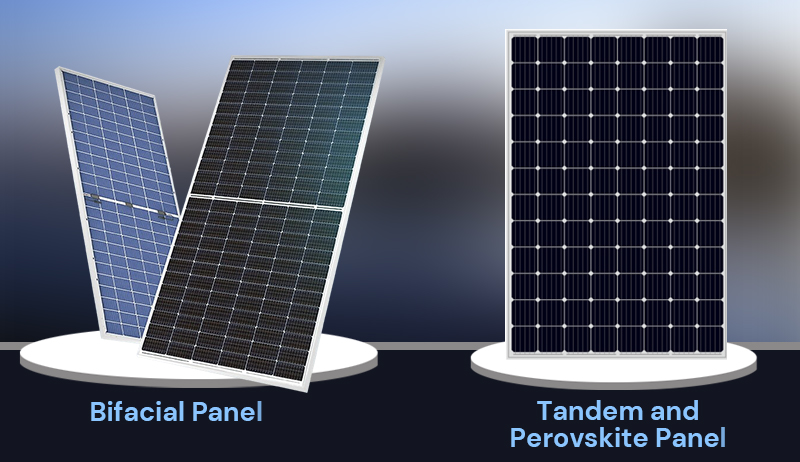
These panels can capture sunlight from both the front and back sides, increasing the total energy output. These panels can utilize reflected and diffused light, making them suitable for installation in various environments.
They can produce 10–30% more energy than conventional panels, especially in Australia’s reflective landscapes, such as deserts, sandy soils, or water bodies.
Additionally, as the cost of bifacial panels continues to decrease, their adoption is expected to increase.
Tandem and Perovskite Panels
These combine two or more layers of different photovoltaic materials to absorb a broader range of the solar spectrum, further enhancing efficiency.
Why are they different?
- These tandem solar cells use layers of different materials to capture a wide range of sunlight.
- Some combinations, such as perovskite-silicon tandems, are achieving lab efficiencies of 30%, significantly higher than those of standard panels.
Beyond the Panels: The Rise of Solar Skins
Most solar panels are installed on rooftops or ground-mounted systems, which can ruin building aesthetics or occupy valuable land space.
A possible solution is to create solar skins, which are thin, flexible materials that can harvest solar energy and also serve as functional or decorative elements in buildings or vehicles.
Solar skins can be made from various technologies, such as:
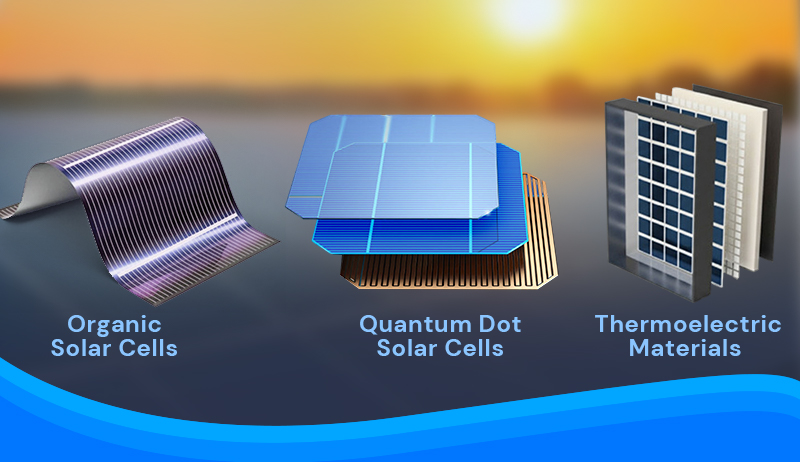
Organic Solar Cells
These cells use organic molecules, such as polymers or dye-sensitized materials, to absorb sunlight and generate electricity. They can be made into colorful and transparent films that can be applied to various surfaces.
Quantum Dot Solar Cells
These cells utilize nanoscale crystals, known as quantum dots, to absorb sunlight and generate electricity. They can be tuned to different colors and brightness levels by changing their size or shape.
Thermoelectric Materials
These materials can convert heat into electricity or vice versa. They can harvest waste heat from buildings or vehicles and turn it into useful power.
So, what are the advantages of integrating solar skins over conventional panels?
Solar skins have several advantages over conventional solar panels, such as:
- Versatility: Solar skins can be integrated into various shapes and forms, such as windows, walls, roofs, pavements, cars, buses, or trains.
- Aesthetics: Solar skins can be designed to match the color and style of the existing environment or create new visual effects.
- Functionality: Solar skins can also provide additional benefits, such as insulation, shading, lighting, or communication.
Solar skins are also still in the research and development stage and face challenges such as durability, reliability, and compatibility.
Moreover, Australian researchers are exploring new ways to create and apply solar skins for various applications.