

The upcoming assessment cycle of the Intergovernmental Panel on Climate Change (IPCC) will be authored by more experts from global south institutions than ever before, Carbon Brief analysis finds.
More than 660 scientists from 90 countries have been selected to write the three “working group” reports that will form the core of the IPCC’s seventh assessment cycle (AR7).
These three reports are scheduled to be published by 2029 and will summarise the latest research on climate change.
Carbon Brief analysis finds that a record 42% of authors of these upcoming reports are based at institutions in the global south.
Overall, the AR7 working groups will have an equal 50-50 representation of authors who are citizens of the global north and global south.
The analysis shows that the UK has the highest number of authors at 59, followed closely by the US with 55.
Furthermore, Carbon Brief finds that 46% of the report authors are listed as “female” – the second-highest percentage to date for any group of IPCC reports.
In a statement, IPCC chair Prof Jim Skea said the new author teams “reflect increased diversity, in terms of both gender balance and greater representation from developing countries and economies in transition”.
Countries
Earlier this year, Carbon Brief published an analysis of the gender and country of affiliation of the authors of all major IPCC reports, from the first assessment report in 1990 to the sixth assessment report (AR6) in 2023, including working group reports, special reports and methodology reports.
Carbon Brief has now expanded the analysis to include the authors of the AR7 working group reports, which are expected to be published by 2029.
For scientists to become IPCC authors, they must nominate themselves or be nominated by someone else to their country’s “national focal point”, which is often the country’s ministry of environment, climate change or meteorology. It is the focal point’s job to assess the applications and send a subset to the IPCC for their consideration.
The final decision on authors lies with the IPCC bureau – which consists of the chair and vice-chairs, as well as a pair of co-chairs for each working group.
The IPCC’s seventh assessment cycle will feature three working group reports:
- Working Group I (WG1): The physical science basis
- Working Group II (WG2): Impacts, adaptation and vulnerability
- Working Group III (WG3): Mitigation of climate change
Across the three working groups, Carbon Brief finds that 42% of the authors are affiliated with institutions in global south countries. This is a record high for any set of IPCC assessment reports.
The chart below shows the percentage of global south authors from every set of IPCC reports ever published.
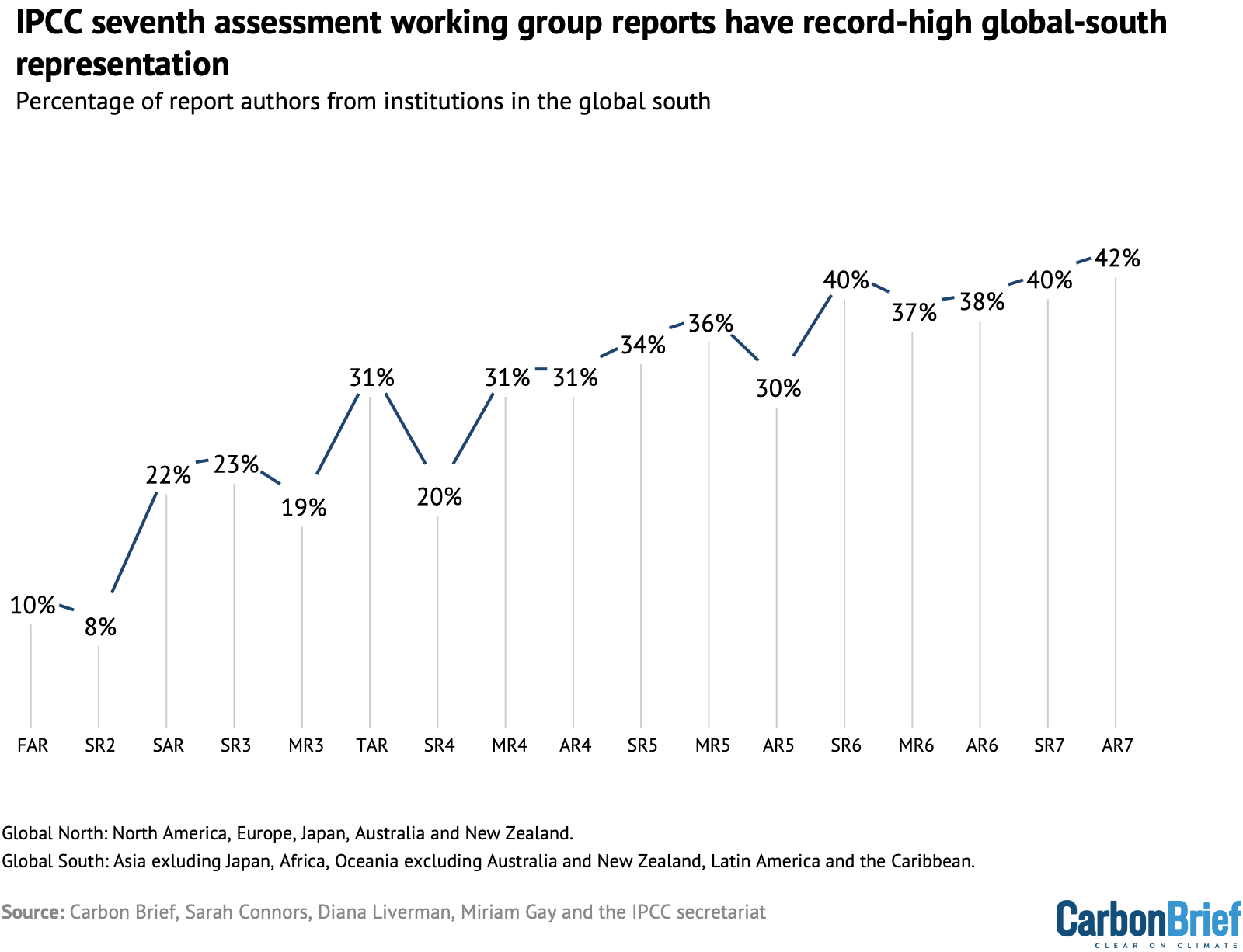
Each IPCC assessment cycle is marked by the publication of three working group reports, which are summarised in a synthesis report. Carbon Brief has grouped these four reports under the headline “assessment reports” for every assessment cycle.
(“AR7” includes only the three working group reports, as the author list for the synthesis report has not yet been released.)
The first, second and third assessment reports are indicated by the acronyms FAR, SAR and TAR. Subsequent assessment reports are indicated by AR, followed by the name of the assessment cycle.
Most assessment cycles also saw the publication of “special reports”, focusing on specific areas of climate change, and “methodology reports” – technical documents that focus on specific areas of the IPCC’s methodology. Acronyms for these reports are given as SR and MR, respectively, followed by the name of the assessment cycle.
For example, the special reports on 1.5C, the ocean and cryosphere and climate change and land – published over 2018-19 – are part of the sixth assessment cycle and are referred to collectively as SR6.
(To assign each special and methodology report to an assessment cycle, Carbon Brief assumes that assessment reports are the last documents to be published in each assessment cycle. Carbon Brief has grouped the authors from special reports (“SR”) and methodology reports (“MR”) separately for each assessment cycle.)
Carbon Brief defines the global north as North America, Europe, Japan, Australia and New Zealand. It defines the global south as Asia (excluding Japan), Africa, Oceania (excluding Australia and New Zealand), Latin America and the Caribbean.
While the three AR7 working group reports collectively have the highest percentage of global south authors compared to other similar groupings, there are individual reports with higher percentages, such as the 2019 special report on land and 2023 synthesis report.
Carbon Brief finds that, with 59 appointed authors, the UK is the most highly represented country in the upcoming IPCC working group reports.
This is closely followed by the US with 55. Rounding off the top five are Australia, Germany and China, with 34, 32 and 29 authors each, respectively.
Comparing the number of authors in each continent shows Europe with comfortably the largest representation, at more than 200 appointed authors. At the other end of the scale, South America and Africa have the fewest authors, with around 80 and 70 authors, respectively.
Of these three reports, WG2 has the highest percentage of global south authors for the IPCC’s seventh assessment cycle, while WG1 has the lowest.
Institutions
Carbon Brief has also ranked which institutions have the largest numbers of IPCC authors. The table below shows the top 15 institutions and their country.
| Institution | Country | Number of authors |
|---|---|---|
| Imperial College London | UK | 10 |
| University of Cape Town | South Africa | 9 |
| Potsdam Institute for Climate Impact Research | Germany | 8 |
| National Centre for Scientific Research | France | 8 |
| CGIAR | International | 6 |
| ETH Zurich | Switzerland | 6 |
| University of Oxford | UK | 5 |
| University of Melbourne | Australia | 5 |
| International Institute for Applied Systems Analysis | Austria | 5 |
| National Institute for Environmental Studies | Japan | 5 |
| CICERO Center for International Climate Research | Norway | 5 |
| International Centre for Integrated Mountain Development (ICIMOD) | International | 4 |
| Environment and Climate Change Canada | Canada | 4 |
| Commonwealth Scientific and Industrial Research Organisation (CSIRO) | Australia | 4 |
| Independent/self employed | International | 4 |
With 10 authors, the UK’s Imperial College London – where IPCC chair Jim Skea worked for almost a decade – tops the list.
It is closely followed by South Africa’s University of Cape Town, which has nine authors. After this, with eight authors apiece are the Potsdam Institute for Climate Impact Research and the French National Centre for Scientific Research.
When Carbon Brief carried out similar analysis in 2018 for the IPCC’s sixth assessment cycle, the US led the pack with 74 out of the 721 authors and the National Oceanic and Atmospheric Administration (NOAA) had eight authors in total.
This year, the most highly ranked US institutions are Cornell University and Rutgers University, which list three authors each.
Only one author from NOAA was listed. This expert’s listing for “institution” specifies “until April 30, 2025 – then retired”.
This comes after disruption to the usual US federal nomination process for selecting IPCC authors.
In February, Donald Trump pulled the US out of a meeting in China to discuss the seventh IPCC assessment cycle, according to Earth.org. The outlet adds that he also ordered federal scientists at the NOAA and the US Global Change Research Program to stop work on all other IPCC climate assessment-related activities.
Citizenship and institution
IPCC authors have two countries listed next to their names – “country” and “citizenship”. For this analysis, Carbon Brief uses the former, which indicates the country where the scientist works, because citizenship data is not available in earlier reports.
However, there are dozens of experts with different countries listed under “country” and “citizenship”.
For example, 59 authors have the UK listed as their “country”, meaning that they work at institutions in the UK. However, 28 of these experts are citizens of other countries, including Kenya, Chile and Spain.
Of the 29 authors with Indian citizenship, nine are registered with institutions in other countries, including Nepal, Malaysia and the UK.
Meanwhile, 13 authors are registered with institutions in Saudi Arabia – including an employee from the oil company Saudi Aramco – but only five have citizenship there.
Carbon Brief finds that a record-high 280 experts are affiliated with institutions in the global south, making up 42% of total authors.
(While half of all authors are citizens of global south countries, citizenship information is not provided with all IPCC reports and so a full comparison throughout IPCC history is not possible.)
IPCC scientists previously told Carbon Brief that experts from the global south often find it easier to apply to join the IPCC via institutions in the global north.
Gender
The IPCC provides binary gender data for all the AR7 authors.
Carbon Brief finds that 46% of the authors of the IPCC’s seventh assessment working group reports are listed as women.
The chart below shows the gender balance of the authors of all IPCC reports ever published.

Of the three AR7 reports, WG2 has the highest proportion of authors who are women.
Just shy of 52% of the authors of the impacts, adaptation and vulnerability report are women, making it the IPCC report with the second-highest proportion of women authors, after the IPCC’s upcoming special report on cities with 53%.
Methodology
Carbon Brief downloaded authorship data on the AR7 working group reports from the IPCC website, which lists data on each author’s gender, citizenship and the country where their institution was based. Carbon Brief also obtained data from the IPCC’s technical support unit.
(The “methodology” section of Carbon Brief’s earlier 2025 and 2023 on IPCC authorship contains more details on how Carbon Brief collected authorship data from the main working group reports and recent special reports.)
Carbon Brief recognises that gender is not best categorised using a binary “male” or “female” label and appreciates that the methods used of determining author gender could result in inaccuracies. However, for the purpose of this analysis, this method was deemed suitable.


The post Analysis: IPCC’s seventh assessment has record-high representation from global south appeared first on Carbon Brief.
Analysis: IPCC’s seventh assessment has record-high representation from global south

Three countries have been named by the Paris Agreement’s compliance committee for failing to submit a nationally determined contribution (NDC) and repeatedly snubbing offers of help with their climate plans.
After months of internal debate over whether to identify serial non-responders, the Paris Agreement’s Implementation and Compliance Committee (PAICC) named the three countries which have failed to engage with it over their NDCs on Friday.
It named Democratic Republic of Congo, Senegal and North Korea in a footnote of its annual report, adding that it decided to name them “with a view to facilitating engagement”, adding that representatives of the three nations had been invited to its meeting in early 2027 “with the purpose of identifying any challenges and constraints”.
“The Committee noted the importance of Parties engaging with the Committee in a timely manner, while noting that some delays may be due to the national capabilities and circumstances of the Parties”, the report said.
-
Under US pressure, World Bank says it will back gas “where appropriate”
The US wants the World Bank to expand its gas support while climate campaigners are pushing for it to end – its head spoke this week of limited backing for the fossil fuel -
IPCC scientists vow to press on with climate reports despite political deadlock
After governments again failed to agree a timeline, nearly 120 IPCC authors pledged to complete their assessment on time and with full scientific rigour -
Paris Agreement committee snubbed over missing NDC climate plans
Many governments have still not submitted a nationally determined contribution to the UN, breaching a key requirement of the Paris Agreement


In July, PAICC said 12 countries had ignored its repeated attempts to discuss why they had not published an NDC as required every five years under the 2015 Paris accord.
Members of the committee had been divided over whether to name them, but at a September meeting decided to do so in their annual report to the annual climate COP summit.
By the time the report was published on Friday, only Congo, Senegal and North Korea “had not communicated an NDC or submitted a [Biennial Transparency Report] and had not yet responded to any of the Committee’s notifications, despite several reminders issued by the Committee in this regard”.
Rainforest and renewable energy ambitions
The silence from Congo and Senegal is notable because the former is home to much of the Congo Basin rainforest while the latter has sought billions of dollars in climate finance to support its renewable energy ambitions.
After Brazil, Congo has more rainforest than any country in the world. This forest, and the country’s peatlands, absorb huge amounts of greenhouse gas but are fast being lost to expanding farmland, charcoal production, logging and mining.
Senegal signed a Just Energy Transition Partnership with Canada and wealthy European nations in 2023, to help it meet its renewable energy targets under the-then government of Macky Sall. It was chair of the Least Developed Countries group between January 2022 and December 2023.

Tejas Rao, who is researching the PAICC as part of a doctoral thesis at Cambridge University, said the governments of the three countries should engage with the committee.
“Engagement costs these governments very little and the committee has shown it will listen,” he said.
“Silence leaves the committee with no basis to help, and it leaves the [governments] exposed to the narrative that they are simply disengaged,” he told Climate Home News.
Paris Agreement requirement
The 2015 Paris Agreement requires all parties to publish an NDC every five years outlining their emissions reduction targets, with each plan meant to be more ambitious than the country’s last NDC.
The latest set – the third round of plans, with new targets for 2035 – was due in February 2025. While most countries missed this deadline, all but around 30 – mostly small emitters but including Egypt, Vietnam and Argentina – have now submitted them.
Over the year, the PAICC – which is made up of government climate officials from developed and developing countries – has been communicating with governments that have not submitted NDCs and trying to overcome barriers to them doing so.
Some nations have cited exceptional circumstances as the reason for not submitting an NDC, a process that requires a significant amount of work in tracking emissions and consulting on how to curb them across the economy. For example, a letter from a Sudanese official to the PAICC, seen by Climate Home News, said that the country’s civil war had led to the suspension of its NDC preparation.
-
IPCC scientists vow to press on with climate reports despite political deadlock
After governments again failed to agree a timeline, nearly 120 IPCC authors pledged to complete their assessment on time and with full scientific rigour -
Under US pressure, World Bank says it will back gas “where appropriate”
The US wants the World Bank to expand its gas support while climate campaigners are pushing for it to end – its head spoke this week of limited backing for the fossil fuel -
Who shapes climate science? The equity question facing the IPCC
Early completion of the next global climate science assessment reports risks excluding research from the Global South, which is key to ensuring the findings are fair
The US and Iran are not signed up to the Paris Agreement and so do not have active NDCs, nor does Taiwan, which is not a UN member state.
Rao said that because the PAICC is “facilitative and non-punitive”, naming the countries “is meant to open a door, not close one – the invited consultation is the point”.
“In recent months, governments that explained their constraints, whether capacity, finance or domestic process, have been met with follow-up and support rather than sanction, and the number of silent governments has fallen sharply,” Rao said.
The post Paris Agreement committee names three countries snubbing it over NDCs appeared first on Climate Home News.
Paris Agreement committee names three countries snubbing it over NDCs