

Nigerian campaigners at the Africa Climate Summit in Addis Ababa this week said Ethiopia is better positioned to host COP32 than Nigeria – which is also bidding for the 2027 UN climate summit – because the East African country has good infrastructure, a simpler visa process and stronger political support.
The Ethiopian government last week announced its intention to host the COP32 conference, due to be held in Africa, six months after Nigeria first threw its hat into the ring. Ethiopian President Taye Atske Selassie told UN Climate Week in Addis Ababa that the country has “the capacity, the facilities, the location, the connectivity to host the much-anticipated climate summit”.
Then, at the opening ceremony of the second Africa Climate Summit (ACS2) this week, Ethiopia’s Prime Minister Abiy Ahmed officially launched the country’s bid to host the annual UN negotiations, saying Ethiopia is “proud to present its candidacy to host COP32 in 2027”.
“We invite the world to Africa’s capital, a global city in climate ambition, to witness our solutions and to help shape the future,” Ahmed said.
Digging beyond oil: Saudi Arabia bids to become a hub for energy transition minerals
Back in March, Nigeria unveiled its intention to host the climate conference in its most populous city of Lagos during a visit by UN climate chief Simon Stiell.
The country’s then climate council director Nkiruka Chidia Maduekwe said Nigeria “has what it takes to host COP32”. She told journalists that Nigeria has shown leadership as a “champion” of climate action and so it is time for the country to host a COP summit.
This announcement was not reinforced by any official statement from Nigeria’s presidential team, signalling that the bid may not have had top-level political backing.
Maduekwe has since been sacked and replaced with climate finance expert and environmental lawyer Omotenioye Majekodunmi. When asked by Climate Home in Addis this week about Nigeria’s continued interest in hosting the climate talks, Majekodunmi declined to comment.
The UN COP summits rotate around global regions and attract tens of thousands of international delegates, from world leaders and CEOs to Indigenous people and youth activists. This year, COP30 will take place in Brazil, in the Amazon city of Belém, which is struggling to offer enough reasonably priced accommodation.
Businesses doubt COP30 logistics as presidency calls on them to come to Belém
Business leaders have opted for events in Rio de Janeiro and São Paulo due to the limited and pricey accommodation in COP30 host city BelémBureaucracy stops Belém residents from listing rooms on official COP30 platform
Government restrictions mean only real estate agencies with more than 40 properties can list on the official COP30 accommodation platformCOP bureau meeting ends in stalemate as Brazil insists Belém logistics can work
A UN survey this month showed a majority of nations had yet to book hotels in Belém due to high costs, raising concerns about lower participation at the climate summit


The location of next year’s COP is still undecided, as Australia and Turkey are locked in a battle over which will host the summit, with Australia said to have greater support. In 2027, it will be Africa’s turn – and 54 countries under the umbrella of the African Group of Negotiators (AGN) will collectively decide on the winning candidate before the end of next year.
Ismaila Shittu, a climate campaigner at the Nigeria-based International Climate Change Development Initiative, told Climate Home he believes Ethiopia has the edge.
“Ethiopia is more ready than Nigeria,” Shittu said. Ethiopia’s efforts to build modern infrastructure, transform its capital city and show its readiness to take on big global events such as ACS2 show “that they are actually ready to host COP”, he said.
These are areas where Nigeria is currently lacking, he added, criticising its tendency towards a “fire-brigade approach” in which event-planning happens at the last minute.
Ethiopia polishes its green credentials
Ethiopia has been strategically positioning itself as a key player in international climate diplomacy and a leader in climate action and green growth. The African Union is headquartered in the country, and it hosted the UN’s second annual climate week right before this month’s Africa Climate Summit, which was attended by more than 25,000 delegates from governments, the private sector and civil society.
On Tuesday, the country launched the largest hydroelectric dam in Africa – the Grand Ethiopian Renaissance Dam (GERD) on the Nile, a controversial project that took 14 years to complete and is aimed at supporting national energy independence and clean economic growth.
In March, the country also opened a new International Convention Centre where it is hosting global events. They include the ongoing ACS2, which proves it can handle major gatherings, campaigners said.

Nigerian climate activist Olumide Idowu said Ethiopia also appears to have more leverage when it comes to international diplomacy, especially with the AU and the UN having head offices in the country. These institutions can help channel resources to support Ethiopia in hosting the conference, he added.
Nigeria lags in terms of accommodation and transport networks, which could need as much as three years to get up to scratch, so “we need to start early to put necessary infrastructure in place”, he said.
To meet Africa’s clean energy goals, investors urged to tolerate higher risk
Ethiopia has also won praise for its easy and flexible visa application and approval process. While some participants at the ACS2 and UN Climate Week faced challenges with the online payment system, the electronic visas were granted within 24 hours of applying, and in some cases even within two hours.
Nigeria, on the other hand, is more challenging to enter from abroad. With visa system delays, payment processing errors and long application wait times, campaigners said they doubted whether Nigeria could offer a quick turnaround for thousands of COP participants and would need to address bottlenecks if it is serious about hosting the summit.
Nigeria’s silence rings loud
To the surprise of some, Nigeria has yet to recommit to its bid to host COP32 since Ethiopia announced its plan to do so. At ACS2, Nigerian President Bola Tinubu’s opening-ceremony speech – delivered by Faruk Yusuf, permanent secretary for solid minerals development – made no mention of hosting COP32.
Second Africa Climate Summit seeks to jump hurdles to green industrialisation
Campaigners said this could mean the West African country has backtracked on its initial intentions to host the conference.
Nnaemeka Oruh, a senior policy analyst at the Nigeria-based Society for Planet and Prosperity, agreed with others that Ethiopia is ahead on logistics and political support for now, adding that “nothing has shown that there is political backing to Nigeria’s bid”. However, if that were to change, Nigeria “can be ready in less than six months”, he added.
The post Ethiopia’s preparedness puts it ahead of Nigeria in bid to host COP32, campaigners say appeared first on Climate Home News.
Ethiopia’s preparedness puts it ahead of Nigeria in bid to host COP32, campaigners say

Three countries have been named by the Paris Agreement’s compliance committee for failing to submit a nationally determined contribution (NDC) and repeatedly snubbing offers of help with their climate plans.
After months of internal debate over whether to identify serial non-responders, the Paris Agreement’s Implementation and Compliance Committee (PAICC) named the three countries which have failed to engage with it over their NDCs on Friday.
It named Democratic Republic of Congo, Senegal and North Korea in a footnote of its annual report, adding that it decided to name them “with a view to facilitating engagement”, adding that representatives of the three nations had been invited to its meeting in early 2027 “with the purpose of identifying any challenges and constraints”.
“The Committee noted the importance of Parties engaging with the Committee in a timely manner, while noting that some delays may be due to the national capabilities and circumstances of the Parties”, the report said.
-
Under US pressure, World Bank says it will back gas “where appropriate”
The US wants the World Bank to expand its gas support while climate campaigners are pushing for it to end – its head spoke this week of limited backing for the fossil fuel -
IPCC scientists vow to press on with climate reports despite political deadlock
After governments again failed to agree a timeline, nearly 120 IPCC authors pledged to complete their assessment on time and with full scientific rigour -
Paris Agreement committee snubbed over missing NDC climate plans
Many governments have still not submitted a nationally determined contribution to the UN, breaching a key requirement of the Paris Agreement

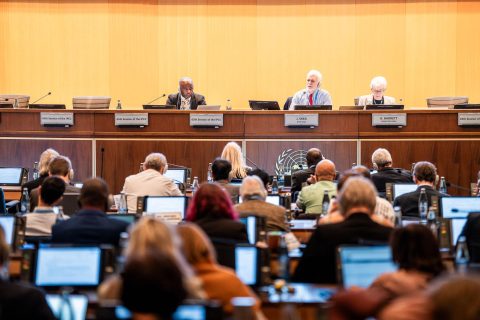

In July, PAICC said 12 countries had ignored its repeated attempts to discuss why they had not published an NDC as required every five years under the 2015 Paris accord.
Members of the committee had been divided over whether to name them, but at a September meeting decided to do so in their annual report to the annual climate COP summit.
By the time the report was published on Friday, only Congo, Senegal and North Korea “had not communicated an NDC or submitted a [Biennial Transparency Report] and had not yet responded to any of the Committee’s notifications, despite several reminders issued by the Committee in this regard”.
Rainforest and renewable energy ambitions
The silence from Congo and Senegal is notable because the former is home to much of the Congo Basin rainforest while the latter has sought billions of dollars in climate finance to support its renewable energy ambitions.
After Brazil, Congo has more rainforest than any country in the world. This forest, and the country’s peatlands, absorb huge amounts of greenhouse gas but are fast being lost to expanding farmland, charcoal production, logging and mining.
Senegal signed a Just Energy Transition Partnership with Canada and wealthy European nations in 2023, to help it meet its renewable energy targets under the-then government of Macky Sall. It was chair of the Least Developed Countries group between January 2022 and December 2023.

Tejas Rao, who is researching the PAICC as part of a doctoral thesis at Cambridge University, said the governments of the three countries should engage with the committee.
“Engagement costs these governments very little and the committee has shown it will listen,” he said.
“Silence leaves the committee with no basis to help, and it leaves the [governments] exposed to the narrative that they are simply disengaged,” he told Climate Home News.
Paris Agreement requirement
The 2015 Paris Agreement requires all parties to publish an NDC every five years outlining their emissions reduction targets, with each plan meant to be more ambitious than the country’s last NDC.
The latest set – the third round of plans, with new targets for 2035 – was due in February 2025. While most countries missed this deadline, all but around 30 – mostly small emitters but including Egypt, Vietnam and Argentina – have now submitted them.
Over the year, the PAICC – which is made up of government climate officials from developed and developing countries – has been communicating with governments that have not submitted NDCs and trying to overcome barriers to them doing so.
Some nations have cited exceptional circumstances as the reason for not submitting an NDC, a process that requires a significant amount of work in tracking emissions and consulting on how to curb them across the economy. For example, a letter from a Sudanese official to the PAICC, seen by Climate Home News, said that the country’s civil war had led to the suspension of its NDC preparation.
-
IPCC scientists vow to press on with climate reports despite political deadlock
After governments again failed to agree a timeline, nearly 120 IPCC authors pledged to complete their assessment on time and with full scientific rigour -
Under US pressure, World Bank says it will back gas “where appropriate”
The US wants the World Bank to expand its gas support while climate campaigners are pushing for it to end – its head spoke this week of limited backing for the fossil fuel -
Who shapes climate science? The equity question facing the IPCC
Early completion of the next global climate science assessment reports risks excluding research from the Global South, which is key to ensuring the findings are fair
The US and Iran are not signed up to the Paris Agreement and so do not have active NDCs, nor does Taiwan, which is not a UN member state.
Rao said that because the PAICC is “facilitative and non-punitive”, naming the countries “is meant to open a door, not close one – the invited consultation is the point”.
“In recent months, governments that explained their constraints, whether capacity, finance or domestic process, have been met with follow-up and support rather than sanction, and the number of silent governments has fallen sharply,” Rao said.
The post Paris Agreement committee names three countries snubbing it over NDCs appeared first on Climate Home News.
Paris Agreement committee names three countries snubbing it over NDCs