Connect with us

Published

on

Australia is one of the sunniest countries on Earth, blessed with over 2,500 hours of sunshine annually across most regions.  

It’s no surprise that Aussies have embraced rooftop solar like no other nation—nearly 3.7 million homes now have solar systems installed as of 2025. 

But what if we fully realised the potential of the solar revolution? What if every house in Australia has solar panels from 2025 onward? 

From climate impact and economic transformation to energy resilience and beyond, this vision has the potential to reshape the nation’s future. 

Every day, the sun emits far more energy to run the planet. Solar panels convert sunlight into electricity. It is essential to decarbonise our society.  

Solar power, a renewable energy source that doesn’t create any CO2 emissions, is not just a green choice, but also a financially savvy one.  

With every passing day, solar panels for household use are becoming increasingly affordable, making it an empowering choice for homeowners.

How Can Solar Benefit Every Household In Australia?

Almost 40% of the roof space is already eligible for a solar system. According to data, solar power station conversion is possible on most rooftops.  

And approximately 134% of the country’s residential electricity needs should meet this number.   

These massive levels of solar installation not only benefit the environment but also the economy. The growth of the solar industry is creating jobs, making it a promising sector for the future.  

With solar becoming more affordable, new financing plans, such as “Energy Matters and Save as You Go Solar,” make owning a PV system very feasible.    

One of these new offers is a no-deposit payment plan. Paying off your solar loan can help reduce your electricity bill.  

On a sunny day, the power generated by rooftop solar panels could render base-load power stations redundant.  

This immediate impact enables Australia to shut down most of its coal-fired power plants within a matter of hours, a significant step toward meeting its emissions targets and combating climate change.  

The overarching concept is for eligible homes to generate more electricity than required. The excess supply is fed back into the grid to meet Australia’s residential and non-residential power needs. With feed-in tariffs, solar panel users can recoup their investment.   

Above all, Solar is a viable solution to Australia’s energy challenges. It would also permanently reduce the country’s dependence on expensive fossil fuels for electricity generation.

But How Is the Progress in 2025?

renewable energy

Australia’s rooftop solar boom continues to surge ahead, setting new records and reinforcing the nation’s global leadership in residential solar adoption.  

According to the Clean Energy Regulator (CER), Australia added more than 3,200 MW of small-scale solar to the grid by the end of 2024, surpassing previous records and highlighting steady growth in household solar uptake. 

Queensland now leads the nation in rooftop solar potential, with around 84% of suitable rooftops equipped with solar PV systems.  

South Australia follows closely with 80%, maintaining its position as a long-time solar stronghold. New South Wales and Victoria have also shown substantial progress, with adoption rates climbing to approximately 54% and 47%, respectively. 

Australia’s overall solar capacity has expanded significantly, growing by nearly 22% in 2024 alone.  

While the residential PV sector encountered some logistical and policy-related hurdles, the large-scale solar market broke installation records, surpassing the levels seen in both 2023 and 2024. 

Looking ahead, projections indicate that an additional 12 GW of solar capacity will be added nationwide by the end of 2027.  

Rooftop solar alone is on track to outpace the capacity of Australia’s entire coal-fired power fleet, accelerating the timeline for coal plant retirements and reinforcing Australia’s transition to a cleaner energy future.

Can Solar Alone Help You With Consumption & Distribution?

Your PV system consists of various components. Depending on your chosen system, several panels will be mounted on your roof. Your expert installer should also install the mounting equipment and an inverter.   

More advanced systems include performance monitoring equipment and a rechargeable battery, which is particularly beneficial for solar-plus-storage systems.  

Solar-plus-storage systems include a solar battery to store any excess energy. And later, it can provide you with stored energy.  

Would you like to learn more about solar energy and batteries? And a solar system for house usage? Then contact us or request a free solar quote. We’d be delighted to discuss the best solar power and battery options tailored to your needs.   

Most of the work is done by your solar panels. It absorbs photons from the sun’s rays and converts them to DC, or Direct Current energy. An inverter converts the direct current (DC) energy from your panels into alternating current (AC) that household appliances can use.  

Performance monitoring equipment can help you track the amount of energy your system produces. Identify any faults to ensure your system operates at peak efficiency. This advanced system can even feed data to a program accessible via the Internet or a mobile app.  

Solar panels generate the majority of their energy during the day when we are away from home, allowing us to use it. When your system generates more energy than it consumes, the excess energy is returned to the grid. And to charge your battery.  

Any excess energy generated will be fed back into the grid when your battery is fully charged. The majority of solar-powered homes are net-metered.  

Any energy you send back to the grid will earn you a ‘feed-in tariff’, a payment for the electricity you generate and send back to the grid. This payment can be applied to the cost of any grid energy you use, effectively reducing your electricity bill. 

What Should You Do Before Getting Solar?

solar batteries

Consider your current electricity consumption. You can use a recent energy bill to check your energy usage. It can estimate your electricity usage based on your area and household size.  

Select the system size that best suits your needs. Consider every future requirement. Your energy retailer can assist you with this information. Understand the numbers. Determine whether you are eligible for any incentives or rebates.  

Calculate the payback period, and discuss the tariff and small-scale technology certificates (STCs) with your retailer. And most importantly, consider how solar energy will affect your current electricity rate.  

Verify if your solar company is an Approved Solar Retailer. Choose Retailers approved by the Clean Energy Council’s Solar Retailer Code of Conduct. This code requires them to provide you with clear and accurate information and service.  

Check that your solar retailer can provide evidence that your new solar panels are genuine. Meet Australian Standards, and have a warranty you can rely on.  

The Clean Energy Council’s Solar Guide is a comprehensive resource that provides technical information to help you decide on the best solar system for your home.  

It covers topics such as system types, sizing, installation, and maintenance, making it a valuable tool in your solar energy journey.   

Many countries were reluctant to the concept of a green future. But we are already here. Independence from the grid allows people to go entirely off-grid. 

Understanding the Cost of Installing Solar in Australia (2025 Update)

What Determines the Cost of a Rooftop Solar System?

The total cost of installing solar panels on your roof can vary widely based on several key factors.  

Here’s what influences the price you might pay: 

  • System Size: Larger systems, measured in kilowatts (kW), produce more electricity but also incur a higher upfront cost. The ideal system size depends on your household’s energy needs and roof space. 
  • Quality of Equipment: Higher-end brands of solar panels, inverters, and batteries may initially cost more, but tend to be more efficient and durable, offering better long-term value. 
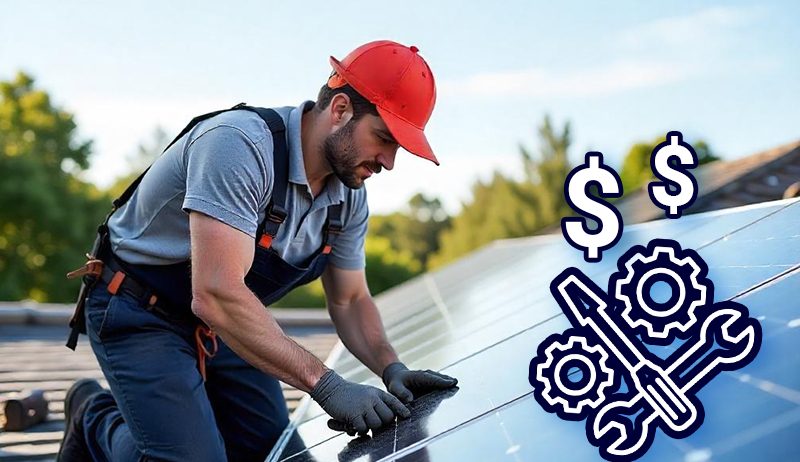
  • Installer Expertise and After-Sales Support: A quality installation from a reputable company often costs more but includes professional service, warranties, and ongoing support, which can ultimately save you money and stress in the long run. 
  • Installation Complexity: If your roof is steep, hard to access, multi-level, or shaded, expect additional labour costs and potentially specialised equipment. These complexities can affect both time and price. 
  • Extra Requirements: You may need to upgrade your home’s switchboard, install custom mounting racks, or run extended cabling—all of which can increase the overall cost. 
  • Adding Battery Storage: While solar batteries offer greater energy independence and night-time usage, they are a significant extra expense. Battery systems can cost as much as, or more than, the panels themselves.  

Choosing the Right Solar System Size for Your Home

There’s no one-size-fits-all approach when it comes to solar. The ideal system for your home depends on: 

  • Your daily energy consumption 
  • What time of day do you use the most electricity 
  • Your budget and financial goals 
  • The amount of unshaded, north-facing roof space 
  • Local council or network regulations that may restrict system size 

For example, a home with high daytime energy use may benefit from a larger system, while smaller households may only need a modest setup. In some locations, grid constraints may also limit the amount of solar energy that can be installed or exported. 

Cyanergy’s mission is to strengthen your path toward renewable energy. And our exclusive solar packages will surely excite you to go solar.  

Solar power in Australia has become increasingly common, so being part of this revolution will only benefit you. Get a free solar quote today!

Your Solution Is Just a Click Away

The post What If Every House In Australia Has Solar Panels from 2025? appeared first on Cyanergy.

What If Every House In Australia Has Solar Panels from 2025?

Continue Reading

Renewable Energy

Impressive Levels of Stupidity

Published

on

Without doubt, stupidity is part of Trumpism, but it’s only a part.

Meanness is also essential.  People with any real compassion for others don’t have what it takes to be a member of the MAGA base.

Impressive Levels of Stupidity

Continue Reading

Renewable Energy

Power and Corruption

Published

on

As Aristotle said (plus or minus): Only people who do not seek power and qualified to hold it.

In retrospect, the United States hadn’t gotten burned too badly until Donald Trump came along.

Power and Corruption

Continue Reading

Renewable Energy

Judge Ends Pentagon Wind Freeze, RWE Exits US Offshore

Published

on

Weather Guard Lightning Tech

Judge Ends Pentagon Wind Freeze, RWE Exits US Offshore

Allen covers a judge lifting the Pentagon’s wind freeze, RWE’s $1.22B US offshore exit, and TotalEnergies buying Shell’s European renewables.

Sign up now for Uptime Tech News, our weekly newsletter on all things wind technology. This episode is sponsored by Weather Guard Lightning Tech. Learn more about Weather Guard’s StrikeTape Wind Turbine LPS retrofit. Follow the show on YouTubeLinkedin and visit Weather Guard on the web. And subscribe to Rosemary’s “Engineering with Rosie” YouTube channel here. Have a question we can answer on the show? Email us!

Good Monday everyone.

You know … there is an old saying. When one door closes … another one opens. Well this week in wind energy … a whole lot of doors were swinging.

Let us start in Washington. For months … the Pentagon had quietly stopped reviewing wind energy project applications. More than a hundred and fifty onshore wind projects … stuck in limbo. The Defense Department claimed that drones in Ukraine had changed the game. Wind turbines … they said … could blind radar to incoming threats. So they hit the brakes.

But on Thursday … a federal judge said … not so fast. Judge Karin Immergut … a Trump appointee no less … issued a preliminary injunction. Resume the reviews … she ordered. Follow the law Congress wrote. The law gives the Pentagon seventy-five days for a preliminary review. As of late July … not a single one had been completed since the halt began in May. When government lawyers were asked to name one project they had reviewed … they could not name a single one. The judge told them plainly. If you want to change the rules … go ask Congress.

Now … while one arm of the government was being told to do its job … another arm was writing checks. German energy giant RWE … handed back its American offshore wind leases. New York. California. Louisiana. In return … the U.S. Department of the Interior cut RWE a check for one-point-two-two billion dollars. RWE is the fifth developer to walk away from American offshore wind under this administration. The company had spent more than a billion dollars on those leases. Years of planning. Investment. Partnership with federal agencies. But RWE said there is simply no path forward to permit these projects … for the foreseeable future.

So where does the $1.22B go? Nine hundred million dollars into Louisiana LNG. Three hundred million into natural gas turbine reservations. Fifteen gas peaking projects across the country. A company that came to America to build wind farms … is now building gas plants instead.

But here is the thing about RWE. They are not leaving the wind business. They are leaving American offshore wind. Globally … RWE operates eighteen offshore wind farms. Four more under construction. And nearly seven gigawatts secured in the United Kingdom’s latest auction. America said no. The rest of the world said … come on in.

And speaking of Europe … TotalEnergies … the French oil major … just bought Shell’s entire onshore renewables business in Europe. Four gigawatts of solar and wind. Five hundred megawatts already running or under construction in Italy and the Netherlands. Three-and-a-half gigawatts more in the pipeline across Italy … the United Kingdom … and Spain. And in the same breath … TotalEnergies sold a fifty percent stake in a one-point-two gigawatt European portfolio to KKR … for an enterprise value of one-point-eight billion euros. Build it. Sell half. Keep operating it. That is the model.

Now let us fly east … to India. GE Vernova just landed a hundred-and-sixty-three megawatt wind order from American developer Enfinity Global. Forty-three turbines. Three-point-eight megawatts each. Headed for the Fatehgarh wind farm in Rajasthan. Deliveries start late this year. And those turbines will be built at GE Vernova’s factory in Pune … which can turn out fifteen hundred megawatts a year. India is pushing for five hundred gigawatts of renewable energy.

Meanwhile … up in Denmark … a Danish wind tower maker named Welcon is raising its voice. Swedish utility Vattenfall just won two offshore wind tenders in Denmark. But when asked whether they would use European-made turbines … Vattenfall would not say.

Welcon’s chief executive Jens Risvig Pedersen said … and I quote …

“It would be completely absurd not to buy European products for the two new Danish offshore wind farms. That would simply shut down the European industry.”

The Danish trade union Dansk Metal agreed. Chinese turbines … they said … should not be financed with Danish taxpayer money. Vattenfall says it has not decided yet. But the debate is on.

And finally … a milestone that happened so quietly … nobody noticed. The world just crossed three terawatts of installed solar power. It took ten years to build the first terawatt. Less than three years for the second. And not even two more years for the third. Seventy-four countries now have at least one gigawatt of solar installed. That is up from forty-two in twenty-twenty. BloombergNEF expects nine terawatts by twenty thirty-six.

But here is the catch. Without batteries … solar hits a ceiling. Places like Australia and California already have so much solar that electricity prices go negative during the day. You heard that right. They pay people to use power. The answer is battery storage. But batteries are not able to keep up with the pace of solar.

Now … if you step back from all of this … something interesting emerges. Nobody in these stories is arguing about whether wind works. Not the judge in Oregon. Not RWE. Not even the Pentagon. The debate has moved on. The question is no longer … can you build a wind farm. The question is … who gets to decide where one goes.

Think about that. A federal judge did not rule that wind turbines are safe or good or necessary. She ruled that the government cannot ignore its own laws. The science was not on trial. The process was.

RWE did not surrender its leases because offshore wind failed. It surrendered them because one government made permitting impossible … while eighteen other wind farms in its global portfolio kept spinning.

And TotalEnergies did not buy four gigawatts of European renewables out of charity. It bought them because Shell … an oil company … decided those assets no longer fit its strategy. One oil major’s exit is another’s entrance. The assets did not lose value. They changed hands.

That is the story underneath all these headlines. Wind energy has crossed a threshold that most industries never reach. It is no longer competing on technology. It is competing on governance. The turbines work. The economics work. The engineering works. What varies … country by country … is whether the rules of the road are clear enough for capital to show up.

And capital … as we saw this week … will always find the door that is open.

That is the state of the wind industry for the 10th of August … twenty twenty-six. Join us for the Uptime Wind Energy podcast tomorrow.

Judge Ends Pentagon Wind Freeze, RWE Exits US Offshore

Continue Reading

Trending

Copyright © 2022 BreakingClimateChange.com