


Apple’s China Clean Energy Fund Initiatives
On March 24, 2025, Apple launched its second China Clean Energy Fund. The company is committing $99.3 million (RMB 720 million) as the main investor. The fund, managed by Schroders, aims to grow renewable energy projects across China.
It builds on the success of Apple’s first clean energy fund, which started in 2018. That first fund helped develop over 1 gigawatt of renewable energy across 14 Chinese provinces. Some of the projects it financed include:
- Concord Jing Tang and Concord Shen Zhang Tang wind farms in Hunan Province, and
- Wind facility developed by Fenghua Energy Investment in Hubei Province.
These projects collectively supplied 134 megawatts of renewable energy, significantly advancing China’s renewable energy targets. The country’s 14th Five-Year Plan aims for renewables to supply 33% of its electricity by 2025. By 2026, solar power is set to surpass coal as the top energy source, reaching 1.38 terawatts—150 GW more than coal.

The new fund will add about 550,000 megawatt-hours of wind and solar energy to China’s power grid each year. This number is expected to rise as more investors join.
Apple’s strategy is to support renewable energy projects at an early stage. This makes it easier for suppliers to switch to clean energy.
- Currently, two-thirds of Apple’s production in China runs on renewable energy. More than 100 suppliers are working toward using 100% renewable energy for Apple products.
Apple CEO Tim Cook stressed the importance of these efforts. He stated,
“The business community has a big role to play in the development of China-U.S. relations. Apple is willing to contribute to the stable, healthy, and sustainable development of bilateral relations.”
This comes at a critical time when the U.S. and China are engaged in a trade war, with tensions rising over technology, tariffs, and economic policies. Despite these challenges, Apple continues to strengthen its ties with China while advancing its clean energy goals.
Progress Toward 2030 Carbon Neutrality
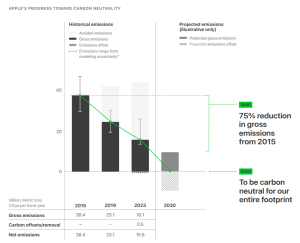
Apple has made major progress in cutting greenhouse gas emissions. According to its 2024 Environmental Progress Report, the company has reduced emissions by over 55% since 2015. Apple aims to cut emissions by 75% from 2015 levels before reaching full carbon neutrality by 2030.
Lisa Jackson, Apple’s Vice President of Environment, Policy, and Social Initiatives, said, “We’ve slashed emissions by more than half, all while serving more users than ever before.”
Apple is taking several steps to reach this goal. The company is moving to low-carbon electricity, using recycled and renewable materials, and improving shipping methods.
One key focus is shifting product transportation from air freight to ocean shipping, which has a lower carbon footprint. These actions are part of Apple’s 2030 plan, a strategy to eliminate net emissions across its entire business.
This approach reflects Apple’s dedication to reducing its environmental impact. It is also setting a standard for corporate responsibility in the tech industry. The image below shows the company’s progress by the numbers.

Here are the other areas where Apple is showing progress in its sustainability efforts.
Supplier Clean Energy Commitments
Apple is also working with its suppliers to help them transition to clean energy. As of April 2024, over 320 suppliers, making up 95% of Apple’s direct manufacturing spending, have committed to using 100% renewable energy by 2030. This number has grown significantly, with more than 50 new suppliers joining in the past year.
These commitments are part of Apple’s Supplier Clean Energy Program, which aims to decarbonize the company’s global supply chain.
In 2021 alone, Apple’s suppliers generated 18.1 million megawatt-hours of clean energy. This avoided 13.9 million metric tons of carbon emissions, a 62% increase over 2020.
The big tech company has also invested in nearly 500 megawatts of renewable electricity projects to help cover upstream emissions. All these show the company’s commitment to encouraging suppliers to also adopt sustainable practices.
Innovations in Product Design
Apple is also reducing its carbon footprint through product design. In September 2023, the company introduced its first carbon-neutral products in the new Apple Watch lineup. Thanks to design improvements and clean energy, product emissions dropped by over 75% for each carbon-neutral Apple Watch.
Apple has also eliminated leather across all its product lines. Instead, the company introduced a new material called FineWoven, which has a much lower carbon footprint. The company is also using entirely fiber-based packaging for its Apple Watch models.
In 2024, Apple reported a 30% reduction in lifecycle greenhouse gas emissions for its iPhone 16 Pro and iPhone 16 Pro Max models. This was achieved by using clean electricity, more recycled materials, and better shipping methods.
Challenges and Criticisms: Facing Greenwashing Claims
Despite these efforts, Apple has faced criticism over its environmental claims. In February 2025, a class-action lawsuit was filed against the company. The lawsuit alleges that Apple misled consumers by labeling certain Apple Watch models as “carbon neutral.”
Plaintiffs argue that Apple’s reliance on carbon offset projects in Kenya and China does not deliver real emissions reductions. The lawsuit seeks damages and an order preventing Apple from marketing these watches as carbon neutral.
These challenges highlight the need for transparency in corporate sustainability claims. In response, Apple continues to emphasize its dedication to real carbon reductions and long-term environmental progress.
Apple remains a leader in corporate sustainability. The company’s $99.3 million China Clean Energy Fund will expand renewable energy and help suppliers transition to 100% clean power. By pushing for clean energy, improving product design, and encouraging supplier commitments, the tech giant is setting an example for the tech industry.
The post Apple Boosts China’s Clean Energy With $99 Million: Can It Power a Carbon-Neutral Future? appeared first on Carbon Credits.

EU carbon credit claims changed on 27 September 2026, the day the Directive (EU) 2024/825 began to apply across the European Union. The change is narrow. It changes how a company can talk about the credits it buys. A product can no longer be called neutral on the strength of compensation alone; however, every specific, evidenced statement about what a company measured, reduced, and funded stays fully available.

The post Promoting Improved Cooking Practices in Nigeria appeared first on Terrapass.


-
Climate Change1 year ago
Guest post: Why China is still building new coal – and when it might stop
-

 Greenhouse Gases2 years ago
嘉宾来稿:满足中国增长的用电需求 光伏加储能“比新建煤电更实惠”
-
Greenhouse Gases1 year ago
Guest post: Why China is still building new coal – and when it might stop
-

 Climate Change2 years ago
嘉宾来稿:满足中国增长的用电需求 光伏加储能“比新建煤电更实惠”
-

 Renewable Energy12 months ago
Sending Progressive Philanthropist George Soros to Prison?
-
Climate Change2 years ago
Bill Discounting Climate Change in Florida’s Energy Policy Awaits DeSantis’ Approval
-
Greenhouse Gases1 year ago
嘉宾来稿:探究火山喷发如何影响气候预测
-

 Climate Change2 years ago
Analysis: China’s CO2 falls 1% in Q2 2024 in first quarterly drop since Covid-19