

Welcome to the first COP28 special edition of DeBriefed, an essential guide to all the key developments at the Dubai climate talks.
This is an online version of Carbon Brief’s weekly DeBriefed email newsletter. Subscribe for free here.
This week
COP28 kick-off
LOSS AND DAMAGE DEAL: The first day of COP28 in Dubai saw agreement on the details of a new “loss-and-damage fund” to help developing countries pay for climate impacts, the Financial Times reported. This comes after a year of “clashes” over “basic issues”, such as who should pay into the fund, the FT said. Several parties, including COP28 host UAE, Germany and the UK, immediately announced “more than $400m” to establish the fund, according to Climate Home News. (The Conversation noted annual loss-and-damage financial needs are “roughly 1,000 times” this amount.)
KING’S SPEECH: The second day of COP28 saw world leaders descend on the conference for the first day of the “World Climate Action Summit”. Opening the event, King Charles warned countries they were “dreadfully far off track” to meeting climate targets and urged them to make COP28 a “critical turning point for genuine transformational action”, the Independent reported. Ahead of his talk, UK prime minister Rishi Sunak told reporters he is “not in hock to ideological zealots” and issued a press release defending climate rollbacks.
COP TEXT TRACKER: After world leaders fly off home on Saturday evening, all attention will turn to COP’s crucial, yet infamously hard-to-follow negotiations. To help keep track of what is happening, Carbon Brief has just launched its traditional COP text tracker, but newly improved thanks to data-scraping wizardry from Dr Simon Evans and Dr Verner Viisainen.
Oily influence
‘OIL-AND-GAS DEALS’: Despite early progress at the summit, a shadow was cast by a series of investigations alleging that the fossil fuel industry could be influencing proceedings. An investigation by BBC News and the Centre for Climate Reporting alleged that the UAE planned to use its role as COP host to strike “secret” oil-and-gas deals behind the scenes of the summit. Journalists at the Centre for Climate Reporting obtained briefing documents from the UAE’s COP28 team that indicated plans to discuss fossil fuel deals with 15 different countries.
‘CAUGHT RED-HANDED’: On Twitter, former UN climate chief Christiana Figueres said the COP28 presidency had been “caught red-handed” and “will be under public scrutiny like no other ever before”. The UAE’s COP28 team at first refused to deny the allegations to BBC News and said that “private meetings are private”. After the story’s release, COP28 president Sultan Al Jaber released a statement saying that the allegations were “false, not true, incorrect and not accurate”, Bloomberg reported.
SAUDI’S OIL PLAN: The Centre for Climate Reporting also released a second investigation alongside Channel 4 News alleging that Saudi Arabia has a plan to “artificially” boost oil consumption in African and Asian countries. In an undercover sting operation, journalists from the Centre for Climate Reporting posed as oil investors and asked officials from Saudi’s ministry of energy whether the country had plans to boost oil demand in certain markets. In response, an official said: “Yes…It’s one of the main objectives that we are trying to accomplish.” Representatives from Saudi’s government refused requests for comment.
Around the world
- MIND ON METHANE: The US and China plan to hold a joint summit on methane and other non-CO2 greenhouse gases during COP28, the South China Morning Post reported. This follows a pledge from the two countries to “jointly tackle global warming” by “ramping up” renewables.
- DECARBONISING CLUB: Germany and Chile are set to launch a “club of governments” to help developing nations invest in cutting industry emissions, particularly from “hard-to-abate sectors” such as steel and cement, according to Reuters.
- KENYA FLOODS: At least 76 people have died and 40,000 have been displaced since heavy rains and flash floods began “pounding” Kenya in October, the Associated Press reported.
- INFLUENCING AFRICA: Climate Home News obtained leaked documents and interviewed multiple people about the alleged influence of the US consultancy firm McKinsey on Africa’s first climate summit.
- PHASE-OUT: Sunak was warned by the UK’s oil and gas regulator that his plan to introduce annual North Sea licensing rounds was “not necessary” to boost production, the Financial Times reported. Former prime minister Theresa May told the Times she disagreed with Sunak’s oil-and-gas push.
84,101
The number of registered delegates at COP28, the biggest UN climate summit in history, according to newly released Carbon Brief analysis.
Latest climate research
- Accounting for the long-term impacts of tropical cyclones increases the “social cost of carbon” – a metric that assesses the societal costs of CO2 emissions – by more than 20%, according to a new study in Nature Communications.
- Global warming could intensify heavy rainfall more than expected, according to a Journal of Climate study using high-resolution climate models.
- There is “little trade-off” between alleviating extreme poverty and limiting global warming, with ending extreme poverty expected to have a “negligible impact” on emissions, according to a Nature study.
(For more, see Carbon Brief’s in-depth daily summaries of the top climate news stories on Monday, Tuesday, Wednesday, Thursday and Friday.)
Captured

The UK’s contribution to climate change since the start of the industrial era is almost twice as high when its activities in former colonies are taken into account, according to new Carbon Brief analysis covered by the Guardian. This is illustrated in the graphic above, which shows CO2 emissions caused by the UK both within its own borders (blue) and in colonised countries under British rule (red). The story is part of a wider Carbon Brief investigation into how considering colonial rule radically shifts responsibility for climate change globally, covered by the Hindustan Times in India and the NRC newspaper in the Netherlands, among others.
Spotlight
Key issues to watch at COP28
This week, Carbon Brief’s team of COP28 reporters break down the key issues to watch as the summit’s first days unfold.
Fossil fuels
As delegates gather in a petrostate made luxurious by fossil-fuel wealth, all eyes are on how COP host UAE will deal with growing calls for countries to commit to phasing out fossil fuels.
The need to “phase down unabated coal” use was mentioned in a COP legal text for the first time at the end of COP26 in Glasgow two years ago. At last year’s talks, COP27 host and oil-and-gas producer Egypt ignored repeated calls for the “phase out” of all fossil fuels to be discussed as part of the summit’s final agreement.
Ahead of COP28, allegations that the UAE planned to use COP to make “secret” oil and gas deals (see above) raised significant doubts about the presidency’s impartiality.
However, during the summit’s opening press conference on Thursday, COP28 president Sultan Al Jaber indicated that he would support including fossil fuels in negotiating texts in the context of tackling climate change – and an early stage negotiating text for the global stocktake (see below) released on Friday morning does make reference to “fossil fuels”. It is yet to be seen whether such references will survive the days to come.
Global stocktake
The “global stocktake” (GST) is the first major review of countries’ progress towards meeting the goals of the Paris Agreement, with an aim of encouraging nations to take more ambitious action.
The two-year process is set to wrap up at COP28. At the first press conference of the talks, Al Jaber told reporters he was “laser-focused” on delivering an ambitious GST. “I’m determined to demonstrate that this presidency is different,” he added.
While the GST’s “technical” phase finished with a report that spelt out the clear shortfall of climate action, finance and capacity to cope, states still have to sign off on political takeaways to deliver faster emissions reductions.
The GST decision is likely to be the main landing zone for language around phasing out fossil fuels, while providing guidance to countries on the next round of climate pledges and how they can course-correct against the 1.5C limit.
The first bare-bones draft of this decision text was published on Friday and mentions peaking global emissions, fossil fuel phase-out or phase down, as well as phase down of unabated coal power. While this is an early-stage draft that could see many iterations and cuts, observers expressed tentative optimism about its contents.
Climate finance
The most high-profile climate-finance outcome of COP28 will undoubtedly be the agreement on the loss-and-damage fund (see above). Yet, with so much climate action depending on scaling up finance for developing countries, the issue permeates the whole event.
On the first day of COP, Canada and Germany assured attendees that developed countries “likely” hit their outstanding $100bn annual climate finance goal last year. But, with the numbers to support this claim still unavailable, developing countries are unlikely to drop the issue. A decision on the new goal to replace the $100bn is not expected until next year.
For the past couple of years, there has been growing pressure on development banks and the private sector to fund more climate action. Building on this, on day two of the conference, 10 countries including the US, the UK, Kenya and Barbados banded together with a “leaders declaration” on a new framework for financial system reform.
Funding for climate adaptation still lags far behind support for emissions-cutting technologies. There are hopes that negotiations on the global goal on adaptation and the global stocktake could both provide venues in which to remedy this.
Food systems
Historically not garnering as much attention at COPs as fossil fuels, the world’s food systems – which account for a third of all human-caused emissions – are on the menu in Dubai. COP28 is the first to designate an entire thematic day for food and agriculture, taking place next weekend.
During the World Climate Action Summit on Friday, UAE environment and climate change minister Mariam Almheiri announced the Emirates Declaration on Sustainable Agriculture, Resilient Food Systems and Climate Action. Some 134 countries signed the agreement at the time of the announcement. The declaration included a recognition of the impacts that the agricultural sector is already experiencing due to climate change and an intention to integrate food systems into national climate plans (called “nationally determined contributions” or NDCs) and other national strategies before COP30 in Brazil.
Most of the new announcements on food systems at COP28 will occur through pledges, rather than negotiated outcomes. Expect to see new funding and new promises from both governments and non-state actors over the next week and a half.
Watch, read, listen
COP OVERVIEW: The Guardian has released a podcast on “everything you need to know” about COP28.
EXTRA READING: Hardy COP watchers at the Third World Network have released an update on what to expect at the Dubai talks.
EXTRA EXTRA READING: The daily summaries from observers at the Earth Negotiations Bulletin are a must-read for COP attendees. Pay attention to the “in the corridors” section for a sense of how behind-the-scenes negotiations are progressing.
Coming up at COP28
- 1-2 December: World Climate Action Summit and high-level segment for heads of government
- 2 December: High-level party event: nation-states join forces to pursue a fossil fuel non-proliferation treaty negotiating mandate
- 2 December: Leaders’ event: protecting nature for climate, lives, and livelihoods
- 3 December: 2023 high-level ministerial dialogue on the new collective quantified goal on climate finance, online
- 5 December: Eliminating methane emissions by 2030
Pick of the jobs
- University of Oxford, postdoctoral research fellow in environmental economics | Salary: £45,585-£54,395. Location: Oxford, UK
- Proof, investigative climate reporter | Salary: $2,000 a week. Location: Remote (EST time zone)
- Covering Climate Now, associate audience editor | Salary: $65,000-$72,000. Location: Remote
DeBriefed is edited by Daisy Dunne. Please send any tips or feedback to debriefed@carbonbrief.org


The post COP28 DeBriefed 1 December 2023: Countries strike loss and damage deal; Oil influence; Key issues to watch appeared first on Carbon Brief.

For the first time, new-energy vehicles (NEVs) made up 67% of new car sales in China in September, according to the latest data from the China Passenger Car Association (CPCA).
The figures show that NEVs, which include battery electric cars and plug-in hybrids, captured a record share of sales, even though fewer were sold than last year.
This is because sales of combustion-engine cars are falling steeply, a trend that the CPCA has attributed to rising petrol prices following the start of the Hormuz crisis.
Indeed, sales of fuel-only cars were down 31% year-on-year in the first nine months of 2026, with plug-in hybrid sales down 26% – whereas battery EV sales were only down 4%.
One analyst tells Carbon Brief that China’s rapidly growing EV fleet has offset demand for 143m barrels of oil since the start of the Hormuz crisis.
Another says that the crisis is “reinforcing China’s electrification of road transport”.
Meanwhile, amid slowing domestic sales, Chinese carmakers’ exports of NEVs more than doubled [in 2026 to date / in September] from a year earlier.
NEV record
A record two out of every three cars sold in September in China were NEVs, according to CPCA data, as shown in the figure below.
(NEVs predominantly include battery electric vehicles – BEVs – and plug-in hybrids – PHEVs. BEVs only run on electricity, whereas PHEVs also have a combustion engine.)
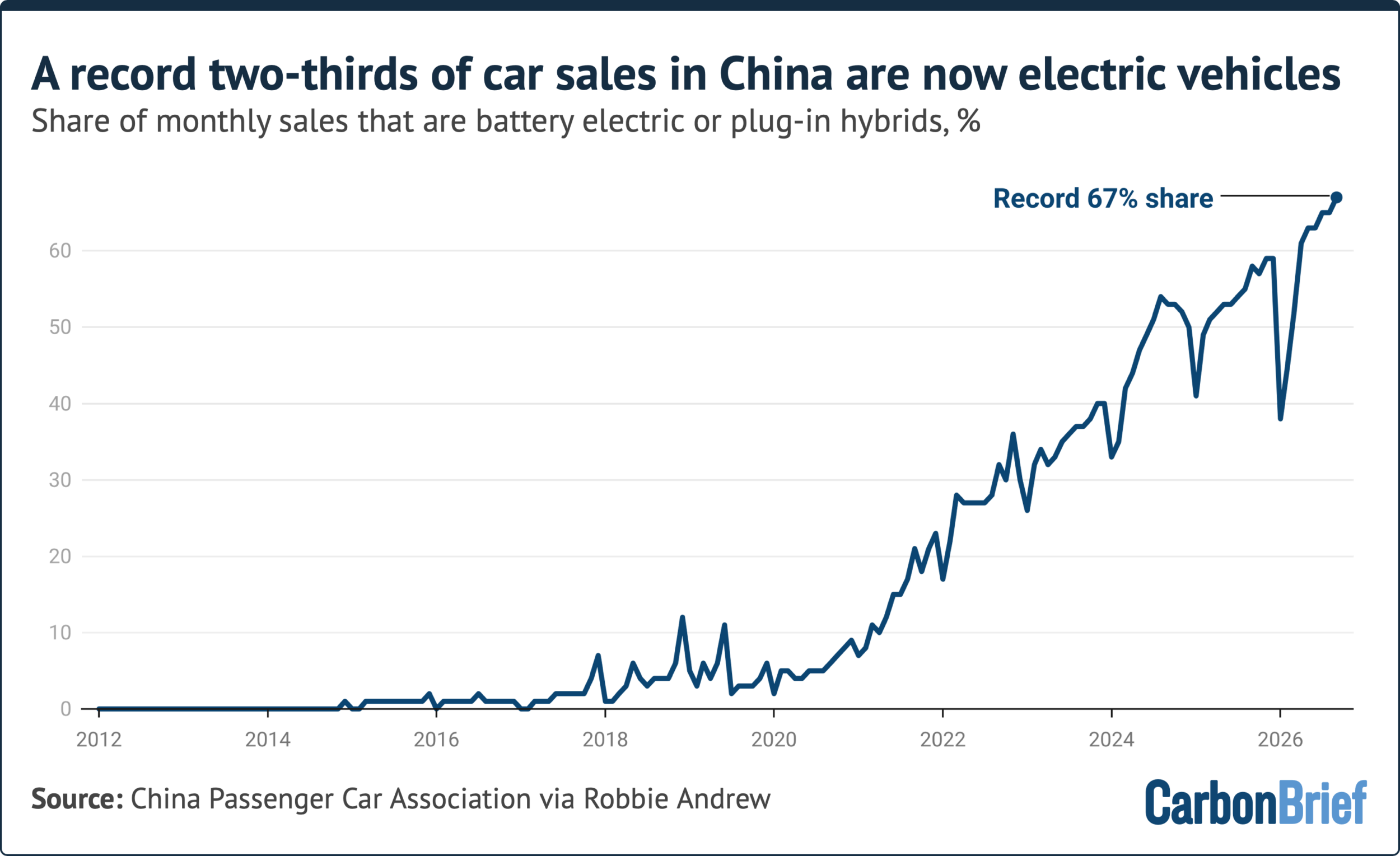
This marks a rapid rise for NEVs from just 6% of new car sales in 2020 up to 58% in 2026 to date – and a record 67% in the month of September.
This year, NEVs’ share of sales has also bounced back from a low of 39% in January, after the full purchase tax exemption that had been in place for more than a decade came to an end in December 2025.
The gain in NEV share in 2026 has come amid a slowdown across the wider domestic passenger-car market, which has hit sales of combustion-engine vehicles particularly hard.
This September, passenger-car retail sales across all categories declined, with overall sales volumes falling 28% year-on-year.
The contraction was led by combustion-engine vehicles, which saw sales fall 43% year-on-year in September and 31% in 2026 to date.
However, sales of PHEVs also fell by 36% year-on-year in September and by 26% in 2026 to date. By comparison, BEVs performed better, although sales still declined 8.5% from a year earlier in September and 4% in 2026 to date.
As a result, NEV sales overall fell by 17% in September and 13% in 2026 to date.
While the market changes in 2026 to date were particularly dramatic, they reflect a broad continuation of trends seen over the past decade.
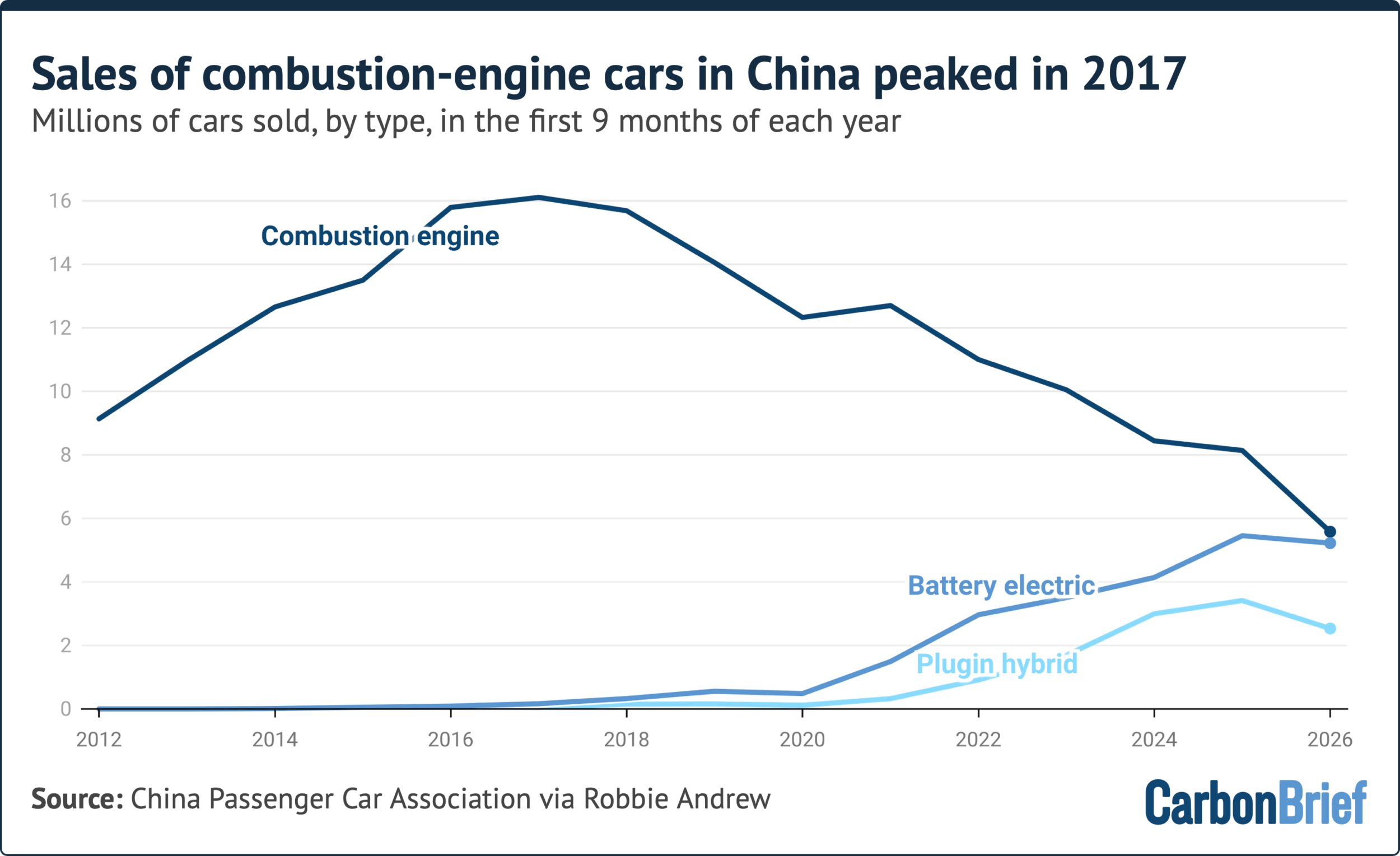
Indeed, sales of combustion-engine cars in China peaked in 2017 and they have been declining ever since, shown in the figure below.
Impact of Hormuz
Part of the reason for the advance of NEVs in 2026, said Chinese technology news outlet OFweek, was petrol cars “giving up market share” as they were outperformed by electric alternatives.
Cui Dongshu, secretary-general of the CPCA, cited higher petrol prices as an explanation for September’s weak combustion-car sales, in comments to financial news outlet National Business Daily.
Imports of oil into China in January-September have fallen 15% compared to 2025, equivalent to 470m barrels, as ongoing conflict tightened supply and drove up prices.
China’s passenger-car NEV fleet has displaced 143m barrels of oil so far during the strait of Hormuz crisis, Euan Graham, senior energy analyst at thinktank Ember, tells Carbon Brief.
EVs “accounted for 12% of the decrease in China’s oil use post-Hormuz”, according to an estimate provided to thinktank the Brookings Institute by an unnamed analyst.