

China and Indonesia partnered for a series of business agreements worth $10 billion during the Indonesia-China Business Forum in Beijing on Sunday. This high-level forum followed a Saturday meeting between China’s President Xi Jinping and Indonesia’s President Prabowo Subianto. Reuters revealed that the leaders expressed their plans for strategic economic growth across sectors like food, clean tech, biotechnology, and pressing issues related to water conservation, maritime resources, and mining, particularly nickel.
Notably President Prabowo Subianto said,
“We must give an example that in this modern age, collaboration — not confrontation — is the way for peace and prosperity.”
The joint statement further explained their plans to expand cooperation across new energy vehicles, lithium batteries, photovoltaic projects, and the digital economy. They also committed to advancing the global energy transition, securing mineral resources, and stabilizing supply chains.

Indonesia’s Nickel Surge: Fresh Billion-Dollar Deals from China
Indonesia’s nickel industry was a significant topic of discussion during the meeting. The country, which leads global nickel production always has been a major investment hub for Chinese firms.
In this regard, the latest news is that Chinese battery materials producer GEM Co., Ltd striking a groundbreaking deal with Indonesia’s PT Vale to build a high-pressure acid leaching (HPAL) plant in Central Sulawesi. The agreement with a deal value of $1.42 billion, will ensure the nickel plant maintains nickel supplies which is crucial for battery-grade materials.
Moving on, Tsingshan Holding Group and Zhejiang Huayou Cobalt, the two major Chinese companies, continue to dominate Indonesia’s nickel industry. Their investments reflect faith in Indonesia as a prominent supplier of raw materials for EVs, lithium-ion batteries, and other green technologies.
Elaborating this further, Bloomberg reported that Zhejiang Huayou Cobalt Co. is pursuing $2.7 billion in financing for its battery-nickel plant in Indonesia. The financing deal, backed by Ford Motor Co., is being coordinated by HSBC Holdings Plc and Standard Chartered Plc, who are inviting additional banks to participate.
The Pomalaa plant, located in Southeast Sulawesi, will use high-pressure acid leaching (HPAL) technology to produce battery-grade nickel for electric vehicles. Notably, it will have a capacity of 120,000 tons of nickel annually, making it one of Indonesia’s largest HPAL projects.
Both nations consider the timing of these deals a boon to the slump nickel market. Currently, nickel prices are weak due to low demand in the stainless-steel market and slow growth of the EV sector.
The Ever-Expanding Indonesian Nickel Industry
Indonesia has always attracted foreign investment to boost its domestic nickel production. The country sees this as essential for boosting and adding value to its vast natural resources. Despite these market pressures, Indonesia and China remain committed to their long-term goals, with Indonesia flagging its nickel industry as an integral part of its economic strategy.
As one of the top producers of metallic commodities—including gold, copper, cobalt, and especially nickel—Indonesia produced over half of the world’s mined nickel in 2023. Indonesia’s cost-effective nickel industry spurred major shifts in the nickel market. While nickel prices have dropped since last year, the country still maintained a resilient and steady production.
According to S&P Global Commodity Insights, Indonesia’s mined nickel production is expected to reach 2.1 million metric tons in 2024. This value is more than 50% of the anticipated global output and more than 2X its 2020 levels.
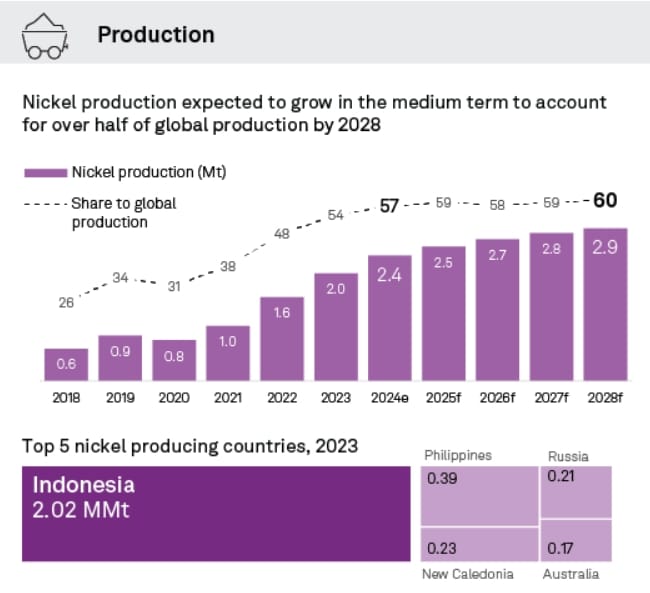
Source: S&P Global Commodity Insights
However, the rapid increase could eventually result in a global supply shortage, pushing prices back up to $28,000 per metric ton.
New Ventures in Tech, Travel, and Trade
China and Indonesia are not limiting their partnerships to the resources sector. Credible media agencies reported that GoTo Gojek Tokopedia, a prominent Indonesian technology company, signed agreements with China’s Tencent and Alibaba to bolster Indonesia’s digital infrastructure.
These partnerships can advance cloud services and foster local digital talent. It also signals a long-term investment in Indonesia’s digital economy and improving digital literacy and infrastructure at large.
Notably, President Subianto envisions transforming Indonesia’s tech landscape with investments in the most advanced sectors like AI and cloud computing.
Reuters reported, in addition to high-level industry deals, China and Indonesia agreed to streamline travel and visa policies, introducing measures like multi-entry long-term visas. This will enable more bilateral exchanges, business trips, and tourism.
Furthermore, the nations also agreed to deepen trade in agricultural products, including fresh coconuts. Interestingly, President Subianto also secured export agreements during his visit. This expansion of agricultural exports creates new opportunities for Indonesian farmers while fulfilling China’s demand for tropical produce.
Overall, it is evident that President Subianto’s decision to choose China as its first state visit shows the nation’s strong intention to deepen ties with Beijing.
Source: China, Indonesia seal $10 billion in deals focused on green energy and tech | Reuters
- FURTHER READING: Nickel Could Be the Key to U.S. Energy Independence: Alaska Energy Metals’ Strategic Role
The post China and Indonesia Bolster Ties with $10B Deal in Strategic Sectors. How will it Impact Indonesia’s Nickel Industry? appeared first on Carbon Credits.

EU carbon credit claims changed on 27 September 2026, the day the Directive (EU) 2024/825 began to apply across the European Union. The change is narrow. It changes how a company can talk about the credits it buys. A product can no longer be called neutral on the strength of compensation alone; however, every specific, evidenced statement about what a company measured, reduced, and funded stays fully available.

The post Promoting Improved Cooking Practices in Nigeria appeared first on Terrapass.



-
Climate Change1 year ago
Guest post: Why China is still building new coal – and when it might stop
-

 Greenhouse Gases2 years ago
嘉宾来稿:满足中国增长的用电需求 光伏加储能“比新建煤电更实惠”
-
Greenhouse Gases1 year ago
Guest post: Why China is still building new coal – and when it might stop
-

 Climate Change2 years ago
嘉宾来稿:满足中国增长的用电需求 光伏加储能“比新建煤电更实惠”
-

 Renewable Energy1 year ago
Sending Progressive Philanthropist George Soros to Prison?
-
Climate Change2 years ago
Bill Discounting Climate Change in Florida’s Energy Policy Awaits DeSantis’ Approval
-
Greenhouse Gases1 year ago
嘉宾来稿:探究火山喷发如何影响气候预测
-

 Climate Change2 years ago
Analysis: China’s CO2 falls 1% in Q2 2024 in first quarterly drop since Covid-19