China has released its “15th five-year plan for the development of renewable energy”, outlining key targets and policies for the sector in 2026-2030.
A key focus of the plan is boosting renewable generation and consumption as a share of China’s overall energy mix.
It calls for continued capacity additions of wind and solar – albeit at lower levels than previous years – as well as hydropower, biomass and other clean-energy sources.
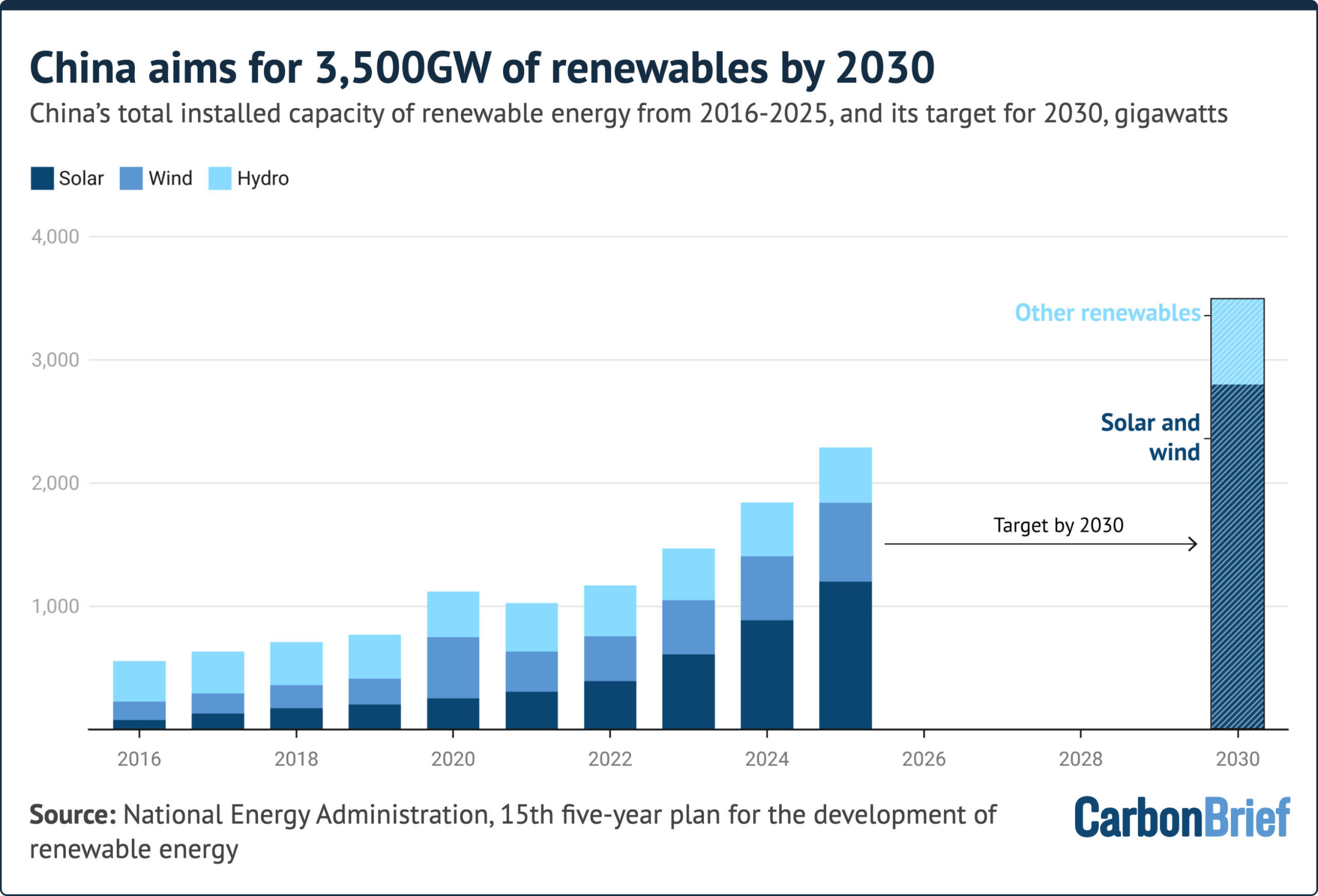
Specifically, China will aim to install 3,500 gigawatts (GW) of renewables capacity by 2030, 2,800GW will be wind and solar.
The country had previously pledged to install 1,200GW of wind and solar by 2030, a goal that China met six years early.
Another major theme is the provision of wind and solar supply that is “dependable” and “grid-friendly”.
Setting a target for “dependable output” from wind and solar could help to entrench their role as a provider of “energy security”, according to analysts.
The government also aims to boost renewables consumption by developing non-power uses of renewable energy, in sectors such as steel and chemicals.
Below, Carbon Brief examines the key targets and policies outlined in the five-year plan and what they mean for China’s energy transition.
Five-year plans are key to China’s political system. An overarching plan, covering all socioeconomic issues of importance to policy leaders, is published at the beginning of each five-year cycle.
The plan for the 15th five-year period (2026-2030) was published in March 2026.
It includes what the government considers to be the most important targets and policy signals for climate and energy. For example, binding targets for carbon intensity, the share of non-fossil energy in total energy consumption and total energy production capacity.
Following this overarching document, five-year plans focused on specific sectors or themes are then published over the course of the five-year plan period.
This year, the government has already published several five-year plans related to energy and climate change. One covers the development of the “new-type” energy sector more broadly. Another wraps climate goals together with other environmental targets under the “Beautiful China” programme.
By contrast, the renewables five-year plan focuses specifically on the development of hydropower, wind, solar, biomass, geothermal and wave energy.
It covers topics including capacity and generation targets, as well as efforts to increase integration and reliability of wind and solar. It also has policies to encourage “non-power use” of renewable energy and ways to strengthen innovation of clean-energy technologies.
What overarching renewables targets are in the plan?
China will aim to install 3,500 gigawatts (GW) of renewables capacity by 2030, according to the five-year plan.
Of this, 2,800GW will be wind and solar – a pledge reiterated from China’s action plan for peaking carbon emissions, which was released earlier this month.
The goal more than doubles a previous 2030 target for wind and solar to reach 1,200GW, which China met six years early.
As of June 2026, the country has installed just under 2,000GW of wind and solar capacity, as well as 454GW of hydropower. Biomass, geothermal and wave energy hold very small shares of the overall energy mix.
As such, China would need to build 160GW of wind and solar each year – and just under 220GW of renewable capacity in total – to meet the targets.
The country installed 277GW of new solar alone in 2024 – and 315GW in 2025.
China’s total installed capacity of renewable energy from 2016-2025, and its target for 2030. Source: National Energy Administration, Carbon Brief.
A key part of meeting the targets will be the development of large-scale clean-energy bases in China’s northern regions. These will generate power to be exported elsewhere via ultra-high voltage lines. The plan also encourages greater “local consumption” and installations of distributed energy (see below).
The plan says that further research will be directed at increasing the renewable share of electricity generated by these large-scale energy bases to 100%.
A recent report by the thinktank Global Energy Monitor (GEM) finds that output from these bases “continues to be paired with coal-fired generation in the name of balancing and system flexibility”. It says that currently, coal generates 42% of the power transmitted to the rest of the country from these bases.
China will also add more hydropower, says the plan, with capacity rising from 448GW in 2025 to 570GW in 2030. Some 160GW of this will be pumped-storage hydropower.
Meanwhile, the plan sets a target for renewable power generation to reach 6,000 terawatt-hours (TWh), 4,000TWh of which would come from wind and solar.
This would be a 50% increase in five years as renewables generated just under 4,000TWh of electricity in 2025, according to the National Energy Administration.
By 2030, the plan says that total consumption of renewable energy will stand at 1.8bn tonnes of coal equivalent (Gtce).
This would be up from 1.2Gtce in 2025, which represented about one-fifth of China’s total energy consumption of 6.2Gtce that year.
The renewable targets in the plan are lower than those suggested in a recent study by high-profile Chinese scholars.
The study, from the department of energy and power engineering and the Institute of Climate Change and Sustainable Development at Tsinghua University in Beijing, assessed the “likelihood of China attaining its carbon peak” under different pathways.
It found that, in order to meet its climate commitments, China would need to either install more than 4,000GW of “non-fossil energy capacity” before 2030, or to “maintain a total energy consumption” below 6.5Gtce.
The table below outlines some of the key renewables targets for 2030, as specified in the plan.
Key targets for 2030, adapted from 15th five-year plan for renewable energy
Type
2025
2030
Percentage change
Renewable energy use
1.2Gtce
1.8Gtce
53%
Total renewables capacity
2,340GW
3,500GW
50%
Wind and solar capacity
1,840GW
More than 2,800GW
52%
Of which: Solar thermal
1.8GW
15GW
733%
Hydro capacity
450GW
570GW
27%
Of which: Pumped storage hydropower
66GW
160GW
142%
Wave energy
–
0.4GW
–
Renewable generation
4,000TWh
6,000TWh
50%
Of which: Wind and solar
2,300TWh
4,000TWh
74%
Non-electricity use
60Mtce
150Mtce
150%
Renewable hydrogen
0.25Mt
2Mt
700%
Why does the plan focus on ‘firm capacity’ for renewables?
As well as increasing the overall size of China’s renewable power supply, the country must also maintain an “uninterrupted and reliable power supply”, officials from the NDRC and NEA told state news agency Xinhua in coverage of the new plan.
To support this goal, the plan says that the development of renewables will “enter a new stage”. This will mean that “improving quality and serving as a reliable alternative” to fossil fuels will be as important as “expanding scale”.
The plan, therefore, proposes targets for the “firm capacity” from wind and solar (置信出力). This is the amount plants or grids can be relied on to produce during critical supply periods, in conjunction with on-site storage.
The target for wind is a firm capacity of at least 11% of total installed capacity by 2030, while the equivalent goal for solar is 6%.
Wind and solar will also be expected to supply more than 20% of total demand in peak periods during the summer and winter evenings, says the plan. It expects “reliable peak-shaving capacity from renewable sources” to reach more than 300GW.
The new targets are a “positive move”, says Yao Zhe, global policy advisor at Greenpeace East Asia, as it “only applies during peak load and critical supply periods, when coal power is typically used to stabilise the power supply”.
She adds that this could, theoretically, “prevent the construction of new coal-fired power projects that are proposed and approved for the reason of meeting peak demand”.
The new metrics mark a change in focus, says Lyu Wenbin, director general of the Energy Research Institute – a state thinktank under the NDRC – in an “explanatory reading” posted on BJX News. He says it “marks a shift in renewable energy development from the mere pursuit of installed capacity to…also taking into account system support capabilities”.
The plan pledges to “accelerate the construction of grid-friendly wind and solar power stations”. It says this will enhance “reliable peak-load generation” and strengthen renewables’ ability to ensure “safe and stable operation” of the grid.
It says this will particularly be a focus in the energy-hungry east, central and south areas of China.
It sets out a slightly different focus for areas that already have a high share of renewables in their power mix, such as north-west China. Here, the aim will be to develop wind and solar parks that are “capable of providing voltage, frequency and inertia support”.
“This is a real challenge”, says James Norman, research analyst at GEM. He says these challenges are particularly acute in some circumstances:
“[For example], when the share of wind and solar is very high, relatively few synchronous generators (like coal) are online or large volumes of electricity are being transferred through high voltage DC lines.”
The plan mentions many technological solutions to address the problem, he tells Carbon Brief. However, he adds, there are no quantitative details for the issue. For example, he notes there is no target for “how many gigawatts of wind and solar must gain grid-forming capability”. This is in contrast to the goals for overall renewables capacity or generation.
Norman was a co-author on the recent GEM report, which identified further barriers to renewable uptake. It said these include transmission bottlenecks, alongside systemic features such as dispatching and power-contract mechanisms.
As a result, said the report, renewable power – especially solar – is increasingly being “curtailed”, particularly in north-western and northern provinces.
Yao also notes that the plan does not “spell out specific measures to address systemic constraints” around the electricity grid and the role of coal in the power sector.
“I interpret this as evidence that the vested interests are still strong in the policy debate,” she adds.
What does the plan say about ‘distributed’ energy?
Alongside gigawatt-scale clean-energy megabases, China also aims to expand construction of “distributed” energy. This means smaller-scale installations, such as rooftop solar.
More than 300GW of “distributed new energy” is to be added over 2026-30, some 60GW per year.
The plan aims for distributed new energy to be adopted in sectors such as industry, transport, buildings and agriculture.
Applications include the use of distributed solar and wind in industrial parks, coal mines and oilfields, as well as encouraging residents to install solar panels on buildings and developing rural clean-energy grids.
In some regions, distributed solar and wind is “likely to meet a large proportion of local demand”, says Prof Pan Jiahua at the Hong Kong University of Science and Technology (Guangzhou). He tells Carbon Brief that micro- and mini-grids using such resources will be particularly important in central and coastal China.
The 60GW annual target for new distributed energy is not “overly ambitious”, says Isadora Wang, head of China at the thinktank Transition Asia. She tells Carbon Brief that distributed solar additions, alone, exceeded 100GW in both 2024 and 2025.
Cosimo Ries, analyst at the consultancy Trivium China, agrees that the target is reachable. The biggest question mark, he tells Carbon Brief, is whether it will continue to make sense for industry and utilities to build distributed power at the volumes seen during the 14th five-year plan period.
He adds that market conditions for distributed solar have deteriorated sharply over the past two years. He says a range of factors have hit investor confidence:
“[Distributed solar faces] growing exposure to market trading, worsening returns in spot markets, growing risks of curtailment and new policies limiting or forbidding the selling of power back to the grid.”
What does the plan say about non-electricity use of renewables?
The plan also sets goals for renewable energy’s role in “non-electricity use”.
This means using renewable energy for purposes other than generating electricity, through converting it to other forms, such as heat or mechanical energy.
The government is aiming for non-power use to nearly triple from 60m tonnes of coal equivalent (Mtce) in 2025 to 150Mtce in 2030.
Ries tells Carbon Brief that he thinks this target is “one of the main highlights” of the plan. However, he notes that limited available data means it is hard to assess the level of its ambition. He adds that, given the relative conservatism of China’s other recent clean-energy targets, this one may also be met relatively easily.
Key applications for non-power use of renewables include “green hydrogen, ammonia and methanol”, says the plan. It also points to using wind and solar for heat, as well as to biomass and geothermal for heating and cooling.
Green hydrogen, ammonia and methanol are the “centrepiece” of the non-power push, according to state-owned newspaper Economic Information Daily.
For hydrogen alone, China plans to scale up renewable hydrogen production to 2m tonnes in 2030, up from 250,000 tonnes in 2025.
Today, non-power use of renewables accounts for only around 1% of China’s total energy consumption, NEA and NDRC officials said in a Q&A. They added that there is “considerable room for growth” in sectors such as industry, transport and buildings.
Potential new applications include the use of wind and solar for heat. This could see the use of centralised wind and solar heating stations in the chemicals, textiles, pharmaceuticals, papermaking and food sectors.
New projects in the steel and cement sectors should use locally-generated wind and solar to power electric-arc furnaces and kilns, adds the plan.
Wang tells Carbon Brief that she believes the naming of individual sectors is a “clear indication” that they will be included in China’s renewable consumption quotas. These already cover aluminium and other heavy industry sectors.
She adds that power and heat demand from the named sectors may help absorb distributed renewable energy. It will also serve as a testing ground for matching demand with supply through increased grid flexibility and power price reforms.
To Ries, the growing focus on non-power use signals that China’s decarbonisation efforts are “now entering deeper waters”. That means regulators are turning from easier-to-abate sectors, such as aluminium, to more challenging industries, such as steel.
The plan could create a “second growth curve” for the new-energy industry, says He Zhao, in a commentary for China Power News Net. He, the vice-president of the China Electric Power Planning and Engineering Institute (EPPEI). says this might begin with non-power use, before shifting to fuel, feedstock and heat substitution.
What does the plan say about China’s cleantech dominance?
The next five years is a prime opportunity for China to “consolidate our leading position across the entire industrial chain” for clean-energy technologies, says the plan.
It adds that the government will “strengthen technological innovation” and accelerate the roll-out of new applications of artificial intelligence in China’s renewable-energy system.
A particular focus for new R&D will be “cutting-edge, original and disruptive technologies”. It also points to technologies that “enhance the reliability of renewable energy” as a substitute for fossil fuels.
The plan names technologies for further development. For wind power, these include “reliable and low-cost” blades, ultra-tall towers and new types of floating platforms. It also mentions the development of “high-altitude wind power”. For solar, it points to the development of perovskite and other “high efficiency” solar cells, as well as space-solar technologies.
The plan also pledges to develop a power market that supports the “full entry” of renewable-energy companies. It underscores that companies should plan for an increasingly market-based and competitive environment.
Meanwhile, the government will also deepen cooperation with other countries on clean energy and “advance” global climate cooperation, it says.
A priority will be “strengthening” international coordination on investment and development in “green energy projects”. Another is “actively promoting the free circulation of China’s high-quality green technologies and products in global markets”.
Chinese exports of clean-energy technologies have been surging, especially since the closure of the strait of Hormuz.
At the same time, Chinese investment in clean-energy projects in Belt and Road Initiative member states totalled $20bn in the first half of 2026. This is also driven by the crisis.
The US, EU and others have launched tariffs and pricing mechanisms to curb imports of Chinese cleantech. This has contributed to pushback from China, against what it and others refer to as “unilateral trade measures”.
China is transitioning from a “major energy nation” (能源大国) to an “energy powerhouse” (能源强国), writes the Energy Research Institute’s Lyu in his explanatory reading. He says this will enable China to increasingly shift to building “systemic” advantages in developing clean-energy technologies.
He continues that, from 2026-2030, China will “move to the very forefront of the global stage” on clean energy, “venturing into uncharted territory”. This will create both “major new challenges and significant opportunities” for the country, he adds.
Interview: Dr Sun Yixian on his new database tracking Chinese climate ‘leadership’
Patrick Schröder is a senior research fellow at Chatham House’s Environment and Society Centre.
A climate summit serious about implementation cannot afford to leave major emissions reductions off the table. Yet, that is the risk COP31 faces unless it makes reducing raw material use central to the way countries decarbonise their economies.
On the sidelines of the UN General Assembly in New York last week, COP31 host Türkiye laid out proposals to accelerate emissions cuts in the next decade. Its plans include global goals to increase the share of recycled products in material use to at least 15% (up from 6.9% in 2025) and halve waste generation by 2035.
COP31 offers an opportunity to connect efforts to improve material circularity with stronger national climate commitments and mitigation pathways. But these targets could be a lot more ambitious.
The case for circularity
The Paris Agreement cannot be delivered through cleaner electricity alone. We must also reduce the emissions that are embedded in the way we extract resources, manufacture products, build infrastructure and dispose of waste.
Circularity principles are pivotal to credible mitigation pathways: designing technologies and products to last, repairing and reusing them, and reducing demand for virgin resources.
The scale of the opportunity is striking. A recent European Environment Agency review found that adopting such principles could deliver average global emissions reductions potential of 52% in the waste sector against a business-as-usual scenario, 48% in construction and buildings, 28% in transport and mobility, 26% in industry and 24% in agriculture.
A new report by an EU-funded research project says the bloc could harness its “urban mines” to reduce its dependence on China for energy transition minerals
Beijing is bracing for a tsunami of spent EV batteries by taking steps to boost recycling – a strategy that could also cut its reliance on imports of clean energy minerals
As countries scramble to secure critical minerals, Kingston’s burgeoning clean tech ecosystem is attracting startups to create circular supply chains and reduce reliance on China
These figures make a compelling case for raising circularity ambitions across the economy, offering the promise of far more than better recycling bins.
In fact, recycling minerals used in cleantech equipment, for example, illustrate the extent of the emissions savings available. The carbon footprint of minerals and metals recovered from secondary sources is up to 80% lower than those produced from new mining and processing, according to the International Energy Agency.
A major EU-funded project estimates that recovered materials could substitute up to 56% of Europe’s primary critical raw material requirements by 2050, provided they achieve the necessary quality. The main takeaway goes beyond Europe: yesterday’s products can become tomorrow’s strategic resources while mitigating climate change.
In this light, a target to increase the share of recovered material use to 15% isn’t enough.
The evidence-based Circularity Gap Report found a 17% target by 2032 is possible and could unlock additional emissions reductions amounting to several gigatonnes of CO2.
Reducing material demand
A higher circularity metric is only part of the answer, however. An economy can increase its recycling rate at the same time as extracting more primary materials if total material demand keeps growing.
The tougher issue governments need to address is identifying what reductions in primary material use are needed.
The Circularity Gap Report uses an indicative benchmark of eight tonnes of virgin materials consumed per person annually. This is already being translated into policy: Germany’s 2024 circular economy strategy aims to reduce primary resource consumption, with the German Federal Environment Agency identifying six to eight tonnes per person as an ambitious target.
An engineer walks past a pump at the battery recycling pilot plant installed in the Eramet Research & Innovation center in Trappes, near Paris, France (Photo: REUTERS/Gonzalo Fuentes)
Reducing primary material demand will require a closer integration of energy and resource policies. Efficient EVs charged with solar power can complement better public transport and walkable cities, while batteries designed to be repaired and reused for stationary energy storage before being recycled will reduce the materials footprint of transport and clean energy services.
Coordinated infrastructure development and urban planning can prevent unnecessary overbuild, while renovating existing building stock reduces demand for new steel, cement and aluminium, which are emissions-intensive to produce. Connecting industrial waste heat to district heating networks can further reduce energy demand and emissions.
What governments should agree at COP31
COP31 can translate this approach into three concrete commitments.
First, governments should agree a stronger circularity ambition, supported by material-footprint indicators and milestones. The presidency should seek recognition of these priorities in negotiated outcomes, alongside concrete delivery partnerships under its COP31 Action Agenda.
Second, countries should include quantified circular economy measures in their updated nationally determined contributions (NDCs) and implementation plans. Such measures should include reuse, material efficiency and circularity targets, as well as transparent estimates of emissions savings that avoid double counting across sectors. By the end of 2025, countries had developed 101 national circular economy roadmaps and action plans, yet these often remained disconnected from their NDCs.
Recycling e-waste can unlock a vast and sustainable supply of transition minerals but in India the sector relies on a neglected informal economy
Third, climate finance should support the delivery of circular solutions such as material recovery at scale, investments into circular critical mineral value chains beyond mining, developing a circular plastics economy, and designing buildings and cities that support material reuse. Developing countries need technology, affordable finance and support to deliver these ambitions, including for the informal workers whose livelihoods depend on recovering and recycling materials.
The test for COP31 is to reach an agreement that can start the transformation of our production and consumption systems and how they are financed.
A headline circularity target will achieve little without policies that address absolute resource demand and deliver measurable emissions cuts. But COP31 offers an opportunity to make circularity a central element of climate policy, with targets strong enough to matter and institutions equipped to deliver them.
An exceptional El Niño is building. The World Meteorological Organization (WMO) says it has intensified to very strong levels and is likely to last at least through February 2027. If its current trajectory holds, it could become stronger than anything seen since WMO monitoring began four decades ago.
That is bad news for agriculture. El Niño – a naturally occurring weather phenomenon – can scramble rainfall patterns across the world, bringing drought to some regions and floods to others. And this time it is unfolding against the backdrop of a significantly hotter climate, with farmers already contending with unreliable growing seasons, extreme heat and less predictable rainfall because of global warming.
We are seeing the consequences already. In Sri Lanka, drought linked to El Niño has dried wells and reservoirs and cut into crops and farmer incomes. Indonesia is experiencing its worst wildfire season in 11 years, with prolonged drought and extreme heat exacerbated by El Niño. And in Peru, authorities are preparing for the opposite extreme: intense rains, flooding and landslides which the national civil-defence agency says could affect around 1.2 million people.
These impacts will multiply as El Niño intensifies.
And yet, just as the risks to food production are rising, the money available to help farmers withstand them is shrinking.
10% funding decline in 2024
A forthcoming analysis from the Food and Agriculture Organization (FAO) shows that climate-related development finance for agrifood systems is moving in the wrong direction. In 2024, the latest year for which data is available, it fell by 10 percent compared with a 2 percent overall decline. The sectors that put food on our tables — crops, livestock, forestry and fisheries — received just 5 percent.
Yet this is precisely the moment when climate investment in agriculture needs to grow, not shrink. It can help communities adapt, build resilience and protect food security, while unlocking larger flows of public and private finance. Agriculture feeds us, supports the livelihoods of well over a billion people, and is often the first sector hit by drought, floods and extreme heat. Cutting that investment now is a false economy.
One failed harvest can plant the seed for the next crisis, forcing farmers to eat the seed they have saved for planting, sell livestock or tools, or take on debt. It can also deepen food insecurity, disrupt supply chains and drive up prices, showing up months later in supermarket aisles far away.
The Central American Dry Corridor, stretching through much of the region, shows both how exposed farmers are, and what investment can do. Based on an analysis of 41 years of satellite observations, FAO finds that some crop and pasture areas there face more than a 50 percent chance of agricultural drought over the coming months.
About half of Central America’s 1.9 million producers of maize, beans and other basic grains live in the Dry Corridor. Many grow food both for sale and for their own families. When a harvest fails, they lose both income and dinner.
El Salvador project conserves water and soil
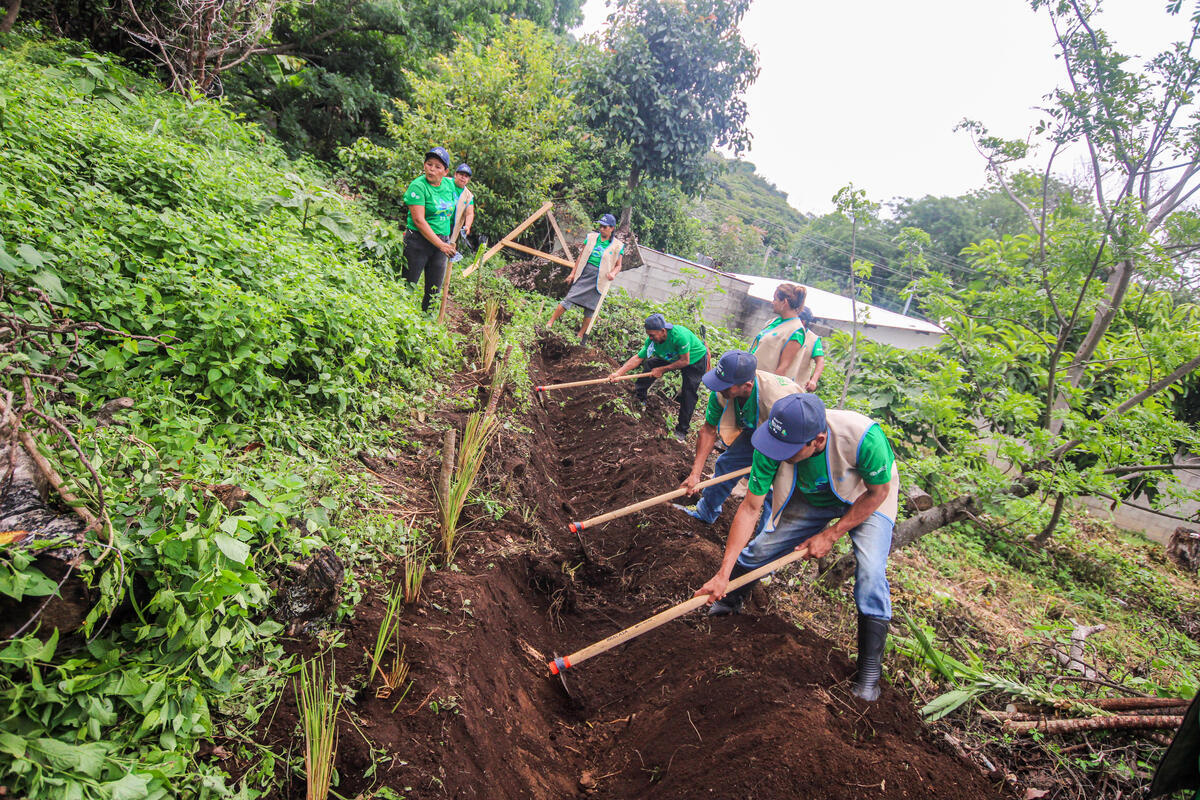
In El Salvador, which lies within the Dry Corridor, more than 50,000 farmers have adopted practices to better withstand drought and increasingly unreliable rainfall through RECLIMA, a project financed by the Green Climate Fund and implemented by FAO in partnership with the government of El Salvador. It has substantial national co-financing, including from the country’s Environmental Investment Fund.
El Niño can intensify El Salvador’s annual mid-season dry spell, known as the canícula, turning it into a longer, harsher drought just as maize needs water most.
For María Cristina Corvera de López, a second-generation farmer in rural Nahualapa, adapting means changing how every drop of rain is captured and used. She plants trees alongside her crops to provide shade and minimise evaporation and uses simple irrigation channels and a homemade drip system to conserve water. Instead of burning stalks, leaves and husks after harvest, as generations before her did, she turns them into mulch to hold moisture in the soil.
“The effects of climate change are a constant challenge,” she says. But the new techniques have made her farm more resilient to El Niño as well. Where she once harvested about 50 bags of maize per acre, she now gets around 80, even during droughts. It’s enough to feed her family and sell the surplus.
Managing risk now cuts future costs
Together, these adaptations can mean the difference between losing a crop and getting through a dry season with enough food, seed and income to plant again. They are also the result of climate finance invested before disaster strikes.
RECLIMA shows what that kind of adaptation investment can buy. Adaptation accounted for 45 percent of climate-related development finance to agrifood systems in 2024, and multilateral development banks are directing more agricultural finance towards resilience. That shift reflects a growing recognition that adaptation is a form of risk management, not just a development cost.
We need much more of it. The same investments that help farmers withstand El Niño also enable them to adapt to a hotter, more unpredictable future. Cutting investment in the people who produce our food just as climate risks intensify does not save money. It simply pushes a much larger bill into the next harvest, the next food crisis, and the next El Niño.
An area of Amazon forest roughly the size of the US state of New Jersey has remained standing due to Luiz Inácio Lula da Silva’s leadership of Brazil, according to Carbon Brief analysis.
Lula beat Jair Bolsonaro in the 2022 election to become president of the nation that is home to nearly 60% of the Amazon rainforest.
Forest loss surged during Bolsonaro’s far-right presidency and dropped sharply under the left-wing Lula, with Amazon deforestation likely to hit its lowest level on record this year.
Now, as another presidential election approaches, Lula is facing off against Bolsonaro’s son, Flávio Bolsonaro, whose “anti-environmental” policies are similar to his father’s.
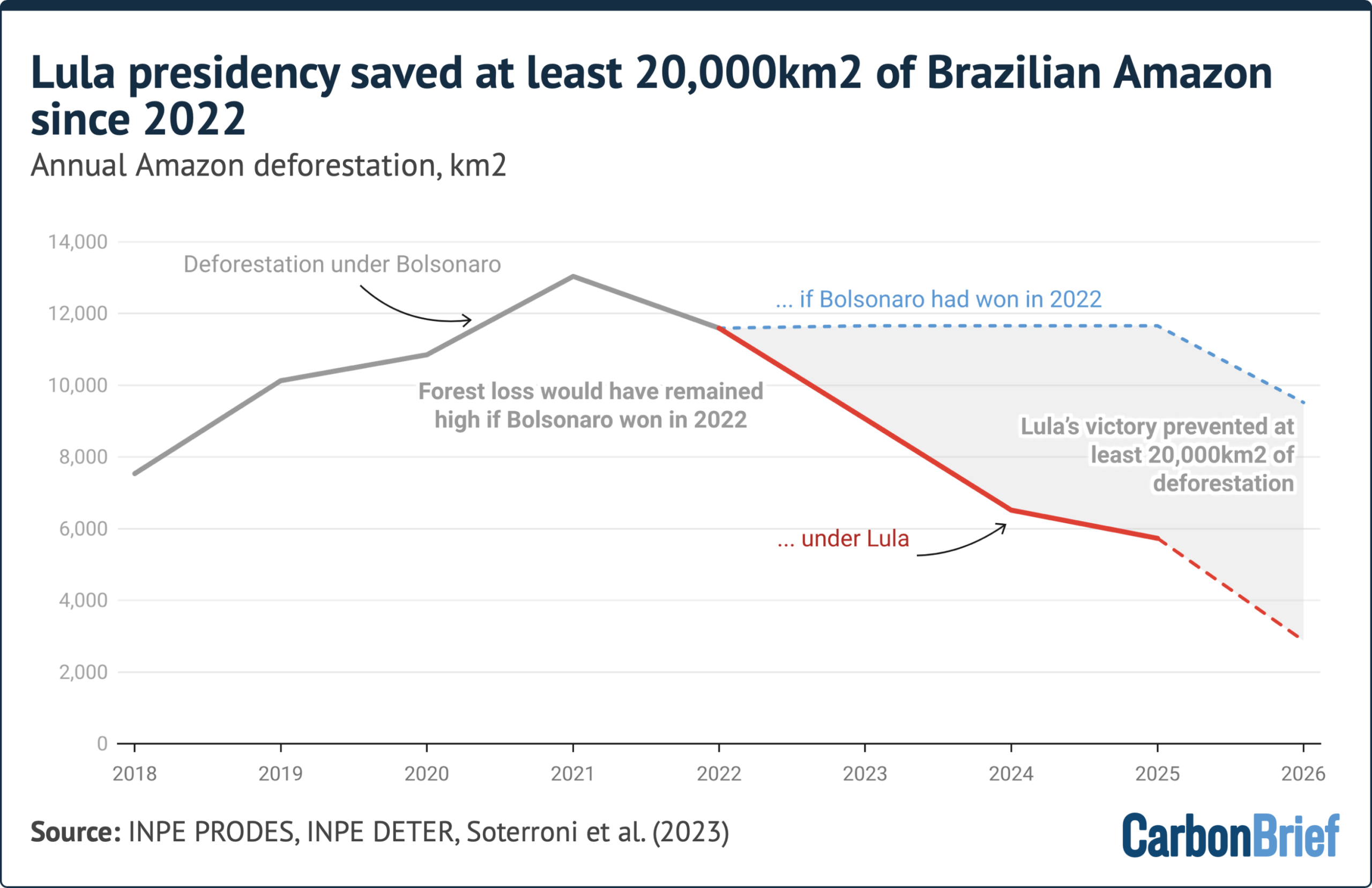
Carbon Brief’s analysis suggests that at least 20,000 square kilometres (km2) of deforestation has been avoided since Lula took office and prioritised Amazon protection.
The analysis is based on modelling by an international research team of an alternative scenario in which Brazil’s flagship forest code legislation was not enforced – a proxy for Jair Bolsonaro’s leadership.
Experts tell Carbon Brief that this estimate is likely “conservative” and that actual deforestation under Bolsonaro could have been “much higher”.
With Lula and Flávio Bolsonaro tied in the polls, the upcoming election is expected to significantly shape the level of environmental action in the world’s fourth-largest emitter, whose emissions are largely driven by deforestation.
‘Brazil is back’
When Jair Bolsonaro was president of Brazil between 2019 and 2022, he championed the nation’s powerful agribusiness sector and oversaw an unprecedented increase in Amazon deforestation.
Bolsonaro weakened regulations, slashed federal agency budgets and empowered illegal activities in the Amazon, while attacking Indigenous and environmental groups.
This meant that the forest code – Brazil’s flagship legislation that requires landowners to preserve and restore forest on their property – was not properly enforced.
After Lula’s presidential victory in 2022, he promised to target “zero deforestation” by 2030, telling the COP27 UN climate summit that “Brazil is back”.
Lula rolled back Bolsonaro’s wave of deregulation and reinstated a deforestation “action plan”. Led by celebrated environmentalist Marina Silva, the environment ministry scaled up enforcement and policing activities in the Amazon.
As a result, annual deforestation in the Amazon has more than halved from 11,594km2 per year in 2022 to 5,731km2 in 2025.
Data from August 2025 to July 2026 – the timespan used in government records – is yet to be released, but preliminary satellite alerts put the deforestation figure at 2,874km2.
While the final figure is likely to be higher, experts still think Amazon deforestation in 2026 could hit its lowest level since records began in 1988.
New Jersey-sized forest
Compared to a scenario in which Bolsonaro won in 2022, Carbon Brief analysis suggests that at least 20,000km2 of Amazon forest remains standing today due to Lula’s leadership.
This area – roughly the size of Wales, Belize, Slovenia or the US state of New Jersey – is indicated by the grey area in the chart below.
Each year covers a period from August to July. Deforestation data is from INPE’s PRODES dataset, except for the 2026 figure. This is based on INPE’s DETER real-time satellite alert data, which tends to give lower estimates than PRODES. The “Bolsonaro” projections are based on a scenario with no forest code enforcement, from a 2023 study.
It is based on a comparison of forest code implementation with a “baseline” scenario in which the code is not enforced, reflecting the kind of weak governance seen under the Bolsonaro administration. (See Carbon Brief’s 2022 article for more details of this modelling.)
Dr Aline Soterroni, a University of Oxford researcher who led the 2023 analysis, tells Carbon Brief that the reversal seen under Lula “shows how quickly deforestation can respond to political will”.
However, she stresses that the modelling of the “no forest code” scenario is “relatively conservative”, with deforestation remaining high but not rising.
Deforestation in this scenario – used here as a proxy for a Bolsonaro election win – is tempered by slower demand growth for Brazilian beef and soy, says Soterroni. She notes that the scenario also does not capture the potential for illegal forest clearing in response to weak governance.
Indeed, some experts anticipated in 2022 that a Bolsonaro victory would send deforestation rates rising to near-record levels.
Claudio Angelo, international policy coordinator at Brazil’s Climate Observatory, tells Carbon Brief that if Bolsonaro had won in 2022, “we have reason to believe [this would have resulted] in much higher rates than during his first term”.
Angelo says the “political signal” would likely have driven an “explosion of wildcat mining” and illegal deforestation in the Amazon. He also points to efforts – including by Flávio Bolsonaro – to formally dismantle the forest code in the Brazilian congress, during Jair Bolsonaro’s first term.
Soterroni notes that deforestation rates did not immediately drop following Lula’s election, as suggested by modelling of a full “forest code compliance” scenario. She says this reflects the “gradual and imperfect process” of restoring and enforcing the law.
Nevertheless, she tells Carbon Brief:
“The key message from our modelling is the contrast between these trajectories: weak environmental governance keeps deforestation substantially higher than full implementation of the forest code. That message remains relevant today.”
Election significance
With Jair Bolsonaro in prison for plotting a coup after losing the 2022 election, his son Flávio Bolsonaro, a senator for Rio de Janeiro, is standing against Lula in the upcoming contest for president.
There are 13 candidates, but Flávio Bolsonaro and Lula are by far the frontrunners and are currently neck-and-neck in opinion polls.
If Lula wins, experts say he is likely to continue with the “zero deforestation by 2030” agenda that has already had a pronounced impact on forest loss.
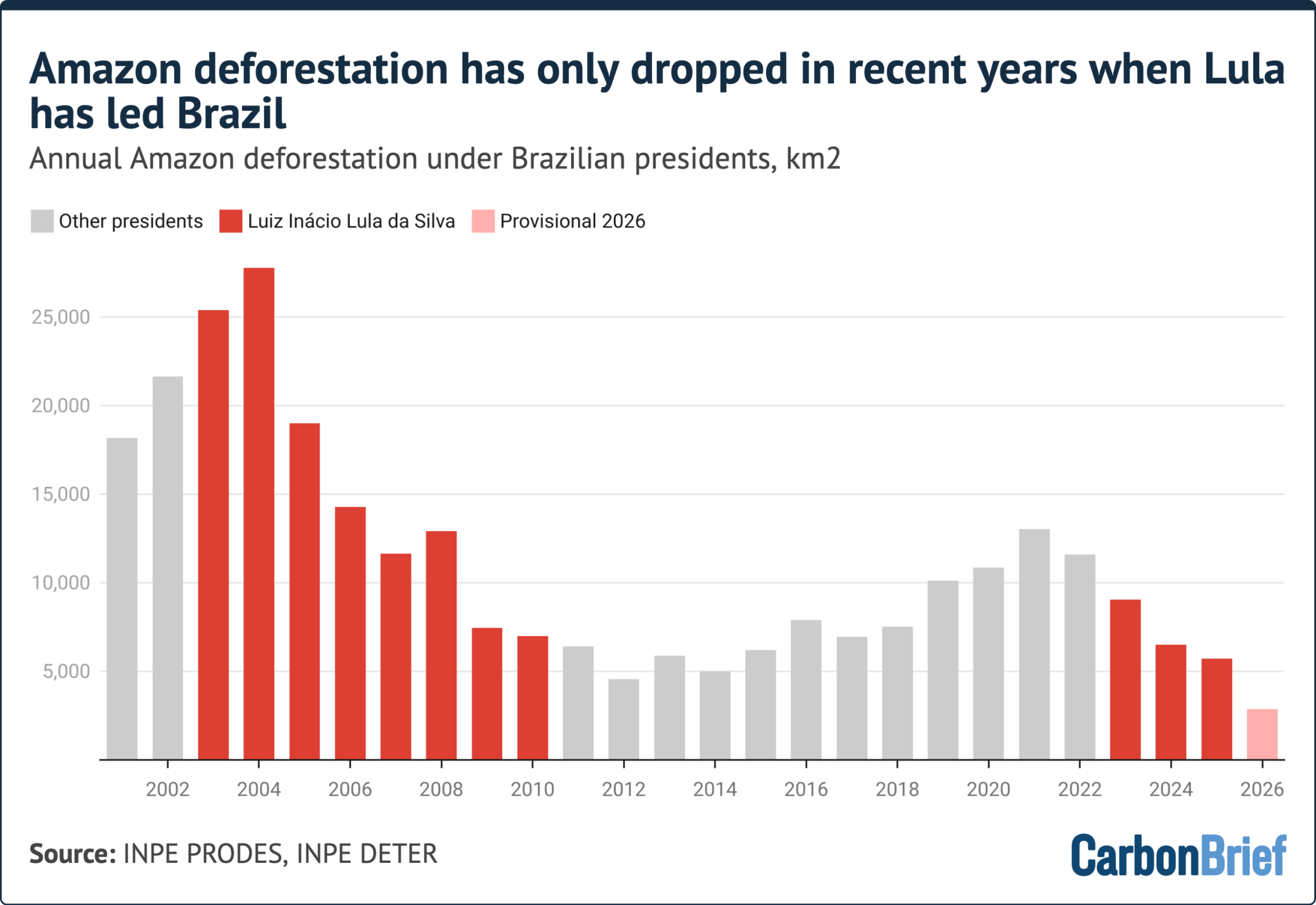
As the chart below shows, periods when Amazon deforestation fell in recent history all occurred during Lula’s three terms as president.
In contrast, experts say Flávio Bolsonaro, a climate sceptic who has indicated he will continue his father’s political agenda and favour agribusiness and mining, will likely drive a surge in deforestation. Angelo tells Carbon Brief:
“At the risk of sounding alarmist, I’ve been saying that Lula’s re-election is the only thing standing between us and a wide destruction of the Amazon.”
“I don’t think we can afford four years of increasing deforestation [and] violence against Indigenous peoples.”
Dr David Lapola, an ecologist focused on Amazon research at the University of Campinas in Brazil, says he believes deforestation “would certainly rise” and Brazil’s climate and deforestation goals “would be thrown in the trash bin”. He tells Carbon Brief:
“The Bolsonaro administration in the 2019-2022 period showed that the deconstruction of environmental policies and institutes can be done very, very quickly.
“In a matter of a few months, they can destroy what has been constructed over decades of environmental policy and activism in Brazil.”
‘Greenest’ policies
Lula has the “greenest” policy proposals of Brazil’s six top-polling presidential candidates, according to analysis by the Climate Observatory.
The analysis identifies 16 “positive and detailed” environmental commitments in Lula’s proposals, including reaffirming his “zero deforestation by 2030” goal.
Flávio Bolsonaro, on the other hand, has one positive environmental commitment and seven “clearly anti-environmental” proposals.
The right-wing politician has committed to zero “illegal” deforestation by 2029. However, he has also previously led an attempt to change the forest code, opening up large tracts of previously out-of-bounds forest for legal clearance by extractive industries.
Given this, Angelo tells Carbon Brief that he is sceptical about the 2029 pledge.
“The only way you can trust him on this is to think that he is going to revoke the forest code and make all illegal deforestation legal.”
Brazilian presidential candidate Flávio Bolsonaro with a cardboard cutout of his father, former president Jair Bolsonaro. Credit: ZUMA Press, Inc. / Alamy Stock Photo
Lula is also the only major candidate to list a clear target for cutting national emissions, sticking with Brazil’s existing goal to cut emissions by 59-67% by 2035, compared to 2005 levels.
Overall, the Climate Observatory notes that climate change and environmental issues “are off the radar for most candidates”, who are instead focusing on the economy and security issues.
Pinho adds that deforestation and the Amazon have not been at the “forefront” of this election, compared to 2022.
If Bolsonaro wins, up to 95% of the Amazon would fall under the leadership of right-wing national governments – including those in Bolivia, Colombia, Ecuador and Peru – reported Mongabay. It noted that presidents in all these nations “explicitly favour agribusiness and mining over environmental conservation”.
If no candidate receives a majority of votes in the first round of Brazil’s election on 4 October, a runoff will take place on 25 October, as has happened at every presidential election since 1998.
Soy moratorium and Brazilian congress
Other factors will also play a role in future deforestation in Brazil, regardless of the next president.
One is the effective end of the Amazon soy moratorium. This is a voluntary agreement signed by companies committing to not buy soya beans grown on land in the Brazilian Amazon that was deforested after 2008.
Conservation organisation WWF’s international director general, Kirsten Schuijt, previously described it as the “most impactful voluntary supply chain policy ever implemented”.
However, major grain traders withdrew from the agreement earlier this year, effectively bringing it to an end. Pinho describes this move as a “huge destruction” of Brazil’s environmental protections.
Research shows the moratorium prevented around 18,000km2 of deforestation in its first decade of operation from 2005-16.
In contrast, a 2026 study estimated that the end of the moratorium could result in 14,000km2 of additional deforestation in the Amazon by 2036.
Alongside choosing a new president on 4 October, Brazilian voters will elect state governors and members of congress, which will also factor into future environmental impacts.
Right-leaning parties, including the far-right Liberal Party linked to the Bolsonaros, currently hold half the seats of the two chambers of congress.
This has led to conflict between lawmakers and Lula. For example, in 2025, congress bypassed Lula’s veto of several aspects of a controversial piece of legislation dubbed the “devastation bill”.
Pinho says that the potential for a right-wing congress and president would be “devastating for the environmental and climate agenda”.
Lapola notes that a Flávio Bolsonaro presidency “would consolidate the view in Brazil that environmental protection is solely a matter of political preference, and not a crucial need of all people”. He adds:
“Land pillage, destruction of precious biodiversity and scorning of Indigenous peoples simply cannot be a nation’s project in the 21st century. We have got to be smarter than that, for sure.”
related
Q&A: What change of power in Colombia could mean for world’s fossil-fuel transition