

A traditional sustainability certification can take six to eight weeks and thousands of dollars in consultancy fees, and still leave purchasers wondering whether the claims actually hold up. Martin Johnston, founder of EarthRating.ai, thinks he can deliver a more useful answer in 10 minutes. His London-based startup is building a universal credibility score for sustainability — a 1,000-point rating, drawn from roughly 100 public data points, that measures whether what a company says about its environmental and social performance is consistent with what its audited filings and regulatory disclosures actually show. The premise borrows directly from consumer credit scoring: a FICO score doesn’t tell a lender whether you’re a good person, only whether your behavior is consistent enough to be trusted. On this episode of Sustainability In Your Ear, Martin explains how EarthRating’s “accelerated impact engine” gathers verified data instead of relying on questionnaires, and why the small and mid-sized businesses now caught up in the EU’s Corporate Sustainability Reporting Directive and the UK’s Procurement Act 2023 need an affordable way to prove their credentials.

Most sustainability frameworks rely on self-reported questionnaires; EarthRating pulls data from audited annual reports, regulatory filings, press coverage, and marketing materials, then cross-checks them against each other to surface contradictions before they become a regulatory or reputational problem. A near-term emissions target that appears in a press release but not in the audited annual report is exactly the kind of credibility gap the platform is designed to flag. Importantly, EarthRating isn’t measuring environmental impact — it’s measuring whether a company’s story is internally consistent and externally verifiable. That sidesteps the impossible problem of reducing carbon, water, biodiversity, and social performance into a single comparable number, and replaces it with a more tractable question: are the claims true? That speed and accessibility comes with real caveats, and Martin and I dig into them. A credibility score isn’t an impact score: a small landscaping firm with a modest, well-documented commitment to electric mowers could rate higher than a multinational with aspirational but unverified net-zero pledges. That’s the right calibration for measuring trust, but it isn’t the same as measuring environmental performance. EarthRating also exists at “Google 1.0,” in Martin’s own words — a launch-stage platform with a proprietary methodology that hasn’t yet been externally audited. Global standards aren’t willed into existence; they’re earned through adoption. The underlying problem EarthRating is trying to solve — making credible sustainability measurement accessible to the businesses that have been priced out of it — is a real one, and worth watching.
To find out more about EarthRating, visit EarthRating.ai.
- Subscribe to Sustainability In Your Ear on iTunes
- Follow Sustainability In Your Ear on Spreaker, iHeartRadio, or YouTube
Interview Transcript
Mitch Ratcliffe 0:09
Hello, good morning, good afternoon, or good evening, wherever you are on this beautiful planet of ours. Welcome to Sustainability In Your Ear. This is the podcast conversation about accelerating the transition to a sustainable, carbon-neutral society, and I’m your host, Mitch Ratcliffe. Thanks for joining the conversation today.
We’re going to talk about, well, in a way, credit scores. Every sustainability claim made today faces the same fundamental problem: we lack a credible common language that quantifies a business’s impact on planet and people. A company, of course, can call itself sustainable simply by cherry-picking a single metric, commissioning a favorable audit, or simply repeating the word often enough that it seems to stick.
However, regulatory pressure is tightening. The EU’s Corporate Sustainability Reporting Directive now covers roughly 50,000 companies, and the UK’s Green Claims Code is actively prosecuting misleading environmental marketing. Here in the United States, the SEC’s climate disclosure rules are still in effect, although they are under attack. Of course, regulation alone doesn’t solve the underlying problem. Businesses, investors, and consumers still lack a fast, affordable, and trustworthy way to evaluate whether a sustainability claim actually holds up.
Our guest today is Martin Johnston, founder of EarthRating.ai. It’s an early-stage company building what it calls a universal credibility score for sustainability. The Earth Rating is a 1,000-point scale generated in minutes using AI and verified data from a company. It’s designed to measure, manage, and monitor sustainability performance across businesses of all sizes, from a regional landscaping firm to a global fashion house.
But unlike legacy frameworks built for large corporations with dedicated sustainability teams and consultancy budgets, EarthRating is designed to be accessible to small and medium-sized companies. They constitute the vast majority of economic activity worldwide and have been almost entirely locked out of credible sustainability measurement. EarthRating’s core proposition is that sustainability credibility should work more like a credit score — standardized, legible, and universally available — rather than opaque, expensive, and inconsistent.
So we’re going to talk with Martin about what makes a sustainability score genuinely credible, rather than just another layer of greenwashing; how EarthRating’s methodology handles the inherent incompleteness of any single score across carbon, water, biodiversity, and governance; and what guardrails prevent businesses from gaming the system he’s designing. We’ll dig into who the primary audience for an Earth Rating actually is — whether it’s regulators, investors, supply chain partners, or even consumers — and how the company is thinking about the gap between giving a business a number and actually changing its behavior. We’ll also look at the roadmap: what EarthRating is building, which markets it’s targeting first, and what would have to be true for a startup like this to become the universal standard it’s aiming to be.
You can learn more about EarthRating at EarthRating.ai. EarthRating is all one word, no space, no dash. EarthRating.ai. So can a single AI-powered score do what decades of sustainability frameworks have failed to accomplish — make environmental credibility fast, affordable, and impossible to fake? Let’s find out right after this brief commercial break.
Mitch Ratcliffe 3:43
Welcome to the show, Martin. How are you doing today?
Martin Johnston 3:45
Oh, yeah, not bad, actually. Thank you very much.
Mitch Ratcliffe 3:47
Well, thanks for joining me. We had a really interesting conversation a couple of months ago about what EarthRating is up to. And I want to start off by asking — you’re describing this as a universal credit score for sustainability. What will make EarthRating credible when so many sustainability scores and certifications have been accused of serving mostly as marketing tools?
Martin Johnston 4:07
Yeah, it’s a good question. I think the difference between us and other people really is the fact that we can summarize it in three words: we don’t actually ask, we find out. Where most other frameworks are reliant upon questionnaires and self-reporting — and I know a lot of them are now catching up on verifying the data and that kind of stuff — we’ve built an accelerated impact engine that gathers 100-plus data points and feeds them into a scoring system where we can verify what people are saying against what they’re actually doing. We search for verified information and verified data, and therefore what comes out of the platform is quite a good indication of the maturity of where a company is at from a sustainability perspective, based on evidence and based on real data, rather than based on a questionnaire that someone else has filled in for them.
Mitch Ratcliffe 5:13
Can you describe briefly what kind of data you get when you make that assessment?
Martin Johnston 5:18
Yeah, I can describe it. Obviously, I don’t want to go too much into detail, but we research the four pillars of sustainability — so human, environmental, economic, and social. Data that comes out includes things like: Is it verified carbon measurement? Do they have a near-term target? Do they have a future target? We then assess whether that is actually verified by an independent body. So it’s not just what the company says about itself — has it actually got third-party endorsement? From there, what we can then look for is any flags or any conflicting statements, because we go into detail from actual reports that have been signed off by their accountancy teams, versus what the press and what marketing materials say. It looks to verify that data and compares the conflicts. So from our point of view, it’s not really a certification. It’s a B2B tool which allows organizations to genuinely use it in an impactful way. It’s not there to scrutinize and be used as a lens so other people can jump on the bandwagon of having a go at businesses who are trying to do the right things and be positive towards the planet and the people who live on it.
Mitch Ratcliffe 6:40
Roughly how long does it take to establish that score once I decide to do it as a company? What does the timeline look like?
Martin Johnston 6:48
To be honest with you, it varies, but we’re talking minutes.
Mitch Ratcliffe 6:52
Minutes?
Martin Johnston 6:53
We’re talking anything up to 10 or 15 minutes. We can do it sometimes in three or four. It depends on the veracity of the information we’re searching for, how much information is available, and whether we have to cross-check that information using our accelerated impact engine. Literally, the speed is how quickly we can ascertain that information — whereas, you know, comparable processes take six to eight weeks for a certification, and 12 months-plus for others.
Mitch Ratcliffe 7:27
Sustainability measurement is fragmented across carbon, water, biodiversity, social impact, the human implications that you described a moment ago. How do you handle that kind of inherent incompleteness in any single score? And how does EarthRating express explicitly what it doesn’t measure as well as what it does?
Martin Johnston 7:49
Good question. Well, we’re measuring the credibility — this is our differentiator. We measure the credibility of what an organization is saying, rather than the impact itself. So what we look for is: What does an organization say it’s doing? What claim is it making? And then we offer data to verify that claim. That’s why it’s a credit score in the true sense of the word — a credit score is actually credibility. That’s what credit means. It’s based on the idea of trust: if you are paying back your debts to your financial institutions on a regular basis within the timeframe and show that you can manage your financial responsibilities in a considerate way, you will get a good trust score, which is what a credit score is. That means you are a good opportunity for underwriters to look at and say, ‘Yeah, you’re a good person to loan my money to. I live where I live, I bank with the right bank, I’m on the electoral roll, and I have a credit history of doing the right thing on a timely basis.’ If you take that financial model and recategorize it to sustainability and change the inputs — are the claims credible? Are they historically valuable? Do they prove themselves time and time again, consistently? — when you do that, you build up a nice picture of an organization that you can actually trust on what it’s claiming to do. And that’s what we’re trying to do.
Mitch Ratcliffe 9:15
That’s interesting. You think about the timeliness of a credit score, which goes down if you don’t use credit. At some point, it will be necessary to be on the system on an ongoing basis. But how frequently would a review be completed? Or is this integrated into the businesses’ systems in such a way that it’s just a continuous score?
Martin Johnston 9:39
Okay, so we’re kind of in launch process at the moment. We’re doing Google 1.0 — not what Google is now, but what Google was back then. For us, we are continuously going to be checking, but continuously means we’ll be giving updates on a quarterly basis to organizations. However, we want to move this to real time, because we believe that, in the words of Douglas Adams, bad news travels fast. If a claim that an organization is making hits the headlines, then that needs to be alerted to the business — just like a credit score has alerts which say somebody’s checked your file, somebody’s looking at your profile, an underwriter or whatever. We think the same process has to happen for businesses to be able to respond quickly and responsibly to potential threats or risks.
Mitch Ratcliffe 10:32
I was particularly intrigued by your focus on small business. Can you explain what a landscaping company, for instance, or maybe a regional logistics firm, might actually do with the sustainability score? Who are they going to show it to, and why does it matter to them to do it?
Martin Johnston 10:50
To be honest, this is the current problem for small businesses. Inherently, reporting on sustainability is too costly, too time-consuming, overwhelming, and confusing. The whole thing needs to be looked at from a complexity level. That means that 91% of small businesses do not report on sustainability at all, yet they make up the vast majority of the economies of the world. If you combine the numbers and the impact, and the ability we could give if small businesses have the same opportunities as larger businesses to report on sustainability — and we break those barriers down — then that allows a business to operate in a world where sustainability needs to be taken a lot more seriously. It needs to be shown as innovative and commercially valuable, not just a nice-to-have. In the UK particularly, we’ve got the new Procurement Act, which has come out, and if you cannot show sustainability and the progress of sustainability for your business, you could be excluded from government contracts. You could be excluded from the largest supply chains. Bigger businesses are looking to regulate their supply chains and their ESG claims throughout, because they’re responsible for their own supply chains. That means small businesses, if they can’t do this, might risk losing or reducing their work or opportunities to gain work. And then the biggest thing as well is tender writing. If we can give them an instant ability to showcase where they sit on a maturity level of sustainability, and how easy it is for them to implement a reporting process that takes minutes, not months — not even years — and costs no time at all in terms of labor to produce, then that removes the bureaucracy and the friction that small businesses face when trying to come up with stuff that they’re required to do for procurement.
Mitch Ratcliffe 12:56
A credit score is typically paid for by another organization that wants to see how my credit is, or my business’s credit is. What’s the business model? You described it as a B2B metric. Am I going to, when I’m reviewing a supplier, pay you to get a rating?
Martin Johnston 13:11
The idea is that eventually, when we process this out and it’s a bit more mature and the business has grown, then, yeah, we will be hopefully selling the reporting processes that organizations can pay for. But for us, this is a tool for a small business to use to implement and to make sustainability actionable, so they pay for it, and they pay to be on the platform.
Mitch Ratcliffe 13:32
Could you also begin to roll up individual entities’ carbon impact? For instance, there’s Scope 1 and 2 emissions, in order to provide some other organization up or downstream visibility into their impact, so they could calculate their Scope 3 score?
Martin Johnston 13:49
Yeah. Well, this is also interesting, because sustainability has a complexity attached to it where consultancy is required for stuff like that. So what we’ve done, and what we are doing, is we’re building a sustainability navigator, which effectively is a tool that sits on a platform. If they need to understand where to go and get their SBTi carbon Scope 1, 2 or 3, or need to do something that requires heavy lifting in terms of what sustainability metrics look like for their business, then our sustainability navigator will point them to the right places without the fees of a consultancy — £800 to £1,500 a day.
Mitch Ratcliffe 14:35
Okay, so this is where the AI comes in. As you’ve developed this guidance you just described, what is it based on — for instance, the SBTi standards? How did you develop the methodology that it’s going to use to coach those small businesses? Because that’s really an interesting opportunity.
Martin Johnston 14:55
Yeah. Well, we’ve been doing sustainability for quite a while, and I’ve looked at all of the frameworks. We haven’t sort of adopted any particular one. But what we do understand is the standardization of questions that are being required through tenders and through responses by businesses. We’ve developed 100-plus data points, which we developed our own over a number of years. It’s proprietary information that we gather. It’s not based on any one framework, but the sustainability navigator will point them to people who actually can help them — organizations that can give guidance in the right way. So that’s what we’ve done. That’s what we’re aiming to do. It’s still in its infancy, and we’re in launch mode, so we’ve got to do more of the doing, rather than more of the talking about what we’re going to do in order to implement this stuff.
Mitch Ratcliffe 15:54
It does sound like one of the functions of that AI guidance in the future could be to look across the market space and say, ‘Here’s a partner who can solve this problem for you.’ Becoming the marketplace, in the long run.
Martin Johnston 16:08
No, absolutely not. It’s not a way to become the marketplace at all. It’s a three-in-one platform. It provides a credit score instantly — or almost as instant as you can be — which gives information to an organization showing how well they are performing against the four pillars of sustainability and where the information gaps are. We then have a Green Claims Code checker, so we actually go out and search for: Are they compliant with the Green Claims Code? Is there anything out there that could put them at risk, and is that affecting their credit score effectively? And then we have the sustainability navigator, which can help them correct anything, fill in the gaps, or provide them with information to say, ‘Look, these are the best three things you can do to increase your score and make the immediate impact you need to do.’ We’ve got a growth mindset built into the platform. The idea is to reward the businesses that want to improve quickly and get them on the journey. Because even having a low score — that’s the difference between us and everybody else. There’s no pass/fail. It’s not negative. A low score is, ‘Well done. You’re on the journey.’ It’s not ‘You need to improve.’ It’s ‘You’ve made the step, you’ve made the commitment, you’ve made the positive commitment to actually want to do something that’s positive for your business.’ For me, commercially, sustainability leads to innovation, it leads to cost efficiencies in the long term, and it helps businesses future-proof themselves. So it’s an absolute no-brainer to want to do something that protects the business from itself in the future.
Mitch Ratcliffe 17:50
You are at the launch stage, and Google version 1.0, as you just said. What are you finding that early customer discussions are pointing towards in terms of what they’re most interested in — the continuous monitoring, the transparency in their supply chain, getting benchmarked?
Martin Johnston 18:08
The most interesting thing is the fact that we do all the work for them. They’re astonished. They say, ‘Well, what do we have to do?’ And we say, ‘Nothing. You give us your company name, you give us your company registration number, and we do the rest.’ The fact that they don’t have to fill in a questionnaire, the fact it doesn’t take them weeks to produce answers to all of these questions, the fact that it’s not labor-intensive — that’s the game changer, we think, which will be the non-bureaucratic, non-burdensome process that stops businesses from wanting to do good.
Mitch Ratcliffe 18:41
Simplification. And we’re talking about an incredibly complex system that’s growing more so all the time, especially with the growing impact of climate change on all of our businesses. This is, I think, a great place to stop and take a quick commercial break. I want to dig into a lot more of this. We’ll be right back. Folks, stay tuned.
Welcome back to Sustainability In Your Ear. Let’s return to my conversation with Martin Johnson. He’s founder of EarthRating.ai, which aims to make environmental impact an easily measured and understood business metric with a universal credibility score for people and planet. So Martin, as we were talking about, this is an immensely complex problem, and you’re at this early stage, still gathering a lot of interest from organizations. What does your roadmap look like? And what are the particular areas of complexity you think you can tackle in the next 12 to 18 months?
Martin Johnston 19:35
Some interesting questions there. I think you’ve nailed on something — the landscape for sustainability is incredibly complex, and it shouldn’t be. The reality is that it took rocket science to get us off the planet, but we only need trees, water, and air to breathe and live on it. So we need to simplify sustainability, and that’s our purpose. The whole idea is to look at how we can make it easier, simpler, and less complex for businesses to start to report and then create operational efficiencies by making the right decisions for their business. The whole concept of sustainability is really about literally the word ‘sustain’ and ‘able.’ If you aren’t doing the right things, you’re putting your business at risk in the future. There’s supply chain risk, demand risk, regulatory risk, and reputational risk that all need to be put into the mix when you start to think about what the future looks like for your business. For us, the roadmap really is to create a universal — and ‘universal’ doesn’t necessarily mean the same; it means available to every business. Making that available to every business means we need to break those barriers down, which create the complexities, and allow businesses to start doing the right things, rather than spending time, money, and energy on reporting the wrong things. That’s where we need to change the system. We need to create a new operating system for sustainable business. Look at how we can then seriously make inroads, so it becomes almost the standard, if you like, by simplifying sustainability and getting mass adoption as quickly as we can. That’s the aim.
Mitch Ratcliffe 21:25
What would you describe as the most important question you can help a business answer about itself or a supplier in the next couple of years? Let’s talk simplification. Bring it down to that level.
Martin Johnston 21:38
I guess the simple question is: if you’re looking to regulate your supply chain and you’re looking to de-risk your supply chain as an organization from above, you need to know that your supply chain is saying what they’re doing and actually implementing what they’re doing — not just saying the right things to help them win tenders, because they’d be putting everybody at risk. So what we’re doing, first of all, is just absolutely putting the credibility back into what sustainability is for businesses and for people. And then what that means for a smaller business who’s looking upwards is that they can show they’re on the journey, show they’re good enough to win and be part of a regulated supply chain, and actually want to be in an ecosystem where businesses think beyond profits and balance sheets — because it’s commercially not astute not to. It’s because it’s commercially the right thing to do.
Mitch Ratcliffe 22:43
When we talked a couple of months ago, when we first met, you mentioned that you’re focused on — and this is a quote — ‘detecting credibility gaps early.’ Can you describe what a credibility gap is going to look like in practice, and how your monitoring will catch it, particularly before it becomes a reputational crisis for the company?
Martin Johnston 23:02
Yeah. One of the things we are doing, as I said right from the beginning — and we didn’t make this statement, Douglas Adams did — bad news travels fast. Bad news travels really quickly, and the ability for businesses to put out statements which are unintentionally wrong is where this goes pear-shaped for them. The well-intentioned statement by any large organization is genuinely probably well-intentioned, but when it doesn’t take total impact into consideration, it can then be taken out of context and actually be untrue. That’s where you need to look at the regulatory complexity and the gap in the marketplace. Look at the statements that they’re making applying across the board. So it’s total impact considerations, actually saying, ‘You can’t say that, because over here you’re not doing it.’ That means you can pull out what could be a compliance risk, a damaging reputational risk, and an opportunity for fines risk, and show businesses, ‘This is how you should be rephrasing this, or sourcing some evidence to prove it,’ before you then spend loads of money on an advertising campaign and getting it all wrong.
Mitch Ratcliffe 24:26
One of the concerns that a lot of people have when we talk about artificial intelligence and sustainability, frankly, is a credibility problem in and of itself. Models can hallucinate. The training data could be biased, and as you’ve pointed out, verification can be really hard. How do you validate all of the inputs and the AI inference that is applied to those inputs when generating the score?
Martin Johnston 24:52
Yeah, okay. There is a lot of hallucination in AI, which is why we use it very minimally. The idea is the gathering of the data. If you take a credit score model, it gathers realistic data from all kinds of places. It then aggregates that data, and that aggregated data can give you a very solid viewpoint of what you can do. You can then potentially use AI to look into that data — which you know is correct — to give you the right information much quicker than if you were to do it with human eyes. That’s the thing you have to do: gather the correct data, the right data, and evidence against that data. The other good thing you can do is compare data sources from one to the other, and by doing that, show the gaps from, say, a news source against the annual report. The annual report will be signed off. The annual report will be true. The annual report will have an accountancy stamp all over it to say this is legally correct. So what you need to do is look at the legally correct information, take the legally correct information, benchmark it against marketing information, and showcase where things could go wrong. That is not necessarily a hallucination AI job. That’s just using AI to show how you can display data quicker than you could do in any other way. But you have to still gather the data and gather the data sources, which is why our accelerated impact engine has gathered all of that. It’s taken years to build. It’s not just sticking something into Claude and saying, ‘What do you think of this?’
Mitch Ratcliffe 26:23
Specialized models are going to be particularly important as you think about the emergence of a universal standard, which, of course, you’re trying to build. What has to be true in terms of the technology — our ability to integrate into systems and do these kinds of credibility checks — in terms of regulation? Do you need to have… as you pointed out, the UK government has a new procurement law. The European Union has transparency laws in terms of the sustainability and environmental impact of a variety of products. Is that all moving in the direction to support your work?
Martin Johnston 26:56
No, I don’t think we need more regulation. I really don’t. I think AI maybe needs regulation, but that’s not what I’m about. It’s not what we’re here to talk about at all. I think the point is, sustainability and more regulation, more red tape, will just stop businesses from doing it. The best example of self-regulation we have in this country is the Law Society, and it’s a system which everybody adopts, everybody understands and learns. It’s almost like the industry self-regulating. I think we need to get businesses to understand that they need to self-regulate against stuff. That’s where sustainability can actually start to take a much bigger impact and a much bigger step forward — if we actually lost a lot of the regulation. For example, you have repurpose and recycling, and then so much insurance invalidation from using materials that have been used before, because of the risks involved. Yet the questions behind that are not necessarily commercially correct. It’s just that the risk is too great. So I think regulation, and imposing stuff on businesses — particularly around wanting to be more sustainable — is just another tax that they don’t need. Innovation moving forwards, doing the right things to de-risk their business from future demand, from future supply chain restriction because of global issues around the world that stop things from happening or trap movement from happening, and international trade being available, is something that needs less friction, less friction — rather than more barriers.
Mitch Ratcliffe 28:44
In the long term — and I’m asking you to think maybe five or 10 years out in the future — who’s the ultimate consumer of the EarthRating score? Does it include investors, and maybe ultimately consumers who would say, ‘Is this business one that I can trust to be sustainable?’
Martin Johnston 29:00
I think that’s a good question, actually. In five years’ time, the aim really is for us to be globally recognized, like a credit score for environmental and social impact — transparent, credible, and recognized worldwide. We’d love investors and consumers to look at it and back businesses with real sustainability credentials, which doesn’t involve greenwashing. It drives demand for genuine impact. Honestly, if we could build this into finance so the highest scores influence lending — they influence decision-making — so that sustainability becomes a strategic financial advantage, that would be incredible. And to finalize it all off, access for small businesses — giving them the tools and the resources to adopt sustainable business practices — is probably the biggest opportunity for us as a race to make a difference to the planet and the businesses that are on it.
Mitch Ratcliffe 30:11
Based on what you’ve learned so far, what’s your advice for a small business that’s thinking about its sustainability moves? Where would you urge them to focus first or second?
Martin Johnston 30:22
I’d obviously go and get yourself an EarthRating.
Mitch Ratcliffe 30:24
Well, beyond that, what would make their EarthRating score really shine?
Martin Johnston 30:31
Well, I think what they need to do is look at their business model. The best businesses solve problems, and they expressly say so through their brand. For example, you’ve got Tony’s Chocolonely in Europe — I don’t know if you have them in the US — although they exist to eradicate poverty in chocolate supply chains. They’ve got an open supply chain methodology, and they’ve grown exponentially by doing something really positive and being really good, then showcasing the problem they solve for the world through their brand. Patagonia do it as well — ‘Don’t buy this jacket.’ All the best brands are universally challenging what a marketing campaign looks like. But I’m actually going back to what they stand for. Where do they fit into this world, and what difference can they make? A small business should apply the same model: What are you doing? Why are you here? And what difference can you make? Then start championing that, because that’s an authentic positioning that no one can copy. That’s most important for any business — to start operating in a way that amplifies that process, because that means you’ll engage suppliers, you’ll engage partners, you’ll engage opportunities, and create advocates for brands and businesses more than any other way. In doing so, you’ll automatically want to adopt sustainable business practices, which just make you a better business.
Mitch Ratcliffe 31:56
I think of an orchestra when you describe that. A lot of people will focus only on the rhythm section or only on the violins because that’s what they do, but they have to see themselves in this larger picture — the way that Patagonia or Tony’s Chocolonely does, where they’re trying to help and create opportunities and solutions for the world, rather than simply meet some demand. As you design EarthRating, how do you describe that vision for your contribution to the larger world?
Martin Johnston 32:23
You just mentioned an analogy I really like — the orchestra. If you take it up to a bigger stage, you know, we’re called Earth, and the only reason we are alive on this planet is because we operate and are located within a larger solar system, where the gravity of the worlds pulls us in a way where we are equidistant from the sun, which allows life and oxygen to exist, right? So if you can take that orchestra analogy and explode it out to the solar system and then bring it back to the planetary system, to the ecosystem — we’re all part of it. It’s really important to understand that, to play a part in its future, we need to think in systems. We need to think system-wide. You can’t operate in isolation, because you just don’t operate within a structure where impact matters — if you don’t understand what your impact is on others.
Mitch Ratcliffe 33:21
You’ve got to look up, take a wider view of the world, it sounds like, and I wholeheartedly agree with that perspective. Now you’re early. You’re still collecting a lot of interest from people. How can folks — say, a small business — get involved with EarthRating.ai?
Martin Johnston 33:39
Well, we’ve got a holding website up there, which you can sign up to, and we can get in contact with you. We’ve also got a LinkedIn page, and I think those are the best two ways. Yeah, that’s probably the right way to go — to EarthRating.ai and register interest, and then we can get in contact. We do need adoption at scale. So yeah, one of the things we want to do is to challenge and transform sustainability by simplifying the whole thing and making it easier, more accessible, and more available to a larger audience group than it currently is.
Mitch Ratcliffe 34:15
Well, Martin, thanks very much for a fascinating conversation.
Mitch Ratcliffe 34:23
Welcome back to Sustainability In Your Ear. You’ve been listening to my conversation with Martin Johnston. He’s the founder of EarthRating.ai, an early-stage company building what it calls a universal credibility score for sustainability claims. You can learn more about Martin and his team’s work at EarthRating.ai. EarthRating is all one word, no space, no dash. EarthRating.ai.
Artificial intelligence has incredible power to find, organize, and systematize large amounts of unstructured information, which humans have plenty of — though its reasoning over that information may not always be sound. AI’s promise for sustainability work, which, as Martin pointed out, is to gather and analyze far more information for contradictions that undermine the credibility of a company’s claims that it achieves a reduced environmental and adverse social impact, is significant. But it’s early days for AI and EarthRating, and they’ve made a lot of promises that we’re going to have to see whether the technology and EarthRating can keep.
EarthRating doesn’t try to measure a company’s environmental impact. It measures whether the claims a company makes about its impact hold up against the evidence available in the public record. So like a FICO score that doesn’t tell a lender whether you’re a good person, this tells them whether your behavior is consistent enough to be trusted. EarthRating proposes to do the same for sustainability claims by pulling roughly 100 data points from audited reports, regulatory filings, news coverage, and marketing materials, and then flagging the gaps between what a company says and what the verifiable record shows.
The promise of a sustainability credibility score generated in minutes, not the six to eight weeks a conventional certification takes, would deliver simplicity. If that works as advertised, it would represent a real application of AI to a problem that has resisted simplification for two decades — the slow, expensive, fragmented mess that sustainability reporting has become. But perhaps we can take simplicity too far.
So two ideas from this conversation come wrapped with a healthy stack of promises still to be kept. The first is the reframe itself — credibility instead of impact. This is interesting because it sidesteps the impossible problem of trying to reduce carbon, water, biodiversity, and social performance into a single comparable number, and replaces it with a more tractable one: whether a company’s statements are internally consistent and externally verifiable. That has obvious value for procurement teams under, for instance, the UK’s new Procurement Act or the EU’s Corporate Sustainability Reporting Directive, which now covers about 50,000 companies and is pushing accountability down the supply chain.
But there’s a limit to transparency too. A high credibility score means a company is telling the truth about what it does, but it doesn’t mean the company is necessarily doing enough. A small landscaping firm with a modest, well-documented commitment to, say, electric mowers and edgers could rate higher than a multinational with ambitious but aspirational net-zero targets that have not been independently verified. That’s probably the right calibration for a trust score, but it’s not the same thing as an environmental performance score. As we’ve discussed with prior guests, the limits of single-metric thinking in a systems world are that every framework leaves something out, and the question is whether the thing it leaves out matters more than the thing it captures.
The second idea is the small business democratization play, and this is where the opportunity is largest and the proof is thinnest. Martin cited a striking number: 91% of small businesses don’t report on sustainability at all, even though they constitute the vast majority of economic activity worldwide. The reasons are exactly as you’d expect — cost, frameworks built for companies with dedicated sustainability teams, and bureaucracy that is overwhelming for a regional logistics firm or a five-person landscaping outfit. If EarthRating can give those companies a credible, low-friction way to participate in regulated supply chains and government tenders, it solves a real economic exclusion problem.
But the platform is, in Martin’s own words, at Google 1.0. And I was there when Google 1.0 was launched, and it did some important and interesting things that set it apart. But it was a launch-stage project with a proprietary scoring methodology — the PageRank algorithm — that wasn’t yet externally audited, and it had no business model. They were still trying to work that out. The vision for EarthRating to become a global standard that influences lending decisions and consumer trust is genuinely interesting, but global standards aren’t willed into existence by founders. They’re ratified by customers, by usage, embraced by regulators, and ultimately require widespread education to ensure that the seal of approval it grants is well understood in the market and not just another meaningless symbol or certification.
So let me add one note of friction here. Martin made the case that sustainability needs less regulation, not more, and that self-regulation is the path forward. I don’t think the historical record supports that argument. The real reason that small businesses are suddenly facing sustainability scrutiny at all is because of the regulation. The UK Procurement Act, the EU’s wide-ranging environmental and circular economy programs, and the SEC climate disclosure rules here in the United States are pushing sustainability reporting down the supply chain. EarthRating exists in a market that regulation created. That’s not a knock on the product — it’s an observation about the soil that it must grow in.
So count me intrigued, but with asterisks. An AI-powered credibility score for sustainability claims is a useful idea, particularly for small and medium-sized businesses that have been left on the sidelines of the reporting economy. Whether EarthRating becomes a standard or is absorbed by a larger framework is a question only adoption will answer, and so we’ll be watching.
Hey, and would you do me a favor? If you’ve enjoyed this conversation, please share it with a friend or a family member. You folks are the amplifiers who can spread more ideas to create less waste. So please tell your friends and family that they can check out more than 550 episodes in our archive and hear us on Apple Podcasts, Spotify, iHeartRadio, Audible, or whatever purveyor of podcast goodness they prefer. Writing a review on your favorite podcast platform does help people find us. Thank you for your support.
I’m Mitch Ratcliffe. This is Sustainability In Your Ear, and we will be back with another innovator interview soon. In the meantime, folks, take care of yourself, take care of one another, and let’s all take care of this beautiful planet of ours. Have a Green Day.
The post Sustainability In Your Ear: EarthRating’s Martin Johnston On Making Sustainability Claims Creditable appeared first on Earth911.
https://earth911.com/podcast/sustainability-in-your-ear-earthratings-martin-johnson-on-making-sustainability-claims-creditable/

When the temperatures go up, all I want to reach for is natural fibers — specifically, my linen clothing. There’s nothing quite as breathable or breezy as linen. So in this guide I break down what to know about this quintessential summer fiber, and share my top selections for linen clothing brands. They’re all small to mid-sized brands, mostly women-led!
Some Background on Linen
Where does linen come from?
Linen fiber is extracted from the stalks of flax plants. This plant is also known for providing us with nutritious flaxseeds and linseed oil — talk about an overachiever!
In fact, linen is one of the oldest fibers known to man, dating back to the prehistoric era. Archaeologists and paleobiologists have discovered flax fibers during excavations that were twisted, indicating they were used to make ropes or strings among many proposed applications that must have been a great advantage to the hunter-gatherer society. In fact, linen wrappings were even used for mummification in ancient Egypt.
Linen fabric is then created by obtaining its fibers from the inner bark (or stalks) of the flax plant.
How is the linen cloth made?
Before the fibers are spun into the breezy linen you know and love, its fibers are loosened and separated from the rest of the stalk through a process known as “retting”. At that point, the fibers are still straw-like and coarse in texture.
To soften it, the fibers are broken up into small, short bits, while the actual fiber is left unharmed, and then “scutched”, where the straw is scraped off the fiber. After which they are then pulled through “hackles”, that comb the straw out of the fiber to finally prepare flax for spinning into linen fabric.
And linen clothing is, of course, garments comprised of linen fiber in its entirety or blended with other fibers. For this guide, I tried to select brands that only used 100% linen or at the minimum blended linen with other natural fibers like cotton.
The Benefits of Linen Clothing
Why wear linen? Known for being ideal during the summers, clothing made from linen will allow heat to escape from the body while absorbing moisture and drying relatively quickly. While linen may have a notorious reputation for wrinkling rather quickly, when blended with other fibers, the creases aren’t as discernible as they would be with pure linens.
While linen may be notorious for its high energy consumption owing to its need to be ironed more, linen clothing’s pros easily outweigh its cons.
Flax plants can be grown in the harshest of climate conditions that require minimum water. What’s more impressive is the plant’s ability to absorb carbon. The European Confederation of Flax and Hemp (CELC) states that one hectare of flax absorbs 3.7 tons of CO2 every year.
Is Linen More Sustainable Than Cotton?
While there are benefits and drawbacks to every fiber when it comes to environmental sustainability, there are a few points where linen stands out when compared to cotton.
First, we know that durability is a key aspect of sustainability, because it means our clothes will last, enabling us to keep our clothes longer and buy new clothing less frequently.
So how long does linen clothing last in comparison to cotton? Linen clothing is up to 12 times stronger than cotton, helping increase its longevity and taking away the need to be replaced so often.
Another question might be about flax’s water usage. While the irrigation needs of the crop are dependent on the region’s climate (just as with cotton), 450–750 mm of water per season is sufficient for flaxseed. In fact, some studies even indicate that flax could be regarded as a drought-tolerant crop.
How to Care for Linen Clothing
When it comes to caring for linen clothing, linen can be washed on a gentle machine cycle with a mild detergent. (Check out these low waste low-impact detergent options.)
In case you’re curious whether linen stretches or shrinks, then there isn’t much to worry about. Linen is mostly pre-shrunk during the manufacturing stages but pure linens may show about 4% shrinkage.
And when it comes to stretch, linens aren’t known to stretch out over time but can show some level of elasticity when blended with other fibers.
Finally, it’s no secret that linen clothing tends to wrinkle easily! You may choose to embrace the natural characteristics of linen and wear your linen clothing as is, or if you want a crisper look, you may either want to look for a linen blended fabric, or be prepared to steam and/or iron your garments relatively frequently.
Note: This guide includes partners and/or affiliates. As always, brands must meet high standards for sustainability and ethics — and I only share brands that I believe in.
How to Find Sustainable Linen Clothing
So of course, I’m a big advocate for “secondhand first” when it comes to all fashion, including linen clothing. While your local thrift store might not be filled with 100% linen clothes, online secondhand shops can be a great resource. For luxury and premium brands, Vestiaire Collective and The RealReal. For more affordable options, my favorite pick is ThredUp because you can filter by natural fibers only. To be clear: the listings aren’t always accurate, so I still double check the descriptions of any product that shows up with that filter, but it does save some time to start there.
When looking for new linen clothing, I always prioritize small to mid-size women-led businesses. And I check the product details to see if they use 100% linen or if they’re deceptively saying “linen blend” and then it’s actually 50% polyester!
And while not perfect you can also look for certifications. These are the ones most relevant to linen clothing and linen fashion brands.
OEKO-TEX Standard 100 certifies that the finished textile product has been tested for harmful substances (heavy metals, formaldehyde, pesticide residue). This is a chemical-safety certification, not a guarantee of fair labor or environmental practices. So it tells you the linen has been tested for potentially toxic chemicals, but it doesn’t tell you who made it or how. Note that some brands just say “OEKO-TEX certified” — that virtually always refers to OEKO-TEX Standard 100, the most common certification from OEKO-TEX.
GOTS (Global Organic Textile Standard) certifies that a textile contains a minimum percentage of certified organic fiber and meets environmental and social criteria through processing. It’s the standard for verifying a fabric is genuinely “organic,” not just marketed that way.
B Corp certifies the company as a whole against social and environmental performance standards (labor, governance, environmental impact). This is a business-level cert, not a product-level one, so it doesn’t speak to any single garment’s materials.
Fair Trade Certified verifies that the specific factory/facility producing the item meets standards for labor conditions, wages, and worker safety, and that a Community Development Premium is paid to workers. It’s a labor and production-facility certification. It doesn’t certify the fabric’s environmental footprint or chemical content (that’s what OEKO-TEX covers), so a garment can carry both certifications and they’re speaking to different things.
Where to Find Eco-Friendly Linen Clothing
I scoured through dozens of brands to find my top picks for brands with sustainably-crafted linen clothing for women (some have men’s clothing too). I’ve included their conscious qualities, what they’re best for, and any caveats so you can make the best decision for yourself. Keep in mind while shopping that 100% linen garments won’t have any stretch — so if you run between sizes, I’d default to sizing up. But of course, check the size chart and reviews for each brand!
1. Linen Handmade Studio
Best for: tailored, elevated linen clothing
A lot of linen clothing can feel quite casual. And while Linen Handmade studio does have relaxed-fit options, what differentiates the brand in my opinion is their tailored options. I often hear from conscious readers that they want to wear natural fibers to work, but they can’t find something nice enough. Enter in: Linen Handmade Studio’s tailored pieces.
The brand has linen blazers and jackets, linen vests, and linen pants elevated enough for work or an evening out. (They even have bridesmaid dresses.) I’ve been wearing their Evelyn Longline Linen Vest in red clay on repeat and gotten so many compliments on it.
Price Range: $68 – $305
Size Range: US 2-18 (runs slightly small, I’d size up!)
Based in: Lithuania | Ships: Internationally; free U.S. shipping on orders $300+

2. MATE
Best for: casual GOTS-certified organic linen clothing
Prioritizing natural non-toxic materials, MATE has a collection of effortless linen shorts, button-downs, and pants made from GOTS-certified organic linen and colored with low-impact dyes.
That means that the color options at MATE are a bit more limited than you might see at other brands. They carry white, black, and “dune” — a soft beige.
I have their organic linen button-down in white and it’s been a reliable staple for me the past two years that’s held up beautifully.
Price Range: $88 – $178
Size Range: XS – XL
Based in: U.S. | Ships: Internationally
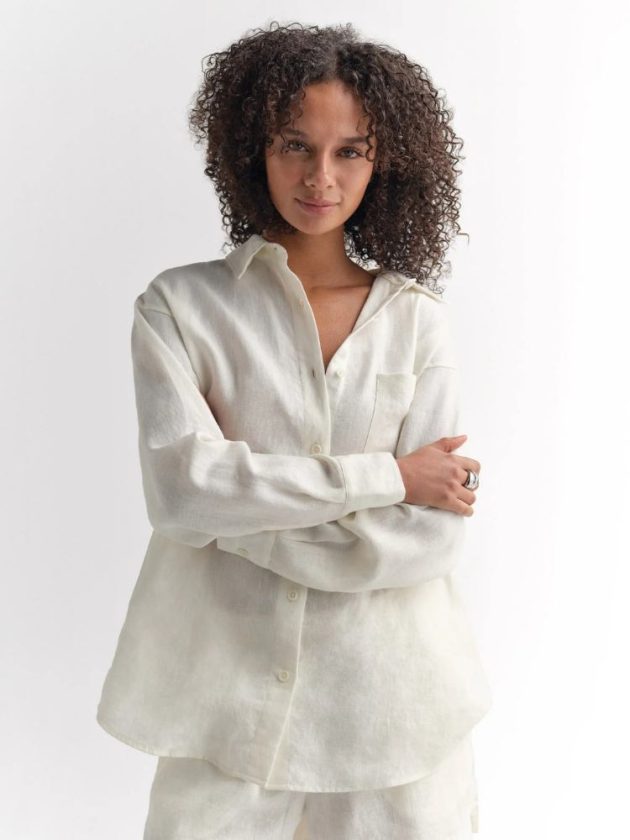
3. Linen Fox
Best for: romantic pastoral clothing in trend-forward colors and prints
Linen Fox is a Lithuanian small independent fashion brand — their team of 16 people make all of their linen clothing — including womenswear, menswear, and kids clothes.
The brand’s garments are made from OEKO-TEX Standard 100 certified linen fabric. The label follows fair trade principles to production and reduces fabric waste by selling their fabric scraps as samples, and crafting accessories like scrunchies. They also ship in 98% plastic-free packaging.
Price Range: $74 – $187
Size Range: XS – XL (several products fit oversized; check each description!)
Based in: Lithuania | Ships: Internationally

4. Magic Linen
Best for: linen separates plus matching home linens
From classic linen shirts to linen aprons and linen pajamas, Magic Linen is your destination for finding summer-ready sustainable linen clothing for men or women.
The small business’ linen clothing is made with European flax linen certified by OEKO-TEX Standard 100.
The Etsy shop also has plenty of linen home goods — I have linen curtains and bedsheets from Magic Linen and the quality of the fabric has been fantastic, with the sheets holding up well even after years of washing.
Price Range: $93 – $298
Size Range: XS – XXL
Based in: Lithuania | Ships: Internationally
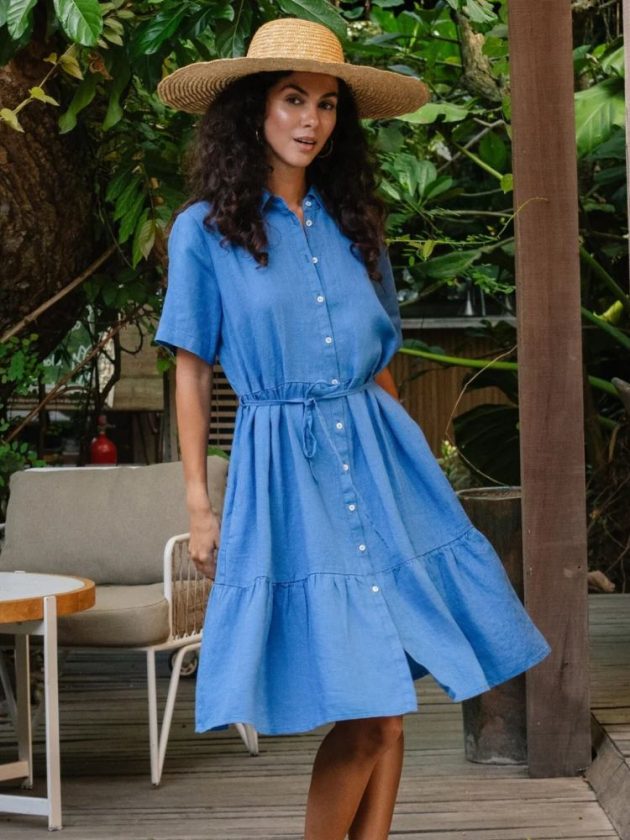
5. Beaumont Organic
Best for: European-made linen clothing with full factory transparency
Looking for breathable garments perfect for your summer getaway to the English countryside or sea? Look no further than Beaumont Organic.
Beaumont Organic is a UK slow fashion brand with garments made from natural fabrics, like flax linen clothing! The brand publishes a directory of the factories they source from — 97% of production takes place in Northern Portugal.
They also have a repair program and are launching a resale program (currently available within the UK only).
Price Range: $211 – $300
Size Range: XS – L
Based in: UK | Ships: Internationally

6. LoveAndConfuse
Best for: feminine style linen clothing
The linen clothing from this lovely small Lithuanian brand on Etsy are truly swoon-worthy!
From wrap dresses to ruffled midi’s to high-waisted linen shorts and linen crop tops, their collection of linen fashion will have you dreaming of a slow travel escape to somewhere warm and sunny.
Price Range: $116 – $225
Size Range: XS – XL
Based in: Lithuania | Ships: Internationally
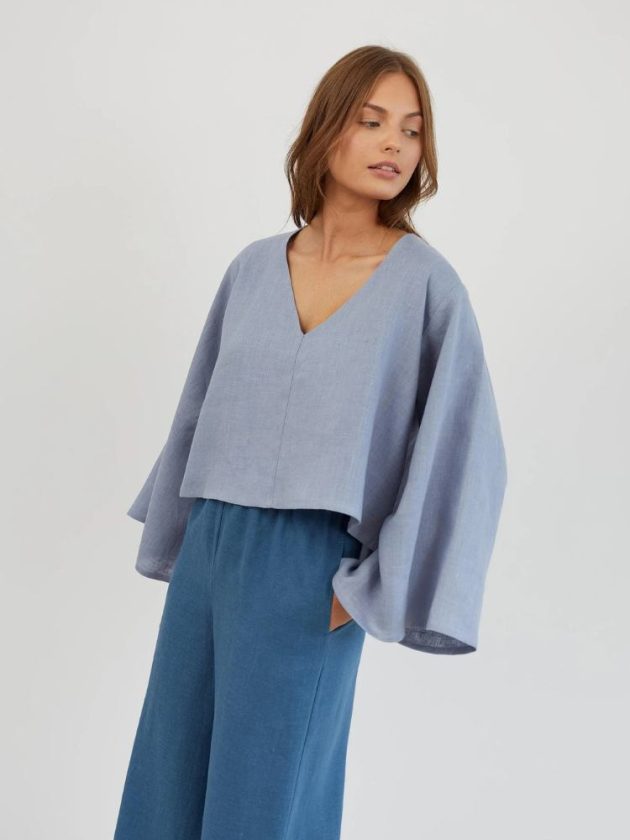
7. Neu Nomads
Best for: classic linen garments and resortwear
With a mission to create simple, sustainable luxury, Neu Nomads offers quality classics made from earth-minded materials, including 100% OEKO-TEX Standard 100-certified linen.
You’ll find linen trousers, effortless shirts, resort-ready kaftans, and tailored linen blazers in classic colors like white, black, olive, and bright coral.
Price Range: $159 – $359
Size Range: XXS – XXL
Based in: U.S. | Ships: Internationally
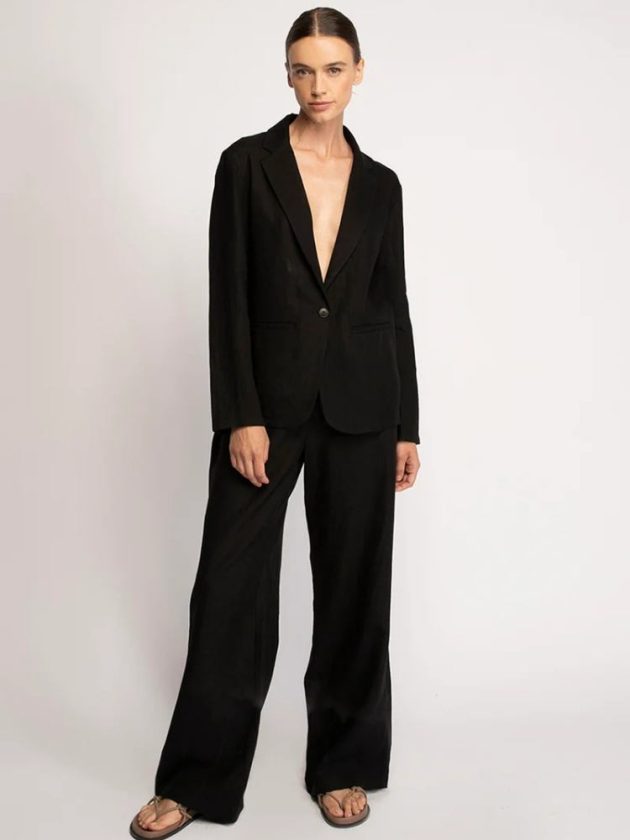
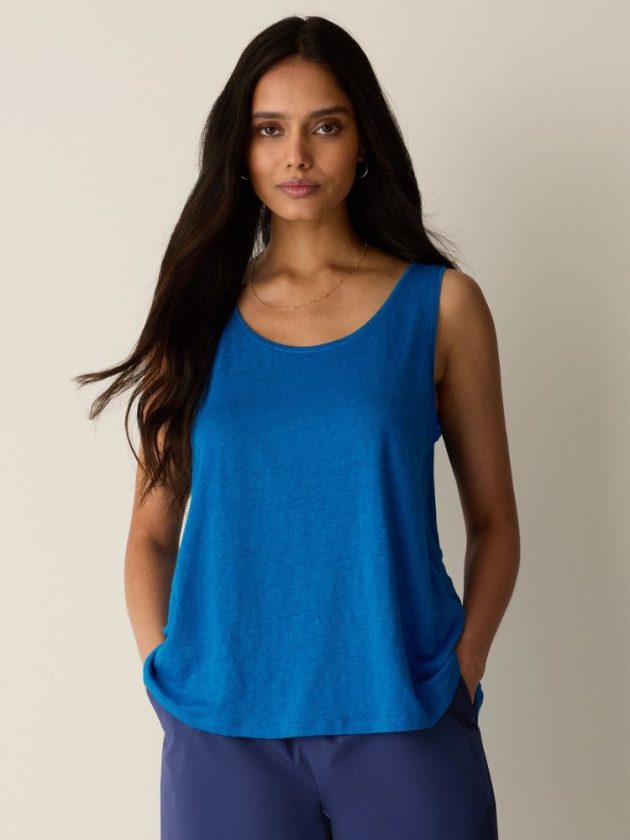
8. EILEEN FISHER
Best for: classic linen clothing with circularity programs
Slow fashion brand EILEEN FISHER has elegant, minimalistic garments made from eco-minded fabrics including organic linen. Several of the pieces are made in Fair Trade Certified factories.
This is the largest company on the list, but still considered a medium-sized enterprise — and, of course, this namesake label is woman-founded.
EILEEN FISHER’s organic linen clothing is timeless and made with quality, as part of their circularity efforts. In addition to ensuring their pieces last, the brand also has a resale program called Renew and a “third life” program that repurposes unwearable garments into unique artwork and other goods.
Price Range: $98 – $268
Size Range: XXS – XL
Based in: U.S. | Ships: Within U.S.
Your Questions, Answered:
What about Quince’s linen clothing?
While Quince offers more affordable linen clothing, in my experience their linen clothing is ok quality, but does not compare with the quality of some of the other brands on this list. Also, I personally want to prioritize women-led small businesses for my guides, not venture-backed billion-dollar companies.
Should I look for organic linen clothing?
While organic linen is wonderful, it is quite rare. Only two brands on this list use certified organic linen. Note that OEKO-TEX Standard 100 linen is not “organic” linen, but rather linen clothing that has been tested against common harmful substances. The most common certification for organic fiber clothing is Global Organic Textile Standard, or GOTS.
Is there any linen clothing that’s work-appropriate?
This one depends on your work place’s dress code, but there are a few options on this list with linen blazers, trousers, and other more tailored pieces like Linen Handmade Studio and Neu Nomads.
More Sustainable Clothing Guides:
The Best Organic Cotton Fashion Brands
Actually Fashionable Hemp Clothing Brands
The post 8 Best Linen Clothing Brands With Easy Breezy, Beautiful Pieces appeared first on Conscious Life & Style.
9 Best Linen Clothing Brands With Easy Breezy, Beautiful Pieces
Breezy, light, and breathable, we take a deep dive into how one of the best summer fabrics fares when it comes to sustainability while discovering these brands that are doing right by linen.
Some Background on Linen
Where does linen come from?
Linen fiber is extracted from the stalks of flax plants. This plant is also known for providing us with nutritious flaxseeds and linseed oil — talk about an overachiever!
In fact, linen is one of the oldest fibers known to man, dating back to the prehistoric era. Archaeologists and paleobiologists have discovered flax fibers during excavations that were twisted, indicating they were used to make ropes or strings among many proposed applications that must have been a great advantage to the hunter-gatherer society. In fact, linen wrappings were even used for mummification in ancient Egypt.
Linen fabric is then created by obtaining its fibers from the inner bark (or stalks) of the flax plant.
How is the linen cloth made?
Before the fibers are spun into the breezy linen you know and love, its fibers are loosened and separated from the rest of the stalk through a process known as “retting”. At that point, the fibers are still straw-like and coarse in texture.
To soften it, the fibers are broken up into small, short bits, while the actual fiber is left unharmed, and then “scutched”, where the straw is scraped off the fiber. After which they are then pulled through “hackles”, that comb the straw out of the fiber to finally prepare flax for spinning into linen fabric.
And linen clothing is, of course, garments comprised of linen fiber in its entirety or blended with other fibers. For this guide, I tried to select brands that only used 100% linen or at the minimum blended linen with other natural fibers like cotton.
The Benefits of Linen Clothing
Why wear linen? Known for being ideal during the summers, clothing made from linen will allow heat to escape from the body while absorbing moisture and drying relatively quickly. While linen may have a notorious reputation for wrinkling rather quickly, when blended with other fibers, the creases aren’t as discernible as they would be with pure linens.
While linen may be notorious for its high energy consumption owing to its need to be ironed more, linen clothing’s pros easily outweigh its cons.
Flax plants can be grown in the harshest of climate conditions that require minimum water. What’s more impressive is the plant’s ability to absorb carbon. The European Confederation of Flax and Hemp (CELC) states that one hectare of flax absorbs 3.7 tons of CO2 every year.
Is Linen More Sustainable Than Cotton?
While there are benefits and drawbacks to every fiber when it comes to environmental sustainability, there are a few points where linen stands out when compared to cotton.
First, we know that durability is a key aspect of sustainability, because it means our clothes will last, enabling us to keep our clothes longer and buy new clothing less frequently.
So how long does linen clothing last in comparison to cotton? Linen clothing is up to 12 times stronger than cotton, helping increase its longevity and taking away the need to be replaced so often.
Another question might be about flax’s water usage. While the irrigation needs of the crop are dependent on the region’s climate (just as with cotton), 450–750 mm of water per season is sufficient for flaxseed. In fact, some studies even indicate that flax could be regarded as a drought-tolerant crop.
How to Care for Linen Clothing
When it comes to caring for linen clothing, linen can be washed on a gentle machine cycle with a mild detergent. (Check out these low waste low-impact detergent options.)
In case you’re curious whether linen stretches or shrinks, then there isn’t much to worry about. Linen is mostly pre-shrunk during the manufacturing stages but pure linens may show about 4% shrinkage.
And when it comes to stretch, linens aren’t known to stretch out over time but can show some level of elasticity when blended with other fibers.
Finally, it’s no secret that linen clothing tends to wrinkle easily! You may choose to embrace the natural characteristics of linen and wear your linen clothing as is, or if you want a crisper look, you may either want to look for a linen blended fabric, or be prepared to steam and/or iron your garments relatively frequently.
Note: This guide includes partners and/or affiliates. As always, brands must meet high standards for sustainability and ethics — and I only share brands that I believe in.
How to Find Sustainable Linen Clothing
So of course, I’m a big advocate for “secondhand first” when it comes to all fashion, including linen clothing. While your local thrift store might not be filled with 100% linen clothes, online secondhand shops can be a great resource. For luxury and premium brands, Vestiaire Collective and The RealReal. For more affordable options, my favorite pick is ThredUp because you can filter by natural fibers only. To be clear: the listings aren’t always accurate, so I still double check the descriptions of any product that shows up with that filter, but it does save some time to start there.
When looking for new linen clothing, I always prioritize small to mid-size women-led businesses. And I check the product details to see if they use 100% linen or if they’re deceptively saying “linen blend” and then it’s actually 50% polyester!
And while not perfect you can also look for certifications. These are the ones most relevant to linen clothing and linen fashion brands.
OEKO-TEX Standard 100 certifies that the finished textile product has been tested for harmful substances (heavy metals, formaldehyde, pesticide residue). This is a chemical-safety certification, not a guarantee of fair labor or environmental practices. So it tells you the linen has been tested for potentially toxic chemicals, but it doesn’t tell you who made it or how. Note that some brands just say “OEKO-TEX certified” — that virtually always refers to OEKO-TEX Standard 100, the most common certification from OEKO-TEX.
B Corp certifies the company as a whole against social and environmental performance standards (labor, governance, environmental impact). This is a business-level cert, not a product-level one, so it doesn’t speak to any single garment’s materials.
Fair Trade Certified verifies that the specific factory/facility producing the item meets standards for labor conditions, wages, and worker safety, and that a Community Development Premium is paid to workers. It’s a labor and production-facility certification. It doesn’t certify the fabric’s environmental footprint or chemical content (that’s what OEKO-TEX covers), so a garment can carry both certifications and they’re speaking to different things.
Where to Find Eco-Friendly Linen Clothing
I scoured through dozens of brands to find my top picks for brands with sustainably-crafted linen clothing for women (some have men’s clothing too). I’ve included their conscious qualities, what they’re best for, and any caveats so you can make the best decision for yourself. Keep in mind while shopping that 100% linen garments won’t have any stretch — so if you run between sizes, I’d default to sizing up. But of course, check the size chart and reviews for each brand!
1. Linen Handmade Studio
Best for: tailored, elevated linen clothing
A lot of linen clothing can feel quite casual. And while Linen Handmade studio does have relaxed-fit options, what differentiates the brand in my opinion is their tailored options. I often hear from conscious readers that they want to wear natural fibers to work, but they can’t find something nice enough. Enter in: Linen Handmade Studio’s tailored pieces.
The brand has linen blazers and jackets, linen vests, and linen pants elevated enough for work or an evening out. (They even have bridesmaid dresses.) I’ve been wearing their Evelyn Longline Linen Vest in red clay on repeat and gotten so many compliments on it.
Price Range: $68 – $305
Size Range: US 2-18 (runs slightly small, I’d size up!)
Based in: Lithuania | Ships: Internationally; free U.S. shipping on orders $300+

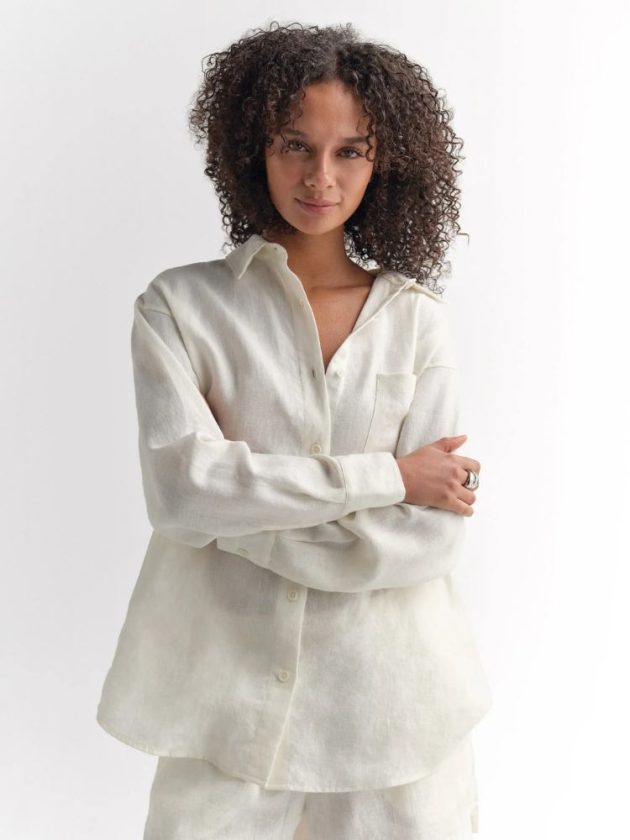
2. MATE
Best for: casual GOTS-certified organic linen clothing
Prioritizing natural non-toxic materials, MATE has a collection of effortless linen shorts, button-downs, and pants made from GOTS-certified organic linen and colored with low-impact dyes.
That means that the color options at MATE are a bit more limited than you might see at other brands. They carry white, black, and “dune” — a soft beige.
I have their organic linen button-down in white and it’s been a reliable staple for me the past two years that’s held up beautifully.
Price Range: $88 – $178
Size Range: XS – XL
Based in: U.S. | Ships: Internationally
3. Linen Fox
Best for: romantic pastoral clothing in trend-forward colors and prints
Linen Fox is a Lithuanian small independent fashion brand — their team of 16 people make all of their linen clothing — including womenswear, menswear, and kids clothes.
The brand’s garments are made from OEKO-TEX Standard 100 certified linen fabric. The label follows fair trade principles to production and reduces fabric waste by selling their fabric scraps as samples, and crafting accessories like scrunchies. They also ship in 98% plastic-free packaging.
Price Range: $74 – $187
Size Range: XS – XL (several products fit oversized; check each description!)
Based in: Lithuania | Ships: Internationally

4. OhSevenDays
Best for: deadstock linen with custom sizing available
OhSevenDays was founded by Megan Mummery after seeing the vast supply of surplus fabrics (i.e. deadstock) in Istanbul, Turkey.
While originally sourcing their deadstock fabric from middleman sellers, OhSevenDays now sources their surplus fabrics (including linen) directly from OEKO-TEX fabric mills for better transparency.
Price Range: $$
Size Range: XS-XL + custom sizing options
Based in: Turkey | Ships: Internationally

5. Magic Linen
Best for: linen separates plus matching home linens
From classic linen shirts to linen aprons and linen pajamas, Magic Linen is your destination for finding summer-ready sustainable linen clothing for men or women.
The small business’ linen clothing is made with European flax that means the pre-certification guidelines of OEKO-TEX Standard 100.
The Etsy shop also has plenty of linen home goods — I have linen curtains and bedsheets from Magic Linen and the quality of the fabric has been fantastic, with the sheets holding up well even after years of washing.
Price Range: $-$$
Size Range: XS – XXL
Based in: Lithuania | Ships: Internationally

6. Beaumont Organic
Best for: UK-made linen with full factory transparency
Looking for breathable garments perfect for your summer getaway to the English countryside or sea? Look no further than Beaumont Organic.
Beaumont Organic is a UK slow fashion brand with garments made from natural fabrics, like flax linen clothing! The brand publishes a directory of the factories they source from — 97% of production takes place in Northern Portugal.
They also have a repair program and are launching a resale program (currently available within the UK only).
Price Range: ££ – £££
Size Range: XS – L
Based in: UK | Ships: Internationally; covers EU customs & fees

7. LoveAndConfuse
Best for: ultra feminine style linen clothing
The linen clothing from this lovely small Lithuanian brand on Etsy are truly swoon-worthy!
From wrap dresses to ruffled midi’s to high-waisted linen shorts and linen crop tops, their collection of linen fashion will have you dreaming of a slow travel escape to somewhere warm and sunny.
Price Range: $ – $$
Size Range: XS – XL
Based in: Lithuania | Ships: Internationally

8. Neu Nomads
Best for: affordable linen garments
With a mission to create simple, sustainable luxury at affordable prices, Neu Nomads offers quality classics made from earth-minded materials, including organic linen.
You’ll find linen trousers, effortless shirts, chic blouses, summer dresses, and even linen blazers in a range of colors among Neu Nomad’s consciously crafted selection.
Price Range: $ – $$
Size Range: XS – XL
Based in: U.S. | Ships: Internationally

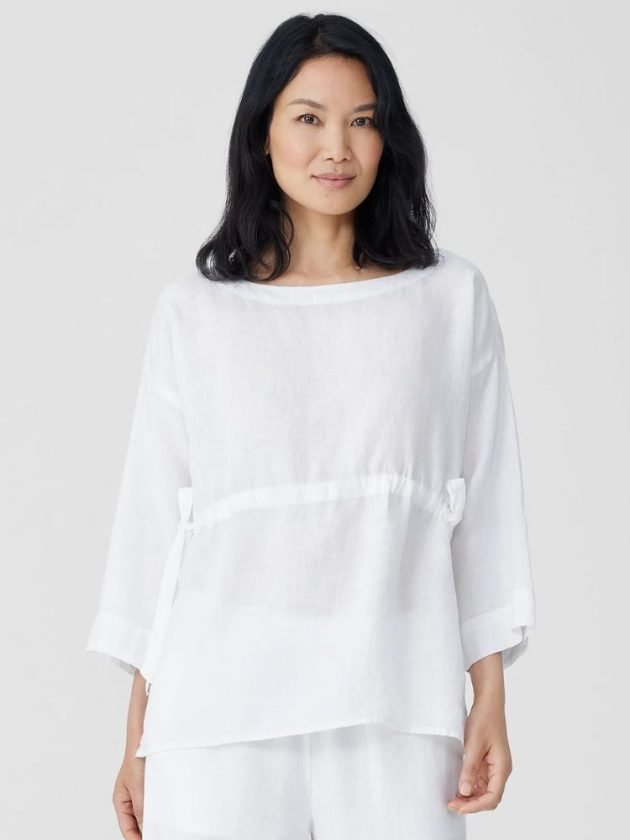
9. EILEEN FISHER
Best for: investment-piece linen with a circularity program
Slow fashion label EILEEN FISHER has elegant, minimalistic garments made from eco-minded fabrics including organic linen.
EILEEN FISHER’s organic linen clothing is timeless and made with quality, as part of their circularity efforts. In addition to ensuring their pieces last, the brand also has a resale program called Renew and a “third life” program called Waste No More that repurposes unwearable garments into unique items.
Price Range: $$$
Size Range: XXS – XL
Based in: U.S. | Ships: Within U.S.
Your Questions, Answered:
What about Quince’s linen clothing?
While Quince offers more affordable linen clothing, in my experience their linen clothing is ok quality, but does not compare with the quality of some of the other brands on this list. Also, I personally want to prioritize women-led small businesses for my guides, not venture-backed billion-dollar companies.
Should I look for organic linen clothing?
While organic linen is wonderful, it is quite rare. Only two brands on this list use certified organic linen. Note that OEKO-TEX Standard 100 linen is not “organic” linen, but rather linen clothing that has been tested against common harmful substances. The most common certification for organic fiber clothing is Global Organic Textile Standard, or GOTS.
More Sustainable Clothing Guides:
The Best Organic Cotton Fashion Brands
Actually Fashionable Hemp Clothing Brands
The post 9 Best Linen Clothing Brands With Easy Breezy, Beautiful Pieces appeared first on Conscious Life & Style.
9 Best Linen Clothing Brands With Easy Breezy, Beautiful Pieces
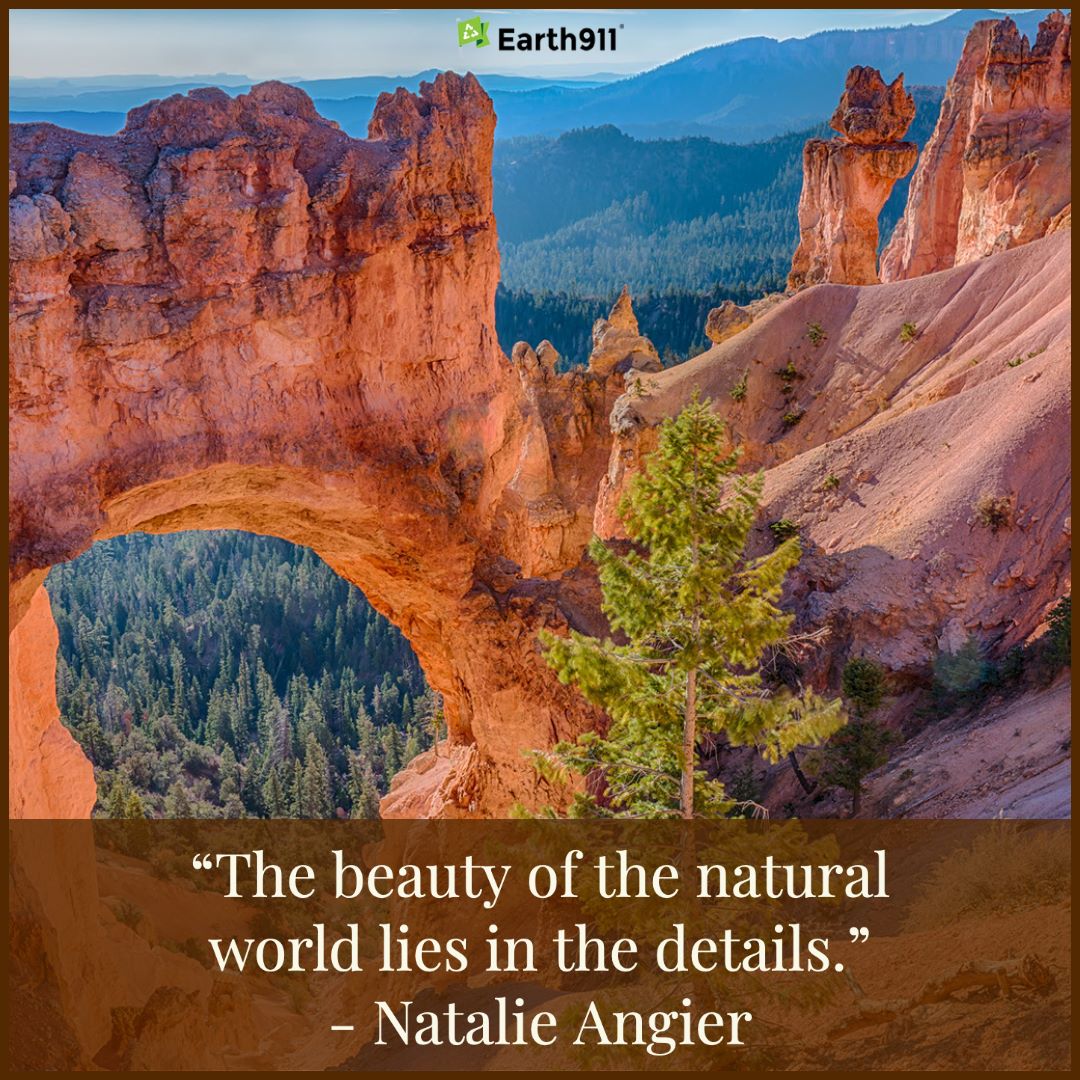
Today’s Earth911 inspiration is from Pulitzer-prize-winning journalist and science writer, Natalie Angier: “The beauty of the natural world lies in the details.”
Earth911 inspirations. Post them and share your desire to help people think of the planet first, every day. Click the poster to get a larger image.
The post Earth911 Inspiration: The Beauty of the Natural World appeared first on Earth911.
https://earth911.com/inspire/earth911-inspiration-the-beauty-of-the-natural-world/



-
Climate Change1 year ago
Guest post: Why China is still building new coal – and when it might stop
-
Greenhouse Gases1 year ago
Guest post: Why China is still building new coal – and when it might stop
-

 Greenhouse Gases2 years ago
嘉宾来稿:满足中国增长的用电需求 光伏加储能“比新建煤电更实惠”
-

 Climate Change2 years ago
嘉宾来稿:满足中国增长的用电需求 光伏加储能“比新建煤电更实惠”
-
Climate Change2 years ago
Bill Discounting Climate Change in Florida’s Energy Policy Awaits DeSantis’ Approval
-

 Renewable Energy10 months ago
Sending Progressive Philanthropist George Soros to Prison?
-
Greenhouse Gases1 year ago
嘉宾来稿:探究火山喷发如何影响气候预测
-

 Carbon Footprint2 years ago
US SEC’s Climate Disclosure Rules Spur Renewed Interest in Carbon Credits