The Trump administration’s relentless rollback of public health and environmental protections has allowed widespread toxic exposures to flourish, warn experts who helped implement safeguards now under assault.
By Liza Gross
In a new report that outlines a dozen high-risk pollutants given new life thanks to weakened, delayed or rescinded regulations, the Environmental Protection Network, a nonprofit, nonpartisan group of hundreds of former Environmental Protection Agency staff, warns that the EPA under President Donald Trump has abandoned the agency’s core mission of protecting people and the environment from preventable toxic exposures.
KOROR, PALAU, Monday 31 August 2026 — As Pacific leaders gather for the 55th Pacific Islands Forum Leaders Meeting in Palau from today, Greenpeace Australia Pacific is urging Prime Minister Anthony Albanese to stand with Pacific family by keeping Pacific needs at the heart of negotiations, backing longstanding Pacific leadership, supporting Pacific energy sovereignty and ocean custodianship, and holding the line on 1.5°C.
Against the backdrop of tense geopolitical turmoil, increasingly frequent and lethal extreme weather disasters, the threat of deep sea mining and an energy crisis driven by fossil fuel dependence, the Pacific Islands Forum Leaders Meeting (PIFLM) is a critical moment for Pacific nations to unite with Pacific needs central to regional dialogue.
The climate crisis, security, the opportunities of renewable energy in the Pacific, ocean protection, and the shifting political landscape will be the focus of the Forum’s discussions.
Speaking from Palau, Shiva Gounden, Head of Pacific at Greenpeace Australia Pacific, said: “The Pacific Islands Forum is the most important multilateral forum in our region, unifying the Pacific under increasingly turbulent global circumstances. We are urging Forum members, including Australia, to not lose focus of Pacific priorities of climate and oceans amid noise and external pressures at this year’s meeting.
“It is very clear that the greatest security threat to our region is climate change and the only way we can address that is through a just transition away from fossil fuels. Regional cooperation is an antidote to climate chaos and geopolitical tension – together, our region can be guided by Pacific nations’ legacy of leadership from the frontlines of the climate crisis, as we build a more peaceful and secure world.
“This year’s Forum will set the stage as we build momentum toward COP31 and a Fossil Fuel Free Pacific. Australia must back Pacific energy sovereignty as a solution to the compounding threats facing our region, including soaring costs of living and increasingly lethal extreme weather disasters, and resist the militarisation of our oceans, deep sea mining, and power politics.
“We must not lose sight of what is needed. The regional adoption of Pacific-led solutions, a Pacific pre-COP with focus on advancing the just transition away from fossil fuels and community-targeted finance for strong and resilient futures beyond fossil fuels must be the foundations of this year’s Forum discussion. What we need now is stronger political will.”
Also in Palau, Dr Simon Bradshaw, COP31 Lead and climate expert at Greenpeace Australia Pacific, said: “Prime Minister Albanese faces a major test of Australia’s climate credibility and Pacific partnership this week. We cannot be a friend to the Pacific and continue to expand fossil fuel production. The best way for Australia to remain the Pacific’s security partner of choice is to act faster on the Pacific’s number one security concern — climate change.
“The Albanese Government has approved at least five new coal and gas projects since the last Pacific Islands Forum Leaders Meeting, and 36 since being elected, every one of which increases the threats to life, security and sovereignty facing Pacific communities.
“Nowhere in the world are the dangers of fossil fuels or the benefits of renewable energy clearer than in the Pacific, which faces the double blow of climate disasters and expensive fuel imports.
“Australia, as incoming President of Negotiations for COP31, has a responsibility to follow the Pacific’s lead, embrace the vision of a resilient Fossil Fuel Free Pacific, and do everything possible to keep 1.5°C alive. Doing so would establish Australia as a highly effective middle power, a force for good in troubled times, and a true ally and partner to the Pacific.”
—ENDS—
Greenpeace Australia Pacific has delegates from the Pacific and Australia at the PIFLM in Palau available for interview
Every six to seven years, climate modelling groups around the world run a coordinated set of simulations that explore how the climate could change in the future.
The new scenarios are quite different from their predecessors in a number of notable ways.
Rather than being named, somewhat enigmatically, according to their “radiative forcing levels”, the new scenarios are named simply by their emissions trajectories – ranging from “low-to-negative” to “high”.
They no longer consider “no-climate-policy” baseline worlds, but instead explore the implications of current policies continuing, being strengthened, or weakening.
These new scenarios also dramatically revise high-end future emissions downward, far below the highest scenarios in prior generations, in order to reflect a world where a 21st century dominated by coal use is no longer plausible.
At the same time, they revise the lowest emissions scenarios upwards relative to those featured in the AR6, with at least some “overshoot” of the Paris Agreement’s “aspirational” target to limit global warming to 1.5C now “unavoidable”.
While modelling groups are just getting started on the full Earth-system model simulations, the emissions scenarios give a clear picture of the range of futures that will inform the IPCC’s seventh assessment cycle (AR7).
Here, Carbon Brief unpacks how the new scenarios were designed and how they differ from the SSPs published almost a decade ago.
The article also compares CO2 emissions and warming outcomes between the new scenarios and their predecessors, explores the range of future warming outcomes and examines why the high end of the scenario range has shifted markedly downward.
Finally, Carbon Brief examines the scale of carbon dioxide removal (CDR) built into the scenarios and new extensions of scenarios to 2150 and beyond.
Key highlights from Carbon Brief’s analysis of the new scenarios include:
The seven new scenarios give a range of global warming in 2100 from 1.6C to 3.3C above pre-industrial levels – markedly narrower than the 1.5C to 4.7C range in their SSP predecessors.
The top of the scenario range has fallen for the first time in four generations of climate modelling. The highest scenarios used in the three previous IPCC assessment cycles all produced around 4.6-4.9C of global warming in 2100, whereas CMIP7’s high scenario only reaches 3.3C and has around half the cumulative CO2 emissions.
The new “medium” scenario that is analogous to policies in place today reaches 2.9C in 2100, crossing 2C around 2050 and 3C around 2110, with a one-in-four chance of exceeding 4C by 2150.
The lowest scenarios have shifted modestly upwards, as a future that avoids any overshoot of 1.5C is no longer considered plausible. The very-low scenario peaks at around 1.8C mid-century before falling back close to 1.5C by 2100.
The updated socioeconomic assumptions underpinning the new scenarios describe a more crowded and less wealthy planet than the original SSPs, with the global human population now peaking at 10.1bn people around 2080 in the medium pathway and income per person in 2100 between 10% and 25% lower.
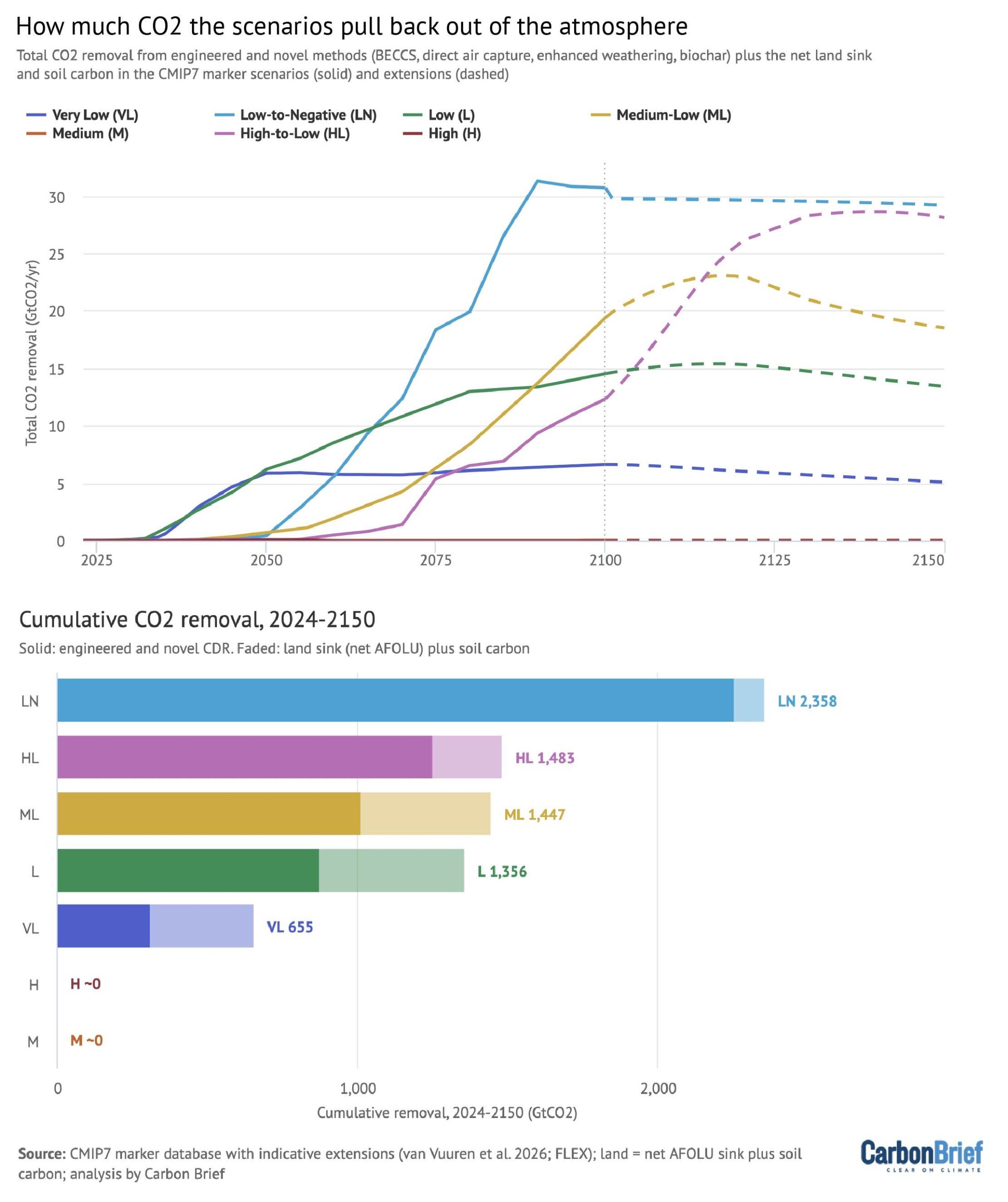
Every scenario that limits warming leans heavily on carbon dioxide removal, with cumulative removals by 2150 ranging from 655GtCO2 in the very-low scenario to 2,360GtCO2 in low-to-negative scenario.
To simulate how human activity could shape the climate of the future, climate modellers must estimate future levels of “radiative forcings” – the external drivers that cause global warming. These include atmospheric concentrations of greenhouse gases, air pollutants and land-use changes.
Given that no one knows how the future will unfold, modellers use a handful of scenarios that span a wide range of plausible outcomes.
The Scenario Model Intercomparison Project (ScenarioMIP) coordinates the development and running of emissions scenarios for climate models used in IPCC reports.
In April 2026, high-level details about the new set of scenarios for CMIP7 were published in the journal Geoscientific Model Development (GMD).
On 1 September, the underlying emissions data was released into the public domain by the ScenarioMIP team.
There are seven new CMIP7 scenarios designed to drive model simulations for AR7. The first model runs took place in spring 2026 and initial results are expected later this year.
The previous SSP scenarios were starting to show their age. Finalised in 2015-17 using historical data ending in 2015, several years projected by the SSP scenarios were already in the past by the time AR6 concluded in 2021. Meanwhile, the world had changed considerably.
(For a full guide to the SSPs, see Carbon Brief‘s 2018 explainer.)
Storylines and emissions levels
The most visible change in the new generation of scenarios is their names. Where the SSPs combined five socioeconomic “storylines” with radiative forcing targets (SSP1-2.6, SSP5-8.5, etc), the CMIP7 scenarios are named simply for the emissions trajectory that they follow.
The table below summarises the seven scenarios and the integrated assessment model (IAM) that produced each “marker” run – in other words, the specific IAM run used to generate the scenario that, in turn, will be used by CMIP7 climate models. IAMs run simulations of how the future energy system and emissions may evolve under different assumptions around socioeconomics, future technology costs and climate policy.
The table below also details how the scenario fares against a number of key metrics assessed by Carbon Brief, including CO2 emissions and warming outcomes.
(For more on Carbon Brief’s approach, see: Methodology.).
1.5C with higher overshoot, then net-negative greenhouse gases
-25
384
1.7 (1.2-2.5)
Warming values are medians (with the 5-95% range) from the 841-member FaIR ensemble used in this article (see: Methodology); the marker model assignments come from the ScenarioMIP database. Note that scenario names in the database differ from the official CMIP7 names (for example, the high-to-low scenario appears as “SSP5 – Medium-Low Emissions_a”).
Each of the new scenarios is built on a set of updated SSP storylines similar to those used in the original SSP scenarios. These include assumptions about future population, technological and economic growth, as well as potential for international cooperation that shape the resulting emissions pathways. The socioeconomic assumptions underlying these revised SSPs were updated in 2024 with new population and economic projections.
Most of the new emissions scenarios are now based on the “middle-of-the-road” SSP2 that assumes current socioeconomic trends broadly continue, with only one scenario using each of SSP1 (“sustainability”), SSP3 (“regional rivalry”) and SSP5 (“fossil-fuelled development”). None of the new scenarios uses SSP4 (“inequality”).
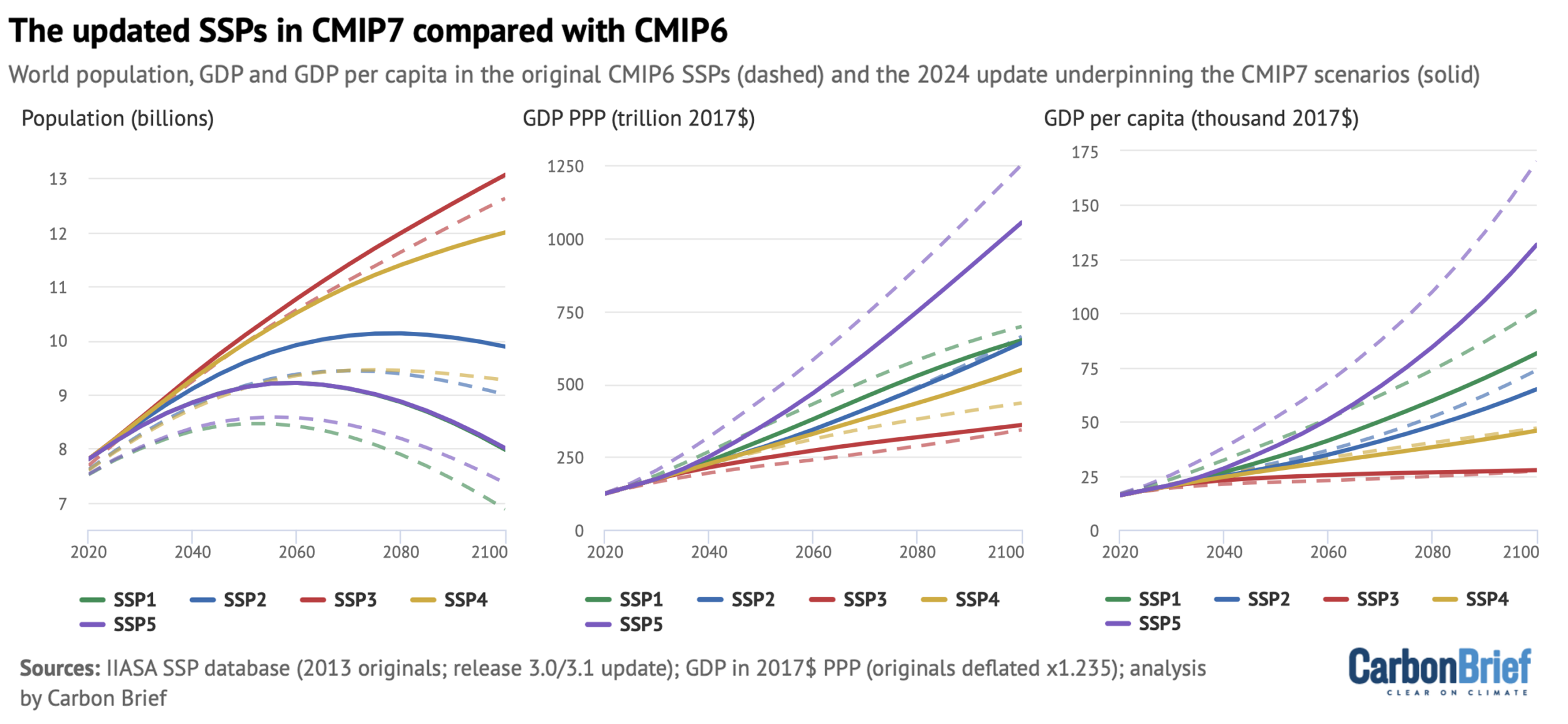
The solid lines in the figure below show updated global human population, GDP and GDP per capita values in CMIP7 (solid lines), compared to the original SSPs from CMIP’s sixth phase (CMIP6), shown by the dashed lines.
World population (left), GDP (centre) and GDP per capita (right) for SSPs 1-5 in the original 2013-era SSP database (dashed) and the 2024 update (solid). Note that the updated SSP1 and SSP5 population curves effectively overlap. GDP is shown in 2017 US dollars PPP, with the original converted from 2005 US dollars using the US GDP deflator (x1.235). Data from the IIASA SSP database; chart by Carbon Brief.
The change in socioeconomic assumptions is substantial. Global population was revised upward in nearly every scenario, with the updated SSP2 projecting there will be 9.9 billion people in 2100 – an increase of 1 billion people compared to the 2013-era SSP.
GDP was revised downward in the high-end growth scenarios (SSP1 and SSP5), slightly upward in SSP3 and SSP4 and was largely unchanged in SS2.
The combination of these changes means that income per person in 2100 is around 10-25% lower in most scenarios, with only SSP3 and SSP4 seeing mostly unchanged income per capita.
In short, the socioeconomic world underlying the new scenarios is somewhat more crowded and less wealthy per person than the one the SSPs originally imagined.
Another notable change is the shift in the SSP that underlies the highest future emissions scenario.
In the original SSPs, the “very high” SSP5-8.5 scenario was based on SSP5, while the new “high” scenario in CMIP7 is based on SSP3.
The GMD study explains that this is because IAM teams that developed the scenarios found that SSP3 and SSP5 variants produced similar emissions. They judged that the “fragmented” SSP3 world – which is characterised by large challenges to adaptation – to be more relevant for exploring high-end risks.
No more ‘baseline’ scenarios and other changes
In another important change, the authors of the CMIP7 scenarios decided to eliminate “baseline” scenarios that assumed a world without any climate policy. These scenarios were previously used as a counterfactual against which to compare climate-changed worlds.
Instead, the range of future emissions scenarios starts with current policies and explores ways that they could be strengthened, weakened, or kept the same. The high scenario explores a plausible “rollback of current mitigation policies“.
The medium scenario, by contrast, extends climate policies officially implemented as of 2025, without assuming countries achieve their Paris Agreement pledges – known as nationally determined contributions (NDCs) – or net-zero targets that are not yet backed by legislation.
In their GMD paper, the authors of the CMIP7 scenarios emphasise that the medium scenario “should not be considered as a ‘most likely’ scenario”, but that it can provide a benchmark against which the effect of future policy strengthening or weakening can be measured. It is roughly analogous in its emissions levels to the old SSP2-4.5 scenario.
The new low scenario explores a world where climate policy is rapidly strengthened and warming by 2100 is limited to below 2C. This makes it analogous to the old SSP1-2.6 scenario.
The very-low scenario limits global warming to around 1.5C by 2100, similar to the old SSP1-1.9 scenario. However, it involves a greater degree of overshoot mid-century, reflecting the fact that global emissions did not begin to rapidly decline in 2020 as envisioned by SSP1-1.9. As the authors of the GMD ScenarioMIP paper point out: “At this point of time, some overshoot of the 1.5C seems unavoidable.”
In addition, there are a number of scenarios that start on one path before undertaking rapid mitigation. These high-to-low, medium-to-low and low-to-negative scenarios are intended to explore futures where mitigation is further delayed, followed by a rapid turn-around later in the century.
The scenario developers noted that there is no specific likelihood or probabilities assigned to any scenario, but rather only a judgement that all are within the realm of plausibility given where the world is today. They also said that “there might be potential futures outside the ScenarioMIP scenario range”.
Timescales and other changes
In addition to the shift away from baseline scenarios, there are three other notable design changes made in CMIP7.
First, CMIP7 models will be driven by emissions of CO2 and other greenhouse gases, rather than set atmospheric concentrations.
In every previous generation of models, the ScenarioMIP experiments required that modelling groups simulate future climate using the same set of CO2 concentrations. For CMIP7, models with an interactive carbon cycle are asked to run in “emissions-driven” mode for CO2, calculating atmospheric concentrations themselves based on emissions.
This is a significant improvement. It means that the substantial uncertainty in carbon-cycle feedbacks will now show up directly in the range of projected warming, rather than being overlooked. (The change applies to CO2 only; methane, nitrous oxide and halocarbons remain prescribed as concentrations.)
Second, emissions match observations up to 2023. IAM modellers were asked to stay close to observed trends up to 2025 to avoid emissions diverging from reality before models were run. Scenario differences only open up after 2026, avoiding an earlier problem of scenarios diverging from reality years before the models were even run.
Finally, the period over which models are being run has been extended from 2100 to 2150. This is important as the world is already more than a quarter of the way through the 21st century.
The extended model runs out to 2150 will provide a more thorough exploration of the warming that people born in the coming decades may experience within their lifetimes.
In addition, all scenarios have extensions to 2500 where temperatures are eventually stabilised. These allow scientists to explore changes to long-term Earth-system processes, such as ice sheets and sea level, as well as whether warming is reversible.
A narrower range of future CO2 emissions
Overall, the new scenarios provide a notably more narrow range of future CO2 emissions than the SSP scenarios used in CMIP6.
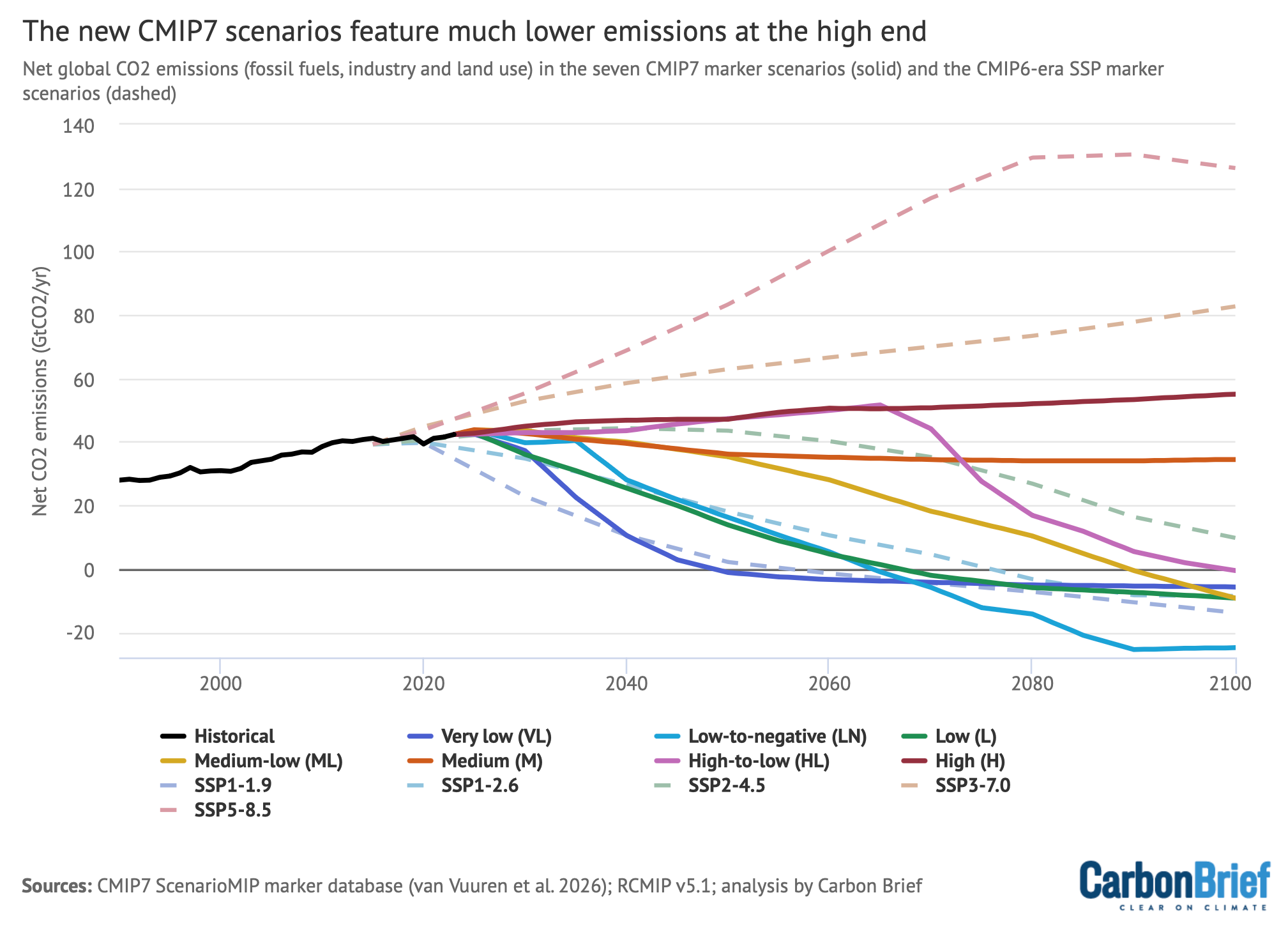
The figure below shows net global CO2 emissions (combining fossil-fuel and land-use emissions) for the seven new scenarios, alongside the five SSP scenarios used for climate model runs in CMIP6 (e.g. SSP1-1.9, SSP1-2.6, SSP2-4.5, SSP3-7.0 and SSP5-8.5).
Net global CO2 emissions (GtCO2/yr) in the seven CMIP7 scenarios (solid lines, coloured) and the CMIP6-era SSP scenarios (dashed) for the period from 1990 to 2100. CMIP7 scenarios are harmonised to 2023, while SSP scenarios (from RCMIP) were harmonised to 2015. Data from the ScenarioMIP database and RCMIP; chart by Carbon Brief.
At the bottom of the range, the new scenarios closely track their predecessors: the very-low scenario reaches net-zero CO2 around mid-century much like SSP1-1.9, while the low scenario lands close to SSP1-2.6.
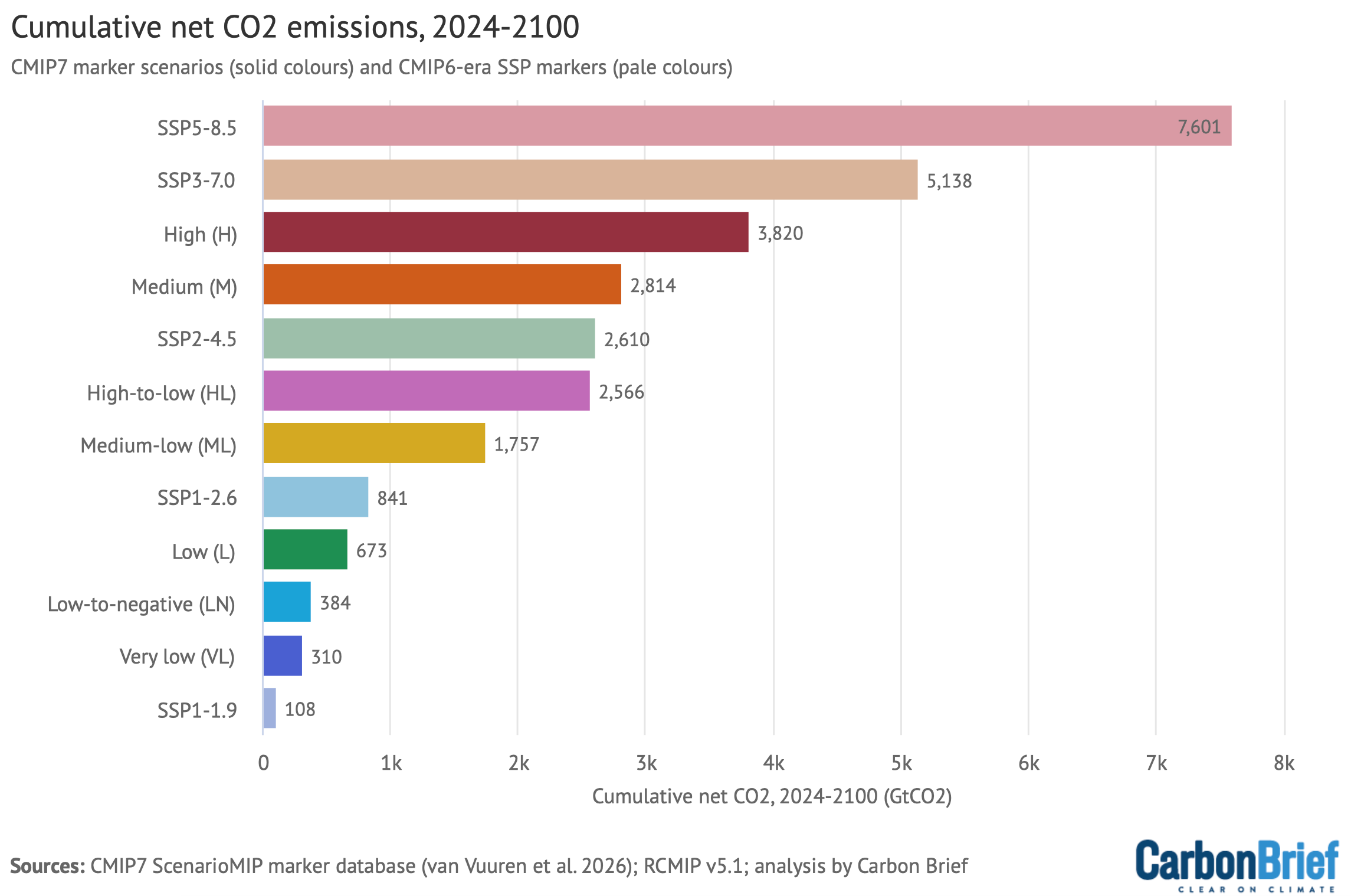
The chart below shows total emissions for the same scenarios for the period 2024-2100.
Cumulative global CO2 emissions (GtCO2) between 2024 and 2100 in the seven CMIP7 scenarios (solid colours) and the CMIP6-era SSPs (light colours). Data from the ScenarioMIP database and RCMIP; chart by Carbon Brief.
The lowest emissions scenarios now have somewhat higher total emissions, reflecting the failure of the world to rapidly reduce emissions after 2020 that occurred in the lower SSP emissions scenarios, such as SSP1-1.9 and SSP1-2.6. The very-low scenario results in 310bn tonnes of CO2 (GtCO2) cumulative emissions between 2024 and 2100, compared to around 110GtCO2 in SSP1-1.9.
At the top end, the change is particularly dramatic. The high scenario in CMIP7 reaches 55GtCO2 per year in 2100. The previous high scenario, SSP5-8.5, by contrast, reached around 126GtCO2 per year in 2100.
In cumulative terms – which is what matters most for global warming – high reaches around 3,820GtCO2 over 2024-2100, half the roughly 7,600GtCO2 of SSP5-8.5 and about three-quarters of the 5,140GtCO2 of SSP3-7.0.
To put it another way: the top of the new scenario range sits between SSP2-4.5 and SSP3-7.0 in cumulative emissions terms, which is territory that CMIP6 treated as its middle ground.
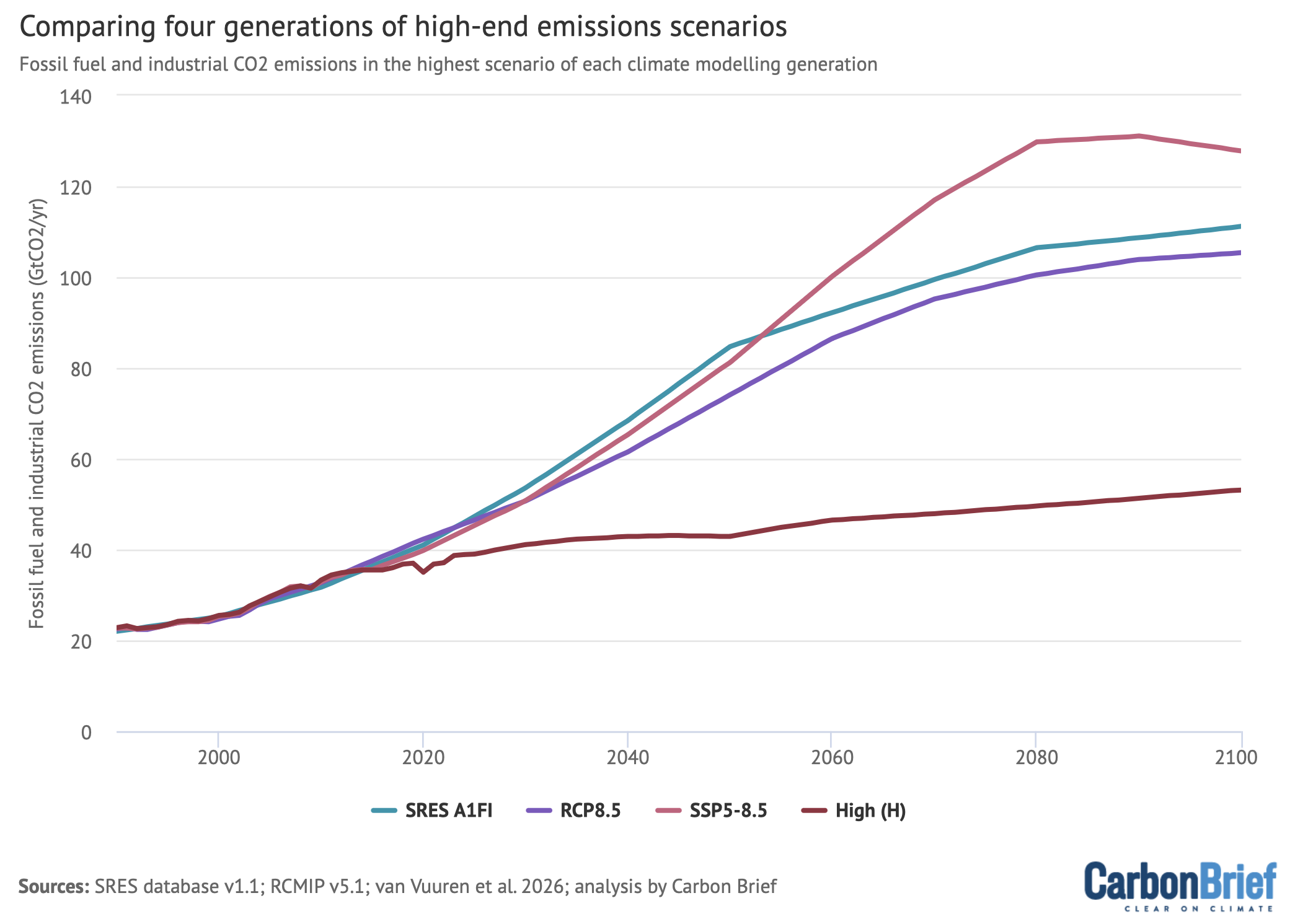
To make the scale of this shift clear, Carbon Brief analysed the CO2 emissions trajectories in each of the prior generations of high-end emissions scenarios, using the same simple climate model – FaIR – to calculate future warming.
Fossil CO2 emissions relative to 1850-1900 for the highest scenario of each climate modelling generation: SRES A1FI (CMIP3, used in AR4), RCP8.5 (CMIP5, AR5), SSP5-8.5 (CMIP6, AR6) and CMIP7’s high, all run through AR6-calibrated FaIR ensemble. Data: SRES database v1.1, RCMIP v5.1, ScenarioMIP database; chart by Carbon Brief.
Below, four different generations of emissions scenarios are examined. The SRES scenarios were originally published in 2000 and used in the IPCC’s third (2001) and fourth (2007) assessment reports (and the corresponding CMIP3 model runs). The RCPs were developed in the early 2010s and used in the IPCC fifth assessment report (AR5; 2013) and CMIP5, while the SSPs were developed in the late 2010s and used in the IPCC AR6 report and CMIP6.
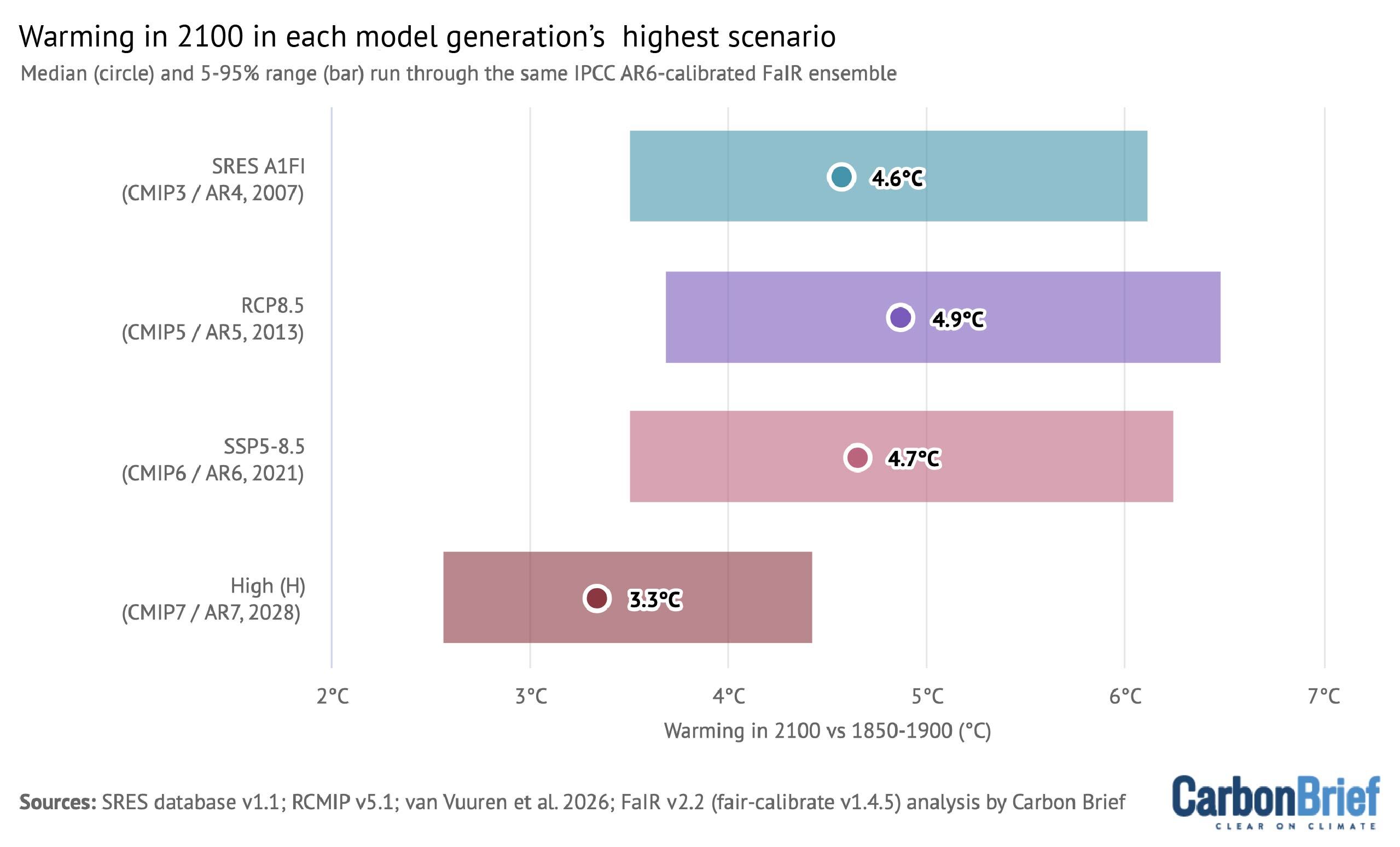
Over the past two decades, the highest emissions scenarios all resulted in comparable amounts of warming in 2100: SRES A1FI (the highest SRES scenario) reached 4.6C in 2100 (5-95% range; 3.5-6.1C), RCP8.5 reached 4.9C (3.7-6.5C) and SSP5-8.5 reached 4.6C (3.5-6.2C).
(RCP8.5 edges out its successor despite lower CO2 emissions because it assumed considerably more methane and nitrous oxide.)
Global mean surface temperature change in 2100 relative to 1850-1900 (medians and 5-95% ranges) for the highest scenario of each climate modelling generation: SRES A1FI (CMIP3, used in AR4), RCP8.5 (CMIP5, AR5), SSP5-8.5 (CMIP6, AR6) and CMIP7’s high, all run through AR6-calibrated FaIR ensemble. Data: SRES database v1.1, RCMIP v5.1, ScenarioMIP database; chart by Carbon Brief.
CMIP7’s high scenario comes in remarkably lower, at 3.3C (2.6-4.4C).
The downward revision of future emissions in CMIP7 reflects two key changes since RCP8.5 was published back in 2011. First, the plausible baseline of a repeal of current policy has fallen. Cheap solar, wind and batteries, a global plateau in coal use and more than $2tr per year in clean-energy investment mean that a rollback in climate policy would not result in coal deployment levels assumed in the RCP8.5 scenario.
The GMD study states that CMIP6’s high-emission levels “have become implausible, based on trends in the costs of renewables, the emergence of climate policy and recent emission trends”.
(For more, see Carbon Brief’s recent factcheck of false claims around the retirement of the SSP5-8.5 emissions scenario. Also see Carbon Brief’s recent interview with Prof Detlef van Vuuren, a key architect of both the old SSPs and new scenarios.)
Second, part of the apparent decline reflects a correction of how scenarios are communicated – rather than real-world progress. The old high-end scenarios always represented an estimate of worst-case scenarios at the time, rather than likely outcomes.
Genuine progress in reducing emissions probably accounts for around 0.7C of the roughly 1.7C gap between SSP5-8.5 and today’s current-policy trajectory, with the remainder reflecting that the baseline was never particularly likely.
What the new scenarios mean for future warming
To compare warming outcomes across scenario generations on a like-for-like basis, Carbon Brief ran both the seven CMIP7 scenarios and the CMIP6 SSP emission scenarios through the same simple climate model.
These values may differ from the ultimate results that are found by CMIP7 climate models, but give a sneak peak of what those results may look like when they become available.
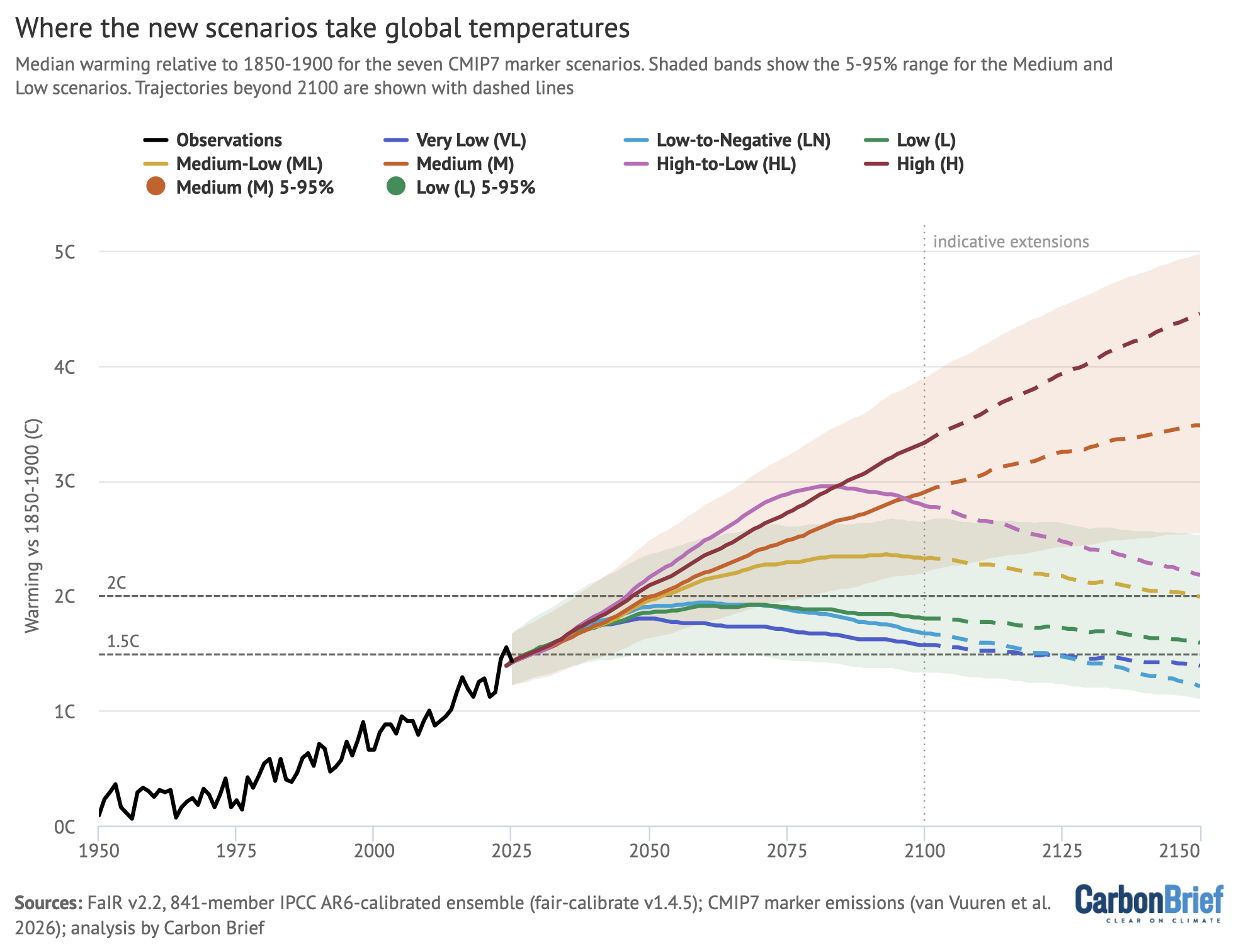
Median warming relative to 1850-1900 for the seven CMIP7 scenarios, with observations to 2025 (black) and the 5-95% ensemble range shaded for the medium and low scenarios. Dashed lines show warming between 2100 and 2150. Chart by Carbon Brief.
The seven scenarios produce warming in 2100, relative to pre-industrial (1850-1900), that ranges from 1.6C (with a 5-95% range of 1.1-2.5C) in the very-low scenario to 3.3C (2.6-4.4C) in high, with the current-policy medium scenario reaching 2.9C (2.2-3.9C). Warming also continues after 2100 in both the medium and high scenarios.
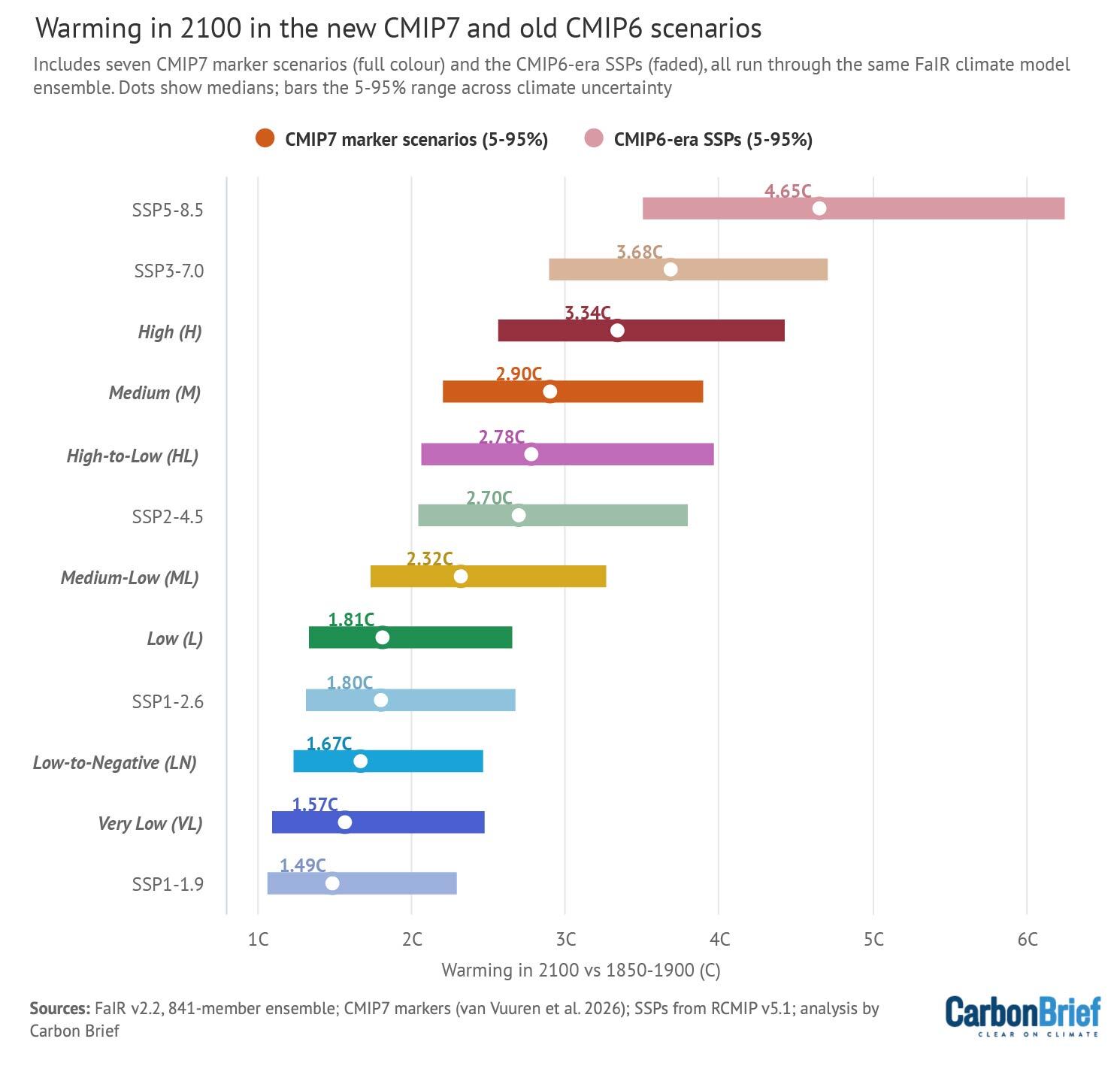
The figure below shows the range of 2100 warming (5th to 95th percentile) relative to the preindustrial period expected in each of the old SSP scenarios and the new CMIP7 ones, along with a central estimate (white dots).
Warming in 2100 for CMIP7 scenarios and CMIP6 SSPs run through the identical FaIR ensemble (medians and 5-95% ranges). Chart by Carbon Brief.
The largest changes are, unsurprisingly, at the top. CMIP7’s high scenario (3.3C in 2100) produces less warming than SSP3-7.0 (3.7C in the same ensemble) and far less than SSP5-8.5 (4.7C).
The entire CMIP6 “high” tier (e.g. SSP5-8.5 and SSP3-7.0) now sits above anything in the new scenario set, at least up to 2100. Extended beyond 2100, however, high keeps climbing towards levels the previous extreme scenarios reached earlier.
At the low end, the picture is more similar. The very-low scenario (1.6C in 2100) lands close to SSP1-1.9 (1.5C) and low (1.8C) is essentially indistinguishable from SSP1-2.6 (1.8C) in 2100.
However, the new low scenario involves more rapid late-century emissions reductions and greater amounts of carbon removal than its SSP analogue, while the very-low scenario involves greater overshoot of 1.5C mid-century.
Crossing warming thresholds
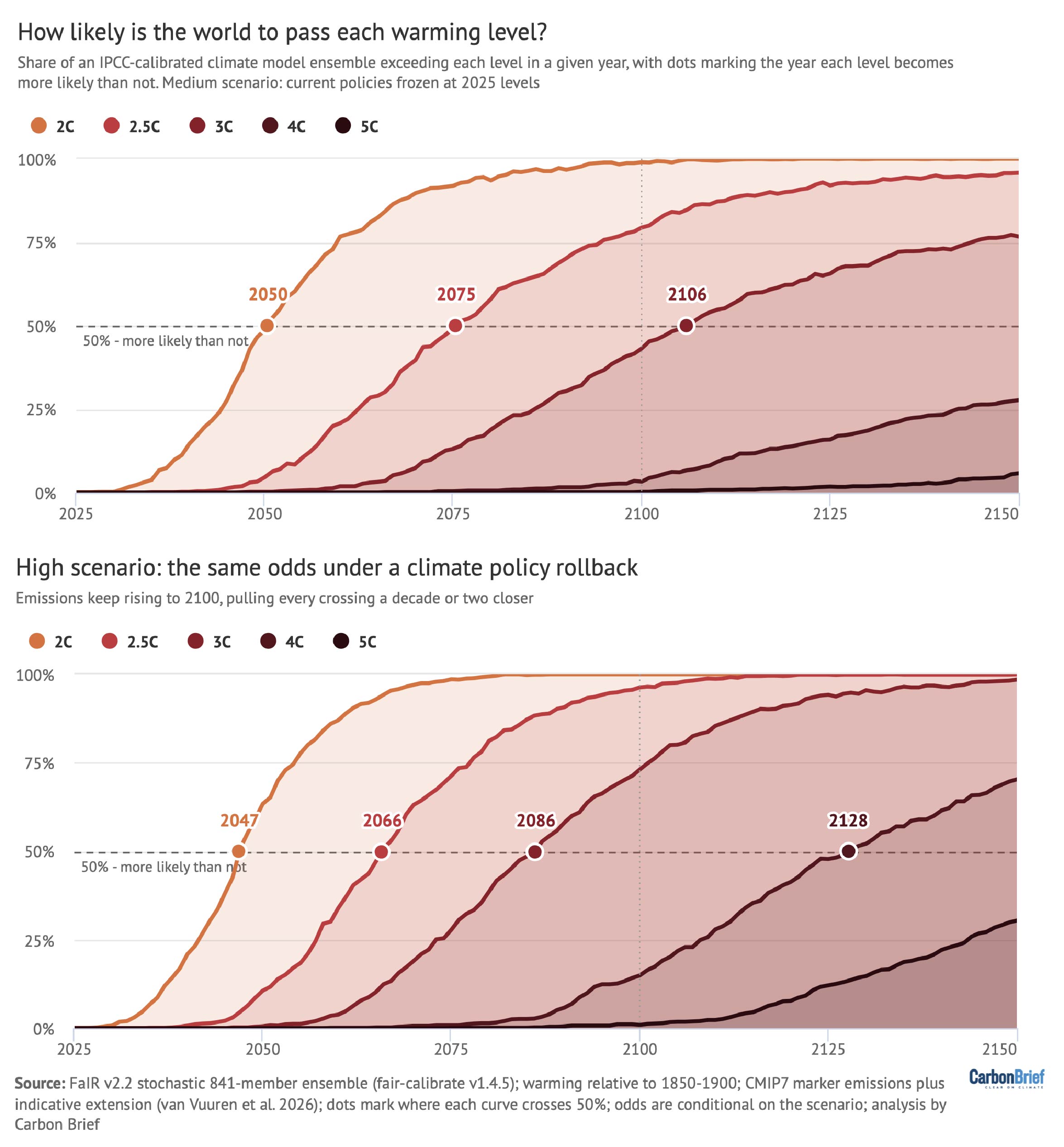
In addition to calculating 2100 and 2150 warming, Carbon Brief has calculated the likelihood of passing different global warming levels (2C, 2.5C, 3C, 4C and 5C) over time in the new CMIP7 scenarios.
The chart below uses the IPCC approach of calculating the crossing year based on a 20-year average, rather than when a single year exceeds the warming level.
Share of the 841-member FaIR climate model runs that exceed each warming level by year under the medium (top) and high (bottom) scenarios. Marked years show the median IPCC-convention (20-year average) crossing; percentages show the chance of exceeding each level by 2150. Chart by Carbon Brief.
Under the medium scenario, which reflects a world where current policies are maintained, passing 1.5C is essentially locked in.
Most models cross the threshold by the late 2020s or early 2030s. The 2C limit is crossed around 2050 on average and 3C by around 2110. The chance of exceeding 4C is around one-in-four by 2150, but, ultimately, rises to roughly 50% if emissions continue after that point.
Under the high scenario, 2C arrives in the 2040s, 3C in the 2080s and the chance of exceeding 4C by 2150 is around 60% (and around 95% by 2300). Even 5C is reached by 2150 in roughly 20% of climate model simulations.
The lower scenarios tell a different story. In the very-low scenario, the chance that peak warming (which the IPCC determines using a 20-year average of warming) ever exceeds 1.5C is around 90%. This reflects the fact that passing 1.5C is almost unavoidable at this point.
However, the chance of surpassing 2C sits at around 30% and the scenario has warming falling after mid-century as more CO2 is removed from the atmosphere than is added.
Carbon dioxide removal
Every scenario that has global warming peaking and declining requires pulling CO2 back out of the atmosphere. Otherwise, warming from CO2 emissions will persist for millennia.
CO2 removal (CDR) remains one of the few levers available to reduce future temperatures – particularly given additional warming caused by cuts to aerosol pollution.
The chart below shows the total CDR deployment in each of the different scenarios by year, reflecting the sum of both land-based and engineered approaches (top), as well as the total CDR deployment between 2024 and 2150 (bottom).
Total carbon dioxide removal (CDR) in the CMIP7 scenarios (solid) and their extensions (dashed), including both “engineered” and “novel” methods (bioenergy and carbon capture and storage (BECCS), direct air capture (DAC), enhanced weathering, biochar) plus land-based removals (the net land-use sink plus soil carbon management), along with with cumulative CDR for 2024-2150. Chart by Carbon Brief.
Every scenario that deeply cuts global emissions in CMIP7 also involves a large amount of CDR.
The low-to-negative scenario pulls a cumulative 2,360GtCO2 out of the atmosphere by 2150, roughly 60 years of today’s emissions run in reverse.
The high-to-low scenario has around 1,480GtCO2 cumulative CDR, medium-low has 1,450GtCO2 and low has 1,360GtCO2.
Even the very-low scenario, which seeks to minimise CDR use, requires 655GtCO2 of removals between 2024 and 2150.
In the low scenario, roughly one-third of the removals is from the land “sink”, while low-to-negative relies almost entirely on engineered methods, with direct air capture alone reaching around 16GtCO2 per year by 2100.
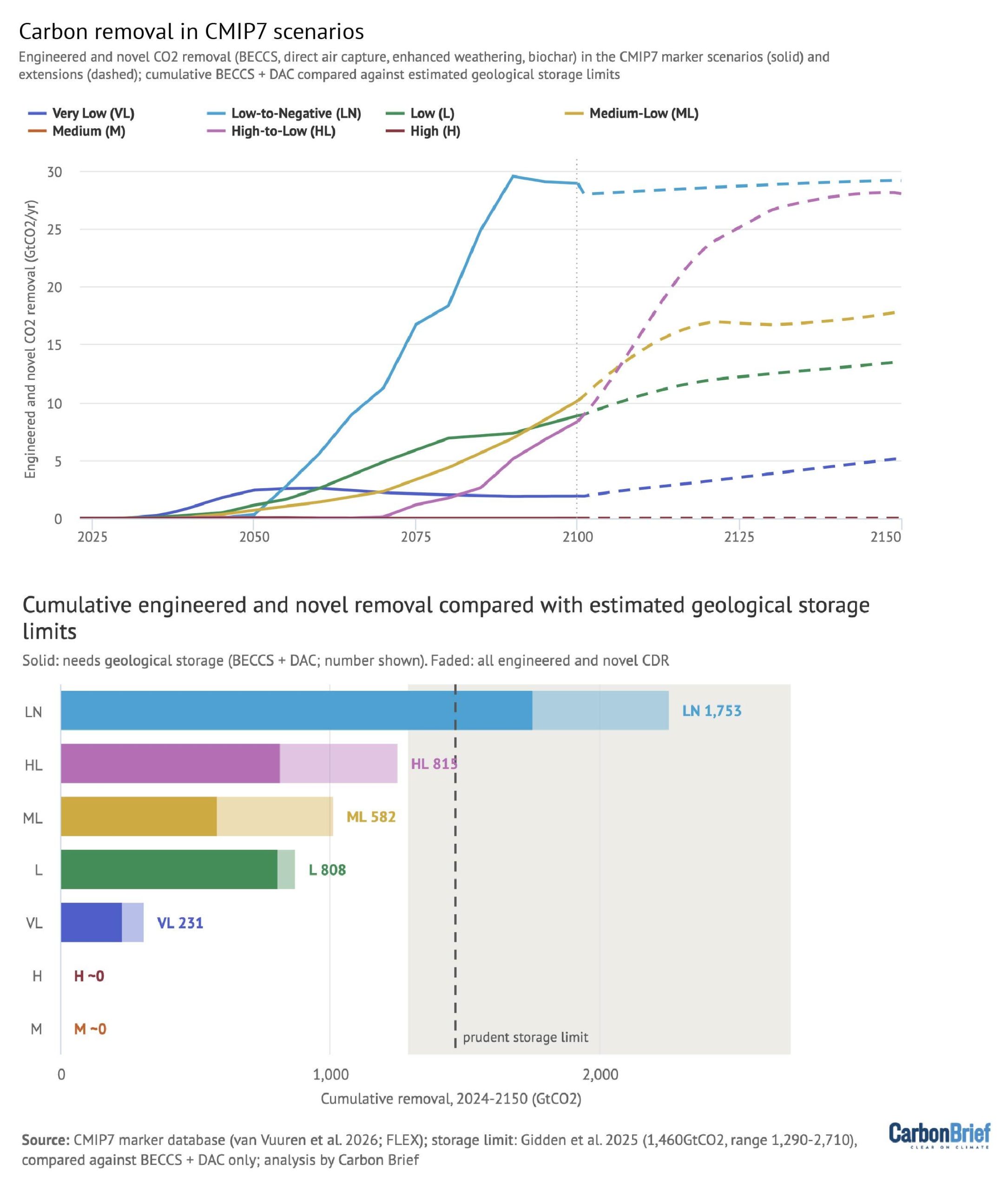
The chart below shows the deployment of engineered removals by year (top), as well as the total engineered CDR used between 2024 and 2150 (bottom). The lower plot also includes a breakdown between the portion of CDR that requires geologic storage (e.g. DAC and BECCS) and the portion that does not (e.g. enhanced weathering and biochar) and compares the total to a recent “prudent” total CO2 storage limit published in the scientific literature.
(For more on limits to carbon storage capacity, see Carbon Brief’s 2025 guest post.)
Engineered and novel CO2 removal only, with the cumulative BECCS and direct air capture component – the technologies requiring geological storage – compared against the “prudent” 1,460GtCO2 (range 1,290-2,710GtCO2) geologic storage limit set out in Gidden et al. (2025). Chart by Carbon Brief.
The amount of CDR going toward geological storage is most highest in the low-to-negative scenario, which injects around 1,750GtCO2 of BECCS and direct-air-capture CO2 underground by 2150.
The high-to-low and low scenarios each commit around 800GtCO2 to storage by 2150. This is within the range of available geologic storage, but would require that the storage industry handles more CO2 than the mass of oil currently moved by the fossil-fuel industry.
That said, there are other potential CDR approaches – such as enhanced rock weathering, surficial mineralisation and ocean alkalinity enhancement – that do not require injection of CO2 into geologic formations. In-situ mineralisation approaches that inject CO2 into alkaline rock formations such as basalt or peridotite could also open up more potential CO2 storage.
It is worth noting that the amount of CDR deployed in these scenarios would require planetary-scale engineering at the cost of trillions of dollars, while many of the engineered CDR approaches are still relatively early-stage technologies.
No single climate future
The goal of scenarios is to span a range of possible futures. While it may be tempting to treat current climate and energy policies – and the medium scenario – as a forecast, there is no reason to expect that they will not change in the future.
It is likely that policies will continue to be strengthened, as has been the case over the past two decades. However, they may also be weakened if national priorities or politics change, as has happened in the US during the two terms of the Trump administration.
In the new CMIP7 scenarios there is no “business-as-usual” scenario, but rather a narrower range of futures than was available in CMIP6, reflecting greater clarity among scientists on where the world is heading in terms of future energy use and emissions.
The fact that the worst-case scenarios of the past have become increasingly implausible is good news. However, this is tempered by the fact that the very-low emission scenarios have, in turn, become harder to achieve given that global emissions have yet to decline.
There is also real uncertainty in the climate-system response to emissions. This is due to uncertainty around how sensitive the climate is to a build-up of CO2 in the atmosphere, as well as how the carbon cycle will respond to emissions.
The CMIP7 medium scenario – which has a central estimate of 2.9C of warming by 2100 – still has around a 3% chance of reaching 4C by that date. If emissions continue, those odds increase to 25% by 2150. This remains far outside anything resembling a safe outcome for the climate system.
The scenarios are now being run using the new CMIP7 models, whose emissions-driven runs will fold carbon-cycle uncertainty directly into projections. These projections will subsequently be analysed in the reports of AR7.
Ultimately, it will be decisions made by governments, businesses and individuals that decide which of these seven futures become closest to reality.
Methodology
Emissions scenarios shown in this article are the seven CMIP7 ScenarioMIP scenarios set out in van Vuuren et al. (2026), harmonised to observed 2023 emissions, with rule-based extensions to 2500 generated using the FLEX methodology. Emissions through 2100 match the ScenarioMIP database; extension trajectories are indicative and may differ from the final published extensions.
Temperature projections use FaIR v2.2 with the fair-calibrate v1.4.5 constrained ensemble (841 members set out in Smith et al. (2024), which matches the AR6 assessed climate sensitivity (ensemble ECS median 3C, 5-95% 2.0-5.1C), historical warming and ocean heat content.
Historical emissions (1750-2022) use the FaIR historical emissions dataset, with scenario emissions spliced in after 2023.
Solar and volcanic forcing are updated through 2025 from the Climate Indicator forcing timeseries; future volcanic forcing ramps to the 1850-2021 climatological background by 2035 (following the CMIP7 protocol) and solar forcing follows a SOLARIS-HEPPA-derived cycle projection to 2300.
All warming is expressed relative to 1850-1900.
SSP comparisons run the RCMIP-harmonised CMIP6 scenario emissions through the FaIR ensemble, which yields 2081-2100 warming 0.1-0.3C below the AR6-assessed values at the high end (e.g. SSP5-8.5: 4.2C vs 4.4C assessed), reflecting differences between the AR6 assessment and the FaIR configurations used here. Updating the volcanic dataset to use CMIP7 values (which revises the eruption-rich 1850-1900 baseline period) raises all reported anomalies by 0.03-0.05C.
For CDR, the scenario database reports the technology split (for example, BECCS, direct air capture, enhanced weathering, biochar, ocean-based, soil carbon management). Agriculture, forestry and other land-use (AFOLU) removals are available only as a net flux, so are shown as the net sink where negative. Soil-carbon management is grouped with land-based rather than engineered removal, and the geological storage comparison uses BECCS plus direct air capture only.
The figure showing high-end scenarios for the past four CMIP generations runs SRES A1FI through the same ensemble using the A1G MiniCAM model from the SRES database v1.1, spliced onto historical emissions at 2000, and covering CO2 (fossil and land use), methane, nitrous oxide and sulphur; SRES-era ozone-precursor projections (nitrous oxide, carbon monoxide and volatile organic compounds) lie outside the calibrated range of FaIR, so RCP8.5 values are used instead. RCP8.5 uses RCMIP v5.1 emissions, with 13 minor halogenated gases absent from the RCP database following SSP5-8.5.
Related
Climate change exposes 580 million children to 20 extra ‘heat-stress days’ every year
Anuradha Barua, Aakriti Wanchoo and Swapan Mehra are from Iora Ecological Solutions, a New Delhi-based company focused on nature-based solutions, climate action, conservation and environmental policy.
When Rojo Neog’s village in northeast India was hit by a power cut in July, he headed out to buy candles. Three days later, his body was recovered – swept away by surging floodwaters. His niece said the water had risen from knee- to neck-level in about half an hour.
The devastating floodshighlight how climate risk across India is becoming harder to confine to a season or a disaster bulletin. Just weeks before the disaster in Assam, authorities in Mumbai rationed water as reservoir storage fell to just over 10%.
India does not lack warnings about climate risk. The more difficult task is making sure money, institutions and communities are ready to act before those warnings become disasters. Adaptation should not be just an obligation once a crisis has arrived, but an investment made while there is still something to protect.
Madagascar’s Rindra Rabarinirinarison takes the helm of the troubled organisation promising to prioritise fundraising, rebuild trust with donors and hone its mission
Splits between developed and developing countries over finance and science held back progress on key areas of climate action, leaving disappointment and much work for COP31
As governments head towards COP31 in Antalya this November, India should push not only for more adaptation finance, but for finance that arrives earlier and can be traced to outcomes on the ground.
That is the gap India needs to close if we wish to become truly resilient in the face of the changing climate. Money must move with risk, institutions must know what to do before an emergency is declared, and long-term spending must reduce vulnerability before it becomes loss.
India’s adaptation disconnect
This year the disconnect has become painfully clear in Assam, where more than 100 people have died due to the flooding, with nearly 140,000 people across seven districts affected. More than 450 villages remain inundated, while some 49,000 people are taking shelter in relief camps after losing everything.
No financing mechanism can stop a river from rising. But timely measures can change what happens before it does. If forecasts and river levels triggered financing before the water arrived, authorities could position boats and stock shelters, and evacuate people where needed, while families could move cattle, seed, medicines and documents before roads disappeared.
India already has much of the information needed to address climate change. High-risk states and districts should agree in advance which local thresholds trigger action, who is responsible and how funds will be released, so officials do not have to negotiate responsibility and budgets from scratch once risk becomes an emergency.
Linking community know-how to financing
Our work in Majuli, a river island district in Assam, shows why this matters.
Across 64 villages, communities helped identify flood and erosion risks, assess their capacity to respond, and to develop resilience measures with indicative budgets and possible funding sources.
Communities often know what would help; the harder task is connecting that knowledge to institutions and finance that can act on it.
Public health offers an example of how systems can adapt as risks change. In New Delhi, vector-control workers who once prepared for a defined “dengue season” now remain on alert throughout the year, using surveillance and hotspot mapping to identify risks earlier.
The next step is to make these systems more predictive by integrating climate forecasts into public health planning.
India needs sustained investment in drainage, health systems, wetlands, water security and climate-resilient agriculture. Some will remain public responsibilities; others, including water reuse, efficient irrigation, resilient cold chains and risk-proofed infrastructure, can generate savings or revenue and attract private capital if projects are prepared well.
The economic case for adaptation is not always about generating new revenue. Often, it is about avoiding future costs. Flood shelters, public-health preparedness, early-warning systems and support for the poorest households will still need public or grant finance. The point is to match the finance to the risk rather than treat adaptation as a single financing problem.
A sugarcane farmer removes weeds which have grown in floodwater in Kolhapur district, Maharashtra, India. Credit: Meenal Upreti
A sugarcane farmer removes weeds which have grown in floodwater in Kolhapur district, Maharashtra, India. Credit: Meenal Upreti
Rising disaster bill shows cost of inaction
India is already spending heavily on adaptation, with related expenditure reaching 5.6% of GDP in 2021-22. Yet tracked adaptation finance was only about $15 billion annually, almost entirely from domestic public sources, against estimated needs of about $100 billion a year through 2030.
Internationally, the shortfall is wider: developing countries may need $310 billion-$365 billion annually by 2035, compared with just $26 billion in international public adaptation finance in 2023.
For governments repeatedly paying for flood, droughts and heat relief, the cost of inaction can quickly exceed the cost of building resilience, though not all the costs of inaction appear neatly on a balance sheet.
In floodplain landscapes such as Assam’s Kaziranga National Park, animals move towards higher ground every monsoon as the floodplain fills, crossing roads and leaving the park in search of safety. During the 2024 floods, 215 animals died, including 13 one-horned rhinos.
Development plans in such sensitive landscapes must leave room for water, wildlife and communities to move safely. A wetland may not generate monetary revenue, but the floodwater it stores has real value. The cost of losing that capacity may only become visible when the next flood arrives.
Success should not be measured only by how quickly relief follows a disaster. It should also be measured by what never had to be replaced: people and animals moved before the water rose, seeds kept dry, medicines waiting at the shelter, a wetland that still had room to hold water, and a family that could leave while the road was still open.
Adaptation becomes an investment when it preserves those choices before they disappear.