
Image generated with Claude. Why have we juxtaposed a bicycle with balcony solar? Read on.
First it was Plug-In Solar. Then it was Balcony Solar. Now it’s Guerrilla Solar, at least according to Inside Climate News, which yesterday proclaimed that The ‘Guerrilla Solar’ Era Has Arrived.
“It,” of course, is Modular solar panels. They’re the hot new photovoltaic solution: cheap enough to buy at Home Depot, easy to hang or prop to catch maximum rays, and small enough to fit on a balcony (if you’ve got one) and plug into your “home grid.” But, alas, too meager a generator of electricity to be more than a bit player in decarbonizing most U.S. homes.
How do I know? I’ve done the math.
A standard, lower-end 220-watt balcony solar array will produce 337 kilowatt-hours a year, or 28 kWh a month averaged over the course of a year. That’s for a 220W unit measuring 3.5 feet by 3.5 feet. (220W x 1/1000 x 17.5% x 8760 hours per year = 337 kWh. Calculation assumes a 17.5% full-year capacity factor, which is arguably generous for New York, where I live. )

Our balcony solar mashup. Top: an install in Germany. Bottom: Home Depot advert.
A typical U.S. home consumes 10,500 kWh a year, or 28 to 29 kWh per day, says Solartech, drawing on U.S. Energy Information Administration data. That puts a home’s daily power needs on par with a balcony solar unit’s monthly output. In effect, once each month the balcony array gifts a homeowner or renter a bit more than day’s full complement of electricity. And earth’s atmosphere gets the same respite: a 3 percent reduction in carbon emissions caused by the home’s electricity usage.
(The 3 percent figure could also be calculated directly by dividing 337 kWh per year of solar production by 10,500 kWh per year to run the home. For bigger or smaller arrays, just prorate your assumed wattage by my 220W; for 440W, say, double my figures.)
Balcony Solar metrics
Why write about balcony solar if it’s so inconsequential? CTC’s mission includes puncturing would-be climate balloons before they ascend too far. In the same vein, we practice quantification to make clear what does and doesn’t move the climate needle. (More on that further below.)
The best way to depict balcony solar’s climate value is to express it in terms of tangible metrics. We’ve selected two. Both assume the basic, lower-end PV array I assumed at the top: a 3.5 foot-square array whose peak output is 220 watts.
1. It would take 50 million 220W balcony solar units (bsu’s) to restore the climate benefit we destroyed in 2020-2021 when we shut the high-performing Indian Point nuclear power plant 32 miles from Midtown Manhattan.
2. A single person cutting back their driving by a mile a day would provide the same climate benefit over the course of a year as a single 220W bsu.
(Calculations in sidebar. Now you know why we led with images of an urban dweller as cyclist and balcony solar user.)
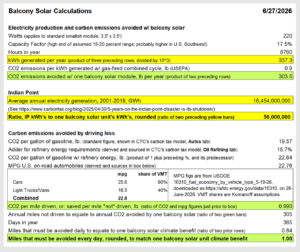
Yes, it’s dense — as befits a sidebar. The numbers tell a story. Follow the color co-ordination.
Ponder that: It would take fifty million smallish bsu’s to level up to the fossil fuel carbon emissions that Indian Point was keeping at bay by supplying the New York City area year in and year out with abundant carbon-free power. Deploying that many balcony solar units would entail 10 bsu’s for each of the 5 million households in the MTA’s service territory. (The Metropolitan Transportation Authority provides subway, bus and commuter rail transit in the five boroughs and seven suburban counties.) Or, if those same households upgraded to 1100-watt bsu’s, collectively they would still make up only half of the lost Indian Point power.
The second comparison, involving driving, is perhaps trickier to grasp but more interesting, since it relates to people’s behavior. Living differently isn’t part of public discourse, at least not in the USA, and especially when what’s being served up is using less. But “reducing,” as we might call it (remember “Reduce, Reuse, Recycle”? or, “Insulate, then Insolate”?) is just as potent for cutting emissions as switching to renewables — even more so when the reducing means driving less, considering the multitude of benefits that accrue from diminishing cars’ imprints on our communities. Still, staying on topic: driving just one fewer mile per day brings about the same shrinkage in carbon emissions as deploying one 220W solar array.
What Balcony Solar boosters are really saying
To be fair, our friends at Inside Climate News and, yes, The New York Times appear to be trying to modulate their balcony solar enthusiasm.
ICN‘s Dan Gearino, whom we cited up front, said he looked to Germany, the birthplace of balcony solar, to see if the units made sense for U.S. households. His takeaway: “It may make more sense financially to spend the cost of plug-in solar on insulation, air sealing or other basic measures to reduce energy use.” Hooray: insulate before you insolate.
Gearino helpfully interviewed renewables guru (and U.S. emigré) Craig Morris, who currently heads Germany’s plug-in solar trade association, Bundesverband Steckersolar. To Morris, balcony solar’s main advantages are that it provides power without taking up land, and that it affords people a way to “become participants in the transition to clean energy.” Behold, guerrilla solar. That, in turn, bolsters “the political consensus that supports the transition.” But Morris also made clear that widespread adoption of plug-in solar would only meet “about 2 percent of Germany’s electricity demand.”
Morris’s “about 2 percent” feels right for Germany. But not for the U.S., where widespread adoption of virtually any individual carbon alternative seems forever out of reach, and where the energy pie is so much larger — think giant fridges, freezers for beer, steroidal homes bursting with piles of powered toys, not to mention industrial and institutional electricity use that Morris correctly excluded from his figure.

Don’t forget to micro-dose. NYT headline + image for David Wallace-Wells’ guest essay (see text). Image by Rui Pu.
Both Gearino and Morris seem more measured than climate journalist Robinson Meyer, founding editor of Heatmap and frequent contributor to The Times, where he wrote about balcony solar in mid-June.
“New zero-carbon power kits will allow Americans to make their own energy choices,” declares the callout to the print version of Meyer’s NYT guest essay, The Tiny Solar Panel That Could Change America. (The even more expansive print headline invites us to “Forget Roofs. Backyard Solar Is the Next Frontier.”)
Wallace-Wells is of two minds. He calls balcony solar “a small way that apartment- and condo-dwelling Americans can take ownership of their energy choices and cut down their pollution on the margins.” No quarrel there, thanks to his qualifiers “small” and “on the margins.” Earlier, though, he opines that balcony solar units “have the potential to change how Americans understand and consume energy,” But read further and you’ll again see Wallace-Wells cautioning that “Balcony solar will play one small role in [the] drama” of transiting to the new world of clean, abundant energy.
Any such caveats are welcome these days, amid widespread solar hoopla. Still, it doesn’t seem to be in Wallace-Wells’ toolkit — or that of Inside Climate News and other mainstream climate journalists — to tutor their audiences as to the true limits of balcony solar and other panaceas. Just like it wasn’t in their field of vision a decade ago to lay out the true stakes of shutting Indian Point as Riverkeeper was singing its siren song.
What’s Next for NY Balcony Solar
Meantime, as Canary Media reported recently (and helpfully), New Yorkers concerned with climate and affordability are waiting for NY Gov. Kathy Hochul to sign the recently passed SUNNY (Solar Up Now New York) Act legalizing balcony and other plug-in solar. It would be head-spinning (and politically suicidal) if she didn’t, given near-universal support ranging from Con Edison to DSA Assembly Member Emily Gallagher, who told Canary Media, “This is the most popular bill I’ve [ever] worked on.”
My guess is that Hochul is waiting for the right moment, and perhaps the right “package,” that can advance and not undercut her push to launch five large new nuclear power plants around the state — one to be built by the public New York Power Authority, the others to be constructed and operated privately. A little bit of math, a la what we offered here a la Indian Point, might help her out.
The governor also must manage the veritable hot potato of her deferred implementation of the landmark 2019 Community Leadership and Climate Protection Act. She might do well to consider jettisoning the act’s unwieldy cap-and-invest centerpiece in favor of a straight-up carbon tax (with the revenues distributed pro rata to the state’s households) in its place. That, far more than balcony (or guerrilla) solar, could blow open the door to the “innovations and technologies we cannot yet imagine” that Wallace-Wells fantasized about in his Times essay.
Carbon Footprint
The new SBTi Corporate Net-Zero Standard: what it means for business
On 11 June 2026, the Science Based Targets initiative (SBTi) published the most substantial revision of its flagship corporate framework since its introduction. The SBTi Corporate Net-Zero Standard Version 2.0 takes effect on 1 February 2027 and reshapes the way companies approach their net-zero targets.
![]()
Carbon Footprint
How cookstove carbon credits deliver value to buyers, communities, and nature
In a kitchen in rural Kenya, a mother kneels beside a three-stone fire to cook the day’s ugali (a starchy staple food). The flames are open, the smoke is thick, and her youngest child sits close by, breathing it in. This scene plays out in millions of homes every morning, and it is also where a measurable carbon credit can begin.
![]()
Carbon Footprint
The Environmental Impact of Industry: Causes, Effects & Solutions
Since the Industrial Revolution, human activities have left a significant and growing mark on the natural world. Pollution, carbon emissions, and altered land use have degraded ecosystems, contaminated water supplies, and pushed global temperatures to record highs. These are not distant consequences. They affect the air people breathe, the food they eat, and the stability of the climate every community depends on.
Understanding the environmental effects of industry is the first step toward meaningful change. When we grasp the full picture of how industrial practices damage the planet, we can make better decisions at every level, from individual choices to corporate policy to government regulation.
This guide covers the origins of industrial pollution, its specific environmental impacts, which industries carry the heaviest footprint, and the solutions that are already making a difference. We also highlight companies leading by example and explain how businesses of all sizes can take action today.
How Did the Industrial Revolution Cause Environmental Pollution?
The Industrial Revolution began in England in the 18th century before spreading through Europe and across the world. Nations shifted from agrarian economies to industrial ones, and fossil fuels were burned on a massive scale to power that transition. The environmental deterioration that followed has been compounding ever since.
Land use changed dramatically alongside industrial growth. As factories and urban centers expanded, farmland shrank and agriculture itself became industrialized. Industrial farming introduced fossil-fuel-powered machinery, synthetic fertilizers, pesticides, and concentrated livestock operations. The result was soil deterioration, widespread air and water pollution, and a significant rise in greenhouse gas emissions from the agricultural sector alone.
Deforestation and urbanization compounded the damage by eliminating natural carbon sinks. Forests and wetlands that once absorbed carbon dioxide from the atmosphere were cleared for development, removing the land’s natural ability to absorb carbon and leaving more greenhouse gases concentrated in the air.
The numbers tell the story clearly. Atmospheric CO2 was consistently around 280 parts per million before industrialization began. According to the IEA, CO2 concentrations reached approximately 427 parts per million in 2025, more than 50% above pre-industrial levels, with total energy-related emissions hitting a record high of nearly 38.4 billion tonnes. That figure has risen every decade since the Industrial Revolution began.
Industrialization continues today in developing nations, many of which lack the financial infrastructure to adopt clean energy and rely instead on coal, oil, and petroleum to power their growing economies. Even many developed nations remain heavily dependent on polluting industries, continuing to add to global greenhouse gas concentrations.
What Are the Environmental Impacts of Industry?
Industrial pollution creates environmental damage at every scale, from local waterways to the global atmosphere. The consequences affect ecosystems, human health, and the long-term stability of the climate. Below are the three primary categories of environmental impact driven by industry.
Pollution
Industry causes pollution across water, air, and soil, the three foundations of life on Earth. Each type of pollution carries its own chain of consequences.
Water pollution occurs in both freshwater systems and oceans. Water used in industrial processes becomes contaminated when it contacts metals, chemicals, or radioactive waste, and that water is often discharged into rivers and waterways. The result is contaminated drinking water, damaged aquatic ecosystems, and crops irrigated with polluted water that can become harmful to consume. Globally, 80% of wastewater is still released untreated into the environment.
Air pollution is any physical, biological, or chemical change to the atmosphere that reduces air quality. Gas, smoke, and fine particulate matter from burning coal or natural gas cause respiratory and cardiovascular disease in humans and threaten ecosystems globally. Air pollution now contributes to approximately 7.9 million premature deaths per year worldwide, making it one of the leading environmental causes of mortality. Airborne contaminants also cause acid rain, which ruins crops and acidifies freshwater bodies.
Soil pollution occurs when chemical levels in the ground exceed safe thresholds and present a threat to human health or ecosystems. Soil becomes polluted through industrial waste, chemical pesticides and fertilizers, oil spills, and landfills. Heavy metal contamination from industrial waste currently affects an estimated 20% of global agricultural land. Contaminated soil reduces crop yields, harms wildlife, and can lead to serious health problems in humans and animals living in affected areas.
Ecological Consequences
Pollution and altered land use place severe strain on ecosystems in ways that ripple outward for generations. Three interconnected effects stand out.
Habitat destruction results from deforestation, urban expansion, and industrial development. When natural habitats are destroyed or fragmented, plants and animals lose the environments they need to survive. Species are pushed into shrinking territories, forcing greater competition for resources and raising extinction risks. According to current data, 33% of global soils are degraded due to pollution and erosion, compressing the productive land available to both agriculture and wildlife.
Slower environmental recovery is another consequence of the cumulative strain on ecosystems. Natural disasters like wildfires and hurricanes are growing more frequent and severe as the climate shifts, and ecosystems already weakened by pollution and habitat loss take longer to recover from each new event. Industrial accidents, such as oil spills or chemical leaks, add further damage that can persist in an environment for decades.
Biodiversity loss continues to accelerate as species go extinct at rates far above natural baselines. The combination of habitat destruction, pollution, climate change, and resource depletion creates overlapping pressures that many species cannot adapt to quickly enough.
Atmospheric Changes
Industrial practices release large quantities of greenhouse gases into the atmosphere, driving global warming and climate change. These two phenomena are distinct but deeply linked.
Global warming occurs when greenhouse gases like CO2 and methane accumulate in the atmosphere and trap heat that would otherwise radiate into space. Burning fossil fuels is the primary driver of CO2 buildup. Agricultural practices and landfills release significant quantities of methane, a greenhouse gas with more than 80 times the short-term warming power of CO2.
Climate change is the broader set of consequences that follows from global warming. Rising temperatures shift rainfall patterns, intensify storms, accelerate glacial melting, raise sea levels, and make agricultural conditions less predictable. Every fraction of a degree of additional warming increases these risks. The remaining carbon budget for limiting warming to 1.5 degrees Celsius is now projected to be exhausted by 2029 at current emission rates.
What Industries Have the Largest Environmental Impact?

Some industries carry a disproportionately large environmental footprint. Researchers evaluate environmental impact across six key components: greenhouse gas emissions, water use, waste generation, land and water pollutants, air pollutants, and natural resource use. The industries that dominate these categories are as follows.
Energy and electric utilities are the most polluting sector on Earth, generating approximately 15.83 billion tonnes of greenhouse gas emissions annually. The energy sector ranks highest in four of the six environmental impact categories: greenhouse gas emissions, waste, air pollutants, and natural resource use. As long as coal and natural gas remain central to electricity generation, this sector will continue to lead all others in environmental damage.
Transport is the second most polluting industry globally, responsible for around 8.43 billion tonnes of greenhouse gas emissions each year. Road transport accounts for the majority of that figure, while aviation and shipping contribute significantly. The sector is under growing pressure to electrify and adopt cleaner fuels.
Manufacturing and construction generate approximately 6.3 billion tonnes of emissions annually and consume vast quantities of raw materials including metals, sand, and timber. This sector appears across all six environmental impact categories, reflecting its broad footprint across pollution, resource use, and land disruption.
Food production ranks as the highest non-utility industry in water use and land and water pollutants. Industrial agriculture is responsible for the majority of freshwater withdrawals globally and is a leading driver of deforestation, soil degradation, and chemical runoff into waterways.
How Can the Environmental Impact of Industry Be Reduced?
Meaningful solutions to industrial pollution already exist. The challenge is implementing them at speed and scale. Below are the most impactful approaches available to businesses and industries today.
Better Waste Management
Improperly handled industrial waste is one of the most direct and preventable causes of environmental pollution. When waste is not treated and disposed of correctly, it contaminates waterways, soil, and groundwater. Industries that invest in proper waste treatment and disposal systems can eliminate a significant portion of their local environmental impact. This is also an area where regulation has historically produced measurable results.
Improved Recycling and Water Reuse
Unnecessary pollution occurs when recyclable materials and reusable water are instead discarded. Industrial water recycling, for example, keeps contaminated water within closed systems rather than releasing it into rivers and oceans. Expanding recycling programs across manufacturing sectors reduces both raw material extraction and waste generation, addressing two environmental problems at once.
Greenhouse Gas Mitigation and Carbon Offsetting
Reducing greenhouse gas emissions from industrial processes is the single most important lever for slowing climate change. Switching to renewable or clean energy cuts emissions at the source. Gas capture programs reduce methane and other potent greenhouse gases that would otherwise escape from operations like landfills and agricultural sites. For emissions that cannot yet be eliminated, verified carbon offset programs allow businesses to fund reforestation, methane capture, and renewable energy projects that compensate for their remaining footprint. Understanding the social cost of carbon helps businesses make the case internally for these investments.
Smarter Land Use
Industrial site selection and land management have lasting ecological consequences. Businesses should choose locations that minimize habitat disruption and avoid high-risk areas where accidents like fires or spills could cause catastrophic environmental damage. Reducing resource extraction on sensitive lands and funding environmental restoration projects, including reforestation and wetland rehabilitation, helps offset the land-use impact of ongoing operations. Carbon removal credits are one mechanism businesses can use to support these restoration efforts directly.
Advancing Technology
Older industrial technologies are often energy-inefficient and generate disproportionately high levels of pollution. Upgrading to newer equipment and processes allows industries to reduce emissions and resource consumption simultaneously. Switching to renewable energy, adopting AI-driven energy management, and investing in cleaner production technologies are all practical steps that industries can take now. The companies seeing the most progress are those that have embedded sustainability goals into their technology roadmaps rather than treating them as separate initiatives.
Environmental Awareness and Impact Assessment
Education and measurement underpin all other solutions. Industries that conduct regular environmental impact assessments, track their resource consumption and emissions, and train employees on sustainability practices are better positioned to identify problems early and respond effectively. Measuring and managing your carbon footprint is as essential for businesses as financial reporting, and increasingly, regulators and investors are requiring exactly that.
What Companies Are Reducing Their Environmental Impact?
Several major companies have made substantial commitments to reducing their environmental footprint and serve as benchmarks for the rest of the corporate world. Their progress, and in some cases their setbacks, offer useful lessons for any business navigating the transition to more sustainable operations.
Microsoft has been carbon neutral since 2012 and has set more ambitious targets since then. The company’s 2025 Environmental Sustainability Report outlines its goals to become carbon negative, water positive, and zero waste by 2030. Microsoft charges an internal carbon fee to business units and reinvests those funds into carbon reduction and removal initiatives. The company achieved its goal to protect more land than it uses by 2025 and has invested in renewable energy across 16 countries, including its first large-scale nuclear energy agreement.
Intel aims to be net positive on water use and achieve 100% renewable energy for its global operations by 2030. Intel links a percentage of employee compensation to corporate sustainability metrics, recognizing that achieving environmental goals requires company-wide participation rather than top-down mandates alone.
Alphabet (Google) has made significant progress on data center efficiency, reducing data center energy emissions by 12% in 2024 despite a 27% increase in overall electricity consumption, driven largely by AI workloads. Google’s data centers now provide six times more computing capacity per unit of electricity compared to five years ago. In 2024, Google signed agreements for more than 8 gigawatts of clean energy, the highest annual volume in the company’s history. The company has also pioneered AI-driven cooling systems for its data centers that dramatically reduce energy waste. It is worth noting that all three of these companies face the growing challenge of rising energy demand from AI infrastructure, a reminder that sustainability commitments require continuous adaptation as business models evolve.
Changing the Environmental Impact of Industry
More than two centuries of large-scale industrial activity have given us a clear view of the consequences. Pollution, ecological damage, and atmospheric change are not side effects we can manage around. They are the defining environmental challenge of our time, and the window for meaningful action is narrowing.
The good news is that solutions are no longer theoretical. Renewable energy is now cost-competitive with fossil fuels in most markets. Carbon capture and offset programs are funding real-world emissions reductions. Companies across every sector are finding that sustainable practices often improve efficiency and reduce long-term costs alongside their environmental benefits.
Whether you run a business or simply want to understand your own role in this picture, the path forward starts with knowing where you stand. Visit Terrapass to learn how you can measure your carbon footprint, reduce your emissions, and support verified projects that make a difference.
Brought to you by terrapass.com
The post The Environmental Impact of Industry: Causes, Effects & Solutions appeared first on Terrapass.
-
Climate Change11 months ago
Guest post: Why China is still building new coal – and when it might stop
-
Greenhouse Gases11 months ago
Guest post: Why China is still building new coal – and when it might stop
-
Greenhouse Gases2 years ago嘉宾来稿:满足中国增长的用电需求 光伏加储能“比新建煤电更实惠”
-

Climate Change2 years ago嘉宾来稿:满足中国增长的用电需求 光伏加储能“比新建煤电更实惠”
-
Renewable Energy8 months agoSending Progressive Philanthropist George Soros to Prison?
-
Climate Change2 years ago
Bill Discounting Climate Change in Florida’s Energy Policy Awaits DeSantis’ Approval
-
Carbon Footprint2 years agoUS SEC’s Climate Disclosure Rules Spur Renewed Interest in Carbon Credits
-
Greenhouse Gases12 months ago
嘉宾来稿:探究火山喷发如何影响气候预测
