Connect with us

Published

on

copper

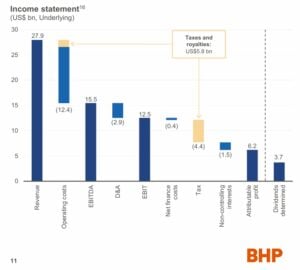
BHP Group delivered a strong first-half performance for FY26, confirming a major shift in global commodity markets. The world’s largest miner posted underlying attributable profit of $6.2 billion, up 22% year over year and broadly in line with forecasts. More importantly, copper has now become the company’s dominant earnings driver.

For the first time in its history, copper contributed 51% of BHP’s underlying EBITDA. This milestone reflects both higher production and stronger prices. It also signals that the long-anticipated structural tightness in copper markets is beginning to materialize.

CEO Mike Henry emphasized that BHP had positioned itself early for this moment. Over the past four years, the company lifted copper production by roughly 30%. That expansion now aligns with rising global demand tied to electrification, renewable energy, and digital infrastructure.
bhp h1 results

Copper Delivers Record Earnings as Prices Rise

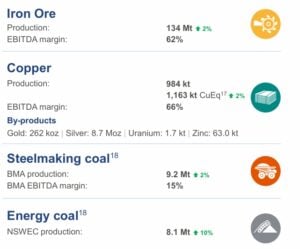
Copper earnings jumped in the first half. The division’s underlying EBITDA rose 59% to $8 billion. Higher prices, up about a third, helped drive the gain. Margins topped 60%, showing strong operations and favorable market conditions.

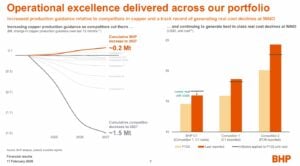
Strong output from Escondida in Chile, along with solid contributions from South Australia, boosted BHP’s results. As a result, the company raised its FY26 copper production guidance to 1.9–2.0 million tonnes. While some competitors lowered their forecasts, BHP went the other way, showing confidence in its operations.
bhp copper

At the same time, better cost management improved profits. Unit costs dropped across major copper assets, helping cash flow while prices stayed high. The company’s internal operating system also kept operations running efficiently and productively.

Meanwhile, iron ore earnings edged higher but showed slower momentum. Demand from Chinese steel exports and manufacturing offset weakness in the country’s property sector. However, China’s broader growth has plateaued. That shift explains why copper, rather than iron ore, now anchors BHP’s earnings profile.

Growth Pipeline Expands Beyond Copper

Copper is driving earnings now, but BHP is also looking at long-term growth. The Jansen Stage 1 potash project is on track to start production by mid-2027. Costs were revised up to $8.4 billion. Once fully operational, each stage could generate about $1 billion in annual EBITDA.

BHP also has copper growth options in Chile, Argentina, Arizona, and South Australia. The company aims to reach around 2.5 million tonnes of copper-equivalent production per year by the mid-2030s. Growth is expected to stay steady through 2035.

Strategic moves are helping BHP’s position. Recent deals could free over $6 billion. This gives the company flexibility to invest in high-return copper projects.
bhp

Copper Market Turns Tighter Heading into 2026

The wider market also supports a positive outlook for copper. The International Copper Study Group (ICSG) says global mine supply growth slowed more than expected. Mine production is expected to rise only slightly in 2025. Refined production may grow very slowly, only at 0.9% in 2026, because of concentrate shortages.
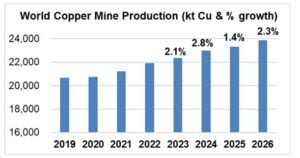
refined copper production
Source: icsg
  • As a result, the market, which had a surplus of 178,000 tonnes in 2025, could swing to a 150,000-tonne deficit in 2026. This is a big change from earlier forecasts that expected a surplus.

At the same time, demand keeps rising. Global refined copper usage could grow about 2% in 2026, reaching nearly 29 million tonnes. Asia continues to drive growth, even though Chinese consumption has slowed. Renewable energy, electric vehicles, grid upgrades, urbanization, and digital infrastructure all support long-term copper demand.
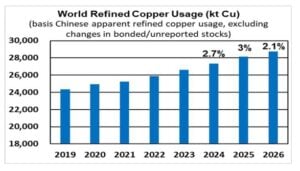
copper usage
Source: ICSG

Copper Prices to Hold Above $12,000?

LME copper prices have fluctuated in early 2026. Prices fell from €13,327 per tonne on February 11 to €12,757 per tonne on February 16, showing short-term volatility. COMEX spot prices also dipped to $5.7710 per pound on February 12, down 3% daily but still up over 25% year-over-year. LME stocks rose slightly to 211,850 tonnes, signaling some inventory replenishment.
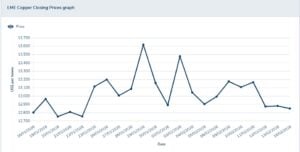
LME copper prices
Source: LME

J.P. Morgan forecasts an average of $12,075 per tonne in 2026. Prices could reach $12,500/tonne in the second quarter. Tight inventories and supply disruptions make the first half of the year particularly bullish.

Data centers are adding to demand. J.P. Morgan says copper used in data center installations could hit 475,000 tonnes in 2026, up 110,000 tonnes from this year. While still a small part of global demand, it adds pressure to an already tight market.

Higher prices could push some buyers toward aluminum. However, analysts warn that substitution is slow. It won’t quickly ease copper shortages.

BHP’s Strategic Advantage in a Structural Shift

For BHP, these trends back its long-term plan. Copper now makes up more than half of group earnings. The company increased production ahead of the market tightening. If prices stay above $12,000, margins could improve further.

Short-term volatility may continue. Slower growth in China or a weaker global economy could push prices down. On the other hand, mine disruptions or higher AI-related demand could push prices up.

Copper is vital for the energy transition. Electrification, decarbonization, and digitalization all need large amounts of the metal. With a projected deficit in 2026 and limited supply growth, the market fundamentals remain strong.

BHP’s results show more than a strong half-year. They highlight a bigger shift in commodities, where copper increasingly drives industrial growth and the clean energy transition.

The post Copper Drives BHP’s $6.2B Profit Surge in FY26 Half-Year Results appeared first on Carbon Credits.

Continue Reading

Carbon Footprint

TotalEnergies Hits Record $73 Million Carbon Credit Spend as 2025 Profits Stay Strong

Published

on

TotalEnergies Hits Record $73 Million Carbon Credit Spend as 2025 Profits Stay Strong

TotalEnergies spent a record $73 million on carbon credits in 2025. This was up 49% compared with 2024. The figure was disclosed alongside the company’s full-year financial results.

Carbon credits allow companies to offset emissions by funding projects that reduce or remove carbon dioxide. These projects include forest protection, reforestation, and other verified climate initiatives.

The higher spending shows that TotalEnergies is expanding its carbon portfolio. The company uses carbon credits to manage emissions that are hard to cut quickly. This includes emissions from oil and gas production and from the use of its products.

The $73 million figure marks the company’s highest annual carbon credit spend to date.

Strong Profits Hold Firm in a Softer Oil Market

TotalEnergies reported strong 2025 financial results even as oil prices softened. For the full year 2025:

  • Adjusted net income reached $15.6 billion, down about 15% from 2024.
  • IFRS net income totaled $13.1 billion, down around 17% year-on-year.
  • The company generated nearly $28 billion in cash flow from operations, about 7% lower than 2024.
  • Return on average capital employed stood at 12.6%, among the highest for major energy companies.
  • Net debt remained low, with a gearing ratio of around 15% at year-end.
Totalenergies 2025 financial results
Source: TotalEnergies

These results show that TotalEnergies maintained strong profitability and balance sheet discipline. Upstream oil and gas production rose by about 4% in 2025, helping offset weaker oil prices. LNG sales also supported earnings.

The company continued to reward shareholders while investing in future growth.

Billions Flow Into Renewables and Power Growth

TotalEnergies invested $17.1 billion in capital expenditures in 2025. About 37% went to new oil and gas projects while around $3.5 billion went to low-carbon energies. Of that, nearly $3 billion was directed to electricity and renewables.

The company added 8 gigawatts (GW) of renewable capacity in 2025. This matches its goal of adding about 8 GW per year through 2030.

Electricity production continues to grow as part of the company’s strategy. In 2024, TotalEnergies reported a 23% rise in net electricity generation compared with the previous year.

Methane reduction also advanced. In 2025, TotalEnergies reported a 65% cut in methane emissions compared with 2020 levels. The company aims for near-zero methane by 2030. 

Totalenergies GHG emissions 2025
Source: TotalEnergies

These steps support its broader climate strategy while keeping traditional energy operations active.

Offsets as a Bridge in the Net-Zero Plan

Carbon credits play a defined role in TotalEnergies’ climate plan. The company has stated that it plans to invest about $100 million per year in carbon projects over time. These projects aim to build a large portfolio of credits to offset residual emissions by 2030.

TotalEnergies net zero 2050 ambition
Source: TotalEnergies

Carbon credits help cover emissions that cannot yet be eliminated through technology or operational changes. For oil and gas companies, this often includes emissions from product use, also known as Scope 3 emissions.

TotalEnergies aims to reach net-zero emissions by 2050 across its operations and energy products. This includes reducing direct emissions and lowering the carbon intensity of the energy it sells.

In 2024, the energy company reported a 16.5% reduction in lifecycle carbon intensity compared with 2015, exceeding its initial 14% target. 

Carbon credits serve as a bridge. They support climate projects while the company expands renewables and reduces operational emissions. The oil major reduced its Scope 1 and 2 GHG emissions from 34.3 Mt CO₂e in 2024 to 33.1 Mt CO₂e in 2025, a drop of 1.2 Mt or ~3.5%. 

TotalEnergies GHG Emissions Dropped 2025

How Big Oil Is Leveraging the Carbon Credit Market

TotalEnergies is not alone in using carbon credits. Many large oil and gas companies use credits as part of their climate plans. For example:

  • Shell has invested in nature-based carbon projects and operates a large carbon credit portfolio to offset customer emissions.
  • BP has also used carbon credits in voluntary carbon markets as part of its net-zero ambition.
  • Equinor invests in carbon capture and storage and has supported carbon market mechanisms.

Oil majors face unique challenges. Their products release emissions when burned. Cutting these emissions fully will take decades and large-scale changes in global energy systems. This is where carbon credits come in. It allows companies to support emission reductions elsewhere while they shift their energy mix. 

The voluntary carbon market has grown in recent years. Companies across sectors use credits to meet climate commitments. However, the market has also faced scrutiny over credit quality and verification standards, and thus, the declining transaction volume. 

Voluntary carbon credit market; price, volume, value 2022-2024

As a result, many large companies now focus on high-quality, verified projects. These include forest conservation, reforestation, and technology-based carbon removal.

For oil majors, carbon credits are often a small share of total spending. But they signal engagement with climate tools and frameworks. TotalEnergies’ record $73 million spend in 2025 reflects both climate strategy and market conditions.

Balancing Cash Flow and Climate Goals

TotalEnergies continues to operate as a diversified energy company. Oil and gas remain core revenue drivers. At the same time, renewables, electricity, and low-carbon investments are growing.

The oil major also plans to keep expanding renewable capacity while maintaining upstream strength.

In 2025, TotalEnergies signed and advanced major electricity projects totaling more than 14 GW of capacity in Europe. It also recycled capital through asset sales to fund further clean energy investments. This dual strategy allows the company to generate cash from traditional energy while investing in transition pathways

The record carbon credit spending fits into this broader balance. It complements operational emission cuts and renewable expansion.

For instance, TotalEnergies has partnered with Google on large renewable energy deals.  The company has signed two 15-year solar PPAs in Texas. These agreements will provide 1 GW of solar capacity. That’s about 28 TWh for Google’s data centers in Texas over the contract period.

These deals reflect TotalEnergies’ expanding role in corporate renewable supply and its growing electricity portfolio across the United States.

2026 Outlook: Profitability Meets Transition Pressure

The French multinational integrated energy company enters 2026 with strong finances and a defined climate path. The company plans to continue investing in oil and gas projects that generate stable returns. At the same time, it aims to grow electricity production and low-carbon assets. Carbon credits will likely remain part of its strategy, especially as voluntary carbon markets mature and standards improve.

The $73 million record in 2025 shows increased use of carbon market tools. It also highlights how energy companies are combining financial performance with climate commitments.

TotalEnergies’ results suggest that profitability and climate investment can move in parallel, even in a changing energy landscape.

The post TotalEnergies Hits Record $73 Million Carbon Credit Spend as 2025 Profits Stay Strong appeared first on Carbon Credits.

Continue Reading

Carbon Footprint

France Shocks Energy Sector and Rewrites Energy Future: New Law Boosts Nuclear, Cuts Renewables

Published

on

France Shocks Energy Sector and Rewrites Energy Future: New Law Boosts Nuclear, Cuts Renewables

France has approved a major new energy law that cuts back renewable energy targets and strengthens support for nuclear power. The law was passed by decree on 13 February 2026 after nearly three years of political debate.

The law is part of France’s Multiannual Energy Programming (PPE), a 10-year framework that guides energy policy through 2035. It sets long-term goals for how power is produced, with revised targets for wind, solar, and nuclear energy.

French Finance Minister Roland Lescure said the changes reflect slower electricity demand growth than expected and the government’s desire for a stable energy mix. He also said nuclear power remains the “backbone” of France’s electricity system, while adding:

“We need to stop ​our internal family ‌squabbling. We need both nuclear and renewables.”

The new law marks a significant shift in French energy policy. It alters renewable goals that were set to help cut emissions and diversify power sources.

Wind and Solar Ambitions Dialed Down

France gets almost 97% of its electricity from low-carbon sources in 2025. Nuclear power provides the largest share, supplying nearly 70% of total generation. This reflects the country’s long-standing reliance on nuclear energy for stable power.

Hydropower contributes about 11%, while wind provides around 9% and solar about 6%. Together, these sources create a diversified clean energy mix. Fossil fuels play a small role, making up just over 3%, mainly from gas and biofuels.

power generation in France 2025
Source: lowcarbonpower.org

France is also a major net exporter of electricity. As transport, heating, and industry electrify, demand will rise. More low-carbon capacity will be needed.

However, the new regulation lowers France’s wind and solar capacity goals for 2035. Previously, draft plans set higher targets for renewable capacity, but under the new law, the goals dropped.

  • Wind and solar combined (draft): 133–163 GW by 2035.
  • Wind and solar (new law): 105–135 GW installed capacity by 2035.

The law also adjusts specific sub-targets:

  • Offshore wind: reduced to 15 GW by 2035 (from 18 GW).

The reduction aims to show slower growth in electricity demand. It also addresses challenges in permitting and grid integration in France and the wider EU.

France’s wind and solar power deployment has been slower than in some neighbouring countries. Recent energy plans show that renewables made up about 14.6% of France’s electricity mix. Wind and solar still lag behind nuclear and hydro power.

Critics say that while renewable energy is growing, the new targets might slow down carbon cuts. They worry it could also make investors less confident in wind and solar projects.

Nuclear Reasserted as the Backbone

France’s low-carbon electricity history centers on nuclear power. In the 1980s, nuclear output grew quickly as new reactors came online. Growth slowed in the 1990s and early 2000s and after 2009, production declined.

Output later recovered, with gains of more than 25 TWh in 2021 and over 40 TWh in 2023 and 2024. Nuclear remains central to France’s low-carbon power system, again.

Electricity generation in France by source
Source: lowcarbonpower.org

The new energy law lets state-run utility Électricité de France (EDF) keep 14 nuclear reactors open. This requirement was part of earlier commitments and had been controversial.

Instead, the framework reinforces nuclear’s role in the energy mix. It also sets a goal for net production of 650–693 terawatt-hours (TWh) of decarbonized electricity by 2035, compared with about 540 TWh today.

EDF currently operates a fleet of 57 nuclear reactors, which supply roughly 65% of France’s electricity — one of the highest nuclear shares in the world. The law also foresees the construction of at least six new nuclear reactors, with the first expected to be inaugurated around 2038.

EDF welcomed the revision and said the law would help the company focus on its output goals and long-term planning.

Support for nuclear power reflects a broader policy shift. France has long relied on nuclear energy for low-carbon generation, and policymakers view it as vital for energy security and independence.

Rebalancing the Power Mix for 2035

The new law reshapes France’s energy mix. It places greater emphasis on nuclear while easing pressure on the rollout of renewables.

The revised framework aims to balance supply security, carbon goals, and economic considerations. Slower electricity demand growth is one reason officials cited for the policy shift.

France is also planning to increase the share of electricity in overall energy consumption to 60% by 2030, up from around 30% today. This goal reflects efforts to electrify transport, buildings, and industry as part of broader decarbonization strategies.

However, renewable energy growth has not kept pace with previous plans. France has reduced its wind and solar capacity targets. Some projects are also facing delays due to regulations and grid issues.

Hydroelectric power is a key renewable source in France, but wind and solar are becoming more important. The country aims to cut fossil fuel use and meet EU renewable goals.

A Divisive Shift in the Energy Transition

The energy law triggered a heated debate among legislators. Some lawmakers criticised the reduction in renewables targets as a step backward for the energy transition.

Marine Le Pen, leader of the far-right National Rally party, urged lawmakers to submit a no-confidence motion in response to the law. She argued that lowered targets could harm French industry and agriculture.

Environmental groups also voiced concern. Greenpeace France stated:

“If this PPE is ​more than two years late on paper, it’s at least a decade behind in its vision of an energy transition.”

Industry groups, including wind and solar developers, had mixed reactions. Some welcomed the clarity provided by the law after years of uncertainty, while others cautioned that investment could slow without stronger renewable goals.

The debate reflects broader tensions in France between emissions reduction goals and economic and security considerations. The law tries to balance these priorities in the face of fiscal pressures and geopolitical uncertainties.

EDF at the Center of France’s Power Strategy

EDF plays a central role in France’s electricity system. The utility’s large nuclear fleet is critical for providing low-carbon base power. The company is also expanding its renewable business. It runs hydroelectric plants and is involved in wind and solar projects domestically and abroad.

However, abundant wind and solar power across Europe has pressured wholesale power prices, reducing revenue for nuclear plants that operate best at higher price levels. The new law seeks to ease some of this pressure by rebalancing targets and supporting nuclear output.

EDF is also working on modernising its fleet. In recent years, it secured financing to extend the life of its older reactors and to pursue small modular reactor (SMR) technologies for future deployment.

The utility’s path forward will involve managing a complex energy mix that includes nuclear, renewables, hydroelectric, and other clean sources. Meeting climate goals while ensuring reliable, affordable power remains a key challenge.

The Road to 2035: Implementation and Impact

France’s new energy law sets the course for the next decade. It guides energy planning through 2035 under the PPE framework.

The law aligns nuclear and renewable policy with expected demand and economic conditions. It seeks to stabilise the power market and support key utilities like EDF.

Energy markets, investors, and grid operators will be watching how capacity targets unfold and how demand patterns evolve. France’s approach may influence broader EU energy policy debates, especially around balancing nuclear with renewable goals in the transition to net zero.

The post France Shocks Energy Sector and Rewrites Energy Future: New Law Boosts Nuclear, Cuts Renewables appeared first on Carbon Credits.

Continue Reading

Carbon Footprint

ArcelorMittal Confirms $1.5 Billion Low-Carbon Steel Investment in France

Published

on

ArcelorMittal Confirms $1.5 Billion Low-Carbon Steel Investment in France

ArcelorMittal will invest €1.3 billion (about $1.5 billion) to build a new electric arc furnace (EAF) at its steel site in Dunkirk, France. The company said the project marks a major step in cutting emissions from its French steel production.

The steelmaker announced the decision as French President Emmanuel Macron visited the Dunkirk site. ArcelorMittal said it now has more confidence to move forward because of recent policy and market changes in Europe and France. CEO Geert van Poelvoorde said,

“The decision to proceed with building an EAF in ArcelorMittal Dunkirk, to produce low-carbon emissions steel at scale for our customers, has been made possible because we now have the conditions in place to make this project a success…We will now focus on steering the Dunkirk EAF project to completion and commercial success.”

The EAF is scheduled to start up in 2029. It will have a capacity of 2 million tonnes of steel per year. 

A 2M-Tonne Shift Toward Scrap-Based Steel

Electric arc furnaces make steel mainly by melting scrap steel. They can also use low-carbon inputs like HBI/DRI (hot briquetted iron / direct reduced iron) mixed with hot metal. ArcelorMittal said its Dunkirk EAF will use a mix of scrap, HBI/DRI, and hot metal.

The company also gave a clear emissions estimate. It said the new EAF will emit about 0.6 tonne of CO₂ per tonne of steel and deliver three times less CO₂ than steel made in a blast furnace route.

This matters because steel is a hard sector to decarbonize. The industry produces significant CO₂e emissions, due to energy-intensive processes and heavy fossil fuel use. 

Per World Steel Association, the steel industry produces ~3 billion tonnes of CO₂ annually, accounting for ~9% of global emissions. The industry emits an average of 1.89 tonnes CO₂ per tonne in 2020. Producing one tonne of steel generates 1.7-1.8 tonnes of CO₂ on average, depending on technology use as seen below.

steel industry carbon emissions
Data source: World Steel Association

How Will France Support the Investment?

ArcelorMittal said part of the project will receive public support through Energy Efficiency Certificates (CEE). CEE is a regulatory mechanism in France that promotes energy savings and CO₂ reductions. The company said the support amount will represent 50% of the €1.3 billion investment.

The steelmaker also pointed to a key energy step in France. It said it recently signed a contract with EDF to secure a long-term supply of low-carbon, competitive electricity. The company described this as a major part of its energy strategy in France.

Electricity supply is critical for EAFs. The carbon benefit of an EAF depends heavily on how clean the grid is and how stable power prices are over time.

Why Did ArcelorMittal Invest in Bunkirk?

ArcelorMittal said three developments gave it confidence to confirm the Dunkirk investment.

  • Import Controls

First, it cited new European Commission proposals to limit unfair imports through a Tariff Rate Quota (TRQ) mechanism. ArcelorMittal said this approach would limit import quantities and impose additional duties if imports exceed set limits.

  • CBAM

Second, it pointed to proposed reforms to the EU’s Carbon Border Adjustment Mechanism (CBAM). ArcelorMittal said it expects these measures—if fully implemented—to restore “fair and competitive conditions” in the European steel market.

CBAM is the EU’s tool to apply a carbon price to certain carbon-intensive goods entering the EU. The European Commission says CBAM’s transitional phase runs from 2023 to 2025, and the definitive regime starts in 2026.

ArcelorMittal’s message was direct. It said it is important to implement the TRQ and adjust CBAM to close remaining loopholes as quickly as possible.

  • EDF Deal

Third, it highlighted its EDF electricity deal as another factor supporting the project.

€500M Bet on Electrification Demand

ArcelorMittal also highlighted another major investment near Dunkirk. At its Mardyck plant, close to Dunkirk, the company said it is starting up a new electrical steel production unit this quarter.

It said the company invested €500 million in this facility. ArcelorMittal described it as its largest investment in Europe in the last 10 years, excluding decarbonization projects.

Electrical steel is used in electric motors and other electrification applications. ArcelorMittal said the new plant supports the electrification of industrial and automotive uses. This point matters for demand.

Steelmakers often need clearer long-term demand signals for low-carbon materials before committing large capital to new production routes. 

From Blast Furnaces to EAFs: ArcelorMittal’s Broader Decarbonization Program

ArcelorMittal says it remains committed to reaching net-zero emissions by 2050. The company set this as a group-wide goal in 2020.

ArcelorMittal net zero or decarbonization roadmap
Source: ArcelorMittal

In its latest sustainability update, ArcelorMittal’s absolute emissions for its 2024 operating perimeter are almost 50% lower than its 2018 operating perimeter. The steel manufacturer further said it has invested $1 billion in decarbonization projects over that period.

The company is also shifting more steel production to the electric arc furnace (EAF) route. EAF production accounted for about a quarter of its global steelmaking in 2024, up from 19% in 2018.

In Europe, ArcelorMittal is moving ahead with several EAF-led projects. It said it started construction of a 1.1 million-tonne EAF at its long products plant in Gijón, Spain, which it expects will cut emissions by 1 million tonnes of CO₂e. It is also increasing output at Sestao, Spain, to 1.6 million tonnes by 2026, using two EAFs.

ArcelorMittal markets its low-carbon products under the XCarb® brand. The company said it can deliver low-carbon steel with a footprint as low as 300 kg CO₂ per tonne of steel, and it expected XCarb sales to rise to around 400,000 tonnes in the year it reported.

More notably, the company already operates an industrial-scale carbon capture and utilization (CCU) facility at Ghent, Belgium, with two additional pilots underway at the same site. 

Carbon Pricing and Competitiveness Reshape Steel

Steel decarbonization requires major capital and new infrastructure. It also needs policy support that reduces carbon leakage risk and helps companies compete with lower-cost imports.

The EU’s CBAM design aims to put a fair carbon price on imports and reduce the incentive to shift production outside the EU. The Commission notes that CBAM is also aligned with the phase-out of free allowances under the EU ETS to support industrial decarbonization.

At the same time, the steel sector still needs faster progress on emissions cuts. The IEA notes that steel emissions and emissions intensity need to fall by about 25% by 2030—around 3% per year—to get on track for net zero by mid-century.

ArcelorMittal’s Dunkirk EAF fits this direction. It shifts part of production toward a lower-emissions process and signals confidence that market rules are moving toward stronger climate and competitiveness safeguards.

Execution Phase: Can Policy and Profit Align?

ArcelorMittal said it will now focus on delivering the Dunkirk EAF project through to completion and commercial success.

The company also said it will review the possibility of building further EAFs elsewhere in Europe, but it plans to take a cautious approach based on its “economic decarbonisation” strategy.

For France, the project adds to broader efforts to keep heavy industry competitive while cutting emissions. Meanwhile, it reflects a wider shift toward low-carbon industrial investment for Europe backed by border measures, market defenses, and energy contracts.

For customers, the key outcome is supply. A 2-million-tonne EAF could provide lower-carbon steel at scale, starting in 2029, if the project stays on schedule and the policy measures ArcelorMittal cited take effect as planned.

The post ArcelorMittal Confirms $1.5 Billion Low-Carbon Steel Investment in France appeared first on Carbon Credits.

Continue Reading

Trending

Copyright © 2022 BreakingClimateChange.com

