

Argentine lawmakers are set to vote this week on government proposals to weaken a landmark law that bans mining on and around glaciers, days after President Javier Milei’s libertarian administration signed a critical minerals supply deal with the US.
Milei will ask Congress to amend 2010 legislation known as the glaciers law – hailed as the first of its kind in the world – which prohibits activities such as mining or oil drilling on the nearly 17,000 glaciers and surrounding periglacial areas that supply water to millions of Argentines and the vital agricultural sector.
While glaciers account for less than 1% of Argentina’s vast territory, they overlap with large mineral deposits, especially copper, a critical mineral which is in hot demand for use in renewable energy systems, power grid infrastructure and batteries for electric vehicles (EVs).
Soaring demand for the red metal is driving a supply shortage that could reach 30% by 2035, according to the International Energy Agency.
Argentina, already a leading global lithium exporter, does not produce copper at present, but several major projects – on hold for years – could go ahead if Milei’s glacier law overhaul is approved by Congress, environmental campaigners and mining advocates say.
The nation’s mining exports reached $6.04 billion in 2025, according to the government.
Mineral-rich provinces would define protected areas
Milei says his bid to amend the glacier law is a way to give greater autonomy to the provinces by allowing them to decide exactly which glacial areas should be protected and off-limits for mining due to their role in water systems, and which should lose that status. Provincial authorities would then be allowed to grant mining permits in periglacial areas.
The amendment comes as part of a wider push by Milei – a close ideological ally of US President Donald Trump – to draw investment to the country, and the legislative overhaul is backed by mining companies and governors in the nation’s biggest mining provinces such as San Juan, Salta, Jujuy and Mendoza.
“This bill we are sending to Congress will bring investments that could create one million jobs,” Milei said of his plan to overhaul the glaciers law in November, adding that “environmentalists would prefer people to die of hunger before touching anything”.
-
‘America needs you’: US seeks trade alliance to break China’s critical mineral dominance
The US has signed nearly a dozen mineral deals with countries as it called for the creation of a trading bloc to diversify supply chains away from China -
West Africa’s first lithium mine awaits go-ahead as Ghana seeks better deal
Ghana wants to benefit from the scramble for lithium but its reliance on mining firms for revenue and expertise weakens its ability to negotiate preferential terms, experts say -
At ‘Davos of mining’, Saudi Arabia shapes new narrative on minerals
Over 100 countries attended the Future Minerals Forum in Riyadh, putting the Kingdom at the heart of discussions on minerals for the energy transition


Earlier this month, Milei’s administration signed a critical minerals deal with the US to strengthen and secure supply chains, saying the accord was expected to drive significant economic growth and new investment.
But many environmental scientists in Argentina say the government’s proposal puts business interests before safeguards vital to protecting the nation’s water supplies at a time when climate change is taking a heavy toll on glacial areas.
“There is a clear intention among those pushing for these modifications to portray the current protection of the periglacial environment, or glacial waste rock, as a legal exaggeration, minimising the importance of these areas within the glaciers themselves and the ecosystem services they provide,” Guillermo Folguera, an environmental researcher from Argentina’s National Council for Scientific and Technical Research (CONICET), told Climate Home News.
Some mining experts say regulators could protect water supplies by establishing technical criteria – such as the ice content of periglacial areas.
Copper projects on ice – for now
By opening a door to mining on areas that are currently protected, Milei’s plan could clear the way for at least four large copper projects that have been on hold since the glaciers law was passed 15 years ago, said FARN, an Argentine NGO focused on environmental issues and natural resources.
“Today, some projects violate the glaciers law and that, with this regulatory change, could potentially begin operating,” Leandro Gómez, environmental policy coordinator at FARN, told Climate Home News.
Giant copper mining projects that could be revived if the overhaul passes Congress include El Pachón and Agua Rica, both of which are owned by Swiss miner and commodities trader Glencore, according to FARN, which along with 26 other environmental organisations published a document rejecting the government’s proposal.
Last year, Glencore said it planned to spend $4 billion to develop Agua Rica and $9.5 billion to develop El Pachón.
The other two copper projects that FARN says could get the go-ahead if Milei’s amendments are passed are Los Azules and Josemaria in San Juan province.

All four projects are located in areas classified as periglacial zones with rock glaciers, according to surveys by IANIGLIA, the national agency responsible for conducting inventories of such areas.
Asked to comment on its Agua Rica project, now called MARA, Glencore said in a statement the site was not located on a rock glacier.
“There is no rock glacier located in the footprint of the MARA project; neither in any current works nor within the foreseen area of future operations,” it said, adding that water management was a key element of the project’s design.
“We have been developing a system designed to minimise or mitigate impacts on the local communities or the environment,” it said.
Milei is confident of congressional approval
Milei’s La Libertad Avanza party gained ground in Congress following a midterm election in October, and he voiced confidence in January about having enough votes to pass his glacier law proposal.
Last week, José Peluc, a deputy for San Juan from La Libertad Avanza, was designated head of the lower house’s environment commission in a signal of support for the amendment, though some opposition lawmakers have condemned Milei’s plan.
Lawmaker Maximiliano Ferraro from the centrist Civic Coalition told Congress in a recent debate that the proposal “is in clear violation” of the country’s constitution and Latin America’s 2018 Escazu Agreement on environmental rights.
The amendment, like other government measures aimed at boosting big mining projects such as the Large Investment Incentive Regime (RIGI), is supported by the CAEM chamber that groups Argentina’s major mining companies. It has also said the change would help revive deadlocked copper projects.
“Seventy-five percent of the surface area of the copper projects that were announced need clarification of the law because they are in areas considered periglacial,” Roberto Cacciola, CAEM president, told La Nación newspaper.
“Most have already started the application to enter the Large Investment Incentive Regime (RIGI),” he said.
“Irreparable consequences” feared near copper project
In the small town of Andalgalá in Catamarca province, which lies about 17 kilometres from the Agua Rica project, anti-mining activists have been holding weekly marches against the mine’s development since 2010 and they describe heavy-handed police tactics aimed at stifling their protests.
They are dismayed by the government’s attempt to water down the glaciers law, fearing that allowing the mine to operate would endanger the town’s water supplies from the Andalgalá River.
“Starting up Agua Rica would mean large-scale environmental destruction,” said Juan José Cólica, an agricultural engineer who worked for 35 years, until his retirement last year, at the National Institute of Agricultural Technology’s Andalgalá office.
-
Lithium tug of war: the US-China rivalry for Argentina’s white gold
As global competition hots up to secure lithium supplies for batteries, China is boosting its investments in Argentina while the US courts President Javier Milei -
As Louisiana bets big on ‘blue ammonia’, communities brace for air pollution
Carbon capture hasn’t delivered major climate benefits — and the plants would still emit thousands of tons of pollution. -
Türkiye prioritises cleaning up garbage emissions in COP31 ‘action agenda’
‘Zero Waste’ is the personal project of Turkish First Lady Emine Erdogan and aims to cut emissions from landfills and waste disposal


Glencore said it was working to complete the exploitation phase environmental impact report (EIR) for the project, which would be subjected to a technical review by the regulatory authority and public consultation.
“We engage with our host communities to understand and address their concerns, including in respect of economic and social development opportunities for the region,” the company said.
Cólica said allowing the mine to operate at the foot of the snow-capped Aconquija mountain would cause “irreparable consequences that could last for generations”.
“There is no technical method or technology to remedy the damage that could be caused, nor to safeguard the population of Andalgalá from the geological, hydrological, environmental and health risks,” he said.
The post Argentina’s pioneering glacier law on the line as Milei bets on copper rush appeared first on Climate Home News.
Argentina’s pioneering glacier law on the line as Milei bets on copper rush

Three countries have been named by the Paris Agreement’s compliance committee for failing to submit a nationally determined contribution (NDC) and repeatedly snubbing offers of help with their climate plans.
After months of internal debate over whether to identify serial non-responders, the Paris Agreement’s Implementation and Compliance Committee (PAICC) named the three countries which have failed to engage with it over their NDCs on Friday.
It named Democratic Republic of Congo, Senegal and North Korea in a footnote of its annual report, adding that it decided to name them “with a view to facilitating engagement”, adding that representatives of the three nations had been invited to its meeting in early 2027 “with the purpose of identifying any challenges and constraints”.
“The Committee noted the importance of Parties engaging with the Committee in a timely manner, while noting that some delays may be due to the national capabilities and circumstances of the Parties”, the report said.
-
Under US pressure, World Bank says it will back gas “where appropriate”
The US wants the World Bank to expand its gas support while climate campaigners are pushing for it to end – its head spoke this week of limited backing for the fossil fuel -
IPCC scientists vow to press on with climate reports despite political deadlock
After governments again failed to agree a timeline, nearly 120 IPCC authors pledged to complete their assessment on time and with full scientific rigour -
Paris Agreement committee snubbed over missing NDC climate plans
Many governments have still not submitted a nationally determined contribution to the UN, breaching a key requirement of the Paris Agreement

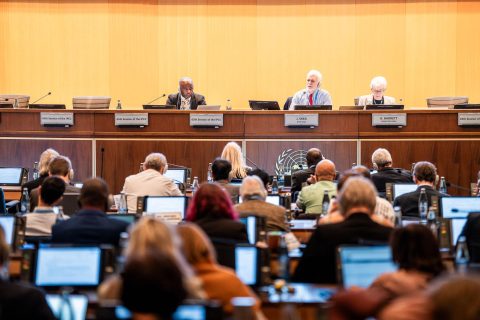

In July, PAICC said 12 countries had ignored its repeated attempts to discuss why they had not published an NDC as required every five years under the 2015 Paris accord.
Members of the committee had been divided over whether to name them, but at a September meeting decided to do so in their annual report to the annual climate COP summit.
By the time the report was published on Friday, only Congo, Senegal and North Korea “had not communicated an NDC or submitted a [Biennial Transparency Report] and had not yet responded to any of the Committee’s notifications, despite several reminders issued by the Committee in this regard”.
Rainforest and renewable energy ambitions
The silence from Congo and Senegal is notable because the former is home to much of the Congo Basin rainforest while the latter has sought billions of dollars in climate finance to support its renewable energy ambitions.
After Brazil, Congo has more rainforest than any country in the world. This forest, and the country’s peatlands, absorb huge amounts of greenhouse gas but are fast being lost to expanding farmland, charcoal production, logging and mining.
Senegal signed a Just Energy Transition Partnership with Canada and wealthy European nations in 2023, to help it meet its renewable energy targets under the-then government of Macky Sall. It was chair of the Least Developed Countries group between January 2022 and December 2023.

Tejas Rao, who is researching the PAICC as part of a doctoral thesis at Cambridge University, said the governments of the three countries should engage with the committee.
“Engagement costs these governments very little and the committee has shown it will listen,” he said.
“Silence leaves the committee with no basis to help, and it leaves the [governments] exposed to the narrative that they are simply disengaged,” he told Climate Home News.
Paris Agreement requirement
The 2015 Paris Agreement requires all parties to publish an NDC every five years outlining their emissions reduction targets, with each plan meant to be more ambitious than the country’s last NDC.
The latest set – the third round of plans, with new targets for 2035 – was due in February 2025. While most countries missed this deadline, all but around 30 – mostly small emitters but including Egypt, Vietnam and Argentina – have now submitted them.
Over the year, the PAICC – which is made up of government climate officials from developed and developing countries – has been communicating with governments that have not submitted NDCs and trying to overcome barriers to them doing so.
Some nations have cited exceptional circumstances as the reason for not submitting an NDC, a process that requires a significant amount of work in tracking emissions and consulting on how to curb them across the economy. For example, a letter from a Sudanese official to the PAICC, seen by Climate Home News, said that the country’s civil war had led to the suspension of its NDC preparation.
-
IPCC scientists vow to press on with climate reports despite political deadlock
After governments again failed to agree a timeline, nearly 120 IPCC authors pledged to complete their assessment on time and with full scientific rigour -
Under US pressure, World Bank says it will back gas “where appropriate”
The US wants the World Bank to expand its gas support while climate campaigners are pushing for it to end – its head spoke this week of limited backing for the fossil fuel