


A major new funding initiative promises a breakthrough for climate-tech startups. A group of top venture capital and private equity firms, called “All Aboard Coalition”, managing $60 billion in assets, has started a $300 million fund. This fund will help climate-tech companies grow from pilot stages to commercial operations. This is the time when many firms encounter the “missing middle.””
Led by TED Conferences curator Chris Anderson, the group aims to bridge the critical funding gap in clean tech—often called the “valley of death.” Anderson stated:
“One of the biggest threats to the world’s future is that the companies capable of building a healthy low-emissions global economy are simply not getting the funding they urgently need. The only way to fix that is through collective action. By acting as a community, we can help propel these exciting vanguard companies to true global scale.”
Closing the “Valley of Death” for Climate Innovations
The “missing middle” refers to a familiar but frustrating gap in climate-tech funding. Early-stage seed rounds usually get enough funding to test ideas in labs. But moving to full deployment needs big infrastructure investments. Traditional venture investors often avoid this type of capital.
This new fund aims to close the gap. It targets rounds of $100–200 million. This money will help companies build manufacturing facilities, test prototypes, or develop commercial systems.
Leading firms backing the fund include recognizable names such as:
- Breakthrough Energy Ventures,
- Khosla Ventures,
- DCVC,
- Clean Energy Ventures,
- Energy Impact Partners.
Their participation signals confidence in the climate solutions market and hopes to bring in generalist capital by reducing risk. The All Aboard Coalition brings both capital and credibility into a sector needing institutional support.
Ramp-Up Amidst Funding Declines
Global venture capital investment in climate tech has fallen for three straight years, according to PitchBook. Funding declined from $25.9 billion in 2022 to $19.7 billion in 2023, and slipped again to $17 billion in 2024—a total drop of about 34% in just two years.
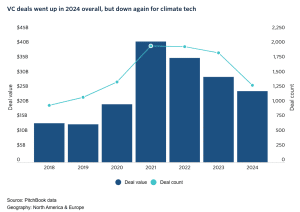
Over the past two years, venture funding in climate technologies has dipped sharply. In early 2025, funding for technologies such as direct air capture fell by over 60% compared to the previous year.
Broadly speaking, global investment in climate tech fell 19% in H1 2025 compared to the same period in 2024, signaling ongoing funding challenges. Non-dilutive funding, like debt and grants, hit record levels. This shows confidence in scalable, infrastructure-focused solutions, even with fewer deals.
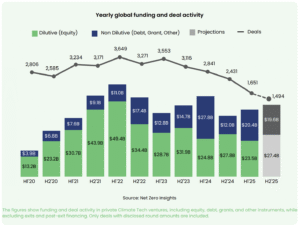
The U.S. market led the global share with 51% of funding (around $21.4 billion), and it may end the year 12% higher overall. In contrast, Europe’s equity investments declined, though a rebound is expected later in the year.
A report by Sightline Climate shows that global climate tech funding fell to $5.9 billion in Q2 2025, the lowest quarterly level since 2020. Although the sector is still expanding, growth has slowed to 7%, a pace the report describes as typical for a maturing market.
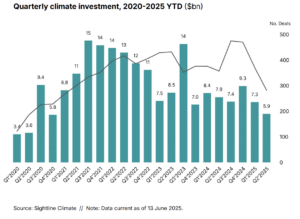
For the climate tech community, however, this shift from rapid acceleration to steadier progress may require a period of adjustment. Moreover, without scalable capital, many startups hit a pause. This delays or stops their work on important technologies.
This new fund directly addresses the problem. By offering a vehicle for later-stage funding, it intends to keep innovations moving forward. One industry analyst said, “You can have great lab-scale solutions. But without funding to build factories or test them in the field, those solutions go nowhere.”
This new fund comes at a key time. It brings fresh energy to a sector facing slow commercialization. This is true even with strong policy support, especially in Europe and North America.
Why Climate-Tech Needs Big, Patient Capital
Climate technologies, such as green hydrogen and advanced battery storage, require different funding. This is unlike the software and service startups that VCs typically back. Building a green hydrogen plant or modular carbon capture equipment can require hundreds of millions in initial investment. This happens before any revenue comes in.
Institutional impact investors or infrastructure funds can provide capital. But this happens only after a concept is proven viable, operations are scaled, and revenue starts flowing.
Many climate companies fail to reach that stage due to capital constraints. This new fund provides flexible capital, using equity and convertible terms. It helps overcome the commercialization hurdle.
Coalition Power: Who’s Onboard and Why It Matters
The coalition gathers firms that manage $60 billion in assets. This gives them strong financial power and expertise in green technology. They have strong capital behind them. Their goal is to invest in later-stage rounds. They want to create a strong market signal. This signal will attract more generalist investors.
Key strategic opportunities this coalition unlocks:
-
Market validation: Their backing signals to other investors that climate tech is viable.
-
Network leverage: Members can share technical and operational support with portfolio companies.
-
Standard-setting: The fund could define benchmarks for due diligence and standards in climate-tech investing.
According to one venture partner, “This is not about gimmicks. It’s about building infrastructure to scale solutions that are already proven technically.”
A Window into the Future
As the fund deploys capital, it will ramp up in three stages:
-
Investment into expansion-stage companies with proven prototypes.
-
Deployment into building manufacturing capacity or first-of-a-kind facilities.
-
Financial returns and impact tracking, demonstrating investment viability.
If it succeeds, the fund could spark a climate-tech ecosystem. This would make delivering solutions faster, less risky, and more appealing to mainstream investors.
Road to Scale: What Drives Impact Forward
This fund arrives amidst promising developments in climate policy and corporate net-zero commitments. The U.S. Inflation Reduction Act and the EU’s Green Deal are reducing risks for clean tech investments.
This is especially true when they team up with private capital. Corporations looking for verified offset credits or ways to decarbonize their operations now have more tools. To maximize impact, the coalition aims to:
-
Invest in technologies fulfilling Tier 4 removals or real-world emissions reductions.
-
Support companies with strong go-to-market plans and partnerships with utilities or industrial firms.
-
Provide supplementary technical advisory support, alongside capital.
A Balanced Path Forward
While optimism is high, risks remain. The fund’s success hinges on:
- Demonstrating real-world returns on large climate investments.
- Ensuring measurement and verification of climate impact.
- Balancing financial ROI with societal and environmental goals.
The launch of this $300 million fund by a coalition managing $60 billion in assets represents a turning point for climate-tech. Targeting the “missing middle” fills a long-standing funding gap. This move could speed up the journey from innovation to real impact.
If capital flows as planned, this fund could spark a wave of climate solutions. These solutions might generate billions in revenue and cut emissions by gigatons by 2030. This initiative provides a financial boost and shows how private capital can support real climate progress.
The post $60B Venture Capital Alliance Backs $300M Fund for Climate-Tech Startups appeared first on Carbon Credits.

EU carbon credit claims changed on 27 September 2026, the day the Directive (EU) 2024/825 began to apply across the European Union. The change is narrow. It changes how a company can talk about the credits it buys. A product can no longer be called neutral on the strength of compensation alone; however, every specific, evidenced statement about what a company measured, reduced, and funded stays fully available.

The post Promoting Improved Cooking Practices in Nigeria appeared first on Terrapass.



-
Climate Change1 year ago
Guest post: Why China is still building new coal – and when it might stop
-

 Greenhouse Gases2 years ago
嘉宾来稿:满足中国增长的用电需求 光伏加储能“比新建煤电更实惠”
-
Greenhouse Gases1 year ago
Guest post: Why China is still building new coal – and when it might stop
-

 Climate Change2 years ago
嘉宾来稿:满足中国增长的用电需求 光伏加储能“比新建煤电更实惠”
-

 Renewable Energy12 months ago
Sending Progressive Philanthropist George Soros to Prison?
-
Climate Change2 years ago
Bill Discounting Climate Change in Florida’s Energy Policy Awaits DeSantis’ Approval
-
Greenhouse Gases1 year ago
嘉宾来稿:探究火山喷发如何影响气候预测
-

 Climate Change2 years ago
Analysis: China’s CO2 falls 1% in Q2 2024 in first quarterly drop since Covid-19