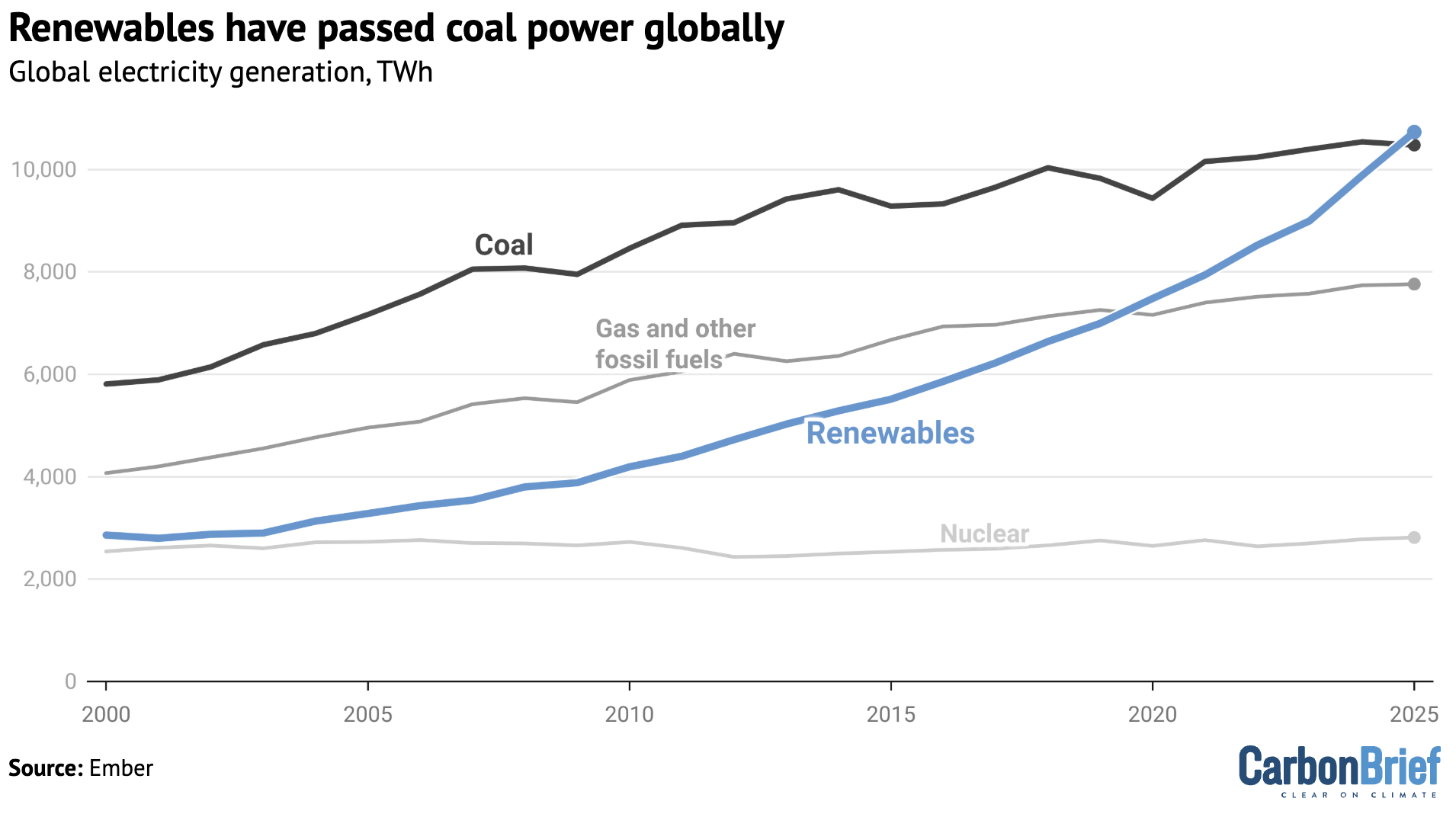
Renewable energy has overtaken coal to become the world’s largest source of electricity in 2025, according to thinktank Ember.
The growth of solar and wind meant that, for the first time since 1919, the share of coal power was lower than that of renewables.
Fossil-fuel generation fell by 0.2% in 2025, the thinktank’s latest annual review says, with wind and solar alone meeting 99% of the growth in electricity demand last year.
While generation from fossil fuels has occasionally fallen year-on-year in the past, Ember says this is the first time it has happened due to the structural shift towards clean power, rather than due to economic crises or other one-off events
Record solar generation was key to pushing fossil fuels into reverse, increasing 30% year-on-year – meaning it met 75% of global electricity demand growth in 2025 alone.
Other findings include:
- Solar power generation grew by a record 636 terawatt hours (TWh) in 2025. This exceeded the electricity that could be generated from all liquid natural gas (LNG) exports through the strait of Hormuz.
- Wind saw the second-largest increase in generation, growing 205TWh.
- Coal power continued to fall, meaning, for the first time in history, it accounted for less than a third of global electricity generation.
- The global electric vehicle (EV) fleet continued to grow, displacing 1.8m barrels per day (mbpd) of oil demand in 2025. New EVs alone in 2025 displaced 0.5mbpd.
Record renewables
In 2025, both solar and wind power generation continued their recent rapid growth, according to Ember.
Solar saw a record increase, with global generation growing by 636 terawatt hours (TWh) – double the total annual electricity demand of the UK. This was 33% higher than the previous solar record growth, set just the year before (479TWh).
Global solar growth in 2025 alone exceeded the electricity that could be generated from all liquid natural gas (LNG) exports through the strait of Hormuz that year, Ember notes. This amounted to 81m tonnes (Mt) or around 550TWh of gas-fired electricity.
Solar in 2025 represented the largest annual increase of any individual electricity source ever, Ember says, with the exception of the rebound in coal generation after the Covid-19 pandemic in 2021 (719TWh).
The continued growth of solar generation last year reflects structural capacity expansion rather than fluctuations in demand. Moreover, 2025 was the fourth year in a row that solar recorded the largest absolute growth of any electricity source.
Solar capacity grew by a record 647 gigawatts (GW) in 2025. This suggests that the technology will continue to dominate generation growth in the coming years, says Ember.
Wind saw the second-largest increase in generation, growing 205TWh (8.2%) in 2025. This was the same rate as seen in 2024, but fell slightly below the record absolute increase seen in 2021 of 265TWh.
Nuclear rose moderately by 35TWh (1.3%), bringing it to an all-time high of 2,812TWh. This was driven by reactors coming online in China (37TWh), as well as increased output in France (12TWh) and Japan (9TWh), which balanced out reductions elsewhere.
However, despite nuclear generation growth, both solar and wind are expected to overtake the technology in 2026, as shown in the chart below.
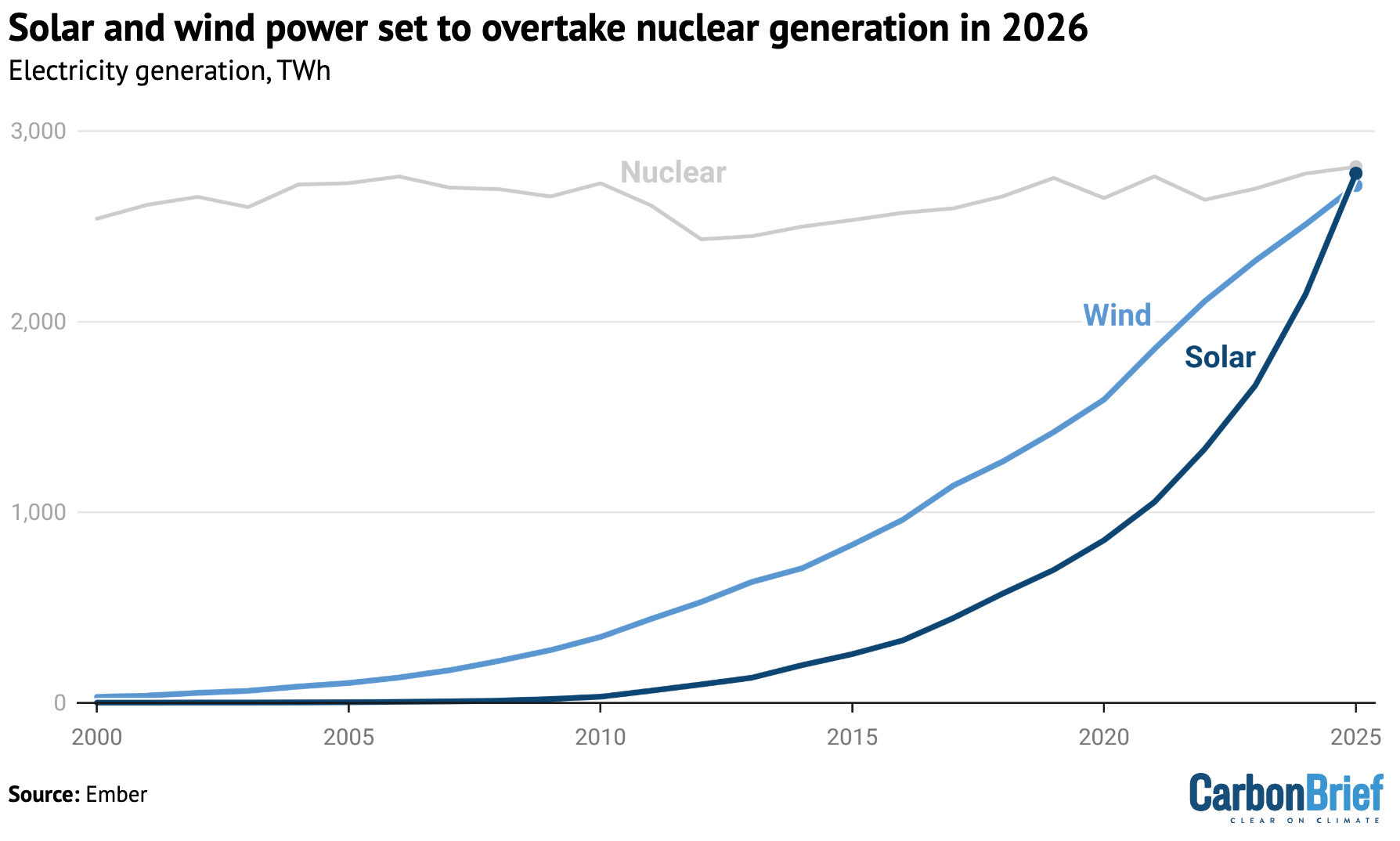
Increasingly, solar and wind are dominating the electricity generation mix. This allowed renewable technologies, collectively, to surpass coal in the first six months of 2025, before successfully overtaking it across the whole year, as shown in Ember’s report.
This marks the first time in history that coal power accounted for less than a third of global electricity generation, it says.
In addition, for the first time, the growth of clean-power sources has pushed fossil-fuel generation into reverse, as shown in the chart below.
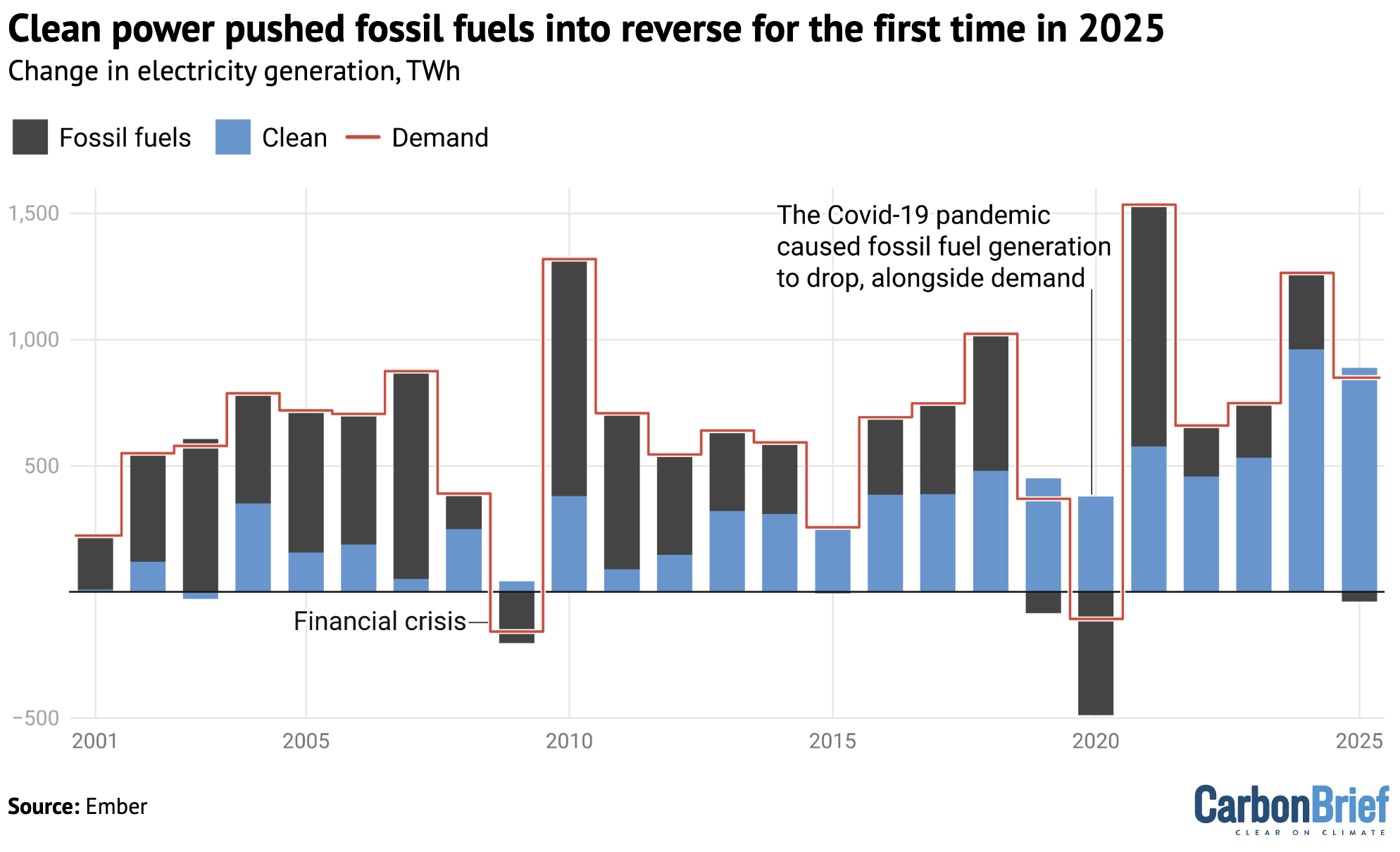
While there have been annual declines in fossil-fuel generation in the past, these were all caused by economic crises or other one-off shocks, such as the global financial crisis in 2008-9 or the coronavirus pandemic in 2020.
Tipping points
The share of wind and solar power in the global electricity mix has risen by more than 10 percentage points over the past decade, from 23% to 33.8%, according to Ember. Over the same time period, the share of coal has dropped from 38.7% to 33.0% in 2025.
Indeed, 81% of all wind and solar generation growth since 2000 occurred over the past 10 years. In contrast, only 27% of fossil-fuel growth since 2000 happened over the past 10 years, as the balance continues to tip towards renewables.
Had wind and solar not grown since 2000, electricity generation from fossil fuels would have been 30% higher in 2025 and emissions 28% higher, Ember says, adding 4,065Mt of carbon dioxide equivalent (CO2e) annually.
It says that the expected growth in clean power will tip fossil-fuel use in the power sector firmly into decline, as well as “aiding decarbonisation in other sectors”.
Renewables have overtaken coal in every region of the world, except Asia. Coal power fell by 63TWh (-0.6%) in 2025. However, at 10,476TWh, coal remained the largest single source of electricity globally.
Gas generation saw a small increase of 36TWh (0.5%) to 6,919TWh in 2025.
Despite Asia being the only region where coal generation has not been overtaken by renewables, two of the world’s biggest emitters on the continent did see fossil-fuel generation fall.
Fossil generation fell in both China (-56TWh/-0.9%) and India (-52TWh/-3.3%) due to rapid clean-power deployment and moderate demand growth, according to Ember.
This is in line with analysis for Carbon Brief earlier this year, which also found that coal power fell in China and India concurrently for the first time in 52 years.
Combined, China and India made up 42% of global fossil-fuel generation in 2025, according to Ember, offsetting a small increase in the US, EU and other economies.
In 1919, when electricity demand was 300 times smaller than in 2025, renewables – mostly hydropower – briefly exceeded coal power.
Over the following 100 years, coal power remained the largest power source globally. Its share in the power mix was around 40% from the 1970s through to the mid-2010s.
The chart below shows the growth of renewables since 2000, has allowed the technologies to overtake coal generation in 2025.
Emissions impact
The growth of clean power generation has helped to decouple demand growth from emissions growth, according to Ember’s report.
Global electricity demand grew by 2.8% (849TWh) in 2025. While this was significantly below the 4.3% growth seen in 2024, it was broadly in line with the 10-year average annual increase of 2.7%.
Last year’s increase still represents the sixth-largest absolute annual rise ever recorded.
Ember analysis suggests that if demand and clean electricity growth continue at their recent pace, then fossil-fuel generation will plateau before starting to decline consistently from the early 2030s.
With renewable energy growth pushing fossil fuels down in 2025, however, power-sector emissions fell slightly despite the increase in demand.
In 2025, the average kilowatt hour produced globally resulted in emissions of 458gCO2e, some 2.7% less than in 2024 (471gCO2e) and down 16% from 2005 (543gCO2e).
Electrification of key sectors is expected to add to rising electricity demand in the coming years, Ember notes, pointing to transport and data centres.
(Note that while demand from electric vehicles and data centres is rising quickly, they are still “relatively slim” in terms of their contribution to overall growth, according to the International Energy Agency. Industry and buildings are the largest sources of growth.)
In 2025, electric vehicle (EV) sales reached more than 25% of the global car market. As a result, Ember says that EVs are becoming a “structural driver of electricity demand growth”, accounting for about 8% (66TWh) of the 849TWh rise in global electricity demand in 2025. This is up from 36TWh in 2024.
In addition, the global EV fleet displaced 1.8m barrels per day (mbpd) of oil demand in 2025. New EVs alone in 2025 displaced 0.5mbpd.
The oil demand displaced through additional transport electrification in 2025 will avoid roughly 80MtCO2e emissions annually, more than the annual power sector emissions of the UK, it says.
Further expansion of renewables to help meet growing demand from sectors such as transport is being supported by the rollout of storage technologies.
Falling battery prices are driving a rapid scale-up in deployments. Battery pack prices for stationary storage applications fell to a record low of $70/kWh in 2025, Ember says – a 45% drop from 2024.
Global battery storage capacity additions reached an estimated 247 gigawatt hours (GWh), up 46% year-on-year. This would be enough to shift about 14% of daily solar generation to other hours, up from 13% in 2024 and just 5% in 2022, according to Ember.
The post Clean energy pushes fossil-fuel power into reverse for ‘first time ever’ appeared first on Carbon Brief.
Clean energy pushes fossil-fuel power into reverse for ‘first time ever’
Climate Change
Colorado River Faces ‘Devastating Consequences’ If Another Dry Winter Lands, Experts Warn
Even a huge snowpack during the coming winter would only give the river basin states less than two years of storage before reservoirs returned to historic lows.
Another warm, arid winter could leave Colorado River reservoirs nearly dry.
Colorado River Faces ‘Devastating Consequences’ If Another Dry Winter Lands, Experts Warn
Climate Change
Q&A: The current state of ‘carbon dioxide removal’ around the world
Carbon dioxide removal (CDR) technologies will need to be deployed at rates even faster than those seen for solar power, if the world is to have a chance of limiting global warming to 1.5C by 2100, says a new report.
Nearly all pathways to meeting the Paris Agreement’s highest ambition of keeping global temperatures to 1.5C above pre-industrial levels in 2100 involve CDR techniques – ranging from tree-planting to sucking CO2 from air with machines.
This is in addition to steep and immediate emissions cuts.
Scientists expect carbon emissions to push warming beyond 1.5C in the decade ahead, meaning that the target can only be achieved “from above” via large-scale CDR that brings down global temperatures.
These temperature trajectories are known as “overshoot” pathways.
The third “state of CDR” report, written by more than 50 scientists, says that countries’ current CDR plans would fall short of what is needed to limit warming to 1.5C by more than 5bn tonnes of CO2 (GtCO2) per year by 2050.
Global CDR would have to increase fourfold – from 2.2GtCO2 in 2026 to 8.75GtCO2 by 2050 – to have a chance of meeting the 1.5C target by 2100, according to the report.
It adds that deploying CDR can be a “gradual process”, making the period 2026-30 “crucial” for “establishing CDR’s role in limiting climate damages” in the future.
Below, Carbon Brief covers the key findings of the third state of CDR report. (This follows from Carbon Brief’s coverage of the first report in 2023 and second report in 2024.)
- What is CDR?
- What are current levels of CDR?
- How much CDR is needed to reach net-zero goals?
- What does the science say about the potential and costs of CDR?
- What have governments pledged on CDR?
- What is the current funding and research landscape for CDR?
- How is policy impacting CDR demand?
What is CDR?
According to the report, the definition of CDR is:
“Human activities capturing CO2 from the atmosphere and storing it durably in geological, terrestrial or ocean reservoirs, or in products. This includes human enhancement of natural removal processes but excludes natural uptake not directly caused by anthropogenic [human-caused] activities.”
In addition to this, the report includes “three key principles” for CDR, which are:
- The captured CO2 must come from the atmosphere, not from “fossil sources”.
- The subsequent storage “must be durable”, so that the CO2 is not soon reintroduced to the atmosphere.
- The removal must result from human intervention that is in addition to Earth’s natural processes.
In this report, a CDR method is considered durable if it is able to lock up carbon for “decades or more”.
The report classifies CDR techniques as either “conventional” or “novel”.
“Convential” CDR techniques are “well established, already deployed at scale and widely reported by countries as part of [land-use] activities”.
The methods included in this group are tree-planting, ecosystem restoration, agroforestry (trees in agriculture), improving soil carbon in croplands and natural lands, and durable wood production.
“Novel” CDR techniques have “lower level of readiness for deployment and, as a consequence, are currently deployed at smaller scales”, says the report.
Some examples of different CDR methods are listed on the graphic below.
The graphic also shows whether carbon is captured through biological or chemical processes, as well as how “ready” the method is and for how long it can store carbon, among other features.
The report says that CDR is “needed alongside deep and rapid emissions reductions” to give Earth a chance of limiting global warming to 1.5C. It continues:
“It should play a smaller role than emissions reductions given uncertainty around the feasible levels of scaling, sustainability limits, storage availability and the risk of reversal, among other constraints.
“In general, CDR should be seen as a limited resource that will need to be used prudently.”
It adds that CDR can “fulfil three major functions”.
In the near term, CDR can help reduce “net emissions”, it says.
In the medium term, CDR can “counterbalance residual emissions” to achieve net-zero CO2 or net-zero greenhouse gas emissions, the report continues.
(“Residual emissions” are those that cannot be eradicated through technologies or societal changes, such as methane emissions from rice production.)
Research suggests that global warming is likely to stop, more or less, once net-zero is achieved globally.
In the long term, CDR can “help achieve net-negative emissions”, a state where CO2 removal exceeds emissions, says the report.
In this state, humans could lower global temperatures. This may allow the world to limit global warming to 1.5C by 2100, even if the temperature target is surpassed earlier on in the century.
Future trajectories where temperatures exceed the 1.5C limit before being brought back down again through CDR techniques are known as “overshoot” pathways.
What are current levels of CDR?
The report says that, at present, “99.9%” of existing CDR is conventional, land-based techniques such as tree-planting and ecosystem restoration.
The world currently removes 2.2GtCO2 per year, equivalent to around 5% of gross global CO2 emissions, it continues.
The largest contributors to removing CO2 from the atmosphere are China, the US, the EU, Brazil and Russia.
The chart below shows the amount of CO2 removed each year over 2014-23 by the largest contributors, through tree-planting (afforestation) and forest restoration (reforestation).

“Novel” CDR, such as biochar and direct air capture, currently removes just 2m tonnes of CO2 annually at present, according to the report.
However, these methods have been growing at a rate of 40% per year – “similar to successful technologies like solar energy, but insufficient for the scale-up required to meet the Paris temperature goal”, says the report.
The graphic below illustrates how the contribution of conventional CDR currently dwarfs novel CDR, but how the latter techniques are quickly growing.

The report says that investment in CDR companies recovered in 2025 following a dip – and its “share of all climate-tech funding” grew to 2.6%.
The report also notes that, at present, most CDR efforts are unevenly distributed across the world.
For example, two-thirds of conventional CDR in voluntary carbon markets is in Latin America, according to the report. (Voluntary carbon markets are where companies can buy credits for carbon-reducing or removing projects, such as tree-planting, to claim that they have “offset” some of their own emissions.)
In addition, most pilot projects that aim to demonstrate novel CDR methods are located in only a few countries, such as Sweden, Denmark and the US, says the report.
The chart below shows the location and timeline of demonstration projects that have been announced, are under construction or in operation globally.

The report continues:
“While first-movers play important roles, if their actions do not diffuse more widely, vulnerability emerges, as evidenced by the impact of US climate policy dismantling.”
(For more, see: How is policy impacting CDR demand?)
How much CDR is needed to reach net-zero goals?
The report examines three scenarios where global temperature rise is limited to “well below” 2C by 2100:
- A current ambition scenario, based on national climate pledges (but omitting the US);
- A highest-possible ambition scenario;
- A delayed ambition scenario, which is consistent with current targets until 2035 and then switches to the highest ambition scenario.
The pledges considered in the report are “nationally determined contributions”, or NDCs, which countries submit periodically to the UN Framework Convention on Climate Change (UNFCCC). NDCs lay out a country’s climate ambition.
Under the current ambition scenario, the report projects a total of 5.9GtCO2 of CDR by 2050 and 12GtCO2 by 2100.
This scenario would result in end-of-century warming of 1.7-2.7C. Importantly, the report says, this scenario does not result in the world reaching net-zero CO2 levels, “meaning that global temperatures would continue to rise, albeit at a much more gradual pace, beyond 2100”.
Under the highest-possible ambition scenario, CDR scales up to 8.8GtCO2 by mid-century and 15.3GtCO2 by the end of the century.
This scenario assumes “full buy-in by all nations”, with economics, scale-up and sustainability providing the main constraints on CDR deployment, the report says.
The highest ambition scenario results in global temperatures peaking at 1.7-1.8C around 2050 and the world achieving net-zero emissions around that time.
Under the delayed ambition scenario, CDR would scale up to 7GtCO2 by 2050 and 23.6GtCO2 by 2100. This scenario shows global temperatures peaking between 1.7C and 2.0C.
This scenario requires larger CDR deployment in the long term than the highest-ambition scenario does, due to the larger cumulative emissions caused by delaying deep emissions reductions.
In both the high ambition and delayed ambition scenarios, the world reaches “deeply net-negative CO2 emissions” by 2100, the report says. This continued deployment of CDR will further draw CO2 from the atmosphere, lowering global temperatures back down to 1.5C.
The chart below shows annual global greenhouse gas emissions through the end of the century under current ambition (red), highest ambition (green) and delayed ambition (blue) scenarios.

While global CDR capacity scales up more slowly in the first and third scenarios, the report notes that, in all three cases, “novel CDR reaches gigatonne-scale deployment by 2050”.
What does the science say about the potential and costs of CDR?
There is a wide range of both carbon-removal potential and associated costs between different methods of CDR, according to the report.
However, it also notes that these numbers “range widely” in the scientific literature.
The discrepancies in estimates of carbon-removal potential are due to a number of factors, the report says, including a lack of available scientific data, inconsistencies in the assumptions made in assessing technical feasibility and a lack of agreement on what, exactly, “potential” means.
These elements also influence the cost of different CDR methods, but additional factors – such as deployment costs in different areas, technological approaches and scope – also play a role in establishing price differences. Because of this, the report says, “cost estimates are often difficult to compare across methods, complicating design and policy decisions”.
The chart below shows the reported range of mitigation potential (left) and reported range of costs (right) for different CDR methods. The top four rows indicate conventional CDR methods, while bottom 11 rows show novel CDR methods. The chart refers to “mitigation potential”, rather than removal potential, because some estimates do not distinguish between removals and avoided emissions.
(Avoided emissions refers to the difference in emissions from carrying out a project, compared to a hypothetical alternative – such as the reduced emissions from halting deforestation.)
The darker colours indicate estimates that are more constrained, meaning that they are either based on stricter assumptions or there is more agreement between different estimates.

The report notes that for most removal methods, the low end of the potential is around 1GtCO2 per year, while the upper limit of costs is more than $200/tCO2.
The least expensive CDR approaches are forestry-based methods, soil-carbon sequestration and biomass burial. For forestry-based methods, the report puts the cost of CDR at $5-$53 per tonne of CO2 removed. Soil-carbon sequestration costs reach as high as $150 per tonne of CO2 removed, but could have negative overall costs “when accounting for crop yield increases potentially resulting” from changed farm-management practices, the report says.
However, it adds that “these CDR methods are typically associated with lower levels of permanence” than other methods.
Other relatively low-cost methods include coastal wetland restoration, biochar, bioenergy with carbon capture and storage (BECCS) and enhanced rock weathering, while ocean alkalinity enhancement is a medium-cost option.
The most expensive methods include direct air carbon capture and storage (DACCS) and direct ocean carbon capture and storage (DOCCS).
The report also notes that a total estimate of CDR removals cannot be obtained by adding up the removal potential of all of the separate methods, since different methods can compete for scarce resources. For example, BECCS, biochar, biomass burial and biomass sinking all rely on the same base input – biomass – and therefore cannot all be maximised at the same time.
What have governments pledged on CDR?
While many countries include some amount of CDR in their national climate plans, there is currently a large gap between the amount of CDR pledged in these plans and the amount that will be needed to limit global temperature rise to 1.5C by the end of the century, says the report.
This quantity is referred to as the “CDR gap” – the difference between what is pledged and what is needed.
The size of the CDR gap is dependent not just on the pledges made by countries, but also the choice of the “benchmark” scenario against which the pledges are measured. Lower – or delayed – emissions reductions lead to larger shortfalls in the long term, meaning “CDR must subsequently be scaled to very high levels”, says the report.
Current NDCs and other country submissions to the UNFCCC total 2.5GtCO2 per year of removals in 2030, 2.7GtCO2 per year in 2035 and 3.6GtCO2 per year in 2050.
This gives a CDR gap of 0.3GtCO2 in 2030, 1.2GtCO2 in 2035 and 5.2GtCO2 in 2050, according to the report. These figures are obtained using assumed “immediate, ambitious action at all levels to reduce emissions” and the most-ambitious estimates of CDR set out in national pledges. Together, this provides a “lower bound” for the CDR gap, says the report.
By comparison, a 10-year delay in implementing ambitious emissions reductions will result in the need to remove at least an additional 150GtCO2 from the atmosphere, compared to the most ambitious scenario. (See: How much CDR is needed to reach net-zero goals?)
The report says that the CDR gap has widened since the second state of CDR report was released in 2024, due to the US leaving the Paris Agreement. It adds that other countries have “not delivered a step change in ambition” in their latest round of climate pledges.
It also cautions that “credibility issues with national pledges may mean that the CDR gap is actually larger than what we assess here”.
The report notes that current CDR pledges by companies are “substantially higher than country pledges”, at 5GtCO2 per year in 2050. However, it adds, “credibility in these announcements is low”.
What is the current funding and research landscape for CDR?
Funding of CDR research and development – as well as investment in CDR companies – has continued to increase in recent years.
In total, there has been around $5.6bn in grant funding distributed to CDR research since 2005, according to the report’s analysis. Roughly one-third of this has come in the past three years.
Funding for CDR research grants grew 13% each year between 2022 and 2025, the report says, and the corresponding number of research publications grew at a similar rate.
Funding was largely targeted at a handful of key areas, notably soil carbon sequestration, biochar and forest-based CDR.
DACCS and BECCS only make up a small number of active grants, but together account for around two-fifths of all funding due to “substantially larger” project sizes.
Despite the growth of research grants and scientific publications, the report concludes that early-stage innovation in CDR is “uneven” and says there is “no strong evidence of a step-change”.
It notes that much of the support for CDR has come from projects with a broader focus, rather than those that focus specifically on CDR.
The authors also point to a decline in “inventive activity”, as measured by patenting of CDR-related innovations. While patenting for emissions-cutting technologies in general has been on an upward trajectory, CDR patenting peaked in 2011.
Meanwhile, the report highlights the “remarkable” sustained investment in CDR companies, against a backdrop of falling investment in climate-related technologies. It notes that CDR now accounts for around 3% of overall “climate-tech funding”.
Yet, again, it says future developments remain “uncertain”. Since the previous 2024 “state of CDR” report, companies have scaled back their ambitions and policy reversals – notably in the US – “underscore that funding uncertainty remains a key barrier”. (See: How is policy impacting CDR demand?)
An upward tick in funding in 2025 was driven primarily by a “surge” in grants from predominantly public institutions, as well as $0.5bn in debt financing for a single BECCS project in Sweden.
Reliance on such funding sources “highlight[s] the volatility of the CDR innovation ecosystem”, according to the report.
The report also has a chapter focusing on the voluntary carbon market, which it describes as “propelling most of the current demand for novel CDR”.
The scale of this market remains fairly small, with contracts for 0.04GtCO2 of removals signed last year.
Moreover, the concentration of sales within a small number of buyers – particularly Microsoft – remains a “critical vulnerability”, the authors note.
How is policy impacting CDR demand?
The report analyses CDR policies in G20 nations – which together account for three-quarters of global emissions – to assess how they are acting to support CDR across their economies.
In total, 140 countries have announced net-zero targets, including virtually all of the world’s major emitters. In doing so, the report points out that the governments of these nations have “implicitly included a role for CDR in their climate plans”.
However, this does not always translate into measures specifically designed to scale up CDR.
Only the EU has adopted a binding, quantified removals target into law – namely, the goal to reach 310m tonnes of CO2 equivalent (MtCO2e) of annual net removals in the land sector by 2030.
Overall, conventional CDR is the main focus of policy, with various governments focusing on tree planting to absorb CO2 from the atmosphere.
Among G20 nations, only the UK and Australia have set specific goals to scale up novel CDR, such as BECCS and DACCS, over the coming decade.
The report highlights some nations, including Canada, Germany, Switzerland and the UK, as taking proactive steps to incentivise CDR.
The authors point to national strategies, financial support for CDR and efforts to integrate it into emissions trading systems (ETS) as examples of effective policy making.
(The report also stresses that the US, which was previously a “leader” on CDR, has now “frozen or dismantled funding and support” for CDR under the Trump administration.)
Most of the successful policies highlighted in the report focus on supporting the supply of CDR, with “less attention so far on creating demand”.
This is significant because CDR “generally lacks a natural market”, meaning there are not automatically buyers willing to spend money on emissions removals. Therefore, the authors say, policy interventions are important to create markets and boost demand.
“Compliance” carbon credits – referring to credits that can be used to meet legally mandated emissions targets – provide a way to support demand, according to the report authors.
Only some ETSs, such as those used in New Zealand and Australia, allow the use of credits based on forest-related removals for compliance. (It is worth noting that such credits are controversial, as removals by forests are not always permanent.)
The report also highlights the need for “foundational policies to create a governance framework for CDR, including rules for quantification of removal, guidelines for community engagement and the minimisation of negative environmental impacts”.
The post Q&A: The current state of ‘carbon dioxide removal’ around the world appeared first on Carbon Brief.
Q&A: The current state of ‘carbon dioxide removal’ around the world
Climate Change
Alligator Alcatraz Emissions Threaten Human Health, Violate Clean Air Act, Lawsuit Claims
The air pollution is associated with the more than 200 diesel-burning generators powering the Everglades migrant detention facility, along with 100 diesel-burning lighting towers.
A new federal lawsuit contends emissions at the Everglades migrant detention site known as Alligator Alcatraz, associated with more than 200 diesel-burning generators and 100 diesel-burning lighting towers, are harmful to human health and the environment and violate the Clean Air Act.
Alligator Alcatraz Emissions Threaten Human Health, Violate Clean Air Act, Lawsuit Claims
-
Climate Change10 months ago
Guest post: Why China is still building new coal – and when it might stop
-
Greenhouse Gases10 months ago
Guest post: Why China is still building new coal – and when it might stop
-
Greenhouse Gases2 years ago嘉宾来稿:满足中国增长的用电需求 光伏加储能“比新建煤电更实惠”
-
Climate Change2 years ago嘉宾来稿:满足中国增长的用电需求 光伏加储能“比新建煤电更实惠”
-
Climate Change2 years ago
Bill Discounting Climate Change in Florida’s Energy Policy Awaits DeSantis’ Approval
-
Renewable Energy7 months agoSending Progressive Philanthropist George Soros to Prison?
-
Carbon Footprint2 years agoUS SEC’s Climate Disclosure Rules Spur Renewed Interest in Carbon Credits
-
Greenhouse Gases11 months ago
嘉宾来稿:探究火山喷发如何影响气候预测