


Uber is moving toward autonomous mobility with a new strategy. This plan highlights collaboration, scale, and sustainability. Recent partnerships with Baidu, Lucid Motors, and Nuro show Uber wants to lead in the self-driving robotaxi market. They aim to compete against Waymo and Tesla.
According to a report, the global robotaxi market could grow from $0.4 billion in 2023 to $45.7 billion by 2030, at a rate of almost 92%.

Uber and Baidu Launch Global Robotaxi Fleet Outside the U.S. and China
Uber Technologies, Inc. (NYSE: UBER) has partnered with Baidu, Inc. (NASDAQ: BIDU) for a multi-year project. They will deploy Baidu’s Apollo Go autonomous vehicles globally, and this rollout will focus on Asia and the Middle East. The U.S. and China are not included, as demand for affordable ride-hailing services is rising fast in these regions.
Dara Khosrowshahi, CEO of Uber, said,
“This partnership brings together two of the world’s most iconic technology companies to help shape the future of mobility. As the world’s largest platform of its kind, spanning mobility, delivery, and freight, Uber is uniquely positioned to help AV leaders like Baidu bring their autonomous technology to the world.”
Baidu’s self-driving tech powers these robotaxis, which will work with the Uber platform. Riders who request eligible trips might soon get matched with Apollo Go’s driverless vehicles.
Notably, Baidu’s sixth-generation AV costs about 200,000 yuan (around $27,670), and it cuts production costs by 60%, enabling larger fleets.
Furthermore, Apollo Go has completed over 11 million rides worldwide, making it one of the most experienced autonomous fleets. Its strong safety record and operations in 15 cities, including Dubai and Abu Dhabi, make it an appealing partner.
Robin Li, Co-founder, Chairman, and CEO of Baidu, also commented,
“We are committed to bringing the benefit of autonomous driving technology to more people in more markets, and this partnership with Uber represents a major milestone in deploying our technology on a global scale. We look forward to working with Uber to deliver safe and efficient autonomous mobility solutions to riders around the world.”
Uber, Lucid, and Nuro Collaborate to Launch Premium Robotaxis in the U.S.
Uber’s next move is teaming up with Lucid Group (NASDAQ: LCID) and American self-driving technology company, Nuro, to launch a premium robotaxi service exclusively for the Uber ride-hailing platform.
This partnership will feature Lucid’s luxury electric SUV, the Lucid Gravity. It will also utilize Nuro’s Level 4 autonomous driving system, the “Nuro Driver™.”
Marc Winterhoff, Interim CEO at Lucid, highlighted,
“This investment from Uber further validates Lucid’s fully redundant zonal architecture and highly capable platform as ideal for autonomous vehicles, and our industry-leading range and spacious well-appointed interiors, as ideal for ridesharing. This is the start of our path to extend our innovation and technology leadership into this multi-trillion-dollar market.”
Uber plans to deploy over 20,000 of these AVs in six years. These robotaxis will be owned and operated by Uber or fleet partners, available only through the Uber app. Testing is underway at Nuro’s facility in Las Vegas, with full-scale production starting soon.
Lucid’s cars can drive up to 450 miles on a single charge, which means they spend less time charging and more time on the road. Nuro’s technology ensures safety and a smooth ride, even in busy or tricky places. All these features add up to scaling robotaxis.
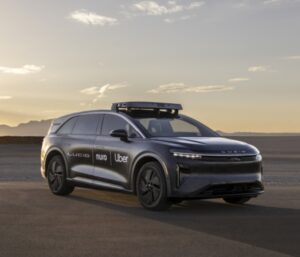
Built for Success: Safe, Efficient, and Ready to Scale
The robotaxi will run on Lucid Gravity’s advanced platform, offering long range, smart controls, and strong electric systems ideal for large-scale use.
- It’s powered by the Nuro Driver, a Level 4 autonomous system.
- It uses AI with built-in safety layers, allowing it to adapt quickly to new cities, roles, and vehicle types, speeding up deployment.
Jiajun Zhu, Co-Founder and CEO at Nuro, said,
“We believe this partnership will demonstrate what’s possible when proven AV technology meets real-world scale. Nuro has spent nearly a decade building an AI-first autonomy system that’s safe, scalable, and vehicle-agnostic, proven through five years of driverless deployments across multiple U.S. cities and states. By combining our self-driving technology with Lucid’s advanced vehicle architecture and Uber’s global platform, we’re proud to enable a robotaxi service designed to reach millions of people around the world.”
Lucid will install all the necessary hardware on its assembly line. Then, once the vehicle is ready for Uber, Nuro will add its self-driving software.
Uber has the reach to roll out robotaxis worldwide, with operations in 70 countries and 34 million trips a day,
Uber’s Autonomous Vehicle Strategy Shifts from In-House to Platform-Based
Uber’s approach to self-driving technology has changed significantly. After selling its Advanced Technologies Group (ATG) to Aurora for $400 million in 2020, Uber moved from creating its own AV technology to using solutions from leading companies.
This shift is paying off. Uber now partners with 18 AV companies and supports 1.5 million autonomous trips each year. Through alliances with Waymo, Pony AI, WeRide, and Volkswagen, Uber is becoming the main global platform for self-driving rides.
Waymo robotaxis are already available on Uber’s app in Phoenix and Austin, with plans to expand to Atlanta soon. These partnerships let Uber grow quickly while lowering costs and risks compared to pursuing its own AV solution.
Chinese Robotaxis Go Global with Uber
Uber is crucial in the global expansion of Chinese robotaxi developers. In addition to Baidu, companies like Pony AI, WeRide, and Beijing Momenta have teamed with Uber to offer AV rides outside China.
Momenta plans to deploy autonomous vehicles in European cities starting in 2026. The initial rollouts will include safety operators in the early phases. These efforts are part of a broader push by Chinese AV firms to enter international markets, especially in the Middle East and Europe.
EV Adoption: The Key Pillar of Uber’s Net Zero Strategy
Uber’s renewed robotaxi push also supports its climate goals. The company aims for all rides in the U.S., Canada, and Europe to be fully electric by 2030, and globally by 2040. With over 34 million trips daily in 70 countries, Uber’s electrification efforts can significantly reduce transportation-related emissions.
It speeds up this shift by helping drivers overcome barriers. High EV costs and limited charging options are key challenges. Partnerships with EV-first companies, such as Lucid, support this mission. They provide longer-range vehicles that cut operating costs and boost ride availability.

Uber Stock Slips Despite Robotaxi Push
Despite announcing more robotaxi partnerships, Uber stock dipped slightly to $90.34 on Thursday, its seventh day of losses in a row. The stock has fallen below its 21-day moving average and is getting close to testing its 50-day line.
Still, Uber shares are up nearly 50% so far in 2025, bouncing back from last year’s decline.

Meanwhile, Baidu stock (BIDU) rose over 2% following the Uber deal, as investors welcomed the expansion of its autonomous driving business. On the other hand, Lucid stock surged more than 42% with the Uber partnership.
However, analysts remain cautious. Wedbush’s Scott Devitt said the Lucid-Nuro deal shows Uber has a “weak hand” in the driverless tech race, especially against big players like Tesla and Waymo.
Can Uber Succeed in the Robotaxi Race?
Uber’s vision is ambitious, but challenges remain in this highly competitive robotaxi space. Different regions have various regulatory frameworks for robotaxis. Validating AV safety in real-world conditions requires significant resources. Operating costs for autonomous fleets can also be high, especially with new hardware.
It leverages its large platform, global reach, and diverse AV partnerships for an edge. It utilizes technology from partners such as Baidu and Nuro, plus advanced EVs from Lucid. This varied strategy may enable Uber to launch robotaxis more quickly and affordably than rivals that focus on in-house development.
Also, Uber’s move from an AV developer to a global AV platform is a game-changer. It is helping Uber meet a variety of customer needs, including budget-conscious riders in Asia to high-end users in major U.S. cities.
With significant AV deals underway and more planned, Uber is signaling a clear message: the future of urban transportation will be electric, autonomous, and platform-driven, and Uber aims to lead the way.
The post Uber Accelerates Robotaxi Ambitions With Baidu and Lucid Partnerships appeared first on Carbon Credits.

EU carbon credit claims changed on 27 September 2026, the day the Directive (EU) 2024/825 began to apply across the European Union. The change is narrow. It changes how a company can talk about the credits it buys. A product can no longer be called neutral on the strength of compensation alone; however, every specific, evidenced statement about what a company measured, reduced, and funded stays fully available.

The post Promoting Improved Cooking Practices in Nigeria appeared first on Terrapass.



-
Climate Change1 year ago
Guest post: Why China is still building new coal – and when it might stop
-

 Greenhouse Gases2 years ago
嘉宾来稿:满足中国增长的用电需求 光伏加储能“比新建煤电更实惠”
-
Greenhouse Gases1 year ago
Guest post: Why China is still building new coal – and when it might stop
-

 Climate Change2 years ago
嘉宾来稿:满足中国增长的用电需求 光伏加储能“比新建煤电更实惠”
-

 Renewable Energy12 months ago
Sending Progressive Philanthropist George Soros to Prison?
-
Climate Change2 years ago
Bill Discounting Climate Change in Florida’s Energy Policy Awaits DeSantis’ Approval
-
Greenhouse Gases1 year ago
嘉宾来稿:探究火山喷发如何影响气候预测
-

 Climate Change2 years ago
Analysis: China’s CO2 falls 1% in Q2 2024 in first quarterly drop since Covid-19