

Dr. Ümit Şahin is senior scholar and head of the climate change program at the Istanbul Policy Center, Sabancı University, Turkey.
At the UN Climate Summit in New York, Turkey’s announcement of its new NDC drew less attention than China’s updated climate targets. That is hardly surprising – China’s emissions dominate global totals. But dismissing Turkey’s role would be a mistake.
As the world’s 15th-largest emitter, with rising emissions and a fast-growing economy, Turkey is an important piece of the climate puzzle. It may not be China – but then again, neither is any other country.
At a moment when the US has stepped back from multilateralism, Europe is losing momentum, and India is doubling down on coal, middle powers like Indonesia, Mexico, South Africa, Brazil, and Turkey will help determine whether the world meets its climate goals. That is why President Recep Tayyip Erdoğan’s September 24 announcement in New York deserves closer attention.
Turkey’s recent climate policy trajectory has been unusually dynamic. After years of debate over whether it should be treated as a developed or developing country under the UN climate regime, Turkey finally ratified the Paris Agreement in 2021, committing to net zero by 2053.
Since then, climate governance has expanded rapidly: the ministry was renamed the Ministry of Environment and Climate Change; a Climate Change Directorate was established; Turkey updated its initial NDC; a multi-stakeholder Climate Council was convened; and this year, Parliament passed the country’s first Climate Law. An emissions trading system is expected soon.
-
Global renewables goal slips off course after Trump, China moves
The IEA downgrades its forecast for renewables growth due to the US cutting renewable tax credits and China’s electricity market reforms -
After building huge new dam, Ethiopia warns of hydropower’s drought risk
Ethiopia wants to reduce heavy reliance on hydropower to diversify to solar and wind in the face of climate-induced droughts


Meanwhile, Turkey is campaigning – alongside Australia – to host COP31 in 2026. Climate change is also moving up the domestic agenda, driven by more frequent floods, droughts, heatwaves, and wildfires. Surveys show that nearly 80 percent of Turkish citizens are concerned about climate change.
‘Business as usual’ baseline
Given this backdrop, one might have expected a stronger NDC. Instead, the targets presented fall short of genuine progress.
The full text has not yet been released, but the topline figure announced by Erdoğan is a 42 percent reduction from a reference scenario. The catch lies in the baseline. Without climate action, Turkey projects its emissions – 552 million tons in 2023 – to double in 12 years, reaching 1,109 million tons. The new target promises to cap that growth at 643 million tons by 2035.
On paper, this looks like a dramatic reduction. In practice, it locks in continued growth: emissions would still be 16 percent higher than in 2023, adding 7–8 million tons annually. Far from a cut, this is a pledge to deliver a “controlled increase” rather than a reduction.
At the Istanbul Policy Center, our recent modeling shows that if Turkey simply continues along its current path, emissions will hit 655 million tons by 2035. Strikingly, this “do nothing new” trajectory almost exactly matches the government’s pledge. Turkey’s new NDC offers no real deviation from business as usual.
Renewables on the rise but coal still big
That does not mean Turkey has done nothing. Renewable energy has grown substantially: in 2024, wind and solar accounted for 18 percent of electricity generation. Including hydro and geothermal, the share of non-fossil sources climbs to 45 percent. Electric vehicles now approach a 20 percent market share, rail electrification is increasing and building efficiency standards are tightening.
These trends have slowed emissions growth. But coal still supplies more than a third of Turkey’s electricity, and overall demand for power, vehicles, and industrial output continues to surge. Without an acceleration in renewables and electrification, emissions will remain on an upward track.
As China and EU disappoint, prospects of meeting 1.5C climate target fade
Most concerning, Turkey’s pledge is fundamentally inconsistent with its 2053 net-zero target.
The updated first NDC submitted in 2022 set 2038 as the country’s emissions peak. If emissions rise to over 650 million tons by then, cutting them to net zero within 15 years would require annual reductions exceeding 10 percent.
No country has ever sustained such rapid decarbonization. And with no plan to phase out coal, no surge in renewables, and no mainstreaming of the green transition, Turkey risks locking itself into a carbon-intensive path.
Turkey could cut emissions much faster
Yet the opportunity remains wide open. Turkey has abundant renewable resources, a young labor force, robust trade links, and access to international finance. At the Istanbul Policy Center, our Decarbonization Roadmap shows that Turkey could cut emissions to 35 percent below 2021 levels by 2035 by phasing out coal by 2036, installing 10 gigawatts of wind and solar annually, reducing fossil fuel use in buildings, and accelerating EV adoption.
None of this requires technological miracles – only political will, a clear declaration of economic transformation, and consistent policy tools.
The message is clear: Turkey’s new climate targets are not aligned with keeping global warming below 1.5C, 2C, or even 3C – and they fall far short of the country’s own 2053 net-zero pledge.
Yet with abundant renewables, strong public support, and clear economic advantages, Turkey has every reason to aim higher. The real question is not whether the country can decarbonize, but whether it will act decisively before the window of opportunity closes.
The post Turkey’s new climate pledge would control emissions growth, not offer real cuts appeared first on Climate Home News.
Turkey’s new climate pledge would control emissions growth, not offer real cuts

Three countries have been named by the Paris Agreement’s compliance committee for failing to submit a nationally determined contribution (NDC) and repeatedly snubbing offers of help with their climate plans.
After months of internal debate over whether to identify serial non-responders, the Paris Agreement’s Implementation and Compliance Committee (PAICC) named the three countries which have failed to engage with it over their NDCs on Friday.
It named Democratic Republic of Congo, Senegal and North Korea in a footnote of its annual report, adding that it decided to name them “with a view to facilitating engagement”, adding that representatives of the three nations had been invited to its meeting in early 2027 “with the purpose of identifying any challenges and constraints”.
“The Committee noted the importance of Parties engaging with the Committee in a timely manner, while noting that some delays may be due to the national capabilities and circumstances of the Parties”, the report said.
-
Under US pressure, World Bank says it will back gas “where appropriate”
The US wants the World Bank to expand its gas support while climate campaigners are pushing for it to end – its head spoke this week of limited backing for the fossil fuel -
IPCC scientists vow to press on with climate reports despite political deadlock
After governments again failed to agree a timeline, nearly 120 IPCC authors pledged to complete their assessment on time and with full scientific rigour -
Paris Agreement committee snubbed over missing NDC climate plans
Many governments have still not submitted a nationally determined contribution to the UN, breaching a key requirement of the Paris Agreement

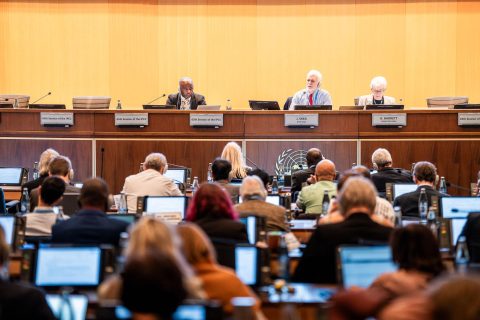

In July, PAICC said 12 countries had ignored its repeated attempts to discuss why they had not published an NDC as required every five years under the 2015 Paris accord.
Members of the committee had been divided over whether to name them, but at a September meeting decided to do so in their annual report to the annual climate COP summit.
By the time the report was published on Friday, only Congo, Senegal and North Korea “had not communicated an NDC or submitted a [Biennial Transparency Report] and had not yet responded to any of the Committee’s notifications, despite several reminders issued by the Committee in this regard”.
Rainforest and renewable energy ambitions
The silence from Congo and Senegal is notable because the former is home to much of the Congo Basin rainforest while the latter has sought billions of dollars in climate finance to support its renewable energy ambitions.
After Brazil, Congo has more rainforest than any country in the world. This forest, and the country’s peatlands, absorb huge amounts of greenhouse gas but are fast being lost to expanding farmland, charcoal production, logging and mining.
Senegal signed a Just Energy Transition Partnership with Canada and wealthy European nations in 2023, to help it meet its renewable energy targets under the-then government of Macky Sall. It was chair of the Least Developed Countries group between January 2022 and December 2023.

Tejas Rao, who is researching the PAICC as part of a doctoral thesis at Cambridge University, said the governments of the three countries should engage with the committee.
“Engagement costs these governments very little and the committee has shown it will listen,” he said.
“Silence leaves the committee with no basis to help, and it leaves the [governments] exposed to the narrative that they are simply disengaged,” he told Climate Home News.
Paris Agreement requirement
The 2015 Paris Agreement requires all parties to publish an NDC every five years outlining their emissions reduction targets, with each plan meant to be more ambitious than the country’s last NDC.
The latest set – the third round of plans, with new targets for 2035 – was due in February 2025. While most countries missed this deadline, all but around 30 – mostly small emitters but including Egypt, Vietnam and Argentina – have now submitted them.
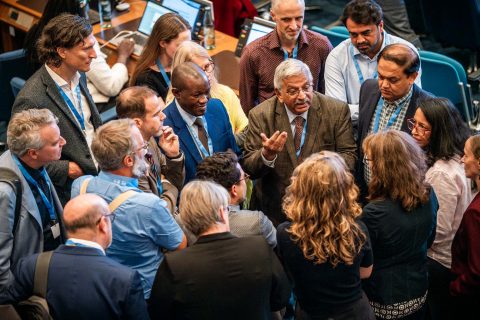
Over the year, the PAICC – which is made up of government climate officials from developed and developing countries – has been communicating with governments that have not submitted NDCs and trying to overcome barriers to them doing so.
Some nations have cited exceptional circumstances as the reason for not submitting an NDC, a process that requires a significant amount of work in tracking emissions and consulting on how to curb them across the economy. For example, a letter from a Sudanese official to the PAICC, seen by Climate Home News, said that the country’s civil war had led to the suspension of its NDC preparation.
-
IPCC scientists vow to press on with climate reports despite political deadlock
After governments again failed to agree a timeline, nearly 120 IPCC authors pledged to complete their assessment on time and with full scientific rigour -
Under US pressure, World Bank says it will back gas “where appropriate”
The US wants the World Bank to expand its gas support while climate campaigners are pushing for it to end – its head spoke this week of limited backing for the fossil fuel -
Who shapes climate science? The equity question facing the IPCC
Early completion of the next global climate science assessment reports risks excluding research from the Global South, which is key to ensuring the findings are fair
The US and Iran are not signed up to the Paris Agreement and so do not have active NDCs, nor does Taiwan, which is not a UN member state.
Rao said that because the PAICC is “facilitative and non-punitive”, naming the countries “is meant to open a door, not close one – the invited consultation is the point”.
“In recent months, governments that explained their constraints, whether capacity, finance or domestic process, have been met with follow-up and support rather than sanction, and the number of silent governments has fallen sharply,” Rao said.
The post Paris Agreement committee names three countries snubbing it over NDCs appeared first on Climate Home News.
Paris Agreement committee names three countries snubbing it over NDCs