

With voluntary commitments to cut methane pollution floundering, the prime minister of Barbados urged fellow leaders at the United Nations last month to draw up a “legally binding global agreement” to reduce emissions of the particularly potent greenhouse gas.
Mia Mottley told the UN Secretary-General’s Climate Summit in New York that voluntary efforts like the UAE-led Oil and Gas Decarbonisation Charter – signed by over 50 oil and gas companies – were “not enough” to rein in methane. She said governments should urgently discuss a “no more than two-or-three page agreement on the reduction of methane as a matter of legally binding obligations”.
The Barbadian leader – who has a global reputation for proposing new ideas on climate action and finance – said governments “do not need to reinvent the wheel”. She suggested replicating the 1987 Montreal Protocol that has phased out the production and use of CFC and other gases found in fridges and air conditioners that were responsible for opening a hole in the Earth’s ozone layer.
That protocol put in place legally binding reduction targets for these chemicals, many of which are also greenhouse gases, incentivising government policies to make companies redesign their appliances.
Emissions of ozone-depleting substances have since dropped by almost 100%, and the ozone layer is closing, with Mottley calling it “the most successful climate agreement in history”.

Why focus on methane?
Methane is a short-lived greenhouse gas that is more than 80 times more potent than carbon dioxide (CO2). Experts say cutting methane emissions is a “low-hanging fruit” for tackling global warming, as it would make a big difference with relatively small actions.
Methane emissions come mainly from the agriculture sector (40%), the oil and gas industry (35%) and waste (20%).
Since COP26 in Glasgow, 111 countries have signed up to the Global Methane Pledge – which aims to cut methane emissions by 30% by 2030, compared to 2020 levels.
But, in its latest global tracking update in May, the International Energy Agency said methane emissions from fossil fuels remain at stubbornly high levels. Commitments like the pledge have boosted target-setting and momentum, it added, but so far “few countries or companies have formulated real implementation plans for these commitments, and even fewer have demonstrated verifiable emissions reductions”.
Russia justifies fossil gas use by citing contentious COP28 loophole
Mottley told the summit at UN headquarters that tightening regulation on methane emissions made sense for the planet, fossil fuel firms and farmers – and would help buy time in the short-term as countries roll out their national climate plans to cut greenhouse gases across the board.
Her call was backed by French President Emmanuel Macron and Tuvalu’s Prime Minister Feleti Teo, who both said in their speeches that a “binding commitment” on methane is needed. “We know that this is a reachable goal,” Macron said, adding that methane reduction would be a priority when France chairs the G7 next year.
A more difficult challenge than ozone?
But replicating the Montreal Protocol for methane will be challenging. The vast majority of ozone-depleting gases come from a relatively small number of appliances and so could be reduced relatively easily. On the other hand, methane escapes into the atmosphere from a wide variety of sources including belching cows, rice paddies, landfills, leaking gas pipelines, coal mines and oil production facilities.
While some emissions can be prevented cheaply or even profitably – particularly in oil and gas production – others, like those from cows, are more expensive and politically controversial to avoid.
Durwood Zaelke, president of the Institute for Governance and Sustainable Development, has previously campaigned against ozone-depleting substances and is now pushing for methane cuts. He spoke alongside Mottley and Macron at a high-profile meeting on methane in New York in late September.
He told Climate Home News that getting a “coalition of the willing” to agree on methane targets is more likely than persuading all the world’s governments to sign up to an agreement. Countries could make their targets legally binding through their own domestic law, he said.
-
Oil giant Pemex fails to control methane emissions, threatening Mexico’s net zero goal
A Climate Home investigation shows Mexico’s state oil firm has struggled to cut its methane emissions as promised, risking the country’s net zero ambitions -
Fossil fuel industry under pressure to cut record-high methane emissions
New regulations and monitoring advances could turn the tide on methane emissions from oil, gas and coal production this year -
World Bank tiptoes into fiery debate over meat emissions
The bank has advised wealthy nations to cut subsidies for high-emissions foods but stopped far short of promoting veganism


An international agreement is possible, he added, “but it also can start from the bottom up” if other governments – including sub-national ones like California and Punjab – adopted similar rules to the European Union’s methane regulation.
The EU requires oil and gas companies to detect and repair methane leaks and bans them from burning gas as a waste product in a process known as flaring. It is also imposing increasingly stringent methane intensity standards – opposed by the Trump administration in the US – on imported fossil fuels.
Zaelke said the next step was for Barbados to try and get the rest of the Climate Vulnerable Forum – a group of around 70 Global South countries which it now chairs – and other small island states on board with the idea.
He predicted that methane would have its “moment” at the COP30 climate summit in Brazil, as reduction of non-CO2 gases is one of the 30 objectives of the COP30 presidency’s “action agenda”.
Mottley’s proposal is expected to be discussed at the pre-COP gathering in Brasilia on October 13-14, although opposition from some countries will likely make reaching global consensus very difficult.
Citing comments by UN chief Antonio Guterres that we are on “the highway to climate hell”, Zaelke said: “We’ve got a methane emergency brake. If you pull it and turn the wheel, you can reverse course and slow warming in the near term more than any other way. I think this is becoming clear and so we’ll see the drumbeat for mandatory pick-up.”
The post Mottley’s “legally binding” methane pact faces barriers, but smaller steps possible appeared first on Climate Home News.
Mottley’s “legally binding” methane pact faces barriers, but smaller steps possible

Continue Reading
Three countries have been named by the Paris Agreement’s compliance committee for failing to submit a nationally determined contribution (NDC) and repeatedly snubbing offers of help with their climate plans.
After months of internal debate over whether to identify serial non-responders, the Paris Agreement’s Implementation and Compliance Committee (PAICC) named the three countries which have failed to engage with it over their NDCs on Friday.
It named Democratic Republic of Congo, Senegal and North Korea in a footnote of its annual report, adding that it decided to name them “with a view to facilitating engagement”, adding that representatives of the three nations had been invited to its meeting in early 2027 “with the purpose of identifying any challenges and constraints”.
“The Committee noted the importance of Parties engaging with the Committee in a timely manner, while noting that some delays may be due to the national capabilities and circumstances of the Parties”, the report said.
-
Under US pressure, World Bank says it will back gas “where appropriate”
The US wants the World Bank to expand its gas support while climate campaigners are pushing for it to end – its head spoke this week of limited backing for the fossil fuel -
IPCC scientists vow to press on with climate reports despite political deadlock
After governments again failed to agree a timeline, nearly 120 IPCC authors pledged to complete their assessment on time and with full scientific rigour -
Paris Agreement committee snubbed over missing NDC climate plans
Many governments have still not submitted a nationally determined contribution to the UN, breaching a key requirement of the Paris Agreement

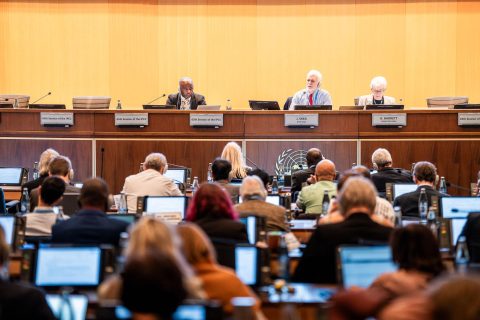

In July, PAICC said 12 countries had ignored its repeated attempts to discuss why they had not published an NDC as required every five years under the 2015 Paris accord.
Members of the committee had been divided over whether to name them, but at a September meeting decided to do so in their annual report to the annual climate COP summit.
By the time the report was published on Friday, only Congo, Senegal and North Korea “had not communicated an NDC or submitted a [Biennial Transparency Report] and had not yet responded to any of the Committee’s notifications, despite several reminders issued by the Committee in this regard”.
Rainforest and renewable energy ambitions
The silence from Congo and Senegal is notable because the former is home to much of the Congo Basin rainforest while the latter has sought billions of dollars in climate finance to support its renewable energy ambitions.
After Brazil, Congo has more rainforest than any country in the world. This forest, and the country’s peatlands, absorb huge amounts of greenhouse gas but are fast being lost to expanding farmland, charcoal production, logging and mining.
Senegal signed a Just Energy Transition Partnership with Canada and wealthy European nations in 2023, to help it meet its renewable energy targets under the-then government of Macky Sall. It was chair of the Least Developed Countries group between January 2022 and December 2023.

Tejas Rao, who is researching the PAICC as part of a doctoral thesis at Cambridge University, said the governments of the three countries should engage with the committee.
“Engagement costs these governments very little and the committee has shown it will listen,” he said.
“Silence leaves the committee with no basis to help, and it leaves the [governments] exposed to the narrative that they are simply disengaged,” he told Climate Home News.
Paris Agreement requirement
The 2015 Paris Agreement requires all parties to publish an NDC every five years outlining their emissions reduction targets, with each plan meant to be more ambitious than the country’s last NDC.
The latest set – the third round of plans, with new targets for 2035 – was due in February 2025. While most countries missed this deadline, all but around 30 – mostly small emitters but including Egypt, Vietnam and Argentina – have now submitted them.
Over the year, the PAICC – which is made up of government climate officials from developed and developing countries – has been communicating with governments that have not submitted NDCs and trying to overcome barriers to them doing so.
Some nations have cited exceptional circumstances as the reason for not submitting an NDC, a process that requires a significant amount of work in tracking emissions and consulting on how to curb them across the economy. For example, a letter from a Sudanese official to the PAICC, seen by Climate Home News, said that the country’s civil war had led to the suspension of its NDC preparation.
-
IPCC scientists vow to press on with climate reports despite political deadlock
After governments again failed to agree a timeline, nearly 120 IPCC authors pledged to complete their assessment on time and with full scientific rigour -
Under US pressure, World Bank says it will back gas “where appropriate”
The US wants the World Bank to expand its gas support while climate campaigners are pushing for it to end – its head spoke this week of limited backing for the fossil fuel -
Who shapes climate science? The equity question facing the IPCC
Early completion of the next global climate science assessment reports risks excluding research from the Global South, which is key to ensuring the findings are fair
The US and Iran are not signed up to the Paris Agreement and so do not have active NDCs, nor does Taiwan, which is not a UN member state.
Rao said that because the PAICC is “facilitative and non-punitive”, naming the countries “is meant to open a door, not close one – the invited consultation is the point”.
“In recent months, governments that explained their constraints, whether capacity, finance or domestic process, have been met with follow-up and support rather than sanction, and the number of silent governments has fallen sharply,” Rao said.
The post Paris Agreement committee names three countries snubbing it over NDCs appeared first on Climate Home News.
Paris Agreement committee names three countries snubbing it over NDCs