


With Q2 2025 earnings released, all eyes are on Tesla’s margins, credit revenue, and regulatory risk. The electric vehicle (EV) pioneer remains a top global player in clean energy and EV manufacturing. However, shifting political winds and market dynamics could hurt its profits—especially its revenue from carbon credits, a long-time earnings booster. The EV giant’s credit sales this quarter drops to more than 50%.
With stiffer competition, changing demand for EVs, and the threat of U.S. climate policy rollbacks, Tesla’s path forward is less predictable than in past quarters. Let’s see how the company performs this quarter and what lies ahead.
Q2 2025 Earnings: Deliveries, Revenue, and Margins All Down
In its latest Q2 2025 report, Tesla posted revenue of $22.5 billion, a 12% drop from the same quarter last year. Net income came in at $1.17 billion, 16% down due to pricing pressure and weaker delivery numbers. Earnings per share (EPS) landed at $0.40, missing analyst expectations of $0.43.
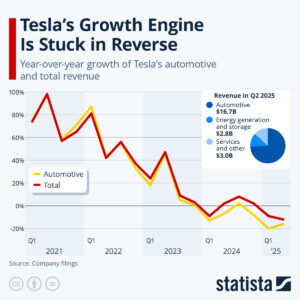
Tesla delivered 384,122 vehicles during the quarter, down from 466,140 in Q2 2024, a decline of nearly 14% year-over-year. Much of the dip came from reduced demand in North America and ongoing price competition in China.
Moreover, Tesla’s energy generation and storage segment, which continues to grow in the past quarters, also fell. This segmet is led by strong sales of its Megapack and Powerwall units. These energy products generated more than $2.8 billion, down 7% year-over-year—an increasingly important line as vehicle profits tighten.
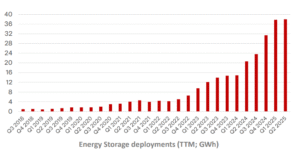
CEO Elon Musk noted in the earnings call that Tesla is pushing ahead with its Robotaxi launch, and reiterated plans for a more affordable EV model in 2026. He acknowledged that while macro and political factors remain uncertain, Tesla remains committed to innovation and global market expansion.
Competition Erodes Tesla’s Global Lead
Tesla’s long-standing EV dominance is being tested. In Q2 2025, Tesla delivered just under 385,000 vehicles globally. Meanwhile, China’s BYD sold over 606,000 battery electric vehicles, widening its lead and showing how quickly the competitive landscape is shifting.
Tesla’s market share in the U.S. has dropped from 75% in 2022 to about 43% in 2025. In Europe, Tesla now holds just 1.6% of the EV market.
Chinese automakers like Xiaomi, Nio, and Xpeng continue to grow quickly, offering lower-priced EVs with strong features. As affordability becomes more important to buyers, Tesla’s premium pricing may limit its growth. This is especially true if U.S. subsidies are scaled back or eliminated.
Unless Tesla launches a budget-friendly model soon, analysts believe it may lose more ground. Combined with falling credit revenue, this puts real pressure on its profit margins.
Tesla’s Carbon Credit Revenue Faces Political Risk
One of Tesla’s most profitable business lines has been the sale of regulatory credits to other automakers that fail to meet emissions targets. These carbon credits have nearly zero production costs and have historically delivered high-margin income.
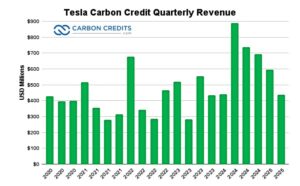
In 2023, Tesla earned $1.79 billion from regulatory credits. That surged to $2.76 billion in 2024, accounting for almost two-thirds of Tesla’s profit in some quarters.
Notably, Q2 2025 carbon credits revenue fell by over 50% to 439 million, from 890 million in the same period last year. And the company’s quarterly credit sales show a decreasing trend since Q2 2024, as seen below.
Still, a major risk is emerging. The proposed “One Big Beautiful Bill” (OBBA) from Republican lawmakers aims to undo several of President Biden’s climate programs. It will eliminate EV tax credits, reverse EPA emissions standards, and weaken the Inflation Reduction Act (IRA). All of this could reduce the need for automakers to buy carbon credits—shrinking Tesla’s most lucrative income stream.
Estimates suggest Tesla’s credit revenue could fall to $595 million or less by 2026, and disappear completely by 2027. This would cut deeply into its margins and future earnings. Despite Elon Musk’s occasional support for deregulation, these changes would be a major setback for Tesla’s business model.
- SEE MORE: Why Tesla (TSLA) Stock Fell: Carbon Credit Crackdown, Musk’s Politics, and Canada’s Frozen Funds
Understanding the Carbon Credit System
Tesla benefits from emissions rules that reward automakers for producing zero-emission vehicles. Since it sells only EVs, Tesla accumulates more credits than it needs. It then sells the extras to competitors like Stellantis, GM, and Toyota, who still sell many gas-powered cars.
This has been an easy revenue stream. But if OBBA or similar legislation weakens clean air rules or emissions targets, the demand for these credits will shrink. That would leave Tesla more dependent on EV sales and energy storage—both of which face their own competitive and pricing challenges.
The Political Climate Adds More Uncertainty
Trump’s OBBA law reflects a broader effort by Republicans to reverse Biden’s climate agenda. With this new policy, many climate-focused programs will be rolled back. This includes EV subsidies, clean energy tax credits, and stricter emissions standards.
Tesla could face a drop in EV demand, especially in the U.S., if those incentives vanish. Ironically, Elon Musk has voiced support for deregulation, but the fallout from such policies could significantly hurt Tesla’s bottom line. Investors are concerned that political shifts could make Tesla’s future earnings far more volatile.
Tesla’s Stock and Strategic Outlook
Tesla’s stock (TSLA) has seen big swings this year. After climbing above $300 per share earlier in 2025, it fell to around $250 in July as delivery numbers declined and political risks grew.
Investors are watching key developments going forward:
- Will Tesla launch an affordable EV model to regain market share?
- Can its energy storage business grow fast enough to offset falling vehicle margins?
- How will regulatory changes affect its carbon credit income?
Upcoming launches like the RoboTaxi platform and Optimus AI robot are exciting but may take time to affect the bottom line. In the near term, Wall Street wants to see stable margins, smart cost controls, and consistent vehicle output.
Driving Forward: Can Tesla Adapt?
Tesla is still a powerful brand with loyal customers and strong technology. But its financial strength depends not only on vehicle sales, but also on favorable policies. Carbon credits and government incentives have played a big role in Tesla’s success.
With political uncertainty rising and competitors growing stronger, Tesla has to adapt fast. The company’s energy business and AI-driven platforms offer new growth paths, but execution and timing will be key.
As Trump’s OBBA bill turned into law, Tesla’s stock could remain volatile. But if the company navigates these challenges and continues to innovate, it may yet hold onto its leadership role in the clean energy transition.
- FURTHER READING: Tesla’s U.S. Robotaxi Launch: A New Catalyst for TSLA Stock Growth?
The post TSLA Stock Drops on Weak Q2 2025 Earnings: Tesla Faces Carbon Credit, Margin, and Political Risks appeared first on Carbon Credits.

EU carbon credit claims changed on 27 September 2026, the day the Directive (EU) 2024/825 began to apply across the European Union. The change is narrow. It changes how a company can talk about the credits it buys. A product can no longer be called neutral on the strength of compensation alone; however, every specific, evidenced statement about what a company measured, reduced, and funded stays fully available.

The post Promoting Improved Cooking Practices in Nigeria appeared first on Terrapass.



-
Climate Change1 year ago
Guest post: Why China is still building new coal – and when it might stop
-

 Greenhouse Gases2 years ago
嘉宾来稿:满足中国增长的用电需求 光伏加储能“比新建煤电更实惠”
-
Greenhouse Gases1 year ago
Guest post: Why China is still building new coal – and when it might stop
-

 Climate Change2 years ago
嘉宾来稿:满足中国增长的用电需求 光伏加储能“比新建煤电更实惠”
-

 Renewable Energy12 months ago
Sending Progressive Philanthropist George Soros to Prison?
-
Climate Change2 years ago
Bill Discounting Climate Change in Florida’s Energy Policy Awaits DeSantis’ Approval
-
Greenhouse Gases1 year ago
嘉宾来稿:探究火山喷发如何影响气候预测
-

 Climate Change2 years ago
Analysis: China’s CO2 falls 1% in Q2 2024 in first quarterly drop since Covid-19