

As in his first term, US President Donald Trump has again kick-started the country’s withdrawal from the Paris Agreement, the global pact to tackle climate change. But this time, he has launched a barrage of additional efforts to end US participation in international climate action during his first 100 days in office.
He not only signed an order for the US to leave the Paris Agreement on his first day in the White House on January 20, a process that takes a year from when the UN is notified. His administration has also crippled international climate finance by cutting aid and saying it will not deliver on pledges to climate funds, financed major fossil fuel projects abroad and undermined environmental treaties such as the United Nations Convention on the Law of the Sea.
“It is the policy of my Administration to put the interests of the United States and the American people first in the development and negotiation of any international agreements with the potential to damage or stifle the American economy,” said Trump’s day-one executive order on global environmental deals.
However, the implications could be far-reaching and weaken the US geopolitically, analysts warned.
“The Trump Administration is fundamentally dismantling the ability of the US government to project influence around the world,” said Jesse Young, former chief of staff at the Office of the U.S. Special Presidential Envoy for Climate under John Podesta, a political adviser to Joe Biden’s government.
“If you take the ball and go home, everyone else still shows up to these fora. It’s not like the party’s cancelled,” Young added. “By withdrawing from the Paris Agreement and doing all this stuff, you make China look better by standing still.”
It is still unclear whether the US will send a delegation to the COP30 UN climate summit in Belém, Brazil, in November, where more than 190 countries are set to discuss a new climate finance roadmap and present updated national climate plans. A no-show for the US would be an unprecedented move for the world’s second-largest carbon polluter.
“The world will keep going,” said Tom di Liberto, public affairs specialist and former climate scientist with the US government. “What we’ve seen is a complete rejection of America’s role in the world.”

Bowing out of the UN climate process
The US leaving the Paris Agreement – although falling short of pulling out of the underlying UN Framework Convention on Climate Change (UNFCCC) – was the first step in a series of actions meant to undermine climate action on the global stage.
In February, the Trump administration prevented its scientists from attending a key meeting of the Intergovernmental Panel on Climate Change (IPCC) held in China, where researchers from UN member states discussed the outlines and deadlines for the world’s upcoming flagship climate science reports.
As part of Trump’s first-day orders, the US also halted all financial contributions to the UNFCCC, leaving the UN climate body with a 22% shortfall in its core budget. In 2024, US contributions totalled $13.3 million.
Shortly after the announcement, American billionaire Michael Bloomberg pledged to fill the funding gap left by the US. Bloomberg Philanthropies had already stepped in during Trump’s first term and is already the UNFCCC’s largest non-state donor.
After Trump’s pullback, Bloomberg promises to fill US funding gap to UN climate body
The United States also failed for the first time to report its climate-warming emissions to the UN, a commitment the US had upheld ever since the UNFCCC was adopted over three decades ago.
And this month, the Trump administration dismantled the entire State Department’s Office for Global Change, which oversees global climate policy and aid, by terminating all of its employees. This was part of a wave of bureaucratic layoffs led by the newly created Department of Government Efficiency (DOGE), run by unelected tech billionaire Elon Musk, who owns electric vehicle maker Tesla and social media platform X.
One of the agencies targeted by DOGE was the National Oceanic and Atmospheric Administration (NOAA), which could suffer an almost 30% budget cut despite being in charge of key global weather and climate data. Di Liberto was one of the scientists fired from NOAA.
“We’re already seeing the impacts, especially in our national weather service, where we already today cannot forecast the weather 24/7 at local forecast offices,” Di Liberto told journalists on an online briefing.
Many developing countries rely on NOAA’s forecasting to prepare for extreme weather events like hurricanes or drought. In a world of increasing climate impacts, the move could “jeopardize most people’s access to life-saving information”, the nonprofit Union of Concerned Scientists (UCS) said in a statement.
Also in April, the Trump administration dismissed all the authors of the Sixth National Climate Assessment – a quadrennial scientific report mandated by Congress since 1990 – saying it is being “reevaluated”.
“Trying to bury this report won’t alter the scientific facts one bit, but without this information our country risks flying blind into a world made more dangerous by human-caused climate change,” warned Rachel Cleetus, one of the authors who is a senior policy director for UCS’s Climate and Energy Program.
Crippling climate finance
In his initial executive order to quit the Paris Agreement, Trump made very clear his intention to dramatically cut US contributions to international climate funding by ordering the US Treasury to “immediately cease or revoke any purported financial commitment” under the UNFCCC.
One of the administration’s first targets was the US government aid agency, USAID, which has suffered a dramatic mass layoff of staff and was subjected to a funding freeze. USAID is the world’s largest grant-based bilateral agency, overseeing hundreds of climate programmes now at risk of disappearing.
Speaking to Climate Home in February, workers at USAID-funded projects in Africa warned of “devastating” consequences to the world’s poorest, warning it would make them more susceptible to extreme weather.
USAID’s climate projects included an $84.5 million clean energy rollout across Southern Africa that would grant first-time electricity access to tens of thousands, as well as $22 million to help farming communities in Iraq deal with climate-related drought, and $18.5 million to boost climate resilience in Palestine.

The US has also walked out of coal-to-clean energy Just Energy Transition Partnerships (JETPs) with South Africa, Indonesia and Vietnam, set up by a group of donors to phase down fossil fuels and boost renewables in these growing economies. Together, the deals are worth a combined $45 billion.
Trump has also targeted international climate funds, rescinding a large pledge to the UN’s Green Climate Fund (GCF) in February, leaving a $4-billion shortfall and an empty seat on the fund’s board. The country also gave up its seat on the board of the new Fund for Responding to Loss and Damage, although the previous administration made good on a previous $17.5-million contribution.
In addition, the US government is putting pressure on global financial institutions that support development around the world. During April’s Spring Meetings, Treasury Secretary Scott Bessent urged the International Monetary Fund (IMF) and the World Bank to drop their climate work, amid fears of a US exit from those agencies.
He said the IMF “devotes disproportionate time and resources to work on climate change, gender and social issues”. The IMF and World Bank chiefs have so far not indicated they will scale back their climate programmes.
Rush for gas and minerals
While cutting funding for climate mitigation, the Trump administration has invested efforts in redirecting international support towards fossil fuel projects, in particular gas.
For instance, back in March, the US Export-Import Bank approved a $4.7-billion loan for a major gas plant in Mozambique described as a “carbon bomb” by experts. The project operated by TotalEnergies is set to emit 121 million tonnes of planet-heating carbon dioxide every year and it would become Africa’s largest-ever energy project.
Trump has also encouraged other countries to buy into the US’s fossil fuel expansion plans, urging Japan, South Korea and Taiwan to commit to a controversial $44-billion liquefied natural gas (LNG) project in Alaska. Asian countries reportedly have diverging views on this, with Taiwan expressing interest and South Korea more hesitant over the costs.
In line with this, the US government has also pushed gas at international energy gatherings. This month, at the International Energy Agency’s Summit for the Future of Energy Security in London, Trump’s envoy criticised renewables, blaming them for recent power cuts in Puerto Rico without providing evidence.
At energy security talks, US pushes gas and derides renewables
Critical minerals – whose global production is currently dominated by China – have featured too in Trump’s foreign policy. Minerals like lithium and cobalt as well as rare earths are key for manufacturing solar cells, batteries and other clean energy technologies. But Trump has set his sights on the military uses of these minerals, analysts told Climate Home.
At peace talks to end the conflicts in both Ukraine and the Democratic Republic of Congo (DRC), the US government has offered “minerals-for-security” deals in an effort to secure key reserves of cobalt and copper in DRC, and graphite and lithium in Ukraine.
Meanwhile, in defiance of the UN Convention on the Law of the Sea (UNCLOS), the Trump administration in April signed an executive order to fast-track controversial deep-sea mining projects planned by Canada-based The Metals Company (TMC). For years, diplomats have tried to set rules for mining the ocean floor at the International Seabed Authority, an UNCLOS body. Trump’s unilateral permitting is set to create international backlash, experts warned.
Xi commits China to full climate plan but emissions-cutting ambition still unclear
Amid the US president’s snubbing of the UN climate process and other global environmental pacts, COP30 host Brazil has called on countries to stay committed to the UNFCCC. China, for example, recently announced it will produce an upgraded national climate plan ahead of COP30, covering all economic sectors and greenhouse gases for the first time.
“Now, we have to make an even greater effort to ensure that multilateralism prevails, and this
has to involve Brazil, China, India, the European Union, South Africa, and all remaining [UNFCCC]
parties,” Brazil’s Environment Minister Marina Silva said in a statement. “Only intense multilateral action can tackle climate change.”
The post Trump’s first 100 days: US walks away from global climate action appeared first on Climate Home News.
Trump’s first 100 days: US walks away from global climate action

Climate Change
After a week of plenty of activity and drama for Greenpeace at sea, I felt like writing to you on a much quieter theme…
Do you have a favourite book, poem or story about the ocean?
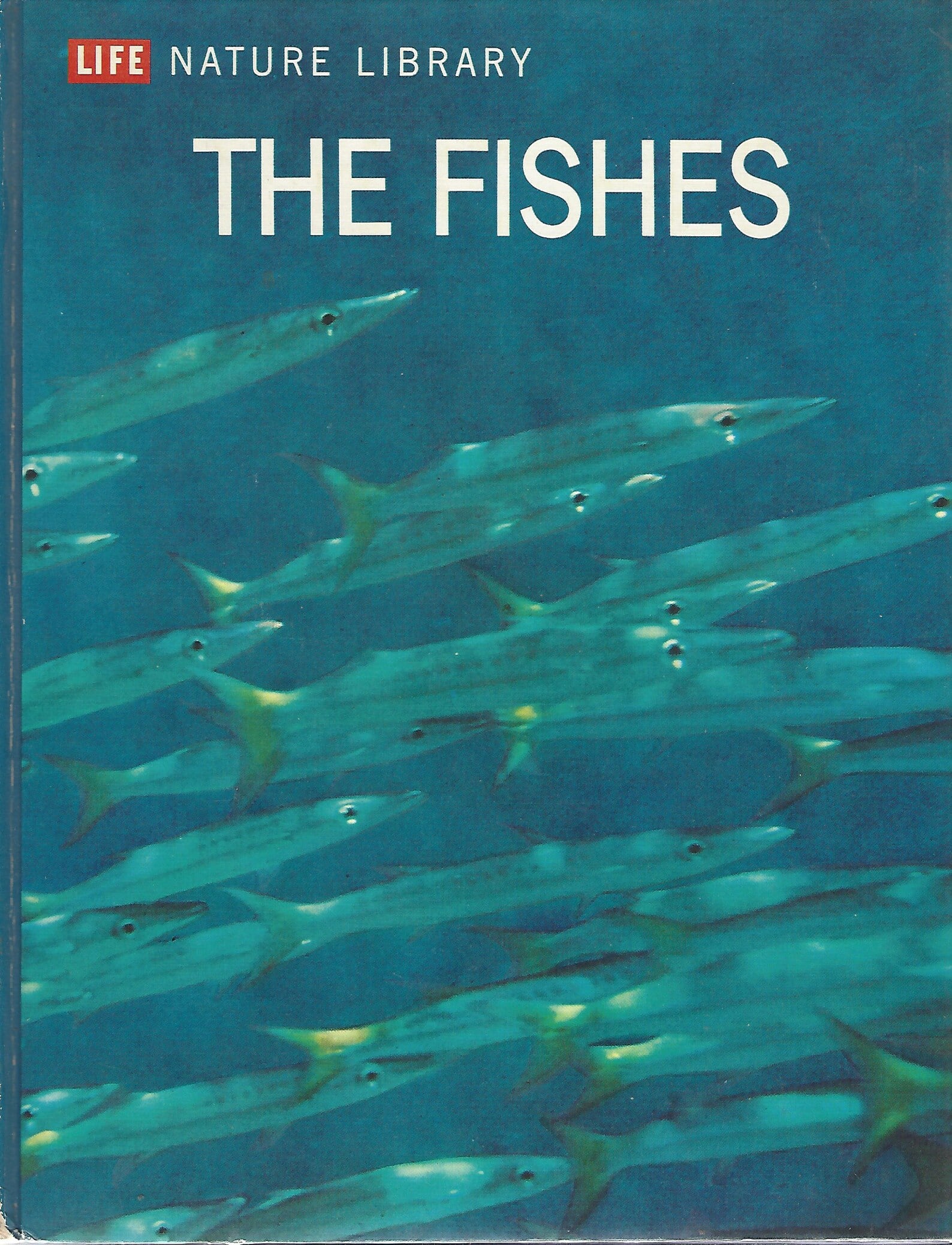
When I was very small, it was the TimeLife book of The Fishes, by F. D. Ommanney, which I remember endlessly poring over, my child’s mind gripped, in total fascination. The cover illustration showed a shoal of barracuda, mid-water and heading upwards, lit up as an iridescent blue by a column of sunlight. Oddly, it is only the cover and the illustrations of the deep sea creatures which I now remember—but I loved that book, as the weakened spine, blunted pages and dog-eared corners attested.
The Fishes has been on my mind recently, because I’ve been working with some dear friends on our own illustrated oceans book, to be published by Upswell Publishing. The book is called Scott Reef: Like Nowhere Else on Earth, and I want to share with you a bit of the story behind its creation.
Scott Reef is absolutely magnificent: Australia’s largest freestanding oceanic reef, brimming with life, including rare and threatened species such as a genetically distinct population of green sea turtles, pygmy blue whales and the wonderfully elegant dusky sea snake. But Scott Reef isn’t near our capital cities; it is way off the north-west coast of WA. And it is threatened with devastation by Woodside, which wants to drill up to 57 toxic wells at the Reef for its vast, dirty Browse gas project.
One of the main challenges in the fight to save Scott Reef from being turned into an industrialised gas zone by Woodside is bringing this incredible location to life for people who haven’t actually experienced it first hand. Because despite its ecological significance and dazzling beauty, ‘Scott Reef’ is also—at least not yet—exactly a household name.
To help get over this barrier, Greenpeace has enabled a number of photographers to travel to Scott Reef by boat (including the Rainbow Warrior) to document its astonishing diversity of colour and life. We then brought these images together in a remarkable photobook, produced by our talented in-house team, which we’ve been putting into the hands of as many leaders as possible—including the MPs whose decisions can determine the Reef’s future.
Back in June this year, I was sharing a copy of our in-house book at a business gathering in Perth when someone pulled me aside. Had we thought about publishing the book commercially? Apart from anything else, he wanted to buy a copy himself! He had a point. We were proud of what we’d created, but a commercially published version could reach a much wider audience and have even greater campaign impact. I immediately turned to my dear friend, Terri-ann White, who runs Upswell Publishing in WA, for advice.
Terri-ann has a huge heart and terrific vision. So many wonderful things in WA owe their existence to her doings, and, true to form, she was immediately encouraging and enthusiastic. “But,” she said, “it would add a whole new dimension if we had some words to accompany the incredible pictures.”
Fair enough, I thought. I could ask a few authors.
“And when would you like it published?” she asked.
“Ideally November,” I answered sheepishly.
Now, in publishing terms, nobody goes from idea to finished work, beautifully produced by a commercial publisher, in just four months. It. Just. Doesn’t. Happen. A book of this scale would ordinarily take nine months, I was told. But Terri-ann was undeterred. “If you can get a rapid turnaround on the writing, I will give it a shot.”
Over the following few days, I sent out 24 emails to prospective writers. To my joy and surprise 23 of them responded almost immediately with an enthusiastic yes!
Terri-ann was somewhat alarmed and perplexed when I told her the good news… we’d discussed a few authors, not more than twenty! “Impossible,” she texted. “Editing is important and you are talking about thousands of words!” But I also know Terri-ann. She does the impossible. And so, here we are… Terri-ann is going to hit that improbable deadline. Scott Reef: Like Nowhere Else on Earth will be on shelves in November.
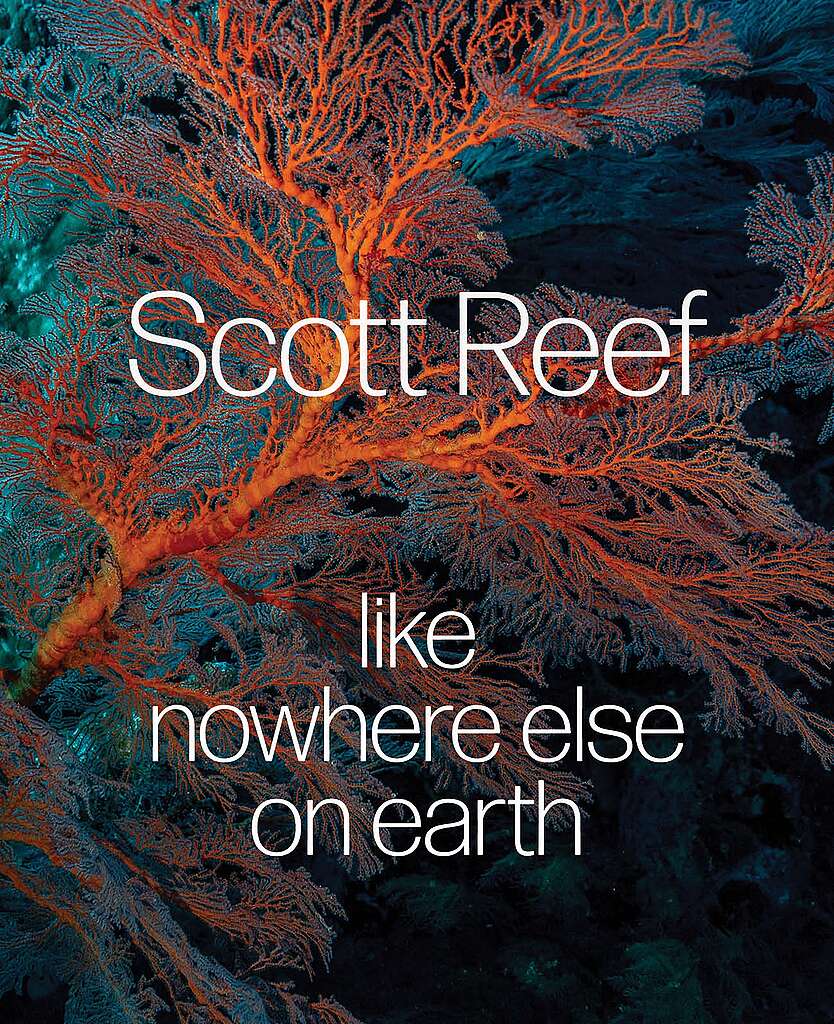
The contributors are a wonderfully diverse bunch, united by their enthusiasm for Scott Reef — and their extraordinary speed!
It’s a brilliant mix. The book brings together national icons like Peter Garrett, Tim Winton, Mick Dodson, Janet Holmes à Court and Fiona Stanley; the intellectual heft of professors Frank Bongiorno, Jessica Meeuwig, Rick Steiner and Samantha Hepburn; the poetic vision of Prema Arasu, Berndt Sellheim and Saadiah Freeman; the field expertise and passionate first hand witnessing of Imogen Zethoven, Tooni Mahto, Ben Fitzpatrick, Geoff Bice, Olaf Meynecke, Paul Gamblin, Sarah Gittoes and Hayley Baillie; and the determination of emerging activist voices Jackson Reid and Emma Sangalli.
Their elegant words wrap themselves around the sheer wonder of the underwater world, brought to life by the work of the photographers — of whom one, Wendy Mitchell, has also contributed a wonderful essay.
Terri-ann showed me the full physical proofs this week and they are breathtaking. This book contains some of my absolute favourite images of wildlife beneath the waves -– and believe me, after almost 20 years at Greenpeace, I’ve been privileged enough to see some remarkable shots! The essays bring a whole new depth and richness to the story of Scott Reef.
If I am being honest, and maybe a bit sentimental, I hope that a four or five-year-old child somewhere in Australia will spend part of their summer holidays turning the pages of this book, wide-eyed with curiosity and awe at the beauty and strangeness of the creatures that call our oceans home.
Our shared commitment is to make sure that, as those children grow up, the wonders of Scott Reef will exist not just in the pages of the book, but out there in the wild waters off north-western Australia—alive, thriving, and every bit as extraordinary as they are today; a living wonder beneath the waves.
Pre-orders of Scott Reef: Like Nowhere Else on Earth are available here.


Q & A
Sometimes you get asked a question so often that you decide to produce a report to answer it!
We know there is strong public opposition to voter opposition to gas drilling at Scott Reef and fracking in the Kimberley in Western Australia. But I am frequently asked whether, even if people don’t want it, more gas drilling is a necessary evil to sustain WA’s prosperity?
The short answer is an unequivocal ‘No’. The longer answer is our new report, From Gas to Green: Building Western Australia’s Future State, which makes the comprehensive case that Asia’s gas market is declining — while WA has an enormous untapped opportunity to become a global leader in green industries and exports, helping drive the region’s shift away from fossil fuels. The faster that WA embarks on a decisive shift away from gas—and that includes no fracking in the Kimberley, or drilling at Scott Reef — so much the better for the state’s people, ecology and economy.
For the first time, new-energy vehicles (NEVs) made up 67% of new car sales in China in September, according to the latest data from the China Passenger Car Association (CPCA).
The figures show that NEVs, which include battery electric cars and plug-in hybrids, captured a record share of sales, even though fewer were sold than last year.
This is because sales of combustion-engine cars are falling steeply, a trend that the CPCA has attributed to rising petrol prices following the start of the Hormuz crisis.
Indeed, sales of fuel-only cars were down 31% year-on-year in the first nine months of 2026, with plug-in hybrid sales down 26% – whereas battery EV sales were only down 4%.
One analyst tells Carbon Brief that China’s rapidly growing EV fleet has offset demand for 143m barrels of oil since the start of the Hormuz crisis.
Another says that the crisis is “reinforcing China’s electrification of road transport”.
Meanwhile, amid slowing domestic sales, Chinese carmakers’ exports of NEVs more than doubled [in 2026 to date / in September] from a year earlier.
NEV record
A record two out of every three cars sold in September in China were NEVs, according to CPCA data, as shown in the figure below.
(NEVs predominantly include battery electric vehicles – BEVs – and plug-in hybrids – PHEVs. BEVs only run on electricity, whereas PHEVs also have a combustion engine.)
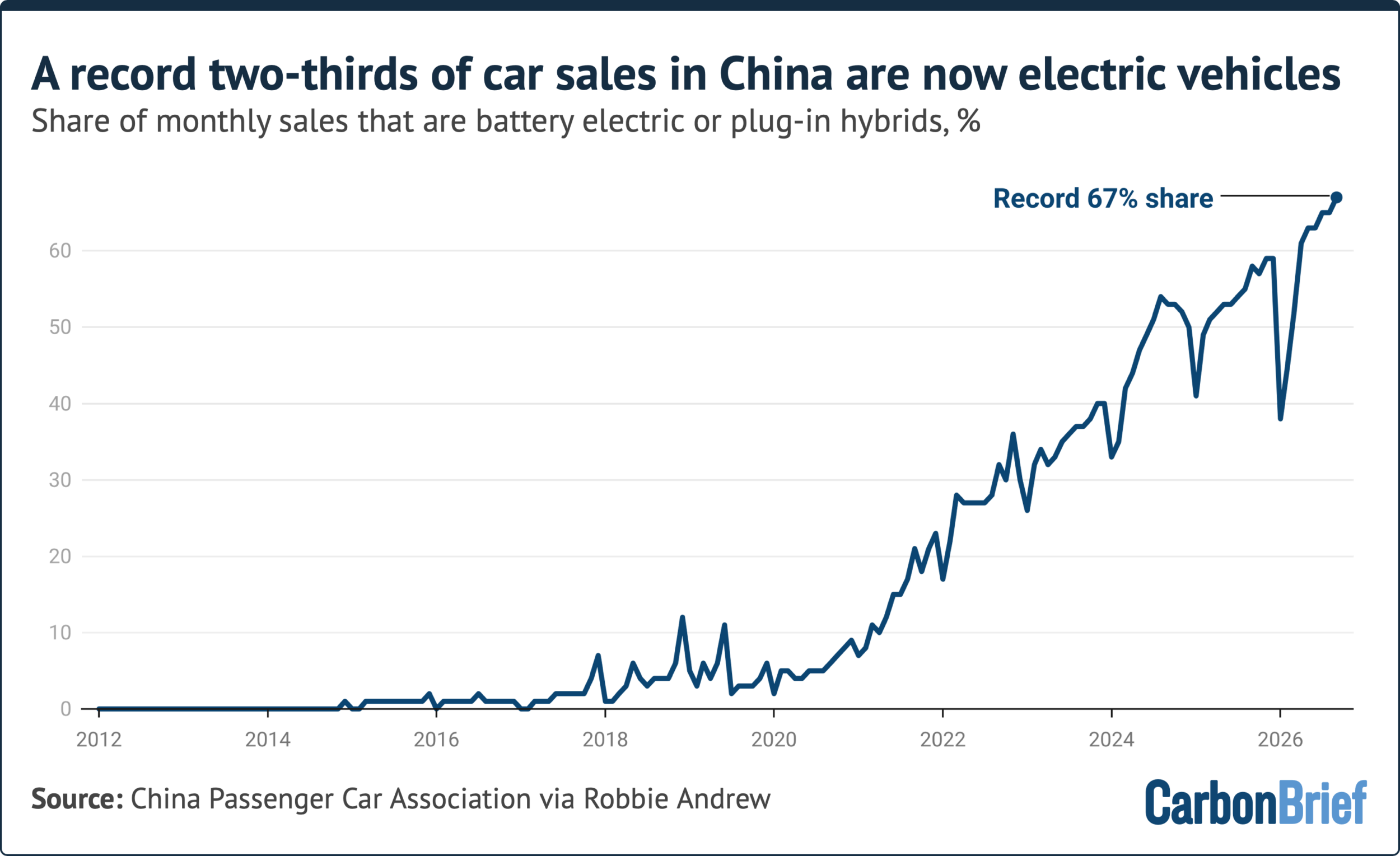
This marks a rapid rise for NEVs from just 6% of new car sales in 2020 up to 58% in 2026 to date – and a record 67% in the month of September.
This year, NEVs’ share of sales has also bounced back from a low of 39% in January, after the full purchase tax exemption that had been in place for more than a decade came to an end in December 2025.
The gain in NEV share in 2026 has come amid a slowdown across the wider domestic passenger-car market, which has hit sales of combustion-engine vehicles particularly hard.
This September, passenger-car retail sales across all categories declined, with overall sales volumes falling 28% year-on-year.
The contraction was led by combustion-engine vehicles, which saw sales fall 43% year-on-year in September and 31% in 2026 to date.
However, sales of PHEVs also fell by 36% year-on-year in September and by 26% in