

HiWi is the abbreviation for the German term ‘Hilfs-Wissenschaftler*in’, which translates to research assistant, and describes a job position for students, often offered by faculties or research institutes. I am definitely not talking about the second definition given by German Wikipedia.
For nearly six years I’ve been one of many HiWis, going through research groups and following up on a range of tasks. I spent weeks of my life literally just scanning documents, but I also went on 10 international research missions. I met great people, built friendships and networks. I also found myself in situations that I wouldn’t wish on anyone. But to leave no room for any doubt; I loved being a HiWi, jumping at any field work opportunity, often taking the initiative, actively asking to join projects or research cruises. To this day I have good relations with my previous superiors, and I know that they only want the best for me. I’ve been very lucky in all of this.
However, I saw the flaws in the system and there are many stories out there, where inexperienced but motivated students/early-carrier scientists were taken advantage of, often under false pretenses and promises. So, I would like to take the opportunity to address some of these issues.

First and foremost is the critical, yet nuanced point of wages. At the core of it, a HiWi position remains a student job and is therefore a source of income. Personally, I was in a financial situation where I needed to generate an income and there are many others out there that similarly rely on a regular income to cover the cost of living. A HiWi position is particularly attractive because it pays while offering contacts and experience in your research field. However, it is no secret that there is little money in research. No surprise that the usual hourly HiWi pay corresponds to the minimum wage, often regardless of the experience or the degree that may be brought along. In contrast, for most other public positions, a higher degree is acknoweledged with a higher salary.
An argument often brought forward is that HiWi positions are not meant to provide a living (really, no student job should since you are a fulltime student) but are about gaining experience. While clearly, I’ve gained a lot of experience and have certainly been benefiting from that in many ways, this argument leaves a bitter aftertaste: does this mean that research experience is a financial privilege? That only those that can afford to earn less, have the opportunities to gain experience in laboratories and in the field outside of their curriculum? And that this is an acceptable state at research institutes? The German Federal Office of Statistics stated in a press release that 38.5 % of students in Germany are at risk of poverty (https://www.destatis.de/DE/Presse/Pressemitteilungen/2022/11/PD22_N066_63.html). This is a systematic issue and nobody expects HiWi hiring institutes to solve this, but I want to put it out here, that many students can simply not afford to be a HiWi. Yet, agreeing to a salary is a decision everyone needs to make for themselves. As you can guess from my brief intro, I agreed and managed to work for most of my studies at minimum wage because of comparably low rents in Kiel, a low budget lifestyle, financial aid, and because I really burn for that whole going-to-sea-shit.
Casually putting the big discussion about the ever growing socio-economic gap in Germany aside, I’d like to address another salary aspect: the real hourly wage. Many HiWis work significantly more hours than their contract calls for without claiming them, effectively decreasing their hourly wage.
Often, working hours are kept flexible or are restricted to a period of field work, which works better for student’s timetables. Rather than agreeing on fixed working hours, it is often about a certain task that needs to be finished by a certain time and date. While this seems attractive at first, in many cases, this leads to HiWis putting in extra time, as tasks may take longer than anticipated by superiors. This is particularly true, when there are only poor instructions given – often because tasks seem trivial to a person working in the field for years already – and honestly, in that moment it feels embarrassing to ask for more explanations as a HiWi. Especially field work is a HiWi trap because many students are extremely eager to get their hands dirty. To make sure we get to go in the field again we accept long working hours, wild working times and poor supervision, trying our hardest to leave a good impression. In 2022 I spend roughly 6 months at sea aboard research vessels. What do you think? Did I work my contractually agreed 20 hours a week?

This brings me to the more emotional and therefore trickier aspects: responsibilities and reputation. And as we gain experience and prove ourselves, we are ‘awarded’ with more responsibilities, which is a double-edged sword. Of course, it is a great feeling to do something yourself, maybe flattering even to know your superiors trust in your abilities, and yes, it will probably look great on your CV. But it is important to see when tasks are simply above your pay grade. I had to face this rather brutal reality after I had worked myself towards the brink of mental and physical health. During a two-month long research cruise I worked very long hours as a laboratory lead, feeling permanently sleep-deprived, stressed, insufficient, and lonely. Months later, I properly counted the hours I had worked and reflected on the emotional toll this had taken on me. I came to the sobering conclusion that I scraped the edge of a mental break-down for less than 2,50 € an hour, receiving little to no recognition. While I was able to communicate and discuss this situation with my superiors, I’ve seen other HiWis working roughly 800 % of their contractual hours, never being paid for the extra time spend. So please, whatever you do: know your worth! So even though it can be hard to formulate such issues to your superiors, it is important to discuss workload and -times.
Additionally, many institutions expect travel expenses to be paid upfront, reimbursing employees later, after an application process. This hits particularly hard when you are a student with little financial freedom (again, according to the press release stated above, every 4th student isn’t even in the financial situation were they are able to pay for unexpected, bigger expenses). Additionally, insecurities arise when you are unfamiliar with bureaucratic applications. The system of reimbursement is often slow, hard to understand, and generally rather opaque for students. Some of my reimbursement processes took more than 9 months and did often not clearly state, which trip it was for. Do better than me: keep track of that shit! And ask more experienced people for help, or if it is possible, avoid this kind of situation all together and find solutions with your superiors.

This brings me to another point that often seems to fall under the table: as a HiWi you have normal employee rights. This may seem obvious when reading, but many students are not aware of that when starting on a HiWi position. For instance, you are entitled to receive continued payment when you are sick, and you are also insured by your employer during working hours and on your way to and from work. There are first motions of unionizing and many information points or counseling centers at universities so make sure to get informed (some links are provided below).
Last but not least, the social aspects: again, especially field work is a minefield because you get to know people on a much more intimate level than in an office. While many great relations may grow from this, there might also be situations where feelings are not mutual. Worst case scenario, there is a misunderstanding between people of different levels of responsibility, maybe even crossing of boundaries. Situations in which I felt uncomfortable include being asked to leave a professional meeting because of my political views, people regarding me as unfit for tasks due to my gender, questions about my sexuality, unasked voicing of opinions on my body, and even proposals of higher positions in exchange for sexual favors. Again, I’ve been lucky enough to have had good people around me, and to have been at an institute with strong gender equality representatives, but even so, some of these experiences were hard to talk about and for several ones I didn’t even grasp the scope until much later. If you ever find yourself in a situation like this, or realize in hindsight that something was not okay, please talk about it to a trusted person!
Finally, I can only repeat that I loved being a HiWi and I would not be where I am today without it. I would have probably quit my studies if it wasn’t for my HiWi job reminding me what I was working towards. But I wished I would have stood my ground firmer on a few occasions, demanded more, been more critical with the system and had better knowledge of my rights and exercised them more vigorously. I’ve been told that the system has come a long way already – but I find that is no argument to accept a situation that still has a lot of room for improvement.
I hope that addressing some of these issues helps with progress. So, to all students, look out for yourselves. And to all superiors, don’t underestimate your impact. I’m hoping this helps someone out there, and with this,
Peace out
Johanna
Some helpful links in case you are now motivated to learn about HiWi rights (unfortunately most in German, sorrey):
https://www.verdi-studierende.de/tv-stud/material-tv-stud/broschuere-studentische-hilfskraefte.pdf
https://www.verdi.de/presse/pressemitteilungen/++co++71a27128-98a2-11ed-9291-001a4a16012a
https://www.meinpraktikum.de/ratgeber/studentische-hilfskraft-faq



When I attended the OBIS Data Mobilization Workshop in the Azores (Thanks to the Air Center) this year, one observation immediately caught my attention: compared with countries such as the United States, Europe still appears surprisingly fragmented and underinvested in biodiversity data mobilization. The issue is not necessarily a lack of biodiversity research. European scientists produce enormous amounts of ecological data. The challenge is that publishing biodiversity observations into global infrastructures such as MBON/GBIF often remains an additional task rather than an integral part of funded research. In the United States, biodiversity data publication is frequently embedded in funding mechanisms and institutional mandates. Data management, curation, and dissemination seem to be recognized research activities. In much of Europe, including Denmark, researchers often mobilize data on top of their existing responsibilities, with limited dedicated funding for long-term stewardship.
I asked myself how is Denmark performing compared with its Nordic and neighboring countries?
Denmark is not lagging behind, but neither is it leading
The numbers reveal a mixed picture.
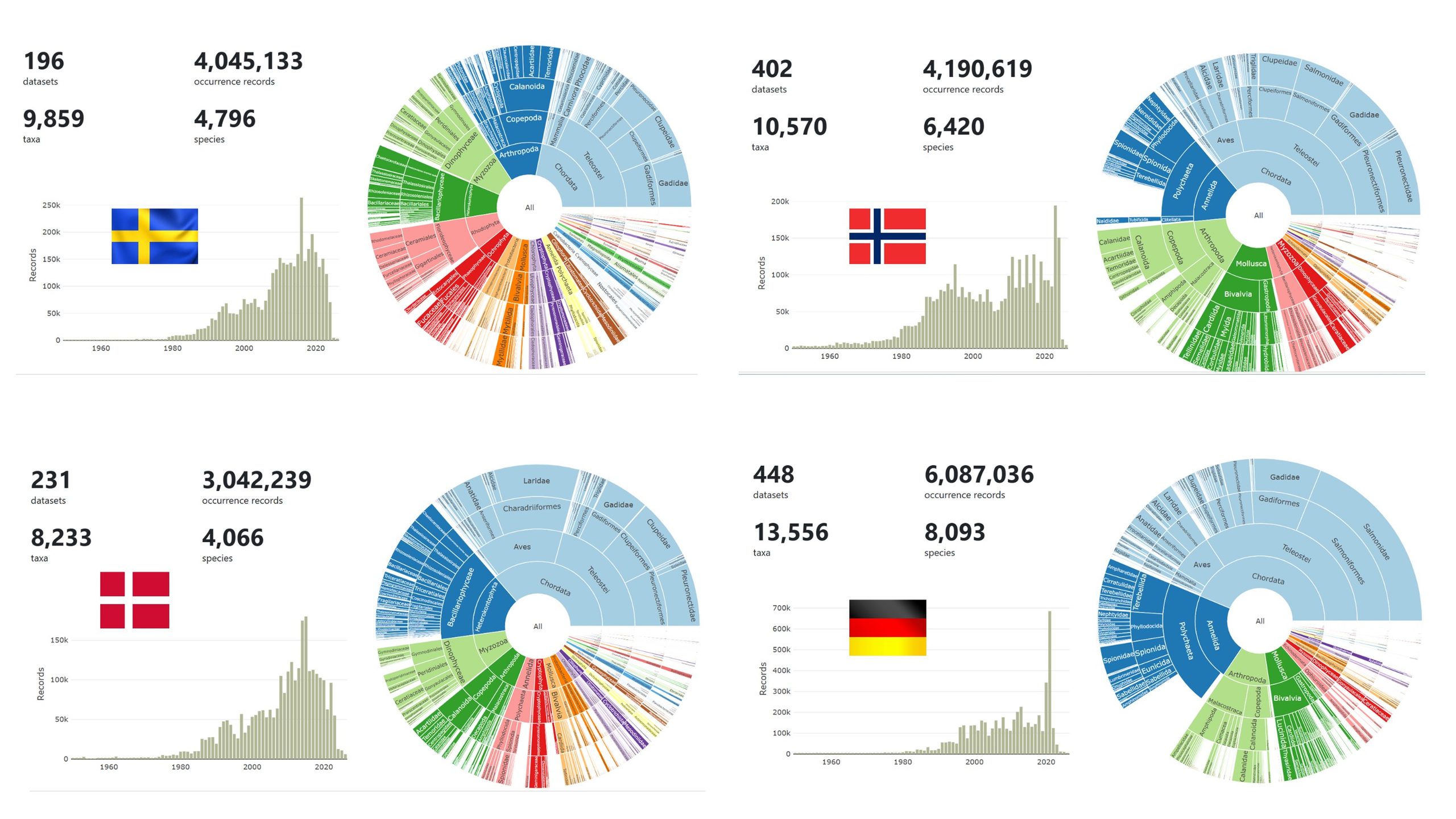
Germany clearly stands out as the regional leader, with both the highest number of datasets and the highest taxonomic coverage. Denmark has the lowest number of occurrence records and species represented among the four countries, despite having a very active biodiversity research community. What is striking is that Denmark does not fall dramatically behind in dataset numbers. Rather, the difference appears in scale and breadth. Danish datasets tend to contain fewer records and cover fewer taxa than those from Germany, Norway, and Sweden.
Different countries tell different biodiversity stories
The taxonomic breakdowns are equally revealing. Denmark should appreciate its fish and birds’ activists. Large portions of the records belong to Gadidae (cod family), Clupeidae (herring family), Laridae (gulls), and other marine vertebrates. This reflects Denmark’s historical strengths in fisheries monitoring, marine ecology, and seabird observations. However, many invertebrate groups, microorganisms, and less visible components of biodiversity remain comparatively underrepresented in global data sets despite active programs like national Program like MONIS.
Norway shows stronger contributions from invertebrate sides such as polychaetes, bivalves, copepods, and marine benthic fauna. The Norwegian data landscape appears heavily influenced by aquaculture sectores, long-term marine monitoring programs and offshore environmental surveys. There is greater representation of marine invertebrates, which are often critical indicators of ecosystem change.
What stood out in Sweden’s data profile is the relatively large contribution from copepods, diatoms, dinoflagellates, and macroalgae. These groups are often overlooked in biodiversity databases because they require specialized expertise and monitoring programs. Sweden’s contribution suggests sustained investment in aquatic ecosystem monitoring beyond commercially important species. Well done Sweden!
Germany’s profile appears the most diverse. While fish and vertebrates remain important, there are strong contributions from polychaete worms, molluscs, arthropods, plankton in general term and benthic organisms. Germany not only contributes more records but also appears to mobilize a wider variety of biodiversity data types. You made me proud Germany 
The real gap may be invisible biodiversity
One lesson from the workshop was that biodiversity databases often reflect what is easiest to observe, identify, and fund. Fish, birds, and mammals are well represented almost everywhere. The groups that drive ecosystem processes, such as jellyfish, zooplankton, benthic invertebrates, phytoplankton, and microbial communities, remain far less visible. This is particularly relevant for marine ecosystems. Some of the most important ecological changes currently occurring in our seas involve gelatinous zooplankton, plankton communities, and benthic assemblages, yet these groups remain underrepresented in many biodiversity repositories. For someone working with jellyfish and marine food webs, this raises an important question:
Are we documenting the biodiversity that is easiest to count, or the biodiversity that is most important for understanding ecosystem change?
This fall, Ocean Conservancy is celebrating its 41st annual International Coastal Cleanup® (ICC), once again bringing together volunteers to protect the beaches and waterways we all love. Ocean Conservancy recently hosted flagship events in Long Beach and Washington, D.C. that celebrated this global movement close to home.
Over the past four decades, nearly 20 million volunteers have rolled up their sleeves to remove more than 405 million pounds of trash from beaches and waterways around the world. And their impact extends far beyond what they collect. ICC volunteers have documented nearly 440 million individual items, creating the world’s largest marine debris database and providing invaluable information that helps Ocean Conservancy and others better understand—and tackle—ocean plastic pollution.
This year’s celebration continued that incredible legacy. At Alamitos Beach in Southern California, more than 150 volunteers gathered on September 19 and removed 1,109 pounds of trash, alongside members of Team USA Artistic Swimming and Olympic and Paralympic athletes. In Washington, D.C., 439 volunteers gathered on September 26 to remove 2,182 pounds of trash from Anacostia Park along the Anacostia River.


“I am so grateful to all of the volunteers who came out today for our ocean—and every volunteer who has made the last 41 years of impact possible,” said Ocean Conservancy’s Senior Director of Conservation Cleanups, Allison Schutes. “Every piece of plastic collected helps protect marine animals and habitats and contributes to research and advocacy.”
And the impact doesn’t stop when the cleanup ends. During International Coastal Cleanup events, volunteers do more than remove trash: They document what they find, helping build a clearer picture of the plastic pollution threatening our waterways and wildlife. Through the Clean Swell® app or paper data sheets, ICC volunteers contribute to Ocean Conservancy’s online, open-access database, the world’s largest repository of marine debris data. These records help scientists, conservation groups and governments understand pollution trends and identify solutions.
That data can also drive meaningful policy change. ICC data were recently used in a peer-reviewed study showing that plastic bag bans lead to reduced plastic bag pollution. The data have also helped advance policies ranging from California’s SB 54 to Florida’s balloon release ban and the federal Farewell to Foam Act. From a neighborhood cleanup to statewide action, every piece of documented trash helps build the evidence needed to tackle plastic pollution at its source.