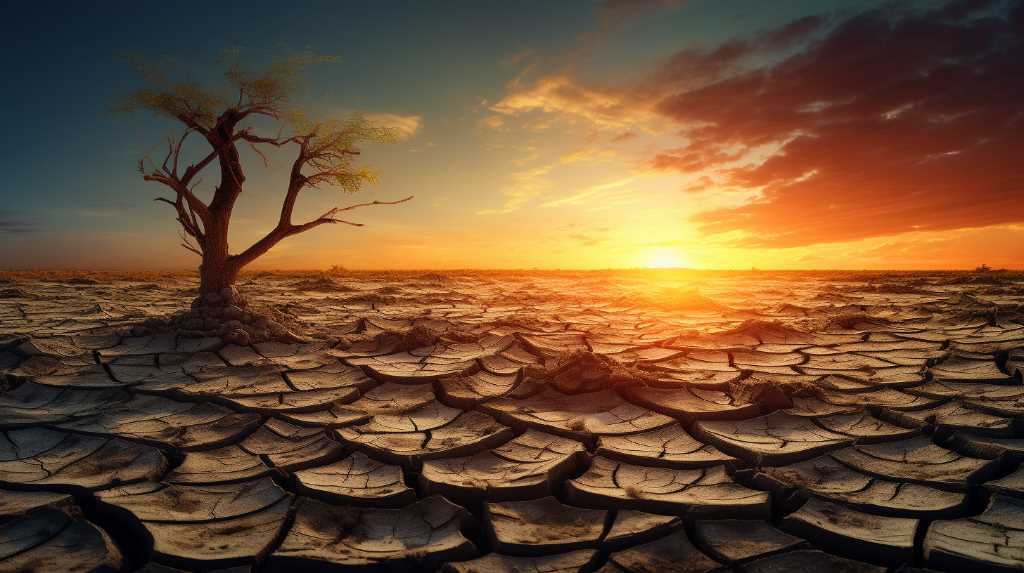
Are you aware of the devastating effects of climate change?
It’s causing extreme weather events, such as hurricanes and wildfires, that threaten lives and homes.
Droughts and floods are becoming more frequent, disrupting ecosystems and agriculture.
Heatwaves and high temperatures are becoming the new norm, putting human health at risk.
Species are going extinct, and biodiversity is being lost at an alarming rate.
Furthermore, food and water scarcity are becoming increasingly common.

Climate change is affecting you, and it’s time to take action.
Key Takeaways
- Extreme weather events such as hurricanes, tornadoes, and floods cause destruction, displacing communities and costing billions of dollars in rebuilding efforts.
- Droughts and floods lead to failed crops, food shortages, and economic instability, while also disrupting ecosystems and causing water scarcity.
- Heatwaves pose serious risks to human health, exacerbate air pollution, and cause damage to ecosystems, including crops and wildlife habitats.
- Climate change threatens biodiversity and species extinction, disrupting delicate balances in ecosystems and impacting food security, water availability, and overall stability.
Extreme Weather Events
Extreme weather events can wreak havoc on communities and infrastructure. When hurricanes strike, homes are destroyed, leaving families homeless and vulnerable. The strong winds and heavy rainfall can cause widespread flooding, making roads impassable and cutting off access to essential services. Power outages are common, leaving people without electricity for days or even weeks.
Tornadoes can tear through neighborhoods, demolishing buildings and uprooting trees. The destruction caused by these extreme weather events not only disrupts daily life but also poses significant risks to public safety. Emergency services are stretched thin, struggling to respond to the overwhelming demand for help. Rebuilding after such disasters can take years and cost billions of dollars.
It’s crucial to take action against climate change to mitigate the frequency and intensity of these devastating events.
Droughts and Floods
Are you aware of the devastating impacts that droughts and floods, caused by climate change, have on communities and ecosystems?
These extreme weather events are becoming increasingly frequent and severe, wreaking havoc on both human lives and natural habitats.
Droughts, characterized by prolonged periods of little to no rainfall, have dire consequences for agriculture, leading to failed crops, food shortages, and economic instability. They also exacerbate water scarcity, leaving communities without access to clean drinking water.

On the other hand, floods, caused by heavy rainfall or melting ice, result in widespread destruction, displacing millions of people, damaging infrastructure, and contaminating water sources.
Both droughts and floods disrupt ecosystems, leading to the loss of biodiversity and the destruction of fragile habitats.
It’s imperative that we take action to mitigate climate change and protect our communities and ecosystems from these devastating impacts.
Heatwaves and High Temperatures
As temperatures continue to rise due to climate change, you’ll experience increasingly frequent and intense heatwaves, posing serious risks to both human health and ecosystems.
Heatwaves, defined as prolonged periods of excessively hot weather, can have devastating consequences. The scorching temperatures can lead to heat-related illnesses, such as heat exhaustion and heatstroke, especially among vulnerable populations like the elderly and young children. High temperatures can also exacerbate air pollution and worsen respiratory conditions, such as asthma.
Furthermore, heatwaves can cause significant damage to ecosystems, including the destruction of crops, forests, and wildlife habitats.
The increased frequency and intensity of heatwaves due to climate change require immediate action to mitigate their harmful effects and protect both human and environmental health.

Species Extinction and Biodiversity Loss
To fully grasp the devastating effects of climate change, you must understand the alarming rate at which species extinction and biodiversity loss are occurring.
Climate change has become a major threat to the world’s biodiversity. Rising temperatures, habitat destruction, and changes in rainfall patterns are causing species to struggle to adapt and survive.
The Intergovernmental Science-Policy Platform on Biodiversity and Ecosystem Services (IPBES) warns that approximately one million species are at risk of extinction in the coming decades if we don’t take immediate action.
This loss of biodiversity not only affects the natural world but also has far-reaching consequences for human society. Ecosystems rely on a diverse range of species to function properly, and the loss of these species can disrupt delicate balances, leading to cascading effects on food security, water availability, and overall ecosystem stability.
It’s crucial that we prioritize conservation efforts and work towards mitigating climate change to protect the incredible diversity of life on Earth.
Food and Water Scarcity
The devastating effects of climate change extend beyond species extinction and biodiversity loss to include the alarming issue of food and water scarcity.
As the planet warms, changing rainfall patterns and increased evaporation rates have a significant impact on agricultural productivity and water availability. Crop yields are declining due to extreme weather events such as droughts, floods, and heatwaves, leading to food shortages and price hikes.

Additionally, rising temperatures affect water sources, causing rivers, lakes, and groundwater reserves to dry up. This scarcity of water not only affects agriculture but also poses a threat to human health and sanitation.
Without access to clean water and sufficient food, communities are left vulnerable to malnutrition, disease, and even conflict as competition for resources intensifies.
Urgent action is needed to mitigate the effects of climate change and ensure a sustainable future for food and water security.
Conclusion
You have witnessed the devastating effects of climate change firsthand. Extreme weather events have become more frequent and destructive, while droughts and floods have left communities struggling for survival.
Heatwaves and high temperatures have become the new normal, endangering lives and ecosystems. Species extinction and biodiversity loss have reached alarming levels, disrupting delicate ecosystems.
The impact of climate change is felt in every aspect of our lives, causing food and water scarcity.
It’s time to take urgent action to mitigate these devastating effects before it’s too late.

Climate Change
Cheniere Energy Received $370 Million IRS Windfall for Using LNG as ‘Alternative’ Fuel
The country’s largest exporter of liquefied natural gas benefited from what critics say is a questionable IRS interpretation of tax credits.
Cheniere Energy, the largest producer and exporter of U.S. liquefied natural gas, received $370 million from the IRS in the first quarter of 2026, a payout that shipping experts, tax specialists and a U.S. senator say the company never should have received.
Cheniere Energy Received $370 Million IRS Windfall for Using LNG as ‘Alternative’ Fuel
Climate Change
DeBriefed 27 February 2026: Trump’s fossil-fuel talk | Modi-Lula rare-earth pact | Is there a UK ‘greenlash’?
Welcome to Carbon Brief’s DeBriefed.
An essential guide to the week’s key developments relating to climate change.
This week
Absolute State of the Union
‘DRILL, BABY’: US president Donald Trump “doubled down on his ‘drill, baby, drill’ agenda” in his State of the Union (SOTU) address, said the Los Angeles Times. He “tout[ed] his support of the fossil-fuel industry and renew[ed] his focus on electricity affordability”, reported the Financial Times. Trump also attacked the “green new scam”, noted Carbon Brief’s SOTU tracker.
COAL REPRIEVE: Earlier in the week, the Trump administration had watered down limits on mercury pollution from coal-fired power plants, reported the Financial Times. It remains “unclear” if this will be enough to prevent the decline of coal power, said Bloomberg, in the face of lower-cost gas and renewables. Reuters noted that US coal plants are “ageing”.
OIL STAY: The US Supreme Court agreed to hear arguments brought by the oil industry in a “major lawsuit”, reported the New York Times. The newspaper said the firms are attempting to head off dozens of other lawsuits at state level, relating to their role in global warming.
SHIP-SHILLING: The Trump administration is working to “kill” a global carbon levy on shipping “permanently”, reported Politico, after succeeding in delaying the measure late last year. The Guardian said US “bullying” could be “paying off”, after Panama signalled it was reversing its support for the levy in a proposal submitted to the UN shipping body.
Around the world
- RARE EARTHS: The governments of Brazil and India signed a deal on rare earths, said the Times of India, as well as agreeing to collaborate on renewable energy.
- HEAT ROLLBACK: German homes will be allowed to continue installing gas and oil heating, under watered-down government plans covered by Clean Energy Wire.
- BRAZIL FLOODS: At least 53 people died in floods in the state of Minas Gerais, after some areas saw 170mm of rain in a few hours, reported CNN Brasil.
- ITALY’S ATTACK: Italy is calling for the EU to “suspend” its emissions trading system (ETS) ahead of a review later this year, said Politico.
- COOKSTOVE CREDITS: The first-ever carbon credits under the Paris Agreement have been issued to a cookstove project in Myanmar, said Climate Home News.
- SAUDI SOLAR: Turkey has signed a “major” solar deal that will see Saudi firm ACWA building 2 gigawatts in the country, according to Agence France-Presse.
$467 billion
The profits made by five major oil firms since prices spiked following Russia’s invasion of Ukraine four years ago, according to a report by Global Witness covered by BusinessGreen.
Latest climate research
- Claims about the “fingerprint” of human-caused climate change, made in a recent US Department of Energy report, are “factually incorrect” | AGU Advances
- Large lakes in the Congo Basin are releasing carbon dioxide into the atmosphere from “immense ancient stores” | Nature Geoscience
- Shared Socioeconomic Pathways – scenarios used regularly in climate modelling – underrepresent “narratives explicitly centring on democratic principles such as participation, accountability and justice” | npj Climate Action
(For more, see Carbon Brief’s in-depth daily summaries of the top climate news stories on Monday, Tuesday, Wednesday, Thursday and Friday.)
Captured
The constituency of Richard Tice MP, the climate-sceptic deputy leader of Reform UK, is the second-largest recipient of flood defence spending in England, according to new Carbon Brief analysis. Overall, the funding is disproportionately targeted at coastal and urban areas, many of which have Conservative or Liberal Democrat MPs.
Spotlight
Is there really a UK ‘greenlash’?
This week, after a historic Green Party byelection win, Carbon Brief looks at whether there really is a “greenlash” against climate policy in the UK.
Over the past year, the UK’s political consensus on climate change has been shattered.
Yet despite a sharp turn against climate action among right-wing politicians and right-leaning media outlets, UK public support for climate action remains strong.
Prof Federica Genovese, who studies climate politics at the University of Oxford, told Carbon Brief:
“The current ‘war’ on green policy is mostly driven by media and political elites, not by the public.”
Indeed, there is still a greater than two-to-one majority among the UK public in favour of the country’s legally binding target to reach net-zero emissions by 2050, as shown below.

Steve Akehurst, director of public-opinion research initiative Persuasion UK, also noted the growing divide between the public and “elites”. He told Carbon Brief:
“The biggest movement is, without doubt, in media and elite opinion. There is a bit more polarisation and opposition [to climate action] among voters, but it’s typically no more than 20-25% and mostly confined within core Reform voters.”
Conservative gear shift
For decades, the UK had enjoyed strong, cross-party political support for climate action.
Lord Deben, the Conservative peer and former chair of the Climate Change Committee, told Carbon Brief that the UK’s landmark 2008 Climate Change Act had been born of this cross-party consensus, saying “all parties supported it”.
Since their landslide loss at the 2024 election, however, the Conservatives have turned against the UK’s target of net-zero emissions by 2050, which they legislated for in 2019.
Curiously, while opposition to net-zero has surged among Conservative MPs, there is majority support for the target among those that plan to vote for the party, as shown below.

Dr Adam Corner, advisor to the Climate Barometer initiative that tracks public opinion on climate change, told Carbon Brief that those who currently plan to vote Reform are the only segment who “tend to be more opposed to net-zero goals”. He said:
“Despite the rise in hostile media coverage and the collapse of the political consensus, we find that public support for the net-zero by 2050 target is plateauing – not plummeting.”
Reform, which rejects the scientific evidence on global warming and campaigns against net-zero, has been leading the polls for a year. (However, it was comfortably beaten by the Greens in yesterday’s Gorton and Denton byelection.)
Corner acknowledged that “some of the anti-net zero noise…[is] showing up in our data”, adding:
“We see rising concerns about the near-term costs of policies and an uptick in people [falsely] attributing high energy bills to climate initiatives.”
But Akehurst said that, rather than a big fall in public support, there had been a drop in the “salience” of climate action:
“So many other issues [are] competing for their attention.”
UK newspapers published more editorials opposing climate action than supporting it for the first time on record in 2025, according to Carbon Brief analysis.
Global ‘greenlash’?
All of this sits against a challenging global backdrop, in which US president Donald Trump has been repeating climate-sceptic talking points and rolling back related policy.
At the same time, prominent figures have been calling for a change in climate strategy, sold variously as a “reset”, a “pivot”, as “realism”, or as “pragmatism”.
Genovese said that “far-right leaders have succeeded in the past 10 years in capturing net-zero as a poster child of things they are ‘fighting against’”.
She added that “much of this is fodder for conservative media and this whole ecosystem is essentially driving what we call the ‘greenlash’”.
Corner said the “disconnect” between elite views and the wider public “can create problems” – for example, “MPs consistently underestimate support for renewables”. He added:
“There is clearly a risk that the public starts to disengage too, if not enough positive voices are countering the negative ones.”
Watch, read, listen
TRUMP’S ‘PETROSTATE’: The US is becoming a “petrostate” that will be “sicker and poorer”, wrote Financial Times associate editor Rana Forohaar.
RHETORIC VS REALITY: Despite a “political mood [that] has darkened”, there is “more green stuff being installed than ever”, said New York Times columnist David Wallace-Wells.
CHINA’S ‘REVOLUTION’: The BBC’s Climate Question podcast reported from China on the “green energy revolution” taking place in the country.
Coming up
- 2-6 March: UN Food and Agriculture Organization regional conference for Latin America and Caribbean, Brasília
- 3 March: UK spring statement
- 4-11 March: China’s “two sessions”
- 5 March: Nepal elections
Pick of the jobs
- The Guardian, senior reporter, climate justice | Salary: $123,000-$135,000. Location: New York or Washington DC
- China-Global South Project, non-resident fellow, climate change | Salary: Up to $1,000 a month. Location: Remote
- University of East Anglia, PhD in mobilising community-based climate action through co-designed sports and wellbeing interventions | Salary: Stipend (unknown amount). Location: Norwich, UK
- TABLE and the University of São Paulo, Brazil, postdoctoral researcher in food system narratives | Salary: Unknown. Location: Pirassununga, Brazil
DeBriefed is edited by Daisy Dunne. Please send any tips or feedback to debriefed@carbonbrief.org.
This is an online version of Carbon Brief’s weekly DeBriefed email newsletter. Subscribe for free here.
The post DeBriefed 27 February 2026: Trump’s fossil-fuel talk | Modi-Lula rare-earth pact | Is there a UK ‘greenlash’? appeared first on Carbon Brief.
Climate Change
Pacific nations want higher emissions charges if shipping talks reopen
Seven Pacific island nations say they will demand heftier levies on global shipping emissions if opponents of a green deal for the industry succeed in reopening negotiations on the stalled accord.
The United States and Saudi Arabia persuaded countries not to grant final approval to the International Maritime Organization’s Net-Zero Framework (NZF) in October and they are now leading a drive for changes to the deal.
In a joint submission seen by Climate Home News, the seven climate-vulnerable Pacific countries said the framework was already a “fragile compromise”, and vowed to push for a universal levy on all ship emissions, as well as higher fees . The deal currently stipulates that fees will be charged when a vessel’s emissions exceed a certain level.
“For many countries, the NZF represents the absolute limit of what they can accept,” said the unpublished submission by Fiji, Kiribati, Vanuatu, Nauru, Palau, Tuvalu and the Solomon Islands.
The countries said a universal levy and higher charges on shipping would raise more funds to enable a “just and equitable transition leaving no country behind”. They added, however, that “despite its many shortcomings”, the framework should be adopted later this year.
US allies want exemption for ‘transition fuels’
The previous attempt to adopt the framework failed after governments narrowly voted to postpone it by a year. Ahead of the vote, the US threatened governments and their officials with sanctions, tariffs and visa restrictions – and President Donald Trump called the framework a “Green New Scam Tax on Shipping”.
Since then, Liberia – an African nation with a major low-tax shipping registry headquartered in the US state of Virginia – has proposed a new measure under which, rather than staying fixed under the NZF, ships’ emissions intensity targets change depending on “demonstrated uptake” of both “low-carbon and zero-carbon fuels”.
The proposal places stringent conditions on what fuels are taken into consideration when setting these targets, stressing that the low- and zero-carbon fuels should be “scalable”, not cost more than 15% more than standard marine fuels and should be available at “sufficient ports worldwide”.
This proposal would not “penalise transitional fuels” like natural gas and biofuels, they said. In the last decade, the US has built a host of large liquefied natural gas (LNG) export terminals, which the Trump administration is lobbying other countries to purchase from.
The draft motion, seen by Climate Home News, was co-sponsored by US ally Argentina and also by Panama, a shipping hub whose canal the US has threatened to annex. Both countries voted with the US to postpone the last vote on adopting the framework.
The IMO’s Panamanian head Arsenio Dominguez told reporters in January that changes to the framework were now possible.
“It is clear from what happened last year that we need to look into the concerns that have been expressed [and] … make sure that they are somehow addressed within the framework,” he said.
Patchwork of levies
While the European Union pushed firmly for the framework’s adoption, two of its shipping-reliant member states – Greece and Cyprus – abstained in October’s vote.
After a meeting between the Greek shipping minister and Saudi Arabia’s energy minister in January, Greece said a “common position” united Greece, Saudi Arabia and the US on the framework.
If the NZF or a similar instrument is not adopted, the IMO has warned that there will be a patchwork of differing regional levies on pollution – like the EU’s emissions trading system for ships visiting its ports – which will be complicated and expensive to comply with.
This would mean that only countries with their own levies and with lots of ships visiting their ports would raise funds, making it harder for other nations to fund green investments in their ports, seafarers and shipping companies. In contrast, under the NZF, revenues would be disbursed by the IMO to all nations based on set criteria.
Anais Rios, shipping policy officer from green campaign group Seas At Risk, told Climate Home News the proposal by the Pacific nations for a levy on all shipping emissions – not just those above a certain threshold – was “the most credible way to meet the IMO’s climate goals”.
“With geopolitics reframing climate policy, asking the IMO to reopen the discussion on the universal levy is the only way to decarbonise shipping whilst bringing revenue to manage impacts fairly,” Rios said.
“It is […] far stronger than the Net-Zero Framework that is currently on offer.”
The post Pacific nations want higher emissions charges if shipping talks reopen appeared first on Climate Home News.
Pacific nations want higher emissions charges if shipping talks reopen
-
Greenhouse Gases7 months ago
Guest post: Why China is still building new coal – and when it might stop
-
Climate Change7 months ago
Guest post: Why China is still building new coal – and when it might stop
-
Greenhouse Gases2 years ago嘉宾来稿:满足中国增长的用电需求 光伏加储能“比新建煤电更实惠”
-
Climate Change2 years ago
Bill Discounting Climate Change in Florida’s Energy Policy Awaits DeSantis’ Approval
-
Climate Change2 years ago
Spanish-language misinformation on renewable energy spreads online, report shows
-
Climate Change2 years ago嘉宾来稿:满足中国增长的用电需求 光伏加储能“比新建煤电更实惠”
-
Climate Change Videos2 years ago
The toxic gas flares fuelling Nigeria’s climate change – BBC News
-

Carbon Footprint2 years agoUS SEC’s Climate Disclosure Rules Spur Renewed Interest in Carbon Credits


