Connect with us

Published

on

A new analysis by Ember shows that solar energy, combined with battery storage, could meet up to 90% of India’s electricity demand at a lower cost than what most states currently pay for power. The findings highlight a major shift: clean energy is no longer just sustainable—it is becoming the most economical option.

India’s solar journey has already begun, but the real opportunity lies in scaling it up and making it available round the clock.

India’s Solar Potential Is Massive but Underused

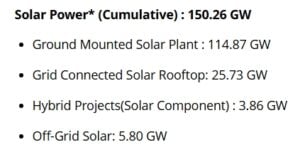
India’s cumulative solar capacity as of March 2026 was 150.26 GW. While this sounds significant, the Ember report states that it represents only about 4% of the country’s estimated 3,343 GW ground-mounted solar potential. In simple terms, India has barely tapped into its solar resources.

india solar
Source: MINISTRY OF NEW AND RENEWABLE ENERGY (MRNE) India

This untapped capacity is enormous. The total feasible solar potential could generate nearly three times the country’s electricity demand in 2024. Even more striking, this estimate uses only a small portion of available land—just 6.7% of suitable wasteland, which is less than 1% of India’s total land area.

Moreover, this figure excludes other major opportunities. Rooftop solar alone could add over 600 GW, while floating solar projects may contribute up to 300 GW. Technologies like agrivoltaics, which combine farming with solar panels, could further expand capacity.

Solar power is already making a visible impact. In 2025, it contributed 9.4% of India’s electricity. During peak sunny hours, it met nearly a quarter of demand. However, the challenge remains clear: solar stops working after sunset. To fully unlock its potential, India must solve the “night problem.”

Why Solar + Storage Makes 90% Clean Power Possible

Now, battery storage is the missing piece. It allows excess solar power generated during the day to be stored and used at night. Thanks to falling battery costs, this solution is now economically viable.

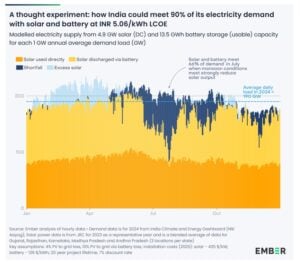
  • According to Ember’s modeling, solar combined with batteries can meet up to 90% of India’s electricity demand at a levelized cost of electricity (LCOE) of about INR 5.06 per kWh. This is cheaper than the average power purchase cost in many states today.

solar battery storage India

However, reaching 100% solar is not as simple. Each additional percentage beyond 90% requires significantly more solar panels and storage capacity. This leads to rising costs, making 90% the most practical and cost-effective target.

To meet this level of demand, India would need around 930 GW of solar capacity. This is still less than one-third of its total feasible ground-mounted potential. Alongside this, about 2,560 gigawatt-hours (GWh) of battery storage would be required.

In practical terms, for every 1 GW of average demand, the system would need about 4.9 GW of solar capacity and 13.5 GWh of storage.

Seasonal Patterns Shape Solar Performance

Solar energy does not perform the same way throughout the year. Its effectiveness depends heavily on seasonal patterns and weather conditions.

The Ember report further highlighted that during the early months of the year, from January to April, solar radiation is strong. In this period, solar and batteries can meet nearly 100% of daily electricity demand. Batteries store excess energy during the day and release it at night, ensuring a stable supply.

In peak summer months like May and June, electricity demand rises by about 10%. Even then, solar and storage can still meet around 88% of demand.

The real challenge appears during the monsoon season. Cloud cover reduces solar output significantly, especially in July. During this time, solar and batteries can meet only about 66% of demand.

This limitation is not due to battery capacity. Instead, it is caused by reduced solar generation over several cloudy days. Batteries can shift energy from day to night, but they cannot store large amounts of power for extended low-sunlight periods.

This is why a balanced energy mix is essential.

Wind and Hydro Will Fill the Gaps

India does not need to rely on solar alone. Other clean energy sources can complement solar power effectively.

Wind energy is especially important. It tends to generate more power during the monsoon months, when solar output is low. This natural balance helps stabilize the overall energy system.

Hydropower and nuclear energy can also provide steady, reliable electricity. Together, these sources reduce the need for excessive solar and battery capacity, keeping costs under control.

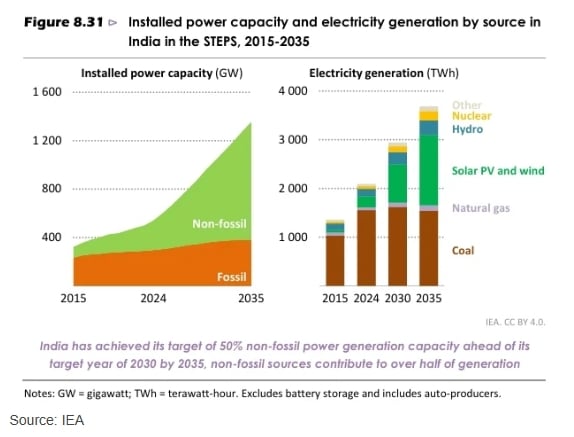
As a result, solar becomes the backbone of the system, while other clean sources fill in the gaps. Looking ahead, solar will play a major role in meeting energy demand. Around 50% of India’s additional electricity demand through 2030 is expected to come from solar power.

india solar

State-Level Trends Show Strong Potential

The feasibility of solar-plus-battery systems varies across states. This depends not only on sunlight availability but also on how and when electricity is used.

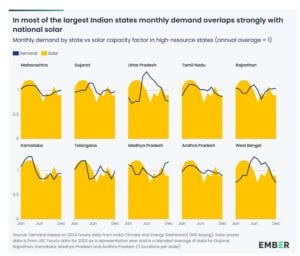
States like Andhra Pradesh, Maharashtra, Karnataka, Telangana, and Tamil Nadu show strong alignment between solar generation and electricity demand. In these regions, demand peaks during sunny months, making it easier for solar to meet a large share of electricity needs.

For example, demand in these states is often 10% to 29% higher than average during high-solar months. At the same time, demand drops during the monsoon, which helps offset lower solar output.

Other states like Gujarat, Rajasthan, and Madhya Pradesh also show favorable conditions. Their demand remains relatively stable throughout the year, which makes solar integration smoother.

india states solar

However, not all states are equally suited. Uttar Pradesh and West Bengal face more challenges. In these regions, electricity demand peaks during the monsoon, when solar output is weakest. This mismatch makes it harder for solar-plus-storage systems to meet demand efficiently.

These differences explain why the same solar and battery setup performs better in some states than others.

Transmission Will Unlock National Benefits

India’s renewable energy strategy already reflects a smart approach. Large-scale solar projects are being developed in high-resource states with strong sunlight and available land. At the same time, the country is expanding its transmission network to move electricity across regions.

This interconnected system allows solar-rich states to supply power to areas with higher demand or lower solar potential. It also improves the overall efficiency of the grid.

As transmission infrastructure grows, the benefits of solar and storage will spread across the country.

The analysis makes one thing clear: India has the resources to transform its power system. Solar energy, backed by battery storage, can deliver clean, reliable, and affordable electricity at scale.

  • In the broader context, the Asia-Pacific region led the global BESS market, generating USD 17.31 billion in 2025 and expected to reach USD 21.32 billion in 2026.

battery energy storage

However, the transition will require careful planning. Seasonal variations, regional differences, and the need for complementary energy sources must all be considered.

Still, the direction is clear. With falling costs and abundant resources, solar plus storage is no longer a future possibility—it is a present-day solution.

India now stands at a turning point. By scaling up solar and investing in storage and grid infrastructure, the country can move closer to a low-cost, low-carbon energy system that meets demand day and night.

The post Solar Plus Batteries Can Meet 90% of India’s Electricity Needs, Says Ember appeared first on Carbon Credits.

Continue Reading

Carbon Footprint

MRV and Additionality: The Two Questions Your Auditor Will Ask First

Published

on

What auditors actually test, where projects actually fail, and the contract clauses that protect you before signature.

The meeting happens about fourteen months after the contract was signed. Your assurance provider has reached the nature-based investment line in your Scope 3 file, and the partner across the table has exactly two questions. How do you know the reductions happened? And how do you know they would not have happened anyway?

The first question is MRV: measurement, reporting, and verification. The second is additionality. Between them, they decide whether your nature-based investment counts, in your inventory, in your disclosure, and in front of your board. Everything else in the project documentation is supporting material for these two answers.

This article walks through what each question actually tests, where projects most commonly fail, what digital MRV has changed (and what it has not), and the contract clauses that protect you. The goal is to give you the diligence framework before you sign, because after the credit issues is the wrong time to discover the answers were weak.

What MRV actually verifies

MRV is the machinery that turns a field intervention into a defensible number. Measurement covers the data: biomass surveys, soil sampling, remote sensing, activity records from participating farms. Reporting covers the translation of that data into claimed reductions under a recognised methodology. Verification covers the independent check: an accredited third party tests the reporting against the methodology and the evidence.

The methodologies live in registries. Verra’s Verified Carbon Standard and the Gold Standard are the two largest for nature-based projects, and each publishes the methodology documents, monitoring requirements, and verification protocols that a project must follow. The ICVCM Assessment Framework now sits above the registries, assessing whole methodologies against the Core Carbon Principles and granting the CCP label to those that pass.

For a buyer, the practical questions are concrete. What is the monitoring frequency, and is it specified in the project design document or left vague? Who is the verifier, how were they selected, and how often do they rotate? What raw data do you, the buyer, get access to, and in what format? A project that answers these in writing is a different procurement than one that answers them in a sales call.

What additionality actually proves

Additionality asks whether the intervention caused the reduction, or whether the reduction would have happened anyway. The test is a counterfactual: what would this landscape, this farm, this forest have done without the project’s money?

Three forms matter in practice. Financial additionality asks whether the project needed the carbon revenue to proceed. Regulatory additionality asks whether the activity was already required by law. Common-practice additionality asks whether the activity is already standard in the region, in which case paying for it buys you nothing the world was not getting for free.

The reason additionality dominates audit conversations is recent history. Research published in 2023, including the Science paper examined at length in our piece on conventional offsets and boardroom credibility, found that a large share of REDD+ credits failed the counterfactual test because baselines were inflated. The market response was a wave of methodology revisions at Verra and the arrival of independent ratings agencies whose entire business is re-testing additionality claims. The Carbon Credit Quality Initiative publishes transparent scoring of methodologies on exactly this dimension, and it is free to consult before you sign anything.

Where projects most commonly fail the test

Five failure modes account for most of the wreckage.

  • Inflated baselines. The counterfactual assumes more deforestation, more degradation, or lower yields than the evidence supports. The claimed reduction is the gap between reality and the baseline, so an inflated baseline manufactures reductions from nothing.
  • Unaccounted leakage. The project protects one forest and the logging moves to the next valley. The methodology is supposed to net this out; weak projects estimate it optimistically.
  • Thin permanence protection. Nature-based carbon can reverse: fire, pest, drought, or a change of landowner. Buffer pools and insurance mechanisms exist for this, but their adequacy varies enormously between projects.
  • Attribution and double counting. In supply chain settings, the same reduction can be claimed by the supplier, the buyer, and a credit purchaser unless contracts prevent it. Our Insetting vs Offsetting piece covers the inventory rules; the point here is that the auditor will ask who else is counting this tonne.
  • Stale monitoring. Data collected at validation and never refreshed. The IPCC AR6 Working Group III land-sector chapter documents how quickly carbon stocks respond to disturbance; a three-year-old measurement is a historical artifact, not a current claim.

What digital MRV changes, and what it does not

Digital MRV is the genuine improvement in the field. Satellite remote sensing, including the free archives at NASA Earthdata, allows biomass and land-cover change to be monitored continuously rather than at multi-year verification intervals. Soil carbon models calibrated with physical sampling reduce the cost of agricultural measurement. The practical effect is more frequent data at lower cost, which compresses the window in which a problem can hide.

What digital MRV does not change is judgment. Baselines are still human decisions about counterfactuals. Additionality is still an argument, not a measurement. Research groups such as the Oxford Smith School have been clear on this point: better sensors improve the M in MRV, but the integrity questions live in the assumptions, and assumptions need governance, not gadgets.

For a buyer, the test is simple. Ask the provider what is measured by instrument, what is estimated by model, and what is assumed by methodology. A provider who can answer that question crisply understands their own evidence chain. A provider who cannot is selling you their confidence rather than their data.

What to require in your contract

The diligence above converts into five contract clauses.

  • Monitoring cadence and buyer data access, specified by dataset and frequency.
  • Verifier independence, named accreditation, and rotation terms.
  • Baseline revision triggers, so the counterfactual updates when the methodology or the evidence changes.
  • Reversal liability and buffer adequacy, with the mechanism named and sized.
  • Documentation handover in audit-ready form, so the evidence file your assurance provider needs already exists.

None of these clauses is exotic. All of them are absent from weak contracts, and their absence is the most reliable early signal that the MRV and additionality answers will be weak too.

If you are evaluating a nature-based investment and want the MRV and additionality stress-tested before signature rather than after, the carbon and sustainability experts at Carbon Credit Capital can run that review against any project on your shortlist, and design nature-based supply chain investments where the evidence chain is built audit-first. Schedule a consultation.

Sources and further reading

Continue Reading

Carbon Footprint

The EU’s New Green Claims Rules and Carbon Credits

Published

on

EU Directive: Empowering Consumers for the Green Transition (ECGT)

The EU Directive, Empowering Consumers for the Green Transition (ECGT), takes effect on September 27, 2026.(1) The goal of ECGT is to protect consumers by ensuring that environmental claims are fair, understandable, and reliable. This regulation does create a new compliance requirement for businesses, but it also provides sustainability and marketing teams with important guidance that helps create consistency in sustainability communications.

Key takeaways

  • ECGT takes effect September 27, 2026, and prohibits claims that a product or service has a neutral, reduced, or positive environmental impact based on offsetting alone.
  • Named example phrases the regulation prohibits include climate neutral, CO2 neutral certified, carbon positive, climate net zero, climate compensated, reduced climate impact, and limited CO2 footprint.
  • ECGT does not want to deter investment in carbon credits. It wants companies to communicate the real benefits of the projects they support instead.
  • SBTi’s guidance recommends framing carbon credits as taking responsibility for ongoing emissions, not as making a product or company neutral.
  • Voluntary carbon projects deliver real climate progress: reducing super-pollutants, protecting and restoring ecosystems, and supporting communities.

Regarding carbon credits specifically, voluntary carbon projects deliver important climate progress and environmental benefits that provide many talking points for companies. They reduce climate super-pollutants by removing industrial emissions like methane, N2O, HFCs and others. They protect and restore valuable ecosystems and carbon sinks like forests, mangroves and grasslands. They help communities by reducing local pollution, creating employment opportunities, improving access to healthcare, and more.

The Science Based Targets Initiative (SBTi), a global leader in business climate action, concludes that alongside aggressive decarbonization, we should also use high quality carbon credits to take responsibility for our ongoing emissions. SBTi recognizes that carbon credits are important “to help limit temperature overshoot, mitigate transition risks, and support climate solutions.”(2)

ECGT language on carbon offsetting says that they do not want to deter investment in carbon credits. They just want companies to focus on communicating the benefits of the projects they support and avoid claims beyond the scope of carbon credits, which is good for everyone, companies and consumers alike.

The regulation reinforces that carbon credits do not change the sustainability of your products, so carbon credit buyers should not suggest that their products are more sustainable because of carbon credits. Instead, companies need to promote their climate contributions as a way to compensate or take responsibility for their carbon emissions by supporting projects that do great things like reducing global carbon emissions, reducing pollution, preventing deforestation, restoring forests, and more.

ECGT language related to carbon offsetting

The regulation is particularly focused on prohibiting claims, based on offsetting greenhouse gas emissions, that a product or service has a neutral, reduced, or positive impact on the environment in terms of greenhouse gas emissions. These claims are prohibited in all circumstances because they mislead consumers into believing the claim relates to the product itself, or to how it was made and supplied, or into thinking that using the product carries no environmental impact at all.

Named examples of prohibited claims include:

  • climate neutral
  • CO2 neutral certified
  • carbon positive
  • climate net zero
  • climate compensated
  • reduced climate impact
  • limited CO2 footprint

These claims are only allowed when they rest on a product’s actual lifecycle impact, not on offsetting emissions outside that product’s value chain, since the two are not equivalent. This prohibition does not stop companies from advertising their investments in environmental initiatives, including carbon credit projects, as long as they present that information in a way that is not misleading and that meets the other requirements of Union law.(1)

SBTi also provides guidance on climate contribution language in its Corporate Net Zero Standard Version 2.0 Draft for Second Public Consultation, November 2025. While the SBTi language is fairly technical, it has a good framework for crafting a climate contribution message.

SBTi Language for Carbon Credits(3)

  • Take responsibility for ongoing emissions by delivering mitigation impact contributions
  • Carbon credits certify the mitigation outcomes of projects that reduce, avoid, or remove carbon emissions
  • Activities that reduce emissions from emission sources not located within the company’s value chain
  • Activities that conserve, protect, and enhance natural carbon sinks
  • Activities that capture and store carbon in storage pools

SBTi’s draft standard also walks through sample claim language for this kind of contribution. In general, the samples move from a simple percentage statement, to naming a specific verified tonnage tied to that percentage, to a fuller statement that breaks the tonnage into reductions versus removals. Across all three, the framing stays consistent: a company took responsibility for a defined share of its ongoing emissions over a set period, by funding a specific, verified amount of mitigation, achieved through emission reductions or removals.(3)

FAQ: ECGT and Carbon Credit Claims

When does the ECGT directive take effect?

The rules apply across the EU from September 27, 2026, after member states transposed the directive into national law by March 27, 2026.

Does ECGT ban carbon offsetting?

No. It bans specific marketing claims that a product or service is environmentally neutral, reduced impact, or positive based on offsetting. Advertising investment in carbon credit projects themselves is still allowed if it is not misleading.

What phrases does ECGT specifically prohibit?

Named examples include climate neutral, CO2 neutral certified, carbon positive, climate net zero, climate compensated, reduced climate impact, and limited CO2 footprint, when those claims are based on offsetting rather than a product’s actual lifecycle impact.

How should a company describe its carbon credit purchases instead?

SBTi’s guidance recommends stating the specific verified tonnage of emissions reductions or removals funded and describing that as taking responsibility for a defined share of ongoing emissions, rather than claiming the company or product is neutral.

Does this rule apply to company level sustainability claims too?

ECGT is focused on claims about specific products and services in consumer marketing. Broader company level sustainability communication is a separate matter still governed by other existing rules.

While ECGT does add a new compliance burden for businesses, it helps create consistency in sustainability messaging that is important to building confidence in voluntary carbon projects and scaling the industry to help us achieve progress on global carbon emissions.

Disclaimer: Terrapass does not provide legal or regulatory advice. Any interpretation of regulation must be approved by your legal representative.

References:
(1) https://eur-lex.europa.eu/eli/dir/2024/825/oj
(2) https://files.sciencebasedtargets.org/production/files/Corporate-Net-Zero-Standard-version-2.pdf
(3) https://files.sciencebasedtargets.org/production/files/CNZS-V2-Second-Consultation-Draft.pdf

The post The EU’s New Green Claims Rules and Carbon Credits appeared first on Terrapass.

Continue Reading

Carbon Footprint

Want a simpler way to buy carbon credits? Discover our carbon marketplace

Published

on

Most businesses that decide to act on their net-zero targets reach the same point of friction. Buying carbon credits has meant tracking down brokers, sitting through sales calls, and requesting a quote just to learn a price, sometimes with limited proof of what you are buying.

Continue Reading

Trending

Copyright © 2022 BreakingClimateChange.com