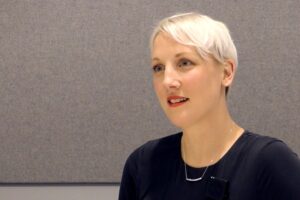
Prof Penny Endersby has been chief executive of the UK Met Office since December 2018.
She took the reins at the UK’s climate and weather service after more than two decades working in the science and technology department of the Ministry of Defence.
Endersby has led the Met Office during a critical period which has seen record-breaking heat in the UK, an intensification of extreme weather around the world and a resurgence in attacks on climate science.
At the same time, advances in artificial intelligence (AI) have started to transform climate modelling and the Met Office has switched on a cloud-based “supercomputer” dedicated to improving weather and climate science.
- On how working on defence is like climate change: “There are more scientific parallels than you would think. Armour modelling is computational fluid dynamics modelling, like weather modelling.”
- On her previous interest in climate change: “I am naturally a sort of geeky, evidence-based person. I actually had kept 10 years of rain gauge records in Wiltshire – just because I was interested – before I ever thought about this job.”
- On how the Met Office informs UK climate-change preparations: “Our core bit is on preparing other people to make the decisions on what to expect. So we do the science of the climate projections that says: ‘Where might we be in 2030, 2050, 2100 under different emission scenarios?’”
- On the aspect of UK climate change that concerns her most: “The one that probably keeps me awake at night is the flash flooding – the surface water flooding from very localised torrential rainfall events, because those are the hardest to model.”
- On the Paris Agreement’s 1.5C temperature limit: “It is theoretically possible we stay within 1.5C, but it’s going to require action that’s never been seen and doesn’t look like it’s coming.”
- On geoengineering: “There’s nothing regulating [it] globally. So other people may do it – whether we advocate [for] it or not. So, we do think it is the right thing to do to understand what the impacts of it could be [so as] to be able to detect it if other people do it.”
- On carbon removal techniques: “The best way to get carbon out of the atmosphere is still a tree…The next easiest thing is direct carbon capture…The other techniques – I think they’re worth investigating, but they’re not going to be available at scale in the times that we need.”
- On budget cuts to the US weather and climate service: “I think the actual impact on funding, so far, has not been as severe as some of the news stories have said – because their role is just as fundamental to the operation of the state as ours is.”
- On the reach of the IPCC’s big assessment reports: “I think, in many ways, our best hope now lies in the global financial system. They’re not very altruistic, but they are very rational and they do use the best evidence… And, if the money sends them into different investments or different insurance strategies – that is still going to be based on the evidence that comes out of the IPCC.”
- On the evolution of climate misinformation: “I think the climate data is now so stark, that anyone who looks at the data at all can see that we’re in unprecedented times. [But] what has happened, to my grief and distress, has been people now attacking the trusted sources of data. And in the UK – that’s us.”
- On how the Met Office deals with misinformation: “We have had to become – per force – experts in countering misinformation and disinformation, and, really, to an extent, quite thought-leading in government and in convening cross-government networks to deal with this.”
- On social media attacks on the Met Office: “The aggression that some of our media-facing people face online [and] the really vile hostility which often quite junior staff are dealing with – that definitely is something where we have to take care of and look after people.”
- On personal attacks on social media: “It can be painful, but you really have to rise above it. And when it’s a woman, there’s always a generous salting of misogyny in there as well.”
- On claims about the inaccuracy of Met Office temperature readings: “Just to be clear, the claims are baseless…Everything we do is to the required standards.”
- On potential applications for AI in climate science: “AI for climate change is relatively new – and the challenge is always, what’s the training data set? Because you don’t have the training data set for climate that hasn’t happened yet.”
- On the Met Office’s work with AI: “Our strategy is to go for the best blend of conventional and AI modelling – but we’re still working out what we think that best blend will be.”
- On the Met Office’s first cloud-based supercomputer: “It needs to be [in the cloud], because the amazing, fantastic, wonderful data that we have – [and] on which all of these products and AI is built – is now so big you can’t move it. We have about half an exabyte of data.”
Carbon Brief: Hi Penny. Thanks for joining us. To start off, I wanted to ask: previous to becoming the chief executive of the Met Office, you worked for the science and technology arm of the Ministry of Defence. How did that role prepare you for your current position – and in what ways is working on climate change like defence?
Penny Endersby: I think the whole of that 25-year career as a scientific civil servant prepared me for my current position. And I started off being a researcher myself in armour and explosives, and then leading scientists in larger and larger chunks. My final role was as head of the cyber information division of the Defence Science and Technology Laboratory (DSTL). I was on the board of DSTL as well.
There are more scientific parallels than you would think. Armour modelling is computational fluid dynamics modelling, like weather modelling. I was responsible for big data and AI. I was responsible for space. So, there was lots of crossover. But the main thing was leading the experts and the people who are passionately committed to making lives better through science. That was the biggest crossover with what I do now.
CB: Why did you want to work for the Met Office?
PE: I have to say being chief executive of the Met Office was completely my dream job. I had actually applied to be chief executive of DSTL, very much on a punt, not long before. I got further than I expected – I got down to the last four, but I wasn’t successful. I had good feedback that went [along the lines of]: “Yeah, try again sometime.”
And then the Met Office [job] came up, and it had just had everything I wanted: a mission that I really cared about, doing something valuable, the scientific content, staying a civil servant and working for the government. [And] not being in London, because I am a great lover of the country. I moved from Wiltshire to Devon to take this job. [It was also] a promotion.
It just was the complete package. I gave getting the job everything.
CB: Why did you start becoming interested in climate change? I don’t know if you remember a particular moment or event?
PE: I was interested in [the] weather [and] the natural world from childhood. So I have always been a naturalist. I am naturally a sort of geeky, evidence-based person. I actually had kept 10 years of rain gauge records in Wiltshire – just because I was interested – before I ever thought about this job.
Although I was concerned about climate change and I knew the basics, I didn’t really study it until I got to this job and then was leading the organisation with the Hadley Centre [the Met Office’s climate research centre] in it, with amazing climate scientists and amazing climate science. So that seven years has been a journey of building my knowledge and my expertise.
CB: The Met Office has a mandate to help people make decisions and stay safe and thrive through its weather services. So could you just tell us a little bit about how the Met Office is equipping citizens for the current and future climate?
PE: You are right, that is our purpose – helping you make better decisions to stay safe and thrive. And it is weather and climate.
So on the “staying safe” side, that goes from everything from severe weather warnings in the shorter term, through to [longer-term] making decisions about what flood defences you are needing in the future. And that’s not [directed at] citizens – that’s [directed at] policymakers.
And on the “thrive” side, as well, it might be as simple as, “am I going to go for a run or hang washing out?” [when it comes to] weather timeframes. On climate timeframes, it is about making sure that we have got built infrastructure that enables us thrive in a changing climate, whether that is houses that don’t overheat or green spaces that cool down our urban centres – all those things.
CB: And in terms of preparing for that infrastructure, could you explain a bit more about how the Met Office actually does that?
PE: So our core bit is on preparing other people to make the decisions on what to expect. So we do the science of the climate projections that says: “Where might we be in 2030, 2050, 2100 under different emission scenarios?” [We ask] what does that look like globally and in the UK? We need to know that for our food security and border security and energy security – and nationally, in detail, in the UK.
And then, it is other people who will take that information and decide what to do with it. So, on the adaptation side, we’re really informing other people’s decisions.
CB: Other people being the government…?
PE: It could be local authorities. We have local authority climate dashboards for local authorities to look at how climate change is going to [impact them]. I did notice that Bermondsey, where we are right now, is right at the peak of the bit of London that is expected to be under water – the floodiest bit of London going forward and the hardest to protect.
And then it could be big national decision-makers. I’ll give you a completely different example. If we’re going to have a renewable energy system in the future, the weather we [are having] today is the worst possible weather for renewable energy. It could be cold as well, but it is dull and still. So, [there is] not much wind, not much solar. How long could that wind drought go on and how long could it persist when it’s also cold and there’s a high heating demand? So, we do the modelling that helps the National Energy System Operator plan for how much capacity they need in different weather scenarios and climate scenarios in the future.
CB: What aspects of current or projected climate change in the UK concern you most?
PE: I think the biggest concern is the flooding. And it’s all the sorts of flooding – [including] the coastal flooding from higher sea level [and] the river flooding from extreme rainfall.
The one that probably keeps me awake at night is the flash flooding – the surface water flooding from very localised torrential rainfall events, because those are the hardest to model. The smaller the scale of a phenomenon, the more difficult it is for us to model well in advance.
And yet we know – and we have seen – we have had a few very near misses in this country with the kind of things that affected Valencia or Germany, or that terrible Texas event – very rapid river rises from torrential downpours.
And it’s not just [about the Met Office] getting the rainfall [warnings] right. Our managing director for this area described [these preparations] as a “team sport”. So, we have to get the rainfall right, the hydrological people, jointly with us, have to get the flooding right, the whole of the response system has to respond to understand what’s going to happen. People have to get out and often in maybe only a couple of hours. Whereas for a great big winter storm, we might be giving seven or eight days notice.
CB: Thinking a bit more globally, a new report from a research group based at [the University of] Exeter suggests that a climate tipping point for warm water corals has already been crossed. What does the prospects of these tipping points mean for the work of climate scientists?
PE: It presents us with lots of new challenges, I think.
If there was one thing that shocked me most, going back to the beginning of my time at the Met Office, it was just how long we have known about the fundamentals of climate science – like, 150 years. I had not realised that our understanding of the greenhouse effect and the rough idea of climate sensitivity went back so far. And we have been really well able to understand and project that, really for my whole lifetime. The good climate modelling goes back to about 1970.
But tipping points changed the whole equation for climate science. And, of course, we’re only just beginning to observe them. So, there, we don’t have the track record of projecting it and checking back against what’s happened in reality. So they’re some of the hottest topics – I dare say you might come on to the AMOC [Atlantic Meridional Overturning Circulation]. But all of those areas are very, very active areas of research and areas where the science is not so settled.
CB: The 1.5C warming threshold of the Paris Agreement is looking more fragile than ever. 2024 was the first year-long breach of the limit. How likely is it, in your opinion, that [the rise in] temperatures are limited to 1.5C? And when do you think that could happen?
PE: Well, it is theoretically possible we stay within 1.5C, but it’s going to require action that’s never been seen and doesn’t look like it’s coming. So, we think the opportunity to stay within that first Paris threshold is vanishingly small now – and, if we continue at the current rate, we have only got a few years to go before we cross it long-term.
And, actually, the Met Office has done quite a bit of work looking at how you identify that threshold without waiting for 10 years of averages to go: “Yes, [the limit] was [breached] 10 years ago.”
So then we are into, well, how far can we limit it? Because obviously it’s not a cliff edge. That’s where we think – and I still think – that’s where the more dangerous impacts of climate change kick in. But between 1.5C and 2C – there’s a huge difference. And at 2C, 3C [and] God forbid 4C, all of those impacts multiply. So, it’s how we stay as close [to 1.5C of warming] as we can.
CB: There are growing calls for solar radiation modification and other forms of geoengineering to be considered to tackle climate change. I wanted to get your take on geoengineering as a climate strategy.
PE: The Met Office doesn’t take any particular stance on geoengineering. I need to make it really clear – because we get lots of conspiracy theories – and we do none. We have some very limited modelling to understand what it might look like and what it might do.
I think I might like to draw a distinction between my personal view and the Met Office here. But the only form of geoengineering that actually solves the problem is taking the carbon back out of the atmosphere. Solar radiation modification – it is a masking technique. It doesn’t stop ocean acidification. And once you start, you’ve got to go on, because if you stop, you can get catastrophic, very rapid, catching up.
So, in as much as we advocate anything, it would always be the mitigation techniques [actions that reduce emissions of greenhouse gases] we already know.
Having said that, there’s nothing regulating [geoengineering] globally. So, other people may do it – whether we advocate it or not. So, we do think it is the right thing to do to understand what the impacts of it could be [so as] to be able to detect it if other people do it and understand what they might be doing. It will be a political decision whether it’s a last resort thing to do.
CB: You mentioned carbon removals just now. Scientists at a recent conference on climate overshoot stressed that the 1.5C goal, if breached, needed to be “met from above” with the help of these technologies that remove emissions from the air. How feasible is that, in your view?
PE: The best way to get carbon out of the atmosphere is still a tree. So, some of these are nature-based solutions. And, then, the next easiest thing is the direct carbon capture – so, catch [the carbon] where it is, don’t try to get it back.
The other techniques – I think they’re worth investigating, but they’re not going to be available at scale in the times that we need. It is an entirely good and valid topic for research, but it shouldn’t be a substitution.
CB: Changing topic a bit. The US government has attacked climate science and is cutting national weather and climate services, including access to satellite data. How is this impacting both weather forecasting and climate research at the Met Office?
PE: So we retain a really close collaboration with NOAA [the US National Oceanic and Atmospheric Administration] who are important partners for us. We continue to have access to all of those US satellites that are gathering data. We exchange that through the World Meteorological Organization’s (WMO’s) data exchange.
And the EUMETSAT is the way we gather European satellite data – and the UK is a part of that, and that is all still exchanged.
I think what we are finding is that any government – irrespective of its political stance – needs the fundamentals of what a national meteorological agency can do. Everybody needs a weather forecast, everybody needs warnings, everybody needs aviation, transport, everybody needs defence.
And, so, there’s certainly been a lot of instability in NOAA, while these things work through. And, obviously there’s a government shutdown at the moment. But I think the actual impact on [NOAA] funding, so far, has not been as severe as some of the news stories have said – because their role is just as fundamental to the operation of the state as ours is.
CB: And, a secondary question to that is, are these events or geopolitics impacting the morale at all at the Met Office? And, as a boss, how do you address that, or try to mitigate that if so?
PE: I think the general Met Office staff are really very interested in their science and the mission and not so politically focused. I spent a lot of time thinking about what are the things that we do that will have value under any government and into the future and how we make sure that we can continue to deliver our great services to the government. And we do that with our executive and board.
What does impact morale is some of the misinformation we’ve seen, where we get people attacking the integrity of our observations or the integrity of our scientists. The aggression that some of our media-facing people face online [and] the really vile hostility which often quite junior staff are dealing with – that definitely is something where we have to take care of and look after people.
CB: In the UK, we’ve seen the Conservatives and Reform describe the UK’s net-zero target as “arbitrary”. And, in the US, we’ve seen the president describe climate change as a “con”. So, I wanted to ask you, do you feel that the Met Office and other influential climate science centres have a responsibility to publicly rebut or respond to these claims?
PE: No, absolutely not. The Met Office is a civil service organisation, so we have a very strong mandate to remain impartial and serve the government of the day. We have a government that is really committed to net-zero and being a green energy superpower and we will do everything we can for that. If a democratically elected government comes with a different mandate, our role is to provide that government with the best science to make the best policy decisions they can. It is not to tell them that their policies are wrong.
CB: I want to talk a bit about the IPCC [Intergovernmental Panel on Climate Change] now and the seventh assessment cycle. The IPCC has appointed five Met Office scientists to its newest cycle. What would you like to see the cycle focus on?
PE So I’m not sure I’m really the best person to answer this. Clearly, they are going to be focused on what happens between and above 1.5C. How do we replace that Paris threshold if it has gone? And therefore, increasingly, the adaptation [topic].
Where I actually get more involved is, as a delegate to the WMO and on the Early Warning for All [initiative]. And obviously, the more extreme climate-driven weather events we see, the more crucial early warning is to protect populations. And that will come out of the projections from the IPCC.
CB: I wondered if you had any thoughts on the IPCC’s big assessment reports. Is this model the best way for it to be effective? Or do you think there’s a better option?
PE: I do firmly believe that good decisions have to be based on good evidence. And the IPCC is as good a gold standard as you could have for benchmark evidence in any field.
So that whole process of collecting all the evidence from across researchers across the globe, factoring in what’s effectively a multi-model ensemble, looking at the error bars coming to consensus – it is too slow, right? Because consensus always lags. What the best guess would be – the consensus was always behind it. But I think it is an important model. I’m reminded of Simon Sharpe’s book Five Times Faster [which states that] it is not just [about] the scientists, it is then all the other, the other responses, as well, that need to respond.
I think, in many ways, our best hope now lies in the global financial system. They’re not very altruistic, but they are very rational and they do use the best evidence. They are actually not remotely interested in the politics, because they will look at where the money sends them. And if the money sends them into different investments or different insurance strategies – that is still going to be based on the evidence that comes out of the IPCC.
CB: After the US pulled its officials from attending the last IPCC meeting in China, how could a reduced US contribution impact the work of the IPCC in the upcoming cycle?
PE: I really can’t speak to that. I don’t know enough about it to give you a sensible answer.
CB: All right, let’s come on to misinformation. You mentioned it already. To start off: how is climate misinformation changing in your view?
PE: I’ve really seen this change in the course of this job. I think I was naive when I took this job. One of the things I said in my pitch for the job was: I believe I will be in post in the period when the person in the street in the UK becomes aware of the impact of climate change.
And I think I was right – we have had the first 40C and extreme wildfire events, extreme floods. People have seen it. But, I thought that that would lead to a rational response of people going: “Oh, gosh, they were right all along – we need to do something about it.”
That didn’t happen. What I have seen, therefore, is it was still more or less possible to go “meh, you’ve got the science wrong and you don’t really understand it” seven years ago.
I think the data is now so stark, that anyone who looks at the data at all can see that we’re in unprecedented times. [But] what has happened, to my grief and distress, has been people now attacking the trusted sources of data. And in the UK – that’s us.
We see increasingly statements about all kinds of rubbish, everything from, “you’re hiding the sensors in aircraft jets exhaust to show fake heating – you’ve gone back and changed the past” [to] “you’re measuring temperatures on the ground instead of properly in the Stevenson screen”. [There are] just a raft of things that take us a lot of time and taxpayers money to rebut.
There’s a name for this law and I’ve forgotten it [Brandolini’s law] – but there’s a law that says that, basically, misinformation can be produced in seconds, but takes days to rebut. And this is very, very true.
And, so, we have had to become – per force – experts in countering misinformation and disinformation and, really, to an extent, quite thought-leading in government and in convening cross-government networks to deal with this.
And although I guess I’m speaking to the converted and I’m offering you some rebuttal. That isn’t the best way; the people who firmly believe these things, they’re not remotely interested in your rebuttal.
The best way to maintain the extraordinary trust the Met Office currently enjoys is actually to be putting out the good stories. Here is the plethora of amazing ways we collect weather observations, from deep ocean buoys to space to marine gliders to measurements in the Arctic – whatever it is. Put out the positive stories, alongside the people stories. At your weather station – wherever you are in the UK – some expert person from the Met Office comes along and checks all the instruments and takes them back for calibration and makes sure the grass is the regulation height and assesses the surrounding area to make sure that things aren’t encroaching and so on.
Putting out those positive stories of how we do it, is a better use of our time and energy and more effective, we think, than rebutting the people who are not acting in good faith.
CB: My next question was going to be about your strategy for dealing with online climate misinformation. And you’ve talked about focusing on the positive story…
PE: Preinoculation in misinformation terms.
CB: I wondered if there was anything else you could share about your strategy and perhaps how it’s evolving as climate misinformation is?
PE: The other thing we found is it’s really useful to get independent voices in. So now, when we do put out stories, particularly when we put one up that we know it’s going to be a red rag. [For instance] it has been the hottest UK year in history. It has been the warmest summer. This was the first year that was above 1.5C for the average globally – which was something we forecast, by the way. We also do the WMO state of the climate and the annual to decadal five-year projections.
Whereas we might have just put those out with the WMO, now we tend to pre-share that information with other trusted parties – whether that is in academia or the Royal Met Soc [the Royal Meteorological Society], or whether it is NOAA or NASA or whoever – and have quotes nicely lined up for journalists, so that they can take them. That kind of independence is useful. I think all the UK scientific bodies are looking at how we can strengthen that network across government, so that we can speak to our areas of expertise when they cross over with other people’s.
CB: I wanted to ask you about AI-generated content as well. Is that something that you’ve seen specifically?
PE: Obviously, we do lots of good work in AI, which we might also come to.
CB: I was talking still in the context of climate misinformation – do you have a strategy for addressing that particular type of content?
PE: Yes. We have even seen Met Office deepfakes. So our presenters [as] deepfakes put out misleading information. And I’m not sure we do have a strategy for this.
The other thing we do, but it’s not so much for the AI, is deal with the clickbait. You know [for example]: “Exact date UK to be wiped out by a wall of snow.” And we do put quite a lot of stories out going: “Have you seen a thing that goes, it’s going to be a heatwave and a wall of snow?” [We] try to help people understand how to tell [a] good source from a bad source. But the level of protection you have, legally, against those things is not very strong.
CB: And striking that balance between, as you were saying earlier, responding to certain claims, but not giving them more air…
PE: We don’t want to make them more salient.
CB: How do you judge, essentially, when it is worth a public response and when it isn’t?
PE: Partly on how much is in its echo chamber versus where it has widened out. Generally, we find that within the echo chambers, it is just not worth a public response. The Met Office has a million followers on the main social media platforms and we have people putting out things who have 20, so if you rebut the 20[-follower] person with your million, everybody sees the 20-person story. That’s not the right thing.
And we have had to change our blocking policy as well, which is a shame, because we had a really [light-touch] blocking policy. We only blocked the obscene and threatening, but we found that our big audiences are being used to gain a platform for misinformation, particularly around geoengineering. And we have had to say we can’t, we can’t live with that. So we block more liberally than we did.
CB: You already brought up the attacks we’ve seen on the accuracy of Met Office temperature readings and data. I wanted to ask, have you been surprised by those stories and what is your general response to those claims?
PE: Just to be clear, the claims are baseless. We’ve dealt particularly with the ones that say the WMO is critiquing our data. You may have seen now the statement from the secretary general of the WMO going “we have the highest confidence in the quality and validity of Met Office data”. So, that was one [claim] where we did source a deliberate rebuttal.
But, generally, I’d just like to reassure you that everything we do is to the required standards, the WMO to ISO9001 [quality management] standards, assured externally and internally. And then the [Met Office] independent public weather service customer group also assures the quality of the science and the outputs [and] the accuracy of the warnings.
The worst thing is if people start to believe [the claims] – and then they don’t take action on warnings when [they are] there to protect their lives.
CB: You have been the subject of quite a lot of attacks on social media. I wanted to ask how you manage that on a personal level?
PE: It can be painful, but you really have to rise above it. And when it’s a woman, there’s always a generous salting of misogyny in there as well. I have tended now not to go and read these things, because they prey on your mind and there’s nothing you can do. We do monitor for actual threats, which we would have to act on.
CB: And you mentioned a lot of colleagues as well were facing [attacks on social media]?
PE: Yes. The personal attacks tend to be on the most senior people, [on] me or the chief scientist [Prof Stephen Belcher]. But, obviously, the person who is managing our social media feed still gets a mouthful of abuse when they’re reading and responding. It is not aimed at them personally, but they are still a human being – and maybe not a very senior or experienced one.
CB: And moving on from social media, I wanted to talk a bit about the media more generally. So have you seen a change in the way that the media covers climate change?
PE: It is around the fringes. I expect you know that we’ve just signed a new partnership deal with the BBC, who are extremely rigorous in how they cover climate change. And one of the things…we’re really excited to work on them. Last time we worked with the BBC, Verify [a service where journalists share their evidence-gathering] didn’t exist. They, too, have had to invest a whole lot of effort in how you counter misinformation – and they have some really leading thinking. We’re excited to work with Verify on weather and climate information.
But, I think it’s the “wilding” of the social media landscape that’s changed.
CB: What climate change topics would you like to see the media cover more?
PE: I think there is lots of coverage across all the topics. I can’t say the information isn’t out there. It is how it is picked out and the way that our social algorithms segregate it. [For] anyone who wants to find out, there is good information out there on almost any topic – because media is always looking for stories, right?
The problem is once you’ve moved yourself into a bubble where you don’t want to see it. And you can see [this] if you watch US media coverage of a weather disaster. Even when it’s highly likely to be climate change-related, they don’t say so. The people presumably watching those channels don’t make that link.
CB: I wanted to talk a bit about AI in a different way now. So, how is AI transforming climate forecasting at the Met Office?
PE: The Met Office has been working with AI for several years – and before the big generative AI shift. We do that in many aspects of our work. AI for climate change is relatively new – and the challenge is always “what’s the training data set”? Because you don’t have the training data set for climate that hasn’t happened yet.
But we are using it to look at some of the opportunities. For example, in what we would call downscaling, which is a technical term, but basically going from a coarse-resolution model – which climate change tends to be, because we need to run them over such a long time and they’re very computer hungry – to see if we can use AI to replicate something that is more like the fine scale of our weather models.
And, more generally, we are enthusiastic, but not naive, adopters of AI, I would like to say. We do now have our own AI weather model, FastNet, which we developed jointly with the Turing Institute. We’re looking at the opportunities for AI and our products and services – so could you fuse it with, say, transport data to say: “Well, the weather’s here and the trains or the planes are there – where are the impacts going to be?” And go straight to the results.
And we use it quite widely in our everyday work as well. So, increasingly, I think 1,000 people in the Met Office are using [Microsoft] Copilot and 97% of people who have a licence use it for just making our everyday work more efficient.
I expect you’re going to come on and ask about the challenges of validation and trust, and if you’re not, I’ll go on that way.
CB: Can you tell me a bit about the challenges that come with using AI?
PE: AI can hallucinate, right? The rule we have in the Met Office is you may use AI for any purpose that is efficient in your job, like to write your code for you. You must declare you’ve used it. So if I use it to summarise a board paper, it’s wonderful. I get a 10-page board paper – I’m not having that – [and use] Copilot [to get it] down to five pages and bring it back. But you must declare it and you are still responsible for the accuracy of what you produce. So, if there’s a bug in your code, or it has actually changed your board paper so it now says something different, that’s still your problem.
Where we are really exploring things is – we rigorously validate anything we use operationally and we’re not really using AI operationally yet. And we have extremely tried and trusted techniques to do that. And every time we upgrade a weather model, we put it through a whole series of checks and balances to make sure it really is better than the last one – and if it isn’t, we don’t implement it.
The techniques we use for conventional modelling have limitations for AI.
AI, you train to replicate. You optimise it for a particular thing [and] it will do that wonderfully. But then, if it has very low average errors, it may still miss the extremes. And if what you do is compare average error, it will look like it’s better than the conventional model. But if, actually, that’s because it smooths everything out and it has missed the extremes – when you really want to know, it’s going to be wrong.
So, what we’re increasingly working on is on running our own AI models. And we’re looking at the other market leaders – the European ones, the [Google] DeepMind one. And we’re continuously evaluating them against the leading conventional models and looking at what the full suite of metrics is you need, if we wanted to feed our app from an AI model, rather than from a numerical one – a physical model. What are the thresholds it would need to pass before we were confident to do that?
CB: That’s really interesting. I wanted to talk a bit more generally about climate modelling as well. We’ve talked about AI, but where are the other exciting innovations, and also perhaps where are the gaps that still need to be addressed?
PE: They are kind of two sides of the same coin, I think. We would love to be able to do the kind of kilometre-scale [modelling] we do for weather for climate. Computationally by conventional methods, it’s just unaffordable and it doesn’t even look close – and with Moore’s law breaking down, it almost looks like you’ll never get there. AI, potentially, could close that gap. And that’s where that downscaling problem that I gave you, came in.
Others of the exciting things, I think they are around particularly the tipping points and the adaptation and the attribution. Some of the live areas of research for us when you see
CB: When you say Moore’s law is breaking down, what do you mean?
PE: The amazing improvement of weather forecasting since the 50s has been built on the fact that computing power doubles every couple of years for the same cost. So you can get more and more transistors on a chip and the supercomputer gets more and more powerful. We can reduce the scale of our weather models and improve the resolution, and can give you more accurate weather. That’s gone on for basically – [it has] improved the weather forecast at a “day a decade” over that period.
We’ve reached about the physical limit of how many transistors you can fit on a chip and supercomputers are no longer basically giving us improved modelling accuracy for free. And, so, we have to use different techniques now to find a way to continue to improve the accuracy of the weather forecast and maintain that “day a decade” improvement. And we’re confident we can and AI will be part of that mix.
So, our strategy is to go for the best blend of conventional and AI modelling – but we’re still working out what we think that best blend will be.
CB: And I know the Met Office recently switched on its new supercomputer, so I wondered if you could just tell us a bit about what’s new and how it might impact your research.
PE: This is a big step up in [computing power] and it’s also… The Met Office, I think we’re on about our 14th supercomputer. The first one we blagged some time on a Lyons tea room computer back in the 50s. But, then, numbers two to 13 we’ve owned and they’ve been based in our headquarters – wherever we’ve been – and we’ve operated them ourselves.
This one is different. Microsoft owns and operates it for us. And that’s a step to the whole thing being fully in the cloud, fully in Azure Cloud. And it needs to be because the amazing, fantastic, wonderful data that we have – [and] on which all of these products and AI is built – is now so big you can’t move it. We have about half an exabyte of data. So, the data needs to be next to the computer to be processed.
And, so, this computer is really exciting. We’re about to implement the first, what we call a parallel suite, but the first big model upgrade. Using it will let us do finer-scale, better microphysics – particularly cloud microphysics – [and] better precipitation. Because we’re running the parallel suite – which isn’t live yet, that’s why it’s a parallel suite – we can see the improvement we’re getting just from that first step forward.
And, then, we’ve got a whole series of scientific upgrades planned over the next few years to continue to improve our forecasting in weather and climate.
CB: Brilliant. That’s everything. Thank you very much.

The post The Carbon Brief Interview: UK Met Office chief executive Penny Endersby appeared first on Carbon Brief.
The Carbon Brief Interview: UK Met Office chief executive Penny Endersby
Climate Change
Q&A: Why does gas set the price of electricity – and is there an alternative?
A surge in gas prices triggered by the Iran war has caused a knock-on spike in the price of electricity in the UK, Italy and many other European markets.
This is because gas almost always sets the price of power in these countries, even though a significant share of their electricity comes from cheaper sources.
This “coupling”, which is part of what UK energy secretary Ed Miliband calls the “fossil-fuel rollercoaster”, is due to the “marginal pricing” system used in most electricity markets globally.
After another fossil-fuel price shock, just four years after Russia’s invasion of Ukraine, this coupling between gas and electricity prices is once again under the spotlight, in the UK and the EU.
There are various alternatives that have been put forward as ways to break – or “decouple” – the link between gas and electricity prices.
Electricity prices could be “decoupled” from gas prices by changing the way the market works, but ideas for doing this either have not been tested or have problems of their own.
Some people have implied that the UK could insulate itself from high and volatile international gas prices by extracting more gas from the North Sea.
However, contrary to false claims by, for example, the hard-right climate-sceptic Reform UK party, this would not be expected to cut energy bills, because gas prices are set on international markets.
Finally, electricity prices can be “decoupled” from gas by burning less of it, a shift that is nearly complete in Spain and that is already having an impact in the UK.
- Why does gas set the price of electricity?
- What is the impact of gas setting the electricity price?
- What market reforms have been proposed?
- Why is ‘marginal pricing’ in the news again?
- Would it help if more gas were extracted domestically?
- Would burning less gas stop it setting electricity prices?
Why does gas set the price of electricity?
In liberalised economies, electricity is bought and sold via market trading. The market uses a system called “marginal pricing” to match buyers with enough supply to meet their demand.
(The same system is used in most commodity markets, including for oil, gas or food products.)
All of the power plants that are available to generate make “bids” to sell electricity at a particular price. The bids are arranged in a “merit order stack”, from the cheapest to the most expensive, shown in the illustrative schematic below.

This means that the price of gas sets the price of electricity, whenever gas plants are at the margin.
In the UK, the marginal unit is almost always a gas-fired power plant. As a result, one widely cited academic analysis found that gas set the price of power 97% of the time in the UK in 2021.
In contrast, the analysis found that gas only sets the price of power 7% of the time in France, as shown in the figure below. This is because the French market is dominated by nuclear power.

The “pay as clear” marginal-pricing system means that gas sets the price of power more often than might be expected, given its share of electricity generation overall.
For example, gas set the price of power 97% of the time in 2021, even though it only accounted for 37% of electricity generation that year. Equally, even though renewables now make up around half of UK electricity supplies, gas still usually sets the price of power in the UK.
(There are some important subtleties to this, due to the fact that not all gas-fired power plants are equally expensive to run. This is discussed further below.)
Overall, the fact that gas hardly ever sets the price of power in some European markets hints at the potential to decouple electricity prices from gas, by shifting towards alternative sources.
What is the impact of gas setting the electricity price?
The tight coupling of gas and electricity prices in the UK and other markets is the source of significant political debate, particularly during periods when the price of gas soars.
When gas prices hit record highs after Russia’s invasion of Ukraine in 2022, politicians, commentators and the media rushed to understand why this also spiked electricity bills.
The same dynamic is playing out in 2026, following the attacks on Iran by the US and Israel, the closure of the Strait of Hormuz and the resulting surge in international gas prices.
An editorial in the Financial Times published earlier this month is headlined: “The déjà vu of Europe’s energy shock.” It says the crisis is once again raising questions over electricity pricing:
“In Britain, in particular, questions remain on how to reform its electricity pricing, which currently leaves it highly exposed to volatile wholesale gas prices.”
This exposure is illustrated in the figure below, which shows the tight link between prices on the “day-ahead” markets for gas and electricity.

Indeed, recent analysis from the UK Energy Research Centre (UKERC), published before the Iran war, found that high gas prices were still the biggest driver of high UK electricity bills.
The UK is not the only market being hit by high electricity prices after the outbreak of war in the Middle East. Italy is also suffering, at a time when it was already in the midst of a major debate over how to cut electricity prices, which are also high due to its heavy reliance on gas power.
What market reforms have been proposed?
Historically, some governments set the price of electricity themselves. However, this is increasingly rare and most countries now have “liberalised” electricity markets to determine prices.
These markets use the “pay as clear” system of marginal pricing, described above, to balance supply and demand in each hour of the day.
Alternative models include “pay as bid”, where each power plant is only paid the amount that it bid to supply electricity, rather than the higher price of the marginal unit.
However, this “would not provide cheaper prices”, according to the European Commission, because bidders would seek to maximise their profits by guessing the clearing price:
“In the pay-as-bid model, producers (including cheap renewables) would simply bid at the price they expect the market to clear, not at zero or at their generation costs.”
Another option would be to create two separate markets, one “green power pool” for renewables and another for conventional sources of electricity.
One proponent of this idea is Prof Michael Grubb at University College London. In a March 2026 post on LinkedIn he says:
“The impact of surging gas prices on electricity will again highlight the oddities of our current electricity market – which make sense to many economists, but to hardly anyone else.”
Explaining his rationale for creating separate power markets, he continues:
“The crisis again emphasises that gas-generated power and renewables are not really the same commodity and deserve distinct and tailored market structures to also enhance transparency. Unless and until that occurs, no amount of policy tinkering can overcome the volatility imposed by geopolitical events outside our control.”
However, the UK government concluded in 2024 that it “[did] not consider [a green power pool] to be deliverable”, adding that, even if it were possible, it “would not provide additional benefits”.
This was part of the UK government “review of electricity market arrangements” (REMA), which considered – and then rejected – a series of alternative ways to structure the market.
Similarly, it is less than two years since the European Commission also considered – and then rejected – alternatives to the marginal pricing system, notes Jon Ferris, head of flexibility and storage at consultancy LCP Delta, in a LinkedIn post. The commission explains:
“This model provides efficiency, transparency and incentives to keep costs as low as possible. There is general consensus that the marginal model is the most efficient for liberalised electricity markets.”
In the UK, a debate in parliament in early March 2026 saw Labour MP Toby Perkins questioning the marginal pricing system, which he said was now “far less robust”. He said:
“Because renewables are cheaper, should we not look to benefit from that, rather than having a system that allows gas to set the price, even if it accounts for only 1% of our energy?”
Ultimately, however, marginal pricing is the “worst approach to clearing markets apart from all the others”, Ferris tells Carbon Brief.
The Iran crisis has also been used to resurface a more radical option, put forward last year by consultancy Stonehaven and NGO Greenpeace, of taking gas out of the market completely.
The idea would effectively see gas plants being taken into a strategic reserve, where they would receive a regulated return for remaining open. They would be managed centrally and called on to generate power as needed outside of the market, which would continue to use marginal pricing.
Adam Bell, partner at Stonehaven and the government’s former head of energy policy, tells Carbon Brief that it would be possible to implement within 18 months, but only if moving at a pace that the civil service might describe as “brave”.
Why is ‘marginal pricing’ in the news again?
Despite the decisions at UK and EU level to reject the alternatives, interest in moving away from marginal pricing has recently been reignited – even before the shock of the Iran war.
For example, in a speech in February, European Commission president Ursula von der Leyen said a recent meeting of member states had seen “intense discussion” over marginal pricing:
“We did not come to a conclusion. I want to be very clear on this one. But to the next European Council, I will bring different options and findings on whether it is time to move forward on the market design or whether we are still good on this market design.”
A subsequent leak from the commission, seen by Carbon Brief, also implies that marginal pricing is up for debate, as part of ongoing discussions on how to tackle high energy prices.
Subsequently, Philippe Lamberts, climate advisor to von der Leyen, made comments implying that the marginal pricing system was problematic.
In response, ahead of a meeting of EU governments in the week beginning 16 March, a group of seven member states wrote to the commission warning against market reform.
Their letter says that “no satisfactory alternative model has been identified” and that “all other options discussed would introduce inefficiencies”, compared with sticking to marginal pricing.
Industry group Eurelectric makes similar comments in its own letter, as well as warning about the uncertainty that would be created by market reform. It says:
“Delivering massive investments in clean power generation is the structural answer to reduce our dependence on fossil fuels. Reopening the fundamental principles of market design risks increasing uncertainty, delaying investment decisions and, ultimately, raising system costs.”
Another element to the debate has come from Italian government proposals to subsidise gas plants, in an effort to reduce electricity prices in the country.
The proposal has drawn comparisons with the so-called “Iberian mechanism”, under which the governments of Spain and Portugal subsidised gas power during the 2022 energy crisis.
This support did yield “short-term price relief”, says Chris Rosslowe, senior analyst at thinktank Ember in a post on LinkedIn. However, he says it also had “perverse consequences”, including increasing demand for gas “in the middle of a gas supply crisis”.
These sorts of ideas “would cause a lot of collateral damage” in terms of market efficiency, investor confidence and other areas, says Prof Lion Hirth at the Hertie School in Berlin, in a LinkedIn post.
Jean-Paul Harreman, director at consultancy Montel Analytics, writes in an article on LinkedIn:
“[R]eplacing transparent marginal pricing with political price formation is often like replacing a thermometer because you dislike the temperature reading. It may feel satisfying. It does not change the weather.”
Would it help if more gas were extracted domestically?
In the UK, there has also been intense pressure from opposition politicians and some sections of the media to expand gas production in the North Sea.
Nigel Farage, the climate-sceptic head of Reform UK, was recently quoted by Bloomberg as claiming: “Producing our own gas would reduce everybody’s electricity bills significantly.”
There is no evidence to support this claim.
While the opposition Conservatives have also been loudly calling for an expansion of North Sea drilling, they have been more circumspect about any impact on bills.
Writing in the Daily Telegraph, Conservative leader Kemi Badenoch only indirectly links such an expansion in domestic gas production with lower bills. She writes:
“[P]art of the reason we’re being hit so hard by [the Iran war] is because we are not drilling our own oil and gas thanks to [the government’s] net-zero madness.”
Badenoch’s own shadow energy secretary Claire Coutinho contradicted this idea in 2023, when she was in government. She said at the time that awarding new oil and gas licensing “wouldn’t necessarily bring energy bills down”.
This is because, as the UK’s energy minister Michael Shanks said at a recent event: “We will always be a price taker in international fossil-fuel markets, not a price maker.”
What he is saying is that UK gas production is small relative to the size of the European and global market for the fuel. As such, any increases in UK production would not materially affect prices.
Moreover, North Sea gas production has been in decline for decades and this is set to continue, whether or not the government allows new drilling to take place. This is because much of the gas it once contained has already been extracted and burned.
Would burning less gas stop it setting electricity prices?
The final idea for breaking the link between gas and electricity prices is simply to burn less gas.
This is one of the key motivations behind the UK government’s “clean power 2030” plan, which aims to largely decarbonise electricity supplies by 2030.
The government said when launching its plan:
“These investments will protect electricity consumers from volatile gas prices and be the foundation of a UK energy system that can bring down consumer bills for good.”
In 2026, however, UK electricity prices are still largely dictated by gas prices, as described above.
Yet this does not mean that the expansion of renewables has had no impact. Indeed, analysis by thinktank the Energy and Climate Intelligence Unit (ECIU) suggests that renewables have already reduced UK wholesale electricity prices by a third in 2025.
As more renewable generation is added to the system, the most expensive gas plants in the merit order “stack” are knocked out of the market. Even though another gas plant may still be setting power prices, it will be a cheaper and more efficient unit.
This intermediate impact of renewables is already visible when comparing electricity prices in the UK with those in Italy and Spain, as shown in the figure below.
The figure shows that UK wholesale electricity prices have been lower than those in Italy, as a result of the expansion of renewable sources over the past decade. (Prior to this, wholesale prices were similar in both countries.)
The contrast with prices in Spain is even larger , where Ember says “strong solar and wind growth [has] reduced the influence of expensive coal and gas power on the electricity market”.

The UK is already seeing electricity prices that are “decoupled” from gas prices on windy days. In addition, an increasing amount of electricity is set to be generated by renewable sources that hold “contracts for difference” (CfDs).
CfD projects are paid a fixed price for the electricity they generate, regardless of the price on the “day-ahead” wholesale market. As such, they dilute the impact of gas on consumer bills.
In 2022, when the last energy crisis hit, only 7% of UK generation was covered by CfDs, according to freelance “energy geek” Ben Watts. As of 2026, he says this has climbed to 13%.
By 2030, CfD projects will make up as much as half of total electricity supplies in the UK.
Callum McIver, research fellow at the University of Strathclyde and a member of the UKERC, tells Carbon Brief that CfDs are a “mechanism to decouple bills from the cost of gas”. He adds:
“With significant volumes of new and lower cost renewables on CfDs expected to connect to the system over the next few years, the impact of the scheme on price decoupling should accelerate…This provides an ever increasing hedge against future price shocks.”
Power-purchase agreements (PPAs) can have a similar effect. Here, large users such as industrial sites sign a contract with a power plant to buy the electricity they generate at a fixed price. Again, this takes some electricity out of the wholesale market, diluting the impact of gas prices.
Increases in UK renewable generation are yet to unseat gas from its role in determining electricity prices in most hours of the year, but this shift is starting to have an impact.
Analysis by consultancy Modo Energy suggests that electricity prices in the UK were above the price of gas power in nearly 90% of hours in 2018, a figure that had fallen to below 80% in 2024. Modo’s director Ed Porter said on Twitter: “The link between gas and power prices is weakening.”
In Spain, analysis by Ember shows that the link is well on the way to being completely broken. Ember data shared with Carbon Brief shows that power prices were above the cost of gas power in 52% of hours in 2021, but this had fallen to 15% of hours in 2026 to date.
This data, shown in the figure below, is in stark contrast with Italy, where the influence of gas on electricity prices has actually increased in recent years.

A similar effect would be possible for the UK. Recent analysis from LCP Delta shows that the UK electricity system would be “almost entirely insulated from gas price shocks”, if it reaches the government’s clean-power 2030 targets.
Posting on LinkedIn, Sam Hollister, principal and head of UK market strategy, writes that a spike in gas prices similar to current levels would only increase household bills by 8%, if the 2030 targets are met. In contrast, bills would rise by 45%, if no CfD-backed renewables were on the system.
In his LinkedIn article, Montel’s Harreman concludes:
“The real structural solution to high power prices is not to mute marginal pricing, but to reduce exposure to fossil fuels and accelerate clean capacity, grids and flexibility. That lowers marginal costs structurally rather than cosmetically.”
“Marginal pricing is uncomfortable in volatile times. But discomfort is not evidence of failure. It is often evidence that the system is telling the truth. And, in energy markets, obscuring the truth is usually more expensive than confronting it.”
The post Q&A: Why does gas set the price of electricity – and is there an alternative? appeared first on Carbon Brief.
Q&A: Why does gas set the price of electricity – and is there an alternative?
Climate Change
DeBriefed 13 March 2026: War and oil | Why gas drives electricity prices | Japan’s ‘vulnerability’ to Iran crisis
Welcome to Carbon Brief’s DeBriefed.
An essential guide to the week’s key developments relating to climate change.
This week
War and oil
HISTORIC: Leaders from 32 countries agreed to the “biggest emergency oil release in history” in response to the energy crisis sparked by the Iran war, reported Politico. The coordinated release of 400m barrels of oil by member nations of the International Energy Agency (IEA) is “more than twice” the amount released following Russia’s invasion of Ukraine in 2022, the outlet continued.
$100 BARREL: The agreement came as oil surged past $100 a barrel for the first time in four years on Monday, as “traders bet widening conflict in the Middle East would lead to weeks-long supply disruptions”, said the Financial Times. According to a report from the US Energy Information Administration, crude oil prices are likely to remain above $95 a barrel in the next two months, before falling to around $70 by the end of this year, reported Reuters. Research consultancy Wood Mackenzie, meanwhile, said oil prices could yet reach $150 per barrel, according to Reuters.
KREMLIN: The war in Iran has pushed up demand for Russian oil and gas, with the nation making €6bn (£5bn) in fossil-fuel sales in the last fortnight, according to analysis by the Centre for Research on Energy and Clean Air covered by the Guardian. Read Carbon Brief’s Q&A on what the war means for the energy transition and climate action.
Around the world
- FLOODS: A month’s worth of rain in 24 hours triggered floods that killed more than 40 people in Kenya, reported the country’s Daily Nation newspaper.
- NET-ZERO: A new report from the UK’s Climate Change Committee outlined that achieving net-zero by 2050 will have less of a financial impact than the kind of fossil-fuel price rises experienced during the 2022 energy crisis, reported Carbon Brief.
- SOLAR: The amount of solar energy installed in the US fell by 14% between 2024 and 2025, according to an industry report, reported the New York Times.
- WATCHING: A Paris Agreement “watchdog” will discuss this month how to respond to countries who have failed to submit their latest national climate plan, Climate Home News reported, adding that about a third of countries are yet to submit more than a year after the deadline.
99%
The amount by which UK gas production in the North Sea is set to fall by 2050, when compared to 2025, as a result of a long-term decline in the basin.
97%
The amount by which North Sea gas production is set to decline from 2025 to 2050 if the government allows new drilling, according to new Carbon Brief analysis.
Latest climate research
- One-third of the world’s population lives in areas where heat and humidity would “severely limit activity for younger adults” | Environmental Research: Health
- The increase in extreme fire weather over 1980-2023 bears a “clear externally-forced signal” that is attributable to human-caused climate change | Science
- More than 85,000 social media posts from commuters in Boston, London and New York reveal “widespread thermal discomfort” in metro systems | Nature Cities
(For more, see Carbon Brief’s in-depth daily summaries of the top climate news stories on Monday, Tuesday, Wednesday, Thursday and Friday.)
Captured
Gas almost always sets the price of power in the UK and many other European countries, due to the “marginal pricing” system used in most electricity markets. A new Carbon Brief Q&A explored why this is the case and whether there are alternatives.
Spotlight
Japan’s ‘vulnerability’ to Iran energy crisis
Carbon Brief talks to experts about the implications of the Iran war for Japan’s energy and economy.
Japan, the world’s fifth largest economy and eighth largest greenhouse gas emitter, is among the countries reeling from the energy crisis fuelled by war in Iran.
Japan’s energy system is “structurally dependent” on imported fossil fuels, making the country “highly vulnerable” to geopolitical shocks, Yuri Okubo, a senior researcher at the Renewable Energy Institute in Tokyo, told Carbon Brief.
Japan currently imports 87% of its energy supply, with the vast majority of that coming from fossil fuels. According to the IEA, 36% of its total supply is met by oil alone.
Some 95% of Japan’s oil comes from the Middle East, with about 70% travelling via the Strait of Hormuz – a crucial shipping route currently under effective blockade, reported Reuters.
That means approximately two-thirds of Japan’s oil supply could currently be prevented from reaching its destination.
‘80 million barrels’
On Wednesday, as the International Energy Agency called for an emergency release of global oil reserves, Japanese prime minister Sanae Takaichi announced she would “release” 45 days of stockpiled oil, the largest volume in Japan’s history, according to the Asahi Shimbun.
This is only a portion of the 254 days of oil Japan has stockpiled, but if a supply shortage were to become severe, the prime minister may have to consider “restriction of energy usage”, like that seen during the oil shocks of the 1970s, Ichiro Kutani, director of the energy security unit at the Institute of Energy Economics, told Carbon Brief.
In 1973, the Organization of Arab Petroleum Exporting Countries (OAPEC) launched an oil embargo against countries suspected of supporting Israel during the 1973 Yom Kippur war, including Japan.
The subsequent shock for Japan’s economy was a major factor in the country’s shift from heavy industries to lighter industries such as electronics, academics have said.
Kutani told Carbon Brief:
“The failure to achieve the goal of reducing dependence on the Middle East for crude oil – pursued for more than 50 years since the 1970s oil crisis – is a bitter lesson.”
‘Nuclear’
On Monday, an opposition leader called on Takaichi to reopen Japan’s remaining fleet of nuclear power plants “as a carbon-free power source with less dependence on overseas sources”.
Prior to the Fukushima disaster in 2011, nuclear power provided roughly 30% of Japan’s electricity.
All 54 of Japan’s nuclear power plants were taken offline in 2011 after the Fukushima Daiichi nuclear plant meltdowns.
Over the past decade these have been slowly coming back online, but 18 out of 33 operable plants remain closed.
Takaichi has previously been vocal in her support of restarting Japan’s fleet of nuclear power plants, but developments in Iran “may add urgency to the debate”, Yuko Nakano of the Center for Strategic and International Studies told Carbon Brief.
Takeo Kikkawa, president of the International University of Japan, told S&P Global that the expansion of renewables has played a role in making up the shortfall from less nuclear power, adding:
“Now, with nuclear reduced to about 8%, renewables, especially solar, have increased to make up some of the difference. But overall, the combined self-sufficiency rate is still only about 15%.”

‘US-Japan summit’
Takaichi has so far resisted condemning or endorsing the attacks on Iran and refrained from making an assessment on the legality of US-Israeli strikes.
This could change next week, however, when she meets president Donald Trump for a US-Japan summit arranged before the war broke out.
In Washington DC, she may be expected to provide a more “full-throated endorsement” of the US war effort, “if not an outright request for Japan to dispatch its forces in support of US military activities in the Persian Gulf,” Tobias Harris, founder of Japan Foresight, a Japan-focused advisory firm in the US, said in a statement.
The Japanese government was already increasing oil imports from the US to diversify after the supply shocks from the Russia-Ukraine war – a trend that will likely be “further encouraged” by the Middle East war, said Dr Jennifer Sklarew, assistant professor of energy and sustainability at George Mason University. She told Carbon Brief:
“The overall effect of the war in the Middle East, thus, may be greater Japanese dependence on US oil and gas.”
Watch, read, listen
PLEDGE WATCH: The Cypress Climate Advisory group released a “NDC benchmarker” that monitors countries’ emissions against their nationally determined contributions (NDC) under the Paris Agreement.
FEMALE LEADERSHIP: A comment piece in Climate Home News explored why women’s leadership is “central” to unlocking the global phaseout of fossil fuels.
NOW OR NEVER: Martin Wolf, the chief economics commentator at the Financial Times, argued that one of the economic lessons from the Iran war is the “need to invest in renewables, in order to reduce vulnerability”.
Coming up
- 9-19 March: 31st Annual Session of the International Seabed Authority, Kingston, Jamaica
- 15 March: Republic of the Congo presidential election
- 15 March: Vietnam parliamentary election
Pick of the jobs
- Grantham Institute for Climate Change, assistant professor or associate professor | Salary: £70,718-£80,148 or £82,969. Location: London
- Centre for Research on Energy and Clean Air (CREA), China analyst | Salary: Unknown. Location: Remote/London
- Climate Action Network, campaign officer | Salary: £31,069-£33,140. Location: Flexible
DeBriefed is edited by Daisy Dunne. Please send any tips or feedback to debriefed@carbonbrief.org.
This is an online version of Carbon Brief’s weekly DeBriefed email newsletter. Subscribe for free here.
The post DeBriefed 13 March 2026: War and oil | Why gas drives electricity prices | Japan’s ‘vulnerability’ to Iran crisis appeared first on Carbon Brief.
Climate Change
Q&A: How climate change and war threaten Iran’s water supplies
Climate change, war and mismanagement are putting Iran’s water supply under major strain, experts have warned.
The Middle Eastern country has faced years of intense drought, which scientists have found was made more intense due to human-caused climate change.
In recent years, Iranian citizens have protested against the government’s management of water supplies, pointing the blame at decades of poor planning and shortsighted policies.
As water supplies run low, authorities warned last year that several of Iran’s major cities – including the capital, Tehran – could soon face “water day zero”, when a city’s water service is turned off and existing supplies rationed.
Meanwhile, recent air strikes on desalination plants in Iran and Bahrain are driving wider questions about how the war might exacerbate water insecurity across the Middle East.
One expert tells Carbon Brief the conflict is “straining an already-fragile [water] system” within Iran.
In this article, Carbon Brief looks at how conflict is combining with climate change and unsustainable use to place pressure on Iran’s water supplies.
- How close are Iran’s major cities to a ‘water day zero’?
- What role is climate change playing?
- What other factors are involved?
- How could attacks on desalination plants impact water supplies in the Middle East?
- What policies could help Iran avoid a ‘water day zero’?
How close are Iran’s major cities to a ‘water day zero’?
Iran is one of the most water-stressed countries in the world and is currently in the grips of an unprecedented, multi-year drought.
The country’s hot and dry climate means that freshwater is scarce. However, many Iranian citizens also blame decades of government mismanagement for the present-day water shortages.
In January, the Guardian explained that over multiple decades, Iranian officials abandoned the country’s “qanat aquifer system”, which consists of tens of thousands of tunnels dug into hillsides across the country that lead to underground water storage. This system has been “supplying [Iran’s] cities and agriculture with freshwater for millennia”, the newspaper said.
To replace the aquifer system, the government built dozens of dams over the second half of the 20th century, which together hold around a quarter of the country’s total water resource, according to the Guardian. However, it added:
“But by putting major dams on rivers too small to sustain them, the authorities brought short-term relief at the cost of longer-term water loss: evaporation from reservoirs increased while upland areas were deprived of water, now trapped behind the dams.”
Yale Environment 360 noted in December that “in the past half century, around half of Iran’s qanats have been rendered waterless through poor maintenance or as pumped wells have lowered water tables within hillsides”.
Agriculture is responsible for 90% of Iran’s water use. Over 2003-19, Iran lost around 211 cubic kilometres of groundwater – around twice the country’s annual water consumption – largely due to unregulated water pumping for farming.
The images below show how Lake Urmia in the north-west of the country – once the largest lake in the Middle East – has almost completely dried up since 2001 as water that feeds that lake has been diverted.

Towards the end of 2025, Iran’s Meteorological Organisation warned that the main dams supplying drinking water to major cities, such as Tehran, Tabriz and Mashhad, were close to “water day zero”.
The term “water day zero” has been used by academics, media and governments to describe the moment when a city or region’s municipal water supply becomes so depleted that authorities have to turn off taps and implement water rationing. It has been used to describe water crises in Cape Town, South Africa and Chennai, India.
In a televised national address in November, Iranian president Masoud Pezeshkian reportedly said the government had “no other choice” but to relocate the capital due to “extreme pressure” on water, land and infrastructure systems.
(This came after the government announced in January it would relocate its capital to the southern coastal region of Makran, citing Tehran’s enduring overpopulation, power shortages and water scarcity.)
Tehran is home to 10 million people and consumes nearly a quarter of Iran’s water supplies.
The water shortages have fuelled nation-wide protests, which have been often-violently suppressed by the government.
Prof Kaveh Madani, former deputy vice-president of Iran and the director of the UN University Institute for Water, Environment and Health, tells Carbon Brief that recent rainfall means the threat of “water day zero” has subsided in Iran in recent months.
However, he stresses that a combination of climate change and “local human factors” mean “many, many places in Iran are in ‘water bankruptcy’ mode”.
“Water bankruptcy” is when water systems have been overused to the point they can no longer meet demand without causing irreversible damage to the environment, according to Madani’s own research.
What role is climate change playing?
Iran is currently facing its sixth year of consecutive drought conditions.
An update posted in November by the National Iranian American Council quoted Mohsen Ardakani – managing director of Tehran Water and Wastewater Company – as saying:
“We are entering our sixth consecutive drought year. Since the start of the 2025-26 water year (about a month ago), not a single drop of rain has fallen anywhere in the country.”
The country’s most recent “water year”, which ran from September 2024 to September 2025, was one of the driest on record. Over the 12-month period, the country recorded 81% less rainfall than the historical average.
Meanwhile, temperatures in Iran can soar above 50C in the hot season, pushing the limits of human survivability and exacerbating water loss through evaporations from reservoirs of water.
Multiple attribution studies have shown that climate change is making the country’s hot and dry conditions more intense and likely.
In 2023, the World Wealth Attribution service (WWA) carried out an analysis on the drought conditions in Iran over 2020-23.
This study investigated agricultural drought, which focuses on the difference between rainfall amounts and levels of evapotranspiration from soils and plants.
The study explored how often a drought of a similar intensity would have occurred in a world without warming and how often it could occur in the climate of 2023. The researchers found that the drought would have been a one-in-80 year event without global warming, but a one-in-five year event in 2023’s climate.
They added that if the planet continues to heat, reaching a warming level of 2C above pre-industrial temperatures, Iran could expect a drought of 2023’s severity, on average, every other year.
The graphic below illustrates these results, where a pink dot indicates the number of years in every 81 with an event like the 2020-23 drought over Iran.
The box on the left shows how often such a drought would be expected in a pre-industrial climate, in which there is no human-driven warming. The box in the centre shows 2023’s climate, which has warmed 1.2C as a result of human-caused climate change. The box on the right shows a world in which the climate is 2C warmer than in the pre-industrial period.

Two years later, WWA carried out another study on drought in Iran, this time focusing on the five-year drought over 2021-25. The authors found an “even stronger impact” of climate change than their previous analysis.
A range of other attribution studies for Iran over the past five years have concluded that climate change made heatwaves and droughts over the region more intense and likely.
Meanwhile, the World Meteorological Organization’s (WMO’s) “state of the climate in the Arab region 2024” report warned about the impact of climate change on water security across the region.
In a statement, WMO secretary general Prof Celeste Saulo warned that “droughts are becoming more frequent and severe in one of the world’s most water-stressed regions”.
What other factors are involved?
Climate change is not the only – or even the primary – driver of water scarcity in Iran.
Madani explains:
“We have both the human factors and the climatic factors…A lot of times, local human factors are much more important and significant than the global factors.”
For example, Madani says, the country has experienced large population growth, but its population is concentrated in “a very few large metropolitan” areas, meaning it can struggle to provide enough water to those places. He also points to inefficient agricultural practices and overreliance on technological solutions, including dams and desalination plants.
The vast majority of the country’s water stress comes from its agricultural sector, which accounts for more than 90% of Iran’s water use.
Dr Assem Mayar, an independent researcher focused on water resources and climate security, tells Carbon Brief that Iran’s arid climate means that it uses more water per unit area for cultivating crops than other countries. This issue is compounded by government policies promoting domestic agriculture, he says:
“[Iran’s] government tries to be self-reliant in [the] food sector, which consumes the most share of water in the country.”
Both of the country’s main water sources – surface water and groundwater – are overexploited, Mayar says.
A 2021 study on the drivers of groundwater depletion in Iran found that between 2002 and 2015, Iran’s aquifers were depleted by around 74 cubic kilometres – 1.6 times larger than the amount of water stored in Iran’s largest lake, Lake Urmia, at its highest recorded levels.
The study also found that some basins had experienced depletion rates of up to 2,600% in that timeframe.
Groundwater aquifers naturally “recharge” as water percolates down from the surface. However, a 2023 study also found that this rate of recharge has been declining since the early 2000s.
When groundwater or other resources are extracted from the ground in high quantities, the land above the aquifer can compact and the aquifers themselves can collapse, leading to “subsidence” as the land surface sinks. Iran is one of the countries with the largest subsidence rates in the world, according to a 2024 study.

In late 2025, BBC News reported that Iran had begun “cloud seeding” – injecting salt particles into clouds to promote condensation, in an effort to “combat the country’s worst drought in decades”.
The country has been employing the technique since 2008 and reports that rainfall increased by 15% in the targeted areas as a result.
However, this does little to address the root of the problem, experts tell Carbon Brief.
Prof Nima Shokri, director of the Institute of Geo-Hydroinformatics at Hamburg University of Technology, tells Carbon Brief:
“Iran’s water crisis stems primarily from decades of policy choices that prioritised ideological and geopolitical objectives over sustainable resource management. A costly foreign policy posture and prolonged international isolation have limited access to foreign investment, modern technology and diversified economic development.
“Domestically, this has translated into policies that encouraged groundwater-dependent agriculture, expanded irrigated land without enforceable extraction limits, maintained heavy energy and water subsidies and underinvested in wastewater reuse, leakage reduction and monitoring systems.”
How could attacks on desalination plants impact water supplies in the Middle East?
A pair of attacks on desalination plants has led to significant media speculation around how the conflict might exacerbate freshwater supplies, both in Iran and across the Middle East.
On Saturday 7 March, Iran accused the US of attacking a desalination plant on Qeshm Island in the Strait of Hormuz.
Describing the attack on the critical water infrastructure as “blatant and desperate crime”, foreign minister Seyed Abbas Araghchi said water supply in 30 villages had been impacted.
The next day, Bahrain government said Iran had caused “material damage” to one of its desalination plants during a drone attack.
David Michel, senior fellow for water security at the Centre for Strategic and International Studies, told the Daily Mail that attacks on water plants in Gulf states by Iran could be designed to “impose costs” that push them to intervene or call for the end of the war.
There has been a boom in desalination across the Middle East in recent decades, as water-scarce countries have turned to the technology – which transforms seawater into freshwater – to boost freshwater supplies.
Collectively, the Middle East accounts for roughly 40% of global desalinated water production, producing 29m cubic metres of water every day, according to a 2026 review. This is shown in the chart below.

Iran has more than 163 desalination plants. However, it is less reliant on these plants than smaller countries in the region with fewer water reserves.
In a 2022 policy paper, the Institut Français des Relations Internationales noted Kuwait, Qatar and Oman sourced 90%, 90% and 86% of drinking water from desalination plants, respectively.
In contrast, an official from Iran’s state-run water company told the Tehran Times in 2022 that just 3% of the country’s drinking water came from desalination plants. (Iran’s water supply is sourced primarily from groundwater and rivers and reservoirs.)
Shrokri says the ongoing conflict is “hitting water security” in Iran through “direct and indirect” attacks on critical infrastructure – including desalination plants, power stations and water networks. He adds:
“The conflict is straining an already fragile system inside Iran. The country entered the war with severe drought, depleted groundwater and shrinking reservoirs, so any disruption to energy systems, industrial facilities or supply chains can quickly cascade into water shortages.”
Shokri also highlights that attacks on desalination plants in the Gulf could have serious consequences for major cities – including Dubai, Doha and Abu Dhabi – “rely heavily” on desalinated seawater for drinking water. He says:
“Without desalination plants, large parts of the region’s modern urban system will struggle to exist. The ripple effects would extend far beyond drinking water. Sanitation systems would begin to fail, public health risks would rise and economic activity could slow dramatically.”
Experts have pointed out that attacks on electricity infrastructure could also impact provision of drinking water, given desalination plants are energy-intensive and often co-located with power plants.
Dr Raha Hakimdavar, a hydrologist at Georgetown University, told Al Jazeera that attacks on desalination plants could also impact domestic food production in the long-term, if groundwater is diverted away from agriculture and towards households.
What policies could help Iran avoid a ‘water day zero’?
Experts tell Carbon Brief that the conflict could make chronic water shortages in Iran more likely – even if hostilities are unlikely to directly force a “water day zero”.
Shokri says:
“The war could accelerate the timeline, but it didn’t create the risk of day zero. Iran’s water system was already under extreme pressure from long-term mismanagement and distorted policy priorities. Conflict simply reduces the margin for error.”
Mayar says the war is “unlikely to force day zero nationwide”, but could bring forward “localised day‑zero conditions in already stressed regions”. These effects could be felt most acutely in Iran’s islands and cities that are already “facing chronic shortages”, he continues.
Since agriculture is such a large contributor to the country’s water usage, potential solutions must focus on that sector, experts say.
Mayar says the government should “phase out subsidy policies that encourage overuse”.
In 2018, researchers at Stanford University released a “national adaptation plan for water scarcity in Iran”, as part of a programme looking at the country’s long-term sustainable development.
That report lays out two sets of adaptation actions: those that work to improve the efficiency of water use and those that end water-intensive activities. Among the specific actions recommended by the report are reusing treated wastewater, reducing irrigated farming and enhancing crop-growing productivity through technological solutions.
The adaptation report concludes:
“The underlying solution to address Iran’s water problem is obvious: consumption should be regulated and reduced, water productivity should be improved and wastewater should be treated and reused in the system.”
Meanwhile, Shokri argues that the “main obstacle” to water reform in Iran is not technical capacity, but “government-set national priorities”. He explains:
“Significant public resources are directed toward non-civil spending and external commitments, leaving limited room for sustained investment in water management and environment…Real progress will require shifting attention and resources toward water security, environmental protection and long-term economic resilience.”
The post Q&A: How climate change and war threaten Iran’s water supplies appeared first on Carbon Brief.
Q&A: How climate change and war threaten Iran’s water supplies
-
Greenhouse Gases7 months ago
Guest post: Why China is still building new coal – and when it might stop
-
Climate Change7 months ago
Guest post: Why China is still building new coal – and when it might stop
-
Greenhouse Gases2 years ago嘉宾来稿:满足中国增长的用电需求 光伏加储能“比新建煤电更实惠”
-
Climate Change2 years ago
Bill Discounting Climate Change in Florida’s Energy Policy Awaits DeSantis’ Approval
-
Climate Change2 years ago
Spanish-language misinformation on renewable energy spreads online, report shows
-
Climate Change2 years ago嘉宾来稿:满足中国增长的用电需求 光伏加储能“比新建煤电更实惠”
-
Climate Change Videos2 years ago
The toxic gas flares fuelling Nigeria’s climate change – BBC News
-
Carbon Footprint2 years agoUS SEC’s Climate Disclosure Rules Spur Renewed Interest in Carbon Credits