

It’s time to stop before you shop. We’re taking a step back to shed light on the issues with Black Friday and Cyber Monday.
The biggest shopping event of the year
It’s that time of the year again: with Halloween behind us and the holidays ahead, businesses are bombarding our mailboxes with promotional emails, and our social media feeds are filled with one thing—Black Friday.
The biggest shopping event of the year is happening on Friday 29th November, closely followed by Cyber Monday. As usual, we’ve been prompted for a good few weeks already to get the early deals and prepare for the hefty discounts. And this year, thanks to the cost of living crisis, many more shoppers than in years past are expected to seek out discounts, according to data from Deloitte.
But this shopping frenzy cannot be good for the planet, people, and animals, and consumers are increasingly questioning the ethics of shopping events like Black Friday and Cyber Monday.
Even when big brands and organisations put a “sustainable” spin on Black Friday, pushing “eco-friendly” deals, something feels off. There’s an air of greenwashing around these sales, and the overconsumption encouraged during this time can’t truly be sustainable.
So this year, we’re taking a step back to shed light on the environmental and social damage of Black Friday. It’s time to stop before you shop and ask: what is Black Friday? Where did it come from? What’s wrong with it? And most importantly, how can we, as conscious consumers, fight against the tide?
What is Black Friday?
Before we look into the issues with Black Friday, let’s rewind a little.
While many believe the term Black Friday is linked to the accounting description of being in the black, which connotes profit, the term is suggested to have been coined in 1960s Philadelphia, when traffic police officers used it to describe the large crowds rushing to stores on the Friday following Thanksgiving to start their Christmas shopping, creating traffic jams and overcrowded sidewalks.
Retailers have since taken advantage of Black Friday, putting a positive spin on it and doing their best to attract larger crowds thanks to exclusive deals and discounts. Black Friday is originally an (unofficial) American holiday, but in recent decades, the US phenomenon has spread its tendrils across the globe, in-store and online.
During Black Friday and its online cousin, Cyber Monday, retailers have one big goal: attract consumers to their store and website with one unmissable deal, hoping that you’ll fill your cart with more things you don’t need once you’re there.
What started as one day of shopping has become a whole season, with offers and discounts beginning as early as October.
What’s wrong with Black Friday?
Overconsumption may be one of the most discussed impacts of Black Friday, but its effect reaches further than that. Here are some of the main issues caused by the shopping event.
Black Friday’s environmental impact
The fashion industry, and especially fast fashion, is already polluting and exploitative as it is. Black Friday makes it even worse, as more and more people are prompted to spend their hard-earned dollars on those juicy deals.
More global consumer spending means more products being manufactured and shipped worldwide, so it’s no surprise that Black Friday’s carbon footprint has grown accordingly. According to data collected by Waste Managed, 2023’s Black Friday was expected to emit 429,000 tonnes of greenhouse gas emissions just from product deliveries.
Because so many transactions are made, more emissions are created, more waste is generated, and more trucks are dispatched to meet the demand. The Guardian revealed that in 2017, a diesel truck left an Amazon fulfilment centre every 93 seconds at peak Black Friday delivery times.
But Black Friday’s environmental impact doesn’t stop the moment the products land on our doorsteps. No—Black Friday promotes overconsumption, pushing consumerism to its extremes by telling us we need more unnecessary, unwanted, cheap goods made from poor-quality, unsustainable materials. And what happens when we realise that juicy deal is falling apart? Most of us throw it away. In fact, one study has suggested that up to 80% of our Black Friday purchases are thrown away after just one or even zero uses.
Black Friday’s social impact
Black Friday doesn’t just impact the planet we live on. It also affects all of us, starting with the workers who produce the goods we’re buying.
Production at a large scale often comes with outsourcing labour to nations where brands get away with paying pennies, depriving workers of access to a living wage and safe working conditions, and trapping them in an inhumane cycle of poverty. And as you might have guessed, the extra profit generated by the sale of even cheaper goods during Black Friday doesn’t end up in the workers’ wallets.
Then comes the workers that package, ship, and deliver the products. They are often under a lot of stress during this time of year, working long hours—from 12-16 each day at Amazon—to meet deadlines. In 2023, Amazon workers in 30 countries threatened to go on strike during Black Friday, demanding better pay and working conditions.
Black Friday also impacts us as consumers, playing on the idea that in this capitalist world, our value is based on the commodities we own and that by buying more things, we’ll feel better—more appreciated, loved, respected, and so on.
As Our Changing Climate highlights in its video, Black Friday’s deals and discounts aren’t created with shoppers in mind—they’re designed to plump up the companies’ balance sheets and the CEOs’ wallets. Black Friday is one of the many ways big brands are exploiting the working class for a profit.
A note on calling out people who shop during Black Friday
We’ve all seen the videos of the enormous crowds in shopping malls during Black Friday, and it’s easy to criticise those people for participating in the shopping event. But for some, Black Friday is one of their only chances to buy things they need. Calling out Black Friday shoppers doesn’t help, and some even argue that it’s classist, racist, and sexist. Part of the solution lies in all of us individually taking a step back, looking at what we consume, and asking ourselves if we really need to participate in Black Friday—not judging what’s in our neighbour’s cart. The other and most important part of the solution lies in addressing the systemic issues that lead to this yearly hysteria.
So what can you do instead?
Say no to the culture of overconsumption perpetuated by #BlackFriday sales, and remember we have power as consumers to push for positive change with more than just our spending
Find out more and get involved: https://t.co/EkvukYmfZC pic.twitter.com/nMqVI1NBh6
— Fashion Revolution (@Fash_Rev) November 11, 2021

So you’ve decided not to engage in Black Friday this year and to mindfully encourage those around you to do the same if they can—congrats! But, what can you do instead? And where do you start?
At Good On You, we want to help you avoid the hype and embrace conscious consumerism. And to do that, we recommend you stop before you shop. Give yourself the gift of taking a moment to shift from unconscious to conscious consumer. Before you reach for your wallet, start by asking yourself these three questions. After doing this short exercise, you might find that you don’t need to buy stuff after all.
Take a look at what’s already in your wardrobe and apply the 5 Rs of sustainable fashion: Reduce (what you own and consume), Rewear, Recycle, Repair, and Resell.
If, after all that, you still need to buy things, be curious and empower yourself to make better choices.
Here are a few other things you can do instead of chasing deals this Black Friday:
- Shop from local fashion brands and support your communities at home.
- At Good On You, we love to recommend some of the best more sustainable brands, rated “Good” or “Great”, but we also encourage shopping pre-owned (we love Vestiaire Collective and eBay) or having a clothes swap with friends, as other great ways to reduce the impact of your fashion choices.
- Participate in Giving Tuesday instead of Black Friday. Giving Tuesday helps promote charitable acts of giving to foster a society that is “more gracious” and inspires people to work together and help each other.
- Behind every discount, we should not forget that workers are being paid poverty wages for the clothes they make and that we wear.
- Make sure to choose something from a fashion brand that positively impacts the planet and its inhabitants. You can use the free Good On You app or directory to check the labour, environment, and animal ratings for thousands of fashion and beauty brands.
To help you out, here is a selection of brands that recognise the damage of events like Black Friday on conscious consumerism and go out of their way to fight against the tide:
- Flamingos’ Life (“Good”): Spanish plant-based shoemaker Flamingos’ Life will face Black Friday overconsumption by closing its online store on Black Friday.
- PANGAIA (“Good): During the Black Friday shopping season, PANGAIA is encouraging shoppers to make a donation of £10, €10, or $10 to charity through its website, and in exchange, they’ll get 30% off their purchase.
- Kotn (“Good”): From 29th November until 3rd December, 100% of Kotn’s sales will go towards building schools in rural Egypt, where the cotton in the brand’s collections is grown.
- Cariuma (“Good”): For every sale made over the Black Friday weekend, sneaker brand Cariuma will plant 10 trees.
- Dedicated (“Great”): Similarly, Swedish clothes brand Dedicated has partnered with One Tree Planted to assure that for every purchase made, a tree will be planted.
- Tripulse (“Great”): This year, the activewear brand is sharing a guide full of “practical advice and tips on how to build a conscious wardrobe for everyday wear and activewear… We want to make it easy for people to consume and wear more responsibly,” says the brand.
- Kuyichi (“Good”): The Dutch denim brand is donating 20% of its turnover from Black Friday to the Dutch Sustainable Fashion Circle, which works to fight greenwashing.
These different actions are changes we can all make to help push the fashion and beauty industries to become more sustainable. But if we want real change to happen, we need to pressure governments to implement regulation and hold brands accountable that are doing the most harm to our planet, people, and animals. In addition to buying less and buying better, you can also participate in social movements, ask for systemic change and justice, and challenge our capitalistic system and cultural habits.
The post Stop Before You Shop: The Issues With Black Friday and Cyber Monday appeared first on Good On You.
Stop Before You Shop: The Issues With Black Friday and Cyber Monday

As a longtime book lover, I may be biased, but I think a full bookshelf is one of the most beautiful additions to a space. There’s nothing better than seeing a showcase of your favorite reads alongside a TBR list.
A bookcase, though, can of course be used for all sorts of purposes from placing your favorite photos of family and friends to showcasing treasured vintage finds.
Whatever the case, this guide will help you find the right sustainable bookshelf for your living room, office, or wherever you like to cozy up with a good read!
So what make a bookcase more sustainable? What makes a bookshelf non-toxic?
First of all: sustainable and non-toxic are two overlapping — but distinct — criteria. And both of those terms can come with a lot of opinions and varying definitions.
When it comes to sustainable bookcases, I look for:
- Responsibly Sourced Materials: most bookshelves are made primarily with wood. While natural, unsustainable wood sourcing can be a cause of deforestation, so we want to see that the wood was from responsibly managed forests or made from reclaimed or repurposed wood. Some bookshelves may feature metal, in which case recycled materials here are important.
- High Quality Construction: sustainability includes longevity — how long will you be able to use that furniture piece before it goes to the landfill and gets replaced? Look for transparency around craftsmanship and woodworking processes. Another sign of quality is the length of warranty a company has for its products.
- Ethically Made: this one is straightforward in theory — were the people making it paid fairly and working in safe conditions? — but is unfortunately not always easy to find information. In this category, I look for transparency in practices, what relationship the brand has with the manufacturer (some produce in-house which is the best case scenario for transparency!), where it was made, and how well the makers were paid.
Ideally a sustainable bookshelf would also be non-toxic — as toxic chemical fumes aren’t exactly sustainable! But this isn’t always the case. For example, if a company prioritizes upcycled materials, they don’t necessarily have control over what inputs were part of the original materials. And sometimes a company focuses more on ethical artisan partnerships and sustainable wood sourcing, more than, say, using non-toxic finishes.
But when it comes to non-toxic bookshelves, this is what I look for. (Note that non-toxic doesn’t necessarily mean safe for all chemical sensitivities. Nor does it mean zero potentially irritating chemicals.)
- Solid Wood (where possible): MDF or pressed wood contains glue to stick the various wood pieces together, which can contain added formaldehyde. I prefer solid wood, or if it is engineered wood, I’d make sure the company is transparent around the type of glue used and/or they at least have a product certification like GREENGUARD. (More on that in a second.)
- Low or Zero VOC Finishes: most wood furniture is completed with some sort of finish to provide a protection against scratches or moisture. Many of these finishes are synthetic, and some can contain high levels of toxic chemicals. Look for a natural finish like linseed oil or beeswax or a low VOC synthetic finish.
Relevant Certifications
You’ll see a few certifications referenced throughout this guide. Here’s what each one covers:
- FSC Certified = the wood sourcing was responsibly managed; this is not a finish, foam, or textile guarantee.
- GREENGUARD / GREENGUARD Gold Certified = the finished product was tested for low chemical emissions, including VOCs, with Gold representing the stricter tier.
- Fair Trade Certified
 = verifies that a factory meets standards for fair wages, safe working conditions, and ethical labor practices.
 - Cradle to Cradle Certified (Gold) = evaluates a product or material across material health, circularity, clean air/climate, water/soil stewardship, and social fairness.
Where to Find Sustainable Bookcases and Shelving
I’m always a secondhand first proponent, and that goes for furniture, too. While your local thrift store might not have used bookshelves, check for dedicated furniture resale shops near you or estate sales. (I use EstateSales.net to find ones near me.) You can also find gently used pieces on online marketplaces like Facebook Marketplace, OfferUp or AptDeco.
If you can’t find something you love secondhand, and you don’t want to DIY your own bookshelf, then the next best choice is to shop from one of the sustainable furniture companies below. (If you’re simply looking for a bookstand, I’d suggest browsing Etsy for a collection of solid wood, bamboo, and reclaimed wood book stands and cookbook stands!)
Note that this guide includes affiliate links, which means we may earn a small commission if you purchase through these links which helps us continue to run this website and create resources like these. As always all brands meet strict sustainability criteria and are brands we love — and that we think you’ll love too!
1. Medley
Best for: low VOC wood bookcases
Medley’s bookshelves are elegant and elevated, perfect for a living room. Each piece is made with 100% solid FSC-certified hardwood for the tops and sides, though low-VOC CARB 2 compliant plywood is used for the shelves.
Every eco-friendly bookcase is handcrafted in the US (California or North Carolina) and completed with a low-VOC wood finish.
Price: $2,395 – $2,995
Materials: White Maple, American Walnut Wood
Conscious Qualities: Made-to-Order, US-Made, FSC-Certified Wood, Natural Finish

2. Thuma
Best for: non-toxic modular bookshelf
Thuma’s eco-friendly bookshelf is made from upcycled wood sourced from rubberwood trees no longer being used to source rubber. The brand’s bookshelf is also GREENGUARD Gold certified.
What makes Thuma’s bookshelf stand out to me, though, is its modularity — their Pillar Bookshelf can be set in 10 different configurations. And if you start with just a few shelves but later decide you want a larger bookshelf, you can simply buy an additional shelf or two to add on to it!
Price Range: $550 – $3,300
Materials: Upcylced Rubber Wood
Conscious Qualities: GREENGUARD Gold Certified, Repurposed Materials, Adaptable

3. West Elm GREENGUARD Certified
Best for: low-tox bookcases and bookracks for kids
This furniture retailer has plenty of adorable, but functional, bookshelves for a playroom or kids’ bedroom. From cubby bookcases to mid-century bookracks, you’ll find plenty of options that are not only GREENGUARD certified, but made in Fair Trade Certifiedfactories, and/or with FSC-certified wood. Note that the company’s bookshelves are made with engineered wood, though.
West Elm also has GREENGUARD certified bookcases large enough for the adults too!
Price: $399 – $2,897
Materials: Solid Wood, Reclaimed Wood
Conscious Qualities: Fair Trade, FSC Certified, and GREENGUARD Certified Options

4. Urban Natural
Best for: a variety of eco-friendly bookshelves
This natural home retailer has sustainable bookcases in all shapes and sizes. From traditional bookcases to open-back asymmetrical shelving units, Urban Natural has options for any interior aesthetic. Each brand they carry values quality craftsmanship, responsible production, and sustainable sourcing.
Price: $1,099 – $5549
Materials: Solid Teak, Maple, Cherry, Walnut, Birch (varies by brand)
Conscious Qualities: FSC-Certified Options, USA-Made Options, Low VOC Finish Options (varies by brand)

5. MasayaCo
Best for: sustainably-sourced wood bookshelves
MasayaCo has a stunning collection of sustainable shelves and bookcases handcrafted by artisans in Nicaragua. Not only is each piece of furniture made from responsibly harvested wood, but MasayaCo plants 100 trees for each order — and has planted 1.3 million trees to date. Plus they keep 40% of the reforestation projects completely untouched, to ensure the ecosystems have the chance to truly thrive.
The company shares that with the right care, their teak wood pieces can last up to 75 years. Note, though, that the finishes used aren’t disclosed, so if that’s one of your priorities, this might not be the top pick for you.
Price: $675-$1,295
Materials: Teak
Conscious Qualities: Artisan Made-to-Order, Reforestation Projects, FSC-Certified

6. Healthier Homes
Best for: affordable non-toxic bookshelves
With shelving options starting at under $250, Healthier Homes is a more affordable option for finding sustainable, non-toxic bookcases and shelving.
Most of their wood furniture is made from Parawood, rescued from rubber tree farms after the trees stop producing latex. And their wooden bookcases come unfinished, so you can have full control over the color and any chemicals used. (The company also sells zero VOC furniture paint.)
Price: $238 – $2,160
Materials: Repurposed Wood, Metal, Zero VOC Finishes
Conscious Qualities: Repurposed Materials

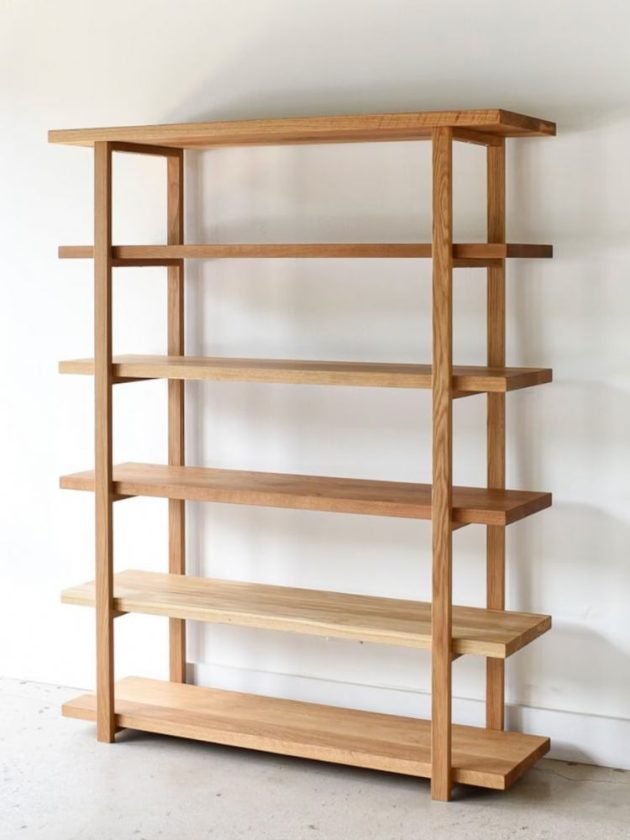
7. What We Make
Best for: reclaimed wood bookshelves
Illinois-based furniture company What We Make crafts non-toxic bookcases with a VOC-free finish.
The shop offers both modern Scandinavian styles (pictured here) using solid oak and industrial style sustainable bookshelves made with a stainless steel frame and the reclaimed wood salvaged from 100+ year old Midwestern barns.
Price: $2,025 – $5,055
Materials: Oak, Reclaimed Wood
Conscious Qualities: Made-to-Order, Repurposed Material Option, Zero-VOC Finish
8. Greenington
Best for: bamboo bookshelves
Greenington is a furniture company with pieces crafted from sustainably hand-harvested Moso bamboo. Greenington sources mature bamboo — reached in just 5 years — for maximum strength and durability. And because bamboo is technically a grass, not a tree, it regenerates after being cut without any replanting.
The company uses every part of the bamboo culm, for zero waste production, winning the Sustainable Furnishings Council Green Ribbon Award in 2020.
Price: $809 – $2,139
Materials: Moso Bamboo
Conscious Qualities: Zero-Waste Production, Sustainable Materials

9. Crate & Barrel FSC-Certified
Best for: certified responsibly sourced wood shelving
Crate & Barrel’s FSC-Certified collection features bookshelves made with materials like solid oak, mahogany wood, teak, and rattan. And you can find a range of styles and finishes in their collection, from natural oak to espresso and driftwood.
It’s worth noting that the company’s bookshelves do contain veneer and engineered wood as well. There are also select products that are also GREENGUARD certified, but not all of them.
Price: $1,399 – $4,949
Materials: FSC-Certified Wood, Some GREENGUARD Certified Pieces
Conscious Qualities: Natural Materials, Responsibly Sourced

More Guides to Browse:
Sustainable Tables and Coffee Tables to Gather Around
The Best Non-Toxic Furniture Brands for a Healthier Home
Sustainable Storage Furniture: Dressers, Media Consoles, and More
The post 9 Sustainable Bookcases to Showcase Your Latest Reads appeared first on Conscious Life & Style.