Unwind and sleep easy with one of these non-toxic and eco-friendly bed frames that you know was sourced consciously, both in respect to your own health and the health of our common home: Mother Earth.
What is a Non-Toxic and Eco-Friendly Bed Frame?
Just as with other eco-friendly furniture, the key elements to consider when it comes to bed frames are the material, finishes, general production practices, and durability.
Materials
If you’re looking for a natural bed frame and want it to be non-toxic, it’s typically best to go the solid wood route if you can.
Most plywood, particleboard, or engineered wood is made with glue that contains formaldehyde. As a Volatile Organic Compound (VOC) and probable carcinogen, formaldehyde is an environmental and health risk for yourself and the workers producing that product.
That said, are some plywood/engineered woods that do not contain formaldehyde. But if the product page doesn’t specifically state that the product is formaldehyde-free, then you’ll want to inquire with the company.
Another material to consider if you’re looking for non-toxic furniture is solid metal, due to its durability, easy maintenance, and recyclability. However, this option isn’t so eco-friendly if that metal was newly mined, so look for recycled metal if you want to go this route!
Sourcing
Of course, although wood is renewable, it’s not always sustainably sourced. Look at a company’s About or Sustainability pages to see what information they can provide about how the wood they use is harvested and where it is sourced from. Look for things like:
- Local sourcing. This minimizes the product’s carbon footprint and typically means that a company has more transparency into their supply chain.
- FSC-certified. While not perfect, the Forest Stewardship Council seal is the most widely used third-party verification for sustainably-sourced wood.
- Reclaimed wood. Finding a bed frame made from repurposed materials is a fantastic option if you can find it. Not only does using reclaimed wood reduce waste, but it minimizes the need to cut down additional trees.
Finishes
Most conventional finishes used on furniture contain VOCs, which can cause a myriad of short-term and long-term health impacts. Look for non-toxic bed frames with low-VOC or even better, zero-VOC finishes.
Other Production Practices:
- Renewable energy use. Does the company use wind or solar power for its operations? Do they purchase Renewable Energy Credits?
- Waste reduction. How does the company handle material waste such as leftover wood? Do they work to minimize water use and energy use?
- Donations. Does the company give back to an environmental organization through a group like 1% for the Planet? Do they plant more trees than the number of trees cut down to produce their products?
Durability
One of the all-too-often left out elements of sustainability is durability and longevity! The longer the bed frame lasts, the longer it stays out of the landfill, and the fewer new bed frames you’ll have to consume.
How can you determine durability? Look for sturdy materials, good construction, check out the reviews for the brand’s products, and see what sort of warranty the brand offers. Some brands offer 1-year or 5-year warranties, and some even include a lifetime guarantee! The longer a brand commits to standing behind its products, the better.
If you’re planning to move around often, you may also want to consider how well the bed frame can be deconstructed and reconstructed. Fast furniture brands with poor construction — and that may use plastic in places that should be supported with metal — may not hold up after a few moves.
Ways Can You Find Sustainable and Natural Bed Frames?
As always, shopping secondhand is a great way to source furniture sustainably and more affordably! Sites like Facebook Marketplace, local Buy Nothing groups, and Craigslist can be resources for finding cheap eco-friendly furniture — sometimes, you can even get a piece for free if you’re willing to take care of the pick-up.
I also recommend checking out EstateSales.net to find local estate sales happening near you! I have found some of my absolute favorite pieces of high-quality, preloved furniture at estate sales.
For a more curated selection of secondhand bed frames, check out AptDeco.
And if vintage furniture (usually defined by being more than 40 years old) is more your style, take a look at Chairish, EBTH, or 1st Dibs.
If you can’t find anything preloved, or you’d prefer to purchase a verified non-toxic bed frame, check out these brands below for sustainable bedroom furniture!
(By the way, if you’re in need of some bedding as well, check out our guides to non-toxic mattresses, eco-friendly pillows, and organic bedding.)
Note that this sustainable bed frame guide contains affiliate links, meaning we’ll earn a small commission if you choose to purchase through one of these links, which helps us continue to run this site. As always, all brands meet rigorous criteria for sustainability and are brands we love — and that we think you’ll love too!
Brands with Sustainable and Non-Toxic Bed Frames:
Our Top Overall Pick: Savvy Rest

Savvy Rest has everything you need to sleep more restfully, from organic mattresses to non-toxic bedroom furniture. The brand’s timeless all-natural platform beds — The Afton is their flagship platform bed and The Esmont is a platform bed with a customizable headboard — are made in their own Virginia workshop. Each bed is crafted out of sustainably-sourced maple and poplar wood and is available unfinished or with a zero-VOC finish.
The non-toxic furniture company also has a sustainable adjustable bed frame crafted from responsibly-sourced solid red oak, featuring a mid-century modern headboard.
Conscious Qualities: Sustainably-Sourced Wood, Zero-VOC Finishes, Local Production
Price: Starts at $945 for a Twin.
*Use code CONSCIOUSSTYLE20 for 20% off all products on Savvy Rest
Best Reclaimed Wood Bed Frame Options: Avocado

Made in their own GOTS-certified (and soon to be Zero Waste certified!) Los Angeles factory, Avocado Mattress makes eco-friendly bed frames with high environmental, health, and social standards. Each bed frame is made out of reclaimed wood or solid FSC-certified timber and zero-VOC finishes.
For the bed frames made from new wood, Avocado Mattress uses non-toxic Titebond wood glues. The Certified B-Corporation also pays living wages and offers benefits, including family healthcare, to their production factory team members.
Conscious Qualities: Reclaimed or FSC-Certified Wood, Zero-VOC Finishes, Local Production in a GOTS-Certified Factory, Greenguard-Certified (Gold), Carbon Neutral Certified
Price: Starts at $695 for Twin
Best Variety of Eco-Friendly Beds: Medley

Using only the highest quality non-toxic materials for their sustainable furniture, Medley has natural bed frames are made from domestically-sourced FSC-certified solid wood. Each wooden bed frame is made-to-order in Los Angeles using zero-VOC glue and zero-VOC all-natural furniture polish. (Note: Medley’s bamboo furniture uses low-VOC finishes.)
If you prefer an upholstered sustainable bed, check out Medley’s Nein bed which has the option to use organic natural latex.
Conscious Qualities: Local In-House Production, FSC-Certified Wood, Natural Finishes, Made-to-Order
Price: Starts at $2,550 for Twin
Best for Sustainable Upholstered Beds: Saatva

Saatva is a sustainable mattress company that has expanded into eco-friendly bed frames too. The company uses responsibly sourced hardwood that has been kiln-dried for maximum durability for the bed frame as well as plywood slats for additional support. (Note: I asked Saatva’s customer support team about potential toxins in the plywood, and they have told me that their beds are free of formaldehyde.)
For upholstery, Saatva offers natural linen as an option, which would be the non-toxic fabric choice!
Probably the most impressive feature of Saatva’s beds is their attention to quality and proper support. They even offer a 180-day trial to make sure you love the bed, plus a lifetime warranty — a feature you definitely won’t find at most big box furniture stores.
Conscious Qualities: Sustainably-Sourced Hardwood, Natural Upholstery Option, Lifetime Warranty
Price: Starts at $895 for a Queen
Best for Heirloom Quality Sustainable Beds: Cisco Home @ Urban Natural

Made to order with exceptional care in Los Angeles, Cisco Home is the real deal when it comes to quality sustainable furniture, including their eco-friendly upholstered or slipcovered beds. (Choose upholstered for a more classic style or select slipcovered for easy cleaning and maintenance.)
Cisco’s cozy yet elegant beds will transform your bedroom into an aesthetically pleasing sanctuary.
For the most eco-minded and non-toxic option, select “Inside Green” on the product pages which will ensure your bed gets made with only the highest quality earth-conscious materials: FSC-certified woods, organic latex, jute, hemp, organic cotton, and wool.
Conscious Qualities: Made In California, Made-to-Order, Low-VOC Stains, FSC-Certified Wood and Natural Materials (with “Inside Green” option)
Price: Starts at $3,175
Best Responsible Forestry Practices: MasayaCo

Beginning as a reforestation project, MasayaCo is dedicated to (beyond) sustainable sourcing. In addition to sourcing the wood for their furniture responsibly from their own forests, 40% of their reforestation projects are left untouched, allowing the flora and fauna to thrive. All of MasayaCo’s eco-friendly teak bed frames are handmade by craftspeople in Nicaragua and finished with low-VOC natural oils.
Conscious Qualities: Invests in Reforestation, Made-to-Order, Ethical Production, FSC-Certified
Price: Starts at $1,895 for Queen
Best Simple Sustainable Wood Bed Frame: Birch

Organic and eco-friendly mattress company Birch also has a natural wood bed frame made from responsibly-sourced hardwood. In fact, all of the wood in the Birch Wood Frame are from FSC-certified and LEED compliant sources, to verify their commitment to responsible wood harvesting and energy use.
Specifically, this sustainable bed frame is made up of Appalachian hardwood bed rails, solid Southern Yellow Pin wood slats, and Appalachian Maple legs. This minimal solid wood bed frame is finished with all-natural water-based VOC-free finishes.
And in case you needed more reasons to love this non-toxic bed frame: it’s handmade in the USA, ships free, and comes with a 5-year warranty.
Conscious Qualities: Solid Wood, Responsibly Sourced, Zero VOC Finishes
Price: $499 for Twin
Best Affordable Eco-Friendly Bed Frame: Thuma

Minimal yet functional, Thuma’s eco-friendly beds are designed with intention — they are supportive and sturdy yet simple and easy to assemble.
Each minimalist bed is made from upcycled and repurposed rubberwood trees and is shipped out efficiently in recycled cardboard. (No styrofoam here!) With an average 4.9 star rating from nearly 10,000 reviews, there’s clearly a lot to love about Thuma’s sustainable bed frames!
Conscious Qualities: Greenguard Certified, Repurposed Wood, Eco Packaging
Price: Starts at $795 for Twin
Best Untreated Non-Toxic Bed Frame: My Green Mattress

MyGreenMattress.com has a simple sustainable bed frame made in the US from untreated domestically-sourced Poplar wood. The non-toxic bed frame does not have any wood stains, adhesives, or toxic chemicals. This slatted platform bed also eliminates the need for a box spring.
Conscious Qualities: Domestically-Sourced Wood, Non-Toxic & Untreated, Made in the US
Price: Starts at $419
Best for Reassembly and Apartment Living: Floyd

Designed with simplicity and longevity in mind, The Floyd eco-friendly bed frame is made with as few parts as possible (forget the headache of sorting through hundreds of pieces to set up your furniture!) so that it can be constructed, deconstructed, and reconstructed with ease.
Floyd’s wooden bed frame is made with sustainably-sourced real wood veneer. Veneer is a composite wood product, though Floyd reports that the panels have extremely low adhesive emissions. Since composite wood makes the bed lighter weight, this choice might it preferable if you’re planning on moving the bed a few times.
You can also customize your Floyd Bed Frame with add-ons like a bedside table, upholstered headboard, or (what would be my personal pick) underbed storage.
Floyd has also recently added a Bed Frame in Color, which is made with 50% recycled wood and comes in at a lower price point.
Conscious Qualities: Long-Lasting, Made With Natural Materials
Price: Starts at $540
And that’s a wrap on our guide to sustainable and non-toxic bed frames. Thanks for reading, and for taking the time to be thoughtful about your next bedroom furniture purchase. It really does matter.
And I hope that this guide saved you some time and research and you’re on your way to finding the right sustainably-crafted bed that suits your needs and style.
Shopping For More Furniture? Browse These Guides:
21 Best Sustainable Furniture Brands
Non-Toxic Furniture Brands For A Healthy Home
The Best Non-Toxic Sofas for Truly Restful Relaxation
Your Ultimate Guide to Eco & Organic Bedding (30+ Brands!)
The post 10 Best Eco-Friendly and Non-Toxic Bed Frames for a Sustainable Slumber appeared first on .
9 Best Eco-Friendly and Non-Toxic Bed Frames for a Sustainable Slumber

As a longtime book lover, I may be biased, but I think a full bookshelf is one of the most beautiful additions to a space. There’s nothing better than seeing a showcase of your favorite reads alongside a TBR list.
A bookcase, though, can of course be used for all sorts of purposes from placing your favorite photos of family and friends to showcasing treasured vintage finds.
Whatever the case, this guide will help you find the right sustainable bookshelf for your living room, office, or wherever you like to cozy up with a good read!
So what make a bookcase more sustainable? What makes a bookshelf non-toxic?
First of all: sustainable and non-toxic are two overlapping — but distinct — criteria. And both of those terms can come with a lot of opinions and varying definitions.
When it comes to sustainable bookcases, I look for:
- Responsibly Sourced Materials: most bookshelves are made primarily with wood. While natural, unsustainable wood sourcing can be a cause of deforestation, so we want to see that the wood was from responsibly managed forests or made from reclaimed or repurposed wood. Some bookshelves may feature metal, in which case recycled materials here are important.
- High Quality Construction: sustainability includes longevity — how long will you be able to use that furniture piece before it goes to the landfill and gets replaced? Look for transparency around craftsmanship and woodworking processes. Another sign of quality is the length of warranty a company has for its products.
- Ethically Made: this one is straightforward in theory — were the people making it paid fairly and working in safe conditions? — but is unfortunately not always easy to find information. In this category, I look for transparency in practices, what relationship the brand has with the manufacturer (some produce in-house which is the best case scenario for transparency!), where it was made, and how well the makers were paid.
Ideally a sustainable bookshelf would also be non-toxic — as toxic chemical fumes aren’t exactly sustainable! But this isn’t always the case. For example, if a company prioritizes upcycled materials, they don’t necessarily have control over what inputs were part of the original materials. And sometimes a company focuses more on ethical artisan partnerships and sustainable wood sourcing, more than, say, using non-toxic finishes.
But when it comes to non-toxic bookshelves, this is what I look for. (Note that non-toxic doesn’t necessarily mean safe for all chemical sensitivities. Nor does it mean zero potentially irritating chemicals.)
- Solid Wood (where possible): MDF or pressed wood contains glue to stick the various wood pieces together, which can contain added formaldehyde. I prefer solid wood, or if it is engineered wood, I’d make sure the company is transparent around the type of glue used and/or they at least have a product certification like GREENGUARD. (More on that in a second.)
- Low or Zero VOC Finishes: most wood furniture is completed with some sort of finish to provide a protection against scratches or moisture. Many of these finishes are synthetic, and some can contain high levels of toxic chemicals. Look for a natural finish like linseed oil or beeswax or a low VOC synthetic finish.
Relevant Certifications
You’ll see a few certifications referenced throughout this guide. Here’s what each one covers:
- FSC Certified = the wood sourcing was responsibly managed; this is not a finish, foam, or textile guarantee.
- GREENGUARD / GREENGUARD Gold Certified = the finished product was tested for low chemical emissions, including VOCs, with Gold representing the stricter tier.
- Fair Trade Certified
 = verifies that a factory meets standards for fair wages, safe working conditions, and ethical labor practices.
 - Cradle to Cradle Certified (Gold) = evaluates a product or material across material health, circularity, clean air/climate, water/soil stewardship, and social fairness.
Where to Find Sustainable Bookcases and Shelving
I’m always a secondhand first proponent, and that goes for furniture, too. While your local thrift store might not have used bookshelves, check for dedicated furniture resale shops near you or estate sales. (I use EstateSales.net to find ones near me.) You can also find gently used pieces on online marketplaces like Facebook Marketplace, OfferUp or AptDeco.
If you can’t find something you love secondhand, and you don’t want to DIY your own bookshelf, then the next best choice is to shop from one of the sustainable furniture companies below. (If you’re simply looking for a bookstand, I’d suggest browsing Etsy for a collection of solid wood, bamboo, and reclaimed wood book stands and cookbook stands!)
Note that this guide includes affiliate links, which means we may earn a small commission if you purchase through these links which helps us continue to run this website and create resources like these. As always all brands meet strict sustainability criteria and are brands we love — and that we think you’ll love too!
1. Medley
Best for: low VOC wood bookcases
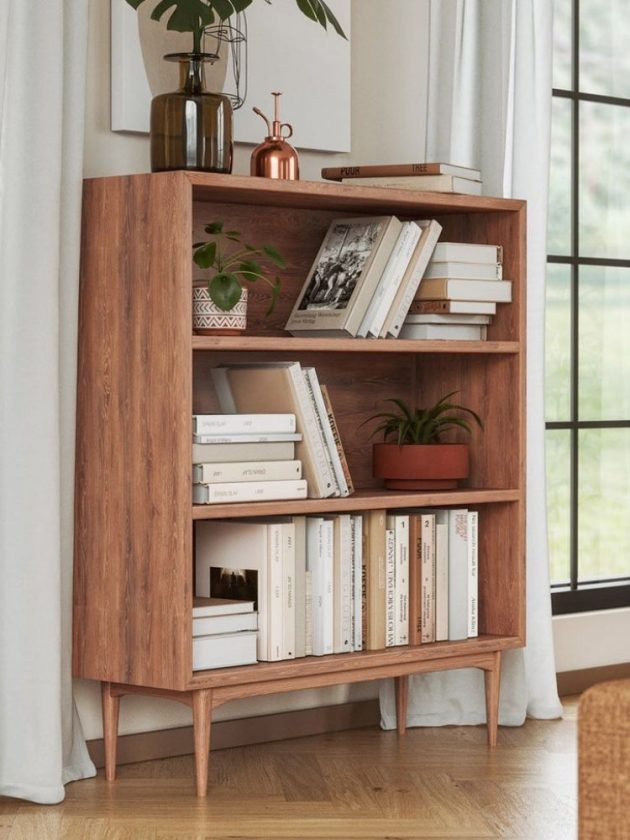
Medley’s bookshelves are elegant and elevated, perfect for a living room. Each piece is made with 100% solid FSC-certified hardwood for the tops and sides, though low-VOC CARB 2 compliant plywood is used for the shelves.
Every eco-friendly bookcase is handcrafted in the US (California or North Carolina) and completed with a low-VOC wood finish.
Price: $2,395 – $2,995
Materials: White Maple, American Walnut Wood
Conscious Qualities: Made-to-Order, US-Made, FSC-Certified Wood, Natural Finish
2. Thuma
Best for: non-toxic modular bookshelf
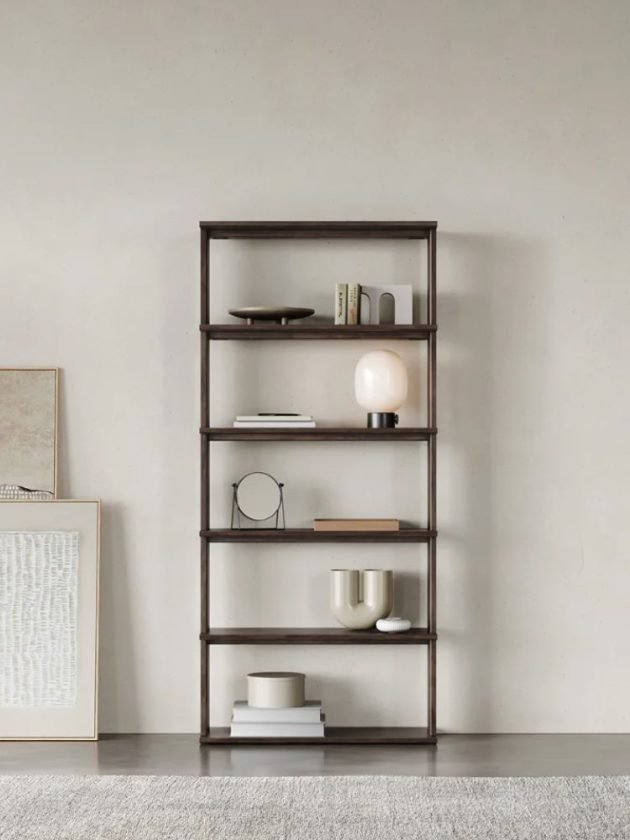
Thuma’s eco-friendly bookshelf is made from upcycled wood sourced from rubberwood trees no longer being used to source rubber. The brand’s bookshelf is also GREENGUARD Gold certified.
What makes Thuma’s bookshelf stand out to me, though, is its modularity — their Pillar Bookshelf can be set in 10 different configurations. And if you start with just a few shelves but later decide you want a larger bookshelf, you can simply buy an additional shelf or two to add on to it!
Price Range: $550 – $3,300
Materials: Upcylced Rubber Wood
Conscious Qualities: GREENGUARD Gold Certified, Repurposed Materials, Adaptable
3. West Elm GREENGUARD Certified
Best for: low-tox bookcases and bookracks for kids
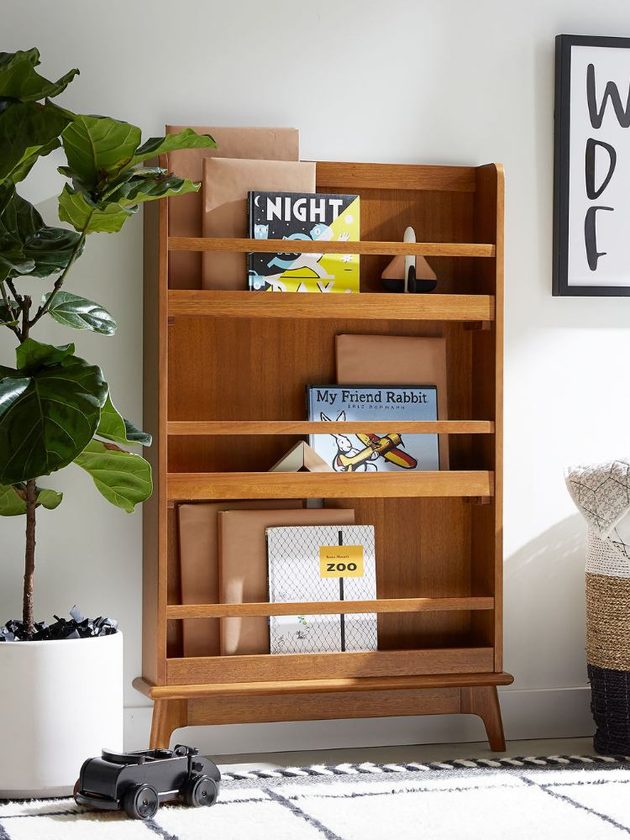
This furniture retailer has plenty of adorable, but functional, bookshelves for a playroom or kids’ bedroom. From cubby bookcases to mid-century bookracks, you’ll find plenty of options that are not only GREENGUARD certified, but made in Fair Trade Certifiedfactories, and/or with FSC-certified wood. Note that the company’s bookshelves are made with engineered wood, though.
West Elm also has GREENGUARD certified bookcases large enough for the adults too!
Price: $399 – $2,897
Materials: Solid Wood, Reclaimed Wood
Conscious Qualities: Fair Trade, FSC Certified, and GREENGUARD Certified Options