

The backers of a rare earths mining project in the arid plains of western South Africa say they have the answer to challenging China’s dominance in global supply chains – a by-product that is also crucial to the clean energy transition.
Producing rare earths used to make permanent magnets for wind turbines and electric vehicles (EVs) can be complex and is often unviable due to the costs, helping to explain the European Union’s decision to put the Zandkopsdrift project on its list of “strategic” mining ventures to reduce its dependence on China.
“We’re expected to be … the lowest-cost producer of magnet rare earths outside China,” Philip Kenny, chair of project owner Frontier Rare Earths, said in a media statement in February.
Zandkopsdrift aims to produce 4,000 metric tons of magnet rare earths per year by 2030 – equal to 17% of the EU’s projected needs. Last month, the miner signed an agreement with French company Carester SAS, which will separate and process the mine’s rare earths at a large-scale facility being built in France.
Central to the company’s business plan for Zandkopsdrift’s rare earths output is a by-product – battery-grade manganese, which the project aims to produce more cheaply than anywhere else in the world.
-
Africa’s mineral wealth can make it an architect of a more just energy transition
African leaders and policymakers must ensure that policies to add value to the continent’s critical minerals bring jobs and dignity to its young people -
Africa urged to unite on minerals as US strikes bilateral deals
In the race for minerals critical for clean energy technologies, experts at the World Economic Forum said African nations should coordinate negotiations with trade partners -
West Africa’s first lithium mine awaits go-ahead as Ghana seeks better deal
Ghana wants to benefit from the scramble for lithium but its reliance on mining firms for revenue and expertise weakens its ability to negotiate preferential terms, experts say


Manganese is increasingly used in the cathodes of lithium-ion EV batteries. Manganese-rich lithium-ion batteries significantly reduce the need for other minerals such as nickel and cobalt, which have been associated with social and environmental impacts in the Democratic Republic of the Congo and Indonesia. However, nearly all of the manganese sulphate used in batteries is currently produced by China.
“We will be the lowest (battery-grade manganese) cost producer in the world. We will have a production cost approximately 20% of China’s,” James Kenny, the company’s CEO, told an EU minerals conference in Brussels last year.
‘Untested’ processing route
While the model is promising, combining rare earth extraction with battery-grade manganese production at a commercial scale is an untested processing route, said Gaylor Montmasson-Clair, an energy consultant and analyst based in Pretoria.
“The production costs claimed are certainly eye-catching and, if verified, would be disruptive,” said Montmasson-Clair, who specialises in issues related to the transition to a green economy.
“However, there is a significant gap between prefeasibility projections and operational reality,” he said, noting that commercial production of rare earths is particularly sensitive to rates of mineral extraction and the costs of chemicals involved in the process.
The project – which will produce the rare earth compounds neodymium, praseodymium, dysprosium and terbium oxide – remains at the feasibility stage, with a Definitive Feasibility Study due for completion in mid-2027.
“We won’t know the true cost curve until the definitive feasibility study is complete and, ultimately, until the plant is running,” Montmasson-Clair added.
Frontier Rare Earths did not respond to repeated requests for comment.
Troubled mining legacy
The project fits in with South Africa’s aim to become a key supplier of critical minerals as countries scramble to secure up supplies of rare earths – a group of 17 elements that are needed to produce a diverse range of goods, including technologies for the clean energy transition.
President Cyril Ramaphosa signed a partnership on critical minerals with the EU in November, and the Industrial Development Corp (IDC), a state development finance institution, has invested $20 million in Zandkopsdrift.
Like other countries with a long and troubled mining legacy, South Africa wants to ensure that the mistakes of past mining booms are not repeated.
That means limiting the damage and disruption to the surrounding environment and communities, creating local jobs and adding value to raw materials exports by processing minerals domestically.
A commitment to meeting higher standards
Frontier Rare Earths has committed to an assessment by the US-based Initiative for Responsible Mining Assurance (IRMA), a voluntary global certification system for socially and environmentally responsible mining that gives miners an opportunity to show they are going beyond compliance.
“The intention is for the IRMA Standard to be useful early in the planning and development process so that future mines are developed in ways that reduce harm from the start,” Aimee Boulanger, IRMA’s executive director, told Climate Home News.
“The full audit report is made public, including the score for each requirement and the auditors’ notes on what evidence they found,” Boulanger said.
Steps pledged by the company for Zandkopsdrift include water-recycling systems to minimise consumption in the semi-arid Namaqualand region where it lies, local procurement targets and tailings storage facilities that are designed to prevent acidic mine drainage.
Additionally, under South Africa’s flagship Black economic empowerment programme, local communities will also hold a 26% stake in the project.
-
Battery passport plan aims to clean up the industry powering clean energy
Some of the world’s largest battery makers are piloting a scheme led by the Global Battery Alliance to reward manufacturers that meet social and environmental standards -
Cobalt and nickel-free electric car batteries boom in “good news” for rainforests
Lithium iron phosphate batteries do not contain cobalt and nickel, which are mostly found in rainforest nations like the DR Congo and Indonesia -
Argentina’s pioneering glacier law on the line as Milei bets on copper rush
President Javier Milei wants Congress to relax groundbreaking glacier protection legislation to boost mining, but opponents say the environmental risks are too great


And as a means to add value and create extra jobs, the IDC holds an option to buy up to 10% of Zandkopsdrift’s production at prevailing market prices, subject to it being used in further downstream processing in South Africa.
“That clause is crucial,” said Montmasson-Clair. “It suggests Pretoria sees value beyond simply digging and exporting. The question is whether South Africa has the industrial capacity to absorb that material, or whether this will catalyse new local beneficiation industries.”
“Who actually benefits?”
Despite the promises of economic benefits, some local people in Namaqualand are wary about the prospect of new mining projects in the semi-desert region, formerly a major diamond-producing area.
Water shortages are a constant worry here, especially among small-scale cattle farmers, and memories of past environmental abuses by mining companies linger.
“We have seen these promises before,” said Sarah Baartman, chair of the Namaqualand Communities Mining Forum, a group formed to demand greater control over mining activities on their land due to concerns over environmental degradation and a lack of economic benefits and public consultation.
“The question is always: who actually benefits? Every mining company says they will be different. Then the water tables drop, dust coats our livestock, and when the mine closes, we are left with contaminated land.”
The post South African rare earths project aims to rival Chinese with low-cost model appeared first on Climate Home News.
South African rare earths project aims to rival Chinese with low-cost model

Climate Change
Trump’s ‘God Squad’ Will Weigh Gulf Oil Drilling Against the Survival of Endangered Whales and Turtles
Citing national security, the Trump administration wants to exempt all federally regulated offshore oil from protections for endangered animals—even if it could cause their extinction.
The Trump administration is turning to the nuclear option on endangered-species protections in the name of national security.
Climate Change
This Year’s US Wildfires Have Already Set Records That Could Foreshadow a Smoky, Fiery Summer
Recently released data show how drought, paltry Western snows and unseasonable heat, all exacerbated by climate change, could be priming the nation for a long wildfire season.
As the Western United States limps away from one of the warmest and driest winters on record, wildfires have burned over 127 percent more acreage so far in 2026 than the 10-year average, potentially setting the stage for a long, fiery summer.
This Year’s US Wildfires Have Already Set Records That Could Foreshadow a Smoky, Fiery Summer
Climate Change
DeBriefed 27 Mach 2026: North Sea myths debunked | India’s climate plan | IPCC and Indigenous knowledge
Welcome to Carbon Brief’s DeBriefed.
An essential guide to the week’s key developments relating to climate change.
This week
Hormuz latest
DELAYED ULTIMATUM: The week started with US president Donald Trump giving Iran 48 hours to reopen the Strait of Hormuz, a vital supply route for oil and gas, or the US would “hit and obliterate” Iranian power plants, reported the Guardian. By the end of the week, Reuters was reporting Trump’s statement that he would “pause” the threat of strikes for 10 days, claiming talks with Iran were “going very well”.
CLOGGED SUPPLY: Fatih Birol, executive director of the International Energy Agency, called the ongoing blockage of oil and gas supplies through the Strait “the greatest global energy security threat in history”, according to the Financial Times. A separate article in the Financial Times reported that countries are “facing a cliff-edge as the flow of liquefied natural gas (LNG) from the Gulf comes to an abrupt end in the next 10 days”.
COAL RESURGENCE: Asian countries are “shifting back to coal” amid disruptions to LNG supplies sparked by the closure of the Strait of Hormuz, reported the Associated Press. Similarly, Japan announced plans to allow more use of coal power plants in an effort to boost energy security, noted Bloomberg. Elsewhere, analysts told CNBC how the crisis could “accelerate a shift into renewables” in a “watershed” moment for the energy transition.
UK fallout of Iran war
RENEWABLE HIGHS: The UK’s renewable output hit a record high on Wednesday, “helping to blunt the impact of the Middle East war on power prices”, reported Bloomberg. Meanwhile, the Press Association described a new government announcement on solar panels and heat pumps for all new homes from 2028 as “doubling down on its clean-energy drive in response to the Iran war”. At a household level, the Times reported that UK homeowners are “rush[ing] to install solar panels amid [the] Iran conflict”.
NORTH SEA MYTHS: Using a comment piece in the Sunday Telegraph, Conservative opposition leader Kemi Badenoch led calls predominately coming from right-leaning politicians and media to issue more oil and gas licences in the North Sea. Carbon Brief has published a factcheck exposing nine false or misleading claims about the impact on household bills, emissions and energy security of more North Sea drilling.
Around the world
- CLIMATE PROTECTION: Germany unveiled a plan to help it reach its 2030 climate target and reduce its dependence on “volatile fossil-fuel imports”, reported Reuters.
- DIAGNOSIS: A long-awaited report into the unprecedented blackout that left Spain and Portugal without electricity last April concluded that the “problem did not lie with solar and wind power”, said the Financial Times.
- DELUGED: The US state of Hawaii struggled in the aftermath of “catastrophic flooding” that could cost over $1bn in damages, reported USA Today.
- ARCTIC LOW: Sea ice in the Arctic has tied last year’s record for the lowest-ever peak winter extent, reported Carbon Brief.
91%
The amount of excess heat trapped by the Earth that is stored in the ocean, according to a UN World Meteorological Organization report covered by Agence France-Presse.
Latest climate research
- Extreme events and climate change pose “major threats” to the preservation of underwater cultural heritage, such as sunken ruins, wrecks and archaeological remains | Proceedings of the National Academy of Sciences
- Human-driven climate change made extreme fires across the Arctic from 2019-21 more than 200 times more likely | Environmental Research Letters
- A county-level study in the US from 2013-24 suggests “higher temperatures are associated with increased risk of police violence” | PLOS One
(For more, see Carbon Brief’s in-depth daily summaries of the top climate news stories on Monday, Tuesday, Wednesday, Thursday and Friday.)
Captured
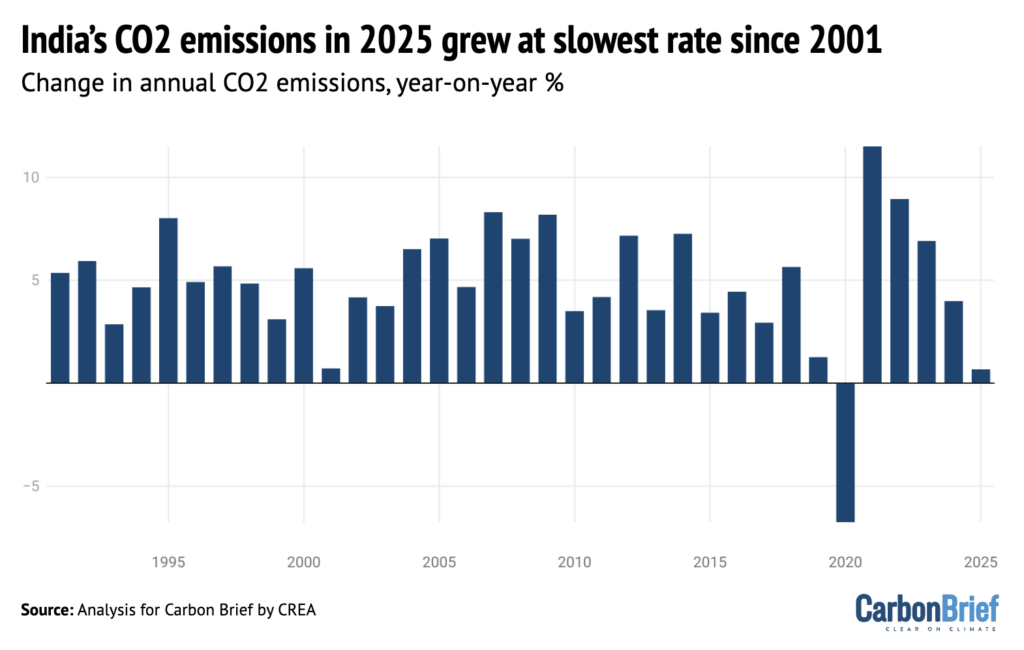
India’s carbon dioxide (CO2) emissions grew by 0.5% in the second half of 2025 and by just 0.7% in the year as a whole, the slowest rate in more than two decades, according to analysis for Carbon Brief published this week. This marks a sharp slowdown from 4-11% in the preceding four years and is largely explained by increases in steel and cement production being compensated by falling emissions in the power sector. Carbon Brief also took an in-depth look at India’s delayed nationally determined contribution (NDC) published this week, which contains a new target to reduce its emissions intensity to 47% below 2005 levels by 2035.
Spotlight
The IPCC and Indigenous representation
This week, Carbon Brief speaks to researchers about how the UN’s climate science panel can better incorporate Indigenous peoples and their knowledge into its highly influential reports.
From the Quechua people in Latin America to the Oraon Tribe in Asia, Indigenous peoples’ lands cover more than a quarter of Earth’s surface.
Built up over millenia and transferred through generations, Indigenous knowledge is vital in conserving the world’s remaining biodiversity and building climate resilience.
Prof Pasang Yangjee Sherpa is a Sherpa woman from the Mount Everest region in Nepal and an assistant professor of lifeways in Indigenous Asia at the University of British Columbia, Canada.
Her research advocates for the inclusion of Indigenous people and their knowledge in climate science, particularly in the work of the Intergovernmental Panel on Climate Change (IPCC). Sherpa told Carbon Brief:
“If we are really interested in planetary health…we have to make sure that Indigenous peoples and Indigenous peoples’ knowledge is also on the table next to physical science and Euro-Western science.”
Ways of knowing
Last month, the IPCC held a workshop in Reading, UK, on engaging diverse knowledge systems in ways that are “inclusive, equitable and aligned with future needs”.
The workshop is expected to produce a set of recommendations, but the report is not yet available and the workshop itself was closed to journalists.

Sherpa was co-author of an independent report that informed the IPCC workshop. The research, funded by Wellcome, combined the team’s experience with a literature review and multilingual “listening sessions” with Indigenous scholars, leaders and thinkers.
The report explained how Indigenous peoples are disproportionately affected by climate change due to “historical and contemporary colonial processes of territorial dispossession, political exclusion and structural inequality”.
But the inclusion in climate science of Indigenous peoples and their knowledge is not just a justice issue, the report continues:
“Indigenous peoples are not merely vulnerable populations – they are frontline climate leaders whose territorial governance and sciences are essential to understanding and responding to the climate crisis.”
Addressing marginalisation
The report makes some “immediate” recommendations that can be done in the current seventh assessment cycle “to prevent harm, ensure equitable participation and begin redressing historical exclusions”.
These include appointing a minimum of two Indigenous contributing authors per relevant chapter and establishing an ad-hoc Indigenous advisory group.
Looking further ahead, the authors argue the eighth assessment cycle (likely due in the 2030s) requires “institutional transformation” to “reshape governance, methodologies and participation structures”.
Sherpa told Carbon Brief:
“It’s very interesting to me that when you look at the UN and other policymaking spheres, Indigenous peoples from around the world have been actively involved for decades. It’s almost like academia has to catch up to reality, globally.”
Dr Rosario Carmona, also a co-author on the report, is a Chilean anthropologist with the International Work Group for Indigenous Affairs. She was also part of the scientific steering committee that proposed the IPCC workshop, on behalf of the Center for Intercultural and Indigenous Research in Chile. Carmona told Carbon Brief:
“There are good precedents – and the IPCC works on these precedents – that recognise Indigenous knowledge systems as standalone, that don’t need to be validated [by other types of knowledge].”
Soul-searching
The IPCC has been convening this week in Bangkok, Thailand, to consider, among other things, fundamental questions about how it does things, for what purpose and on what timelines.
Now is a good opportunity for wider change in the IPCC mindset, Carmona told Carbon Brief:
“I feel that there is a critical moment now – and there is a huge awareness and a willingness to do things better.”
Watch, read, listen
CHOKING OF HORMUZ: The New York Times took a look inside the “global, exceptionally critical journey of oil and gas, now upended by war”.
WARMING LIMITS: Writing in the Kathmandu Post, Maheswar Rupakheti, vice-chair of Working Group I of the IPCC, and policy researcher Gobinda Prasad Pokharel explored “climate overshoot”.
REFORM RECKONING: A feature in the Guardian examined how residents of flood-stricken Lincolnshire are growing tired with the climate-sceptic views of their MP, Reform deputy leader Richard Tice.
Coming up
- 22-29 March: COP15 for migratory species, Campo Grande, Brazil
- 23 March-2 April: Third meeting of the preparatory commission for the High Seas Treaty, New York
- 30 March: International Energy Agency energy technology perspectives 2026 report launch
Pick of the jobs
- Intergovernmental Panel on Climate Change, secretary | Salary: Unknown Location: Geneva, Switzerland
- International Institute for Sustainable Development, policy adviser, trade and climate change | Salary: Unknown. Location: Manila, Philippines, Jakarta, Indonesia or remote
- International Institute for Applied Systems Analysis, research scholar/modeller – global land carbon cycle and land-use change | Salary: €55,215.00. Location: Laxenburg, Austria
- Beyond Fossil Fuels, energy campaigner in Poland | Salary: €33,000-€37,000. Location: Poland
DeBriefed is edited by Daisy Dunne. Please send any tips or feedback to debriefed@carbonbrief.org.
This is an online version of Carbon Brief’s weekly DeBriefed email newsletter. Subscribe for free here.

The post DeBriefed 27 Mach 2026: North Sea myths debunked | India’s climate plan | IPCC and Indigenous knowledge appeared first on Carbon Brief.



-
Greenhouse Gases8 months ago
Guest post: Why China is still building new coal – and when it might stop
-
Climate Change8 months ago
Guest post: Why China is still building new coal – and when it might stop
-

 Greenhouse Gases2 years ago
嘉宾来稿:满足中国增长的用电需求 光伏加储能“比新建煤电更实惠”
-
Climate Change2 years ago
Bill Discounting Climate Change in Florida’s Energy Policy Awaits DeSantis’ Approval
-

 Climate Change2 years ago
嘉宾来稿:满足中国增长的用电需求 光伏加储能“比新建煤电更实惠”
-
Climate Change Videos2 years ago
The toxic gas flares fuelling Nigeria’s climate change – BBC News
-

 Carbon Footprint2 years ago
US SEC’s Climate Disclosure Rules Spur Renewed Interest in Carbon Credits
-

 Renewable Energy5 months ago
Sending Progressive Philanthropist George Soros to Prison?