

Researchers identified 24 new creatures and an entire superfamily of species in the Pacific, all while NOAA moves to fast-track deep-sea mining permits there.
Beneath the neon lights of a laser-scanning microscope, newly classified species glow in vivid greens and oranges—a far cry from the pitch-black abyss of their natural ocean floor.

Climate Change
DeBriefed 27 Mach 2026: North Sea myths debunked | India’s climate plan | IPCC and Indigenous knowledge
Welcome to Carbon Brief’s DeBriefed.
An essential guide to the week’s key developments relating to climate change.
This week
Hormuz latest
DELAYED ULTIMATUM: The week started with US president Donald Trump giving Iran 48 hours to reopen the Strait of Hormuz, a vital supply route for oil and gas, or the US would “hit and obliterate” Iranian power plants, reported the Guardian. By the end of the week, Reuters was reporting Trump’s statement that he would “pause” the threat of strikes for 10 days, claiming talks with Iran were “going very well”.
CLOGGED SUPPLY: Fatih Birol, executive director of the International Energy Agency, called the ongoing blockage of oil and gas supplies through the Strait “the greatest global energy security threat in history”, according to the Financial Times. A separate article in the Financial Times reported that countries are “facing a cliff-edge as the flow of liquefied natural gas (LNG) from the Gulf comes to an abrupt end in the next 10 days”.
COAL RESURGENCE: Asian countries are “shifting back to coal” amid disruptions to LNG supplies sparked by the closure of the Strait of Hormuz, reported the Associated Press. Similarly, Japan announced plans to allow more use of coal power plants in an effort to boost energy security, noted Bloomberg. Elsewhere, analysts told CNBC how the crisis could “accelerate a shift into renewables” in a “watershed” moment for the energy transition.
UK fallout of Iran war
RENEWABLE HIGHS: The UK’s renewable output hit a record high on Wednesday, “helping to blunt the impact of the Middle East war on power prices”, reported Bloomberg. Meanwhile, the Press Association described a new government announcement on solar panels and heat pumps for all new homes from 2028 as “doubling down on its clean-energy drive in response to the Iran war”. At a household level, the Times reported that UK homeowners are “rush[ing] to install solar panels amid [the] Iran conflict”.
NORTH SEA MYTHS: Using a comment piece in the Sunday Telegraph, Conservative opposition leader Kemi Badenoch led calls predominately coming from right-leaning politicians and media to issue more oil and gas licences in the North Sea. Carbon Brief has published a factcheck exposing nine false or misleading claims about the impact on household bills, emissions and energy security of more North Sea drilling.
Around the world
- CLIMATE PROTECTION: Germany unveiled a plan to help it reach its 2030 climate target and reduce its dependence on “volatile fossil-fuel imports”, reported Reuters.
- DIAGNOSIS: A long-awaited report into the unprecedented blackout that left Spain and Portugal without electricity last April concluded that the “problem did not lie with solar and wind power”, said the Financial Times.
- DELUGED: The US state of Hawaii struggled in the aftermath of “catastrophic flooding” that could cost over $1bn in damages, reported USA Today.
- ARCTIC LOW: Sea ice in the Arctic has tied last year’s record for the lowest-ever peak winter extent, reported Carbon Brief.
91%
The amount of excess heat trapped by the Earth that is stored in the ocean, according to a UN World Meteorological Organization report covered by Agence France-Presse.
Latest climate research
- Extreme events and climate change pose “major threats” to the preservation of underwater cultural heritage, such as sunken ruins, wrecks and archaeological remains | Proceedings of the National Academy of Sciences
- Human-driven climate change made extreme fires across the Arctic from 2019-21 more than 200 times more likely | Environmental Research Letters
- A county-level study in the US from 2013-24 suggests “higher temperatures are associated with increased risk of police violence” | PLOS One
(For more, see Carbon Brief’s in-depth daily summaries of the top climate news stories on Monday, Tuesday, Wednesday, Thursday and Friday.)
Captured
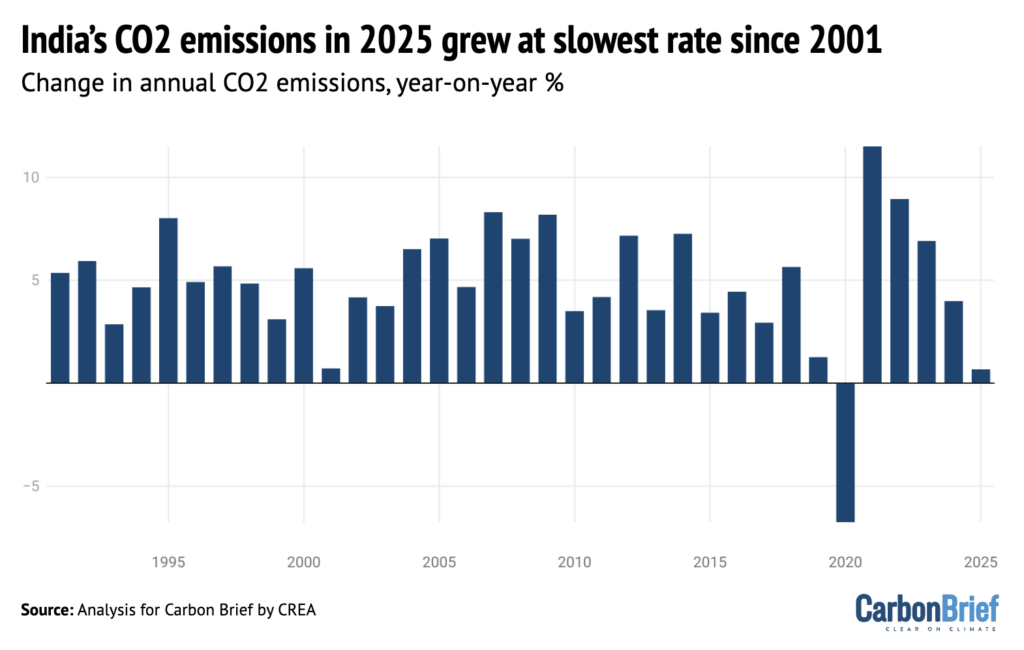
India’s carbon dioxide (CO2) emissions grew by 0.5% in the second half of 2025 and by just 0.7% in the year as a whole, the slowest rate in more than two decades, according to analysis for Carbon Brief published this week. This marks a sharp slowdown from 4-11% in the preceding four years and is largely explained by increases in steel and cement production being compensated by falling emissions in the power sector. Carbon Brief also took an in-depth look at India’s delayed nationally determined contribution (NDC) published this week, which contains a new target to reduce its emissions intensity to 47% below 2005 levels by 2035.
Spotlight
The IPCC and Indigenous representation
This week, Carbon Brief speaks to researchers about how the UN’s climate science panel can better incorporate Indigenous peoples and their knowledge into its highly influential reports.
From the Quechua people in Latin America to the Oraon Tribe in Asia, Indigenous peoples’ lands cover more than a quarter of Earth’s surface.
Built up over millenia and transferred through generations, Indigenous knowledge is vital in conserving the world’s remaining biodiversity and building climate resilience.
Prof Pasang Yangjee Sherpa is a Sherpa woman from the Mount Everest region in Nepal and an assistant professor of lifeways in Indigenous Asia at the University of British Columbia, Canada.
Her research advocates for the inclusion of Indigenous people and their knowledge in climate science, particularly in the work of the Intergovernmental Panel on Climate Change (IPCC). Sherpa told Carbon Brief:
“If we are really interested in planetary health…we have to make sure that Indigenous peoples and Indigenous peoples’ knowledge is also on the table next to physical science and Euro-Western science.”
Ways of knowing
Last month, the IPCC held a workshop in Reading, UK, on engaging diverse knowledge systems in ways that are “inclusive, equitable and aligned with future needs”.
The workshop is expected to produce a set of recommendations, but the report is not yet available and the workshop itself was closed to journalists.

Sherpa was co-author of an independent report that informed the IPCC workshop. The research, funded by Wellcome, combined the team’s experience with a literature review and multilingual “listening sessions” with Indigenous scholars, leaders and thinkers.
The report explained how Indigenous peoples are disproportionately affected by climate change due to “historical and contemporary colonial processes of territorial dispossession, political exclusion and structural inequality”.
But the inclusion in climate science of Indigenous peoples and their knowledge is not just a justice issue, the report continues:
“Indigenous peoples are not merely vulnerable populations – they are frontline climate leaders whose territorial governance and sciences are essential to understanding and responding to the climate crisis.”
Addressing marginalisation
The report makes some “immediate” recommendations that can be done in the current seventh assessment cycle “to prevent harm, ensure equitable participation and begin redressing historical exclusions”.
These include appointing a minimum of two Indigenous contributing authors per relevant chapter and establishing an ad-hoc Indigenous advisory group.
Looking further ahead, the authors argue the eighth assessment cycle (likely due in the 2030s) requires “institutional transformation” to “reshape governance, methodologies and participation structures”.
Sherpa told Carbon Brief:
“It’s very interesting to me that when you look at the UN and other policymaking spheres, Indigenous peoples from around the world have been actively involved for decades. It’s almost like academia has to catch up to reality, globally.”
Dr Rosario Carmona, also a co-author on the report, is a Chilean anthropologist with the International Work Group for Indigenous Affairs. She was also part of the scientific steering committee that proposed the IPCC workshop, on behalf of the Center for Intercultural and Indigenous Research in Chile. Carmona told Carbon Brief:
“There are good precedents – and the IPCC works on these precedents – that recognise Indigenous knowledge systems as standalone, that don’t need to be validated [by other types of knowledge].”
Soul-searching
The IPCC has been convening this week in Bangkok, Thailand, to consider, among other things, fundamental questions about how it does things, for what purpose and on what timelines.
Now is a good opportunity for wider change in the IPCC mindset, Carmona told Carbon Brief:
“I feel that there is a critical moment now – and there is a huge awareness and a willingness to do things better.”
Watch, read, listen
CHOKING OF HORMUZ: The New York Times took a look inside the “global, exceptionally critical journey of oil and gas, now upended by war”.
WARMING LIMITS: Writing in the Kathmandu Post, Maheswar Rupakheti, vice-chair of Working Group I of the IPCC, and policy researcher Gobinda Prasad Pokharel explored “climate overshoot”.
REFORM RECKONING: A feature in the Guardian examined how residents of flood-stricken Lincolnshire are growing tired with the climate-sceptic views of their MP, Reform deputy leader Richard Tice.
Coming up
- 22-29 March: COP15 for migratory species, Campo Grande, Brazil
- 23 March-2 April: Third meeting of the preparatory commission for the High Seas Treaty, New York
- 30 March: International Energy Agency energy technology perspectives 2026 report launch
Pick of the jobs
- Intergovernmental Panel on Climate Change, secretary | Salary: Unknown Location: Geneva, Switzerland
- International Institute for Sustainable Development, policy adviser, trade and climate change | Salary: Unknown. Location: Manila, Philippines, Jakarta, Indonesia or remote
- International Institute for Applied Systems Analysis, research scholar/modeller – global land carbon cycle and land-use change | Salary: €55,215.00. Location: Laxenburg, Austria
- Beyond Fossil Fuels, energy campaigner in Poland | Salary: €33,000-€37,000. Location: Poland
DeBriefed is edited by Daisy Dunne. Please send any tips or feedback to debriefed@carbonbrief.org.
This is an online version of Carbon Brief’s weekly DeBriefed email newsletter. Subscribe for free here.

The post DeBriefed 27 Mach 2026: North Sea myths debunked | India’s climate plan | IPCC and Indigenous knowledge appeared first on Carbon Brief.
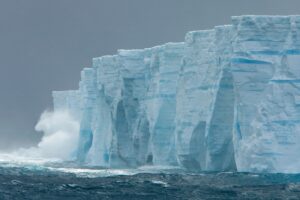
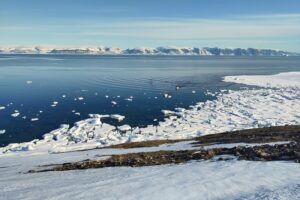
Arctic sea ice has reached its peak extent for this winter, clocking in as the joint-smallest in a satellite record going back almost half a century.
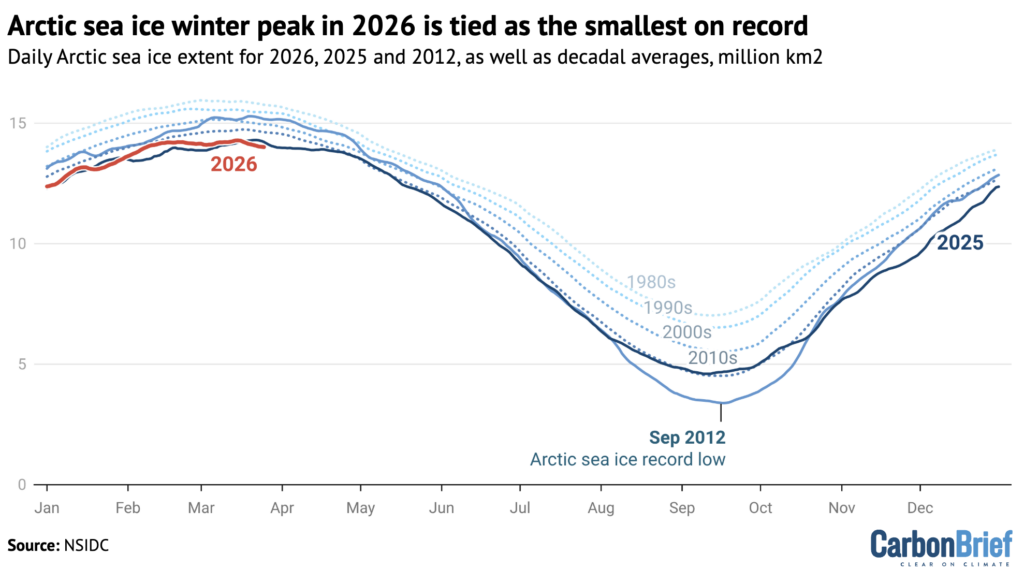
Provisional data from the US National Snow and Ice Data Center (NSIDC) shows that sea ice extent peaked at 14.29m square kilometres (km2) on 15 March.
This is slightly smaller than the previous record for the annual maximum – set just last year – but it counts as a statistical tie, the NSIDC says.
The annual maximum is a key marker in a cycle that sees sea ice extent grow through the cold, dark winter, before melting in spring and summer to a yearly minimum.
The joint record marks a “very alarming” winter for Arctic sea ice, Dr Zack Labe – a scientist at Climate Central – tells Carbon Brief.
And there is more “grim news”, Labe says, as the thickness of the ice is near record lows – meaning that Arctic sea ice is “entering late winter in one of its weakest states in the satellite record”.
‘Unusually warm’
The past six months has seen Arctic sea ice extent “at record or near-record lows, alongside unusually warm conditions” across much of the region, says Dr Lettie Roach, a polar climate scientist at the Alfred Wegener Institute.
These go “hand in hand”, Roach tells Carbon Brief, as “warmer air and ocean temperatures help melt the ice and with less ice, the ocean absorbs more heat, which further speeds up warming”.
The chart below shows Arctic sea ice extent in 2025 (dark blue) and 2026 (red) so far. For comparison, the chart shows decadal averages (dotted lines) as well as 2012 (mid blue), the year of the smallest summer sea-ice minimum on record.
Recent months have seen “strong temperature contrasts” over the northern hemisphere, continues Roach:
“In addition to large parts of the Arctic, temperatures were unusually warm in the western US, southern Europe and eastern Eurasia, while northern Eurasia, northern Canada and the north-eastern US experienced unusually cold conditions.
“That’s linked to a more ‘wavy’ jet stream, which can push cold Arctic air southward while bringing warmer air into the Arctic.”
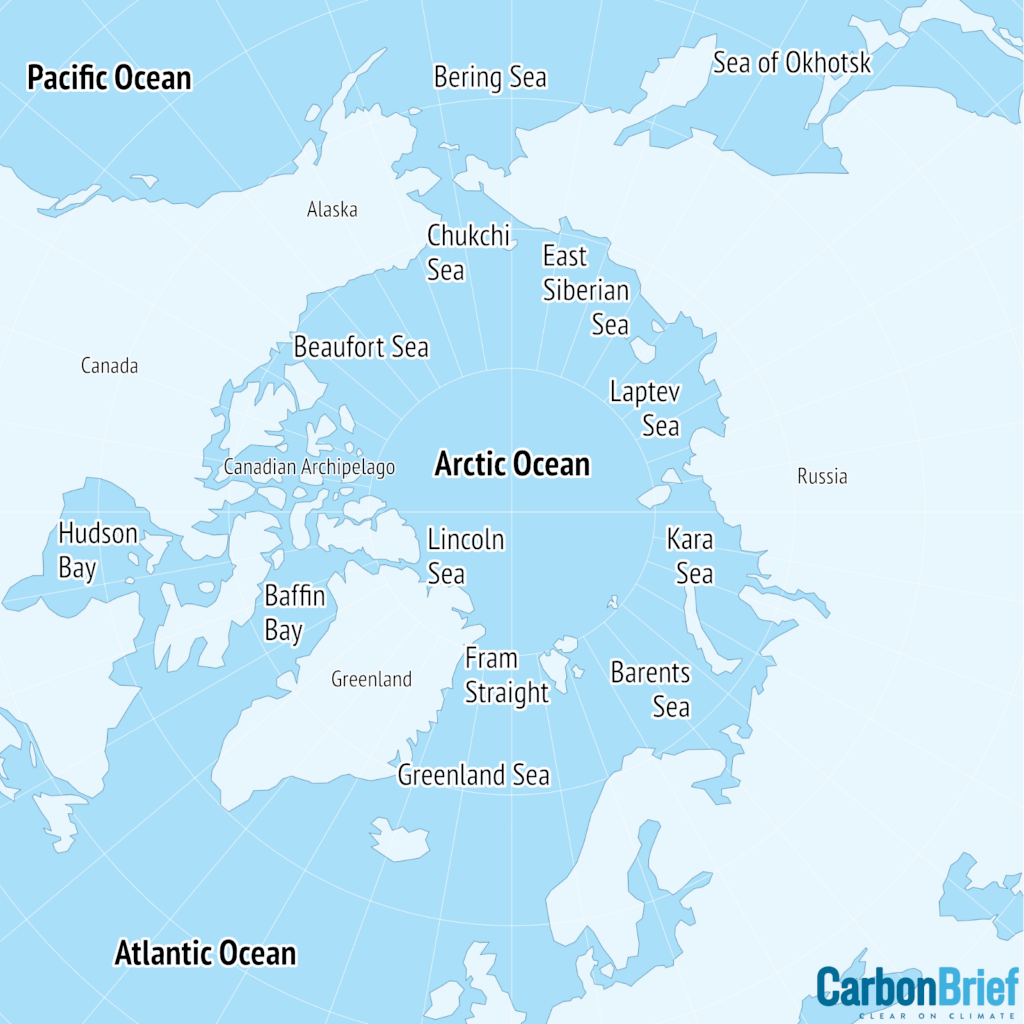
These conditions have contributed to “particularly bad” sea ice levels in regions such as the Sea of Okhotsk, Baffin Bay, Barents Sea and Kara Sea, says Labe. He adds that “one of the only regions with more sea ice relative to normal is across the eastern Bering Sea around Alaska”.
‘Long-term downward trend’
This year’s winter peak is the latest milestone in the “long-term downward trend we’ve observed” in Arctic sea ice since the start of satellite observations in the late 1970s, says Roach.
According to the NSIDC, the 2026 maximum extent is 1.36km2 smaller than the 1981-2010 average. That is “equivalent to about twice the size of Texas”, the centre says.
Arctic sea ice is “not just shrinking in extent”, says Roach, it is “also much thinner and more fragile than it used to be”.
Labe notes the “grim news” that sea ice “near the north pole has had record-low thickness for several months now”, adding:
“In February, total Arctic sea ice volume was the second lowest on record. Taken together, Arctic sea ice is entering late winter in one of its weakest states in the satellite record.”
While there is a “lot of year-to-year variability due to natural fluctuations in the atmosphere and ocean”, this long-term decline is “mainly due to human-caused climate change”, says Roach.
Labe adds:
“Human-caused climate change is completely reshaping the polar environment and this is already having wide-ranging consequences.”
The chart below shows the annual winter maxima (blue) and summer minima (red) since the start of the satellite record.
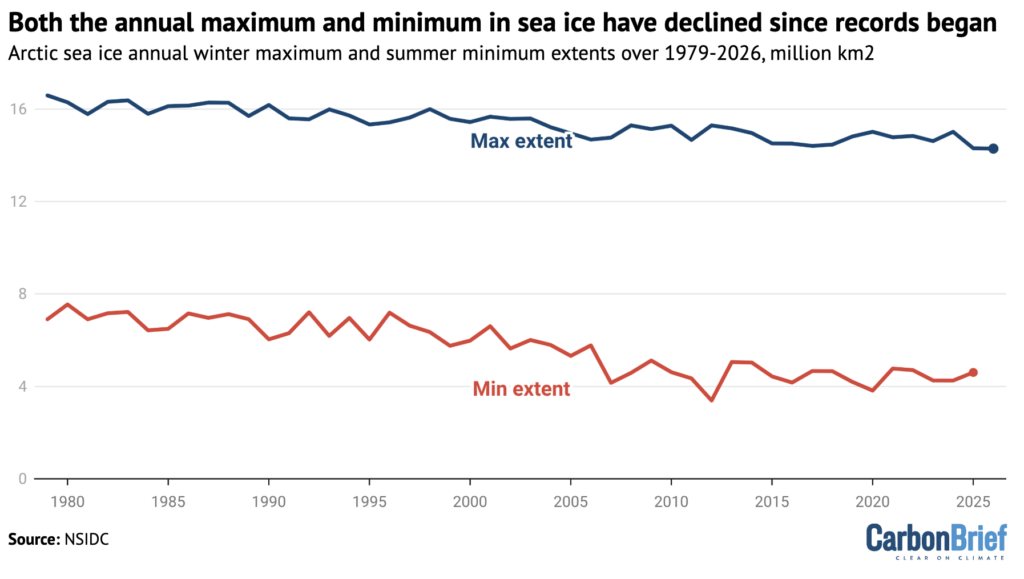
The chart highlights that the annual maximum has “shown a relatively steady decline over the past 40 years, with the [previous] record low occurring as recently as last year”, says Dr Mika Rantanen, a researcher at the Finnish Meteorological Institute.
This is in “sharp contrast to the annual minimum, where the record [low] still dates back to 2012”, he tells Carbon Brief. This indicates that the summer minimum is “more prone” to yearly ups and downs of natural variability, he explains.
It is for this reason that “it is still too early to say” what the low winter peak means for the forthcoming summer melt season as “regional weather can change quickly”, adds Labe:
“But winter of 2025-26 is another clear signal of just how fast the Arctic is shifting.”
‘Average’ Antarctica
At the Earth’s other pole, sea ice around Antarctica has been melting through the southern-hemisphere summer.
It reached its annual minimum extent of 2.58m km2 on 26 February, the NSIDC says, placing this year as the 16th smallest on record.
For most of the summer, Antarctic sea ice has been “below average”, Dr Clare Eayrs, a postdoctoral researcher at the Korea Polar Research Institute (KOPRI), tells Carbon Brief. However, she continues:
“That changed in January and February, when a shift in surface winds slowed the retreat. Southerly winds over the Weddell Sea pushed existing sea ice northward, keeping coverage higher than expected in that region, while sea ice cover in the Bellingshausen Sea remained low.”
These winds were mostly “redistributing ice rather than new ice forming in these regions”, Eayrs notes:
“This was enough to keep the summer sea ice coverage much closer to average than in the previous four years…It is a reminder that where a season starts does not always determine where it ends.”
Recent years have seen a series of record-low extents in the sea ice that surrounds Antarctica.
While it is “likely” that climate change is influencing Antarctic sea ice, scientists “remain uncertain about the extent and precise mechanisms involved”, says Eayrs:
“This uncertainty is itself an important part of the story. Antarctic sea ice has always been highly variable and its variability has masked any emerging long-term signal for much of the satellite era.”
However, recent research points to a recent “structural change” in Antarctica’s sea ice system, Eayrs notes. This is marked by a greater persistence of low sea ice and a “weaker tendency for the system to return to its earlier mean state”.
In other words, says Eayrs, “when sea ice drops to unusual lows, it no longer bounces back as readily as it once did”.


The post ‘Very alarming’ winter sees Arctic sea ice hit record-low for second year running appeared first on Carbon Brief.
‘Very alarming’ winter sees Arctic sea ice hit record-low for second year running
India has set a new target to reduce its “emissions intensity” – greenhouse gas emissions per unit of economic output – to 47% below 2005 levels by 2035.
The much-awaited announcement comes within India’s delayed new nationally determined contribution (NDC) for 2035 under the Paris Agreement, which had been due last year.
The pledge, which has not yet been published by the UN, was approved by India’s cabinet and issued as a government press release on 25 March.
The updated NDC from the world’s third-largest emitter lands amid the global energy crisis triggered by the Iran war, which has already led to Indians grappling with gas shortages.
In its pledge, India has committed to non-fossil energy making up 60% of its installed electricity-generating capacity by 2035.
The country has also announced an increase to its target for the amount of CO2 that will be absorbed by carbon sinks, such as forests – the first such rise since India made its first pledge to the Paris Agreement.
Some climate experts in India have welcomed the new pledge, saying the country “is pulling more than its weight given its minimal historical contribution to emissions” and “despite recent geopolitical headwinds”.
However, others point out that the targets “underestimate India’s potential” for clean-energy growth and “allow for an acceleration” of emissions, while “hiding” deforestation.
Below, Carbon Brief outlines India’s new climate pledge for 2035 and its implications for the nation’s energy sector, emissions and adaptation efforts.
This article will be updated once the full NDC has been formally published by the UN.
- What is in India’s updated climate pledge?
- What do India’s pledges mean for its energy sector?
- What do India’s pledges mean for its land sector?
- What are the political considerations behind India’s new climate pledge?
- How have India’s new pledges been received?
What is in India’s updated climate pledge?
The 1,200-word press release announcing the approval of India’s new NDC for 2035 is thin on detail. For example, it does not spell out any climate-finance needs for adaptation, mitigation or climate change-induced loss and damage.
The details provided in the press release include three headline quantified targets for three areas:
- GDP emissions intensity
- “Non-fossil fuel” share of electricity generation
- Land and forestry
First, India commits to cutting the “emissions intensity” of its GDP to 47% below 2005 levels by 2035, a small increase from the 45% target for 2030 set out in its previous pledge in 2022.
Emissions intensity is defined as the total amount of greenhouse gas emitted for each unit of GDP, which means it applies to all sectors of the economy and covers all gases, such as methane and nitrous oxide, as well as carbon dioxide (CO2).
However, there is no globally agreed benchmark to measure this type of target.
According to the Indian government’s fourth “biennial update report” submitted to the UN on 30 December 2024, India had already reduced its emissions intensity by 36% between 2005 and 2020.
By setting an intensity target, India would be able to continue increasing its emissions as its economy grows, as Carbon Brief has previously explained. This target, therefore, depends on the size of India’s economy in 2035, as well as its total emissions.
(Under the terms of the Paris Agreement and the first “global stocktake” agreed in 2023, only developed countries are expected to set “absolute” targets to cut their emissions. Developing countries are “encouraged” to move towards such targets “over time”.)
The two-point increase in India’s intensity target, to 47% by 2035, “will not bring any real emission reductions, given India’s fast-growing GDP”, says a statement from climate research group Climate Action Tracker.
It says this new goal is ‘unlikely to drive significantly more ambitious action”.
India’s GDP is expected to grow by an average 6.1% per year out to 2035, which is “more than any other major country or region”, according to the International Energy Agency (IEA).
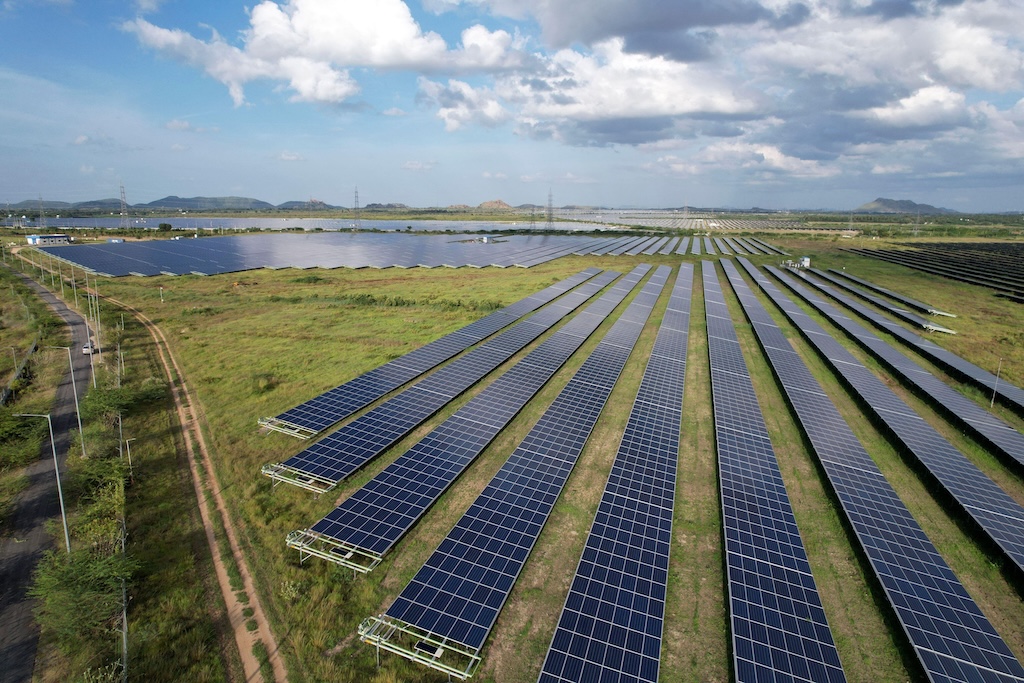
Second, the country has pledged to raise the share of “non-fossil fuel-based energy resources in installed electric power capacity” to 60%. (India defines “non-fossil sources” as including large-scale hydropower, nuclear, bioenergy, solar and wind power.)
The target is a 10-percentage point increase from the previous goal of “about 50%” by 2030.
In July 2025, the Indian government announced that it had achieved this target, five years ahead of schedule. As of February 2026, non-fossil sources already made up 52.6% of installed capacity.
The IEA estimates that India’s existing policies would be sufficient to achieve the newly targeted 60% share as early as 2030, reaching 70% by 2035.
Third, the country has raised its land and forestry sector target for the first time since 2015.
According to the press release description of the new pledge:
“[India has] further enhanced the ambition of creating [a] carbon sink through forest and tree cover to 3.5-4.0bn tonnes of CO2-equivalent [GtCO2e] by 2035 from 2005 level[s].”
However, the baseline from which India calculates its emissions reductions from forests was only clarified in 2024 and its metrics for measuring forest and tree cover remain controversial. (See: What does India’s pledge mean for its land sector?)
Additionally, the target corresponds to a “business-as-usual scenario”, according to India’s own forest authorities, with no additional policies required to achieve it.
Beyond the three quantitative headline goals, the NDC pledge also contains five qualitative targets. The government release says these are “intended to embed sustainability into everyday life and governance systems, promote climate-resilient development pathways and enable a just and inclusive transition for all sections of society”.
They include a target to “mobilise domestic, and new and additional finance from developed countries”.
Another qualitative target is a commitment to develop “resilient infrastructure” in order to “adapt to climate change in various sectors like agriculture, water resources, health, disaster management and fragile ecosystems”.
The government release does not explicitly mention the 1.5C aspirational global warming limit agreed as part of the Paris Agreement, but it does “recogni[se] that climate change impacts are already being felt”. It also says the government has “placed strong emphasis on adaptation and disaster resilience across the key actors of its economy”.
The release lists a range of adaptation actions and initiatives that the government is engaged in, from mangrove restoration to “heat action plans” and monitoring glacial lake outburst floods. However, it does not set any new adaptation goals.
According to India’s national economic survey for 2025/26, adaptation and “resilience-related” domestic spending “surged” to 5.6% of the country’s GDP in 2022-23, from 3.7% in 2016-17, with 98% of adaptation finance sourced domestically.
The Indian government says that the NDC “mark[s] a significant step towards the goal of achieving net-zero by 2070”, but does not offer further explanation.
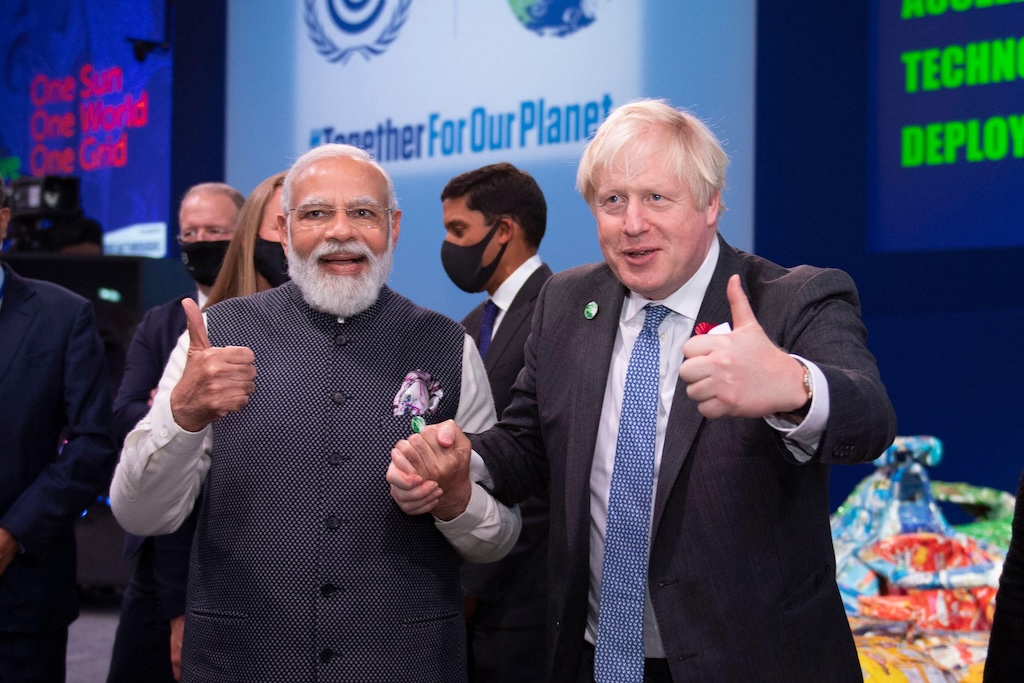
Additionally, it does not mention two targets announced by president Narendra Modi in 2021 at COP26 in Glasgow. These were to install 500 gigawatts (GW) of non-fossil capacity by 2030 and to reduce cumulative emissions between 2021-30 to 1bn tonnes of CO2 (GtCO2) below expected levels.
However, the release does reiterate that the “achievement of our targets ahead of time…provides strong confidence in the country’s ability to deliver on future commitments”.
The release also says that India has “considered” the outcomes of the first ”global stocktake” and the “need for greater ambition” in line with the Paris Agreement’s long-term temperature goal in “shaping” India’s 2035 NDC.
It adds that, when formulating the pledge, the government took into account the principles of equity and common, but differentiated responsibility, as well as development and energy security priorities.
What does India’s pledge mean for its energy sector?
India’s new target for non-fossil sources to make up 60% of installed electricity generating capacity builds on its 2022 NDC target to reach “about 50%” by 2030.
Although not specified in the latest release, the previous goal was said to have been conditional on the availability of low-cost international finance. In July 2025, India announced that it had already achieved this 50% target, five years ahead of schedule.
When this announcement was made in June last year, India’s installed non-fossil capacity comprised 38.1% renewables, 10.2% of large hydropower and 1.8% nuclear energy.
In January 2026, India’s non-fossil installed capacity reached 50.6% and, per the announcement, had already reached 52.6% in February.
Meeting the new 2035 target would, therefore, require only another 8 percentage-point increase in the non-fossil share of installed capacity over the next nine years.
This is much less ambitious than India’s own national generation adequacy plan, published in March 2026, which says that non-fossil fuel-based installed capacity would reach “70% of the total installed capacity by 2035-36”.
According to estimates from the Centre for Science and Environment (CSE), India could hit the 60% target as early as 2028.
Beyond the overall non-fossil capacity target, the NDC release does not include specific goals for domestic renewable generation or capacity installation.
According to the Central Electricity Authority, renewable energy, including large hydropower, only accounted for 22.4% of total electricity generation – a far lower share than the installed capacity percentage.
As of January 2026, coal-fired power still accounted for 69% of total generation.
India is still planning to add approximately 56GW of new coal-fired power generation capacity by 2030, because of the expected growth in peak electricity demand.
According to a report by government thinktank Niti Aayog, India’s coal consumption for all uses “could more than double by mid-century before plunging sharply”.
On the other hand, research for Carbon Brief by the Centre for Research on Energy and Clean Air (CREA) shows that electricity generation from coal in India fell by 3% year-on-year in 2025. It suggests that power-sector emissions could peak before 2030, if clean-energy capacity and electricity demand grow as expected.
The analysis found that the fall in coal-fired power was partly a result of accelerated clean-energy growth, which played a significant role in driving down coal generation for the first time.
Nevertheless, a range of challenges are holding back the growth of India’s grid-based solar power, according to a 2025 report by the Institute for Energy Economics and Financial Analysis (IEEFA), which points to issues including delays in power supply agreements and transmission challenges.
Solar manufacturing has seen a “13-fold jump” that has outpaced domestic demand. In September, it was reported that India had 44GW of renewable energy “ready for deployment”, but challenges around secure long-term power contracts were holding back its deployment.
Experts tell Carbon Brief that off-grid solar might absorb some of this glut, which could explain additional outlays for rooftop solar in India’s February budget. In 2025, India added 7.1GW of rooftop solar capacity, a 122% increase from the previous year.
However, Reuters reports that this rooftop solar push “is falling short of targets despite heavy subsidies” because of poor financing and limited support from state utilities and vendors.
The country is expanding its hydropower fleet in the high eastern Himalayan region – near a disputed border with China – despite biodiversity concerns, drought and flood impacts on dams and reservoirs.
According to Down To Earth, the country is also “prioritising pumped hydropower storage projects over battery systems”, expecting to add around 50GW of such capacity by 2032.
India is also looking to nuclear energy to serve as a steady source of power to complement variable renewable output.
In December 2025, the government enacted a landmark new nuclear law, dubbed the “Shanti” act – an acronym for “sustainable harnessing and advancement of nuclear energy for transforming India”.
It aims to help India increase its nuclear capacity more than tenfold, from 8GW in 2024 to 100GW by 2047. (India has some 6GW of nuclear capacity under construction.)
However, given high costs, extended timescales and India’s long history of public protests against nuclear energy over safety and land-acquisition concerns, it remains to be seen how quickly this capacity can be ramped up.
What does India’s pledge mean for its land sector?
For the first time since issuing its first target in 2015, India has raised its land and forestry carbon-sink goal in its updated NDC.
This target aims to create an additional annual carbon sink of 3.5GtCO2e through “additional tree and forest cover” by 2035, compared with 2005 levels.
This is a 1GCO2e increase from its target for 2030, which was to sequester 2.5-3GtCO2e through additional forest and tree cover by 2030. This time, India finally spells out a clear 2005 baseline from which these targets are to be measured.
According to the Forest Survey of India’s (FSI) last India state of forest report, the country had “already reached 2.29Gt of additional carbon sink” against its 2005 baseline in 2023.
Dr Sharad Lele, professor of environmental policy and governance at the Ashoka Trust for Research in Ecology and the Environment, tells Carbon Brief that the increase in India’s forest NDC target is “concerning” for several reasons.
First among these, Lele says, is that the FSI’s official claim of sequestration so far “is based on shaky methods and non-transparent datasets”. He continues:
“Second, the country continues to lose dense forests of high conservation and livelihood value to development projects while sequestration seems to be done through plantations.
Third, and most important, carbon as well as conservation goals should not bypass the rights of Indigenous and local communities, [which] continues to result in both forest destruction and plantation happening in ways that disregard community concerns and priorities.”

In recent years, the Modi government clarified two key missing components of India’s carbon-sink target, which had confused even forest authorities.
In 2024, the Indian government clarified the baseline year against which its carbon sink is measured, setting it to 2005.
Second, India retrospectively adopted an interpretation of annual forest cover metrics that allow it to meet its carbon sequestration target “without implementing additional measures per se for increasing forest carbon sink”, according to the FSI.
The FSI’s metrics have been questioned by the UN, scientists and the media for their lack of transparency and for “masking” deforestation. In addition, its definition of what constitutes forest cover is seen as controversial because it includes monocultures, commercial plantations and urban parks.
The FSI defines the term “forest cover” in India as follows:
“All lands, more than or equal to one hectare in area, with a tree canopy of more than or equal to 10%, irrespective of ownership and legal status; and includes orchards, bamboo and palm.”
Because of this definition and how it is measured, India’s forest cover has “shown a gradual and steady trend of increase in the last one and a half decades”, according to the FSI.
Souparna Lahiri, a climate and land-use expert with the Climate Land Ambition and Rights Alliance (CLARA), tells Carbon Brief that this approach means deforestation is “hidden”:
“When you choose a carbon sequestration target, what you’re trying to mask is the real health of India’s forests.…This is a self-rewarding scheme for when you have compensatory afforestation schemes for many, many years that are basically raising plantations.”
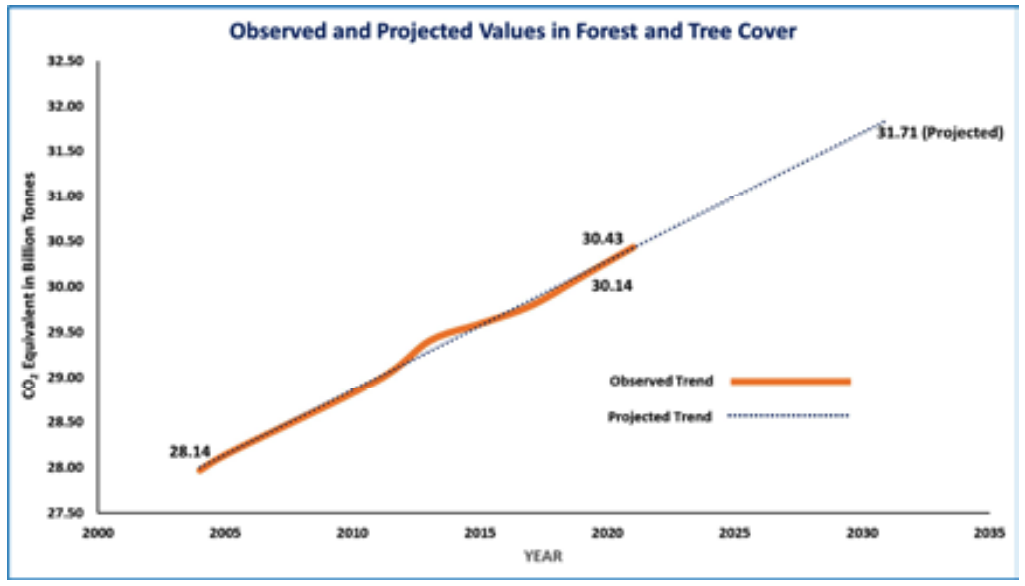
The chart below shows the FSI’s estimates of forest carbon stocks from 2005 to 2023 (orange) and its projections for further carbon sequestration out to 2030 (dotted line).
The figure shows that the FSI expects India to exceed its 2030 target of boosting forest carbon stocks by 2.5-3.0GtCO2e over 2005 levels, with a projected 3.57GtCO2e increase. Indeed, this projected increase would see the new 2035 target, for a 3.5GtCO2e increase over 2005 levels, being met by 2030, five years early.
Meanwhile, according to the forest data platform Global Forest Watch, India lost 1.3m hectares (mha) of tree cover from 2015 to 2024, equivalent to 5% of the forested area in 2010. It says this area would have sequestered 830MtCO2e prior to being deforested.
The country’s climate ministry has prioritised granting and fast-tracking permits for forest clearance for strategic infrastructure and energy projects, with further exemptions for critical minerals, exploration and other projects.
The Indian government has also allowed for private monoculture plantations on public forest land without compensating for the loss of primary forest.
Ashish Kothari, veteran environmentalist and founder of non-profit Kalpavriksh, tells Carbon Brief:
“There are so many contradictions. We’re currently fighting the Great Nicobar case, where the government wants to clearfell 130sqkm of rainforest and believes it can compensate for this with plantations 2,400km away in Haryana in north India. All of this never makes it to India’s NDC.”

At the same time, new research warns that increasing “ecological droughts” induced by climate change could weaken India’s forest carbon sinks.
Another study estimates that carbon uptake of India’s forests fell by 5-12% in the decade from 2010 to 2019, compared to the previous one.
Land availability for afforestation and restoration to meet India’s carbon-sink target is another key contention.
In a recent Carbon Brief guest post, researchers estimated that less than 0.5% of the country’s area is “immediately available for forest restoration”, which, if regenerated, could sequester less than 10% of India’s 2030 pledge.
Carbon markets under Article 6 of the Paris Agreement were a key priority for India in the run-up to COP30 and the country has been setting up its own domestic forest carbon market.
Lahiri points out that India’s carbon market is “still restricted” within the energy sector, but now has a “green credit scheme” for the land sector – spanning afforestation, mangrove restoration and wetland conservation – where one tree can equal one “green credit” unit.
Lahiri says that this shows India is intending to “balance the energy sector emissions from carbon sequestration”.
What are the political considerations behind India’s new climate pledge?
India’s climate pledges have been delayed in the past, so the late arrival of its latest NDC is not necessarily a significant sign. However, the new pledge was announced amid an energy shock triggered by the US-Israel war on Iran.
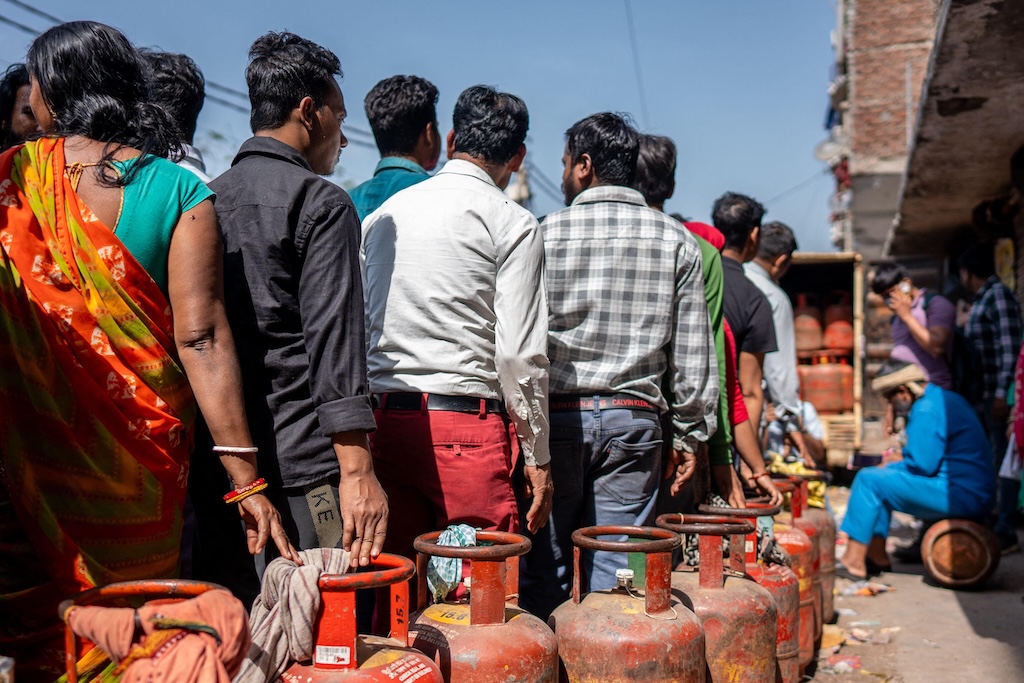
This means that India is trying to secure energy supplies from different sources, as people around the country face widespread shortages. Additionally, key state elections are being held in April.
While the country was hailed in 2022 for proposing language to “phase out all fossil fuels” and not just coal, recent events indicate less tolerance for such a stance.
A key consideration for India’s level of climate commitment within its latest NDC has also been the $300bn a year climate-finance target agreed at COP29 in Baku. Since then, many developed countries have cut their aid budgets.
At COP29, India called the climate-finance outcome “a joke” and accused the presidency of pushing the deal through without proper consent, following chaotic last-minute negotiations.
![Bluesky post by Aruna Chandrasekhar, handle @arunacsekhar.bsky.social. Bluesky post says: INDIA: "We informed the #COP29 presidency we wanted to make a statement prior to any decision on the adoption lof the #NCQG finance goal]." "This has been stage-managed, and we are extremely disappointed." "This document is nothing more than an optical illusion. India opposes [its] adoption." There is a photo attached of a woman speaking at COP29.](https://breakingclimatechange.com/wp-content/uploads/2026/03/bsky.app_profile_arunacsekhar.bsky_.social_post_3lbnm6cq5p22o-862x1024-4.png)
According to government sources quoted in the Indian Express earlier in 2026, India’s NDC was expected to “reflect the disappointment of COP29 outcome on climate finance”.
In addition, the US exit from the Paris Agreement, the UNFCCC, IPCC, climate funds and even the India-led International Solar Alliance has fuelled fears around the future of multilateral environmental governance.
War and conflict have also contributed to an increased emphasis on energy security.
Finally, India’s climate diplomacy position has historically been to “underpromise and overdeliver”. In this wider context, some experts welcomed the fact that India had announced an NDC with higher targets than the previous version, in the current geopolitical climate.
For example, according to Dhruba Purkayastha, consultant to the UNFCCC’s standing committee on finance, the announcement “is a clear sign of leadership” on climate action at a time when “it is evident that the west is not going to lead”. Puryakastha said in a statement:
“At a time when the world order stands diminished and when there is little traction for climate – which seems to have lost its standing as a global public good – it is good to see that India is staying on track. And, given that India is the BRICS chair, this announcement probably paves the way for a BRICS-led climate action.
On the other hand, Dr Nandini Das – climate economist and India lead at Climate Action Tracker – said in a statement that the country “missed an opportunity to come up with a national, economy-wide 2035 target to cut greenhouse gas emissions.”
How have India’s new pledges been received?
The new pledge has received a positive response from many climate experts in India, but a more cautious reception from overseas commenters.
Avantika Goswami, programme manager of climate change at CSE, tells Carbon Brief that the new targets stand out “in the current context” and “represent a commitment” to climate multilateralism. She tells Carbon Brief:
“At a time when developed countries are backtracking on ambition, deepening their fossil-fuel entrenchment and dragging the world towards military conflict, the signal from India shows that global south leadership on climate ambition is concrete and real.”
Prof Navroz K Dubash, professor of public and international affairs at Princeton University, tells Carbon Brief that India’s new pledge falls into an “ongoing pattern” of NDCs that “under-commit and will overcomply”, a description he says also fits China’s recent pledge.
Dubash elaborates:
“This pattern suggests that statements of ambition are no longer the driver of climate action, if indeed they ever were. Instead, indications of implementation on the ground – real domestic policy and investment trends – are the more useful benchmark of progress.”
In a statement, Dr Arunabha Ghosh, director at the Council on Energy, Environment and Water (CEEW), says that the pledge balances “energy security and resilience”, as the country faces “macroeconomic shocks and climate extremes”.
Ghosh points out that India’s power markets are evolving rapidly and, if “supply chain disruptions” ease, India could exceed its targets again. He says:
“A targeted 60% share of non-fossil electricity capacity in 2035 suggests that, while India has raised its ambition to decarbonise the power sector, it is also doubling down on energy security and affordability for hundreds of millions of its citizens.”
Madhura Joshi, programme lead at climate change thinktank E3G, says the NDC shows “strong intent to bet on clean energy at home as part of a strategic move to improve its energy security and prosperity”.
In a statement, she adds:
“India’s raising of ambition on non-fossil fuel capacity, emissions intensity and on carbon sinks reflects a measured and meaningful step forward, but India’s strong track record suggests that it will surpass these targets ahead of schedule.”
Others have been more cautious about the NDC targets, with Lauri Myllyvirta, lead analyst and co-founder at CREA, saying in a statement that the targets “underestimate the country’s potential for transformative clean energy growth”.. He adds:
“Under current plans, the target of 60% clean-power capacity will be achieved before 2030, rather than by 2035. Continuing the current clean-energy growth at rates already achieved in 2024-25 would enable India to peak power-sector emissions well before 2030 and significantly slow down its CO2 emission growth rates.
“Yet, the carbon-intensity target…allows for an acceleration of emissions growth compared with past rates, if GDP growth is at target. India’s booming clean-energy industry is highly likely to deliver much faster progress than policymakers were prepared to commit to today.”



The post Q&A: What does India’s new Paris Agreement pledge mean for climate action? appeared first on Carbon Brief.
Q&A: What does India’s new Paris Agreement pledge mean for climate action?



-
Greenhouse Gases8 months ago
Guest post: Why China is still building new coal – and when it might stop
-
Climate Change8 months ago
Guest post: Why China is still building new coal – and when it might stop
-

 Greenhouse Gases2 years ago
嘉宾来稿:满足中国增长的用电需求 光伏加储能“比新建煤电更实惠”
-
Climate Change2 years ago
Bill Discounting Climate Change in Florida’s Energy Policy Awaits DeSantis’ Approval
-

 Climate Change2 years ago
嘉宾来稿:满足中国增长的用电需求 光伏加储能“比新建煤电更实惠”
-
Climate Change Videos2 years ago
The toxic gas flares fuelling Nigeria’s climate change – BBC News
-

 Carbon Footprint2 years ago
US SEC’s Climate Disclosure Rules Spur Renewed Interest in Carbon Credits
-

 Renewable Energy5 months ago
Sending Progressive Philanthropist George Soros to Prison?