A controversial way of measuring how much methane warms the planet has stirred debate in recent years – particularly around assessing the climate impact of livestock farming.
The metric – known as GWP* (global warming potential star) – was designed to more precisely account for the warming impact of short-lived greenhouse gases, such as methane.
No country so far has used GWP* to measure emissions, but New Zealand is currently considering its use.
In June, a group of climate scientists from around the world wrote an open letter advising against this.
They argued that the metric “creates the expectation that current high levels of methane emissions are allowed to continue”.
Climate experts tell Carbon Brief that there is “no strong debate” on the science behind GWP* and that it can accurately assess the global warming effect of methane.
But many experts also firmly caution against its use in national climate targets, believing it could allow countries to prolong high levels of emissions at a time when they should be drastically cut.
Some researchers tell Carbon Brief that GWP* is an “accounting trick” and a “get-out-of-jail-free card for methane emitters”. A 2021 Bloomberg article called the metric “fuzzy methane math”.
Prof Myles Allen, one of the scientists who created GWP*, tells Carbon Brief that the metric is “nothing more” than one way of better understanding the climate impact of different actions as part of efforts to limit warming under the Paris Agreement.
In this Q&A, Carbon Brief explains the science behind GWP*, why the metric is so divisive and the ways in which its use has been considered.
- What is GWP*?
- What are the main controversies around using GWP*?
- Do any countries currently use GWP* to measure methane emissions?
- What do experts think about the use of GWP*?
What is GWP*?
Global warming is caused by a build up of greenhouse gases – mainly from burning fossil fuels – trapping heat in the atmosphere.
Different gases cause differing levels of warming and remain in the atmosphere for varying lengths of time. For example, carbon dioxide (CO2), the main contributor to warming, lingers for centuries, whereas other gases last decades or even millennia.
To account for these variables, scientists use a metric known as global warming potential (GWP), which assesses the warming caused by different gases compared to CO2, which has a GWP of 1.
Using GWP, emissions of other gases are calculated in terms of their “CO2 equivalent” over a given amount of time.
In their reports, the Intergovernmental Panel on Climate Change (IPCC) set out three GWP variants measured over 20 years (GWP20), 100 years (GWP100) and 500 years (GWP500).
GWP100 is the most common approach and is used to calculate emissions under the Paris Agreement.
Methane is a short-lived gas that only remains in the atmosphere for around 12 years before breaking down. But it causes a large burst of initial warming that is around 80 times more powerful than CO2, according to the IPCC.
This means that one tonne of methane causes the same amount of warming as around 80 tonnes of CO2, when measured over a period of 20 years.
When calculated over 100 years, methane’s shorter lifetime means it causes around 30 times more warming than CO2.
Some experts have criticised the use of GWP100, saying it does not sufficiently account for the fact that methane leaves the atmosphere much more quickly than CO2 and does not actually last for 100 years. This is the issue that GWP* was designed to fix.
GWP* calculates the warming contributions of long- and short-lived gases at different rates, accounting for their varying lifetimes in the atmosphere.
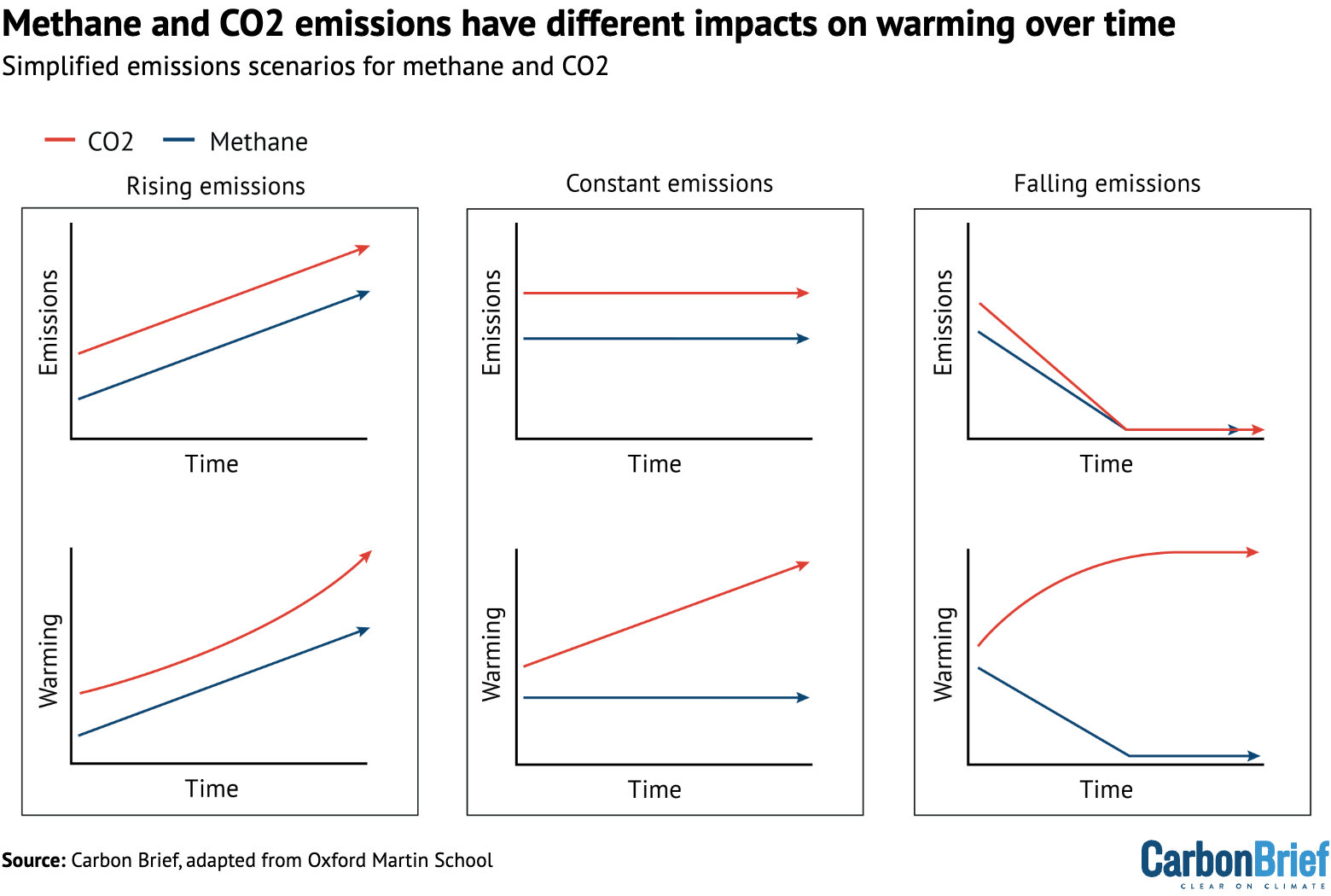
One of the researchers behind GWP*, Dr Michelle Cain, explained in a 2018 Carbon Brief guest post that a constant rate of methane emissions can maintain stable atmospheric concentrations of the gas, assuming methane sinks remain constant as well.
In contrast, a constant rate of CO2 emissions “leads to year-on-year increases in warming, because the CO2 accumulates in the atmosphere”, Cain wrote. CO2 does not leave the atmosphere after a decade or so, as methane does, and continues to build over time until emissions stop.
Cain, formerly a researcher at the University of Oxford and now a senior lecturer at Cranfield University, added:
“For countries with high methane emissions – due to, say, agriculture – this can make a huge difference to how their progress in emission reductions is judged.”
Methane emissions that slowly decline or remain stable over time are calculated as contributing “no additional warming” to the planet, which is not the case with other GWP calculations.
The chart below shows simplified emissions scenarios for CO2 and methane, highlighting the different impacts they have on global warming over time.
The chart below shows how using the two different metrics – GWP* and GWP100 – affects the same emissions pathway throughout the 21st century, given the different warming impacts of greenhouse gases.

If, for example, a country emitted 4m tonnes of methane annually from 1990-2005, these emissions would now be considered “climate-neutral” using GWP*, as they are not actively contributing new warming to the atmosphere, but rather maintaining the existing levels of methane in the atmosphere in 1990.
This would not be the case under GWP100, which looks at the warming potential of emissions over the course of a century and does not account for their different atmospheric lifetimes.
GWP* can be used for other short-lived gases, such as some hydrofluorocarbons, but methane is the most significant short-lived gas when it comes to climate change.
The IPCC notes that converting methane emissions into CO2 equivalent using GWP100 “overstates the effect of constant methane emissions on global surface temperature by a factor of 3-4” and understates the impact of new methane emissions “by a factor of 4-5 over the 20 years following the introduction of the new source”.
GWP* was created by several researchers, including Prof Myles Allen, the head of atmospheric, oceanic and planetary physics at the University of Oxford. The concept was detailed in a 2016 study and first named in a 2018 study. It was further updated by the authors in 2019 and 2020.
Allen tells Carbon Brief that the researchers involved were “reluctant” to give their new metric a name, as it “was just a way of using reported numbers to calculate warming impact”. He adds:
“I think it’s really unfortunate that people have latched onto GWP*. It doesn’t matter. We could forget about GWP* entirely, we can just use a climate model to work out the warming impact…GWP* is a handy way of calculating the warming impact of activities. Nothing more.”
What are the main controversies around using GWP*?
Efforts to cut methane emissions are widely viewed as a “quick-win” to help limit the effects of climate change in the short term.
More than 100 countries signed a pledge, launched at COP26 in 2021, to cut global methane emissions by 30% by 2030.
Cutting methane would also help to counteract an acceleration in warming due to declining aerosol emissions, which are currently masking around half a degree of warming.
Experts Carbon Brief spoke to agree on the importance of cutting methane emissions, but disagree on whether GWP* helps or hinders these efforts.
The debate around the metric centres on the possible impacts of its use, rather than the soundness of the science behind it.
Prof Joeri Rogelj, a climate science and policy professor at Imperial College London, explains:
“At the global level, at any level, the method of GWP* actually provides a good, new way to translate the trajectory of methane emissions into equivalent emissions of CO2, or emissions of CO2 that would have an equivalent warming effect…The debate is on the application.”
Allen says he is a “little frustrated” that discussions around the use of GWP* have “become so emotive”. He tells Carbon Brief:
“Every action we take has both a temporary impact on global temperature and a permanent one. How much is in both areas depends on the action. We need to know those two things in order to make decisions about choices of action in pursuit of a temperature goal…GWP* gives you a handy way of doing that.”
Below, Carbon Brief details some of the main discussion points and controversies around GWP*.
Carbon cycle
A misleading claim frequently made about livestock is that cows do not contribute much to global warming because the methane they emit eventually returns to the land through the carbon cycle – the set of processes in which carbon is exchanged between the atmosphere, land and ocean, as well as the organisms they contain.
Those in favour of using GWP* to measure methane emissions often also stress the difference between methane emissions that come from animals – known as biogenic methane – and methane from fossil fuels.
Rogelj tells Carbon Brief that biogenic and fossil-sourced methane are “slightly different, but that difference is really second-order” when it comes to climate change.
Methane warms the planet while it is in the atmosphere, so the “climate effect is exactly the same, irrespective of which source the methane comes from”, Rogelj adds.
The differences become more significant when methane breaks down in the atmosphere and oxidises into water vapour and CO2.
CO2 that originated from a cow can be reabsorbed by plants and the land. But the CO2 resulting from fossil methane – which stems from sources such as flaring from oil and gas drilling – stays in the atmosphere. Although fossil methane has a “bit of a longer effect”, Rogelj says:
“This is a bit of a red herring, because the main effect is, of course, the effect that the methane has while it is methane and not what the carbon molecule of that methane has after [the] methane has been broken down or oxidised to CO2.”
He adds that there are ways of reducing agricultural methane, such as “diet change” or “management measures”, but no way to remove the emissions “100%”.
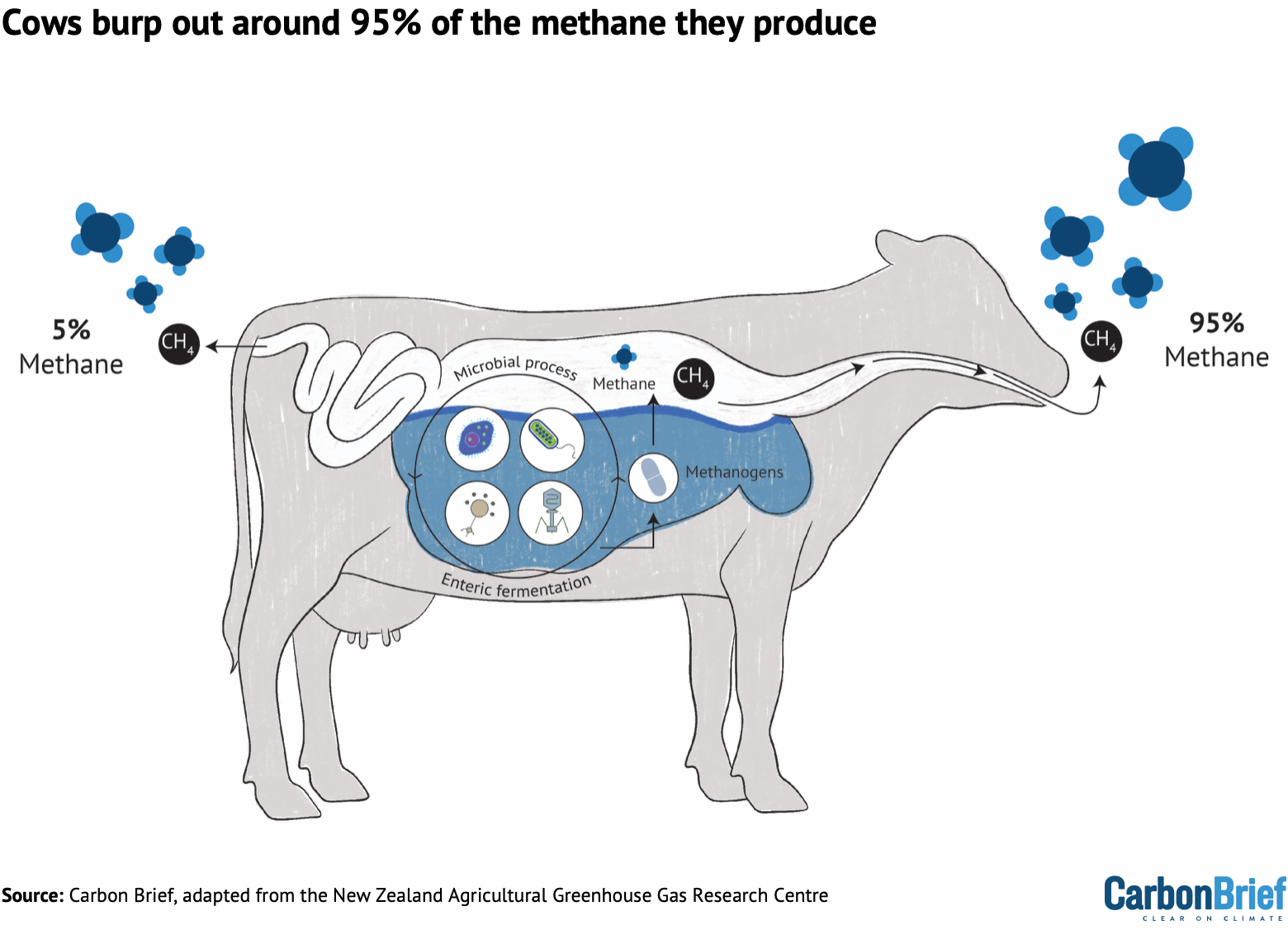
The graphic below shows the digestive process through which a cow emits methane.
Agriculture also causes other significant environmental harms. It is responsible for around 80% of global deforestation and is a key driver of biodiversity loss and water pollution.
Prof Frank Mitloehner, a professor and air-quality specialist at the University of California, Davis (UC Davis), is one of the main proponents of GWP*, frequently speaking about it in public presentations and discussions with the farming sector.
He tells Carbon Brief that, while animal agriculture can cause environmental harm, it is a “silly argument” to say these impacts are being ignored in carbon-cycle discussions.
He gives an example of discussions on deaths from car accidents excluding mentions of the emissions from cars, saying that these wider impacts are still important and can be discussed separately.
He adds that it is an “urban myth” that biogenic methane emissions are not a concern because of the carbon cycle.
‘No additional warming’
Under GWP*, methane emissions stop causing new warming once they reduce by 10% over the course of 30 years – around 3% each decade, or 0.3% each year.
These emissions are then described in research and policy as causing “no additional warming”.
For example, a 2021 study from Mitloehner and other UC Davis researchers, found that methane emissions from the US cattle industry “have not contributed additional warming since 1986”, based on GWP* calculations. It also said that the dairy industry in California “will approach climate neutrality” by the 2030s, if methane emissions are cut by just 1% annually.
(According to the US Environmental Protection Agency, methane emissions from enteric fermentation – the digestive process through which cows produce the greenhouse gas – increased by more than 5% over 1990-2022.)
However, many critics take issue with the “no additional warming” concept.
The main criticism is that, although a gradually reducing herd of cattle may stabilise methane emissions, it still emits the polluting gas. If animal numbers were instead drastically reduced, this would cut methane emissions and lower warming rather than maintaining current levels.
Dr Caspar Donnison, a postdoctoral researcher at Lawrence Livermore National Laboratory in the US, says the term no additional warming is “absolutely misleading” in the context of GWP*. He tells Carbon Brief:
“You just assume, on the face of it, that this means it has a neutral impact on the climate…But ‘no additional warming’ means that you’re still sustaining the warming that the herd is causing.”
Allen says that the debate focuses on the “stock of warming versus additional warming”. He compares it to accounting for historical emissions of CO2:
“If a country got rich by burning CO2, they’ve caused a lot of warming in the past. If they reduce their CO2 emissions to zero, then people are generally happy to call what they’re doing climate-neutral, even though they may be sitting on a huge heap of historical warming caused by their CO2 emissions while they were burning [fossil fuels].
“And yet, temperature-wise, that’s exactly the same thing as having a source of methane that’s declining by 3% per decade.”
Climate ambition
Another criticism around the use of GWP* is that countries or companies with high agricultural methane emissions could use the metric to make small emission reductions appear larger.
Dr Donal Murphy-Bokern, an independent agricultural and environmental scientist, believes that the metric can be used as a “get-out-of-jail-free card for methane emitters”. He adds:
“It’s all about saying carry on as we are; we’ll manage this by slightly reducing our emissions over a critical period in history, so as to appear at that critical period in history to be so-called ‘climate-neutral’.”
Mitloehner disagrees with this, noting that, while reductions in methane emissions appear significant under GWP*, increases also appear significant. He says:
“It is simply not true that GWP* is a get-out-of-jail-free card. It’s not. If you reduce emissions, it makes your contributions look less. If you increase emissions, it makes your contributions much worse.”
Rogelj says he has not seen GWP* being used to advocate for the “highest possible ambition” in cutting methane emissions.
However, Allen says that “no metric tells you what to do”. He adds:
“How you measure emissions and how you measure warming has absolutely no bearing on whether you think a country has an obligation to undo some of the damage to the climate they’ve caused in the past.
“This is where the ‘free-pass’ argument makes no sense to me, because the existence of a method to calculate the warming impact of your emissions allows you to make decisions about emissions in light of their warming impact, sure, but it doesn’t tell you what the outcomes of those decisions should be.”
Allen adds that the livestock sector is “unsustainable globally”, with animal numbers and methane levels still rising.
The chart below shows how atmospheric methane concentrations have increased in recent decades.

Allen tells Carbon Brief:
“Do we need to eliminate livestock agriculture to stop global warming? No…[but] we do need to start decreasing it. And if we can decrease it faster than 3% per decade then that would help reduce warming that’s caused by other sectors or, indeed, undo some of the warming that the livestock sector has caused in the past.”
Mitloehner says considerations on the fairness of using GWP* are “real from a policy standpoint and they have to be addressed from a policy standpoint”. He adds:
“But, from a scientific standpoint – and that’s where I’m coming from – I think it’s not controversial.”
Baseline and historical emissions
The baseline year from which emissions reduction targets are set is significant, as it helps form the scope of climate ambition.
For example, high-emitting countries, such as the UK, have set 1990 as their baseline year for emissions-cutting targets, whereas many low-emitting countries may choose further back or more recent years, depending on their needs. Rogelj says:
“Because GWP* translates a change in emissions into either an instantaneous emission or instantaneous removal of CO2, your starting point becomes really important.
“If you start with very high emissions of methane and you did not in any way account for this high starting point, then even very minor, unambitious reductions in methane would result in creating credits for high-polluting countries.”
However, he notes that this is just one way of applying the metric and that there could be ways to avoid this “inequitable outcome”, such as applying GWP* globally and allocating each country a per-capita methane budget, instead of assessing based on national current or past emissions. (Rogelj and Prof Carl-Friedrich Schleussner discussed other possible GWP* equity measures in a 2019 study.)
The chart below, adapted from that study, shows how GWP* can significantly change the per-capita methane emissions of different countries. Some countries with high agricultural methane emissions, such as New Zealand, change from high to low per-capita emitters.
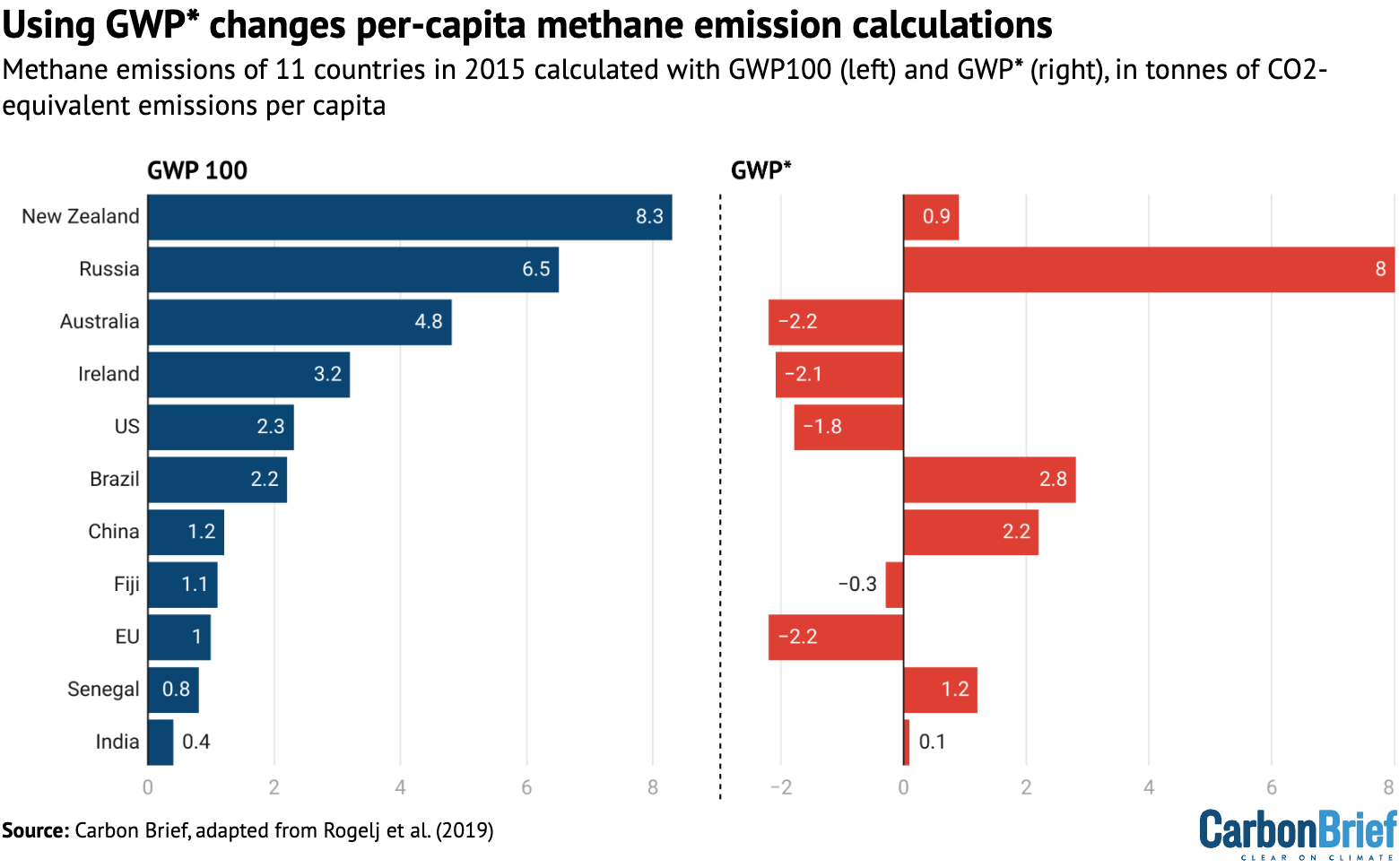
A 2025 study used a climate model to quantify future national warming contributions for Ireland under different emissions scenarios and found that “no additional warming” approaches, such as GWP*, are “not a robust basis for fair and effective national climate policy”.
Discussing baseline concerns, Allen says these considerations are the same for any other metric:
“It depends on how much account you want to take of [the] warming you’ve caused in the past – and at what point you want to take responsibility for the warming your actions had caused.”
He believes that most climate experts agree that it is good to understand the impact emissions have on global temperatures, but “where the controversy arises is about what you consider someone’s nominal emissions to be today”. He adds:
“This is where everybody gets upset, because if you use GWP*, then a livestock sector that’s reducing its emissions by 3% per decade – which most global-north livestock sectors are doing – it looks like their emissions are quite small.
“But that’s only a problem if you think that the main issue is working out whose fault global warming is, rather than working out what we should do about it.”
Communication
Many experts Carbon Brief spoke to took issue with how GWP* has been discussed by some of its proponents.
Murphy-Bokern criticises how Mitloehner and other experts communicate the metric. He says:
“The confusion arises from the activities of Mitloehner, in particular, where he presents the farming community – and the industry in general – with the idea that you can magic away the warming effect of methane simply by looking at the rate of change of methane emissions.”
Mitloehner says he has no regrets about his communication of GWP*, adding that he has “always emphasised to the livestock sector that reductions of methane are important”. He tells Carbon Brief:
“I’m proud because I have been able to take the livestock sector along with the understanding that reductions are needed and that they can be part of a solution if they understand that.”
The New York Times reported in 2022 that the research centre led by Mitloehner at the University of California, Davis “receives almost all its funding from industry donations and coordinates with a major livestock lobby group on messaging campaigns”. Other reports note his discussions about GWP* with stakeholders in various countries.
In response to these reports, Mitloehner says he believes it is important to work with the sector you are researching, adding that he receives both public and private funding. He tells Carbon Brief:
“The problem is not that they [the meat industry] are investing in research and communications and extension. The problem is that they are not putting in enough, because the public sector is withdrawing from this.
“Climate research is being slashed…If the government is not paying into research to quantify and reduce emissions – and those people who are critical of what we do say ‘oh, industry shouldn’t do it’ – then, I ask you, who should?”
Colin Woodall, the chief executive of the National Cattlemen’s Beef Association, a US lobby group, said in 2022 that GWP* is the “methodology we need to make sure everybody is utilising in order to tell the true story of methane”, Unearthed reported. According to the outlet, he added:
“We’re working with our partners around the globe to ensure that everybody is working towards adoption of GWP*.”
Asked if he regrets anything about his communication of GWP*, Allen tells Carbon Brief:
“When we first introduced this – and, perhaps, this is one thing I do regret – I was, perhaps, a little naive in that I thought everybody would seize on focusing on [the] warming impact because it was, from a policy perspective, potentially much easier for the agricultural sector.
“I thought that this would actually be welcomed. But, sadly, it’s not been. And I think part of that is because of this narrative of blame.”
Do any countries currently use GWP* to measure methane emissions?
GWP* is not yet used by any country in methane emission reporting or targets. But it has been considered by New Zealand, Ireland and other nations with high agricultural emissions.
A 2024 statement from dozens of NGOs and environmental organisations called for countries and companies not to use GWP* in their greenhouse gas reporting or to guide their climate mitigation policies. They wrote:
“The risks of GWP* significantly outweigh the benefits.”
New Zealand
New Zealand is currently considering changing its biogenic methane target, including applying the “no additional warming” approach used in GWP*. If it does so, it could become the first country to adopt GWP*.
The nation is a major livestock producer and agriculture generates nearly half of all its greenhouse gas emissions.
The chart below shows that the agricultural sector is also responsible for more than 90% of the country’s methane emissions.
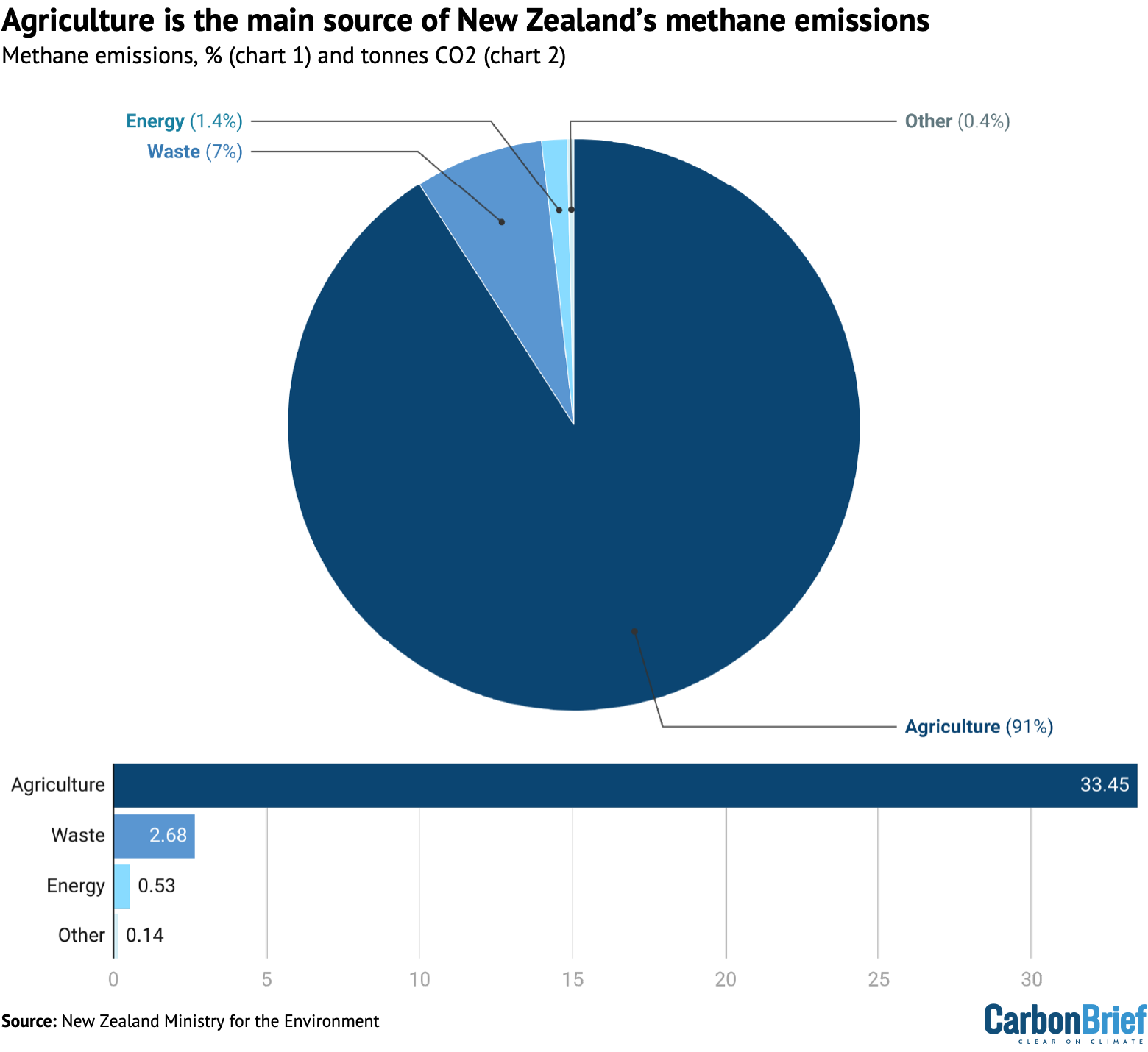
New Zealand has a legally binding target to reach net-zero greenhouse gas emissions by 2050. However, biogenic methane has separate targets to reduce by 10% by 2030 and by 24-47% by 2050, compared to a baseline of 2017 levels.
In late 2024, a review from the nation’s Climate Change Commission recommended that the government change its 2050 greenhouse gas targets, including to increase the biogenic methane goal to a 35-47% reduction by 2050.
At the same time, an independent panel commissioned by the New Zealand government reviewed how the country’s climate targets would look under the “no additional warming” approach.
The resulting report, which did not look specifically at GWP*, but used a similar concept, found that a 14-15% cut in biogenic methane by 2050 would be “consistent with meeting the ‘no additional warming’ condition”, under mid-range global emissions scenarios that keep temperatures below 2C.
The government is “currently considering” these findings, a spokesperson for the Ministry for the Environment tells Carbon Brief in a statement.
The spokesperson says that the report is “part of the body of evidence” that the government will use in its response to the Climate Change Commission’s review, which it must publish by November 2025.
Cain, the Cranfield University lecturer who co-created GWP*, wrote in Climate Home News in 2019 that New Zealand reducing biogenic methane by 24% would “offset the warming impact” of the rest of the country’s emissions, adding:
“New Zealand could declare itself climate-neutral almost immediately, well before 2050 and only because farmers were reducing their methane emissions. That’s a free pass to all the other sectors, courtesy of New Zealand’s farmers.”
A report on GWP* by the Changing Markets Foundation found that, in 2020, 16 industry groups in New Zealand and the UK “urged” the UN’s Intergovernmental Panel on Climate Change to use GWP* to assess warming impacts.
Australia
The Guardian reported in May 2024 that Cattle Australia, a cattle producer trade group, was “lobbying the red-meat sector to ditch its net-zero target in favour of a ‘climate-neutral’ goal that would require far more modest reductions in methane emissions”.
Cattle Australia’s senior adviser and former chief executive, Dr Chris Parker, tells Carbon Brief in a statement that the organisation is “working with the Australian government to ensure methane emissions within the biogenic carbon cycle are appropriately accounted for in our national accounting systems”. He adds:
“We believe GWP* offers a more accurate way of assessing methane’s temporary place in the atmosphere and its impact on the climate. Australian cattle producers are part of the climate solution and we need policy settings to enable them to participate in carbon markets.”
Australia’s Department of Climate Change, Energy, the Environment and Water did not respond to Carbon Brief’s request for comment.
Ireland
Internal documents assessed for the Changing Markets Foundation’s GWP* report “suggest” that Ireland’s Department of Agriculture, Food and the Marine has advocated for GWP* “at the international level”, including at the UN’s COP26 climate summit in 2021.
Allen and Mitloehner were involved in a 2022 Irish parliamentary discussion on methane, in which Allen advocated for the country to “be a policy pioneer” by using GWP* in its methane reporting alongside standard methods.
The country’s coalition government, formed earlier this year, pledged to “recognise the distinct characteristics of biogenic methane” and also “advocate for the accounting of this greenhouse gas to be re-classified at EU and international level”.
A spokesperson for Ireland’s Department of Agriculture, Food and the Marine tells Carbon Brief that this does not refer to using GWP* specifically. They say the country is “in favour of using accurate, scientifically validated and internationally accepted emission measurement metrics”, adding:
“It is important that the nature of how biogenic methane interacts in the environment is accurately reflected in how it is accounted for. This does not mean the use of the metric GWP*.”
In December 2024, Ireland’s Climate Change Advisory Council proposed temperature neutrality pathway options to the government that do not specifically refer to GWP*, but use the same concept of no “additional warming”.
The Irish Times reported that this was “in part to reduce potential disruption from Ireland’s legal commitment to achieve national ‘climate neutrality’ by 2050”.
The climate and energy minister, Darragh O’Brien, said he has “not formed a definitive view” on this, the newspaper noted, and that expert views will feed into ongoing discussions on the 2031-40 carbon budgets, which are due to be finalised later in 2025.
In an Irish Times opinion article, Prof Hannah Daly from University College Cork, described the temperature neutrality consideration as “one of the most consequential climate decisions this government will make”. She wrote that the approach “amounts to a free pass for continued high emissions” of livestock methane.
Paraguay
Paraguay mentioned GWP* in a national submission to the UN in 2023 after agribusiness representatives “pushed” to adopt the metric, according to Consenso, a Paraguayan online newsletter.
The country’s National Directorate of Climate Change told Consenso for a separate article related to GWP* that it is “aware” of questions around the metric, but that it “has the option of using other measurement systems” for emissions reporting.
UK
The National Farmers’ Union, the main farming representative group in England and Wales, is in favour of using GWP* to measure agricultural methane emissions.
Carbon Brief understands that the UK government is not currently considering using GWP* in addition to, or instead of, GWP100 in its emissions reporting.
What do experts think about the use of GWP*?
Most experts Carbon Brief spoke to agreed that GWP* could be a useful metric to apply to global methane emissions, but that it is difficult to apply equitably in individual countries or sectors. Rogelj believes that are are some contexts in which GWP* could be used, but adds:
“You cannot just take targets that were set and discussed historically with one greenhouse gas metric in mind – GWP100 under the UNFCCC [United Nations Framework on Climate Change] and the Paris Agreement and all that – [and] then simply apply a different metric to it. They change meaning entirely.
“So, if one would like to use GWP*, one should build the policy targets and frameworks from the ground up to take advantage of the strengths of that metric, but also put in place safeguards that ensure that the weaknesses and limitations of that metric do not result in unfair or undesirable outcomes.”
A 2022 study says that using GWP* in climate plans “would ask countries to start from scratch in terms of their political target setting processes”, calling it a “bold ask” for policymakers.
It adds that achieving net-zero emissions, as measured with GWP*, “would only lead to a stabilisation of temperatures at their peak level”.
However, a 2024 study found that GWP* gives a “dynamic” assessment of the warming impact of emissions that “better aligns with temperature goals” than GWP100, when measuring methane emissions from agriculture.
Allen believes that criticism over the use of GWP* is similar to “saying it’s a meaningless question” to consider the warming impact of a country or company’s actions. He adds:
“That seems a very strange position to me, because we need to know how different activities are contributing to global warming because we have a temperature target.
“In saying GWP* is a bad thing, what people are actually saying is it’s a bad thing to know the warming impact of our actions, which is a very strange thing to say.”
He says that such metrics help countries to make informed decisions on climate action, but that “we can’t expect metrics to make these decisions for us”.
Murphy-Bokern notes that GWP* could be useful in modelling global, rather than national, methane emissions to avoid high-emitting countries making small methane cuts to achieve “no additional warming”, rather than significantly reducing these emissions.
He says the metric would be particularly useful if global emissions were close to zero, as a way to target the final remaining emissions. But, he adds:
“We are so far away from that very happy situation, that the discussion now with GWP* is a huge distraction from the key objective, which is to reduce emissions.”
Mitloehner – and every expert Carbon Brief spoke with – agrees with this wider point. He says:
“The main point is we need to reduce emissions. In the case of livestock, we need to reduce methane emissions. And the question is how do we get it done? And how do we quantify the impacts that [that reduction] would have accurately and fairly? The other issues are issues that politicians have to answer.”
The post Q&A: What the ‘controversial’ GWP* methane metric means for farming emissions appeared first on Carbon Brief.
Q&A: What the ‘controversial’ GWP* methane metric means for farming emissions
Greenhouse Gases
Analysis: Fossil-fuel CO2 emissions to set new record in 2025, as land sink ‘recovers’
Carbon dioxide (CO2) emissions from fossil fuels and cement will rise around 1.1% in 2025, reaching a record 38.1bn tonnes of CO2 (GtCO2), according to the latest figures from the Global Carbon Project.
However, falling land-use emissions means that global CO2 emissions in 2025 will remain relatively unchanged compared to 2024 levels.
The 20th edition of the annual Global Carbon Budget report, published today, also finds that the land carbon sink – the portion of human-caused CO2 emissions absorbed by plants and soils – appears to have recovered to its pre-El Niño strength after two unusually weak years.
However, research published alongside the report by the same team also suggests that climate change has caused a long-term decline in land and ocean carbon sinks, with sinks being about 15% weaker over the past decade than they would have been without climate impacts.
The study, published in Nature, finds that the decline of carbon sinks has contributed about 8% to the rise in atmospheric CO2 concentration since 1960.
The 2025 Global Carbon Budget report also estimates that:
- Emissions in China and India are projected to grow much less in 2025 compared to the past decade, while emissions in the US and EU are projected to grow this year after years of decline.
- Global CO2 emissions from land-use change are expected to decrease by nearly 10% in 2025, driven by reductions in deforestation and forest degradation in South America.
- Total CO2 emissions – fossil and land use – have grown more slowly over the past decade (0.3% per year on average) compared to the previous decade (1.9% per year).
- The remaining carbon budget to limit global warming to 1.5C is virtually exhausted and is equivalent to only four years of current emissions. Carbon budgets to limit warming to 1.7C and 2C would similarly be used up in 12 and 25 years, respectively.
- The concentration of CO2 in the atmosphere is set to reach 425.7 parts per million (ppm) in 2025, 2.3ppm above 2023 and 52% above pre-industrial levels.
(For detailed coverage of previous editions of the report, see Carbon Brief’s coverage for 2024, 2023 and 2022.)
Global emissions remain flat
The Global Carbon Budget (GCB) finds that total global CO2 emissions in 2025 – including those from fossil fuels and land use – are projected to remain approximately flat at 42.2GtCO2, falling by a negligible -0.04% compared to last year.
This means 2025 is effectively tied with 2024 as the highest global CO2 emissions on record.
Flat total CO2 emissions in 2025 reflect a combination of continued rising emissions from fossil fuel and industry and declining emissions from land-use change. Fossil CO2 emissions rose 1.1% to 38.1GtCO2, while land-use emissions declined by -9.8% to 4.1GtCO2 (albeit with large uncertainties).
The figure below shows the 2025 global CO2 emissions update (red solid line) alongside 2024 (dark blue dotted), 2023 (mid blue dotted) 2022 (light blue dotted), 2021 (light grey dotted) and 2020 (dark grey dotted). The shaded area indicates the uncertainty around the new 2025 budget.
(Each year, the GCB is updated to include the latest data as well as improvements to modelling sources and sinks, resulting in some year-to-year revisions to the historical record.)

The 2025 figures are notably higher than those in the prior five GCB reports, reflecting an upward revision in historical land-use emissions. (This is discussed in more detail in the land-use emissions section below.)
Total global CO2 emissions have notably flattened in the past decade (2014-25), growing at only 0.3% per year compared to the 1.9% rate of growth during the prior decade (2004-13) and the longer-term average growth rate of 1.6% over 1959-2014.
This apparent flattening is due to declining land-use emissions compensating for continued – but slow – increases in fossil CO2 emissions. Fossil emissions grew around 0.2GtCO2 per year over the past decade, while land-use emissions decreased by a comparable amount.
However, despite the emissions plateau, there is still no sign of the rapid and deep decrease in CO2 emissions needed to reach net-zero and stabilise global temperatures in-line with the Paris Agreement temperature goal.
If global emissions remain at current levels, the remaining carbon budget to limit warming to 1.5C (with a 50% chance) will be rapidly exhausted.
(The carbon budget is the total amount of CO2 that scientists estimate can be emitted if warming is to be kept below a particular temperature threshold. Earlier this year, the Indicators of Global Climate Change report estimated the remaining carbon budget had declined by three-quarters between the start of 2020 and the start of 2025.)
With human-caused global warming sitting at around 1.36C above pre-industrial levels in 2024, the remaining budget for 1.5C is 170GtCO2, equivalent to four years of current emissions.
The GCB report finds that the remaining carbon budgets to limit warming to 1.7C and 2C have been reduced to 525GtCO2 (12 years at current emissions levels) and 1,055GtCO2 (25 years), respectively.
Global fossil CO2 emissions also grew more slowly in the past decade (0.8% per year) compared to the previous decade (2.1%). This was driven by the continued decarbonisation of energy systems – including a shift from burning coal to gas and replacing fossil fuels with renewables – as well as slightly weaker global economic growth during the past decade.
The figure below breaks down global emissions (dark blue line) in the 2025 budget into fossil (mid blue) and land-use (light blue) components. Fossil CO2 emissions represent the bulk of total global emissions in recent years, accounting for approximately 90% of emissions in 2025 (compared to 10% for land use). This represents a large change from the first half of the 20th century, when land-use emissions were approximately the same as fossil emissions.
Global fossil emissions include CO2 emitted from burning coal, oil and gas, as well as the production of cement. However, to determine total fossil emissions, the Global Carbon Budget also subtracts the cement carbonation sink – CO2 slowly absorbed by cement once it is exposed to the air – from fossil emissions.

Global emissions can also be expressed on a per-capita basis, as shown in the figure below.
While it is ultimately total global emissions that matter for the Earth’s climate – and a global per-capita figure glosses over a lot of variation among, and within, countries – it is noteworthy that global per-capita fossil emissions peaked in 2012 and have been slightly declining in the years since.

Land-use emissions continue downward trend
Global land-use emissions stem from deforestation, forest degradation, loss of peatlands and harvesting trees for wood. They averaged around 5.0GtCO2 over the past decade (2015-24) and the Global Carbon Budget provides an initial projection for 2025 of 4.1GtCO2.
This represents a 0.5GtCO2 decrease in land-use emissions relative to 2024. The GCB report suggests that this was largely driven by a combination of reductions in deforestation and forest degradation in South America and by the end of the dry 2023-24 El Niño conditions.
Overall, land-use emissions have decreased by around 32% compared to their average in the 2000s, with a particularly large drop in the past decade. This decline is statistically significant and is due both to decreasing deforestation and increasing levels of reforestation and afforestation globally.
Three countries – Brazil, Indonesia and the Democratic Republic of the Congo (DRC) – collectively contribute approximately 57% of the global land-use emissions. In the past, China has been a meaningful contributor to land-use emissions, but in recent years its land-use emissions have turned net-negative as more trees have been planted than cut down.
The figure below shows changes in emissions over time in these countries, as well as land-use emissions in the rest of the world (grey).

Historical land-use emissions have been revised upward in the 2025 GCB report compared to prior estimates. This reflects a combination of two factors:
- The discontinuation of one of the four bookkeeping models that GCB has historically relied on for land-use emissions estimates. This model tended to show lower land-use emissions than the others.
- The inclusion of the impacts from CO2 fertilisation on global biomass densities. Because forests have higher biomass densities now than in the past, due to increasing CO2, this tends to increase the estimate of land-use emissions for recent years.
Fossil-fuel CO2 hits record highs
Global emissions of fossil CO2 – including coal, oil, gas and cement – increased by around 1.1% in 2025, relative to 2024, with an uncertainty range of 0.2-2.2%. This represents a new record high and surpasses the prior record set in 2024.
The figure below shows global CO2 emissions from fossil fuels, divided into emissions from major emitting countries including China (dark blue shading), the US (mid blue), the EU (light blue), India (light blue) and the remainder of the world (grey).

China represents 32% of global CO2 emissions today. Its 2025 emissions are projected to increase by a relatively small 0.4% (with an uncertainty range of -0.9% to 2%), driven by a small rise in emissions from coal (0.3%), a modest rise in gas (1.3%) and a larger rise in oil (2.1%).
Given the uncertainty range, a decrease in Chinese emissions is also a possibility, but this will not be confirmed until the full 2025 data is available.
Similarly, recent analysis for Carbon Brief found that China’s emissions were “finely balanced between a small fall or rise” in 2025. However, it said that a drop in the full-year total became more likely after a 3% decline in September. (The Global Carbon Project estimates are based on data covering January through to August, which point towards a small rise in 2025.)
Whether China’s emissions see small rise or fall in 2025, the outcome will be due to moderate growth in energy consumption combined with an extraordinary growth in renewable power generation. This would represent the second year in a row where Chinese emissions growth was well below the average rate over the past decade.
The US represents 13% of global emissions and emissions in 2025 are projected to increase by 1.9% (-0.2 to +4.1%) compared with 2024. This marks a reversal from recent trends in declining CO2 emissions.
The projected growth of emissions in the US is likely driven by a combination of three factors: a colder start to the year after a mild 2024, which led to greater heating requirements, higher gas prices, which led to more coal being used in power generation, as well as an increase in total demand for electricity.
US emissions from coal are expected to increase by a substantial 7.5% in 2025, emissions from both oil and gas by a more modest 1.1% and emissions from cement to fall by -8.0%.
While policies enacted by the current US administration may increase CO2 emissions going forward, their impact on national emissions levels in 2025 were likely relatively modest compared to other factors.
India represents 8% of global emissions. In 2025, its emissions are projected to increase by 1.4% (-0.3% to +3.1%) on 2024 levels, significantly below recent trends.
An early monsoon with the highest-ever May rainfall substantially reduced cooling requirements in May and June, the hottest months of the year. Strong growth or renewables – particularly solar – has also helped limit the growth of Indian emissions.
Indian emissions from coal are expected to grow 1.7%, with oil growing 0.1%, gas shrinking by -6.4% and cement growing by 9.9%.
The EU represents 6% of global emissions. Its emissions are projected to increase by 0.4% in 2025, with an uncertainty range of -2.1 to +2.8%. This represents a divergence from a past decline in emissions (albeit with large uncertainties).
EU emissions from coal are expected to decline by -0.3%, whereas emissions from oil and gas are projected to increase by 0.6% and 0.9%, respectively. Cement emissions are expected to fall by -4.1%.
The increase in EU emissions is in part from weather-related low hydropower and wind generation which – despite increases in solar – have led to an increase in electricity generation from gas. In addition, a relatively cold February led to increased use of natural gas for space heating.
International aviation and shipping (included in the “rest of world” in the chart above) are responsible for 3% of global emissions. They are projected to increase by 6.8% for aviation, but remain flat for international shipping. This year will be the first time that aviation emissions have exceeded pre-Covid levels.
The rest of the world (excluding aviation) represents 38% of global emissions. Emissions are expected to grow by 1.1% in 2025 (ranging from -1.1% to +3.3%), with increases in emissions from coal (1%), oil (0.5%), gas (1.8%) and cement (2.4%).
The total emissions for each year over 2022-25, as well as the countries and regions that were responsible for the changes in absolute emissions, are shown in the figure below.
Annual emissions for 2022, 2023, 2024 and estimates for 2025 are shown by the black bars. The smaller bars show the change in emissions between each set of years, broken down by country or region – the US (dark blue), EU (mid blue), China (light blue), India (pale blue) and the rest of the world (grey). Negative values show reductions in emissions, while positive values reflect emission increases.

The US represented a large part of the rise in global fossil-fuel emissions in 2025. US emissions increases over 2024-25 contributed about 40% of the total global increase – more than the EU, China and India contributions combined.
The Global Carbon Project notes that emissions have declined over the past decade (2015-24) in 35 nations, which collectively account for 27% of global emissions. This is up from 18 countries during the prior decade (2005-14).
The decrease in emissions in those countries comes despite continued domestic economic growth and represents a long-term “decoupling” of CO2 emissions and the economy.
The carbon intensity of energy has consistently decreased over the past decade in China, the US, the EU – and, to a lesser extent, globally.
However, peaking CO2 emissions requires that the rate of decarbonisation exceeds the growth in energy demand. This has happened in some regions, including the US and EU, but not yet globally.
Modest growth in emissions from coal, oil, gas and cement
Global fossil-fuel emissions primarily result from the combustion of coal, oil and gas.
In 2025, coal is responsible for more emissions than any other fossil fuel, representing approximately 42% of global fossil-fuel CO2 emissions. Oil is the second largest contributor at 33% of fossil CO2, while gas comes in at 21%.
The production of cement is responsible for around 3.8% of global emissions, but this is reduced to 1.9% once the carbonation sink – the drawdown of atmospheric CO2 by concrete – is taken into account.
These percentages reflect both the amount of each fossil fuel consumed globally, but also differences in CO2 intensities. Coal results in the most CO2 emitted per unit of heat or energy produced, followed by oil and gas.
The figure below shows global CO2 emissions from different fuels over time, covering coal (dark blue), oil (mid blue) and gas (light blue), as well as cement production (pale blue) and other sources (grey).
While coal emissions increased rapidly in the mid-2000s, they have largely flattened since 2013. However, coal use increased significantly in 2021 and then more modestly in the subsequent four years.

Global emissions from coal increased by 0.8% in 2025 compared to 2024, while oil emissions increased 1.0% and gas emissions increased by 1.3%.
Despite setting a new record this year, global coal use is only 6% above 2013 levels – a full 13 years ago. By contrast, during the 2000s, global coal use grew at a rate of around 4% every single year.
The figure below shows the total emissions for each year over 2022-25 (black bars), as well as the absolute change in emissions for each fuel between years.

Global oil emissions were suppressed for a few years after the 2020, but rebounded to pre-pandemic levels as of 2024 and have continued to grow in 2025.
This reflects that, despite falling sales of internal combustion engine vehicles, not enough electric vehicles (EVs) have yet been sold to result in peak oil demand.
The global carbon budget
Every year, the Global Carbon Project provides an estimate of the overall “global carbon budget”. This is based on estimates of the release of CO2 through human activity and its uptake by the oceans and land, with the remainder adding to atmospheric concentrations of the gas.
(This differs from the commonly used term “remaining carbon budget”, which refers to the amount of CO2 that can be released while keeping warming below global limits of 1.5 or 2C.)
The most recent budget, including estimated values for 2025, is shown in the figure below.
Values above zero represent sources of CO2 – from fossil fuels and industry (dark blue shading) and land use (mid blue) – while values below zero represent carbon sinks that remove CO2 from the atmosphere. Any CO2 emissions that are not absorbed by the oceans (light grey) or land vegetation (mid grey) accumulate in the atmosphere (dark grey). In addition, a dashed black line is shown to represent the expected sum of sinks based on estimated emissions.

Over the past decade (2015-24), the world’s oceans have taken up approximately 29% of total human-caused emissions, or around 11.8GtCO2 per year.
The ocean CO2 sink has been relatively flat since 2014 after growing rapidly over the prior decades, reflecting the flattening of global emissions during that period.
This estimate for carbon sinks has been revised up from 26% in prior versions of the GCB, reflecting a major update to carbon budgets driven by new data and modelling of carbon sink behavior.
The land sink takes up around 21% of global emissions, or 8.7GtCO2 per year on average over the past decade – discussed in more detail in the section below. This is down from 29% in prior budgets.
The atmosphere continues to accumulate the bulk of human-caused CO2 emissions, with about 49% going into the atmosphere on average over the past decade – a rate of 20.4GtCO2 per year.
The growth rate of atmospheric CO2 in 2025 is expected to be around 2.3ppm, which is a bit below the decadal average rate of 2.6ppm over the past decade (2015-24). This is well below the record-setting rise of 3.7ppm in 2024, which was primarily driven by the effect of the 2023-24 El Niño conditions weakening the land sink.
Atmospheric CO2 concentrations are set to reach an annual average of 425.7ppm in 2025, representing an increase of 52% above pre-industrial levels of 280ppm.
There remains an unusual imbalance in the carbon budget in 2024, where the sum of the sinks is notably larger than estimated emissions. This can be seen in the figure above, where the dashed line is below the shaded area.
Budget imbalances are not unprecedented – there are large uncertainties in both emissions data and sink estimates. But the rise in the amount of CO2 accumulating in the atmosphere in 2024 is larger than would be expected based on emissions.
There are a number of potential explanations for this 2024 imbalance. The land cover data for 2024 is not yet complete and it is possible that some fire emissions data might be missing from the record. This might result in either higher land-use emissions or lower land sinks than currently estimated.
Alternatively, it could be due to the CO2 growth rate – captured by surface stations managed by the US National Atmospheric and Oceanic Administration (NOAA) – being slightly high. CO2 records for 2024 from these stations are higher than those obtained from satellite-based sensors, though it remains unclear which provides the most accurate measurement.
A declining, but not collapsing, land sink
After an usually weak land carbon sink in 2023, there were a number of media articles about its potential collapse.
For example, in October 2024, the Guardian wrote that “the sudden collapse of carbon sinks was not factored into climate models – and could rapidly accelerate global heating”.
The truth is a bit more complicated. While the impending collapse of the land carbon sink has been greatly exaggerated, there is growing evidence of a long-term weakening of both the land and ocean carbon sinks due to human activity.
And while the land sink has recovered to its pre-El Niño strength in 2025, aided by relatively low global fire CO2 emissions, it will continue to gradually weaken as global temperatures rise. This is not unexpected – scientists have long foreseen a weaker carbon sink in a warmer world.
A weaker land sink will contribute to higher global temperatures in the future as more CO2 emissions from burning fossil fuels and land use change will accumulate in the atmosphere.
The figure below shows the percentage of human emissions absorbed by the land sink in every year since 1959, with a recovery upwards in 2025 after two relatively low years.

In a study published in Nature alongside the release of the 2025 Global Carbon Budget, the same team of researchers provide a detailed estimate of exactly how the land and ocean sinks have changed as a result of human activity.
The research finds that the land and ocean sinks are 25% smaller and 7% smaller, respectively, than they would have been without the effects of climate change over 2015-24.
This amounts to a nearly 20% reduction in the efficacy of current global carbon sinks – that is, both the land and ocean – and a 15% reduction compared to how large they would be without the effects of climate change.
The figure below, from the new paper, shows the impact of climate change on the ocean sink (blue), the land sink (green) and atmospheric CO2 concentrations (grey) since 1960.

The weakening of carbon sinks due to human activity has led to an increase of atmospheric CO2 of more than 8ppm since 1960. The combined effects of climate change and deforestation have turned tropical forests in south-east Asia and in large parts of South America from CO2 sinks to sources.
And these sinks will likely continue to weaken as long as atmospheric CO2 concentrations continue to rise and the world continues to warm. There are a wide range of estimates of carbon cycle feedbacks among climate models, but a large carbon cycle feedback could result in a few tenths of a degree of future warming.
The post Analysis: Fossil-fuel CO2 emissions to set new record in 2025, as land sink ‘recovers’ appeared first on Carbon Brief.
Analysis: Fossil-fuel CO2 emissions to set new record in 2025, as land sink ‘recovers’
Greenhouse Gases
IEA: Fossil-fuel use will peak before 2030 – unless ‘stated policies’ are abandoned
The world’s fossil-fuel use is still on track to peak before 2030, despite a surge in political support for coal, oil and gas, according to data from the International Energy Agency (IEA).
The IEA’s latest World Energy Outlook 2025, published during the opening days of the COP30 climate summit in Brazil, shows coal at or close to a peak, with oil set to follow around 2030 and gas by 2035, based on the stated policy intentions of the world’s governments.
Under the same assumptions, the IEA says that clean-energy use will surge, as nuclear power rises 39% by 2035, solar by 344% and wind by 178%.
Still, the outlook has some notable shifts since last year, with coal use revised up by around 6% in the near term, oil seeing a shallower post-peak decline and gas plateauing at higher levels.
This means that the IEA expects global warming to reach 2.5C this century if “stated policies” are implemented as planned, up marginally from 2.4C in last year’s outlook.
In addition, after pressure from the Trump administration in the US, the IEA has resurrected its “current policies scenario”, which – effectively – assumes that governments around the world abandon their stated intentions and only policies already set in legislation are continued.
If this were to happen, the IEA warns, global warming would reach 2.9C by 2100, as oil and gas demand would continue to rise and the decline in coal use would proceed at a slower rate.
This year’s outlook also includes a pathway that limits warming to 1.5C in 2100, but says that this would only be possible after a period of “overshoot”, where temperature rise peaks at 1.65C.
The IEA will publish its “announced pledges scenario” at a later date, to illustrate the impact of new national climate pledges being implemented on time and in full.
(See Carbon Brief’s coverage of previous IEA world energy outlooks from 2024, 2023, 2022, 2021, 2020, 2019, 2018, 2017, 2016 and 2015.)
World energy outlook
The IEA’s annual World Energy Outlook (WEO) is published every autumn. It is regarded as one of the most influential annual contributions to the understanding of energy and emissions trends.
The outlook explores a range of scenarios, representing different possible futures for the global energy system. These are developed using the IEA’s “global energy and climate model”.
The latest report stresses that “none of [these scenarios] should be regarded as a forecast”.
However, this year’s outlook marks a major shift in emphasis between the scenarios – and it reintroduces a pathway where oil and gas demand continues to rise for many decades.
This pathway is named the “current policies scenario” (CPS), which assumes that governments abandon their planned policies, leaving only those that are already set in legislation.
If the world followed this path, then global temperatures would reach 2.9C above pre-industrial levels by 2100 and would be “set to keep rising from there”, the IEA says.
The CPS was part of the annual outlook until 2020, when the IEA said that it was “difficult to imagine” such a pathway “prevailing in today’s circumstances”.
It has been resurrected following heavy pressure from the US, which is a major funder of the IEA that accounts for 14% of the agency’s budget.
For example, in July Politico reported “a ratcheted-up US pressure campaign” and “months of public frustrations with the IEA from top Trump administration officials”. It noted:
“Some Republicans say the IEA has discouraged investment in fossil fuels by publishing analyses that show near-term peaks in global demand for oil and gas.”
The CPS is the first scenario to be discussed in detail in the report, appearing in chapter three. The CPS similarly appears first in Annex A, the data tables for the report.
The second scenario is the “stated policies scenario” (STEPS), featured in chapter four of this year’s outlook. Here, the outlook also includes policies that governments say they intend to bring forward and that the IEA judges as likely to be implemented in practice.
In this world, global warming would reach 2.5C by 2100 – up marginally from the 2.4C expected in the 2024 edition of the outlook.
Beyond the STEPS and the CPS, the outlook includes two further scenarios.
One is the “net-zero emissions by 2050” (NZE) scenario, which illustrates how the world’s energy system would need to change in order to limit warming in 2100 to 1.5C.
The NZE was first floated in the 2020 edition of the report and was then formally featured in 2021.
The report notes that, unlike in previous editions, this scenario would see warming peak at more than 1.6C above pre-industrial temperatures, before returning to 1.5C by the end of the century.
This means it would include a high level of temporary “overshoot” of the 1.5C target. The IEA explains that this results from the “reality of persistently high emissions in recent years”. It adds:
“In addition to very rapid progress with the transformation of the energy sector, bringing the temperature rise back down below 1.5C by 2100 also requires widespread deployment of CO2 removal technologies that are currently unproven at large scale.”
Finally, the outlook includes a new scenario where everyone in the world is able to gain access to electricity by 2035 and to clean cooking by 2040, named “ACCESS”.
While the STEPS appears second in the running order of the report, it is mentioned slightly more frequently than the CPS, as shown in the figure below. The CPS is a close second, however, whereas the IEA’s 1.5C pathway (NZE) receives a declining level of attention.

US critics of the IEA have presented its stated policies scenario as “disconnected from reality”, in contrast to what they describe as the “likely scenario” of “business as usual”.
Yet the current policies scenario is far from a “business-as-usual” pathway. The IEA says this explicitly in an article published ahead of the outlook:
“The CPS might seem like a ‘business-as-usual’ scenario, but this terminology can be misleading in an energy system where new technologies are already being deployed at scale, underpinned by robust economics and mature, existing policy frameworks. In these areas, ‘business as usual’ would imply continuing the current process of change and, in some cases, accelerating it.”
In order to create the current policies scenario, where oil and gas use continues to surge into the future, the IEA therefore has to make more pessimistic assumptions about barriers to the uptake of new technologies and about the willingness of governments to row back on their plans. It says:
“The CPS…builds on a narrow reading of today’s policy settings…assuming no change, even where governments have indicated their intention to do so.”
This is not a scenario of “business as usual”. Instead, it is a scenario where countries around the world follow US president Donald Trump in dismantling their plans to shift away from fossil fuels.
More specifically, the current policies scenario assumes that countries around the world renege on their policy commitments and fail to honour their climate pledges.
For example, it assumes that Japan and South Korea fail to implement their latest national electricity plans, that China fails to continue its power-market reforms and abandons its provincial targets for clean power, that EU countries fail to meet their coal phase-out pledges and that US states such as California fail to extend their clean-energy targets.
Similarly, it assumes that Brazil, Turkey and India fail to implement their greenhouse gas emissions trading schemes (ETS) as planned and that China fails to expand its ETS to other industries.
The scenario also assumes that the EU, China, India, Australia, Japan and many others fail to extend or continue strengthening regulations on the energy efficiency of buildings and appliances, as well as those relating to the fuel-economy standards for new vehicles.
In contrast to the portrayal of the stated policies scenario as blindly assuming that all pledges will be met, the IEA notes that it does not give a free pass to aspirational targets. It says:
“[T]argets are not automatically assumed to be met; the prospects and timing for their realisation are subject to an assessment of relevant market, infrastructure and financial constraints…[L]ike the CPS, the STEPS does not assume that aspirational goals, such as those included in the Paris Agreement, are achieved.”
Only in the “announced pledges scenario” (APS) does the IEA assume that countries meet all of their climate pledges on time and full – regardless of how credible they are.
The APS does not appear in this year’s report, presumably because many countries missed the deadlines to publish new climate pledges ahead of COP30.
The IEA says it will publish its APS, assessing the impact of the new pledges, “once there is a more complete picture of these commitments”.
Fossil-fuel peak
In recent years, there has been a significant shift in the IEA’s outlook for fossil fuels under the stated policies scenario, which it has described as “a mirror to the plans of today’s policymakers”.
In 2020, the agency said that prevailing policy conditions pointed towards a “structural” decline in global coal demand, but that it was too soon to declare a peak in oil or gas demand.
By 2021, it said global fossil-fuel use could peak as soon as 2025, but only if all countries got on track to meet their climate goals. Under stated policies, it expected fossil-fuel use to hit a plateau from the late 2020s onwards, declining only marginally by 2050.
There was a dramatic change in 2022, when it said that Russia’s invasion of Ukraine and the resulting global energy crisis had “turbo-charged” the shift away from fossil fuels.
As a result, it said at the time that it expected a peak in demand for each of the fossil fuels. Coal “within a few years”, oil “in the mid-2030s” and gas ”by the end of the decade”.
This outlook sharpened further in 2023 and, by 2024, it was saying that each of the fossil fuels would see a peak in global demand before 2030.
This year’s report notes that “some formal country-level [climate] commitments have waned”, pointing to the withdrawal of the US from the Paris Agreement.
The report says the “new direction” in the US is among “major new policies” in 48 countries. The other changes it lists include Brazil’s “energy transition acceleration programme”, Japan’s new plan for 2040 and the EU’s recently adopted 2040 climate target.
Overall, the IEA data still points to peaks in demand for coal, oil and gas under the stated policies scenario, as shown in the figure below.
Alongside this there is a surge in clean technologies, with renewables overtaking oil to become the world’s largest source of energy – not just electricity – by the early 2040s.

In this year’s outlook under stated policies, the IEA sees global coal demand as already being at – or very close to – a definitive peak, as the chart above shows.
Coal then enters a structural decline, where demand for the fuel is displaced by cheaper alternatives, particularly renewable sources of electricity.
The IEA reiterates that the cost of solar, wind and batteries has respectively fallen by 90%, 70% and 90% since 2010, with further declines of 10-40% expected by 2035.
(The report notes that household energy spending would be lower under the more ambitious NZE scenario than under stated policies, despite the need for greater investment.)
However, this year’s outlook has coal use in 2030 coming in some 6% higher than expected last year, although it ultimately declines to similar levels by 2050.
For oil, the agency’s data still points to a peak in demand this decade, as electric vehicles (EVs) and more efficient combustion engines erode the need for the fuel in road transport.
While this sees oil demand in 2030 reaching similar levels to what the IEA expected last year, the post-peak decline is slightly less marked in the latest outlook, ending some 5% higher in 2050.
The biggest shift compared with last year is for gas, where the IEA suggests that global demand will keep rising until 2035, rather than peaking by 2030.
Still, the outlook has gas demand in 2030 being only 7% higher than expected last year. It notes:
“Long-term natural gas demand growth is kept lower than in recent decades by the expanding deployment of renewables, efficiency gains and electrification of end-uses.”
In terms of clean energy, the outlook sees nuclear power output growing to 39% above 2024 levels by 2035 and doubling by 2050. Solar grows nearly four-fold by 2035 and nearly nine-fold by 2050, while wind power nearly triples and quadruples over the same periods.
Notably, the IEA sees strong growth of clean-energy technologies, even in the current policies scenario. Here, renewables would still become the world’s largest energy source before 2050.
This is despite the severe headwinds assumed in this scenario, including EVs never increasing from their current low share of sales in India or the US.
The CPS would see oil and gas use continuing to rise, with demand for oil reaching 11% above current levels by 2050 and gas climbing 31%, even as renewables nearly triple.
This means that coal use would still decline, falling to a fifth below current levels by 2050.
Finally, while the IEA considers the prospect of global coal demand continuing to rise rather than falling as expected, it gives this idea short shrift. It explains:
“A growth story for coal over the coming decades cannot entirely be ruled out but it would fly in the face of two crucial structural trends witnessed in recent years: the rise of renewable sources of power generation, and the shift in China away from an especially coal-intensive model of growth and infrastructure development. As such, sustained growth for coal demand appears highly unlikely.”
The post IEA: Fossil-fuel use will peak before 2030 – unless ‘stated policies’ are abandoned appeared first on Carbon Brief.
IEA: Fossil-fuel use will peak before 2030 – unless ‘stated policies’ are abandoned
Greenhouse Gases
Analysis: Which countries have sent the most delegates to COP30?
For the first time in the history of COP climate summits, the US – the world’s largest historical emitter – has not sent a delegation to the talks.
Back in January, newly inaugurated US president Donald Trump signed a letter to the UN to trigger the start of a US withdrawal from the Paris Agreement for a second time.
Although this process is not yet complete, the White House confirmed earlier this month that no “high-level officials” would be attending COP30 in Belém, Brazil.
The US joins Afghanistan, Myanmar and San Marino as the only countries not registering a delegation for the summit, according to Carbon Brief’s analysis of the provisional lists of delegates published by the United Nations Framework Convention on Climate Change (UNFCCC).
Despite these absences, more than 56,000 delegates have signed up to COP30, provisionally placing the summit as one of the largest in COP history.
This is despite the run-up to the negotiations being dogged by reports of a shortage of beds and “sky-high” accommodation costs.
Brazil even offered free cabins on cruise ships moored in Belém to delegations from low-income nations who were otherwise unable to attend.
According to the provisional figures, 193 countries, plus the European Union, have registered a delegation for the summit.
Unsurprisingly, the largest delegation comes from COP30 hosts Brazil, with 3,805 people registered.
This is followed, in order, by China, Nigeria, Indonesia and the Democratic Republic of the Congo.
This year also sees the largest number of “virtual” delegates, with more than 5,000 people signed up to attend the talks online.
Party delegations
With 56,118 delegates registered, COP30 is provisionally the second-largest COP in history, behind only COP28 in Dubai, which was attended by more than 80,000 people.
This is the provisional total, based on the delegates that have registered to be at the summit in person. At recent COPs, the final total is at least 10,000 lower, which would drop COP30 down to the fourth largest.
(The UNFCCC releases the final figures – based on participants collecting a physical badge at the venue – after the summit has closed.)
The chart below shows how the provisional figures for COP30 compare to the final totals in past COPs – going back to COP1 in Berlin in 1995.

The participant lists provided by the UNFCCC are divided between the different types of groups and organisations attending the summit. The largest group at COP30 is for delegates representing parties. These are nation states, plus the European Union, that have ratified the convention and play a full part in negotiations.
This group adds up to 11,519 delegates – the fourth largest behind the past three COPs.
(In keeping with recent COPs, the UNFCCC has published spreadsheets that name every single person that has registered for the summit – excluding support staff. Previously, COPs have typically included thousands of “overflow” participants in which countries and UN agencies could nominate delegates without their names appearing on their official lists.)
For consistency with Carbon Brief’s analysis of previous COPs, the above chart includes overflow delegates as a single group. However, the participant lists do divide the overflow delegates between parties and observer groups. Including the overflow numbers approximately doubles the total for party representatives to 23,509.
US no-show
Overall, of the 198 parties to the UNFCCC, 194 have registered delegations for COP30.
The most notable absentee is the US, which has been present at every other COP in history – even throughout Donald Trump’s first presidency.
On average, the US sends a delegation of around 100 people, typically making it one of the larger groups at the talks.
The absent parties – Afghanistan, Myanmar and San Marino – have been more sporadic attendees at past COPs.
Despite reports of a “logistical nightmare” hosting a COP summit in the Amazon, there has been no drop-off in the number of countries registering delegations for COP30.
In addition to hotel rooms and rental properties in Belém, beds have been made available on cruise ships, in converted shipping containers and in motels that Reuters primly described as being typically “aimed at amorous couples”.
Reports suggested that many developing nations considered scaling back their presence at COP30, with smaller delegations or attendees only coming for a few days.
While the average party delegation size of 59 (excluding overflows) is lower than the previous two COPs, it is similar to the average in COP26 in Glasgow and COP27 in Sharm el-Sheikh.
The map and table below present the delegation size – split between party and overflow badges – for all the countries registered for COP30. The darker the shading, the more delegates that country has signed up. Use the search box to find the data for a specific party.
The largest delegation comes from host country Brazil, with 3,805 people registered. China (789) and Nigeria (749) follow with the second- and third-largest, respectively.
Making up the rest of the top 10 are Indonesia (566), the Democratic Republic of the Congo (556), France (530), Chad (528), Australia (494), Tanzania (465) and Japan (461).
The UK comes someway down the list with a delegation of 210.
(It is worth noting that some countries – such as Brazil – allocate some of their party badges to NGOs, which can artificially inflate the size of their official delegation.)
The smallest delegation is the one person registered to represent Nicaragua. There are five delegations of two people (North Korea, Latvia, Liechtenstein, Saint Vincent and the Grenadines and Slovakia).
Ahead of COP30, Latvia's climate minister, told Reuters that the country had asked if its negotiators could dial into the summit by video call. However, Latvia does not appear to have registered any delegates to attend virtually.
In total, 40 parties registered virtual delegates. Party totals are all in single figures apart from the Philippines (31), Costa Rica (21) and Turkey (16).
Changing gender balance
The UNFCCC’s participant lists typically provide a title – such as Mr, Ms, Sr or Sra – for each registered delegate. In the past, this has allowed Carbon Brief to work out the balance of men to women in the delegations that each country has sent to a COP.
(This analysis always carries the caveat that the titles are designated by UNFCCC and not by Carbon Brief. In addition, Carbon Brief recognises that gender is not best categorised using a binary “man” or “woman” label and appreciates that the UNFCCC’s lists may not be wholly accurate.)
Overall, the COP30 provisional list suggests an average gender balance of party delegations of 57% men to 43% women.
As the chart below shows, this makes COP29 the most balanced COP in history. For consistency, the COP28, COP29 and COP30 figures only include those on party badges, not overflow ones.
(Note: Since COP28 last year, the UNFCCC has also used titles that do not indicate gender – such as Dr, Prof, Ambassador and Honourable. Therefore, for this analysis, these non-gendered titles – which make up 1% of all the people at COP30, for example – have not been included.)

There are four party delegations this year that are all men – Tuvalu (three delegates), Niger (three), North Korea (two) and Nicaragua (one) – and one that is all women (Nauru, with five delegates).
The full list of COP30 party delegation sizes can be found here.
(For previous COPs, see Carbon Brief’s delegate analysis for COP21, COP23, COP24, COP25, COP26, COP27, COP28, COP29)
The post Analysis: Which countries have sent the most delegates to COP30? appeared first on Carbon Brief.
Analysis: Which countries have sent the most delegates to COP30?
-
Climate Change3 months ago
Guest post: Why China is still building new coal – and when it might stop
-
Climate Change2 years ago
Spanish-language misinformation on renewable energy spreads online, report shows
-
Greenhouse Gases3 months ago
Guest post: Why China is still building new coal – and when it might stop
-
Climate Change Videos2 years ago
The toxic gas flares fuelling Nigeria’s climate change – BBC News
-
Greenhouse Gases1 year ago嘉宾来稿:满足中国增长的用电需求 光伏加储能“比新建煤电更实惠”
-
Climate Change1 year ago嘉宾来稿:满足中国增长的用电需求 光伏加储能“比新建煤电更实惠”
-
Carbon Footprint2 years agoUS SEC’s Climate Disclosure Rules Spur Renewed Interest in Carbon Credits
-
Renewable Energy4 months ago
US Grid Strain, Possible Allete Sale


