Connect with us

Published

on

Welcome to Carbon Brief’s DeBriefed.
An essential guide to the week’s key developments relating to climate change.

This week

Shattered climate consensus

FRACKING BAN: UK energy secretary Ed Miliband has announced that the government will bring forward its plans to permanently ban fracking, in a move designed to counter a promise from the hard-right Reform party to restart efforts to introduce the practice, the Guardian said. In the same speech, Miliband said Reform’s plans to scrap clean-energy projects would “betray” young people and future generations, the Press Association reported.

ACT AXE?: Meanwhile, Kemi Badenoch, leader of the Conservatives, pledged to scrap the 2008 Climate Change Act if elected, Bloomberg reported. It noted that the legislation was passed with cross-party support and strengthened by the Conservatives.
‘INSANE’: Badenoch faced a backlash from senior Tory figures, including ex-prime minister Theresa May, who called her pledge a “catastrophic mistake”, said the Financial Times. The newspaper added that the Conservatives were “trailing third in opinion polls”. A wide range of climate scientists also condemned the idea, describing it as “insane”, an “insult” and a “serious regression”.

Around the world

  • CLIMATE CRACKDOWN: The US Department of Energy has told employees in the Office of Energy Efficiency and Renewable Energy to avoid using the term “climate change”, according to the Guardian.
  • FOREST DELAY: Plans for Brazil’s COP30 flagship initiative, the tropical forests forever fund, are “suffer[ing] delays” as officials remain split on key details, Bloomberg said.
  • COP MAY BE ‘SPLIT’: Australia could “split” the hosting of the COP31 climate summit in 2026 under a potential compromise with Turkey, reported the Guardian.
  • DIVINE INTERVENTION: Pope Leo XIV has criticised those who minimise the “increasingly evident” impact of global warming in his first major climate speech, BBC News reported.

€44.5 billion

The  cost of extreme weather and climate change in the EU in the last four years – two-and-a-half times higher than in the decade to 2019, according to a European Environment Agency report covered by the Financial Times.


Latest climate research

(For more, see Carbon Brief’s in-depth daily summaries of the top climate news stories on Monday, Tuesday, Wednesday, Thursday and Friday.)

Captured
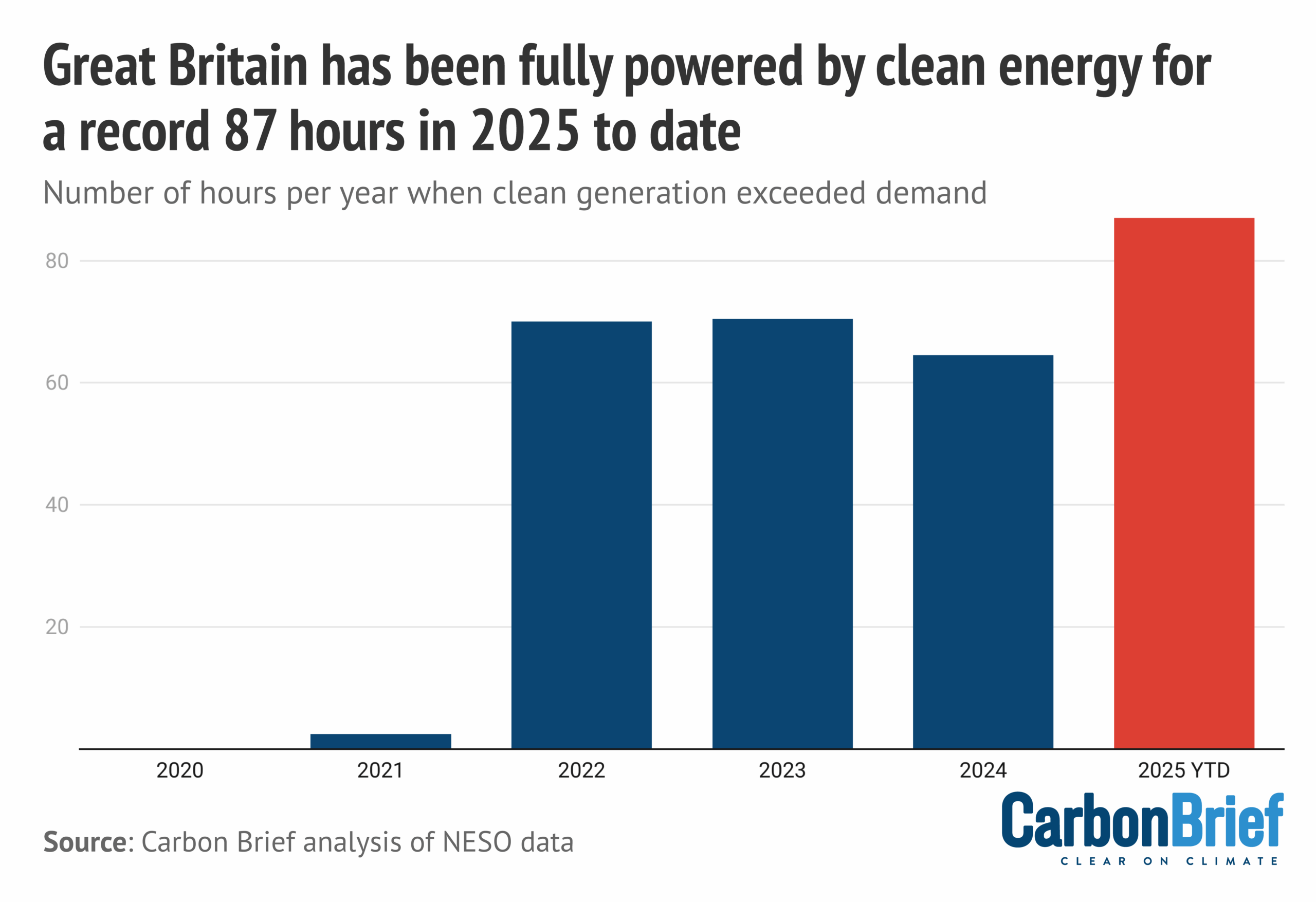
Bar chart showing that Great Britain has been fully powered by clean energy for a record 87 hours in 2025 to date

Clean energy has met 100% of Great Britain’s electricity demand for a record 87 hours this year so far, according to new Carbon Brief analysis. This is up from just 2.5 hours in 2021 and 64.5 hours in all of 2024. The longest stretch of time where 100% of electricity demand was met by clean energy stands at 15 hours, from midnight on 25 May 2025 through to 3pm on 26 May, according to the analysis.

Spotlight

‘Overshoot’ unknowns

As the chances of limiting global warming to 1.5C dwindle, there is increasing focus on the prospects for “overshooting” the Paris Agreement target and then bringing temperatures back down by removing CO2 from the atmosphere.

At the first-ever Overshoot Conference in Laxenburg, Austria, Carbon Brief asks experts about the key unknowns around warming “overshoot”.

Sir Prof Jim Skea

Chair of the Intergovernmental Panel on Climate Change (IPCC) and emeritus professor at Imperial College London’s Centre for Environmental Policy

So there are huge knowledge gaps around overshoot and carbon dioxide removal (CDR). As it’s very clear from the themes of this conference, we don’t altogether understand how the Earth would react in taking CO2 out of the atmosphere.

We don’t understand the nature of the irreversibilities and we don’t understand the effectiveness of CDR techniques, which might themselves be influenced by the level of global warming, plus all the equity and sustainability issues surrounding using CDR techniques.

Prof Kristie Ebi

Professor at the University of Washington’s Center for Health and the Global Environment

There are all kinds of questions about adaptation and how to approach effective adaptation. At the moment, adaptation is primarily assuming a continual increase in global mean surface temperature. If there is going to be a peak – and of course, we don’t know what that peak is – then how do you start planning? Do you change your planning?

There are places, for instance when thinking about hard infrastructure, [where overshoot] may result in a change in your plan – because as you come down the backside, maybe the need would be less. For example, when building a bridge taller. And when implementing early warning systems, how do you take into account that there will be a peak and ultimately a decline? There is almost no work in that. I would say that’s one of the critical unknowns.

Dr James Fletcher

Former minister for public service, sustainable development, energy, science and technology for Saint Lucia and negotiator at COP21 in Paris.

The key unknown is where we’re going to land. At what point will we peak [temperatures] before we start going down and how long will we stay in that overshoot period? That is a scary thing. Yes, there will be overshoot, but at what point will that overshoot peak? Are we peaking at 1.6C, 1.7C, 2.1C?

All of these are scary scenarios for small island developing states – anything above 1.5C is scary. Every fraction of a degree matters to us. Where we peak is very important and how long we stay in this overshoot period is equally important. That’s when you start getting into very serious, irreversible impacts and tipping points.

Prof Oliver Geden

Senior fellow and head of the climate policy and politics research cluster at the German Institute for International and Security Affairs and vice-chair of IPCC Working Group III

[A key unknown] is whether countries are really willing to commit to net-negative trajectories. We are assuming, in science, global pathways going net-negative, with hardly any country saying they want to go there. So maybe it is just an academic thought experiment. So we don’t know yet if [overshoot] is even relevant. It is relevant in the sense that if we do, [the] 1.5C [target] stays on the table. But I think the next phase needs to be that countries – or the UNFCCC as a whole – needs to decide what they want to do.

Prof Lavanya Rajamani

Professor of international environmental law at the University of Oxford

I think there are several scientific unknowns, but I would like to focus on the governance unknowns with respect to overshoot. To me, a key governance unknown is the extent to which our current legal and regulatory architecture – across levels of governance, so domestic, regional and international – will actually be responsive to the needs of an overshoot world and the consequences of actually not having regulatory and governance architectures in place to address overshoot.

Watch, read, listen

FUTURE GAZING: The Financial Times examined a “future where China wins the green race”.

‘JUNK CREDITS’: Climate Home News reported on a “forest carbon megaproject” in Zimbabwe that has allegedly “generated millions of junk credits”.
‘SINK OR SWIM’: An extract from a new book on how the world needs to adapt to climate change, by Dr Susannah Fisher, featured in Backchannel.

Coming up

Pick of the jobs

DeBriefed is edited by Daisy Dunne. Please send any tips or feedback to debriefed@carbonbrief.org.

This is an online version of Carbon Brief’s weekly DeBriefed email newsletter. Subscribe for free here.


The post DeBriefed 3 October 2025: UK political gap on climate widens; Fossil-fuelled Typhoon Ragasa; ‘Overshoot’ unknowns appeared first on Carbon Brief.

DeBriefed 3 October 2025: UK political gap on climate widens; Fossil-fuelled Typhoon Ragasa; ‘Overshoot’ unknowns

Continue Reading

Greenhouse Gases

Analysis: Fossil-fuel CO2 emissions to set new record in 2025, as land sink ‘recovers’

Published

on

Carbon dioxide (CO2) emissions from fossil fuels and cement will rise around 1.1% in 2025, reaching a record 38.1bn tonnes of CO2 (GtCO2), according to the latest figures from the Global Carbon Project

However, falling land-use emissions means that global CO2 emissions in 2025 will remain relatively unchanged compared to 2024 levels.

The 20th edition of the annual Global Carbon Budget report, published today, also finds that the land carbon sink – the portion of human-caused CO2 emissions absorbed by plants and soils – appears to have recovered to its pre-El Niño strength after two unusually weak years. 

However, research published alongside the report by the same team also suggests that climate change has caused a long-term decline in land and ocean carbon sinks, with sinks being about 15% weaker over the past decade than they would have been without climate impacts.

The study, published in Nature, finds that the decline of carbon sinks has contributed about 8% to the rise in atmospheric CO2 concentration since 1960.

The 2025 Global Carbon Budget report also estimates that:

  • Emissions in China and India are projected to grow much less in 2025 compared to the past decade, while emissions in the US and EU are projected to grow this year after years of decline.
  • Global CO2 emissions from land-use change are expected to decrease by nearly 10% in 2025, driven by reductions in deforestation and forest degradation in South America. 
  • Total CO2 emissions – fossil and land use – have grown more slowly over the past decade (0.3% per year on average) compared to the previous decade (1.9% per year). 
  • The remaining carbon budget to limit global warming to 1.5C is virtually exhausted and is equivalent to only four years of current emissions. Carbon budgets to limit warming to 1.7C and 2C would similarly be used up in 12 and 25 years, respectively.
  • The concentration of CO2 in the atmosphere is set to reach 425.7 parts per million (ppm) in 2025, 2.3ppm above 2023 and 52% above pre-industrial levels.

(For detailed coverage of previous editions of the report, see Carbon Brief’s coverage for 2024, 2023 and 2022.)

Global emissions remain flat

The Global Carbon Budget (GCB) finds that total global CO2 emissions in 2025 – including those from fossil fuels and land use – are projected to remain approximately flat at 42.2GtCO2, falling by a negligible -0.04% compared to last year. 

This means 2025 is effectively tied with 2024 as the highest global CO2 emissions on record.

Flat total CO2 emissions in 2025 reflect a combination of continued rising emissions from fossil fuel and industry and declining emissions from land-use change. Fossil CO2 emissions rose 1.1% to 38.1GtCO2, while land-use emissions declined by -9.8% to 4.1GtCO2 (albeit with large uncertainties).

The figure below shows the 2025 global CO2 emissions update (red solid line) alongside 2024 (dark blue dotted), 2023 (mid blue dotted) 2022 (light blue dotted), 2021 (light grey dotted) and 2020 (dark grey dotted). The shaded area indicates the uncertainty around the new 2025 budget. 

(Each year, the GCB is updated to include the latest data as well as improvements to modelling sources and sinks, resulting in some year-to-year revisions to the historical record.)

Annual total global CO2 emissions – from fossil and land-use change – between 1959-2024 for the 2020, 2021, 2022, 2023, 2024 and 2025 versions of the Global Carbon Project’s Global Carbon Budget, in GtCO2.
Annual total global CO2 emissions – from fossil and land-use change – between 1959-2024 for the 2020, 2021, 2022, 2023, 2024 and 2025 versions of the Global Carbon Project’s Global Carbon Budget, in GtCO2. Shaded area shows the estimated one-standard-deviation uncertainty for the 2025 budget. Data from the Global Carbon Project. Chart by Carbon Brief.

The 2025 figures are notably higher than those in the prior five GCB reports, reflecting an upward revision in historical land-use emissions. (This is discussed in more detail in the land-use emissions section below.)

Total global CO2 emissions have notably flattened in the past decade (2014-25), growing at only 0.3% per year compared to the 1.9% rate of growth during the prior decade (2004-13) and the longer-term average growth rate of 1.6% over 1959-2014.

This apparent flattening is due to declining land-use emissions compensating for continued – but slow – increases in fossil CO2 emissions. Fossil emissions grew around 0.2GtCO2 per year over the past decade, while land-use emissions decreased by a comparable amount.

However, despite the emissions plateau, there is still no sign of the rapid and deep decrease in CO2 emissions needed to reach net-zero and stabilise global temperatures in-line with the Paris Agreement temperature goal.

If global emissions remain at current levels, the remaining carbon budget to limit warming to 1.5C (with a 50% chance) will be rapidly exhausted.

(The carbon budget is the total amount of CO2 that scientists estimate can be emitted if warming is to be kept below a particular temperature threshold. Earlier this year, the Indicators of Global Climate Change report estimated the remaining carbon budget had declined by three-quarters between the start of 2020 and the start of 2025.)

With human-caused global warming sitting at around 1.36C above pre-industrial levels in 2024, the remaining budget for 1.5C is 170GtCO2, equivalent to four years of current emissions. 

The GCB report finds that the remaining carbon budgets to limit warming to 1.7C and 2C have been reduced to 525GtCO2 (12 years at current emissions levels) and 1,055GtCO2 (25 years), respectively.

Global fossil CO2 emissions also grew more slowly in the past decade (0.8% per year) compared to the previous decade (2.1%). This was driven by the continued decarbonisation of energy systems – including a shift from burning coal to gas and replacing fossil fuels with renewables – as well as slightly weaker global economic growth during the past decade.

The figure below breaks down global emissions (dark blue line) in the 2025 budget into fossil (mid blue) and land-use (light blue) components. Fossil CO2 emissions represent the bulk of total global emissions in recent years, accounting for approximately 90% of emissions in 2025 (compared to 10% for land use). This represents a large change from the first half of the 20th century, when land-use emissions were approximately the same as fossil emissions.

Global fossil emissions include CO2 emitted from burning coal, oil and gas, as well as the production of cement. However, to determine total fossil emissions, the Global Carbon Budget also subtracts the cement carbonation sink – CO2 slowly absorbed by cement once it is exposed to the air – from fossil emissions.

Global CO2 emissions separated out into fossil and land-use change components between 1959 and 2025.
Global CO2 emissions separated out into fossil and land-use change components between 1959 and 2025. Data from the Global Carbon Project. Chart by Carbon Brief.

Global emissions can also be expressed on a per-capita basis, as shown in the figure below.

While it is ultimately total global emissions that matter for the Earth’s climate – and a global per-capita figure glosses over a lot of variation among, and within, countries – it is noteworthy that global per-capita fossil emissions peaked in 2012 and have been slightly declining in the years since.

Global per-capita CO2 emissions over 1959-2025.
Global per-capita CO2 emissions over 1959-2025. Data from the Global Carbon Project. Chart by Carbon Brief.

Land-use emissions continue downward trend

Global land-use emissions stem from deforestation, forest degradation, loss of peatlands and harvesting trees for wood. They averaged around 5.0GtCO2 over the past decade (2015-24) and the Global Carbon Budget provides an initial projection for 2025 of 4.1GtCO2.

This represents a 0.5GtCO2 decrease in land-use emissions relative to 2024. The GCB report suggests that this was largely driven by a combination of reductions in deforestation and forest degradation in South America and by the end of the dry 2023-24 El Niño conditions.

Overall, land-use emissions have decreased by around 32% compared to their average in the 2000s, with a particularly large drop in the past decade. This decline is statistically significant and is due both to decreasing deforestation and increasing levels of reforestation and afforestation globally.

Three countries – Brazil, Indonesia and the Democratic Republic of the Congo (DRC) – collectively contribute approximately 57% of the global land-use emissions. In the past, China has been a meaningful contributor to land-use emissions, but in recent years its land-use emissions have turned net-negative as more trees have been planted than cut down.

The figure below shows changes in emissions over time in these countries, as well as land-use emissions in the rest of the world (grey).

Annual CO2 emissions from land-use change by major emitting countries and the rest of world over 1959-2024.
Annual CO2 emissions from land-use change by major emitting countries and the rest of world over 1959-2024. Country-level land-use change emissions are not yet available for 2025. Data from the Global Carbon Project. Chart by Carbon Brief.

Historical land-use emissions have been revised upward in the 2025 GCB report compared to prior estimates. This reflects a combination of two factors:

  • The discontinuation of one of the four bookkeeping models that GCB has historically relied on for land-use emissions estimates. This model tended to show lower land-use emissions than the others.
  • The inclusion of the impacts from CO2 fertilisation on global biomass densities. Because forests have higher biomass densities now than in the past, due to increasing CO2, this tends to increase the estimate of land-use emissions for recent years.

Fossil-fuel CO2 hits record highs

Global emissions of fossil CO2 – including coal, oil, gas and cement – increased by around 1.1% in 2025, relative to 2024, with an uncertainty range of 0.2-2.2%. This represents a new record high and surpasses the prior record set in 2024.

The figure below shows global CO2 emissions from fossil fuels, divided into emissions from major emitting countries including China (dark blue shading), the US (mid blue), the EU (light blue), India (light blue) and the remainder of the world (grey).

Annual fossil CO2 emissions by major countries and the rest of the world over 1959-2025.
Annual fossil CO2 emissions by major countries and the rest of the world over 1959-2025. This data excludes the cement carbonation sink as national-level values are not available, meaning that the sum of values reported here are slightly higher than the global average numbers. Data from the Global Carbon Project. Chart by Carbon Brief.

China represents 32% of global CO2 emissions today. Its 2025 emissions are projected to increase by a relatively small 0.4% (with an uncertainty range of -0.9% to 2%), driven by a small rise in emissions from coal (0.3%), a modest rise in gas (1.3%) and a larger rise in oil (2.1%).

Given the uncertainty range, a decrease in Chinese emissions is also a possibility, but this will not be confirmed until the full 2025 data is available.

Similarly, recent analysis for Carbon Brief found that China’s emissions were “finely balanced between a small fall or rise” in 2025. However, it said that a drop in the full-year total became more likely after a 3% decline in September. (The Global Carbon Project estimates are based on data covering January through to August, which point towards a small rise in 2025.)

Whether China’s emissions see small rise or fall in 2025, the outcome will be due to moderate growth in energy consumption combined with an extraordinary growth in renewable power generation. This would represent the second year in a row where Chinese emissions growth was well below the average rate over the past decade.

The US represents 13% of global emissions and emissions in 2025 are projected to increase by 1.9% (-0.2 to +4.1%) compared with 2024. This marks a reversal from recent trends in declining CO2 emissions. 

The projected growth of emissions in the US is likely driven by a combination of three factors: a colder start to the year after a mild 2024, which led to greater heating requirements, higher gas prices, which led to more coal being used in power generation, as well as an increase in total demand for electricity.

US emissions from coal are expected to increase by a substantial 7.5% in 2025, emissions from both oil and gas by a more modest 1.1% and emissions from cement to fall by -8.0%.

While policies enacted by the current US administration may increase CO2 emissions going forward, their impact on national emissions levels in 2025 were likely relatively modest compared to other factors.

India represents 8% of global emissions. In 2025, its emissions are projected to increase by 1.4% (-0.3% to +3.1%) on 2024 levels, significantly below recent trends.

An early monsoon with the highest-ever May rainfall substantially reduced cooling requirements in May and June, the hottest months of the year. Strong growth or renewables – particularly solar – has also helped limit the growth of Indian emissions. 

Indian emissions from coal are expected to grow 1.7%, with oil growing 0.1%, gas shrinking by -6.4% and cement growing by 9.9%.

The EU represents 6% of global emissions. Its emissions are projected to increase by 0.4% in 2025, with an uncertainty range of -2.1 to +2.8%. This represents a divergence from a past decline in emissions (albeit with large uncertainties).

EU emissions from coal are expected to decline by -0.3%, whereas emissions from oil and gas are projected to increase by 0.6% and 0.9%, respectively. Cement emissions are expected to fall by -4.1%.

The increase in EU emissions is in part from weather-related low hydropower and wind generation which – despite increases in solar – have led to an increase in electricity generation from gas. In addition, a relatively cold February led to increased use of natural gas for space heating.

International aviation and shipping (included in the “rest of world” in the chart above) are responsible for 3% of global emissions. They are projected to increase by 6.8% for aviation, but remain flat for international shipping. This year will be the first time that aviation emissions have exceeded pre-Covid levels.

The rest of the world (excluding aviation) represents 38% of global emissions. Emissions are expected to grow by 1.1% in 2025 (ranging from -1.1% to +3.3%), with increases in emissions from coal (1%), oil (0.5%), gas (1.8%) and cement (2.4%).

The total emissions for each year over 2022-25, as well as the countries and regions that were responsible for the changes in absolute emissions, are shown in the figure below.

Annual emissions for 2022, 2023, 2024 and estimates for 2025 are shown by the black bars. The smaller bars show the change in emissions between each set of years, broken down by country or region – the US (dark blue), EU (mid blue), China (light blue), India (pale blue) and the rest of the world (grey). Negative values show reductions in emissions, while positive values reflect emission increases.

Annual global CO2 emissions from fossil fuels
Annual global CO2 emissions from fossil fuels (navy blue bars) and drivers of changes between years by country (smaller bars), excluding the cement carbonation sink as national-level values are not available. Negative values indicate reductions in emissions. Note that the y-axis does not start at zero. Data from the Global Carbon Project. Chart by Carbon Brief.

The US represented a large part of the rise in global fossil-fuel emissions in 2025. US emissions increases over 2024-25 contributed about 40% of the total global increase – more than the EU, China and India contributions combined.

The Global Carbon Project notes that emissions have declined over the past decade (2015-24) in 35 nations, which collectively account for 27% of global emissions. This is up from 18 countries during the prior decade (2005-14).

The decrease in emissions in those countries comes despite continued domestic economic growth and represents a long-term “decoupling” of CO2 emissions and the economy.

The carbon intensity of energy has consistently decreased over the past decade in China, the US, the EU – and, to a lesser extent, globally.

However, peaking CO2 emissions requires that the rate of decarbonisation exceeds the growth in energy demand. This has happened in some regions, including the US and EU, but not yet globally.

Modest growth in emissions from coal, oil, gas and cement

Global fossil-fuel emissions primarily result from the combustion of coal, oil and gas.

In 2025, coal is responsible for more emissions than any other fossil fuel, representing approximately 42% of global fossil-fuel CO2 emissions. Oil is the second largest contributor at 33% of fossil CO2, while gas comes in at 21%.

The production of cement is responsible for around 3.8% of global emissions, but this is reduced to 1.9% once the carbonation sink – the drawdown of atmospheric CO2 by concrete – is taken into account.

These percentages reflect both the amount of each fossil fuel consumed globally, but also differences in CO2 intensities. Coal results in the most CO2 emitted per unit of heat or energy produced, followed by oil and gas.

The figure below shows global CO2 emissions from different fuels over time, covering coal (dark blue), oil (mid blue) and gas (light blue), as well as cement production (pale blue) and other sources (grey).

While coal emissions increased rapidly in the mid-2000s, they have largely flattened since 2013. However, coal use increased significantly in 2021 and then more modestly in the subsequent four years.

Annual CO2 emissions by fossil fuel over 1959-2025.
Annual CO2 emissions by fossil fuel over 1959-2025. Data from the Global Carbon Project. Chart by Carbon Brief.

Global emissions from coal increased by 0.8% in 2025 compared to 2024, while oil emissions increased 1.0% and gas emissions increased by 1.3%.

Despite setting a new record this year, global coal use is only 6% above 2013 levels – a full 13 years ago. By contrast, during the 2000s, global coal use grew at a rate of around 4% every single year.

The figure below shows the total emissions for each year over 2022-25 (black bars), as well as the absolute change in emissions for each fuel between years.

Annual global CO2 emissions from fossil fuels (black bars) and drivers of changes between years by fuel.
Annual global CO2 emissions from fossil fuels (black bars) and drivers of changes between years by fuel. Negative values indicate reductions in emissions. Note that the y-axis does not start at zero. Data from the Global Carbon Project. Chart by Carbon Brief.

Global oil emissions were suppressed for a few years after the 2020, but rebounded to pre-pandemic levels as of 2024 and have continued to grow in 2025.

This reflects that, despite falling sales of internal combustion engine vehicles, not enough electric vehicles (EVs) have yet been sold to result in peak oil demand.

The global carbon budget

Every year, the Global Carbon Project provides an estimate of the overall “global carbon budget”. This is based on estimates of the release of CO2 through human activity and its uptake by the oceans and land, with the remainder adding to atmospheric concentrations of the gas.

(This differs from the commonly used term “remaining carbon budget”, which refers to the amount of CO2 that can be released while keeping warming below global limits of 1.5 or 2C.)

The most recent budget, including estimated values for 2025, is shown in the figure below.

Values above zero represent sources of CO2 – from fossil fuels and industry (dark blue shading) and land use (mid blue) – while values below zero represent carbon sinks that remove CO2 from the atmosphere. Any CO2 emissions that are not absorbed by the oceans (light grey) or land vegetation (mid grey) accumulate in the atmosphere (dark grey). In addition, a dashed black line is shown to represent the expected sum of sinks based on estimated emissions.

Annual global carbon budget of sources and sinks over 1959-2025.
Annual global carbon budget of sources and sinks over 1959-2025. Fossil CO2 emissions include the cement carbonation sink. Note that the budget does not fully balance every year due to remaining uncertainties, particularly in sinks; the imbalance can be seen by the difference between the sum of the sinks and the sum of the sources (dashed black line). Data from the Global Carbon Project. Chart by Carbon Brief.

Over the past decade (2015-24), the world’s oceans have taken up approximately 29% of total human-caused emissions, or around 11.8GtCO2 per year.

The ocean CO2 sink has been relatively flat since 2014 after growing rapidly over the prior decades, reflecting the flattening of global emissions during that period.

This estimate for carbon sinks has been revised up from 26% in prior versions of the GCB, reflecting a major update to carbon budgets driven by new data and modelling of carbon sink behavior.

The land sink takes up around 21% of global emissions, or 8.7GtCO2 per year on average over the past decade – discussed in more detail in the section below. This is down from 29% in prior budgets.

The atmosphere continues to accumulate the bulk of human-caused CO2 emissions, with about 49% going into the atmosphere on average over the past decade – a rate of 20.4GtCO2 per year.

The growth rate of atmospheric CO2 in 2025 is expected to be around 2.3ppm, which is a bit below the decadal average rate of 2.6ppm over the past decade (2015-24). This is well below the record-setting rise of 3.7ppm in 2024, which was primarily driven by the effect of the 2023-24 El Niño conditions weakening the land sink.

Atmospheric CO2 concentrations are set to reach an annual average of 425.7ppm in 2025, representing an increase of 52% above pre-industrial levels of 280ppm.

There remains an unusual imbalance in the carbon budget in 2024, where the sum of the sinks is notably larger than estimated emissions. This can be seen in the figure above, where the dashed line is below the shaded area.

Budget imbalances are not unprecedented – there are large uncertainties in both emissions data and sink estimates. But the rise in the amount of CO2 accumulating in the atmosphere in 2024 is larger than would be expected based on emissions.

There are a number of potential explanations for this 2024 imbalance. The land cover data for 2024 is not yet complete and it is possible that some fire emissions data might be missing from the record. This might result in either higher land-use emissions or lower land sinks than currently estimated.

Alternatively, it could be due to the CO2 growth rate – captured by surface stations managed by the US National Atmospheric and Oceanic Administration (NOAA) – being slightly high. CO2 records for 2024 from these stations are higher than those obtained from satellite-based sensors, though it remains unclear which provides the most accurate measurement.

A declining, but not collapsing, land sink

After an usually weak land carbon sink in 2023, there were a number of media articles about its potential collapse.

For example, in October 2024, the Guardian wrote that “the sudden collapse of carbon sinks was not factored into climate models – and could rapidly accelerate global heating”. 

The truth is a bit more complicated. While the impending collapse of the land carbon sink has been greatly exaggerated, there is growing evidence of a long-term weakening of both the land and ocean carbon sinks due to human activity. 

And while the land sink has recovered to its pre-El Niño strength in 2025, aided by relatively low global fire CO2 emissions, it will continue to gradually weaken as global temperatures rise. This is not unexpected – scientists have long foreseen a weaker carbon sink in a warmer world.

A weaker land sink will contribute to higher global temperatures in the future as more CO2 emissions from burning fossil fuels and land use change will accumulate in the atmosphere.

The figure below shows the percentage of human emissions absorbed by the land sink in every year since 1959, with a recovery upwards in 2025 after two relatively low years.

Percentage of global CO2 emissions (land use and fossil) taken up by the land sink each year.
Percentage of global CO2 emissions (land use and fossil) taken up by the land sink each year. Data from the Global Carbon Project. Chart by Carbon Brief.

In a study published in Nature alongside the release of the 2025 Global Carbon Budget, the same team of researchers provide a detailed estimate of exactly how the land and ocean sinks have changed as a result of human activity.

The research finds that the land and ocean sinks are 25% smaller and 7% smaller, respectively, than they would have been without the effects of climate change over 2015-24.

This amounts to a nearly 20% reduction in the efficacy of current global carbon sinks – that is, both the land and ocean – and a 15% reduction compared to how large they would be without the effects of climate change.

The figure below, from the new paper, shows the impact of climate change on the ocean sink (blue), the land sink (green) and atmospheric CO2 concentrations (grey) since 1960.

Impact of climate change on the land sink
Impact of climate change on the land sink (panel a), the ocean sink (panel b) and their cumulative effect on atmospheric CO2 concentrations (panel c). Source: Friedlingstein et al. (2025).

The weakening of carbon sinks due to human activity has led to an increase of atmospheric CO2 of more than 8ppm since 1960. The combined effects of climate change and deforestation have turned tropical forests in south-east Asia and in large parts of South America from CO2 sinks to sources.

And these sinks will likely continue to weaken as long as atmospheric CO2 concentrations continue to rise and the world continues to warm. There are a wide range of estimates of carbon cycle feedbacks among climate models, but a large carbon cycle feedback could result in a few tenths of a degree of future warming.

The post Analysis: Fossil-fuel CO2 emissions to set new record in 2025, as land sink ‘recovers’ appeared first on Carbon Brief.

Analysis: Fossil-fuel CO2 emissions to set new record in 2025, as land sink ‘recovers’

Continue Reading

Greenhouse Gases

IEA: Fossil-fuel use will peak before 2030 – unless ‘stated policies’ are abandoned

Published

on

The world’s fossil-fuel use is still on track to peak before 2030, despite a surge in political support for coal, oil and gas, according to data from the International Energy Agency (IEA).

The IEA’s latest World Energy Outlook 2025, published during the opening days of the COP30 climate summit in Brazil, shows coal at or close to a peak, with oil set to follow around 2030 and gas by 2035, based on the stated policy intentions of the world’s governments.

Under the same assumptions, the IEA says that clean-energy use will surge, as nuclear power rises 39% by 2035, solar by 344% and wind by 178%.

Still, the outlook has some notable shifts since last year, with coal use revised up by around 6% in the near term, oil seeing a shallower post-peak decline and gas plateauing at higher levels.

This means that the IEA expects global warming to reach 2.5C this century if “stated policies” are implemented as planned, up marginally from 2.4C in last year’s outlook.

In addition, after pressure from the Trump administration in the US, the IEA has resurrected its “current policies scenario”, which – effectively – assumes that governments around the world abandon their stated intentions and only policies already set in legislation are continued.

If this were to happen, the IEA warns, global warming would reach 2.9C by 2100, as oil and gas demand would continue to rise and the decline in coal use would proceed at a slower rate.

This year’s outlook also includes a pathway that limits warming to 1.5C in 2100, but says that this would only be possible after a period of “overshoot”, where temperature rise peaks at 1.65C.

The IEA will publish its “announced pledges scenario” at a later date, to illustrate the impact of new national climate pledges being implemented on time and in full.

(See Carbon Brief’s coverage of previous IEA world energy outlooks from 2024, 2023, 2022, 2021, 2020, 2019, 2018, 2017, 2016 and 2015.)

World energy outlook

The IEA’s annual World Energy Outlook (WEO) is published every autumn. It is regarded as one of the most influential annual contributions to the understanding of energy and emissions trends.

The outlook explores a range of scenarios, representing different possible futures for the global energy system. These are developed using the IEA’s “global energy and climate model”.

The latest report stresses that “none of [these scenarios] should be regarded as a forecast”.

However, this year’s outlook marks a major shift in emphasis between the scenarios – and it reintroduces a pathway where oil and gas demand continues to rise for many decades.

This pathway is named the “current policies scenario” (CPS), which assumes that governments abandon their planned policies, leaving only those that are already set in legislation.

If the world followed this path, then global temperatures would reach 2.9C above pre-industrial levels by 2100 and would be “set to keep rising from there”, the IEA says.

The CPS was part of the annual outlook until 2020, when the IEA said that it was “difficult to imagine” such a pathway “prevailing in today’s circumstances”.

It has been resurrected following heavy pressure from the US, which is a major funder of the IEA that accounts for 14% of the agency’s budget.

For example, in July Politico reported “a ratcheted-up US pressure campaign” and “months of public frustrations with the IEA from top Trump administration officials”. It noted:

“Some Republicans say the IEA has discouraged investment in fossil fuels by publishing analyses that show near-term peaks in global demand for oil and gas.”

The CPS is the first scenario to be discussed in detail in the report, appearing in chapter three. The CPS similarly appears first in Annex A, the data tables for the report.

The second scenario is the “stated policies scenario” (STEPS), featured in chapter four of this year’s outlook. Here, the outlook also includes policies that governments say they intend to bring forward and that the IEA judges as likely to be implemented in practice.

In this world, global warming would reach 2.5C by 2100 – up marginally from the 2.4C expected in the 2024 edition of the outlook.

Beyond the STEPS and the CPS, the outlook includes two further scenarios.

One is the “net-zero emissions by 2050” (NZE) scenario, which illustrates how the world’s energy system would need to change in order to limit warming in 2100 to 1.5C.

The NZE was first floated in the 2020 edition of the report and was then formally featured in 2021.

The report notes that, unlike in previous editions, this scenario would see warming peak at more than 1.6C above pre-industrial temperatures, before returning to 1.5C by the end of the century.

This means it would include a high level of temporary “overshoot” of the 1.5C target. The IEA explains that this results from the “reality of persistently high emissions in recent years”. It adds:

“In addition to very rapid progress with the transformation of the energy sector, bringing the temperature rise back down below 1.5C by 2100 also requires widespread deployment of CO2 removal technologies that are currently unproven at large scale.”

Finally, the outlook includes a new scenario where everyone in the world is able to gain access to electricity by 2035 and to clean cooking by 2040, named “ACCESS”.

While the STEPS appears second in the running order of the report, it is mentioned slightly more frequently than the CPS, as shown in the figure below. The CPS is a close second, however, whereas the IEA’s 1.5C pathway (NZE) receives a declining level of attention.

Number of mentions of each scenario per 100 pages of text.
Number of mentions of each scenario per 100 pages of text. Source: Carbon Brief analysis.

US critics of the IEA have presented its stated policies scenario as “disconnected from reality”, in contrast to what they describe as the “likely scenario” of “business as usual”.

Yet the current policies scenario is far from a “business-as-usual” pathway. The IEA says this explicitly in an article published ahead of the outlook:

“The CPS might seem like a ‘business-as-usual’ scenario, but this terminology can be misleading in an energy system where new technologies are already being deployed at scale, underpinned by robust economics and mature, existing policy frameworks. In these areas, ‘business as usual’ would imply continuing the current process of change and, in some cases, accelerating it.”

In order to create the current policies scenario, where oil and gas use continues to surge into the future, the IEA therefore has to make more pessimistic assumptions about barriers to the uptake of new technologies and about the willingness of governments to row back on their plans. It says:

“The CPS…builds on a narrow reading of today’s policy settings…assuming no change, even where governments have indicated their intention to do so.”

This is not a scenario of “business as usual”. Instead, it is a scenario where countries around the world follow US president Donald Trump in dismantling their plans to shift away from fossil fuels.

More specifically, the current policies scenario assumes that countries around the world renege on their policy commitments and fail to honour their climate pledges.

For example, it assumes that Japan and South Korea fail to implement their latest national electricity plans, that China fails to continue its power-market reforms and abandons its provincial targets for clean power, that EU countries fail to meet their coal phase-out pledges and that US states such as California fail to extend their clean-energy targets.

Similarly, it assumes that Brazil, Turkey and India fail to implement their greenhouse gas emissions trading schemes (ETS) as planned and that China fails to expand its ETS to other industries.

The scenario also assumes that the EU, China, India, Australia, Japan and many others fail to extend or continue strengthening regulations on the energy efficiency of buildings and appliances, as well as those relating to the fuel-economy standards for new vehicles.

In contrast to the portrayal of the stated policies scenario as blindly assuming that all pledges will be met, the IEA notes that it does not give a free pass to aspirational targets. It says:

“[T]argets are not automatically assumed to be met; the prospects and timing for their realisation are subject to an assessment of relevant market, infrastructure and financial constraints…[L]ike the CPS, the STEPS does not assume that aspirational goals, such as those included in the Paris Agreement, are achieved.”

Only in the “announced pledges scenario” (APS) does the IEA assume that countries meet all of their climate pledges on time and full – regardless of how credible they are.

The APS does not appear in this year’s report, presumably because many countries missed the deadlines to publish new climate pledges ahead of COP30.

The IEA says it will publish its APS, assessing the impact of the new pledges, “once there is a more complete picture of these commitments”.

Fossil-fuel peak

In recent years, there has been a significant shift in the IEA’s outlook for fossil fuels under the stated policies scenario, which it has described as “a mirror to the plans of today’s policymakers”.

In 2020, the agency said that prevailing policy conditions pointed towards a “structural” decline in global coal demand, but that it was too soon to declare a peak in oil or gas demand.

By 2021, it said global fossil-fuel use could peak as soon as 2025, but only if all countries got on track to meet their climate goals. Under stated policies, it expected fossil-fuel use to hit a plateau from the late 2020s onwards, declining only marginally by 2050.

There was a dramatic change in 2022, when it said that Russia’s invasion of Ukraine and the resulting global energy crisis had “turbo-charged” the shift away from fossil fuels.

As a result, it said at the time that it expected a peak in demand for each of the fossil fuels. Coal “within a few years”, oil “in the mid-2030s” and gas ”by the end of the decade”.

This outlook sharpened further in 2023 and, by 2024, it was saying that each of the fossil fuels would see a peak in global demand before 2030.

This year’s report notes that “some formal country-level [climate] commitments have waned”, pointing to the withdrawal of the US from the Paris Agreement.

The report says the “new direction” in the US is among “major new policies” in 48 countries. The other changes it lists include Brazil’s “energy transition acceleration programme”, Japan’s new plan for 2040 and the EU’s recently adopted 2040 climate target.

Overall, the IEA data still points to peaks in demand for coal, oil and gas under the stated policies scenario, as shown in the figure below.

Alongside this there is a surge in clean technologies, with renewables overtaking oil to become the world’s largest source of energy – not just electricity – by the early 2040s.

Total energy demand chart

In this year’s outlook under stated policies, the IEA sees global coal demand as already being at – or very close to – a definitive peak, as the chart above shows.

Coal then enters a structural decline, where demand for the fuel is displaced by cheaper alternatives, particularly renewable sources of electricity.

The IEA reiterates that the cost of solar, wind and batteries has respectively fallen by 90%, 70% and 90% since 2010, with further declines of 10-40% expected by 2035.

(The report notes that household energy spending would be lower under the more ambitious NZE scenario than under stated policies, despite the need for greater investment.)

However, this year’s outlook has coal use in 2030 coming in some 6% higher than expected last year, although it ultimately declines to similar levels by 2050.

For oil, the agency’s data still points to a peak in demand this decade, as electric vehicles (EVs) and more efficient combustion engines erode the need for the fuel in road transport.

While this sees oil demand in 2030 reaching similar levels to what the IEA expected last year, the post-peak decline is slightly less marked in the latest outlook, ending some 5% higher in 2050.

The biggest shift compared with last year is for gas, where the IEA suggests that global demand will keep rising until 2035, rather than peaking by 2030.

Still, the outlook has gas demand in 2030 being only 7% higher than expected last year. It notes:

“Long-term natural gas demand growth is kept lower than in recent decades by the expanding deployment of renewables, efficiency gains and electrification of end-uses.”

In terms of clean energy, the outlook sees nuclear power output growing to 39% above 2024 levels by 2035 and doubling by 2050. Solar grows nearly four-fold by 2035 and nearly nine-fold by 2050, while wind power nearly triples and quadruples over the same periods.

Notably, the IEA sees strong growth of clean-energy technologies, even in the current policies scenario. Here, renewables would still become the world’s largest energy source before 2050.

This is despite the severe headwinds assumed in this scenario, including EVs never increasing from their current low share of sales in India or the US.

The CPS would see oil and gas use continuing to rise, with demand for oil reaching 11% above current levels by 2050 and gas climbing 31%, even as renewables nearly triple.

This means that coal use would still decline, falling to a fifth below current levels by 2050.

Finally, while the IEA considers the prospect of global coal demand continuing to rise rather than falling as expected, it gives this idea short shrift. It explains:

“A growth story for coal over the coming decades cannot entirely be ruled out but it would fly in the face of two crucial structural trends witnessed in recent years: the rise of renewable sources of power generation, and the shift in China away from an especially coal-intensive model of growth and infrastructure development. As such, sustained growth for coal demand appears highly unlikely.”

The post IEA: Fossil-fuel use will peak before 2030 – unless ‘stated policies’ are abandoned appeared first on Carbon Brief.

IEA: Fossil-fuel use will peak before 2030 – unless ‘stated policies’ are abandoned

Continue Reading

Greenhouse Gases

Analysis: Which countries have sent the most delegates to COP30?

Published

on

For the first time in the history of COP climate summits, the US – the world’s largest historical emitter – has not sent a delegation to the talks.

Back in January, newly inaugurated US president Donald Trump signed a letter to the UN to trigger the start of a US withdrawal from the Paris Agreement for a second time.

Although this process is not yet complete, the White House confirmed earlier this month that no “high-level officials” would be attending COP30 in Belém, Brazil.

The US joins Afghanistan, Myanmar and San Marino as the only countries not registering a delegation for the summit, according to Carbon Brief’s analysis of the provisional lists of delegates published by the United Nations Framework Convention on Climate Change (UNFCCC).

Despite these absences, more than 56,000 delegates have signed up to COP30, provisionally placing the summit as one of the largest in COP history.

This is despite the run-up to the negotiations being dogged by reports of a shortage of beds and “sky-high” accommodation costs.

Brazil even offered free cabins on cruise ships moored in Belém to delegations from low-income nations who were otherwise unable to attend.

According to the provisional figures, 193 countries, plus the European Union, have registered a delegation for the summit.

Unsurprisingly, the largest delegation comes from COP30 hosts Brazil, with 3,805 people registered.

This is followed, in order, by China, Nigeria, Indonesia and the Democratic Republic of the Congo.

This year also sees the largest number of “virtual” delegates, with more than 5,000 people signed up to attend the talks online.

Party delegations

With 56,118 delegates registered, COP30 is provisionally the second-largest COP in history, behind only COP28 in Dubai, which was attended by more than 80,000 people.

This is the provisional total, based on the delegates that have registered to be at the summit in person. At recent COPs, the final total is at least 10,000 lower, which would drop COP30 down to the fourth largest.

(The UNFCCC releases the final figures – based on participants collecting a physical badge at the venue – after the summit has closed.)

The chart below shows how the provisional figures for COP30 compare to the final totals in past COPs – going back to COP1 in Berlin in 1995.

Overall totals for delegates from parties, observers and the media for all COPs, as published by the UNFCCC
Overall totals for delegates from parties, observers and the media for all COPs, as published by the UNFCCC (see this article for more details on the data). Data for COPs 1-29 are the “final” figures, while COP30 data is “provisional”. Chart by Carbon Brief.

The participant lists provided by the UNFCCC are divided between the different types of groups and organisations attending the summit. The largest group at COP30 is for delegates representing parties. These are nation states, plus the European Union, that have ratified the convention and play a full part in negotiations.

This group adds up to 11,519 delegates – the fourth largest behind the past three COPs.

(In keeping with recent COPs, the UNFCCC has published spreadsheets that name every single person that has registered for the summit – excluding support staff. Previously, COPs have typically included thousands of “overflow” participants in which countries and UN agencies could nominate delegates without their names appearing on their official lists.)

For consistency with Carbon Brief’s analysis of previous COPs, the above chart includes overflow delegates as a single group. However, the participant lists do divide the overflow delegates between parties and observer groups. Including the overflow numbers approximately doubles the total for party representatives to 23,509.

US no-show

Overall, of the 198 parties to the UNFCCC, 194 have registered delegations for COP30.

The most notable absentee is the US, which has been present at every other COP in history – even throughout Donald Trump’s first presidency.

On average, the US sends a delegation of around 100 people, typically making it one of the larger groups at the talks.

The absent parties – Afghanistan, Myanmar and San Marino – have been more sporadic attendees at past COPs.

Despite reports of a “logistical nightmare” hosting a COP summit in the Amazon, there has been no drop-off in the number of countries registering delegations for COP30.

In addition to hotel rooms and rental properties in Belém, beds have been made available on cruise ships, in converted shipping containers and in motels that Reuters primly described as being typically “aimed at amorous couples”.

Reports suggested that many developing nations considered scaling back their presence at COP30, with smaller delegations or attendees only coming for a few days.

While the average party delegation size of 59 (excluding overflows) is lower than the previous two COPs, it is similar to the average in COP26 in Glasgow and COP27 in Sharm el-Sheikh.

The map and table below present the delegation size – split between party and overflow badges – for all the countries registered for COP30. The darker the shading, the more delegates that country has signed up. Use the search box to find the data for a specific party.

The largest delegation comes from host country Brazil, with 3,805 people registered. China (789) and Nigeria (749) follow with the second- and third-largest, respectively.

Making up the rest of the top 10 are Indonesia (566), the Democratic Republic of the Congo (556), France (530), Chad (528), Australia (494), Tanzania (465) and Japan (461).

The UK comes someway down the list with a delegation of 210.

(It is worth noting that some countries – such as Brazil – allocate some of their party badges to NGOs, which can artificially inflate the size of their official delegation.)

The smallest delegation is the one person registered to represent Nicaragua. There are five delegations of two people (North Korea, Latvia, Liechtenstein, Saint Vincent and the Grenadines and Slovakia).

Ahead of COP30, Latvia's climate minister, told Reuters that the country had asked if its negotiators could dial into the summit by video call. However, Latvia does not appear to have registered any delegates to attend virtually.

In total, 40 parties registered virtual delegates. Party totals are all in single figures apart from the Philippines (31), Costa Rica (21) and Turkey (16).

Changing gender balance

The UNFCCC’s participant lists typically provide a title – such as Mr, Ms, Sr or Sra – for each registered delegate. In the past, this has allowed Carbon Brief to work out the balance of men to women in the delegations that each country has sent to a COP.

(This analysis always carries the caveat that the titles are designated by UNFCCC and not by Carbon Brief. In addition, Carbon Brief recognises that gender is not best categorised using a binary “man” or “woman” label and appreciates that the UNFCCC’s lists may not be wholly accurate.)

Overall, the COP30 provisional list suggests an average gender balance of party delegations of 57% men to 43% women.

As the chart below shows, this makes COP29 the most balanced COP in history. For consistency, the COP28, COP29 and COP30 figures only include those on party badges, not overflow ones.

(Note: Since COP28 last year, the UNFCCC has also used titles that do not indicate gender – such as Dr, Prof, Ambassador and Honourable. Therefore, for this analysis, these non-gendered titles – which make up 1% of all the people at COP30, for example – have not been included.)

The average percentage split between women (orange) and men (purple) across party delegations
The average percentage split between women (orange) and men (purple) across party delegations (excluding overflows) for each COP, according to titles given by the UNFCCC Data for COPs 1-29 collated from “final” participant lists published by the UNFCCC, while COP30 data is based on the “provisional” list. Note that a small number (<1%) of delegates are not included because there is no information on their gender. Chart by Carbon Brief.

There are four party delegations this year that are all men – Tuvalu (three delegates), Niger (three), North Korea (two) and Nicaragua (one) – and one that is all women (Nauru, with five delegates).

The full list of COP30 party delegation sizes can be found here.

(For previous COPs, see Carbon Brief’s delegate analysis for COP21, COP23, COP24, COP25, COP26, COP27, COP28, COP29)

The post Analysis: Which countries have sent the most delegates to COP30? appeared first on Carbon Brief.

Analysis: Which countries have sent the most delegates to COP30?

Continue Reading

Trending

Copyright © 2022 BreakingClimateChange.com