

China’s surging electric vehicles (EVs) ownership – now exceeding 25.5m – is opening the door to a new technology that can help to enhance the flexibility of electricity supply.
EVs connected via “vehicle-to-grid” (V2G) technology can function as “batteries on wheels” that charge and discharge according to the needs of the wider electricity system.
The idea of turning EVs into “power banks” has already sparked both business and political interest in China.
How can V2G help balance the grid?
V2G involves two-way electric charging that allows EVs to act as flexible power sources, which can potentially help with the electricity supply from the grid.
In China, EVs with bidirectional batteries, when plugged into V2G-capable charging stations, are able to sell their stored electricity back to the grid, once owners complete registration on WeChat.
The country is currently trialling the technology in nine “pilot cities”, including Shanghai, as well as Guangzhou and Shenzhen, where EV operators are able to sell electricity to the grid, according to a V2G policy announced in April.
The policy is the world’s first nationwide pilot that aims to roll out V2G at scale in major cities. Payments – either in cash or coupons – are provided to EV owners to offset their charging costs in industrial parks, ports, as well as malls and residential compounds.
This is, however, not the first top-level policy framework for V2G in China. In late 2023, the National Reform and Development Commission (NDRC) pledged to establish a system of V2G technical standards by 2025 and to test its potential.
Dr Muyi Yang, senior electricity analyst at thinktank Ember, tells Carbon Brief that the April policy sends a “signal that China’s energy transition is entering a deeper phase”.
He adds that this new policy marks a major step in integrating EVs with the power grid, considering that China is rapidly enlarging its renewable capacity. However, the country’s current grid system sometimes struggles to take in all of the electricity being generated.
“China’s wind and solar capacity is becoming too large for the current grid to handle,” Yang tells Carbon Brief. “With their [combined] capacity now exceeding that of coal power, the grid flexibility has become increasingly insufficient.”
A fleet of grid-connected EVs could help China achieve its broader plan to restructure its power sector towards a “new power system” that aims to be more flexible and responsive to power volatility, says Yang.
Equipped with V2G, EVs could charge up their batteries or sell stored electricity according to owners’ preferences and the overall needs of the power system.
This provides the means and potential for the grid to integrate renewable energy more flexibly, says Zhou Xiaohang, China clean-power project manager at the US-registered Natural Resource Defense Council in Beijing.
She tells Carbon Brief that, in the long run, V2G can help to address the curtailment issue for renewable energy, which is often referred to as the “Xiaona” problem in China.
What is the current state of V2G adoption?
Currently, V2G has not been widely deployed in China. The cost of V2G infrastructure installation remains high.
Zhou says the success of large-scale roll out of V2G depends on whether there are enough EVs equipped with the bidirectional batteries and able to be plugged into V2G-capable charging stations.
Data company China Automotive Technology and Research Centre says that the share of new car sales made up by “new-energy vehicles” (NEVs) – mostly EVs – is more than 40% in almost all nine pilot cities tapped to develop V2G.
Even though not all EVs support V2G, the large number of EVs on the road suggests strong potential to build it into a profitable commercial model.
Zhou says that since China “already [has] enough EVs on the road to make [V2G] possible”, there are “no major technical barriers to scale up V2G interaction”.
Meanwhile, popular car brands such as BYD and Nio have released new EV models with V2G features and many more are actively testing and preparing for two-way electric charging.
In a June podcast, Anders Hove, senior research fellow at the Oxford Institute for Energy Studies, says carmakers are pushing for faster progress. He explains:
“My understanding is that the Chinese EV and battery makers are communicating with grid companies and power-sector regulators that the technology is now ready. They would like there to be additional regulations to enable this to start happening at scale.”
There are 30 such demonstration projects going on at the moment. The results of those projects will be collected by the NDRC and the National Energy Administration for evaluating future scaleup.
Shenzhen, for example, received more than 70,000 kilowatt hours (kWh) of electricity from about 2,500 EVs in June.
V2G services have the potential to become popular nationwide, says Yang, partly because it could also become a source of income for EV owners and businesses.
According to the Paper, a Shanghai-based news outlet, an EV owner could earn roughly 500 yuan ($70) in electricity charging vouchers by discharging 460kWh in a month.
In Shenzhen, a logistics company with 30 EVs is estimated to save up to 4,500 yuan ($631) a month by joining the V2G programme, says China Automotive News, a state-sponsored media outlet.
What are the challenges in expansion?
Regional governments are working to introduce more profitable pricing systems to boost user participation.
Guangdong province, in south China, has launched a V2G pricing plan that is “appealing” enough for EV owners to see a profit from participating in the scheme, according to Zhou, which will help drive wider adoption.
However, there will need to be a deeper level of power-sector reform for V2G to become fully commercialised, says Shen Xinyi, researcher at Centre for Research on Energy and Clean Air (CREA).
Currently, a large share of China’s electricity is still traded through long-term power contracts, which could limit incentives for individual EV owners to engage in power trading.
Shen tells Carbon Brief:
“Flexible systems like V2G and distributed solar power need a well-developed spot market and experienced, professional players such as power retailers to truly thrive…I think it still needs a lot of patience to see how theory turns into practice.”
It could take years before V2G reaches a significant level of adoption, due to the uncertainty of whether it can be turned into a viable business model, says Shen.
According to Zhou, whether V2G can be rolled out at scale also depends on the attitudes of consumers.
“The key to expanding V2G is getting users motivated and willing to take part,” she says, adding that more work needs to be done to address Chinese consumers’ concerns on battery health and safety issues, including whether frequent discharges could cause battery degradation.
According to the 2023 policy, the lifespan of EV batteries still needs to improve so it can handle frequent use without wearing out too quickly – a concern long noted by the industry.
In April 2024, Hui Dong, chief technical expert at the China Electric Power Research Institute, a research institute affiliated to the State Grid Corporation of China, stated that, in terms of lifespan, chemical energy storage systems, represented by lithium-ion batteries, are still “underperforming”.

The post Q&A: How ‘vehicle-to-grid’ technology could boost China’s electricity system appeared first on Carbon Brief.
Q&A: How ‘vehicle-to-grid’ technology could boost China’s electricity system

Continue Reading
Three countries have been named by the Paris Agreement’s compliance committee for failing to submit a nationally determined contribution (NDC) and repeatedly snubbing offers of help with their climate plans.
After months of internal debate over whether to identify serial non-responders, the Paris Agreement’s Implementation and Compliance Committee (PAICC) named the three countries which have failed to engage with it over their NDCs on Friday.
It named Democratic Republic of Congo, Senegal and North Korea in a footnote of its annual report, adding that it decided to name them “with a view to facilitating engagement”, adding that representatives of the three nations had been invited to its meeting in early 2027 “with the purpose of identifying any challenges and constraints”.
“The Committee noted the importance of Parties engaging with the Committee in a timely manner, while noting that some delays may be due to the national capabilities and circumstances of the Parties”, the report said.
-
Under US pressure, World Bank says it will back gas “where appropriate”
The US wants the World Bank to expand its gas support while climate campaigners are pushing for it to end – its head spoke this week of limited backing for the fossil fuel -
IPCC scientists vow to press on with climate reports despite political deadlock
After governments again failed to agree a timeline, nearly 120 IPCC authors pledged to complete their assessment on time and with full scientific rigour -
Paris Agreement committee snubbed over missing NDC climate plans
Many governments have still not submitted a nationally determined contribution to the UN, breaching a key requirement of the Paris Agreement

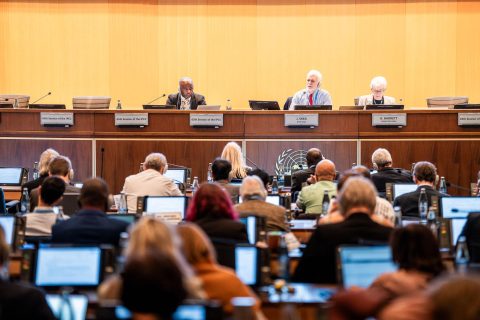

In July, PAICC said 12 countries had ignored its repeated attempts to discuss why they had not published an NDC as required every five years under the 2015 Paris accord.
Members of the committee had been divided over whether to name them, but at a September meeting decided to do so in their annual report to the annual climate COP summit.
By the time the report was published on Friday, only Congo, Senegal and North Korea “had not communicated an NDC or submitted a [Biennial Transparency Report] and had not yet responded to any of the Committee’s notifications, despite several reminders issued by the Committee in this regard”.
Rainforest and renewable energy ambitions
The silence from Congo and Senegal is notable because the former is home to much of the Congo Basin rainforest while the latter has sought billions of dollars in climate finance to support its renewable energy ambitions.
After Brazil, Congo has more rainforest than any country in the world. This forest, and the country’s peatlands, absorb huge amounts of greenhouse gas but are fast being lost to expanding farmland, charcoal production, logging and mining.
Senegal signed a Just Energy Transition Partnership with Canada and wealthy European nations in 2023, to help it meet its renewable energy targets under the-then government of Macky Sall. It was chair of the Least Developed Countries group between January 2022 and December 2023.

Tejas Rao, who is researching the PAICC as part of a doctoral thesis at Cambridge University, said the governments of the three countries should engage with the committee.
“Engagement costs these governments very little and the committee has shown it will listen,” he said.
“Silence leaves the committee with no basis to help, and it leaves the [governments] exposed to the narrative that they are simply disengaged,” he told Climate Home News.
Paris Agreement requirement
The 2015 Paris Agreement requires all parties to publish an NDC every five years outlining their emissions reduction targets, with each plan meant to be more ambitious than the country’s last NDC.
The latest set – the third round of plans, with new targets for 2035 – was due in February 2025. While most countries missed this deadline, all but around 30 – mostly small emitters but including Egypt, Vietnam and Argentina – have now submitted them.
Over the year, the PAICC – which is made up of government climate officials from developed and developing countries – has been communicating with governments that have not submitted NDCs and trying to overcome barriers to them doing so.
Some nations have cited exceptional circumstances as the reason for not submitting an NDC, a process that requires a significant amount of work in tracking emissions and consulting on how to curb them across the economy. For example, a letter from a Sudanese official to the PAICC, seen by Climate Home News, said that the country’s civil war had led to the suspension of its NDC preparation.
-
IPCC scientists vow to press on with climate reports despite political deadlock
After governments again failed to agree a timeline, nearly 120 IPCC authors pledged to complete their assessment on time and with full scientific rigour -
Under US pressure, World Bank says it will back gas “where appropriate”
The US wants the World Bank to expand its gas support while climate campaigners are pushing for it to end – its head spoke this week of limited backing for the fossil fuel -
Who shapes climate science? The equity question facing the IPCC
Early completion of the next global climate science assessment reports risks excluding research from the Global South, which is key to ensuring the findings are fair
The US and Iran are not signed up to the Paris Agreement and so do not have active NDCs, nor does Taiwan, which is not a UN member state.
Rao said that because the PAICC is “facilitative and non-punitive”, naming the countries “is meant to open a door, not close one – the invited consultation is the point”.
“In recent months, governments that explained their constraints, whether capacity, finance or domestic process, have been met with follow-up and support rather than sanction, and the number of silent governments has fallen sharply,” Rao said.
The post Paris Agreement committee names three countries snubbing it over NDCs appeared first on Climate Home News.
Paris Agreement committee names three countries snubbing it over NDCs