

Denmark is on its way to introducing a world-first tax on greenhouse gas emissions from agriculture in 2030.
Central to the proposals – announced by the Danish government on 24 June – is the plan to charge farmers for emissions from their livestock.
This carbon tax would cost around €100 (£85) annually per cow, according to the Financial Times.
The proposal is one part of a wider agreement between the government and different agriculture and environmental groups aimed at helping the country meet its climate goals for 2030 and beyond.
As a major producer of dairy and pork, one-quarter of Denmark’s greenhouse gas emissions come from agriculture.
In this Q&A, Carbon Brief explains the agriculture tax plans, the possible impacts on farmers and the effect it could have on cutting Denmark’s emissions.
- How will the tax work?
- How will this tax help Denmark meet its climate targets?
- How was the agreement reached?
- What will the tax mean for Danish farmers?
- Are other countries planning to introduce a carbon tax on agriculture?
How will the tax work?
Under the proposed plans, Danish landowners will pay a levy based on their emissions from “livestock, fertiliser, forestry and the disturbance of carbon-rich agricultural soils”, the Copenhagen Post reported.

The effective cost of the tax paid by farmers will amount to 120 Danish kroner (£14/$18) per tonne of CO2-equivalent (CO2e) emitted when the tax is implemented in 2030. It will rise to 300 kroner (£34/$44) per tonne of CO2e from 2035 onwards.
The true cost of these taxes is actually higher (300 kroner per tonne of CO2e in 2030 and 750 kroner per tonne from 2035 onwards), but the government will also implement a 60% deduction. The aim of this “basic tax break” is to “limit the impact of the measure on production costs”, says EurActiv. It adds that, in the long run, “the most climate-efficient farms could be close to paying no tax”.
The proceeds of the levy “are to be pooled in a fund to support the livestock industry’s green transition for at least two years after the tax comes into effect”, according to the Guardian.
The tax is just one element of a wider agreement on a “Green Denmark”. This was signed by a “green tripartite”, namely, a three-party agreement between the Danish government, conservation groups and the Danish industrial and agricultural sectors.

The agreement aims to “form the long-term basis for a historic reorganisation and transformation of Denmark’s land and of food and agricultural production”.
Under the deal, Denmark will relinquish some agricultural lands to provide more space for nature and biodiversity. Those lands will comprise heaths, meadows, river valleys and bogs that had historically been converted to agriculture.
The country will plant 250,000 hectares of new forests by 2045 and set aside 140,000 hectares of lowlands to protect their carbon-rich soils by 2030. It will also acquire strategic agricultural lands and distribute or sell them to private and public investments to “contribute to large nature areas” or “installation of renewable energy” and boost technologies and measures to cut emissions, the agreement says.

All these targets will be financed by a new Denmark’s Green Area Fund, which amounts to 40bn kroner (£4.6bn/$5.9bn). Denmark’s government will also use EU agricultural subsidies for the technology transition.
Finally, the agreement also aims to improve Denmark’s coastal waters and freshwater and reduce nitrogen fertiliser use.
The Danish parliament still needs to approve the plan, but Reuters noted that “political experts expect a bill to pass following the broad-based consensus”.
How will this tax help Denmark meet its climate targets?
According to Denmark’s most recent national inventory report, the agricultural sector is the country’s second-largest source of emissions, after the energy sector.
Agriculture contributes around 28% of Denmark’s total greenhouse gas emissions, the report says, and accounts for more than 80% of methane and nitrous oxide emissions specifically.
A “major part” of these emissions stem from livestock production, the report says. Denmark has more than 15,000 livestock farms containing millions of cows, pigs and other animals.
The country’s high agriculture emissions “cannot continue”, the climate minister Lars Aagaard said in a statement about the CO2-cutting proposals, adding that a “great deal of work awaits” to implement these plans.

By 2030, the country is aiming to cut overall greenhouse gas emissions by 70% and agriculture and forestry emissions by 55-65%.
The new proposals are estimated to cut 1.8m tonnes of CO2e emissions in 2030, according to the government.
This will help Denmark meet its 2030 climate goals and “take a big step closer to becoming climate neutral in 2045”, tax minister Jeppe Bruus said in a statement.
The agreement will also boost forests, large wetlands and nature protection, according to the president of the Danish Society for Nature Conservation, Maria Reumert Gjerding.

Prof Søren Petersen, a soil microbiologist at Aarhus University in Denmark, agrees that the plan “could lead to substantial reductions in agricultural emissions” if implemented correctly. He tells Carbon Brief:
“It is my impression that there is a real interest in promoting climate-smart solutions and developing solutions that achieve real reductions in emissions.”
Petersen says that the agreement highlights the “need to speed up” new climate technologies and measures to cut greenhouse gas emissions from agriculture. He adds:
“Perhaps the greatest barrier at the moment is that many technologies with potential for greenhouse gas mitigation have not yet been sufficiently documented, or that the source is highly variable and difficult to quantify.”
He notes that it is often “difficult to measure” agricultural emissions, adding:
“If we can arrive at a set of criteria for documenting emissions, and effects of mitigation measures, and if such criteria can also be accepted in the international review of the national inventory, then I do think there is potential for developing several technologies for use at farm level.
“But tangible impact will require land use changes, as well as mitigation technologies.”
Niklas Sjøbeck Jørgensen, senior advisor on food and bioresources at Green Transition Denmark, an environmental thinktank, says the agreement is “an important step in a greener direction”.
But, he says, it “fails by maintaining problematic animal production”, adding in a statement:
“Unfortunately, the CO2 tax is correspondingly lagging behind, as the floor deduction of 60% and large technology subsidies maintain the current intensive form of animal production.”
How was the agreement reached?
The Danish government and the other members of the green tripartite reached this “historic agreement” after almost five months of talks, Politico reported.
Agreeing the tax “has been a very difficult journey”, Martin Kristian Brauer, chief economist at the Danish Agriculture and Food Council, one of Denmark’s largest organisations representing farmers and part of the green tripartite, tells Carbon Brief.
Brauer says his organisation had been against the tax from the beginning of the negotiations since “the risk connected to such a tax is far too big for the sector”. But over the past two years, they have worked on identifying those risks, listening to farmers’ concerns and negotiating with the government. He tells Carbon Brief:
“Although we have many [farmers] in Denmark still oppos[ing] this tax, I think we reached a point where we can live with it.”

Brauer says that broad participation of the different sectors was fundamental to allowing this “very difficult issue” to turn “into real politics”. He tells Carbon Brief:
“That was an agreement among all the parties. It was not just closing a lot of agricultural farms and thereby reducing emissions. The goal was to make a new regulation, where Danish agriculture meets climate goals, but [also having] the possibility to develop…an economically sustainable sector.”
Members of the tripartite agreed that the country “must have a strong and competitive” agricultural sector “with attractive business potential and jobs”, according to a statement by the Danish Ministry of Economic Affairs.
The agreement also stated that the new Green Area Fund would attempt to “facilitate a land conversion that mitigates the economic consequences for Danish agriculture”.
Brauer points out that there will be subsidies to incentivise farmers to enrol in the programme. The Green Area Fund, according to the agreement, will support private afforestation, the conservation of aquatic ecosystems and drinking water and the conversion of other lands, including wetlands and lowlands.
What will the tax mean for Danish farmers?
Petersen tells Carbon Brief that the agricultural CO2 tax proposal is “quite flexible and lenient on farmers”.
He notes that the gradual increase in the cost farmers will pay from 2030 to 2035 will “buy time for farmers to adjust, and for researchers to deliver the documentation of the effects of potential mitigation measures”.
In fact, farmers that comply with proven climate solutions “can avoid the tax”, according to a statement by Søren Søndergaard, president of the Danish Agriculture and Food Council.
The agreement provides a number of climate measures already available for farms from fertiliser use to livestock feed management. It also states that Denmark’s government will document and look for new climate technologies and measures for the agricultural sector.
Feed additives may be used to reduce direct emissions from livestock, Brauer notes. He tells Carbon Brief:
“That is an additive put into the feed and when the cows eat [it], emissions are reduced by maybe 20 or 30%.”
Another part of the agreement is land conversion and management. The territorial reorganisation will be planned and implemented by local governments, with the participation of coastal water councils and river basin management groups, the agreement says.

Brauer, from the Danish Agriculture and Food Council, says that land conversion does not mean farmers will lose their lands, instead, they will receive a subsidy to “convert the land”. He tells Carbon Brief:
“The farmer in Denmark in the future will be not just an agricultural farmer, he will actually be a land manager and will have some areas which [are] going to be traditional agricultural farming, forests and maybe wetlands. So he will have a portfolio of different kinds of lands in his state that will all generate some income.”
The agreement points out that farmers’ participation in setting aside carbon-rich shallow soils and reducing nitrogen emissions is voluntary, but they can obtain financial incentives from the new fund for doing so.
Brauer adds that for those goals, each Danish region is mandated to reach certain targets. He says:
“If that area does not meet these goals together, then there will be a mandatory regulation set up for each farmer, pushed from the government.”
Regarding how small producers would be impacted, the agreement mentions that it is being analysed how to determine when a producer or farm will be subject to taxation, through a threshold that aims “to exempt farms with relatively low greenhouse gas emissions to ensure that the total administrative and economic costs of the tax are commensurate with the potential CO2e reductions”.
Are other countries planning to introduce a carbon tax on agriculture?
Denmark is the first country to introduce this kind of legislation, although other countries have considered it and, until recently, New Zealand was pioneering similar moves.
Around half of New Zealand’s greenhouse gas emissions come from agriculture, primarily livestock. To tackle this, in 2022 the previous government planned to include agriculture in the country’s emissions trading scheme from 2025 onwards.
Under this scheme, the government sets a limit for the amount of greenhouse gases companies in certain sectors can emit. Companies whose emissions fall under the limit can sell their extra allowances to other organisations. These limits reduce over time, in line with climate targets.

Some New Zealand farmers protested these plans and the government received pushback from farm lobby groups.
In June this year, the country’s relatively new centre-right government scrapped plans for the so-called “burp tax” – a reference to the methane produced by livestock. This fulfilled a “pre-election pledge by [New Zealand prime minister] Christopher Luxon’s National Party”, Al Jazeera said at the time.
The government said it would instead invest hundreds of millions of dollars on emissions-reduction technology and boost funding for an agricultural greenhouse gas research centre.
Agriculture minister Todd McClay said that the government is “committed to meeting our climate change obligations without shutting down Kiwi farms”.
The Green and Labour parties criticised the government’s decision, Radio New Zealand reported.

In the EU, there have been on-and-off discussions about bringing agriculture into the bloc’s emissions trading system.
In March, Carbon Pulse reported that the EU was “testing the waters” on either creating a new emissions trading system for agriculture or revising existing rules.
Since then, a new European parliament was elected and the next European Commission line-up will be finalised this summer.
The EU’s climate advisory board earlier this year recommended introducing emissions pricing for agriculture and land use.
Danish prime minister, Mette Frederiksen, said she hopes Denmark’s planned agriculture carbon tax will “pave the way forward regionally and globally” for similar moves, the Financial Times reported.
Brauer says that farmers in Denmark are “quite concerned” about the tax as it may lead to Danish products being “a little bit more expensive than a product from Germany or from elsewhere”. He adds:
“If we get some kind of regulation in the whole EU, this difficulty would disappear.”


The post Q&A: How Denmark plans to tax agriculture emissions to meet climate goals appeared first on Carbon Brief.
Q&A: How Denmark plans to tax agriculture emissions to meet climate goals

This letter is a bit more direct and longer than most of those which I write, but I hope you will be okay with that, because the times seem to call for being plain.
A few weeks ago I got a text message from an old and dear friend —let’s call her Hannah.
I have enough shared life with Hannah that, whenever we talk, the conversation always feels current and effortless, despite gaps of months or even years.
Hannah has been talking with her son — we’ll call him Neil — who is a teenager and doing well in school, but wildly worried about the state of the world, including the imminent trajectory of global warming. Hannah and I don’t text each other other very often, but on this occasion she’s reached out with something visceral:
Neil has challenged me to point him to something hopeful, if I can find it. He says so far no one is showing any will to uphold the Paris Agreement. I am checking in to see how you still manage to have real hope.*
Then, just a few days later, the United Nations Environment Programme Limiting Overshoot report landed, containing the principal finding that it is likely the global temperature will soon exceed 1.5°C.
After that news, and the real time devastation in Nepal, and in the context of the broader state of the world, I found myself having multiple conversations with friends and colleagues about the structure of hope. I want to openly share that after a few of these exchanges, I metaphorically closed the blinds, and wondered how to feel, and what to do, because there is no avoiding the dreadfulness of the news, and what it means for the suffering of people and life on Earth.
But if you are fortunate enough to have time, space and security to do so, then after the darkness, you open the shutters and once again there is light. This is the structure of my innermost resolve.
* * *
Our lives — those of us living on our magnificent earth now — have the greatest possible purpose.
There is virtually no problem that we endlessly clever and creative, human beings cannot solve, when we work together.
And we are not just intelligent and ingenious; we are inherently social, nurturing and brave; capable of the deepest enduring love.
Each of the roughly 12,000 generations of humanity so far has made life possible for those who have followed, through acts of devotion.
Babies have been held and fed. Water and food have been found and shared. Shelter has been built. For 12,000 generations we have held the hands of our children.
Every single one of us was once carried in the arms of another, unable to walk ourselves. It is our thoughtfulness, kindness and care that have seen us through as a species. Sometimes this has been in the most exigent of circumstances, when enough of our ancestors did not give in, faced incredibly difficult things, to somehow make it through.
And so it comes to this. To what we now must do. We must do as 12,000 generations of people did for us.
The struggle to keep global warming to under 1.5 degrees may be over. The battle of return—to get our planet back to safe temperatures at emergency speed and scale — is just beginning. Upon this struggle depends the future of all we care about, and that of all life on Earth. The prospects of the next 12,000 generations are conditioned by our efforts now.
Our work now is to keep the overshoot as low as we can, make it as brief as possible, and do everything within our power to alleviate other pressures on nature. It is to take care of humanity — of one another — in the face of mounting climate and ecological damage. And by these efforts, create the conditions for future flourishing. Every fraction of every degree matters.
What must now be done is hard, much tougher than should have been necessary, because of the vested interests in coal, oil and gas and deforestation, and the failures of decision makers. And while renewable energy has surged, making the case for change much simpler, on the other side of the ledger there’s the reactionary and gangsterist turn of politics and the multiplier effects of wars and mass violence, with the existential destabilisation of big tech looming over all.
There is no sugarcoating the scale of difficulty. But what is necessary remains within our collective power. We must never, for one second, say that returning our planet to flourishing is impossible — many of the obvious solutions already exist; but even where transformation relies on reforms, technologies or capabilities that might sound fanciful, or historical changes that are unprecedented, this can be no barrier to our conviction. After all, much of what we take for granted today as ordinary features of social life, would have been considered impossible by every single generation before us.
The world has not been destroyed by nuclear war; we solved the growing hole in the ozone layer; Antarctica was kept sacrosanct from exploitation. Humanity has collectively triumphed before, and can do so again.
We can find the necessary social and political will to do what is needed because these are endlessly renewable resources. The necessary financial capital exists. Apart from the fossil fuel industry, the greatest barrier we face is to mistakenly concede that what lies before us is insurmountable. It is not.
We must avoid the siren song of fatalism. Because. It. Is. Never. Too. Late.
None of which is to be insensitive to the horrors already unleashed — the deadly and grotesque harm to people, places and species that cannot be undone; or to be blind to the impacts that are coming. But where we have the power to act, we also have the responsibility — and the extraordinary privilege — to do what must be done.
Although she is wounded, our planet is still alive and beautiful beyond all of our comprehension. Hundreds of billions of creatures live and thrive still upon this earth. Nothing has happened until it has happened, and life fights for life. Every beetle, every tree, all the fish in the ocean, the smallest of the geothermal shrimps, the greatest of the whales and the mightiest of the birds — all demand life every second of their existence, so that their species too may have future generations.
No individual has to know how to solve this alone. Indeed, finding some detachment and humility is essential to concentrate on the role that each of us can play.
Hope is not merely a mindset or a story we tell ourselves. Collective power is not abstract; it is what we do, together, applying ourselves to the practical mechanics of change and contestation within society, by being part of the organisations and networks of people that are dedicated to effective strategies. It is why I am so committed to Greenpeace.
Working from without and within, there are opportunities to make rapid change within institutions, governments, businesses and communities to create the social, economic and political momentum for emissions reduction at speed and scale, reminding ourselves always of what remains possible, even if it hasn’t happened yet.
We can return the planet to safer temperatures. We can put technologies back in the service of people and life. We can return to the assumptions that seemed so obvious just one generation ago — that it is both possible, and our obligation, to build a better future for all people, and for life on Earth.
I did write back to Hannah and Neil, to say honestly to a treasured friend and her son, that yes, as a matter of faith, conviction, evidence and strategy, absolutely there is real hope. And this is a pledge not just to Neil and his generation, but to the next 12,000.
Together, we have the power. Together, we cross this bridge through the dark. To secure an Earth capable of nurturing life in all of its magnificent diversity.
We did not choose to carry this historic responsibility, but here we are. And it is so lucky that we are here.
I wouldn’t choose any other time to be here, alive on Earth, with you.

Antarctic sea ice has recorded its third-smallest winter peak extent since satellite records began 48 years ago, new data reveals.
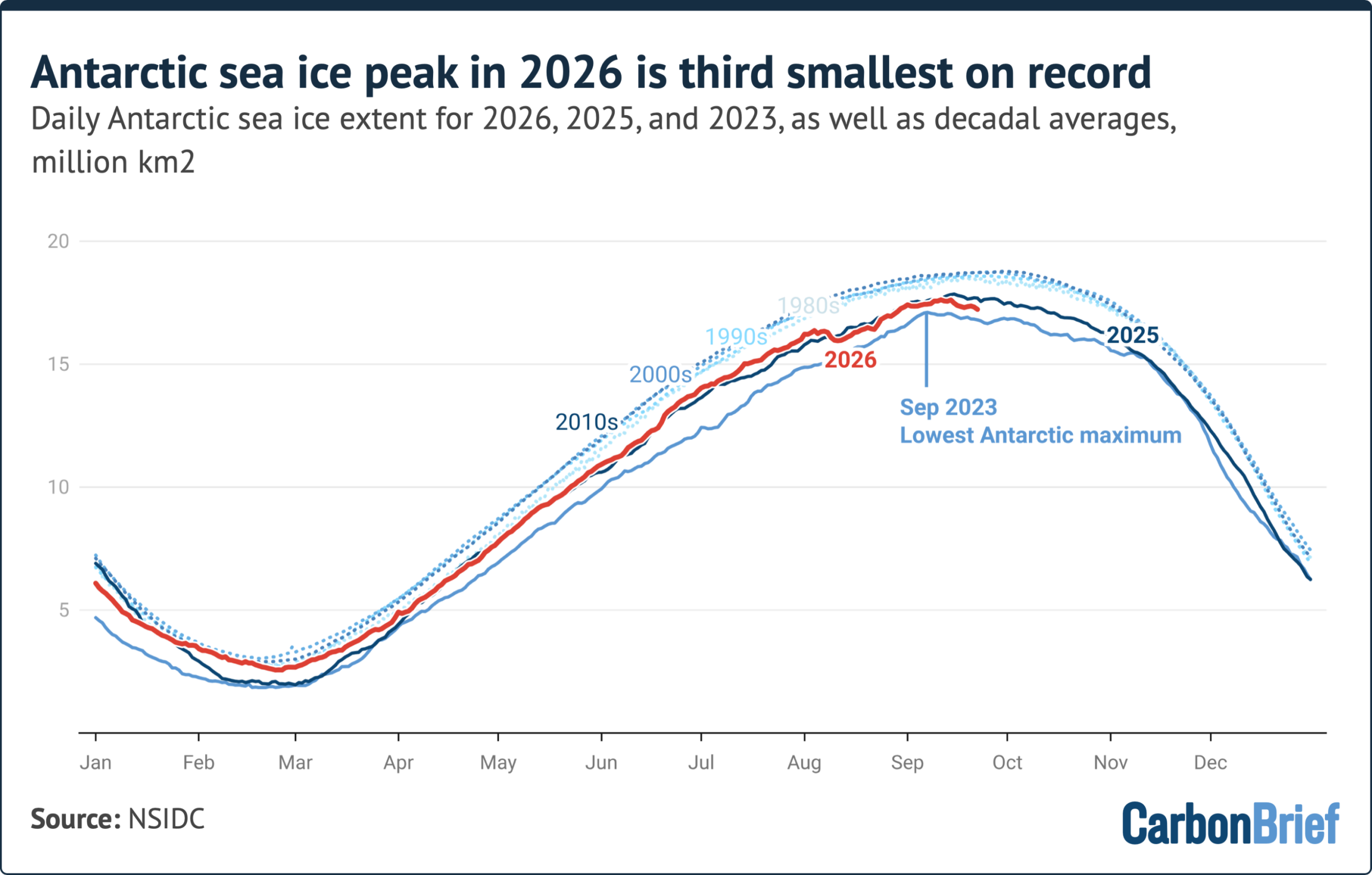
Provisional data from the US National Snow and Ice Data Center (NSIDC) shows that Antarctic sea ice hit its annual winter peak on 14 September, with an extent of 17.59m square kilometres (km2).
The organisation notes that the data is still preliminary, adding that “large fluctuations in extent are typical of Antarctic sea ice near the seasonal maximum”.
One expert tells Carbon Brief that it is “concerning to see these low values persisting”, but says that scientists need more time to determine whether this represents a “structural shift” in Antarctic sea ice extent.
Meanwhile, at the Earth’s other pole, Arctic sea ice reached its annual minimum on 12 September, ranking as the joint-10th lowest in the satellite record.
The NSIDC notes that the last 20 years have seen the lowest 20 Arctic sea ice extents in the satellite record.
Antarctic peak
Dr Lettie Roach, a polar climate scientist at the Alfred Wegener Institute in Germany, tells Carbon Brief that this year’s Antarctic sea ice maximum was “well below average for the season”. She warns that, “after several decades of stable or increasing winter Antarctic sea ice conditions, it is concerning to see these low values persisting”.
She adds:
“Compared with the Arctic, it’s less clear how recent changes in Antarctic sea ice are attributable to human-caused warming vs natural variability. We need more years of observations to better understand whether this is truly a structural shift.”
Dr Clare Eayrs, a postdoctoral researcher at the Korea Polar Research Institute (KOPRI), tells Carbon Brief that, since recording a “near-average February minimum” extent, Antarctic sea ice has “returned to unusually low winter coverage”.
She notes that Antarctic sea ice extent in July and August this year were the fifth and fourth lowest on record, respectively, adding that “all five of the lowest July extents have occurred since 2022 and all four of the lowest August extents since 2023”.
The chart below shows Antarctic sea ice extent in 2025 (dark blue) and 2026 (red) so far. For comparison, the chart shows decadal averages (dotted lines) as well as 2023 (mid blue), the year of the smallest winter sea-ice maximum on record.
Eayrs tells Carbon Brief that the regional pattern of Antarctic sea ice cover “changed substantially during the growth season”.
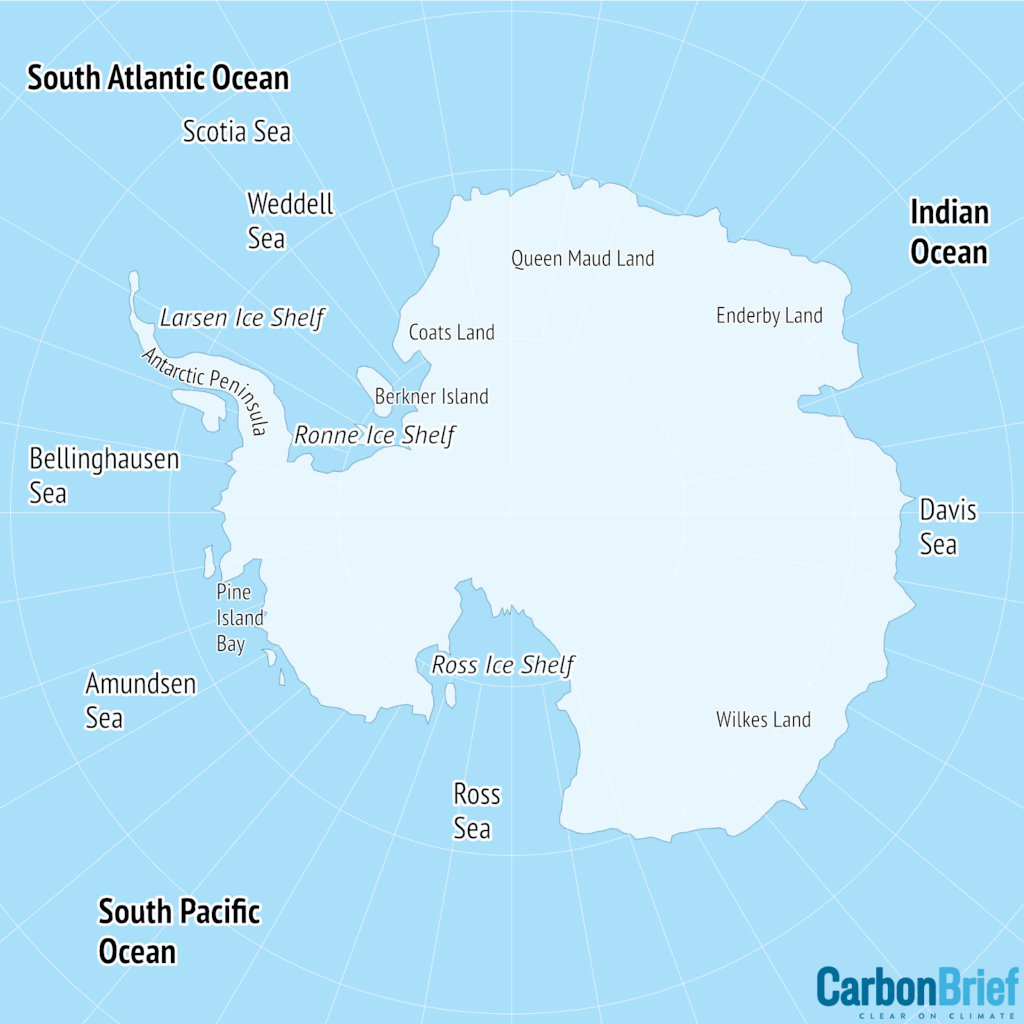
For example, she says that “in April, the Bellingshausen Sea remained almost entirely ice-free, while the neighbouring Amundsen Sea had more ice than usual”.
However, by late August, changes in atmospheric pressure and wind meant that “the Bellingshausen deficit had largely recovered, while ice was unusually scarce in the Amundsen Sea and across much of East Antarctica”.
Arctic minimum
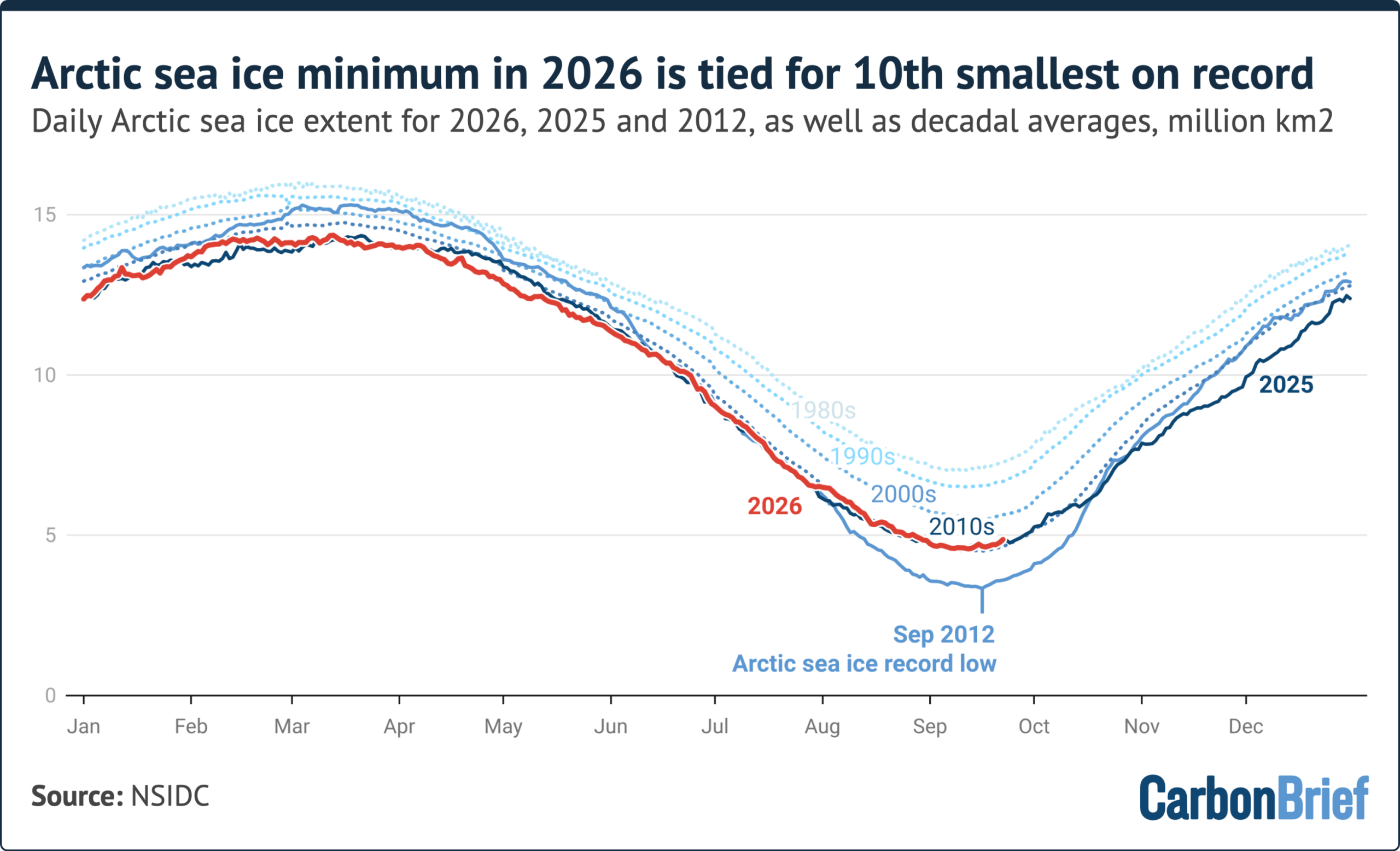
Meanwhile, the Arctic recorded its minimum summer sea ice extent on 12 September. At 4.60m km2, this year ties with 2025, 2010 and 2008 as the 10th-lowest sea ice extent on record.
The chart below shows Arctic sea ice extent in 2025 (dark blue) and 2026 (red) so far. For comparison, the chart shows decadal averages (dotted lines) as well as 2012 (mid blue), the year of the smallest summer sea-ice minimum on record.
Roach tells Carbon Brief that although this minimum is not “record setting”, it is still “lower than any sea ice minimum before 2007”. She adds:
“Human-caused climate change has reduced Arctic sea ice cover and thickness, so the region is fundamentally different compared to a few decades ago.”
Scientists have been tracking Arctic sea ice thickness using a reanalysis produced called the Pan-Arctic Ice Ocean Modeling and Assimilation System (PIOMAS) since 1979.
In March 2026, the National Oceanographic and Atmospheric Administration (NOAA) terminated a global dataset of air pressure that scientists relied upon to produce PIOMAS, forcing both datasets to stop publishing updates.
The PIOMAS website says it will take “considerable effort and time” to find alternative data to use in their reanalysis. It adds that “we don’t yet have a good sense if that’s possible with available funds and if so, when we will be able to resume production of a new PIOMAS timeseries”.
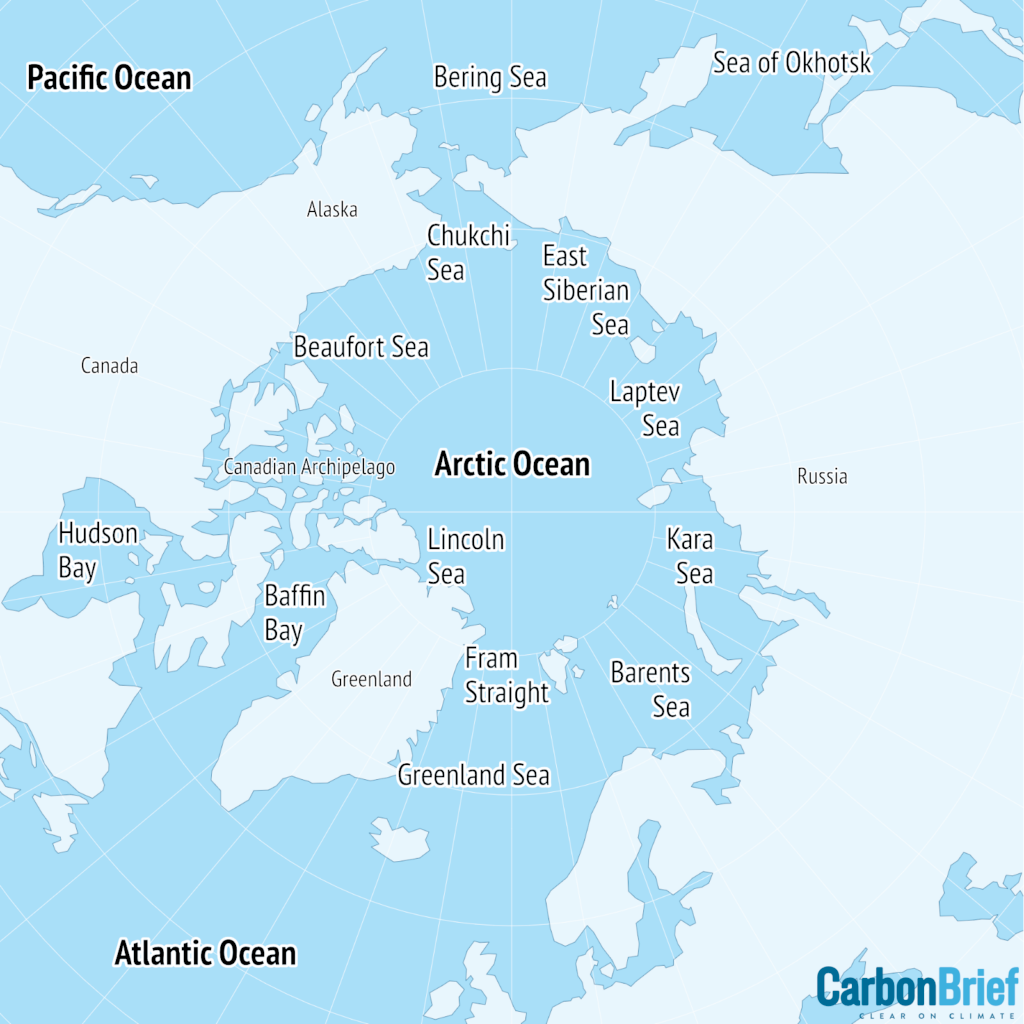
Roach also notes that August saw record-breaking heat sweep across much of the world, explaining that high temperatures “extended into Arctic coastal regions, close to regions with substantial sea ice loss – particularly the Barents-Kara and East Siberian seas”.
Dr Zack Labe, a scientist at Climate Central, tells Carbon Brief that the absence of a new record does not mean that ice cover is becoming more “resilient”. He says:
“Local weather patterns across the Arctic play a really important role in year-to-year sea-ice extent, even as the long-term trend is clearly downward.”
Labe tells Carbon Brief that weather in the Arctic this summer was “influenced mainly by lower pressure toward the central Arctic, which brought cloudier and cooler conditions that limited surface melt and delayed the start of the melt season”.
He explains that this “was most obvious across parts of the Beaufort and Chukchi seas, where the melt season didn’t really kick off until after early July, which was more than two weeks later than normal”.
In contrast, he says, the Atlantic side of the Arctic “had a much more extreme summer”, with sea ice in the Barents Sea recording its “earliest melt-out on record”.
This was partly due to “unusually warm air and ocean temperatures”, Labe says. He notes, for example, that parts of western Siberia saw unusually persistent temperatures more than 5C above the 1981-2010 average for much of the summer, which extended out over the Kara Sea and contributed to substantial ice melt in this area”.
Labe tells Carbon Brief that, going forward, scientists need “more data and observations of other sea-ice metrics, like ice thickness, which may give us better insight into the overall condition of the ice pack, especially during years like 2026 when it is very fragmented”.
(In March 2026, Arctic sea ice reached its peak extent for this winter, clocking in as the joint-smallest in a satellite record going back almost half a century.)
Related
Guest post: Climate change has caused one-fifth of Pine Island glacier retreat
‘Very alarming’ winter sees Arctic sea ice hit record-low for second year running
Q&A: How Trump is threatening climate science in Earth’s polar regions
Limiting warming to 2C is ‘crucial’ to protect pristine Antarctic Peninsula
The post ‘Concerning’ low sea ice persists as Antarctic hits third-lowest winter peak appeared first on Carbon Brief.
‘Concerning’ low sea ice persists as Antarctic hits third-lowest winter peak
Participants at COP31 in Antalya will have a “duty” not to interfere in Türkiye’s internal affairs under the country’s hosting deal with the UN, reviving a clause dropped for last year’s climate summit in Brazil that human rights groups warn could put activists at risk.
Türkiye has faced growing criticism from human rights groups over the jailing of opposition figures, journalists and activists and imposed a blanket protest ban around July’s summit of the NATO military alliance in Ankara.
The contested provision is included in the binding agreement between the UN climate secretariat and the Turkish government that sets out responsibilities over logistical arrangements and details participants’ rights and obligations.
The document, signed in June but only made public on Wednesday, gives accredited COP31 attendees immunity from legal action over what they say, write or do in connection with the conference. Climate Home News understands that this safeguard can be applied to what takes place both inside and, in certain circumstances, outside of the UN-controlled COP “Blue Zone”. For the first time, this protection explicitly continues after the summit ends.

But participants enjoying these “privileges and immunities” also have a duty to respect Türkiye’s laws and regulations and not to interfere in its internal affairs, the agreement states. Rights groups fear its wide-ranging formulation could be used to discourage criticism of the host government.
Climate Home News understands that whether an action is covered by the immunity or infringes on the host’s internal affairs would be evaluated on a case-by-case basis, with close coordination between the country’s authorities and the UN climate change body.
A separate provision states that immunity shall be waived where the UN believes it would “impede the course of justice”.
‘Chilling effect’
Those same provisions featured in the host country agreements for COP28 in the United Arab Emirates and COP29 in Azerbaijan, both regarded as authoritarian regimes, before being dropped for COP30 in Brazil.
Ann Harrison, climate justice policy advisor at Amnesty International, said it is “extremely disappointing” that the COP31 agreement re-introduced clauses that could “hinder the ability of human rights defenders and civil society organisations to conduct their work safely”.
COP31 electrification pledge leaves out clean power commitment
She added the provisions could have a “wider chilling effect” on rights to freedom of expression and peaceful assembly, given concerns over the human rights situation in Türkiye, including laws that “have shrunk civic space” and their “abusive” implementation by authorities.
The UN climate change body declined to comment.
Rights groups have documented blanket protest bans, unlawful use of force by the police and prosecutions of journalists, human rights defenders and lawyers across Türkiye in the last year.
Arrests and protest bans
Last July, environmental activist Esra Işık was sentenced to more than two years for “resisting” a public official over what Amnesty International described as a peaceful protest against an urgent expropriation order linked to the expansion of coal mining in south-western Türkiye. She is appealing the conviction.
Ahead of a summit of the NATO alliance in the capital Ankara in July, authorities put in place a 13-day blanket ban on demonstrations, citing “national security”, and arrested over 200 people. Human Rights Watch said the crackdown showed Türkiye’s “ruthless intolerance of freedom of speech and assembly”.
Earlier this month, Turkish police detained dozens of people as part of what rights groups described as the government’s widening crackdown on LGBTQ+ activists and venues.
Questioned by media as to how he would guarantee the right to protest at COP31, Kurum said earlier in September that his team would “try to meet” any request they receive from civil society and give them “a free space to express themselves”.
“Don’t worry, thinking you will not be able to voice your opinions or really share your thoughts,” he said in an attempt to reassure campaigners, adding that he had put former deputy environment minister Mehmet Birpinar in charge of liaising with civil society.
Civic space needed
Camilla Pollera, human rights and climate change campaigner at the Center for International Environmental Law (CIEL), said meaningful participation at COP31 is fundamental to the legitimacy of climate action.
“At a climate summit, civil society participation necessarily includes being present, speaking out, scrutinising governments’ decisions and climate policies, and advocating for communities most vulnerable to climate change,” she added.
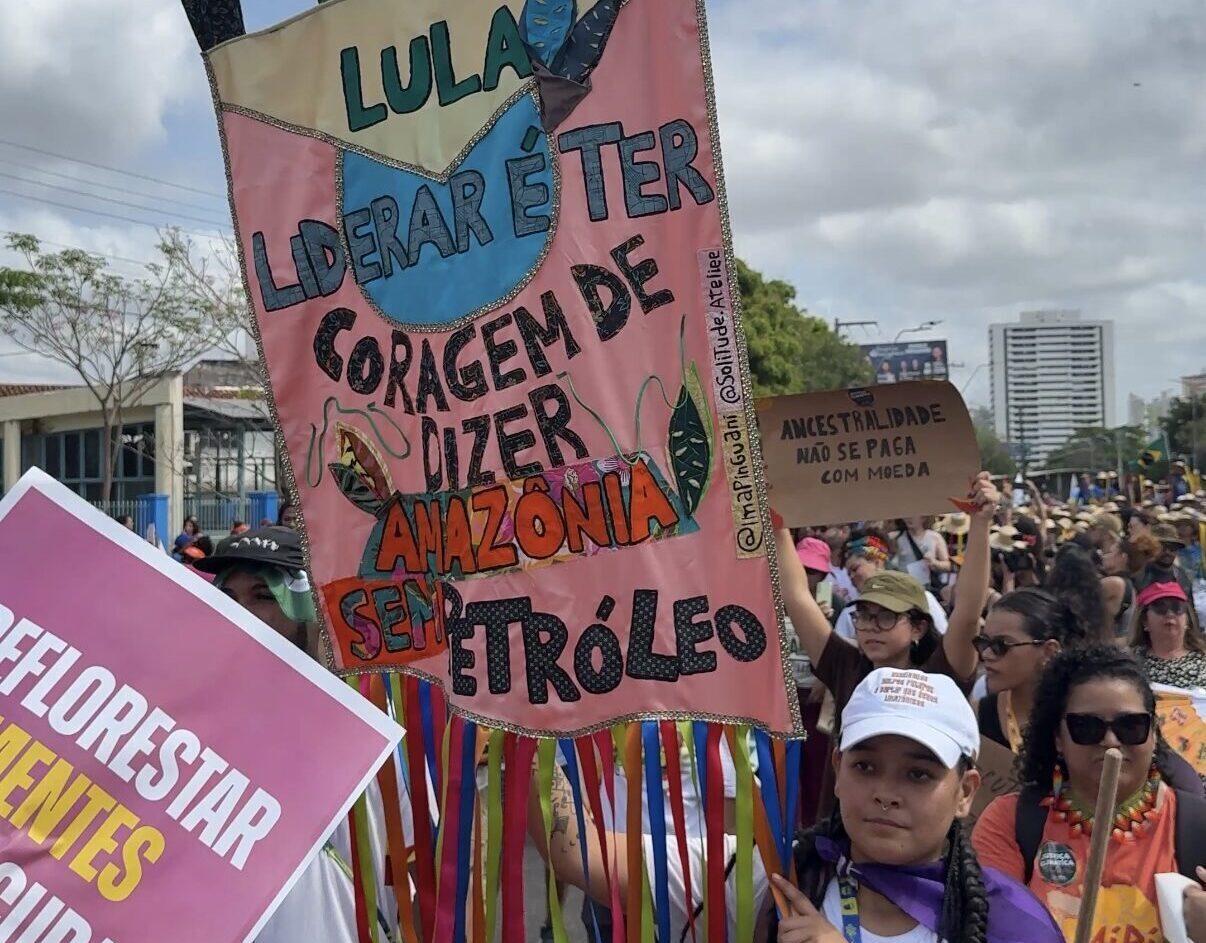
At last year’s COP30 summit, thousands of Indigenous people and climate activists peacefully marched through the Amazonian city of Belém in the first major demonstration outside the UN venue in four years. Smaller-scale demonstrations were largely confined to the “Blue Zone” at COP27 in Egypt, COP28 in the UAE and COP29 in Azerbaijan.
In two other separate incidents in Belém, members of the Munduruku tribe blocked access to the conference centre for hours, demanding an end to development projects in their ancestral land, and protesters stormed through the venue clashing with UN security officials.
The COP31 hosting agreement keeps some of the safeguards previously hailed by civil society groups. The government and the UN secretariat commit to upholding “the fundamental human rights” of all participants in the agreement’s preamble.
Under the deal, Türkiye also needs to ensure that security personnel follow “the highest ethical and professional standards and are expected to behave with integrity and respect”.
The post COP31 attendees told not to interfere in Türkiye’s “internal affairs” appeared first on Climate Home News.
COP31 attendees told not to interfere in Türkiye’s “internal affairs”



-

 Greenhouse Gases2 years ago
嘉宾来稿:满足中国增长的用电需求 光伏加储能“比新建煤电更实惠”
-
Climate Change1 year ago
Guest post: Why China is still building new coal – and when it might stop
-
Greenhouse Gases1 year ago
Guest post: Why China is still building new coal – and when it might stop
-

 Climate Change2 years ago
嘉宾来稿:满足中国增长的用电需求 光伏加储能“比新建煤电更实惠”
-
Climate Change2 years ago
Bill Discounting Climate Change in Florida’s Energy Policy Awaits DeSantis’ Approval
-

 Renewable Energy11 months ago
Sending Progressive Philanthropist George Soros to Prison?
-
Greenhouse Gases1 year ago
嘉宾来稿:探究火山喷发如何影响气候预测
-

 Climate Change2 years ago
Analysis: China’s CO2 falls 1% in Q2 2024 in first quarterly drop since Covid-19