

The European Commission has set out a proposal to cut EU emissions 90% by 2040, with up to 3% coming via carbon credits purchased from other countries.
In a proposed amendment to EU climate legislation, the commission has laid out what it calls a “new way to get to 2040”, including “flexibilities” to ease the burden on member states.
Besides the limited use of carbon credits, the proposal also gives a potentially larger role to carbon dioxide (CO2) removal technologies and leaves the door open for weaker sectoral goals.
It has drawn criticism from climate NGOs and left-leaning European politicians, who argue that it “waters down” the EU’s climate ambitions and presents “considerable risks”.
Yet, the proposal is seen by many as an acceptable compromise option, following strong pushback from many member states to the 90% target, originally proposed last year.
With all nations expected to come forward with new international climate targets for 2035 by September and ahead of the COP30 climate summit, the 2040 goal will also be crucial in determining where the EU’s pledge lands.
In this Q&A, Carbon Brief outlines what the amendment proposed by the commission includes, why it has proved controversial and what is expected to happen next.
What has the European Commission proposed?
The European Commission has proposed an amendment to the EU Climate Law, which would set a target for a 90% reduction in net greenhouse gas (GHG) emissions by 2040, compared to 1990 levels.
It will “give certainty to investors, innovation, strengthen industrial leadership of our businesses and increase Europe’s energy security”, the commission says.
In a statement, Ursula von der Leyen, president of the European Commission, added:
“As European citizens increasingly feel the impact of climate change, they expect Europe to act. Industry and investors look to us to set a predictable direction of travel. Today we show that we stand firmly by our commitment to decarbonise [the] European economy by 2050. The goal is clear, the journey is pragmatic and realistic.”
The proposal includes new “flexibilities”, such as a limited role for “high-quality international credits” from 2036, the use of domestic permanent emissions removals within the EU Emissions Trading System (EU ETS) and additional flexibilities across certain hard-to-decarbonise sectors.
These additional flexibilities are designed to allow countries to meet targets in a cost-effective and “socially fair” way, the commission adds. It says they will provide the possibility that a member state could compensate for a struggling land-use sector with overachievement in other areas, such as emissions from waste or transport.
The target will “send a signal to the global community” that the EU will “stay the course on climate change, deliver the Paris Agreement and continue engaging with partner countries to reduce global emissions”, says the commission.
It has been announced ahead of the UN COP30 climate summit in Belém, Brazil in November.
The European Commission says it will now work with the council presidency – representing EU member state governments – to finalise the EU’s climate pledges for 2035, so that the EU can submit its “nationally determined contribution” (NDC) under the Paris Agreement.
The EU was among the 95% of countries that missed the UN deadline to submit their NDCs by February of this year.
A recent update from the European parliament noted that the EU “needs to update its NDC…by September”, in order to meet an extended deadline from the UN.
In 2023, independent advisory body the European Scientific Advisory Board on Climate Change recommended that the EU should aim for net emissions reductions of 90-95% by 2040, compared to 1990 levels.
As such, the advisory board said that the bloc would need to limit its cumulative emissions from 2030-50 to 11-14bn tonnes of CO2 equivalent (GtCO2e), in order to be in line with bringing global warming down to 1.5C by the end of the century.
The 90% emissions reduction figure set out by the EU is on the lower end of guidance.
Why is the commission making this proposal now?
The European Commission’s new proposal builds on previous targets and roadmaps, representing a significant step towards enshrining the 2040 target in law.
In July 2021, the European Climate Law officially entered into force, setting a target of a net GHG reduction of at least 55% by 2030, compared to 1990 levels, as shown in the chart below.
Rules were introduced governing sectors, such as clean energy, energy efficiency and transport, among others, to help meet this target.
If all were successful in their implementation, they would reduce emissions by roughly 57% by 2030, according to a European parliament assessment in 2022.
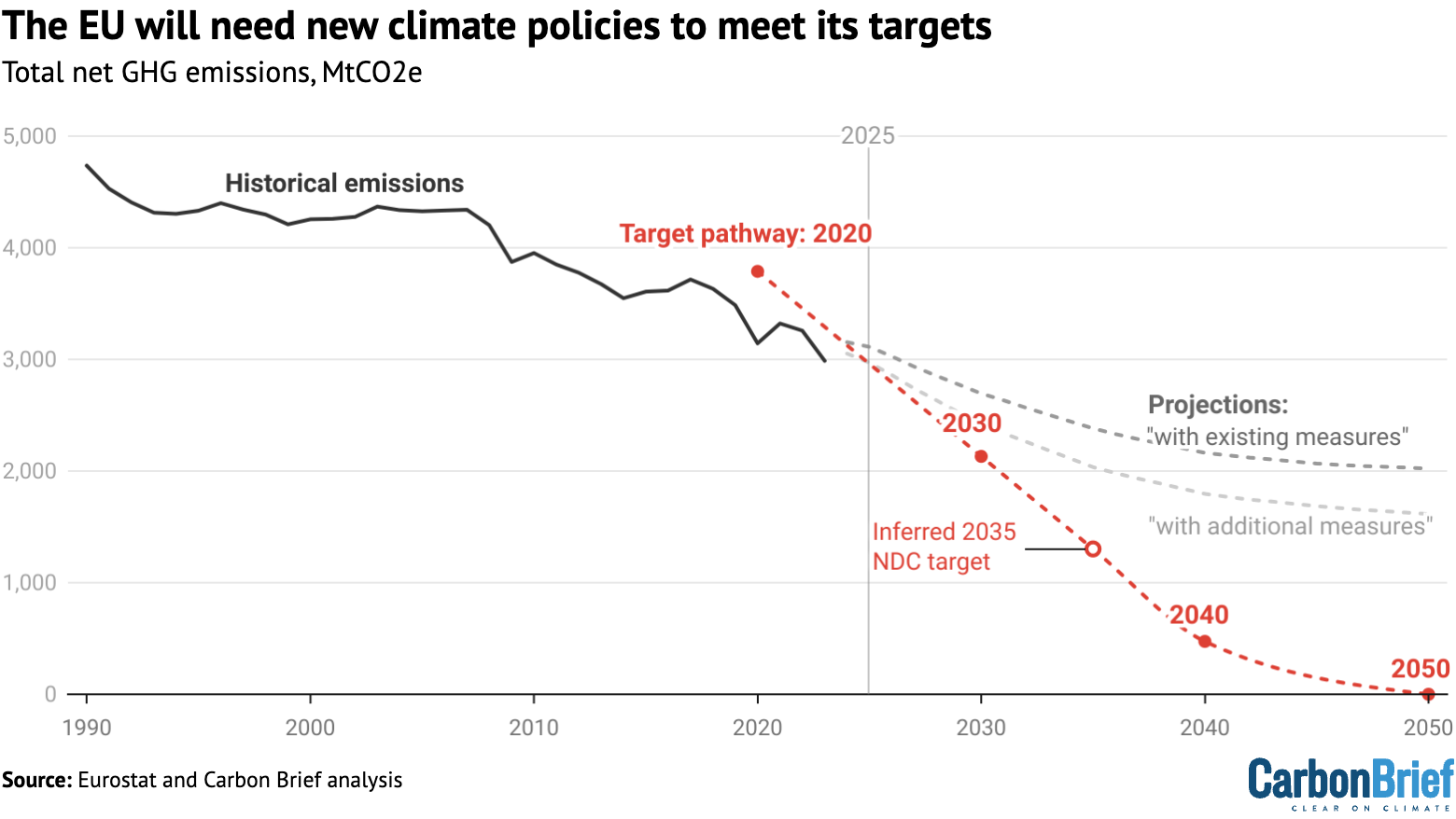
Subsequently, the commission has been working on developing a target for 2040, as an interim benchmark between the 2030 target and the EU goal – announced in 2018 – to be “climate neutral” by 2050. At this point, the bloc would reach net-zero emissions overall and would stop adding to global warming.
In 2024, the commission published an impact assessment, detailing the underlying qualitative analysis it had undertaken around emissions reduction targets for 2040.
This, together with the European Scientific Advisory Board on Climate Change’s report (detailed above) and advice from the UN’s Intergovernmental Panel on Climate Change, formed the basis for the 90% target, the commission says.
The headline 90% target for 2040 was announced as part of a roadmap outlined by the commission in February 2024.
The roadmap kicked off a lengthy process in which EU politicians and institutions worked to cement the details of this target, ahead of this week’s proposal on turning it into law.
This process included “substantial engagement” with member states, the European parliament, stakeholders, civil society and citizens, the commission says.
In particular, certain European countries have been placing pressure on the commission to change or adapt the 2040 target, slowing the progress of this week’s proposal, which had been due out in February.
For example, Italy called for the goal to be weakened and France asked for “flexibility” to be introduced (See: Who has supported and opposed the proposed climate target?).
The commission hopes that publishing the proposed target now will allow it to be factored into the EU’s upcoming NDC, in which it will establish an emissions reduction target for 2035.
What does it say about international carbon credits and ‘flexibilities’?
The European Commission’s proposal sets out a “pragmatic” pathway towards the 2040 target, including specific measures to give EU member states “flexibility”.
Of these, the one that has received the most attention is to allow limited use of international carbon credits, under Article 6 of the Paris Agreement, starting in 2036.
In effect, this flexibility means that emissions within the EU would only need to fall to 87% below 1990 levels by 2040, with the remaining 3% taking place overseas.
This would mean member states could buy credits generated by emissions-cutting projects in other countries and count those cuts towards their own targets.
Other nations, including Japan and Switzerland, have already welcomed the use of international credits to meet their climate goals.
In an unusual intervention that coincided with the proposal itself, the European Scientific Advisory Board on Climate Change stated that the EU should not count such credits towards the 2040 target. It said:
“Using international carbon credits to meet this target, even partially, could undermine domestic value creation by diverting resources from the necessary transformation of the EU’s economy.”
The board also mentioned other concerns that are frequently levelled at “carbon offsetting”, such as credits not resulting in real-world emissions cuts.
The commission’s proposal refers to “high-quality international credits under Article 6”, but does not specify which types of credit. This leaves the door open for lower quality options.
For example, carbon trading under Article 6.2 is subject to far less oversight than trading of Article 6.4 credits.
The proposal also states that: “The origin, quality criteria and other conditions concerning the acquisition and use of any such credits shall be regulated in union law.”
This suggests that the EU would conduct its own assessment of any credits used by member states, beyond the rules that have been negotiated at an international level.
Jonathan Crook, the lead expert on global carbon markets at Carbon Market Watch, tells Carbon Brief that additional safeguards would be “essential”, given outstanding issues with Article 6 carbon credits.
A Q&A accompanying the commission proposal states that credits would be bought from “credible and transformative” projects in nations with Paris-aligned climate goals.
It mentions direct air carbon capture and storage (DACCS) and bioenergy with carbon capture and storage (BECCS) as examples of the kinds of projects that the EU could source credits from.
This could severely limit the pool of available credits, because – as it stands – almost all carbon credits are from tree planting, forest conservation and clean-energy projects.
DACCS and BECCS projects could result in relatively permanent carbon removal. Crook says this would be one of the “many necessary safeguards” needed for credit purchases, although he points to potential issues with such projects. He adds:
“This potential durability criterion is only mentioned in the Q&A, rather than in the actual commission proposal and so currently has very limited standing unless it is introduced [into the legal text] during the co-legislation process.”
There are two additional “new flexibilities” mentioned in the commission’s proposal, to help member states meet the 2040 emissions target more easily.
One is the inclusion of permanent carbon dioxide (CO2) removal in the EU ETS, something that was already being discussed as part of an ETS revision.
This would mean that DACCS and BECCS projects in EU member states could sell credits to help high-emitting companies, such as steel plant operators, stay within their ETS limits.
Paying for such credits could become more appealing as the number of available emissions “allowances” under the overall “cap” for ETS system shrinks and the allowances become more expensive.
The commission says this would help to “compensate for residual emissions from hard-to-abate sectors”, referring to those that are expensive or difficult to reduce to zero.
The need to remove CO2 from the atmosphere is widely recognised and inclusion in the ETS could help to drive investment into early-stage technologies, such as DACCS.
However, there are concerns that focusing on removals diverts investment from readily available technologies that cut emissions, such as electric-arc furnaces for steel plants.
In its recommendations, the European Scientific Advisory Board on Climate Change says there should be separate targets for emissions reductions and removals. This would ensure the removals contribute to EU targets “without deterring emission reductions”, it says.
Finally, the commission’s proposal also includes a vague mention of “enhanced flexibility across sectors, to support the achievement of targets in a cost-effective way”.
Linda Kalcher, executive director of the thinktank Strategic Perspectives, tells Carbon Brief that this is “alluding to the fact that we might see weakening of some laws”.
Michael Forte, a senior policy advisor at thinktank E3G, expands on this, noting that it could mean member states adjusting emissions targets between different parts of the EU climate architecture, depending on where they were over- or underperforming.
“I would infer that this means letting member states transfer a greater share of their mitigation efforts between these different instruments,” Forte tells Carbon Brief.
Kalcher notes that such changes cannot be regulated in this law, but instead would need to be part of the expected 2040 framework or other pieces of law:
“They are more alluding to future changes, instead of making them now. So that…gives confidence to the countries that have concerns [about the 2040 target] that something will happen.”
Who has supported and opposed the proposed climate target?
Climate campaigners and left-leaning politicians were highly critical of the “flexibilities” included in the commission’s proposal, in particular the use of international carbon credits.
The options proposed were described by civil-society groups as “creative accounting” and a “dangerous new precedent” that relies on “outsourcing Europe’s responsibility” to other countries.
The European parliament’s centre-left Socialists and Democrats coalition issued a statement warning that “the inclusion of international carbon credits as a means to meet the target carries considerable risks”.
Critics also noted that using such flexibilities contradicted the official advice offered by the European Scientific Advisory Board on Climate Change.
Yet the proposal, presented as a “new way to get to 2040”, is widely viewed as an attempt to find a political compromise against a tricky geopolitical backdrop.
It allows the EU to aim for the target set out by its scientific advisers, albeit at the lower end of the “90-95%” emissions reduction that had been proposed. This is in spite of a strong political pushback from some member states.
A statement released by Peter Liese and Christian Ehler, German members of the European parliament’s centre-right European People’s Party (EPP) group, explained:
“We think it’s very dangerous to criticise the European Commission because they intend to include flexibility in their proposal on the 2040 target. We don’t see a majority in parliament nor council for any 2040 target without flexibility.”
Some member states, including Spain and Denmark, supported the 90% target without asking for major concessions. Others, including Poland and Italy, have argued for a less stringent headline goal.
Meanwhile, others pushed for some kind of compromise during discussions of the new target.
Notably, the newly elected, right-leaning German government gave qualified support for the 90% goal in its coalition agreement, subject to conditions such as the inclusion of international carbon credits. Other influential nations have also increasingly stressed the need for “flexibility” around the target.
Meanwhile, according to Politico, France has been part of a push – alongside “climate laggards” Hungary and Poland – to separate discussions of the EU’s domestic 2040 target from its international 2035 NDC pledge.
According to the news outlet, such decoupling could result in a weaker 2035 target, compared to the 2035 target that is expected to be derived from the 90% reduction 2040 goal.
How does the goal fit with the EU’s industrial growth plans?
The commission says its 2040 proposal goes “hand in hand” with its clean industrial deal strategy, its affordable energy action plan and its “competitiveness compass” plan.
Alongside tabling its 2040 climate goal, the commission issued a new “communication” on “delivering on the clean industrial deal”. (The deal was first announced in February.)
The communication says that “decarbonisation and reindustrialisation are two sides of the same coin” and reaffirms that the aim of the deal is to “enable the EU to lead in
developing the clean-technology markets of the future”.
The commission says delivery of the deal is “already underway”. It points to the adoption of the clean industrial deal state aid framework on 25 June, an €85bn ($100bn) state-aid package for helping member states transition their economies.
Environmental law charity Client Earth said a draft version of the framework risked “entrenching support for fossil gas and fossil based low-carbon gases”.
The clean industrial deal communication also notes that the commission this week published recommendations on tax incentives for speeding up the energy transition.
On 18 June, the European parliament and council agreed on a commission proposal to simplify the EU’s Carbon Border Adjustment Mechanism (CBAM), a policy for taxing carbon-intensive imports at levels equivalent to the EU ETS.
The agreement introduces a new exemption threshold of 50 tonnes for CBAM goods, meaning small and medium-sized companies that do not exceed this weight of imports per year will now be exempt from the measure.
EU climate commissioner Wopke Hoekstra described it as a “win for both climate policy and competitiveness of our companies”, with the new measure meaning 90% of companies will now be exempt from the CBAM, but 99% of emissions will still be covered.
Previous analysis has found that, in isolation, the CBAM will have a limited impact on global emissions.
What comes next?
Before the target can be adopted, it must be agreed by member states and pass through the European parliament.
Once the parliament and national ministers have agreed on their separate positions, three-way “trialogue” negotiations between them and the commission can begin with the aim of finalising the 2040 legislative proposal.
All nations were asked to submit new 2035 climate pledges, known as “nationally determined contributions” (NDCs), to the UN by February of this year (see: What has the European Commission proposed?). The EU was among the vast majority of parties to miss the deadline.
UN climate chief Simon Stiell has now asked all parties to submit their NDCs “by September”. This is to allow time for the preparation of a report on the collective ambition of all nations’ pledges before COP30 in November.
The EU’s NDC will include an “indicative 2035 figure” derived from the bloc’s 2040 climate target, according to the commission.
The commission says it will work with the Danish presidency of the EU council and member states to finalise its NDC.
It is expected that the EU will aim to finalise both its 2035 NDC and its 2040 climate goal ahead of the next UN general assembly, which starts on 9 September in New York.


The post Q&A: European Commission’s proposal to cut EU emissions 90% by 2040 appeared first on Carbon Brief.
Q&A: European Commission’s proposal to cut EU emissions 90% by 2040

The agency typically doesn’t allow smog-creating ethanol blends in the summer but is relaxing that restriction to appease consumers and farmers.
The Trump administration handed farmers and the ethanol industry a win on Wednesday by issuing a waiver that will allow the use of higher corn-based ethanol blends in gas tanks this summer.
As Prices Soar, EPA Greenlights Higher Ethanol Blends in Gasoline
A group of farmers plans to sue the developers of the East African Crude Oil Pipeline (EACOP) in a British court, claiming the project breaches the Ugandan constitution and climate and environment law.
In a previously unreported letter before action, sent to the developers’ UK-based arm in January, the farmers say they and their livelihoods risk being harmed by climate change which the pipeline will worsen by generating millions of tonnes of greenhouse gas emissions.
Their law firm, London-based Leigh Day, plans to file a formal claim in the next few months, in which it will ask for construction of the pipeline – which will cost around $5.6 billion to build, spans Uganda and Tanzania and is four-fifths complete – to be halted.
The lawsuit has been crowdfunded by donations from over 40,000 people, coordinated by the Avaaz campaign group, which promote the case as “one final chance to stop one of the worst oil pipelines on the planet”.
-
Where East African oil pipeline meets sea, displaced farmers bemoan “bad deal” on compensation
The oil export project has pushed up the price of land, so compensation is too low to maintain affected villagers’ standard of living

The pipeline is a joint venture led by French company TotalEnergies, with smaller stakes owned by Uganda, Tanzanian and Chinese national oil firms. But it is operated by EACOP Ltd, a company registered to an office in Canary Wharf, the tallest building in London’s financial district.
Leigh Day solicitor Joe Snape, who represents the group of farmers, said EACOP highlights how corporations in the Global North are profiting from fossil fuel extraction projects in the Global South which also suffer most from their worsening of climate change.
Ugandan law tested in UK court
The group of four farmers accuses EACOP Ltd of breaching their right to a clean and healthy environment under the Ugandan constitution, as well as its legal obligations under Uganda’s National Environment Act and National Climate Change Act.
Leigh Day solicitor Joe Snape, who represents the farmers, told Climate Home News that Ugandan law has novel clauses allowing people to make environmental claims without having to demonstrate a precise link to their own loss. They just have to show that the action complained of threatens, or is likely to threaten, efforts to reduce emissions or adapt to climate change, he said.
However, these clauses have not yet been tested in court, so it will be up to British judges, if they accept the case, to interpret how they apply in practice.
Leigh Day is keen to use the UK’s legal system because it perceives it as more impartial and efficient than that of Uganda, Snape said. A climate lawsuit filed in Uganda more than a decade ago by a group of young people has yet to conclude.
EACOP has been subject to repeated lawsuits in several countries, none of which have succeeded. A case at the East African Court of Justice, brought by campaign groups against Uganda and Tanzania, was rejected on procedural grounds last November.
A separate ongoing lawsuit in TotalEnergies’ home country of France – a refiled version of an earlier failed claim – cannot stop EACOP going ahead, but it does seek damages from TotalEnergies for affected communities.
Thousands already displaced
The pipeline, which will link Uganda’s Lake Albert oil fields to Africa’s east coast in Tanzania, is around 80% completed according to its developers, with first oil exports possible as early as October.
Thousands of people have already been displaced by the pipeline, with compensation paid and many training schemes – whose quality has been criticised – already completed.
Despite this progress, the farmers’ legal team say that a court could still stop the pipeline from being completed. Any contractual or compensation issues arising from the stoppage and the billions of dollars of sunk costs would have to be dealt with separately, said Snape.
Gerald Barekye, a farmer, researcher and campaigner, from the pipeline-affected Hoima district, will be one of the claimants. He said that Ugandan communities were already living with flooding, drought and food insecurity caused by climate change.
“Allowing these oil companies to complete the construction of the EACOP pipeline and extract millions of barrels of oil, which will produce millions of tonnes of emissions, will only make this situation in this region worse and deepen our suffering,” he said.
Agriculture, which makes up a fifth of Uganda’s GDP and employs two-thirds of its population, is likely to be affected by falling yields, rising plant pests and diseases, reduced suitable for crop growing and changes to growing seasons caused by climate change.
As well as the climate impacts, they will argue that the pipeline will have a significant impact on local nature and wildlife from possible oil spills, habitat fragmentation, noise pollution and new infrastructure, and poses a threat to major water resources.

Michel Forst, UN Special Rapporteur on environmental defenders under the Aarhus Convention, has raised further concerns about “serious allegations of persistent and widespread attacks and threats” against environmental defenders in Uganda over the project.
In 2022, Ugandan police arrested nine activists protesting against EACOP. One protester, Nabuyanda John Solomon, told Climate Home News at the time that police had broken one man’s arm and hit another in the eye with a baton.
EACOP Limited did not respond to a request for comment.
The post Ugandan farmers use British court to try to stop oil pipeline appeared first on Climate Home News.
Ugandan farmers use British court to try to stop oil pipeline
Pepukaye Bardouille is the Director of the Bridgetown Initiative and Special Advisor in the Prime Minister’s Office of Barbados. Kerrie Symmonds is Barbados’ Minister of Energy and Business and Senior Minister coordinating Productive Sectors.
When conflict erupts in one region, consequences can reverberate across the globe. Beyond the tragic human toll, the economic impact is palpable. In 2022, the war in Ukraine illustrated this clearly: fractured supply chains and soaring oil prices sent fuel import bills skyrocketing. And again, today, as oil prices spike amidst conflict in the Middle East, the stakes could not be higher, in particular for Small Island Developing States (SIDS).
For SIDS, resilience and energy have always been inseparable. When a hurricane hits, power lines fall. When shipments stall, oil dependence becomes a liability. Yet these countries also hold a strategic advantage in the form of abundant wind, sun, waves, and in many cases geothermal resources.
Harnessed effectively, these can power entire economies cost-effectively. With this in mind, SIDS have set some of the world’s most ambitious climate targets, with several pledging 100% renewable electricity within the next decade or two. And they have made progress: installed renewable capacity across SIDS tripled from 3.3 GW in 2014 to 9.4 GW in 2024.
But execution and financing still lag well behind ambition – and in the midst of an oil shock, closing that gap isn’t a policy preference for SIDS. It’s a matter of survival.
Lessons from Barbados
Barbados offers an example of what a credible pathway looks like. Its 50MW Lamberts and Castle project will be the country’s first utility-scale onshore wind farm and one of the largest in the Caribbean – building on a renewables base that already supplies 16% of power capacity.
Developed as a public-private partnership, it evolved from a 10MW concept into a utility-scale investment. That journey holds several lessons for other SIDS looking to accelerate their energy transition.
First, be honest about what is politically palatable and ensure the population shares in the upside. Many SIDS operate state utilities that view private power producers as threats to sovereignty or revenue. But private actors often bring the capital and expertise that large-scale projects require.
The answer is smart design. Barbados models this well, pairing private generation ownership with structures that ensure national benefit, including opportunities for citizens to invest directly.
-
Middle East war is another wake-up call for fossil fuel-reliant food systems
Much of the world’s food production depends on fossil fuels for fertiliser and transportation, and the crisis in the Gulf will push up prices – and, in turn, hunger -
India sets achievable green electricity and emissions intensity targets
While most analysts hailed the 2035 goals, some said they are too easy to meet given the progress India is already making


Second, ensure that the financials really work. Small islands face high per-megawatt costs, which logistics compound: transporting and installing large wind turbines can require port reinforcements, specialist cranes, and road widening.
These numbers rarely appear in headline budgets but can quietly kill a deal. Financing packages must therefore cover not just generation, but storage, grid upgrades, and the full logistics chain. These are too often treated as afterthoughts when they are, in practice, the difference between a project that gets built and one that doesn’t.
Collaboration required
Third, development partners must streamline energy transition support without compromising sustainability. Environmental and social studies, bird and bat surveys, community consultations, and grid analyses all take time, and rightly so. But their multiyear development timelines before a tender is issued are incompatible with 2030 or even 2035 energy targets.
SIDS need simplified processes with upfront permitting clarity, clearer regulatory pathways, and predefined safeguards. Development partners must move from project-by-project structuring to practical, time-sensitive and replicable models that reduce procedural drag while upholding environmental rigor.

Fourth, recognize that land access is critical to national energy security. In land-constrained countries, which most SIDS are, a handful of parcels can determine whether critical capacity is built. In Barbados, we expanded the Lamberts and Castle wind project site from 30MW to 50MW through careful planning and negotiation. These decisions can make or break a project’s financials, so landowners must be partners in the process, not obstacles to it.
Finally, mandate ‘all of government’ teams with the stamina to deliver. The Lamberts and Castle project advanced because the Ministry of Energy and Business, Barbados National Energy Company, Barbados Light and Power, community stakeholders and International Finance Corporation – the government’s transaction adviser – worked as a unified team.
Cheaper electricity and greater security
Energy transition projects need cross-agency partners empowered to make timely decisions, and a shared mission – all cemented by the ability to remove bottlenecks at the highest level. Institutional collaboration is not a nice-to-have, it is the engine of delivery.
Resilience cannot be outsourced, nor achieved through pledges alone. It must be built: panel by panel, battery by battery, turbine by turbine, grid by grid.
Building on the progress at Lamberts and Castle, Barbados is exploring the possibility of tripling its wind energy capacity through a public–private partnership model. Importantly, this expansion will not compromise food security. Wind turbines typically occupy less than 5% of the land area, allowing the remaining space to continue supporting agricultural production, another key resilience priority for Barbados.
In Barbados, new turbines will soon turn in the same trade winds that once powered sugar windmills, this time delivering cheaper electricity, greater economic security, and the ability to meet climate goals on our own terms. By putting renewables at the heart of resilience, SIDS can secure energy independence and lead the world in climate and economic security.
The post How small island states can make renewables the bedrock of resilience appeared first on Climate Home News.
How small island states can make renewables the bedrock of resilience



-
Greenhouse Gases8 months ago
Guest post: Why China is still building new coal – and when it might stop
-
Climate Change8 months ago
Guest post: Why China is still building new coal – and when it might stop
-

 Greenhouse Gases2 years ago
嘉宾来稿:满足中国增长的用电需求 光伏加储能“比新建煤电更实惠”
-
Climate Change2 years ago
Bill Discounting Climate Change in Florida’s Energy Policy Awaits DeSantis’ Approval
-

 Climate Change2 years ago
嘉宾来稿:满足中国增长的用电需求 光伏加储能“比新建煤电更实惠”
-
Climate Change Videos2 years ago
The toxic gas flares fuelling Nigeria’s climate change – BBC News
-

 Carbon Footprint2 years ago
US SEC’s Climate Disclosure Rules Spur Renewed Interest in Carbon Credits
-

 Renewable Energy5 months ago
Sending Progressive Philanthropist George Soros to Prison?