

Fossil fuels affect all stages of human life, with their consequences starting even before the fuels are burned – releasing climate-heating gases and other pollutants – and extending long after, according to a new report by the Global Climate and Health Alliance.
The effects of fossil fuel extraction and use are also unevenly distributed, the report says, impacting marginalised groups including Indigenous peoples, racial minorities and low-income populations the most, and exacerbating other pre-existing health inequalities in those vulnerable communities.
Published this Tuesday, the flagship report compiles more than 600 scientific citations, case studies from around the world, and testimonials from affected communities and health professionals in every region, from oil spills in Nigeria to coal pollution in India and gas extraction in the United States.
Dr Jemilah Mahmood, executive director at the Sunway Centre for Planetary Health, whose testimonial features in the report, said in a statement: “Fossil fuels are not just an environmental crisis – they are a public health emergency… As health professionals, we know the cost of inaction is measured in lives.”
-
COP observers invited to reveal who is bank-rolling their participation at climate talks
As UN climate change body introduces new voluntary transparency measures, campaigners welcome “much needed step” to keep fossil fuel influence out of the talks -
Banned from the US: The voices missing at New York Climate Week
How can there be climate justice when people from some of the world’s most vulnerable countries are shut out of the conversation by Trump’s travel ban? -
Countries trail COP30 clash over global response to shortfall in national climate plans
China, India and Saudi Arabia rejected a COP30 dialogue on an upcoming UN review of climate plans, widely expected to show the world is not on track to limit global warming to agreed levels


In an interview with Climate Home News, study co-author Shweta Narayan, campaign lead at the Global Climate and Health Alliance (GCHA), which unites over 200 health and development organisations, explained that the report – more than a year in the making – focuses on the unseen health effects of fossil fuels.
“It was important to show the scale of the problem that we’re dealing with,” she said. “Unless you understand the scope and the scale, you will not be able to advocate for the appropriate policies for climate action.”
According to the report, there are three main ways for pollutants from fossil fuel activities to enter the body: contact or absorption, ingestion or inhalation. Children are especially vulnerable to inhalation, since they breathe more rapidly than adults and take in more air as well as the pollutants it carries relative to their body weight, and those pollutants may be more damaging to their narrower airways.
In addition, children directly exposed to fossil fuel activities like unconventional oil and gas developments, refineries, major roads and petrol stations show higher rates of cancer, most consistently with leukemia.
Trillions in dirty subsidies
The report authors debunk the popular argument that fossil fuels are the cheapest way to obtain energy. In 2022, estimated global fossil fuel subsidies were $7 trillion, of which $5.7 trillion represented indirect costs such as healthcare spending, productivity losses and climate-related damages, the report notes.
Children also bear a large share of those costs as the money spent on subsidising fossil fuels diverts public resources from essential services such as healthcare and education.
UN experts accuse top oil firms of rights violations over Nigerian asset sales
Dr. Jeni Miller, the GHCA’s executive director, called on governments to halt “new oil, gas and coal projects, setting clear timelines to phase out existing projects, and ending the shocking $1.3 trillion in direct subsidies that keep this industry afloat”.
Instead, they should invest that sum in public health, clean energy and protecting the communities suffering from the impacts of climate change, she added.
She urged political leaders at the COP30 climate summit in November to recognise fossil fuel dependence as a widespread driver of disease and inequality, as well as planet-heating emissions.

The most affected groups
The report documents how the impacts of coal, oil and gas start even before their extraction and processing, with the worst consequences for those least able to protect themselves.
Exploration and site development often result in environmental destruction, disrupting access to clean water, polluting the air and sometimes displacing people from their homes. One Texas study noted an increase in hospitalisation among children with asthma during periods of gas drilling. Another study from Colombia showed that people exposed to open pit mines were more likely to have DNA damage.
The transportation of fossil fuels can also end up being a health hazard to workers and the environment, especially when disasters like spills and explosions occur. Leaks release harmful pollutants into marine, freshwater and land ecosystems.
Many fossil fuel workers come from already vulnerable communities, including rural areas where poverty is rife and work options are limited, which can push people to labour in hazardous conditions.

The report shows that workers exposed to fossil fuels face an elevated risk of developing cancer and cardio-respiratory diseases that can lead to impairment, disability and premature death. To make matters worse, they often face greater exposure to climate impacts, resulting in “disproportionate health, economic and social harms”, it adds.
And because of their limited political and social power, relocation – or even opposition to the siting of industrial facilities, landfills and extractive operations – is less of an option, which further fuels a cycle of vulnerability, the report says.
These populations are also among the hardest to study, with the health risks they face under-researched, and relevant data and information non-existent or inaccessible, it notes.
Other hard-hit groups include older people with underlying conditions exacerbated by fossil fuel-driven air pollution. One quoted study from China found that increased exposure to sulphur dioxide, mostly from burning coal and oil, was associated with premature mortality.
For pregnant women, exposure to fossil fuel pollutants is associated with early birth, low birth weight and congenital abnormalities including anencephaly, spina bifida, and heart and gastrointestinal defects.
In 2018, air pollution cost the global economy $2.9 trillion through premature mortality, lost labour and diminished quality of life, the report notes, citing a Greenpeace study.
The politics behind the harm
GCHA’s Miller called for the influence of the fossil fuel industry on international climate negotiations to be reined in. Almost 1,800 coal, oil and gas lobbyists attended COP29 last year – a sharp increase from the roughly 500 present at COP26.
“Just as governments once curbed tobacco industry influence, they must now ban fossil fuel lobbying and disinformation,” she added in a statement. “COP30 is the moment to act – not only for the climate, but for people’s health and futures.”
And this lobbying is not limited to climate diplomacy, with Narayan pointing to the negotiations on a global treaty to rein in plastic pollution that ended with no agreement or clear way forward.
Plastics treaty talks collapse without a deal after “chaotic” negotiations
“The disruption of the process itself because of undue influence of petrostates and industry lobbyists was very evident,” she said, noting that all multilateral processes are “riddled with undue influence by the industry. And that undue influence has to be curbed and restricted if we want to protect people’s health and have a livable future.”
The authors of the report call for a just transition away from fossil fuels, defining it as one “shaped by policy frameworks that ensure it is fair, inclusive, and health-promoting”.
That transition must also include the cleanup of existing fossil fuel sites, as the toxins that harm health remain in the environment for a long time – and that remediation should be done by the polluting companies, which often try to avoid it due to the high cost, Narayan told Climate Home.
“That’s why we see them evading the issue of accountability and responsibility,” she said. “But accountability is very important for protecting people’s health.”
The post “Public health emergency”: Report shows fossil fuel impacts on every stage of life appeared first on Climate Home News.
“Public health emergency”: Report shows fossil fuel impacts on every stage of life

Three countries have been named by the Paris Agreement’s compliance committee for failing to submit a nationally determined contribution (NDC) and repeatedly snubbing offers of help with their climate plans.
After months of internal debate over whether to identify serial non-responders, the Paris Agreement’s Implementation and Compliance Committee (PAICC) named the three countries which have failed to engage with it over their NDCs on Friday.
It named Democratic Republic of Congo, Senegal and North Korea in a footnote of its annual report, adding that it decided to name them “with a view to facilitating engagement”, adding that representatives of the three nations had been invited to its meeting in early 2027 “with the purpose of identifying any challenges and constraints”.
“The Committee noted the importance of Parties engaging with the Committee in a timely manner, while noting that some delays may be due to the national capabilities and circumstances of the Parties”, the report said.
-
Under US pressure, World Bank says it will back gas “where appropriate”
The US wants the World Bank to expand its gas support while climate campaigners are pushing for it to end – its head spoke this week of limited backing for the fossil fuel -
IPCC scientists vow to press on with climate reports despite political deadlock
After governments again failed to agree a timeline, nearly 120 IPCC authors pledged to complete their assessment on time and with full scientific rigour -
Paris Agreement committee snubbed over missing NDC climate plans
Many governments have still not submitted a nationally determined contribution to the UN, breaching a key requirement of the Paris Agreement

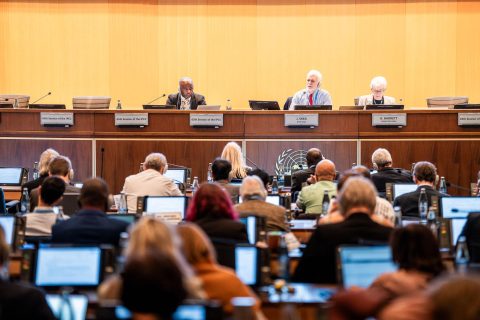

In July, PAICC said 12 countries had ignored its repeated attempts to discuss why they had not published an NDC as required every five years under the 2015 Paris accord.
Members of the committee had been divided over whether to name them, but at a September meeting decided to do so in their annual report to the annual climate COP summit.
By the time the report was published on Friday, only Congo, Senegal and North Korea “had not communicated an NDC or submitted a [Biennial Transparency Report] and had not yet responded to any of the Committee’s notifications, despite several reminders issued by the Committee in this regard”.
Rainforest and renewable energy ambitions
The silence from Congo and Senegal is notable because the former is home to much of the Congo Basin rainforest while the latter has sought billions of dollars in climate finance to support its renewable energy ambitions.
After Brazil, Congo has more rainforest than any country in the world. This forest, and the country’s peatlands, absorb huge amounts of greenhouse gas but are fast being lost to expanding farmland, charcoal production, logging and mining.
Senegal signed a Just Energy Transition Partnership with Canada and wealthy European nations in 2023, to help it meet its renewable energy targets under the-then government of Macky Sall. It was chair of the Least Developed Countries group between January 2022 and December 2023.

Tejas Rao, who is researching the PAICC as part of a doctoral thesis at Cambridge University, said the governments of the three countries should engage with the committee.
“Engagement costs these governments very little and the committee has shown it will listen,” he said.
“Silence leaves the committee with no basis to help, and it leaves the [governments] exposed to the narrative that they are simply disengaged,” he told Climate Home News.
Paris Agreement requirement
The 2015 Paris Agreement requires all parties to publish an NDC every five years outlining their emissions reduction targets, with each plan meant to be more ambitious than the country’s last NDC.
The latest set – the third round of plans, with new targets for 2035 – was due in February 2025. While most countries missed this deadline, all but around 30 – mostly small emitters but including Egypt, Vietnam and Argentina – have now submitted them.
Over the year, the PAICC – which is made up of government climate officials from developed and developing countries – has been communicating with governments that have not submitted NDCs and trying to overcome barriers to them doing so.
Some nations have cited exceptional circumstances as the reason for not submitting an NDC, a process that requires a significant amount of work in tracking emissions and consulting on how to curb them across the economy. For example, a letter from a Sudanese official to the PAICC, seen by Climate Home News, said that the country’s civil war had led to the suspension of its NDC preparation.
-
IPCC scientists vow to press on with climate reports despite political deadlock
After governments again failed to agree a timeline, nearly 120 IPCC authors pledged to complete their assessment on time and with full scientific rigour -
Under US pressure, World Bank says it will back gas “where appropriate”
The US wants the World Bank to expand its gas support while climate campaigners are pushing for it to end – its head spoke this week of limited backing for the fossil fuel -
Who shapes climate science? The equity question facing the IPCC
Early completion of the next global climate science assessment reports risks excluding research from the Global South, which is key to ensuring the findings are fair
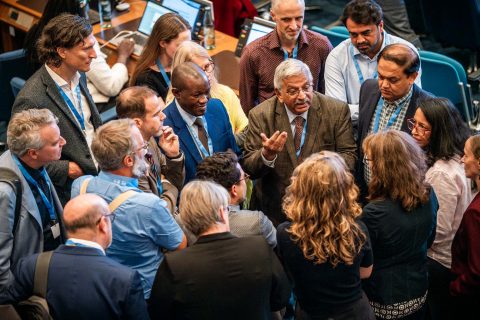
The US and Iran are not signed up to the Paris Agreement and so do not have active NDCs, nor does Taiwan, which is not a UN member state.
Rao said that because the PAICC is “facilitative and non-punitive”, naming the countries “is meant to open a door, not close one – the invited consultation is the point”.
“In recent months, governments that explained their constraints, whether capacity, finance or domestic process, have been met with follow-up and support rather than sanction, and the number of silent governments has fallen sharply,” Rao said.
The post Paris Agreement committee names three countries snubbing it over NDCs appeared first on Climate Home News.
Paris Agreement committee names three countries snubbing it over NDCs