

The Cook Islands and the Federated States of Micronesia are separated by around 6,000 kilometres of Pacific Ocean.
Despite the vast stretch of water between them, the two small island nations share a common challenge: how to protect their people from rising seas and extreme weather.
Climate change is an ever-present reality for these two countries – and all other island states – in the region. The land that juts out of the Pacific Ocean makes up less than 1% of the total area. The sea that surrounds these islands is both an essential economic resource and a looming threat.
“Climate change isn’t just science – it’s personal,” one participant told the Cook Islands National Loss and Damage Dialogue held in Rarotonga in mid-April. “With warmer temperatures and fewer pandanus trees, the women’s weaving traditions are under threat.”
Recent research from NASA found that Pacific islands are expected to experience at least 6 inches (15.24 cm) of sea level rise over the next 30 years, whether the world reduces greenhouse gas emissions or not. In recent years, the climate crisis has exacerbated many existing problems for island nations: more severe droughts and cyclones, together with the encroaching sea, have destroyed livelihoods and increased people’s economic vulnerabilities.
“Communities on remote Pacific islands are in danger of having their culture and way of life erased if we don’t act now and help them survive,” said Mikko Ollikainen, head of the Adaptation Fund. “It’s desperately important that we work to support people most vulnerable to climate shocks,” he added.
Countries reach hard-fought compromise on climate adaptation metrics in Bonn
As extreme weather persists, small but crucial interventions are being explored to support people to adapt to their new reality. In small island developing states, such as the Cook Islands and Federated States of Micronesia, these ideas have been put to the test, with both nations implementing projects to build climate resilience and enable communities to thrive in spite of the growing stresses they face.

Remoteness makes resilience key
Many of the climate-related issues for small island – or large ocean – states are connected to their remoteness. There are over 1,000 islands comprising the sovereign nations in the Pacific – the Federated States of Micronesia alone has more than 600 islands.
These inhabited islands are often hard to reach and lack basic infrastructure such as electricity access, healthcare provision and water security. This makes them even more vulnerable to disasters and increases the need to build resilience to climate shocks.
In recent years, governments in the Cook Islands and Micronesia have sought financing from the Adaptation Fund to address these chronic issues. The resulting projects provide important lessons in adaptation in places on the frontlines of the climate crisis.
Both countries have locally based organisations, known as national implementing entities (NIEs), accredited through the Adaptation Fund’s “direct access” scheme which helps countries manage their adaptation efforts. Entities can propose and develop projects and receive financial support from the Fund without going through international agencies.
Projects in both island states are tailored to local adaptation needs, but bear many similarities in their approach to climate problems. They are focused on outer islands, water and food security, data monitoring, gender concerns and restoring ecosystem health, as a path to climate resilience.
“We need to work harder to understand what life is like for people in remote places, especially on low-lying Pacific islands. From the beginning, these projects built in these concerns, ensuring decisions and solutions were community-led, inclusive, and informed by local knowledge,” added Ollikainen.
Adaptation for farmers and fishers
On the Cook Islands this meant increasing water storage across the outer Pa Enua islands, alongside 25 new farms and 11 agro-nurseries with a strong focus on establishing climate-resilient crops. A new early warning system was created, with local training provided on disaster risk preparedness and centralised data management.
In addition, 35 community grants were awarded to farmers and households to help pay for adaptive tools such as fencing, tanks and agricultural equipment. “The climate has changed, full-stop. But now we’ve got drip irrigation [to sustainably water crops]. We’re still growing,” commented one farmer on Mitiaro, a tiny volcanic island.
Mani Mate, a director at the Ministry of Finance and Economic Management, the NIE carrying out the resilient livelihoods “PEARL” project, said it shows “how small island nations can deliver tangible, locally led resilience when adaptation is community-driven and well-resourced”.
“While challenges remain, the Cook Islands now have tools, systems and experience to build on, along with growing interest in a second phase of support,” Mate added.
Businesses may be investing more in climate adaptation than we think
In a similar way, the Micronesian project implemented by the Micronesia Conservation Trust, also an Adaptation Fund NIE based on the island, has put in place effective state protections for marine habitats, increasing awareness and enforcement capabilities, as well as access to sustainable finance. The project issued locally led small grants across the islands to allow communities to directly implement marine-based measures, such as the restoration of upland forests and mangroves and stronger fisheries management.
The focus on protected areas is in keeping with the wider Micronesia Challenge, an initiative of five governments across the wider region, to conserve 50% of marine resources by 2030, equivalent to 2.5 million square miles (6.5 million square kilometres).

Adaptation Futures conference in the Pacific
Climate scientists have long understood how precarious islands are when confronted with extreme weather, such as powerful cyclones or long dry spells. The experiences of ocean states, and the recent interventions in the Cook Islands and Micronesia, could provide policymakers with sufficient evidence to inform future adaptation responses.
“The project gave us the tools, but more importantly it gave us the confidence to lead our own resilience,” commented a local representative on Mauke in the Cook Islands.
Practitioners will be given ample opportunity to discuss these issues in New Zealand later this year. The biannual Adaptation Futures conference in October will put Indigenous and Pacific island concerns at the heart of the event, providing a unique moment to have these stories told and acted on.
“Pacific island concerns have not always received the right amount of attention and awareness,” said Ollikainen. “But what happens in these places – drought, flooding, sea level rise – is being repeated around the world. Low-lying islands are the canary in the coal mine – we ignore the warning at our peril.”
Adam Wentworth is a freelance writer based in Brighton, UK.
The post Pacific islands push back against growing climate threats appeared first on Climate Home News.

Three countries have been named by the Paris Agreement’s compliance committee for failing to submit a nationally determined contribution (NDC) and repeatedly snubbing offers of help with their climate plans.
After months of internal debate over whether to identify serial non-responders, the Paris Agreement’s Implementation and Compliance Committee (PAICC) named the three countries which have failed to engage with it over their NDCs on Friday.
It named Democratic Republic of Congo, Senegal and North Korea in a footnote of its annual report, adding that it decided to name them “with a view to facilitating engagement”, adding that representatives of the three nations had been invited to its meeting in early 2027 “with the purpose of identifying any challenges and constraints”.
“The Committee noted the importance of Parties engaging with the Committee in a timely manner, while noting that some delays may be due to the national capabilities and circumstances of the Parties”, the report said.
-
Under US pressure, World Bank says it will back gas “where appropriate”
The US wants the World Bank to expand its gas support while climate campaigners are pushing for it to end – its head spoke this week of limited backing for the fossil fuel -
IPCC scientists vow to press on with climate reports despite political deadlock
After governments again failed to agree a timeline, nearly 120 IPCC authors pledged to complete their assessment on time and with full scientific rigour -
Paris Agreement committee snubbed over missing NDC climate plans
Many governments have still not submitted a nationally determined contribution to the UN, breaching a key requirement of the Paris Agreement

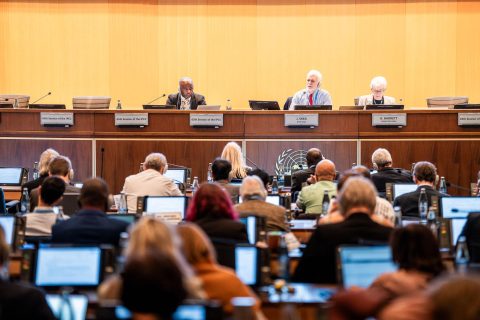

In July, PAICC said 12 countries had ignored its repeated attempts to discuss why they had not published an NDC as required every five years under the 2015 Paris accord.
Members of the committee had been divided over whether to name them, but at a September meeting decided to do so in their annual report to the annual climate COP summit.
By the time the report was published on Friday, only Congo, Senegal and North Korea “had not communicated an NDC or submitted a [Biennial Transparency Report] and had not yet responded to any of the Committee’s notifications, despite several reminders issued by the Committee in this regard”.
Rainforest and renewable energy ambitions
The silence from Congo and Senegal is notable because the former is home to much of the Congo Basin rainforest while the latter has sought billions of dollars in climate finance to support its renewable energy ambitions.
After Brazil, Congo has more rainforest than any country in the world. This forest, and the country’s peatlands, absorb huge amounts of greenhouse gas but are fast being lost to expanding farmland, charcoal production, logging and mining.
Senegal signed a Just Energy Transition Partnership with Canada and wealthy European nations in 2023, to help it meet its renewable energy targets under the-then government of Macky Sall. It was chair of the Least Developed Countries group between January 2022 and December 2023.

Tejas Rao, who is researching the PAICC as part of a doctoral thesis at Cambridge University, said the governments of the three countries should engage with the committee.
“Engagement costs these governments very little and the committee has shown it will listen,” he said.
“Silence leaves the committee with no basis to help, and it leaves the [governments] exposed to the narrative that they are simply disengaged,” he told Climate Home News.
Paris Agreement requirement
The 2015 Paris Agreement requires all parties to publish an NDC every five years outlining their emissions reduction targets, with each plan meant to be more ambitious than the country’s last NDC.
The latest set – the third round of plans, with new targets for 2035 – was due in February 2025. While most countries missed this deadline, all but around 30 – mostly small emitters but including Egypt, Vietnam and Argentina – have now submitted them.
Over the year, the PAICC – which is made up of government climate officials from developed and developing countries – has been communicating with governments that have not submitted NDCs and trying to overcome barriers to them doing so.
Some nations have cited exceptional circumstances as the reason for not submitting an NDC, a process that requires a significant amount of work in tracking emissions and consulting on how to curb them across the economy. For example, a letter from a Sudanese official to the PAICC, seen by Climate Home News, said that the country’s civil war had led to the suspension of its NDC preparation.
-
IPCC scientists vow to press on with climate reports despite political deadlock
After governments again failed to agree a timeline, nearly 120 IPCC authors pledged to complete their assessment on time and with full scientific rigour -
Under US pressure, World Bank says it will back gas “where appropriate”
The US wants the World Bank to expand its gas support while climate campaigners are pushing for it to end – its head spoke this week of limited backing for the fossil fuel -
Who shapes climate science? The equity question facing the IPCC
Early completion of the next global climate science assessment reports risks excluding research from the Global South, which is key to ensuring the findings are fair
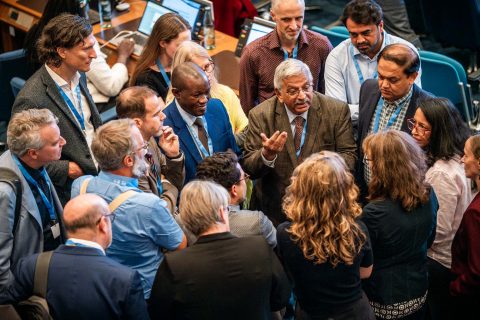
The US and Iran are not signed up to the Paris Agreement and so do not have active NDCs, nor does Taiwan, which is not a UN member state.
Rao said that because the PAICC is “facilitative and non-punitive”, naming the countries “is meant to open a door, not close one – the invited consultation is the point”.
“In recent months, governments that explained their constraints, whether capacity, finance or domestic process, have been met with follow-up and support rather than sanction, and the number of silent governments has fallen sharply,” Rao said.
The post Paris Agreement committee names three countries snubbing it over NDCs appeared first on Climate Home News.
Paris Agreement committee names three countries snubbing it over NDCs